
Cloak anemone (Adamsia palliata)
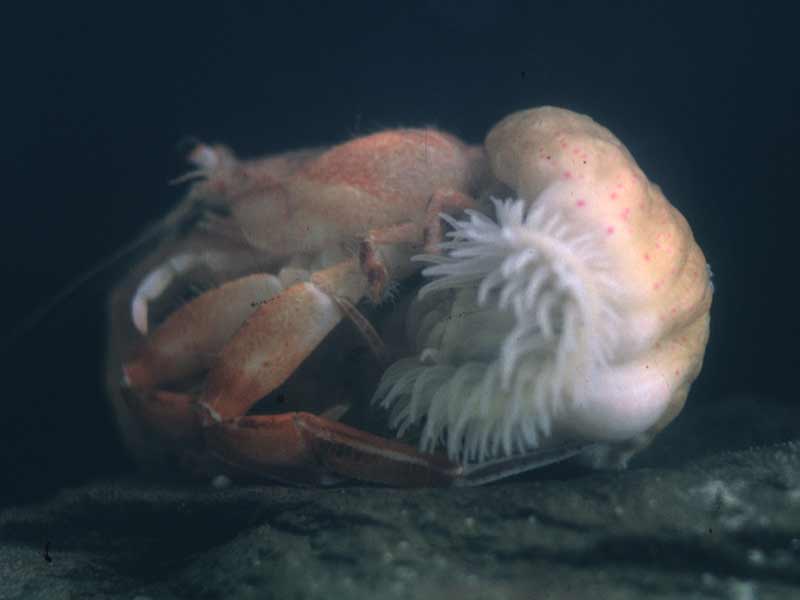
Aquarium photograph of Adamsia palliata on Pagurus prideaux.
Photographer: Keith Hiscock Copyright: Dr Keith Hiscock
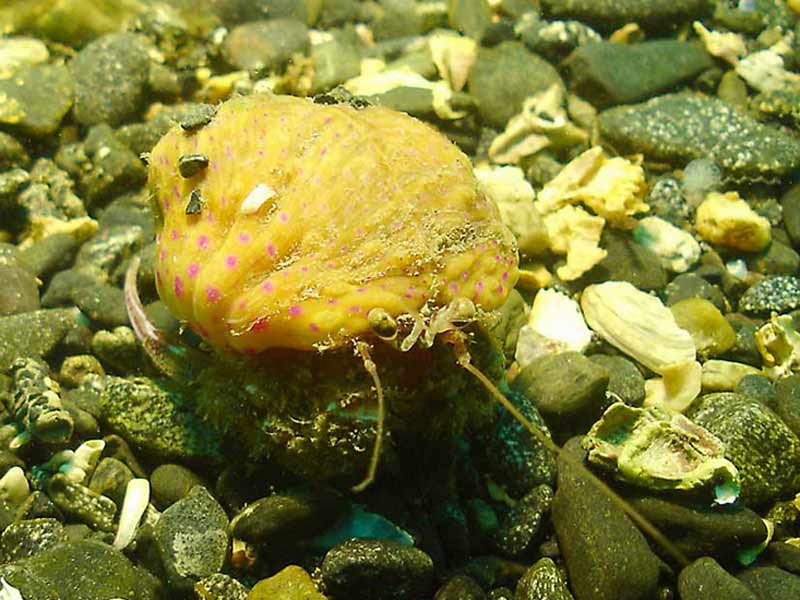
Adamsia palliata on a hermit crab at Porthkerris Reef, south Cornwall.
Photographer: Fiona Crouch Copyright: Fiona Crouch
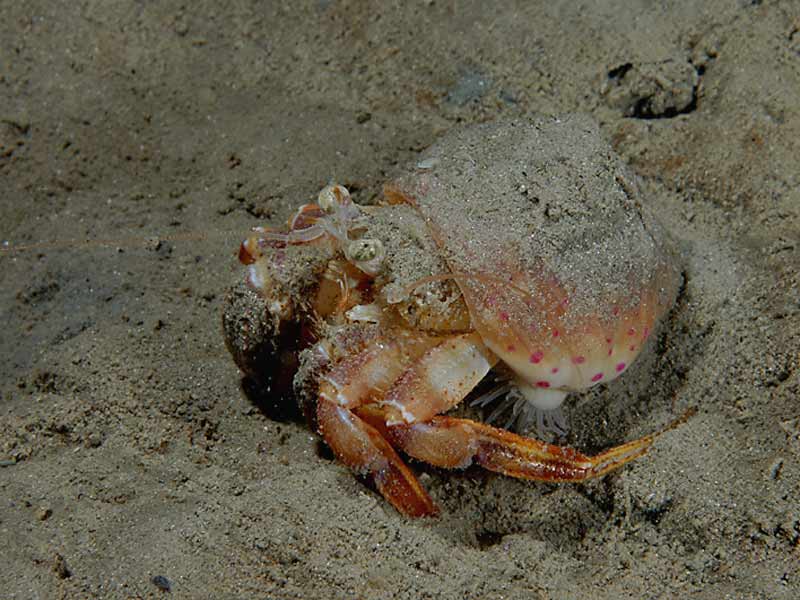
Adamsia palliata on a hermit crab at the Breakwater Fort in the Plymouth Sound.
Photographer: Keith Hiscock Copyright: Dr Keith Hiscock
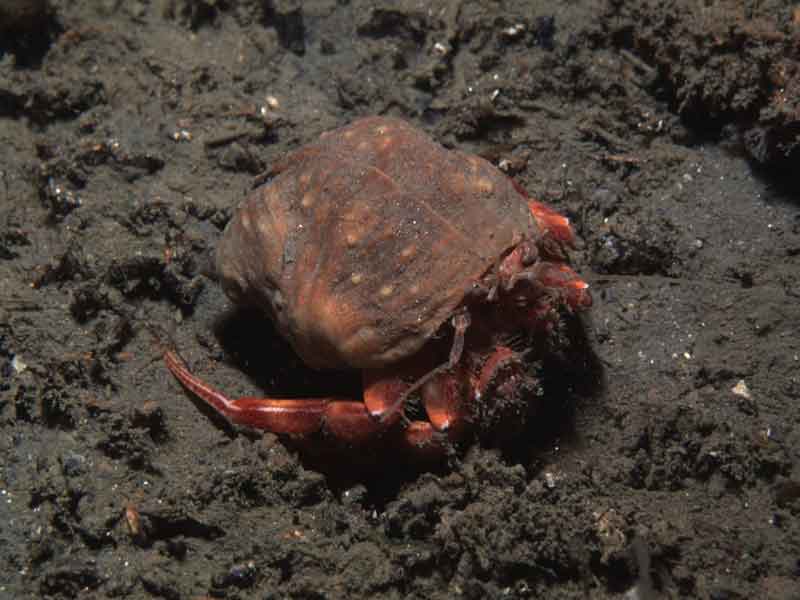
Adamsia palliata on hermit crab.
Photographer: Keith Hiscock Copyright: Dr Keith Hiscock
Distribution data supplied by the Ocean Biodiversity Information System (OBIS). To interrogate UK data visit the NBN Atlas.Map Help
| Researched by | Frances Peckett & Dr Samantha Garrard | Refereed by | Admin |
| Authority | (Müller, 1776) | ||
| Other common names | - | Synonyms | Adamsia carciniopados (Otto, 1823) |
Summary
Description
Recorded distribution in Britain and Ireland
Present around all coasts of Britain and Ireland.Global distribution
Recorded from Norway to the Mediterranean.Habitat
This anemone lives almost exclusively on the hermit crab Pagurus prideaux which is found on sand or gravel, especially if stones and broken shells are present. It is a sublittoral species which can occur down to 200 m but can be observed on the lower shore if washed up after storms. Young specimens may be found on rocks or shells between tidemarks.Depth range
-Identifying features
- Occurs attached to hermit crab Pagurus prideaux.
- This anemone has a white column with lilac-pink or crimson spots.
- The disc and tentacles always occur beneath the belly of the crab.
- The span of the tentacles is up to 5 cm.
- Long acontia (defensive white threads) are emitted from the lower part of the column when the anemone is disturbed.
Additional information
This anemone is almost always found on the hermit crab Pagurus prideaux. The association appears to be obligatory between the 2 species and they are not generally found apart in normal circumstances and both degenerate quickly if separated. The base of the sea anemone secretes a chitinous membrane which effectively increases the size of the gastropod shell so as the crab grows it does not need to change shells.Listed by
- none -
Bibliography
Hayward, P.J. & Ryland, J.S. (ed.) 1995b. Handbook of the marine fauna of North-West Europe. Oxford: Oxford University Press.
Howson, C.M. & Picton, B.E., 1997. The species directory of the marine fauna and flora of the British Isles and surrounding seas. Belfast: Ulster Museum. [Ulster Museum publication, no. 276.]
Manuel, R.L., 1988. British Anthozoa. Synopses of the British Fauna (New Series) (ed. D.M. Kermack & R.S.K. Barnes). The Linnean Society of London [Synopses of the British Fauna No. 18.]. DOI https://doi.org/10.1002/iroh.19810660505
Datasets
NBN (National Biodiversity Network) Atlas. Available from: https://www.nbnatlas.org.
OBIS (Ocean Biodiversity Information System), 2024. Global map of species distribution using gridded data. Available from: Ocean Biogeographic Information System. www.iobis.org. Accessed: 2024-04-25
Citation
This review can be cited as:
Last Updated: 12/02/2007