
Black scour weed (Ahnfeltia plicata)
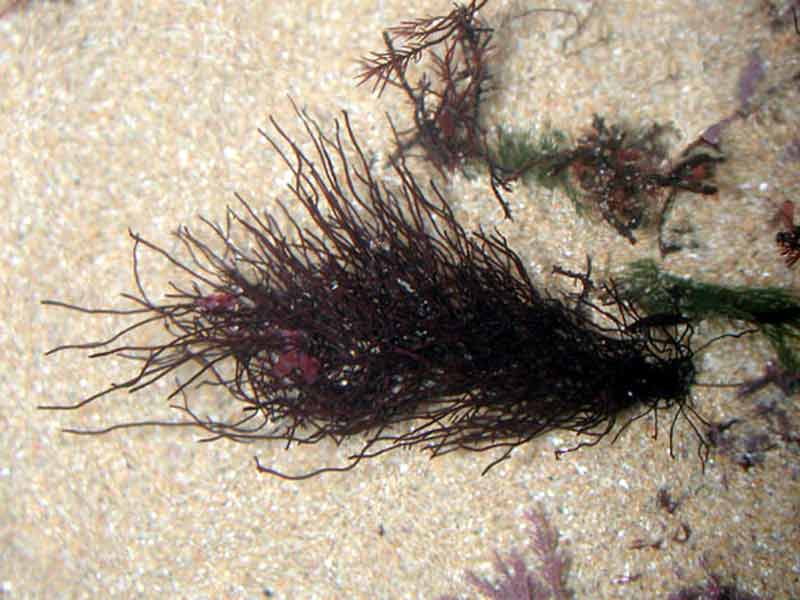
Bushy specimen of Ahnfeltia plicata in shallow sandy lower shore pool.
Photographer: Francis Bunker Copyright: Francis Bunker
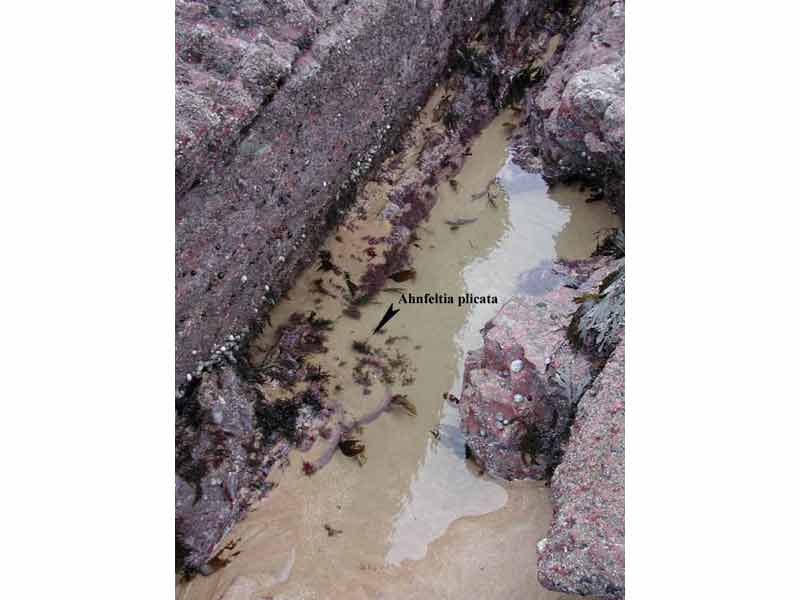
Lower shore sandy pool with Ahnfeltia plicata.
Photographer: Francis Bunker Copyright: Francis Bunker
Distribution data supplied by the Ocean Biodiversity Information System (OBIS). To interrogate UK data visit the NBN Atlas.Map Help
| Researched by | Will Rayment | Refereed by | Dr Fabio Rindi |
| Authority | (Hudson) E.M.Fries, 1836 | ||
| Other common names | - | Synonyms | - |
Summary
Description
A perennial red seaweed which forms dense, tangled tufts. The fronds are very fine, tough and wiry with irregular or dichotomous branching and up to 21 cm in length. The holdfast is disc-like or encrusting, 0.5 to 2 cm in diameter. The fronds are dark brown when moist and appear almost black when dry. The uppermost branches are often green.
Recorded distribution in Britain and Ireland
Occurs on all coasts of Britain and Ireland. There is a paucity of records from south east England, reflecting a lack of suitable substrata.Global distribution
Occurs in Europe from northern Russia to southern Portugal and in the Baltic Sea. Occurs in the Americas from arctic Canada to Mexico and is widely distributed in the Indian and Pacific Oceans.Habitat
Ahnfeltia plicata forms turfs on shallow sublittoral bedrock and in rockpools on the lower shore, often partly buried by sand. It may form part of the turf on soft or friable rocks which are too unstable for large fucoids. The tetrasporophyte phase is common on pebbles, whereas the mature gametophytes only occur on more stable substrata.Depth range
lower shore to 22 mIdentifying features
- Gametangial thallus consists of discoid holdfast up to 10 mm in diameter, producing erect fronds.
- Fronds are terete, of horn-like consistency, uniformly 0.5 mm in diameter.
- Apices very blunt, axils usually rounded.
- Branching highly variable, from dichotomous to completely irregular.
- Male plants form spermatangial sori, visible as thickenings of mature axes, but absent from basal and apical regions of plant.
- Female plants form gametangial sori, up to 5 mm long and 70 µm high, usually on one side of the mature axes. Individual mature carposporophytes are hemispherical and about 300 µm wide. They may be discrete but are usually coalesced into elongate clusters up to 5 mm long.
- Tetrasporangial plants are crustose. Tetrasporangia occur in mucilaginous superficial sori with zonately arranged tetraspores.
Additional information
-none-Listed by
- none -
Biology review
Taxonomy
| Level | Scientific name | Common name |
|---|---|---|
| Phylum | Rhodophyta | Red seaweeds |
| Class | Florideophyceae | |
| Order | Ahnfeltiales | |
| Family | Ahnfeltiaceae | |
| Genus | Ahnfeltia | |
| Authority | (Hudson) E.M.Fries, 1836 | |
| Recent Synonyms | ||
Biology
| Parameter | Data | ||
|---|---|---|---|
| Typical abundance | High density | ||
| Male size range | 3 - 21cm | ||
| Male size at maturity | 3cm | ||
| Female size range | 3cm | ||
| Female size at maturity | |||
| Growth form | Foliose | ||
| Growth rate | See additional information | ||
| Body flexibility | High (greater than 45 degrees) | ||
| Mobility | |||
| Characteristic feeding method | Autotroph | ||
| Diet/food source | |||
| Typically feeds on | |||
| Sociability | |||
| Environmental position | Epilithic | ||
| Dependency | No information found. | ||
| Supports | Independent | ||
| Is the species harmful? | No | ||
Biology information
Growth rate
Maggs & Pueschel (1989) recorded observations on growth of Ahnfeltia plicata from Nova Scotia. 4 months after germination of carpospores, tetrasporophyte crusts had grown up to 2.6 mm in diameter. 2 months after germination of tetraspores, the basal holdfast had reached 1.1 mm in diameter, with numerous hair like fronds emerging. After 14 months the axes had grown up to 50 mm in length.
In a continuous spray culture with water at 8-11°C and light intensities of 40-60 µE/m²/s, mean apical growth of Ahnfeltia plicata was 17.2 µm/day over 19 days (Indergaard et al., 1986). Permanently immersed plants under the same conditions grew at approximately 7 µm/day. Conversely, percentage biomass increase was greater under the permanent immersion regime; 0.57% increase in mass/day vs. 0.20% for the plants in spray culture (Indergaard et al., 1986).
Habitat preferences
| Parameter | Data |
|---|---|
| Physiographic preferences | Open coast, Strait or Sound, Enclosed coast or Embayment |
| Biological zone preferences | Lower eulittoral, Lower infralittoral, Sublittoral fringe, Upper infralittoral |
| Substratum / habitat preferences | Bedrock, Coarse clean sand, Cobbles, Pebbles |
| Tidal strength preferences | Moderately strong 1 to 3 knots (0.5-1.5 m/sec.), Weak < 1 knot (<0.5 m/sec.) |
| Wave exposure preferences | Exposed, Moderately exposed, Sheltered |
| Salinity preferences | Full (30-40 psu), Reduced (18-30 psu), Variable (18-40 psu) |
| Depth range | lower shore to 22 m |
| Other preferences | |
| Migration Pattern | Non-migratory or resident |
Habitat Information
Lüning (1990) suggested that Ahnfeltia plicata typically occurs as an understorey algae beneath Laminaria sp. at depths of 1.5 to 4 m.Life history
Adult characteristics
| Parameter | Data |
|---|---|
| Reproductive type | See additional information |
| Reproductive frequency | Annual protracted |
| Fecundity (number of eggs) | No information |
| Generation time | Insufficient information |
| Age at maturity | see additional information |
| Season | July - January |
| Life span | See additional information |
Larval characteristics
| Parameter | Data |
|---|---|
| Larval/propagule type | - |
| Larval/juvenile development | Spores (sexual / asexual) |
| Duration of larval stage | No information |
| Larval dispersal potential | No information |
| Larval settlement period |
Life history information
LifespanNo information was found concerning the longevity of Ahnfeltia plicata. However, it is a slow maturing perennial (Dickinson, 1963) and the thallus survives several years without considerable losses (Lüning, 1990). It likely to have a lifespan of 5-10 years, similar to other red seaweeds, such as Furcellaria lumbricalis.
Age at maturity
No definitive information was found concerning age at maturity. However, Maggs & Pueschel (1989) made observations of Ahnfeltia plicata from Nova Scotia. Tetrasporophyte crusts matured and released tetraspores after 15 months. Gametangial plants had produced abundant monosporangia after 14 months but no other reproductive structures were formed during this time.
Reproductive type
Ahnfeltia plicata has a heteromorphic life history (Maggs & Pueschel, 1989). Carpospores formed on the female thallus as a result of sexual reproduction give rise to the tetrasporophyte encrusting form. In turn, the tetraspores formed on the tetrasporophyte phase give rise to the erect, gametophyte plants. However, male gametophytes also give rise to monosporangia, producing monospores which also develop into gametophytes. Maggs & Pueschel (1989) suggest that the recycling of erect male gametophytes may be important in habitats which are unsuitable for the encrusting phase.
Timing of reproduction
Maggs & Pueschel (1989) recorded observations of reproduction by Ahnfeltia plicata in Nova Scotia. Spermatangia were present on male gametophytes between July and January. Carpogonia were present on female gametophytes between July and November, carposporophytes began development between September and November, and were mature between October and July. Monosporangia, which were only found on male plants in the intertidal, were present from November to January.
Sensitivity review
The MarLIN sensitivity assessment approach used below has been superseded by the MarESA (Marine Evidence-based Sensitivity Assessment) approach (see menu). The MarLIN approach was used for assessments from 1999-2010. The MarESA approach reflects the recent conservation imperatives and terminology and is used for sensitivity assessments from 2014 onwards.
Physical pressures
Use / to open/close text displayed
| Intolerance | Recoverability | Sensitivity | Evidence / Confidence | |
Substratum loss [Show more]Substratum lossBenchmark. All of the substratum occupied by the species or biotope under consideration is removed. A single event is assumed for sensitivity assessment. Once the activity or event has stopped (or between regular events) suitable substratum remains or is deposited. Species or community recovery assumes that the substratum within the habitat preferences of the original species or community is present. Further details EvidenceRemoval of the substratum would also remove the entire population of Ahnfeltia plicata growing on it. Intolerance is therefore assessed as high. Recoverability is recorded as high (see additional information below) but may be delayed if the hydrodynamic regime does not allow a supply of spores from distant populations. | High | High | Moderate | High |
Smothering [Show more]SmotheringBenchmark. All of the population of a species or an area of a biotope is smothered by sediment to a depth of 5 cm above the substratum for one month. Impermeable materials, such as concrete, oil, or tar, are likely to have a greater effect. Further details. EvidenceAhnfeltia plicata is an erect species which grows up to 20 cm in length and is tolerant of sand cover (Dixon & Irvine, 1977). Larger plants are therefore likely to tolerate smothering. However, developing propagules and the encrusting tetrasporophyte phase of Ahnfeltia plicata are likely to be buried by 5 cm of sediment and would be unable to photosynthesize. For example, Vadas et al. (1992) stated that algal spores and propagules are adversely affected by a layer of sediment, which can exclude up to 98% of light. There is therefore likely to be some mortality of the population and intolerance is assessed as intermediate. Recoverability is recorded as high (see additional information below). | Intermediate | High | Low | Low |
Increase in suspended sediment [Show more]Increase in suspended sedimentBenchmark. An arbitrary short-term, acute change in background suspended sediment concentration e.g., a change of 100 mg/l for one month. The resultant light attenuation effects are addressed under turbidity, and the effects of rapid settling out of suspended sediment are addressed under smothering. Further details EvidenceAhnfeltia plicata is not likely to be affected directly by an increase in suspended sediment. However, increased suspended sediment will decrease light attenuation (considered in 'turbidity') and increase siltation. As discussed above in 'smothering', increased rate of siltation may inhibit development of algal spores and propagules resulting in some mortality. Intolerance is therefore assessed as intermediate. Recoverability is recorded as high (see additional information below). | Intermediate | High | Low | Low |
Decrease in suspended sediment [Show more]Decrease in suspended sedimentBenchmark. An arbitrary short-term, acute change in background suspended sediment concentration e.g., a change of 100 mg/l for one month. The resultant light attenuation effects are addressed under turbidity, and the effects of rapid settling out of suspended sediment are addressed under smothering. Further details EvidenceAhnfeltia plicata is unlikely to be affected directly by a decrease in suspended sediment. The consequent effect of decreased turbidity is discussed below. | Tolerant | Not relevant | Not sensitive | Low |
Desiccation [Show more]Desiccation
EvidenceNo information was found directly relating to the tolerance of Ahnfeltia plicata to desiccation. The species occurs predominantly in the subtidal, but also in rockpools in the lower intertidal (Fish & Fish, 1996), suggesting that it would be intolerant of desiccation to some degree. However, the thallus is robust with a horn-like consistency (Dixon & Irvine, 1977) and the species would be unlikely to dehydrate sufficiently during the benchmark emersion period of 1 hour to cause mortality. Photosynthesis is likely to be inhibited however and so intolerance is recorded as low. Photosynthesis is likely to return to normal very quickly following immersion and so recoverability is recorded as immediate. | Low | Immediate | Not sensitive | Very low |
Increase in emergence regime [Show more]Increase in emergence regimeBenchmark. A one hour change in the time covered or not covered by the sea for a period of one year. Further details EvidenceAhnfeltia plicata is predominantly a subtidal species, but also occurs in rockpools in the lower intertidal (Fish & Fish, 1996). The benchmark increase in emergence would result in the individuals furthest up the shore experiencing greater risk of desiccation and greater fluctuations in temperature and salinity. Some mortality is likely and therefore intolerance is assessed as intermediate. Recoverability is recorded as high (see additional information below). | Intermediate | High | Low | Low |
Decrease in emergence regime [Show more]Decrease in emergence regimeBenchmark. A one hour change in the time covered or not covered by the sea for a period of one year. Further details EvidenceAhnfeltia plicata occurs predominantly in the subtidal and could potentially benefit from a decrease in emergence regime. | Tolerant | Not relevant | Not sensitive | High |
Increase in water flow rate [Show more]Increase in water flow rateA change of two categories in water flow rate (view glossary) for 1 year, for example, from moderately strong (1-3 knots) to very weak (negligible). Further details EvidenceAhnfeltia plicata occurs in biotopes in areas with 'moderately strong' or 'weak' water flow (Connor et al., 1997a). Moderate water movement is beneficial to seaweeds as it carries a supply of nutrients and gases to the plants, removes waste products, and prevents settling of silt. However, if flow becomes too strong, plants may be damaged and growth stunted. Additionally, an increase to stronger flows may inhibit settlement of spores and remove adults or germlings. It is likely therefore that the benchmark increase in water flow rate to 'strong' or 'very strong' flow would result in some mortality, particularly of older individuals or those attached to the least stable substrata. Intolerance is therefore assessed as intermediate. Recoverability is recorded as high (see additional information below). Low growing forms, such as the encrusting tetrasporophyte phase of Ahnfeltia plicata, are least likely to be intolerant of increases in flow rate. | Intermediate | High | Low | Low |
Decrease in water flow rate [Show more]Decrease in water flow rateA change of two categories in water flow rate (view glossary) for 1 year, for example, from moderately strong (1-3 knots) to very weak (negligible). Further details EvidenceAhnfeltia plicata occurs in biotopes in areas with 'moderately strong' or 'weak' water flow (Connor et al., 1997a). The benchmark decrease in water flow would place the species in areas of 'weak' water flow. Seaweeds in still water rapidly deplete the nutrients in the immediate vicinity (Kain & Norton, 1990) and are likely to be more vulnerable to depletion of essential dissolved gases and accumulation of waste products. Furthermore, decreased water flow would result in deposition of fine sediments and possible smothering of low growing forms, such as the encrusting tetrasporophyte phase. Some mortality is likely to result and so intolerance is assessed as intermediate. Recoverability is recorded as high (see additional information below). | Intermediate | High | Low | Low |
Increase in temperature [Show more]Increase in temperature
For intertidal species or communities, the range of temperatures includes the air temperature regime for that species or community. Further details EvidenceAhnfeltia plicata has a very wide geographic range, occurring from northern Russia to Portugal. The species is therefore likely to be tolerant of higher temperatures than it experiences in Britain and Ireland. Lüning & Freshwater (1988) incubated Ahnfeltia plicata from British Columbia at a range of temperatures for 1 week and tested their survivability by ability to photosynthesize at the end of the incubation period. The species survived from the coldest temperature tested (-1.5°C) to 28°C. Total mortality occurred at 30°C. Lüning & Freshwater (1988) suggested that Ahnfeltia plicata was therefore amongst the group of most eurythermal heat tolerant algae. Haglund et al. (1987) incubated Ahnfeltia plicata from the subtidal in Sweden at a range of temperatures and measured photosynthetic rate. There were no significant results, but photosynthetic rate appeared to be optimal at 15°C and decreased either side of this temperature.Considering that maximum sea surface temperatures around the British Isles rarely exceed 20C (Hiscock, 1998), the benchmark temperature increase is unlikely to cause mortality of Ahnfeltia plicata, but photosynthesis and growth may be compromised, so intolerance is recorded as low. Physiological processes should quickly return to normal when temperatures return to their original levels so recoverability is recorded as very high. | Low | Very high | Very Low | High |
Decrease in temperature [Show more]Decrease in temperature
For intertidal species or communities, the range of temperatures includes the air temperature regime for that species or community. Further details EvidenceAhnfeltia plicata has a very wide geographic range, occurring from northern Russia to Portugal. The species is therefore likely to be tolerant of lower temperatures than it experiences in Britain and Ireland. Lüning & Freshwater (1988) incubated Ahnfeltia plicata from British Columbia at a range of temperatures for 1 week and tested their survivability by ability to photosynthesize at the end of the incubation period. The species survived from the coldest temperature tested (-1.5°C) to 28°C. Haglund et al. (1987) incubated Ahnfeltia plicata from the subtidal in Sweden at a range of temperatures and measured photosynthetic rate. There were no significant results, but photosynthetic rate appeared to be optimal at 15°C and decreased either side of this temperature.Minimum surface seawater temperatures rarely fall below 5C around the British Isles (Hiscock, 1998) so it is unlikely that the benchmark decrease in temperature would cause mortality of Ahnfeltia plicata. However, low temperatures would result in sub-optimal photosynthesis and growth rate so intolerance is assessed as low. Physiological processes should quickly return to normal when temperatures return to their original levels so recoverability is recorded as very high. | Low | Very high | Very Low | High |
Increase in turbidity [Show more]Increase in turbidity
EvidenceIn general, subtidal red algae are able to exist at relatively low light levels (Gantt, 1990). Ahnfeltia plicata typically occurs as an understory alga beneath Laminaria sp. (Lüning, 1990) and so is presumably well adapted to growth in low light conditions. An increase in turbidity would reduce the amount of light reaching the understory. Over the course of a year, this may result in mortality of the Ahnfeltia plicata individuals at the limit of their depth range. Intolerance is therefore assessed as intermediate. Recoverability is recorded as high (see additional information below). | Intermediate | High | Low | Very low |
Decrease in turbidity [Show more]Decrease in turbidity
EvidenceA decrease in turbidity would result in greater light availability for Ahnfeltia plicata. Haglund et al. (1987) reported no inhibition of photosynthesis up to 500 µE/m²/s and suggested that Ahnfeltia plicata had a high potential for growth provided no other factors were limiting. Ahnfeltia plicata is therefore assessed as being tolerant to decrease in turbidity, with the potential to benefit from the factor. | Tolerant* | Not relevant | Not sensitive* | Moderate |
Increase in wave exposure [Show more]Increase in wave exposureA change of two ranks on the wave exposure scale (view glossary) e.g., from Exposed to Extremely exposed for a period of one year. Further details EvidenceAhnfeltia plicata occurs in biotopes in 'exposed' or 'moderately exposed' locations (Connor et al., 1997a). The erect thallus has flexible, cylindrical fronds growing in compact, wiry clumps (Dixon & Irvine, 1977; Daly & Mathieson, 1977) and would be expected to be relatively resistant to wave action. However, the benchmark increase in wave exposure would place a portion of the population in the 'extremely exposed' category. Strong wave action is likely to cause some damage to fronds resulting in reduced photosynthesis and compromised growth. Furthermore, individuals may be damaged or dislodged by scouring from sand and gravel mobilized by increased wave action (Hiscock, 1983). The deepest living individuals are likely to avoid the worst impact of wave exposure and the encrusting tetrasporophyte phase is likely to be most resistant. Some mortality is likely due to increased wave exposure and so intolerance is assessed as intermediate. Recoverability is recorded as high (see additional information below). | Intermediate | High | Low | Low |
Decrease in wave exposure [Show more]Decrease in wave exposureA change of two ranks on the wave exposure scale (view glossary) e.g., from Exposed to Extremely exposed for a period of one year. Further details EvidenceA decrease in wave exposure is unlikely to affect Ahnfeltia plicata directly. The consequent effects of decreased wave action are likely to include increased deposition of fine material and increased risk of stagnation. Species more tolerant of these factors, e.g. Polyides rotundus and Furcellaria lumbricalis, are more likely to proliferate in these conditions, eventually at the expense of Ahnfeltia plicata. However, over the course of a year, no mortality of Ahnfeltia plicata is expected so intolerance is assessed as low. Growth and reproduction should quickly return to normal when wave exposure returns to typical levels so recoverability is assessed as very high. | Low | Very high | Very Low | Low |
Noise [Show more]Noise
EvidenceAlgae have no mechanisms for detection of sound and therefore would be not sensitive to disturbance by noise. | Tolerant | Not relevant | Not sensitive | High |
Visual presence [Show more]Visual presenceBenchmark. The continuous presence for one month of moving objects not naturally found in the marine environment (e.g., boats, machinery, and humans) within the visual envelope of the species or community under consideration. Further details EvidenceAlgae have no visual acuity and therefore would not be affected by visual disturbance. | Tolerant | Not relevant | Not sensitive | High |
Abrasion & physical disturbance [Show more]Abrasion & physical disturbanceBenchmark. Force equivalent to a standard scallop dredge landing on or being dragged across the organism. A single event is assumed for assessment. This factor includes mechanical interference, crushing, physical blows against, or rubbing and erosion of the organism or habitat of interest. Where trampling is relevant, the evidence and trampling intensity will be reported in the rationale. Further details. EvidenceNo information was found concerning the intolerance of Ahnfeltia plicata to physical abrasion. The erect thallus has flexible, cylindrical fronds growing in compact, wiry clumps (Dixon & Irvine, 1977; Daly & Mathieson, 1977). It would be expected to be relatively resistant to physical impacts. Physical abrasion equivalent to a passing scallop dredge (see benchmark) or a dragging anchor would be likely to snag in the fronds and result in some damage or detachment of the thallus. The holdfast is similar in form to the encrusting phase (Dickinson, 1963) and would be unlikely to be damaged by physical abrasion. Daly & Mathieson (1977) noted that regeneration of upright fronds occurred from the holdfast. Physical abrasion would therefore probably result in some mortality and so intolerance is assessed as intermediate. Full recovery would occur, but may take several months so recoverability is assessed as high. | Intermediate | High | Low | Very low |
Displacement [Show more]DisplacementBenchmark. Removal of the organism from the substratum and displacement from its original position onto a suitable substratum. A single event is assumed for assessment. Further details EvidenceThe holdfast of Ahnfeltia plicata is a thin crust which grows epilithically (Dickinson, 1963). It is unlikely that the holdfast, or the encrusting tetrasporophyte phase, would survive removal from the substratum and be able to reattach to a new substratum. Intolerance is therefore assessed as high. Recoverability is recorded as high (see additional information below). | High | High | Moderate | Low |
Chemical pressures
Use [show more] / [show less] to open/close text displayed
| Intolerance | Recoverability | Sensitivity | Evidence / Confidence | |
Synthetic compound contamination [Show more]Synthetic compound contaminationSensitivity is assessed against the available evidence for the effects of contaminants on the species (or closely related species at low confidence) or community of interest. For example:
The evidence used is stated in the rationale. Where the assessment can be based on a known activity then this is stated. The tolerance to contaminants of species of interest will be included in the rationale when available; together with relevant supporting material. Further details. EvidenceNo evidence was found specifically relating to the intolerance of Ahnfeltia plicata to synthetic chemicals. However, inferences may be drawn from the sensitivities of red algal species generally. O'Brien & Dixon (1976) suggested that red algae were the most sensitive group of algae to oil or dispersant contamination, possibly due to the susceptibility of phycoerythrins to destruction. They also report that red algae are effective indicators of detergent damage since they undergo colour changes when exposed to relatively low concentration of detergent. Smith (1968) reported that 10 ppm of the detergent BP 1002 killed the majority of specimens in 24hrs in toxicity tests, although Ahnfeltia plicata was amongst the algal species least affected by the detergent used to clean up the Torrey Canyon oil spill. Laboratory studies of the effects of oil and dispersants on several red algal species concluded that they were all sensitive to oil/ dispersant mixtures, with little difference between adults, sporelings, diploid or haploid life stages (Grandy, 1984, cited in Holt et al., 1995). Cole et al. (1999) suggested that herbicides , such as simazine and atrazine were very toxic to macrophytes. The evidence suggests that in general red algae are very sensitive to synthetic chemicals. Intolerance of Ahnfeltia plicata is therefore recorded as high. Recoverability is recorded as high (see additional information below) but may be delayed if the hydrodynamic regime does not allow a supply of spores from distant populations. | High | High | Moderate | Low |
Heavy metal contamination [Show more]Heavy metal contaminationEvidenceBryan (1984) suggested that the general order for heavy metal toxicity in seaweeds is: Organic Hg > inorganic Hg > Cu > Ag > Zn > Cd > Pb. Cole et al. (1999) reported that Hg was very toxic to macrophytes. The sub-lethal effects of Hg (organic and inorganic) on the sporelings of an intertidal red algae, Plumaria elegans, were reported by Boney (1971). 100% growth inhibition was caused by 1 ppm Hg. No information was found concerning the effects of heavy metals on Ahnfeltia plicata specifically, and therefore an intolerance assessment has not been attempted. | No information | No information | No information | Not relevant |
Hydrocarbon contamination [Show more]Hydrocarbon contaminationEvidenceNo evidence was found specifically relating to the intolerance of Ahnfeltia plicata to hydrocarbon contamination. However, inferences may be drawn from the sensitivities of red algal species generally. O'Brien & Dixon (1976) suggested that red algae were the most sensitive group of algae to oil or dispersant contamination, possibly due to the susceptibility of phycoerythrins to destruction. Laboratory studies of the effects of oil and dispersants on several red algal species concluded that they were all sensitive to oil/dispersant mixtures, with little difference between adults, sporelings, diploid or haploid life stages (Grandy, 1984, cited in Holt et al., 1995). Intolerance is therefore assessed as high. Recoverability is recorded as high (see additional information below) but may be delayed if the hydrodynamic regime does not allow a supply of spores from distant populations. | High | High | Moderate | Low |
Radionuclide contamination [Show more]Radionuclide contaminationEvidenceNo evidence was found concerning the intolerance of Ahnfeltia plicata to radionuclide contamination. | No information | No information | No information | Not relevant |
Changes in nutrient levels [Show more]Changes in nutrient levelsEvidenceAs a result of increased nutrient levels, it has been suggested that slow growing perennials, such as Ahnfeltia plicata, are likely to be out-competed by rapid growing, ephemeral annual species (Johansson et al., 1998). Altered depth distributions of algal species caused by decreased light penetration and/or increased sedimentation through higher pelagic production have been reported in the Baltic Sea (Kautsky et al., 1986; Vogt & Schramm, 1991). Johansson et al. (1998) studied changes in the benthic algal community of the Swedish Skagerrak coast, an area heavily affected by eutrophication, but did not detect any change in abundance of Ahnfeltia plicata. Haglund et al. (1987) reported no inhibition of photosynthesis up to 500 µE/m²/s and suggested that Ahnfeltia plicata had a high potential for growth provided no other factors were limiting. A moderate increase in nutrient levels may therefore enhance growth of Ahnfeltia plicata. However, excessive eutrophication would probably result in the species being out-competed by ephemeral species with rapid growth rates, such as filamentous green and brown algae. Intolerance is therefore assessed as intermediate. Recoverability is recorded as high (see additional information below). | Intermediate | High | Low | Low |
Increase in salinity [Show more]Increase in salinity
EvidenceAhnfeltia plicata occurs in areas of full salinity (Connor et al., 1997a) and therefore increase in salinity is not a relevant factor. No information was found concerning reaction to hypersaline conditions. Haglund et al. (1987) studied photosynthetic rate of Ahnfeltia plicata from the subtidal in Sweden and found that, at constant temperature, rate increased up to the maximum salinity tested (33 psu). | Not relevant | Not relevant | Not relevant | Not relevant |
Decrease in salinity [Show more]Decrease in salinity
EvidenceAhnfeltia plicata occurs over a very wide range of salinities. The species penetrates almost to the innermost part of Hardanger Fjord in Norway where it experiences very low salinity values and large salinity fluctuations due to the influence of snowmelt in spring (Jorde & Klavestad, 1963). Ahnfeltia plicata penetrates further than the euryhaline species, Polyides rotundus, and probably has a similar salinity tolerance to Furcellaria lumbricalis, which is limited only by the 4 psu isohaline (see review by Bird et al., 1991). Haglund et al. (1987) studied photosynthetic rate of Ahnfeltia plicata from the subtidal in Sweden and found that, at constant temperature, photosynthesis was positively correlated with salinity between 15 and 33 psu. It is likely therefore that the benchmark decrease in salinity would not result in mortality, but photosynthesis would not be optimal and so growth and reproduction may be compromised. Intolerance is therefore assessed as low. Physiological processes should quickly return to normal when salinity returns to original levels, so recoverability is recorded as very high. | Low | Very high | Very Low | High |
Changes in oxygenation [Show more]Changes in oxygenationBenchmark. Exposure to a dissolved oxygen concentration of 2 mg/l for one week. Further details. EvidenceThe effects of reduced oxygenation on algae are not well studied. Plants require oxygen for respiration, but this may be provided by production of oxygen during periods of photosynthesis. Lack of oxygen may impair both respiration and photosynthesis (see review by Vidaver, 1972). A study of the effects of anoxia on another red alga, Delesseria sanguinea, revealed that specimens died after 24 hours at 15°C but that some survived at 5°C (Hammer, 1972). Insufficientinformation is available to make an intolerance assessment for Ahnfeltia plicata. | No information | No information | No information | Not relevant |
Biological pressures
Use [show more] / [show less] to open/close text displayed
| Intolerance | Recoverability | Sensitivity | Evidence / Confidence | |
Introduction of microbial pathogens/parasites [Show more]Introduction of microbial pathogens/parasitesBenchmark. Sensitivity can only be assessed relative to a known, named disease, likely to cause partial loss of a species population or community. Further details. EvidenceLittle information was found concerning the infection of Ahnfeltia plicata by microbial pathogens. Dixon & Irvine (1977) noted that galls, probably formed as a reaction to bacterial infection, were common in older plants. | No information | No information | No information | Not relevant |
Introduction of non-native species [Show more]Introduction of non-native speciesSensitivity assessed against the likely effect of the introduction of alien or non-native species in Britain or Ireland. Further details. EvidenceThe habitat preferences of Sargassum muticum and Ahnfeltia plicata are likely to overlap and competition could potentially occur, with the vigorous Sargassum muticum likely to proliferate. However, no evidence of displacement of Ahnfeltia plicata was found. | No information | No information | No information | Not relevant |
Extraction of this species [Show more]Extraction of this speciesBenchmark. Extraction removes 50% of the species or community from the area under consideration. Sensitivity will be assessed as 'intermediate'. The habitat remains intact or recovers rapidly. Any effects of the extraction process on the habitat itself are addressed under other factors, e.g. displacement, abrasion and physical disturbance, and substratum loss. Further details. EvidenceAhnfeltia plicata is one of the world's principal commercial agarophytes. It is harvested mainly on the Russian coast of the White Sea as a source of high quality, low sulphate agar (Chapman & Chapman, 1980). In Britain and Ireland, however, Ahnfeltia plicata does not occur in sufficient quantities to harvest on a commercial scale (Dickinson, 1963). | Not relevant | Not relevant | Not relevant | Not relevant |
Extraction of other species [Show more]Extraction of other speciesBenchmark. A species that is a required host or prey for the species under consideration (and assuming that no alternative host exists) or a keystone species in a biotope is removed. Any effects of the extraction process on the habitat itself are addressed under other factors, e.g. displacement, abrasion and physical disturbance, and substratum loss. Further details. EvidenceNo information was found concerning effects of harvesting other species on Ahnfeltia plicata. | No information | No information | No information | Not relevant |
Additional information
Little information was found concerning the recoverability of Ahnfeltia plicata. Recoverability potential must therefore be estimated from the species' life history. Maggs & Pueschel (1989) reported that mature gametophytes in Nova Scotia varied in size from 3-21 cm, and that 14 months after germination, gametophyte fronds had reached up to 5 cm in length. It is expected therefore that Ahnfeltia plicata would reach maturity within a year. Red algae are typically highly fecund, but their spores are non-motile (Norton, 1992) and therefore entirely reliant on the hydrographic regime for dispersal. Norton (1992) reviewed dispersal by macroalgae and concluded that dispersal potential is highly variable. Spores of Ulva sp. (as Enteromorpha) have been reported to travel 35 km, %Phycodrys rubens% 5 km and %Sargassum muticum% up to 1 km. However, the point is made that reach of the furthest propagule and useful dispersal range are not the same thing and recruitment usually occurs on a much more local scale, typically within 10 m of the parent plant. Hence, it is expected that Ahnfeltia plicata would normally only recruit from local populations and that recovery of remote populations would be much more protracted.Ahnfeltia plicata has a heteromorphic life history (Maggs & Pueschel, 1989) and is therefore able to respond to local environmental conditions. For example, development of monosporangia may occur on male gametophytes in areas unsuitable for the growth of the encrusting tetrasporophyte phase.
The life history characteristics of Ahnfeltia plicata suggest that the species is likely to recover within 5 years if local populations exist, but that recovery of remote populations will be more protracted and dependent upon hydrodynamic regime. Recoverability is therefore assessed as high.
Importance review
Policy/legislation
- no data -
Status
| National (GB) importance | - | Global red list (IUCN) category | - |
Non-native
| Parameter | Data |
|---|---|
| Native | - |
| Origin | - |
| Date Arrived | - |
Importance information
Ahnfeltia plicata is one of the world's principal commercial agarophytes. It is harvested mainly on the Russian coast of the White Sea as a source of high quality, low sulphate agar (Chapman & Chapman, 1980). The most important property of agar is the considerable strength of the gel, even at extremely low concentrations. It is used as a gelling and thickening agent in the food industry, as a carrier for drug products where slow release is required, as a stabilizer for emulsions, as a constituent of cosmetics, ointments and lotions and as a stiffening agent in growth media for bacteriology and mycology (see review by Dixon, 1973).Bibliography
Bird, C.J., Saunders, G.W. & McLachlan, J., 1991. Biology of Furcellaria lumbricalis (Hudson) Lamouroux (Rhodophyta: Gigartinales), a commercial carrageenophyte. Journal of Applied Phycology, 3, 61-82.
Boney, A.D., 1971. Sub-lethal effects of mercury on marine algae. Marine Pollution Bulletin, 2, 69-71.
Bryan, G.W., 1984. Pollution due to heavy metals and their compounds. In Marine Ecology: A Comprehensive, Integrated Treatise on Life in the Oceans and Coastal Waters, vol. 5. Ocean Management, part 3, (ed. O. Kinne), pp.1289-1431. New York: John Wiley & Sons.
Chapman, V.J. & Chapman, D.J., 1980. Seaweeds and their uses. Chapman & Hall.
Cole, S., Codling, I.D., Parr, W. & Zabel, T., 1999. Guidelines for managing water quality impacts within UK European Marine sites. Natura 2000 report prepared for the UK Marine SACs Project. 441 pp., Swindon: Water Research Council on behalf of EN, SNH, CCW, JNCC, SAMS and EHS. [UK Marine SACs Project.]. Available from: http://ukmpa.marinebiodiversity.org/uk_sacs/pdfs/water_quality.pdf
Connor, D.W., Dalkin, M.J., Hill, T.O., Holt, R.H.F. & Sanderson, W.G., 1997a. Marine biotope classification for Britain and Ireland. Vol. 2. Sublittoral biotopes. Joint Nature Conservation Committee, Peterborough, JNCC Report no. 230, Version 97.06., Joint Nature Conservation Committee, Peterborough, JNCC Report no. 230, Version 97.06.
Daly, M.A. & Mathieson, A.C., 1977. The effects of sand movement on intertidal seaweeds and selected invertebrates at Bound Rock, New Hampshire, USA. Marine Biology, 43, 45-55.
Dickinson, C.I., 1963. British seaweeds. London & Frome: Butler & Tanner Ltd.
Dixon, P.S. & Irvine, L.M., 1977. Seaweeds of the British Isles. Volume 1 Rhodophyta. Part 1 Introduction, Nemaliales, Gigartinales. London: British Museum (Natural History) London.
Dixon, P.S., 1973. Biology of the Rhodophyta. Edinburgh: Oliver & Boyd.
Fish, J.D. & Fish, S., 1996. A student's guide to the seashore. Cambridge: Cambridge University Press.
Gantt, E., 1990. Pigmentation and photoacclimation. In Biology of the Red Algae (ed. K.M. Cole and R.G. Sheath), 203-219. Cambridge University Press.
Haglund, K., Axelsson, L. & Pedersen, M., 1987. Photosynthesis and respiration in the alga Ahnfeltia plicata in a flow through system. Marine Biology, 96, 409-412.
Hammer, L., 1972. Anaerobiosis in marine algae and marine phanerograms. In Proceedings of the Seventh International Seaweed Symposium, Sapporo, Japan, August 8-12, 1971 (ed. K. Nisizawa, S. Arasaki, Chihara, M., Hirose, H., Nakamura V., Tsuchiya, Y.), pp. 414-419. Tokyo: Tokyo University Press.
Hardy, F.G. & Guiry, M.D., 2003. A check-list and atlas of the seaweeds of Britain and Ireland. London: British Phycological Society
Hiscock, K., 1983. Water movement. In Sublittoral ecology. The ecology of shallow sublittoral benthos (ed. R. Earll & D.G. Erwin), pp. 58-96. Oxford: Clarendon Press.
Hiscock, K., ed. 1998. Marine Nature Conservation Review. Benthic marine ecosystems of Great Britain and the north-east Atlantic. Peterborough, Joint Nature Conservation Committee.
Holt, T.J., Jones, D.R., Hawkins, S.J. & Hartnoll, R.G., 1995. The sensitivity of marine communities to man induced change - a scoping report. Countryside Council for Wales, Bangor, Contract Science Report, no. 65.
Howson, C.M. & Picton, B.E., 1997. The species directory of the marine fauna and flora of the British Isles and surrounding seas. Belfast: Ulster Museum. [Ulster Museum publication, no. 276.]
Indergaard, M., Oestgaard, K., Jensen, A. & Stoeren, O., 1986. Growth studies of macroalgae in a microcomputer-assisted spray cultivation system. Journal of Experimental Marine Biology and Ecology, 98, 199-213.
JNCC (Joint Nature Conservation Committee), 1999. Marine Environment Resource Mapping And Information Database (MERMAID): Marine Nature Conservation Review Survey Database. [on-line] http://www.jncc.gov.uk/mermaid
Johansson ,G., Eriksson, B.K., Pedersen, M. & Snoeijs, P., 1998. Long term changes of macroalgal vegetation in the Skagerrak area. Hydrobiologia, 385, 121-138.
Jorde, I. & Klavestad, N., 1963. The natural history of the Hardangerfjord. 4. The benthonic algal vegetation. Sarsia, 9, 1-99.
Kain, J.M., & Norton, T.A., 1990. Marine Ecology. In Biology of the Red Algae, (ed. K.M. Cole & Sheath, R.G.). Cambridge: Cambridge University Press.
Kautsky, N., Kautsky, H., Kautsky, U. & Waern, M., 1986. Decreased depth penetration of Fucus vesiculosus (L.) since the 1940s indicates eutrophication of the Baltic Sea. Marine Ecology Progress Series, 28, 1-8.
Lewis, J.R., 1964. The Ecology of Rocky Shores. London: English Universities Press.
Lüning, K. & Freshwater, W., 1988. Temperature tolerance of northeast Pacific marine algae. Journal of Phycology, 24, 310-315.
Maggs, C.A. & Pueschel, C.M., 1989. Morphology and development of Ahnfeltia plicata (Rhodophyta) : proposal of Ahnfeltiales ord. nov. Journal of Phycology, 25, 333-351.
Norton, T.A., 1992. Dispersal by macroalgae. British Phycological Journal, 27, 293-301.
O'Brien, P.J. & Dixon, P.S., 1976. Effects of oils and oil components on algae: a review. British Phycological Journal, 11, 115-142.
Picton, B.E. & Costello, M.J., 1998. BioMar biotope viewer: a guide to marine habitats, fauna and flora of Britain and Ireland. [CD-ROM] Environmental Sciences Unit, Trinity College, Dublin.
Smith, J.E. (ed.), 1968. 'Torrey Canyon'. Pollution and marine life. Cambridge: Cambridge University Press.
Vadas, R.L., Johnson, S. & Norton, T.A., 1992. Recruitment and mortality of early post-settlement stages of benthic algae. British Phycological Journal, 27, 331-351.
Vidaver, W., 1972. Dissolved gases - plants. In Marine Ecology. Volume 1. Environmental factors (3), (ed. O. Kinne), 1471-1490. Wiley-Interscience, London.
Vogt, H. & Schramm, W., 1991. Conspicuous decline of Fucus in Kiel Bay (Western Baltic): what are the causes ? Marine Ecology Progress Series, 69, 189-194.
Datasets
Centre for Environmental Data and Recording, 2018. Ulster Museum Marine Surveys of Northern Ireland Coastal Waters. Occurrence dataset https://www.nmni.com/CEDaR/CEDaR-Centre-for-Environmental-Data-and-Recording.aspx accessed via NBNAtlas.org on 2018-09-25.
Fenwick, 2018. Aphotomarine. Occurrence dataset http://www.aphotomarine.com/index.html Accessed via NBNAtlas.org on 2018-10-01
Fife Nature Records Centre, 2018. St Andrews BioBlitz 2015. Occurrence dataset: https://doi.org/10.15468/xtrbvy accessed via GBIF.org on 2018-09-27.
Fife Nature Records Centre, 2018. St Andrews BioBlitz 2016. Occurrence dataset: https://doi.org/10.15468/146yiz accessed via GBIF.org on 2018-09-27.
Kent Wildlife Trust, 2018. Biological survey of the intertidal chalk reefs between Folkestone Warren and Kingsdown, Kent 2009-2011. Occurrence dataset: https://www.kentwildlifetrust.org.uk/ accessed via NBNAtlas.org on 2018-10-01.
Kent Wildlife Trust, 2018. Kent Wildlife Trust Shoresearch Intertidal Survey 2004 onwards. Occurrence dataset: https://www.kentwildlifetrust.org.uk/ accessed via NBNAtlas.org on 2018-10-01.
Manx Biological Recording Partnership, 2017. Isle of Man wildlife records from 01/01/2000 to 13/02/2017. Occurrence dataset: https://doi.org/10.15468/mopwow accessed via GBIF.org on 2018-10-01.
Manx Biological Recording Partnership, 2018. Isle of Man historical wildlife records 1995 to 1999. Occurrence dataset: https://doi.org/10.15468/lo2tge accessed via GBIF.org on 2018-10-01.
National Trust, 2017. National Trust Species Records. Occurrence dataset: https://doi.org/10.15468/opc6g1 accessed via GBIF.org on 2018-10-01.
NBN (National Biodiversity Network) Atlas. Available from: https://www.nbnatlas.org.
OBIS (Ocean Biodiversity Information System), 2024. Global map of species distribution using gridded data. Available from: Ocean Biogeographic Information System. www.iobis.org. Accessed: 2024-04-24
Outer Hebrides Biological Recording, 2018. Non-vascular Plants, Outer Hebrides. Occurrence dataset: https://doi.org/10.15468/goidos accessed via GBIF.org on 2018-10-01.
Royal Botanic Garden Edinburgh, 2018. Royal Botanic Garden Edinburgh Herbarium (E). Occurrence dataset: https://doi.org/10.15468/ypoair accessed via GBIF.org on 2018-10-02.
South East Wales Biodiversity Records Centre, 2018. SEWBReC Algae and allied species (South East Wales). Occurrence dataset: https://doi.org/10.15468/55albd accessed via GBIF.org on 2018-10-02.
Citation
This review can be cited as:
Last Updated: 20/09/2004