
Short-beaked common dolphin (Delphinus delphis)
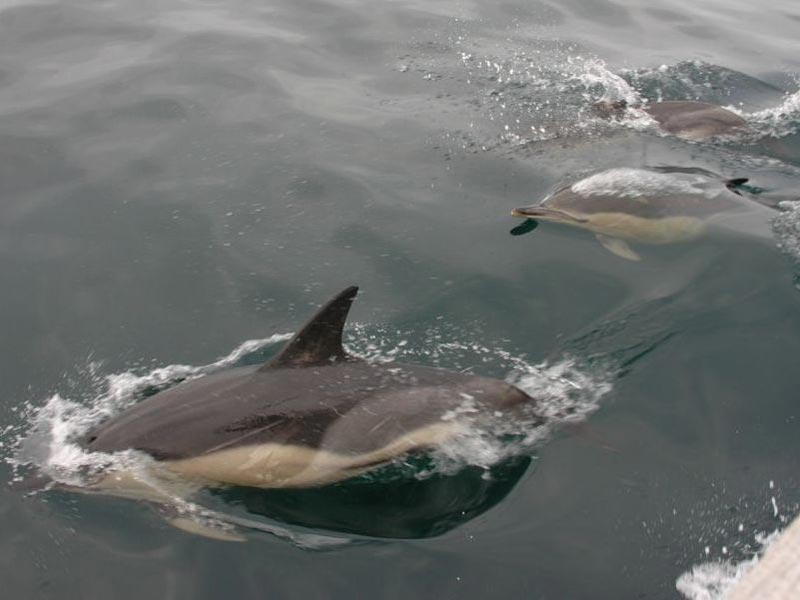
Three common dolphins leaping out of the water.
Photographer: Norman Jackson Copyright: Norman Jackson
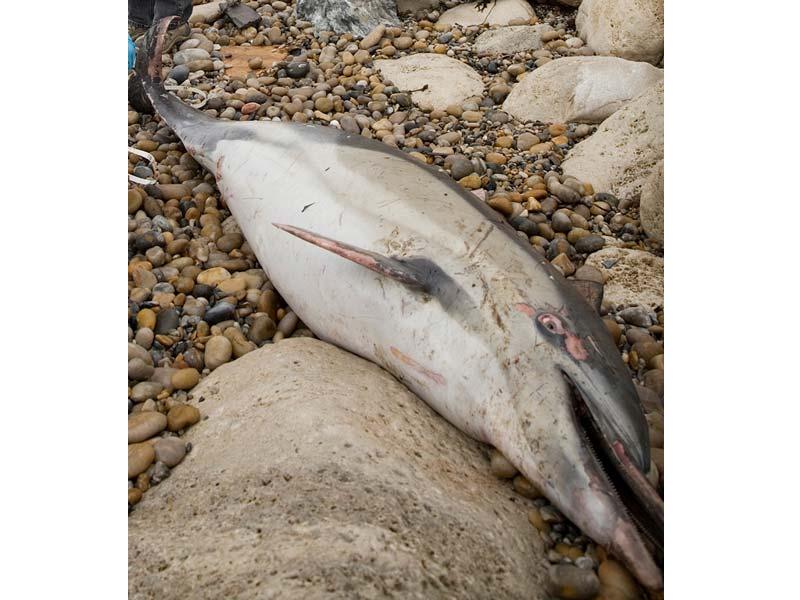
A dead common dolphin on the shore.
Photographer: Judith Oakley Copyright: Judith Oakley
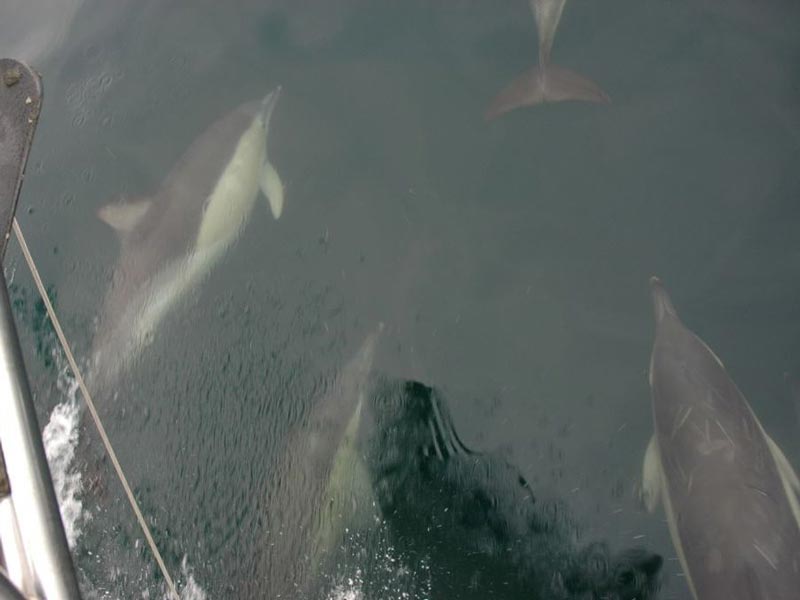
Common dolphins swimming in front of a sailing vessel.
Photographer: Norman Jackson Copyright: Norman Jackson
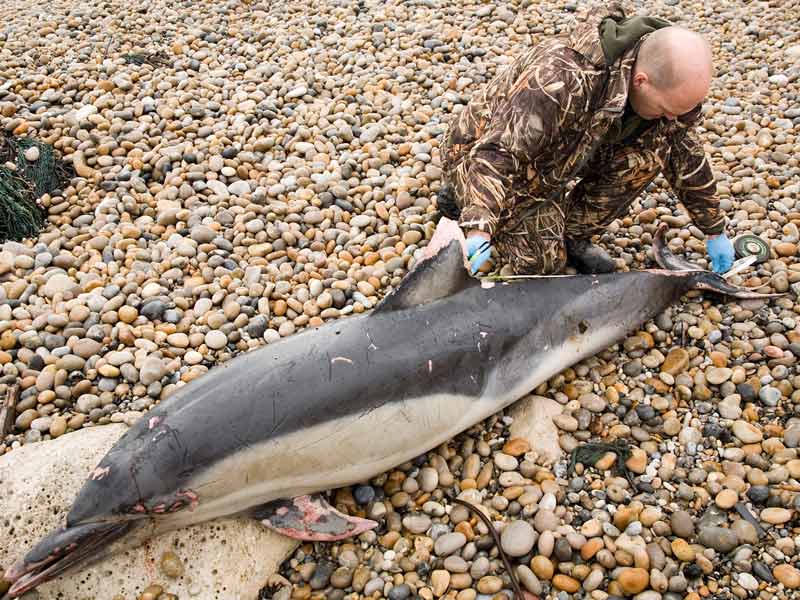
Measuring a dead Delphinus delphis individual on the shore.
Photographer: Lin Baldock Copyright: Lin Baldock
Distribution data supplied by the Ocean Biodiversity Information System (OBIS). To interrogate UK data visit the NBN Atlas.Map Help
| Researched by | Judith Oakley | Refereed by | This information is not refereed |
| Authority | Linnaeus, 1758 | ||
| Other common names | - | Synonyms | - |
Summary
Description
Recorded distribution in Britain and Ireland
Recorded off the west coasts of Britain and Ireland. The species is found in continental shelf waters, especially the Celtic Sea, the western approaches to the Channel and off south and west Ireland. Seen in the Sea of Hebrides and North Sea in summer.Global distribution
Temperate and tropical waters throughout the Pacific Ocean and adjoining seas, the North Atlantic Ocean, Mediterranean and Black Seas.Habitat
Pelagic, generally occurring well out to sea and continental shelf waters.Depth range
-Identifying features
- Slender body with clearly demarcated black or pale-tipped beak.
- 40-61 teeth in each half of both jaws.
- Head with black eye patch and black stripe running from corner of mouth to flipper.
- Well defined hour-glass pattern on flanks with yellow panel at front and grey panel at rear, a black cape and white belly.
- Dorsal fin black to almost white and about 40 cm in height.
Additional information
This highly gregarious species lives in pods of several hundreds to thousands of animals, depending on the time of day and time of year. Some observations suggest that permanent social units contain fewer than 30 dolphins (Nowak, 2003). Delphinus delphis usually travels at 10 km/hr but is capable of reaching more than 40 km/hr (Nowak, 2003). The common dolphin is highly vocal, producing clicks for echolocation, whistles for group coordination and various other sounds. This species is often seen breaching and somersaulting out of water and riding the bow waves of ships (Jefferson et al, 1993). It can dive to 280 m and remain submerged for 8 minutes. However, they usually remain below the surface for between 2 seconds and 2 minutes (Kinze, 2002). The calf is nursed by the mother for up to a year. For information on how to report dolphin sightings see 'Sealife Survey'.
Delphinus delphis is listed in the UK Biodiversity Action Plan list of Species of Conservation Concern (Biodiversity Steering Group, 1995; Anon, 1999 (e) ). All species of cetaceans are given protection under the Wildlife and Countryside Act 1981 and the Wildlife (Northern Ireland) Order 1985. All cetacean species are listed on Annex A of EU Council Regulation 338/97 and therefore treated by the EU as if they are on CITES Appendix I thus prohibiting their commercial trade. The common dolphin is listed in Annex II and IV (Animal and Plant Species of Community Interest in Need of Strict Protection) of the EC Habitats Directive. Under Annex IV the keeping, sale or exchange of the species is banned, as well as deliberate capture, killing or disturbance. The Directive requires that member states monitor the incidental capture and killing of all dolphins. An 'Agreement on the Conservation of Small Cetaceans in the Baltic and North Seas' (ASCOBANS), formulated in 1992, has now been signed by seven European countries, including the UK. The Agreement makes provision for protection of specific areas, monitoring, research, information exchange, pollution control and heightening public awareness. The Bonn Convention includes North and Baltic Sea populations of common dolphin on Appendix II.
A report on dolphins in the south west of England (Marine Connection & Wildlife Trusts, 2007) informs of large increases in sightings of Delphinus delphis since 2000, with a peak from December to February.Listed by
Bibliography
Anonymous, 1999e. Small dolphins. Grouped Species Action Plan. http://www.ukbap.org.uk/UKPlans.aspx?ID=337, 2002-01-25
Biodiversity Steering Group, 1995. Biodiversity: the UK Steering Group report, vol. 1 & 2. London: HMSO.
Howson, C.M. & Picton, B.E., 1997. The species directory of the marine fauna and flora of the British Isles and surrounding seas. Belfast: Ulster Museum. [Ulster Museum publication, no. 276.]
Jefferson, T.A., Leatherwood, S. & Webber, M.A., 1994. FAO species identification guide. Marine mammals of the world. Rome: United Nations Environment Programme, Food and Agriculture Organization of the United Nations.
Kinze, C. C., 2002. Photographic Guide to the Marine Mammals of the North Atlantic. Oxford: Oxford University Press.
Marine Connection & Wildlife Trusts, 2007. The south west dolphin report.
Nowak, R.M., 2003. Walker's Marine Mammals of the World. Baltimore: John Hopkins University Press.
Reid. J.B., Evans. P.G.H., Northridge. S.P. (ed.), 2003. Atlas of Cetacean Distribution in North-west European Waters. Peterborough: Joint Nature Conservation Committee.
Datasets
Bristol Regional Environmental Records Centre, 2017. BRERC species records within last 15 years. Occurrence dataset: https://doi.org/10.15468/vntgox accessed via GBIF.org on 2018-09-25.
Cofnod – North Wales Environmental Information Service, 2018. Miscellaneous records held on the Cofnod database. Occurrence dataset: https://doi.org/10.15468/hcgqsi accessed via GBIF.org on 2018-09-25.
Dumfries and Galloway Environmental Resources Centre, 2017. Mammal records for Dumfries and Galloway. Occurrence dataset: https://doi.org/10.15468/oirkpx accessed via GBIF.org on 2018-09-27
Environmental Records Information Centre North East, 2018. ERIC NE Combined dataset to 2017. Occurrence dataset: http://www.ericnortheast.org.ukl accessed via NBNAtlas.org on 2018-09-38
Fife Nature Records Centre, 2018. Fife Nature Records Centre combined dataset. Occurrence dataset: https://doi.org/10.15468/ccc1ip accessed via GBIF.org on 2018-09-27.
Glasgow Museums BRC, 2017. Mammal records for Clyde Faunal Area, 1850 to 2007. Occurrence dataset: https://doi.org/10.15468/fphygc accessed via GBIF.org on 2018-09-27.
Hebridean Whale and Dolphin Trust, 2018. Visual sightings data set 2003-2017. Occurrence dataset: https://hwdt.org/ accessed via NBNAtlas.org on 2018-09-27.
Isle of Wight Local Records Centre, 2017. Isle of Wight Notable Species. Occurrence dataset: https://doi.org/10.15468/sm4ety accessed via GBIF.org on 2018-09-27.
John Muir Trust, 2017. Species Records for John Muir Trust Properties 2007-2009. Occurrence dataset: https://doi.org/10.15468/p5lw5z accessed via GBIF.org on 2018-09-27.
Manx Biological Recording Partnership, 2017. Isle of Man wildlife records from 01/01/2000 to 13/02/2017. Occurrence dataset: https://doi.org/10.15468/mopwow accessed via GBIF.org on 2018-10-01.
Merseyside BioBank., 2017. Merseyside BioBank (verified). Occurrence dataset: https://doi.org/10.15468/ar0p6s accessed via GBIF.org on 2018-10-01.
National Trust, 2017. National Trust Species Records. Occurrence dataset: https://doi.org/10.15468/opc6g1 accessed via GBIF.org on 2018-10-01.
NBN (National Biodiversity Network) Atlas. Available from: https://www.nbnatlas.org.
Norfolk Biodiversity Information Service, 2017. NBIS Records to December 2016. Occurrence dataset: https://doi.org/10.15468/jca5lo accessed via GBIF.org on 2018-10-01.
North East Scotland Biological Records Centre, 2017. NE Scotland marine mammal records 1800-2010. Occurrence dataset: https://doi.org/10.15468/suphju accessed via GBIF.org on 2018-10-01.
OBIS (Ocean Biodiversity Information System), 2024. Global map of species distribution using gridded data. Available from: Ocean Biogeographic Information System. www.iobis.org. Accessed: 2024-04-23
Outer Hebrides Biological Recording, 2018. Vertebrates (except birds, INNS and restricted records), Outer Hebrides. Occurrence dataset: https://doi.org/10.15468/dax3tf accessed via GBIF.org on 2018-10-01.
South East Wales Biodiversity Records Centre, 2018. SEWBReC Mammals (South East Wales). Occurrence dataset: https://doi.org/10.15468/atlxpp accessed via GBIF.org on 2018-10-02.
The Mammal Society., 2017. National Mammal Atlas Project, online recording. Occurrence dataset: https://doi.org/10.15468/i2eosa accessed via GBIF.org on 2018-10-02.
West Wales Biodiversity Information Centre, 2018. Seatrust Cetacean Records West Wales. Occurrence dataset: https://doi.org/10.15468/ecsmqh accessed via GBIF.org on 2018-10-02.
Whale and Dolphin Conservation, 2018. WDC Shorewatch Sightings. Occurrence dataset: https://doi.org/10.15468/9vuieb accessed via GBIF.org on 2018-10-02.
Citation
This review can be cited as:
Last Updated: 03/07/2008