
Maerl (Lithothamnion glaciale)
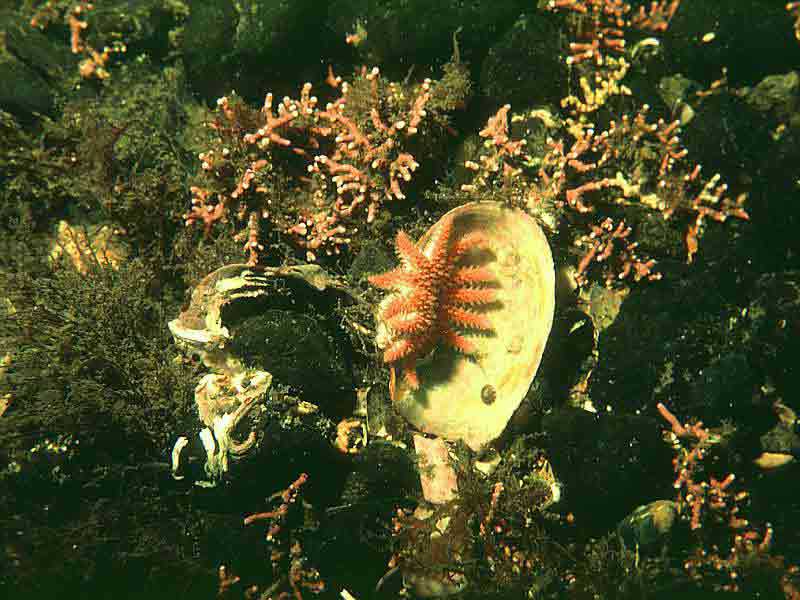
Lithothamnion glaciale nodules amongst pebbles with the sunstar Crossaster papposus, Isle of Lewis.
Photographer: Christine Howson Copyright: Joint Nature Conservation Committee (JNCC)
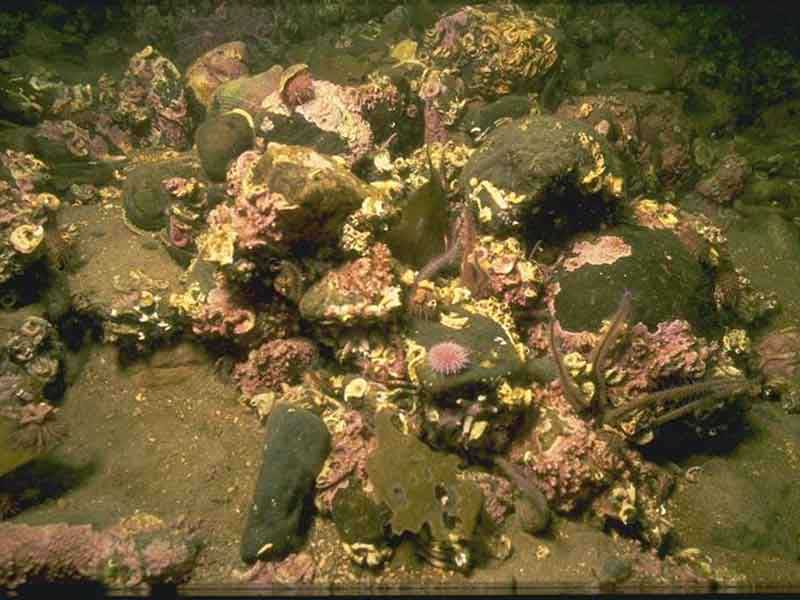
Boulders with Psammechinus miliaris and encrusting Lithothamnion glaciale.
Photographer: Christine Howson Copyright: Joint Nature Conservation Committee (JNCC)
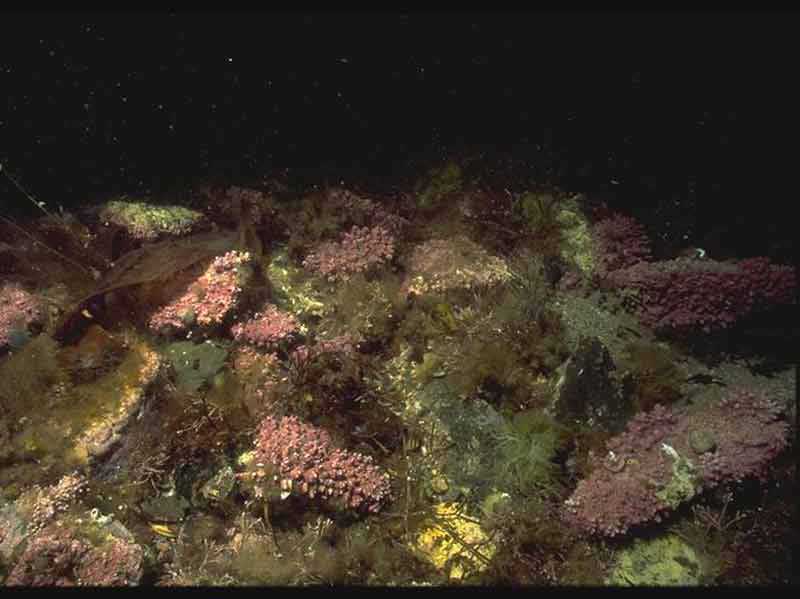
Boulders with encrusting, branched Lithothamnion glaciale.
Photographer: Anon. Copyright: Joint Nature Conservation Committee (JNCC)
Distribution data supplied by the Ocean Biodiversity Information System (OBIS). To interrogate UK data visit the NBN Atlas.Map Help
| Researched by | Angus Jackson | Refereed by | This information is not refereed |
| Authority | Kjellman, 1883 | ||
| Other common names | - | Synonyms | - |
Summary
Description
The form of this calcareous alga is very variable. It occurs in two main forms, a thin, hard crust on hard substrata as well as an unattached, fragile, branched nodules. When young, the crustose form is smooth with some scattered young mounds but develops branches with age. The loose-lying nodules may form dense beds of algal gravel. Encrusting individuals may reach up to 20 cm across and free-living plants may reach 4 - 5 cm across. In the free-living form the branches are up to 4 mm in diameter and 15 mm in length. The plants, when alive, are reddish to deep pink in colour with a violet tinge and white when dead.
Recorded distribution in Britain and Ireland
Most abundant in the sea lochs of western Scotland, Orkney and Shetland. Recorded along the east coast south to Flamborough. Occasional on the south coast, Wales, Isle of Man and Lundy. Sparse records from north and south-western Ireland.Global distribution
In the NE Atlantic from the British Isles north to Arctic Russia including the Faeroe Isles, Iceland and western Baltic. In the NW Atlantic from Cape Cod north to Arctic Canada and Greenland. Also northern Japan and China in the western Pacific.Habitat
Lithothamnion glaciale occurs in two main growth forms - as a thin encrusting species on rock, boulders, pebbles and shells etc. and also as a loose-lying algal gravel. This species occurs mainly in the mid-lower regions of the photic zone where there is considerable but not excessive water movement, either from wave exposure or tidal currents.Depth range
0-70Identifying features
- Forms a branching crust or a free-living branching nodule.
- Smooth, matt surface.
- Branches hard, not brittle.
- Branch diameter variable but up to 4 mm.
- Reddish to deep pink with violet tinge.
- May be an important component of maerl beds.
Additional information
This genus was previously called Lithothamnium but now Lithothamnion is the preferred name. Previous classifications included two varieties (sometimes formerly given species status): Lithothamnium granii (Foslie); and Lithothamnium colliculosum. It is quite difficult to differentiate between Lithothamnion glaciale and Lithothamnion corallioides. The hard surface and the absence of numerous surface mounds on Lithothamnion glaciale may help separate them although for greater accuracy the cortical cell structure should be used.
Listed by
- none -
Biology review
Taxonomy
| Level | Scientific name | Common name |
|---|---|---|
| Phylum | Rhodophyta | Red seaweeds |
| Class | Florideophyceae | |
| Order | Corallinales | |
| Family | Lithothamniaceae | |
| Genus | Lithothamnion | |
| Authority | Kjellman, 1883 | |
| Recent Synonyms | ||
Biology
| Parameter | Data | ||
|---|---|---|---|
| Typical abundance | High density | ||
| Male size range | |||
| Male size at maturity | |||
| Female size range | Medium(11-20 cm) | ||
| Female size at maturity | |||
| Growth form | Algal gravel | ||
| Growth rate | 13 | ||
| Body flexibility | None (less than 10 degrees) | ||
| Mobility | |||
| Characteristic feeding method | Autotroph | ||
| Diet/food source | |||
| Typically feeds on | |||
| Sociability | |||
| Environmental position | Epifloral | ||
| Dependency | Independent. | ||
| Supports | See additional information | ||
| Is the species harmful? | No | ||
Biology information
- Maerl has been found in densities of up to 22,000 thalli per square metre. The proportion of live to dead nodules varies considerably (Birkett et al., 1998). In the British Isles, Lithothamnion glaciale is found in relative abundances of up to 36 of coralline red algae and up to 80 further north (Adey & Adey, 1973)
- Individual thalli of this species may occur as male female, asexual or non-breeding plants depending on the development of the various types of reproductive conceptacles.
- Crustose plants adhere strongly to the substratum and reach 20 cm in diameter at least (Suneson, 1943; Irvine & Chamberlain, 1994). Unattached plants probably reach 4-5 cm in diameter.
- Little is known about growth rates of this species. Maerl is amongst the slowest growing species in the North Atlantic (Birkett et al., 1998). Adey, (1970) recorded rates of up to 13 microns per day in the lab. This is fast in comparison to other sub-arctic maerl species which may explain why Lithothamnion glaciale is often the most abundant North Atlantic crustose coralline alga.
- Mobility and sociability is not applicable to algal species.
- Maerl beds in general are known as a particularly diverse habitat with over 150 macro algal species and 500 benthic faunal species recorded (Birkett et al., 1998(a)). The loose structure of these beds permits water circulation and oxygenation to considerable depth. As a consequence of this loose structure, maerl provides shelter for an astonishing variety of fauna e.g. molluscs (Hall-Spencer, 1998) and amphipods (Grave De, 1999).
Habitat preferences
| Parameter | Data |
|---|---|
| Physiographic preferences | Open coast, Strait or Sound, Sea loch or Sea lough, Ria or Voe, Estuary |
| Biological zone preferences | Lower circalittoral, Lower infralittoral, Upper circalittoral, Upper infralittoral |
| Substratum / habitat preferences | Bedrock, Cobbles, Gravel / shingle, Large to very large boulders, Maerl, Pebbles, Small boulders |
| Tidal strength preferences | Moderately strong 1 to 3 knots (0.5-1.5 m/sec.), Strong 3 to 6 knots (1.5-3 m/sec.), Weak < 1 knot (<0.5 m/sec.) |
| Wave exposure preferences | Exposed, Moderately exposed, Sheltered, Very sheltered |
| Salinity preferences | Full (30-40 psu), Variable (18-40 psu) |
| Depth range | 0-70 |
| Other preferences | No text entered |
| Migration Pattern | Non-migratory or resident |
Habitat Information
- Information on distribution of Lithothamnion glaciale in Fair Isle is available at http://www.fairisle.org.uk/FIMETI/Reports/Safeguarding_Our_Heritage/appendix5.htm
- Detail about British Isles distribution is found in Hall-Spencer (1985).
- Most abundant from 6-30 metres (Suneson, 1943). In the clear waters around northern Japan it may be found as deep as 60-70 m. Depth range is highly dependent on turbidity although temperature plays a role. Below 4-6 °C growth rate has little dependence on light availability (Adey, 1970).
- Occasionally found in shallow waters and even in large tide pools on the shore (Adey, 1970).
- Deposits from maerl beds can sometimes form quite extensive white 'coral sand' beaches, such as those in the Western Isles and Orkney.
Life history
Adult characteristics
| Parameter | Data |
|---|---|
| Reproductive type | Vegetative |
| Reproductive frequency | Annual protracted |
| Fecundity (number of eggs) | No information |
| Generation time | Insufficient information |
| Age at maturity | Insufficient information |
| Season | Insufficient information |
| Life span | 20-100 years |
Larval characteristics
| Parameter | Data |
|---|---|
| Larval/propagule type | - |
| Larval/juvenile development | Spores (sexual / asexual) |
| Duration of larval stage | Not relevant |
| Larval dispersal potential | No information |
| Larval settlement period | Insufficient information |
Life history information
- Adey, (1970) estimates the lifespan of individual plants to be from 10-50 years.
- Little is known about the reproductive mechanisms of this species. However, sexual reproduction can occur between gonochoristic plants. Asexual reproduction occurs through the formation of spores. In some populations sexual individuals are rare (e.g. in the Gulf of Maine, (Adey, 1966)) and reproduction is mediated mainly if not entirely by the production of asexual conceptacles.
- Reproduction is probably mainly controlled by temperature (Adey, 1970). In Greenland and Sweden, Lithothamnion glaciale has reproductive conceptacles all year round whereas in Scotland, although conceptacles are common in winter, the plants are sterile in summer (Hall-Spencer, 1994 cited in Birkett et al., 1998)
- A further form of propagation is by vegetative growth and division of a single thallus into two or more competent individuals that continue to grow. In the other main maerl species that occur round the British Isles (Phymatolithon calcareum and Lithothamnion corallioides), this vegetative growth is the main form of propagation (Irvine & Chamberlain, 1994). Spores can potentially disperse long distances although if dispersal is dependent on vegetative propagation, then distances will be extremely limited.
Sensitivity review
The MarLIN sensitivity assessment approach used below has been superseded by the MarESA (Marine Evidence-based Sensitivity Assessment) approach (see menu). The MarLIN approach was used for assessments from 1999-2010. The MarESA approach reflects the recent conservation imperatives and terminology and is used for sensitivity assessments from 2014 onwards.
Physical pressures
Use / to open/close text displayed
| Intolerance | Recoverability | Sensitivity | Evidence / Confidence | |
Substratum loss [Show more]Substratum lossBenchmark. All of the substratum occupied by the species or biotope under consideration is removed. A single event is assumed for sensitivity assessment. Once the activity or event has stopped (or between regular events) suitable substratum remains or is deposited. Species or community recovery assumes that the substratum within the habitat preferences of the original species or community is present. Further details EvidenceBoth the crustose and free living forms of this species will be highly intolerant of substratum loss. The crustose form is closely adherent to hard substrata (Suneson, 1943; Irvine & Chamberlain, 1994). For the loose-lying form, loss of the substratum (which may include maerl itself) will also cause loss of the living Lithothamnion glaciale. Because the species is photosynthetic it is only found on the surface of the maerl bed or other substratum. Information on reproduction and recruitment is rather limited, particularly round the British Isles. Sexual and asexual reproduction has been recorded but in some areas there may be virtually no sexual plants (e.g. The Gulf of Maine, Adey, 1966). In Scotland, although Lithothamnion glaciale conceptacles are common in winter, the plants are sterile in summer (Hall-Spencer, 1994 cited in Birkett et al., 1998) Propagation can also occur through vegetative growth and division of existing crusts or nodules, although this requires there to be a proportion of the population to remain. Once a population has become extinct, sexual or asexual propagules from other populations may recolonize the area. Even if recolonization occurs, with the slow growth rates of coralline algae, it will take a very long time to re-establish a similar population although this may be faster for Lithothamnion glaciale than for other maerl species (Irvine & Chamberlain, 1994). It will probably take much longer for maerl beds to recover than for crustose populations. | High | Very low / none | Very High | Moderate |
Smothering [Show more]SmotheringBenchmark. All of the population of a species or an area of a biotope is smothered by sediment to a depth of 5 cm above the substratum for one month. Impermeable materials, such as concrete, oil, or tar, are likely to have a greater effect. Further details. EvidenceSmothering will block light penetration to the algal thalli preventing photosynthesis. Information on reproduction and recruitment is rather limited, particularly round the British Isles. Scallop dredging is one of the main causes of smothering in maerl beds. A single passage of a dredge may bury and kill 70 % of living maerl in their path (Hall-Spencer & Moore, 2000(a)). Sexual and asexual reproduction has been recorded but in some areas there may be virtually no sexual plants (e.g. The Gulf of Maine, Adey, 1966). In Scotland, although Lithothamnion glaciale conceptacles are common in winter, the plants are sterile in summer (Hall-Spencer, 1994 cited in Birkett et al., 1998) Propagation can also occur through vegetative growth and division of existing crusts or nodules, although this requires there to be a proportion of the population to remain. Once a population has become extinct, sexual or asexual propagules from other populations may recolonize the area. Even if recolonization occurs, with the slow growth rates of coralline algae, it will take a very long time to re-establish a similar population although this may be faster for Lithothamnion glaciale than for other maerl species (Irvine & Chamberlain, 1994). It will probably take much longer for maerl beds to recover than for crustose populations. | High | Very low / none | Very High | Moderate |
Increase in suspended sediment [Show more]Increase in suspended sedimentBenchmark. An arbitrary short-term, acute change in background suspended sediment concentration e.g., a change of 100 mg/l for one month. The resultant light attenuation effects are addressed under turbidity, and the effects of rapid settling out of suspended sediment are addressed under smothering. Further details EvidenceIncreased siltation will cause deposition of a thin layer of material on the surface of the algae blocking incident light and preventing photosynthesis. There is no specific mechanism for clearing this material although some coralline species can slough off outer cell layers to remove epiphytic species etc. Increased siltation may also fill up the spaces between nodules in maerl beds changing the substratum. Information on reproduction and recruitment is rather limited, particularly round the British Isles. Sexual and asexual reproduction has been recorded but in some areas there may be virtually no sexual plants (e.g. The Gulf of Maine, Adey, 1966). In Scotland, although Lithothamnion glaciale conceptacles are common in winter, the plants are sterile in summer (Hall-Spencer, 1994 cited in Birkett et al., 1998). On loss of a proportion of a population, sexual or asexual propagules from this or other populations may recolonize the area. Propagation can also occur through vegetative growth and division of existing crusts or nodules. With the slow growth rates of coralline algae, it will take a very long time to re-establish a similar population although this may be faster for Lithothamnion glaciale than for other maerl species (Irvine & Chamberlain, 1994). It will probably take much longer for maerl beds to recover than for crustose populations. | Intermediate | Low | High | Low |
Decrease in suspended sediment [Show more]Decrease in suspended sedimentBenchmark. An arbitrary short-term, acute change in background suspended sediment concentration e.g., a change of 100 mg/l for one month. The resultant light attenuation effects are addressed under turbidity, and the effects of rapid settling out of suspended sediment are addressed under smothering. Further details Evidence | No information | |||
Desiccation [Show more]Desiccation
EvidenceMaerl species (unlike most seaweeds) have a very poor ability to tolerate desiccation - only a few minutes exposure to the air would be sufficient to cause death (Birkett et al., 1998). Information on reproduction and recruitment is rather limited, particularly round the British Isles. Sexual and asexual reproduction has been recorded but in some areas there may be virtually no sexual plants (e.g. The Gulf of Maine, Adey, 1966). In Scotland, although Lithothamnion glaciale conceptacles are common in winter, the plants are sterile in summer (Hall-Spencer, 1994 cited in Birkett et al., 1998) Propagation can also occur through vegetative growth and division of existing crusts or nodules, although this requires there to be a proportion of the population to remain. Once a population has become extinct, sexual or asexual propagules from other populations may recolonize the area. Even if recolonization occurs, with the slow growth rates of coralline algae, it will take a very long time to re-establish a similar population although this may be faster for Lithothamnion glaciale than for other maerl species (Irvine & Chamberlain, 1994). It will probably take much longer for maerl beds to recover than for crustose populations. | High | Very low / none | Very High | High |
Increase in emergence regime [Show more]Increase in emergence regimeBenchmark. A one hour change in the time covered or not covered by the sea for a period of one year. Further details EvidenceMaerl species (unlike most seaweeds) have a very poor ability to tolerate desiccation - only a few minutes exposure to the air would be sufficient to cause death (Birkett et al., 1998). Information on reproduction and recruitment is rather limited, particularly round the British Isles. Sexual and asexual reproduction has been recorded but in some areas there may be virtually no sexual plants (e.g. The Gulf of Maine, Adey, 1966). In Scotland, although Lithothamnion glaciale conceptacles are common in winter, the plants are sterile in summer (Hall-Spencer, 1994 cited in Birkett et al., 1998) Propagation can also occur through vegetative growth and division of existing crusts or nodules, although this requires there to be a proportion of the population to remain. Once a population has become extinct, sexual or asexual propagules from other populations may recolonize the area. Even if recolonization occurs, with the slow growth rates of coralline algae, it will take a very long time to re-establish a similar population although this may be faster for Lithothamnion glaciale than for other maerl species (Irvine & Chamberlain, 1994). It will probably take much longer for maerl beds to recover than for crustose populations. | High | Very High | High | |
Decrease in emergence regime [Show more]Decrease in emergence regimeBenchmark. A one hour change in the time covered or not covered by the sea for a period of one year. Further details Evidence | No information | |||
Increase in water flow rate [Show more]Increase in water flow rateA change of two categories in water flow rate (view glossary) for 1 year, for example, from moderately strong (1-3 knots) to very weak (negligible). Further details EvidenceChanges in water flow rate may have some effect on Lithothamnion glaciale. Conditions with 'streaming water' are noted as being the best for this species (Suneson, 1943). Increases in water flow rate are unlikely to affect crustose individuals. Extreme water movement may cause movement of maerl nodules into less favourable conditions (e.g. deeper water). A reduction in water flow rate may allow greater build up of deposited particulate matter effectively covering the algae and restricting photosynthesis (see also siltation and smothering). Information on reproduction and recruitment is rather limited, particularly round the British Isles. Sexual and asexual reproduction has been recorded but in some areas there may be virtually no sexual plants (e.g. The Gulf of Maine, Adey, 1966). In Scotland, although Lithothamnion glaciale conceptacles are common in winter, the plants are sterile in summer (Hall-Spencer, 1994 cited in Birkett et al., 1998). On loss of a proportion of a population, sexual or asexual propagules from this or other populations may recolonize the area. Propagation can also occur through vegetative growth and division of existing crusts or nodules. With the slow growth rates of coralline algae, it will take a very long time to re-establish a similar population although this may be faster for Lithothamnion glaciale than for other maerl species (Irvine & Chamberlain, 1994). It will probably take much longer for maerl beds to recover than for crustose populations. | Intermediate | Low | High | Low |
Decrease in water flow rate [Show more]Decrease in water flow rateA change of two categories in water flow rate (view glossary) for 1 year, for example, from moderately strong (1-3 knots) to very weak (negligible). Further details Evidence | No information | |||
Increase in temperature [Show more]Increase in temperature
For intertidal species or communities, the range of temperatures includes the air temperature regime for that species or community. Further details EvidenceAdey, (1970) found optimal growth rates at between 10-12 °C. Long term chronic temperature decreases are likely to have little effect since the species is primarily subarctic and occurs in waters down to 0 °C (Adey, 1970). This species differs to Lithothamnion corallioides where the minimum survival temperature is between 2 and 5 °C. Information on reproduction and recruitment is rather limited, particularly round the British Isles. Sexual and asexual reproduction has been recorded but in some areas there may be virtually no sexual plants (e.g. The Gulf of Maine, Adey, 1966). However, the species does appear to be intolerant of increases in temperature. In Scotland for example, although Lithothamnion glaciale conceptacles are common in winter, the plants are sterile in summer (Hall-Spencer, 1994 cited in Birkett et al., 1998). Intolerance to temperature changes has, therefore, been assessed as intermediate. On loss of a proportion of a population, sexual or asexual propagules from this or other populations may recolonize the area. Propagation can also occur through vegetative growth and division of existing crusts or nodules. With the slow growth rates of coralline algae, it will take a very long time to re-establish a similar population although this may be faster for Lithothamnion glaciale than for other maerl species (Irvine & Chamberlain, 1994). It will probably take much longer for maerl beds to recover than for crustose populations. | Intermediate | Low | High | Moderate |
Decrease in temperature [Show more]Decrease in temperature
For intertidal species or communities, the range of temperatures includes the air temperature regime for that species or community. Further details Evidence | No information | |||
Increase in turbidity [Show more]Increase in turbidity
EvidenceDepth distribution of photosynthesising coralline algae is strongly affected by available light. In clearer waters the bottom depth limit is much greater than in turbid waters (e.g. Adey et al., 1976). The lower clarity of coastal waters of the British Isles restricts the distribution of maerl to shallow waters - typically less than 10 metres but occasionally down to around 30 m. Increases in turbidity would further restrict the depth distribution of a population. However, light availability is apparently not a limiting factor in temperatures below 4-6 °C (Adey, 1970). Decreases in turbidity would facilitate photosynthesis and benefit the population. Information on reproduction and recruitment is rather limited, particularly round the British Isles. Sexual and asexual reproduction has been recorded but in some areas there may be virtually no sexual plants (e.g. The Gulf of Maine, Adey, 1966). In Scotland, although Lithothamnion glaciale conceptacles are common in winter, the plants are sterile in summer (Hall-Spencer, 1994 cited in Birkett et al., 1998). On loss of a proportion of a population, sexual or asexual propagules from this or other populations may recolonize the area. Propagation can also occur through vegetative growth and division of existing crusts or nodules. With the slow growth rates of coralline algae, it will take a very long time to re-establish a similar population although this may be faster for Lithothamnion glaciale than for other maerl species (Irvine & Chamberlain, 1994). It will probably take much longer for maerl beds to recover than for crustose populations. | Intermediate | Low | High | Moderate |
Decrease in turbidity [Show more]Decrease in turbidity
Evidence | No information | |||
Increase in wave exposure [Show more]Increase in wave exposureA change of two ranks on the wave exposure scale (view glossary) e.g., from Exposed to Extremely exposed for a period of one year. Further details EvidenceIncreases in wave action will probably have little effect on crustose populations of Lithothamnion glaciale since it is a hard, thin, strongly adherent species. Maerl beds with loose-lying nodules are restricted to less wave exposed areas (e.g. sea lochs for Lithothamnion glaciale beds). Some wave action may be beneficial in creating the 'streaming water' flow that this species prefers. Strong wave action can break up the nodules into smaller pieces and scatter them from the maerl bed. Wave action during storms can be very important in determining the loss rates of thalli from maerl beds (Birkett et al., 1998). Information on reproduction and recruitment is rather limited, particularly round the British Isles. Sexual and asexual reproduction has been recorded but in some areas there may be virtually no sexual plants (e.g. The Gulf of Maine, Adey, 1966). In Scotland, although Lithothamnion glaciale conceptacles are common in winter, the plants are sterile in summer (Hall-Spencer, 1994 cited in Birkett et al., 1998). On loss of a proportion of a population, sexual or asexual propagules from this or other populations may recolonize the area. Propagation can also occur through vegetative growth and division of existing crusts or nodules. With the slow growth rates of coralline algae, it will take a very long time to re-establish a similar population although this may be faster for Lithothamnion glaciale than for other maerl species (Irvine & Chamberlain, 1994). It will probably take much longer for maerl beds to recover than for crustose populations. | Intermediate | Low | High | Moderate |
Decrease in wave exposure [Show more]Decrease in wave exposureA change of two ranks on the wave exposure scale (view glossary) e.g., from Exposed to Extremely exposed for a period of one year. Further details Evidence | No information | |||
Noise [Show more]Noise
EvidenceIt is highly unlikely that noise vibrations will affect crustose corallines such as Lithothamnion glaciale. | Tolerant | Not relevant | Not sensitive | High |
Visual presence [Show more]Visual presenceBenchmark. The continuous presence for one month of moving objects not naturally found in the marine environment (e.g., boats, machinery, and humans) within the visual envelope of the species or community under consideration. Further details EvidenceIt is highly unlikely that visual disturbance will affect crustose corallines such as Lithothamnion glaciale. | Tolerant | Not relevant | Not sensitive | High |
Abrasion & physical disturbance [Show more]Abrasion & physical disturbanceBenchmark. Force equivalent to a standard scallop dredge landing on or being dragged across the organism. A single event is assumed for assessment. This factor includes mechanical interference, crushing, physical blows against, or rubbing and erosion of the organism or habitat of interest. Where trampling is relevant, the evidence and trampling intensity will be reported in the rationale. Further details. EvidenceAbrasion and physical disturbance may break up loose-lying maerl nodules or highly branching crustose plants into smaller pieces resulting in easier displacement by wave action. Abrasion may also disrupt the physical integrity of accreted maerl beds. Boat moorings and dragging anchor chains have been noted to damage the surface of maerl beds as has demersal fishing gear. Hall-Spencer & Moore (2000a, c) reported that a single pass of a scallop dredge could bury and kill 70% of the living maerl (usually found at the surface), redistributed coarse sediment and affected the associated community. Dredge tracks remained visible for 2.5 years. Hall-Spencer & Moore (2000a, c) suggested that repeated anchorage could create impacts similar to towed fishing gear. Overall, Hall-Spencer & Moore (2000a, c) concluded that maerl beds were particularly vulnerable to damage from scallop dredging activities. Therefore, intolerance has been recorded as high. Information on reproduction and recruitment is rather limited, particularly round the British Isles. Sexual and asexual reproduction has been recorded but in some areas there may be virtually no sexual plants e.g. the Gulf of Maine (Adey, 1966). In Scotland although Lithothamnion glaciale conceptacles are common in winter, the plants are sterile in summer (Hall-Spencer, 1994 cited in Birkett et al., 1998). On loss of a proportion of a population, sexual or asexual propagules from this or other populations may recolonize the area. Propagation can also occur through vegetative growth and division of existing crusts or nodules. With the slow growth rates of coralline algae, it will take a very long time to re-establish a similar population although this may be faster for Lithothamnion glaciale than for other maerl species (Irvine & Chamberlain, 1994). It will probably take much longer for maerl beds to recover than for crustose populations. | High | Very High | Moderate | |
Displacement [Show more]DisplacementBenchmark. Removal of the organism from the substratum and displacement from its original position onto a suitable substratum. A single event is assumed for assessment. Further details EvidenceCrustose plants of Lithothamnion glaciale are strongly adherent to hard substrata. Branches that break off from these attached plants can continue to live and grow as loose-lying nodules but if the entire plant was removed form the substratum, it may die. Some maerl beds are highly mobile and displacement may have little effect. Other beds may be accreted and the branching nodules highly interlocked. Displacement from these 'fixed' beds may cause dispersion of the nodules into more unsuitable habitat. Information on reproduction and recruitment is rather limited, particularly round the British Isles. Sexual and asexual reproduction has been recorded but in some areas there may be virtually no sexual plants (e.g. The Gulf of Maine, Adey, 1966). In Scotland, although Lithothamnion glaciale conceptacles are common in winter, the plants are sterile in summer (Hall-Spencer, 1994 cited in Birkett et al., 1998). On loss of a proportion of a population, sexual or asexual propagules from this or other populations may recolonize the area. Propagation can also occur through vegetative growth and division of existing crusts or nodules. With the slow growth rates of coralline algae, it will take a very long time to re-establish a similar population although this may be faster for Lithothamnion glaciale than for other maerl species (Irvine & Chamberlain, 1994). It will probably take much longer for maerl beds to recover than for crustose populations. | Intermediate | High | Low |
Chemical pressures
Use [show more] / [show less] to open/close text displayed
| Intolerance | Recoverability | Sensitivity | Evidence / Confidence | |
Synthetic compound contamination [Show more]Synthetic compound contaminationSensitivity is assessed against the available evidence for the effects of contaminants on the species (or closely related species at low confidence) or community of interest. For example:
The evidence used is stated in the rationale. Where the assessment can be based on a known activity then this is stated. The tolerance to contaminants of species of interest will be included in the rationale when available; together with relevant supporting material. Further details. EvidenceInsufficientinformation | No information | No information | No information | Not relevant |
Heavy metal contamination [Show more]Heavy metal contaminationEvidenceInsufficientinformation | No information | No information | No information | Not relevant |
Hydrocarbon contamination [Show more]Hydrocarbon contaminationEvidenceInsufficientinformation | No information | No information | No information | Not relevant |
Radionuclide contamination [Show more]Radionuclide contaminationEvidenceInsufficientinformation | No information | No information | No information | Not relevant |
Changes in nutrient levels [Show more]Changes in nutrient levelsEvidenceCabioch (1969) has suggested that maerl is tolerant to increases in nutrients. However, in shallower waters, growth of ephemeral algae may be increased, smothering the maerl and restricting photosynthesis. King & Schramm, (1982) report that ionic calcium concentration is the main factor affecting growth of maerl in culture experiments rather than salinity per se (although this has not been shown in the field). For Phymatolithon calcareum, uptake of calcium carbonate occurs optimally at 30 psu. Information on reproduction and recruitment is rather limited, particularly round the British Isles. Sexual and asexual reproduction has been recorded but in some areas there may be virtually no sexual plants (e.g. The Gulf of Maine, Adey, 1966). In Scotland, although Lithothamnion glaciale conceptacles are common in winter, the plants are sterile in summer (Hall-Spencer, 1994 cited in Birkett et al., 1998). On loss of a proportion of a population, sexual or asexual propagules from this or other populations may recolonize the area. Propagation can also occur through vegetative growth and division of existing crusts or nodules. With the slow growth rates of coralline algae, it will take a very long time to re-establish a similar population although this may be faster for Lithothamnion glaciale than for other maerl species (Irvine & Chamberlain, 1994). It will probably take much longer for maerl beds to recover than for crustose populations. | Intermediate | Low | High | Moderate |
Increase in salinity [Show more]Increase in salinity
EvidenceUnlike Lithothamnion corallioides and Phymatolithon calcareum, Lithothamnion glaciale is tolerant to some variation in salinity. It is found regularly in sea lochs off the west coast of Scotland where riverine in-put and precipitation run-off cause variable salinity. Growth rates are decreased by reduced salinity (Adey, 1970). Resumption of normal growth rates will probably occur on return to full salinity. | Low | Very high | Very Low | Moderate |
Decrease in salinity [Show more]Decrease in salinity
Evidence | No information | |||
Changes in oxygenation [Show more]Changes in oxygenationBenchmark. Exposure to a dissolved oxygen concentration of 2 mg/l for one week. Further details. EvidenceAnoxia will kill live maerl (J. Hall-Spencer, pers. comm.) but exposure to low oxygen concentrations for a week may not kill the plants. Respiration, growth and reproduction may be affected by hypoxia but the effects are likely to be short lasting on return to normal oxygen concentrations. | Low | Very high | Very Low | Moderate |
Biological pressures
Use [show more] / [show less] to open/close text displayed
| Intolerance | Recoverability | Sensitivity | Evidence / Confidence | |
Introduction of microbial pathogens/parasites [Show more]Introduction of microbial pathogens/parasitesBenchmark. Sensitivity can only be assessed relative to a known, named disease, likely to cause partial loss of a species population or community. Further details. EvidenceNo diseases of European maerl species are known. However, the bacterial pathogen 'coralline lethal orange disease' from the Pacific is highly virulent (Littler & Littler, 1985). Information on reproduction and recruitment is rather limited, particularly round the British Isles. Sexual and asexual reproduction has been recorded but in some areas there may be virtually no sexual plants (e.g. The Gulf of Maine, Adey, 1966). In Scotland, although Lithothamnion glaciale conceptacles are common in winter, the plants are sterile in summer (Hall-Spencer, 1994 cited in Birkett et al., 1998). On loss of a proportion of a population, sexual or asexual propagules from this or other populations may recolonize the area. Propagation can also occur through vegetative growth and division of existing crusts or nodules. With the slow growth rates of coralline algae, it will take a very long time to re-establish a similar population although this may be faster for Lithothamnion glaciale than for other maerl species (Irvine & Chamberlain, 1994). It will probably take much longer for maerl beds to recover than for crustose populations. | Intermediate | Low | High | Moderate |
Introduction of non-native species [Show more]Introduction of non-native speciesSensitivity assessed against the likely effect of the introduction of alien or non-native species in Britain or Ireland. Further details. EvidenceThe introduced species Crepidula fornicata has radically altered the ecology of maerl beds in the Rade de Brest, France through increasing siltation and provision of substrata (J. Hall-Spencer pers. comm.). This alien species may impact the few populations of Lithothamnion glaciale recorded in southern Britain but has not spread far enough north to affect areas where Lithothamnion glaciale is abundant. Information on reproduction and recruitment is rather limited, particularly round the British Isles. Sexual and asexual reproduction has been recorded but in some areas there may be virtually no sexual plants (e.g. The Gulf of Maine, Adey, 1966). In Scotland, although Lithothamnion glaciale conceptacles are common in winter, the plants are sterile in summer (Hall-Spencer, 1994 cited in Birkett et al., 1998). On loss of a proportion of a population, sexual or asexual propagules from this or other populations may recolonize the area. Propagation can also occur through vegetative growth and division of existing crusts or nodules. With the slow growth rates of coralline algae, it will take a very long time to re-establish a similar population although this may be faster for Lithothamnion glaciale than for other maerl species (Irvine & Chamberlain, 1994). It will probably take much longer for maerl beds to recover than for crustose populations. | Intermediate | Low | High | Moderate |
Extraction of this species [Show more]Extraction of this speciesBenchmark. Extraction removes 50% of the species or community from the area under consideration. Sensitivity will be assessed as 'intermediate'. The habitat remains intact or recovers rapidly. Any effects of the extraction process on the habitat itself are addressed under other factors, e.g. displacement, abrasion and physical disturbance, and substratum loss. Further details. EvidenceIt is extremely unlikely that crustose populations of Lithothamnion glaciale would be targeted for extraction. In contrast, maerl beds, of which Lithothamnion glaciale can form an important component, particularly in Scotland, may be subject to exploitation Harvesting of maerl beds is one of the greatest threats. In England only dead maerl is extracted. However, even this can have detrimental effects, resuspending sediments that resettle and cover the algae reducing photosynthesis. In live beds the living nodules are typically on the surface so these are the first to be removed. Information on reproduction and recruitment is rather limited, particularly round the British Isles. Sexual and asexual reproduction has been recorded but in some areas there may be virtually no sexual plants (e.g. The Gulf of Maine, Adey, 1966). In Scotland, although Lithothamnion glaciale conceptacles are common in winter, the plants are sterile in summer (Hall-Spencer, 1994 cited in Birkett et al., 1998). On loss of a proportion of a population, sexual or asexual propagules from this or other populations may recolonize the area. Propagation can also occur through vegetative growth and division of existing crusts or nodules. With the slow growth rates of coralline algae, it will take a very long time to re-establish a similar population although this may be faster for Lithothamnion glaciale than for other maerl species (Irvine & Chamberlain, 1994). It will probably take much longer for maerl beds to recover than for crustose populations. | Intermediate | Low | High | High |
Extraction of other species [Show more]Extraction of other speciesBenchmark. A species that is a required host or prey for the species under consideration (and assuming that no alternative host exists) or a keystone species in a biotope is removed. Any effects of the extraction process on the habitat itself are addressed under other factors, e.g. displacement, abrasion and physical disturbance, and substratum loss. Further details. EvidenceLithothamnion glaciale has no known obligate relationships so the loss of other species should not have a great effect on the viability of the plant population. However, the physical effects of removal of other species can be very serious. Extraction of other organisms such as scallops using dredges can cause great damage through physical disruption, crushing, burial and the loss of stabilising algae (Hall-Spencer & Moore, 2000(a)). Other large burrowing bivalves such as Ensis sp. and Venerupis sp. are harvested using suction dredging which causes structural damage and resuspends sediment that resettles, covering the algae and reducing photosynthesis (Hall-Spencer & Moore, 2000(a)). These effects are best addressed using the relevant physical factors above. Information on reproduction and recruitment is rather limited, particularly round the British Isles. Sexual and asexual reproduction has been recorded but in some areas there may be virtually no sexual plants (e.g. The Gulf of Maine, Adey, 1966). In Scotland, although Lithothamnion glaciale conceptacles are common in winter, the plants are sterile in summer (Hall-Spencer, 1994 cited in Birkett et al., 1998). On loss of a proportion of a population, sexual or asexual propagules from this or other populations may recolonize the area. Propagation can also occur through vegetative growth and division of existing crusts or nodules. With the slow growth rates of coralline algae, it will take a very long time to re-establish a similar population although this may be faster for Lithothamnion glaciale than for other maerl species (Irvine & Chamberlain, 1994). It will probably take much longer for maerl beds to recover than for crustose populations. | Intermediate | Low | High | High |
Additional information
Importance review
Policy/legislation
- no data -
Status
| National (GB) importance | - | Global red list (IUCN) category | - |
Non-native
| Parameter | Data |
|---|---|
| Native | - |
| Origin | - |
| Date Arrived | - |
Importance information
It is proposed that Lithothamnion glaciale is added to Annex V of the EC Habitats Directive. The other British Isles maerl species (Phymatolithon calcareum and Lithothamnion corallioides) are already listed. Maerl beds are also identified as a key habitat within the EC Habitats Directive Annex I category 'Sand banks which are covered by sea-water at all times'. Maerl biotopes are covered by a UK Biodiversity Habitat Action Plan that, therefore, also addresses Lithothamnion glaciale. In 1996, a licence was granted to take some 20,000 cubic metres (approximately 36,000 tonnes) from Orkney waters (http://www.rbge.org.uk/search-bin/nph-readbtree.pl/usedata/maxvals=10/firstval=1?SPECIES_XREF=Lithothamnion+glaciale).
Bibliography
Adey, W.H. & Adey, P.J., 1973. Studies on the biosystematics and ecology of the epilithic crustose corallinacea of the British Isles. British Phycological Journal, 8, 343-407.
Adey, W.H., 1966. The genera Lithothamnium, Leptophytum (nov. gen.) and Phymatolithon in the Gulf of Maine. Hydrobiologia, 28, 321-370.
Adey, W.H., 1970. The effects of light and temperature on growth rates in boreal-subarctic crustose corallines. Journal of Phycology, 6, 269-276.
Adey, W.H., Masaki, T. & Akioka, H., 1976. The distribution of crustose corallines in Eastern Hokkaido and the biogeographic relationships of the flora. Bulletin of the Faculty of Fisheries, Hokkaido University, 26, 303-313.
Birkett, D.A., Maggs, C.A. & Dring, M.J., 1998a. Maerl. an overview of dynamic and sensitivity characteristics for conservation management of marine SACs. Natura 2000 report prepared by Scottish Association of Marine Science (SAMS) for the UK Marine SACs Project., Scottish Association for Marine Science. (UK Marine SACs Project, vol V.). Available from: http://ukmpa.marinebiodiversity.org/uk_sacs/publications.htm
Cabioch, J., 1969. Les fonds de maerl de la baie de Morlaix et leur peuplement vegetale. Cahiers de Biologie Marine, 10, 139-161.
Cardinal, A., Cabioch, J., & Gendron, L., 1979. Les corallinacées (Rhodophytes; Cryptonemiales) des côtes du Québec II. Lithothamnium Philippi emend Adey (I). Cahiers be Biologie Marine, 20, 171-179.
Grave De, S., 1999. The influence of sediment heterogeneity on within maerl bed differences in infaunal crustacean community. Estuarine, Coastal and Shelf Science, 49, 153-163.
Hall-Spencer, J.M. & Moore, P.G., 2000a. Impact of scallop dredging on maerl grounds. In Effects of fishing on non-target species and habitats. (ed. M.J. Kaiser & S.J., de Groot) 105-117. Oxford: Blackwell Science.
Hall-Spencer, J.M. & Moore, P.G., 2000c. Scallop dredging has profound, long-term impacts on maerl habitats. ICES Journal of Marine Science, 57, 1407-1415.
Hall-Spencer, J.M., 1995. Lithothamnion corallioides (P. & H. Crouan) P. & H. Crouan may not extend into Scottish waters. http://www.botany.uwc.ac.za/clines/clnews/cnews20.htm, 2000-10-15
Hall-Spencer, J.M., 1998. Conservation issues relating to maerl beds as habitats for molluscs. Journal of Conchology Special Publication, 2, 271-286.
Hardy, F.G. & Guiry, M.D., 2003. A check-list and atlas of the seaweeds of Britain and Ireland. London: British Phycological Society
Howson, C.M. & Picton, B.E., 1997. The species directory of the marine fauna and flora of the British Isles and surrounding seas. Belfast: Ulster Museum. [Ulster Museum publication, no. 276.]
Irvine, L. M. & Chamberlain, Y. M., 1994. Seaweeds of the British Isles, vol. 1. Rhodophyta, Part 2B Corallinales, Hildenbrandiales. London: Her Majesty's Stationery Office.
JNCC (Joint Nature Conservation Committee), 1999. Marine Environment Resource Mapping And Information Database (MERMAID): Marine Nature Conservation Review Survey Database. [on-line] http://www.jncc.gov.uk/mermaid
Littler, M., & Littler, D., 1995. CLOD (Coralline Lethal Orange Disease). http://www.botany.uwc.ac.za/clines/clnews/cnews20.htm, 2000-10-15
Rosenvinge, L.K., 1917. The marine algae of Denmark. Contributions to their natural history. II Rhodophyceae II (Cryptomeniales). Kongelige Dansk Videnskabernes Selskabs Skrifter, Naturvidenskabelig Matematik Afdeling, 7, 153-284.
Suneson, S., 1943. The structure, life-history, and taxonomy of the Swedish Corallinaceae. Lunds Universitets Årsskrift N.F. Avd 2, 39, 1-66. Kungliga Fysiografiska Sållskapets Handlingar N.F., 54(9).
Datasets
Centre for Environmental Data and Recording, 2018. Ulster Museum Marine Surveys of Northern Ireland Coastal Waters. Occurrence dataset https://www.nmni.com/CEDaR/CEDaR-Centre-for-Environmental-Data-and-Recording.aspx accessed via NBNAtlas.org on 2018-09-25.
Environmental Records Information Centre North East, 2018. ERIC NE Combined dataset to 2017. Occurrence dataset: http://www.ericnortheast.org.ukl accessed via NBNAtlas.org on 2018-09-38
Manx Biological Recording Partnership, 2017. Isle of Man wildlife records from 01/01/2000 to 13/02/2017. Occurrence dataset: https://doi.org/10.15468/mopwow accessed via GBIF.org on 2018-10-01.
Manx Biological Recording Partnership, 2018. Isle of Man historical wildlife records 1990 to 1994. Occurrence dataset:https://doi.org/10.15468/aru16v accessed via GBIF.org on 2018-10-01.
NBN (National Biodiversity Network) Atlas. Available from: https://www.nbnatlas.org.
OBIS (Ocean Biodiversity Information System), 2024. Global map of species distribution using gridded data. Available from: Ocean Biogeographic Information System. www.iobis.org. Accessed: 2024-04-20
Outer Hebrides Biological Recording, 2018. Non-vascular Plants, Outer Hebrides. Occurrence dataset: https://doi.org/10.15468/goidos accessed via GBIF.org on 2018-10-01.
Royal Botanic Garden Edinburgh, 2018. Royal Botanic Garden Edinburgh Herbarium (E). Occurrence dataset: https://doi.org/10.15468/ypoair accessed via GBIF.org on 2018-10-02.
Citation
This review can be cited as:
Last Updated: 08/10/2003