
A bristleworm (Ophelia borealis)
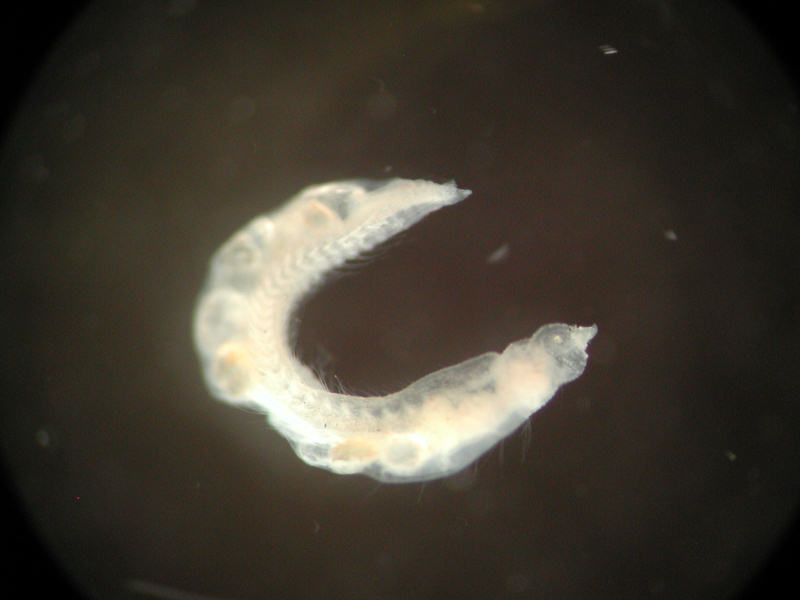
Ophelia borealis highlighting cone-shaped prostomium.
Photographer: Crown copyright Copyright: Crown copyright
Distribution data supplied by the Ocean Biodiversity Information System (OBIS). To interrogate UK data visit the NBN Atlas.Map Help
| Researched by | Saskiya Richards | Refereed by | Admin |
| Authority | Quatrefages, 1866 | ||
| Other common names | - | Synonyms | - |
Summary
Description
Recorded distribution in Britain and Ireland
Ophelia borealis is widespread around the British Isles but less common on the Irish coasts.Global distribution
-Habitat
Ophelia borealis inhabits clean sand in the subtidal and intertidal zones up to high water.Depth range
-Identifying features
- Stout, body with approximately 30 segments.
- Body is widest at tenth segment and up to 2.3 cm in length.
- Deep pinkish, red colour with a lilac or blue iridescent tint.
- Segments marked with 5-7 superficial rings.
- Chaetae slender, unjointed, and shorter on the neuropodia than the notopodia.
- Abdominal region distinguished by a deep ventral groove commencing at the seventh segment, two lateral grooves and chaetae-like gills.
- Numerous papillae cover the pygidium.
Additional information
This species is similar to Ophelia limacina.Listed by
- none -
Bibliography
Bruce, J.R., Colman, J.S. & Jones, N.S., 1963. Marine fauna of the Isle of Man. Liverpool: Liverpool University Press.
Costello, M.J., Bouchet, P., Boxshall, G., Emblow, C. & Vanden Berghe, E., 2004. European Register of Marine Species [On-line]. http://www.marbef.org/data/erms.php,
Foster-Smith, J. (ed.), 2000. The marine fauna and flora of the Cullercoats District. Marine species records for the North East Coast of England. Sunderland: Penshaw Press, for the Dove Marine Laboratory, University of Newcastle upon Tyne.
Hayward, P.J. & Ryland, J.S. (ed.) 1995b. Handbook of the marine fauna of North-West Europe. Oxford: Oxford University Press.
Howson, C.M. & Picton, B.E., 1997. The species directory of the marine fauna and flora of the British Isles and surrounding seas. Belfast: Ulster Museum. [Ulster Museum publication, no. 276.]
Tebble, N. 1952. On three species of the Genus Ophelia (Polychaeta) from British & adjacent waters. The Annals and Magazine of Natural History Vol 5 Series 12, 553-560.
Datasets
NBN (National Biodiversity Network) Atlas. Available from: https://www.nbnatlas.org.
OBIS (Ocean Biodiversity Information System), 2024. Global map of species distribution using gridded data. Available from: Ocean Biogeographic Information System. www.iobis.org. Accessed: 2024-04-17
Citation
This review can be cited as:
Last Updated: 12/09/2007