
Phosphorescent sea pen (Pennatula phosphorea)
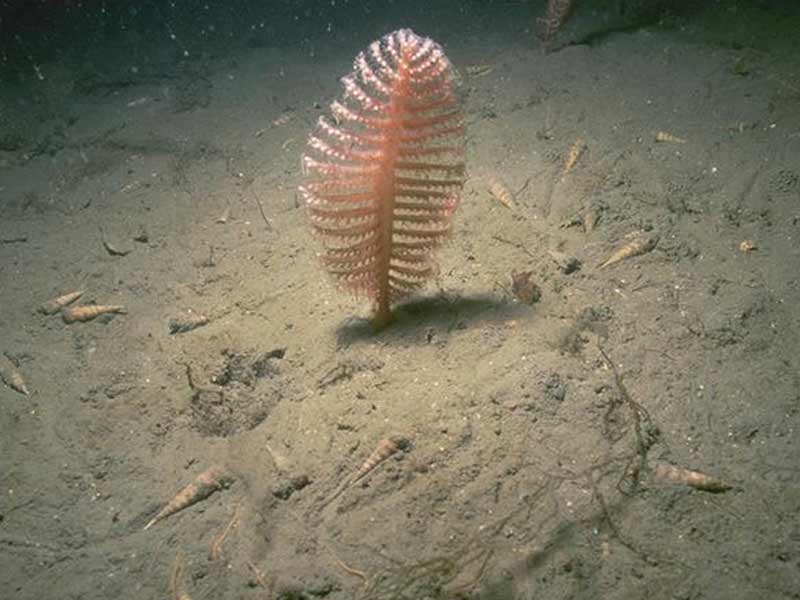
Pennatula phosphorea and Turritella communis in muddy sediment.
Photographer: Mark Davies Copyright: Joint Nature Conservation Committee (JNCC)
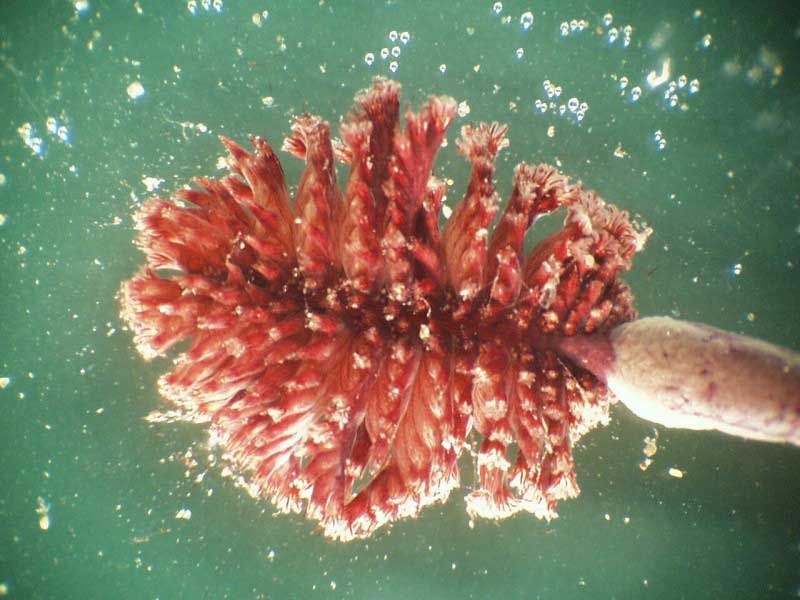
Close-up view of Pennatula phosphorea.
Photographer: Hilmar Hinz Copyright: Dr Hilmar Hinz
Distribution data supplied by the Ocean Biodiversity Information System (OBIS). To interrogate UK data visit the NBN Atlas.Map Help
| Researched by | Hugh Jones | Refereed by | Admin |
| Authority | Linnaeus, 1758 | ||
| Other common names | - | Synonyms | - |
Summary
Description
Recorded distribution in Britain and Ireland
Recorded in Scottish west coast sea lochs and the Shetlands. It has also been recorded in west Scotland, the Irish Sea including off the Welsh coast and is frequent in the North Sea, but not in southern England.Global distribution
Manual (1988) records the species as present widely in the north-east Atlantic and in the Mediterranean.Habitat
Found in sandy and muddy substrata at depths of 10m-100 m.Depth range
-Identifying features
- Feeding polyps separate.
- Upper regions of the body with red/pink colouration.
- The central axis of the colony is often bent over at the tip like a shepherds crook.
- Flesh is translucent, yellowish or pale pink with white polyps.
Additional information
Pennatula phosphorea luminesces in a blue/green colour when stimulated. The luminous waves proceed in either direction, with a measurable velocity, to the extremities of the animal. Light is emitted by the polyps, which are believed to be connected by a nerve net. There is a gradual increase in light intensity with increasing number of disturbances as a result of facilitation (Nicol, 1958). Pennatula phosphorea contracts when disturbed, and swells by up-taking water when unperturbed (Nicol, 1958). It is also capable of withdrawing into a tube below the mud surface (Mackie, 1998). Extracts from this species have been found to show narcotic and anorectic properties, acting as feeding deterrents for the octocoral's main predator the Dover sole, Solea solea (Mackie, 1998). They have stinging organelles like most sea anemones and all cnidarians, which are contained in polyps along the branches off the long peduncle.Listed by
- none -
Bibliography
Basford, D.J., Eleftheriou, A. & Raffaelli, D., 1989. The epifauna of the northern North-Sea (56-°-61°N). Journal of the Marine Biological Association of the United Kingdom, 69, 387-407.
Howson, C.M. & Picton, B.E., 1997. The species directory of the marine fauna and flora of the British Isles and surrounding seas. Belfast: Ulster Museum. [Ulster Museum publication, no. 276.]
Mackie, A.M., 1998. Preliminary studies on the chemical defences of British octocorals Alcyonium digitatum and Pennatula phosphorea. Comparative Biochemistry and Physiology A- Physiology, 86, 629-632.
Manuel, R.L., 1988. British Anthozoa. Synopses of the British Fauna (New Series) (ed. D.M. Kermack & R.S.K. Barnes). The Linnean Society of London [Synopses of the British Fauna No. 18.]. DOI https://doi.org/10.1002/iroh.19810660505
Nicol, J.A., 1958. Observations on the luminescence of Pennatula phosphorea, with a note on the luminescence of Virgularia mirabilis. Journal of the Marine Biological Association of the United Kingdom, 37, 551-563.
Datasets
NBN (National Biodiversity Network) Atlas. Available from: https://www.nbnatlas.org.
OBIS (Ocean Biodiversity Information System), 2024. Global map of species distribution using gridded data. Available from: Ocean Biogeographic Information System. www.iobis.org. Accessed: 2024-04-19
Citation
This review can be cited as:
Last Updated: 17/04/2008