
A brachiopod (Terebratulina retusa)
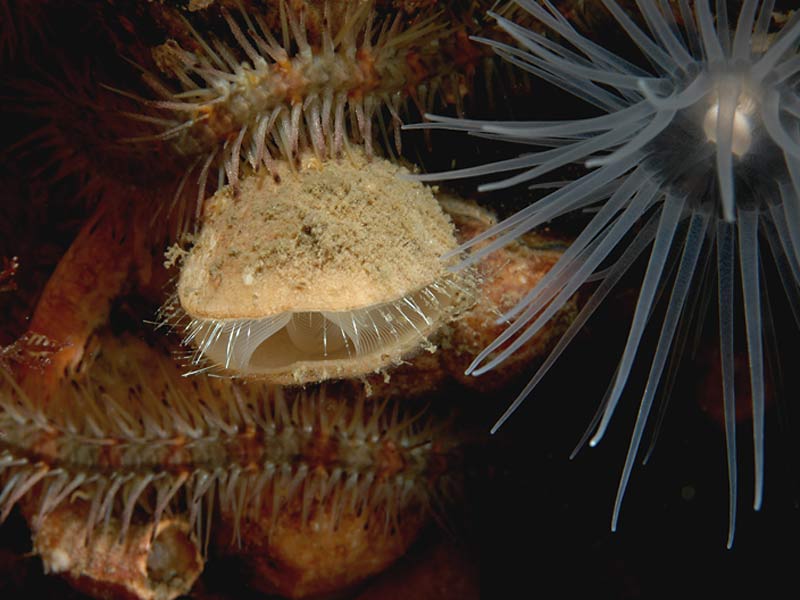
Terebratulina retusa amongst Ophiothrix fragilis arms at Loch Duich, West Scotland.
Photographer: Keith Hiscock Copyright: Dr Keith Hiscock
Distribution data supplied by the Ocean Biodiversity Information System (OBIS). To interrogate UK data visit the NBN Atlas.Map Help
| Researched by | Sonia Rowley | Refereed by | This information is not refereed |
| Authority | (Linnaeus, 1758) | ||
| Other common names | - | Synonyms | Anomia caputserpentis Linnaeus, 1767, Anomia retusa Linnaeus, 1758 |
Summary
Description
Terebratulina retusa is a plump, almost pear-shaped brachiopod up to 3.3 cm long and 2.5 cm wide. Characteristic of this phyla, the convex valves are inequivalve with the lower valve more convex than the upper valve. The upper valve tapers posteriorly and the lower valve has a large foramen close to the hinge. The cuticle-covered stalk (pedicle) extends from the foramen and attaches the animal to the substrata. The surface of both valves has distinct central growth lines and ca 11-14 numerous, coarse, ribs that radiate outwards from the hinge-line to the anterior edges of the valves. The ribs also form smooth rounded tubercles on the lateral margins towards the hinge but are more prominent on the lower umbo. The anterior margin of the shell can be rounded, straight or slightly concave. This species has a whitish or yellow shell but may be orange (in females) or cream (in males) during the breeding season due to the colour of the ripe gonads. The shells of live individuals are covered in a spongy, protein-rich layer.
Recorded distribution in Britain and Ireland
This deep water species is likely to be under recorded but has been recorded on the west coasts of Scotland and Ireland. Also recorded to the south of the Isle of Man. No records have been found off the east coast of England.Global distribution
-Habitat
This species can be found on vertical rock faces and coarse substrata. It can also be attached to the horse mussel Modiolus modiolus, hydroids and associated with deep water coral reefs. This is a sublittoral species found from 15 to >1500 meters depth.Depth range
-Identifying features
- Plump, almost pear-shaped up to 3.3 cm long and 2.5 cm wide.
- The lower valve is larger than the upper valve.
- The lower valve bears a large foramen (pore) close to the hinge.
- The valve surfaces have 11-14 coarse ribs, radiating from the hinge.
- The fine shell is whiteish to yellow, although orange or cream during the breeding season.
Additional information
Terebratulina retusa is the most common brachiopod in British waters but may be confused with the deep-living Terebratulina septentionalis. However, Terebratulina septentionalis has no pedicle and has 16-20 coarse radiating ribs on the outside of the valves.
Terebratulina retusa is gonochoristic with external fertilization and planktonic larvae present in the water column for up to 3 weeks. James et al. (1991) noted that reproductive cycles and fecundities varied relative to depth and food availability. Two populations of Terebratulina retusa were studied from the Firth of Lorn and Loch Fyne in Scotland at 200 and 30 meters depth respectively. Populations from Loch Fyne had numerous spawning events during the spring and summer, having five times greater planktonic productivity than those studied at depth from the Firth of Lorn, which had only a single spawning event in November.
Interestingly, brachiopods were present in the early Cambrian marine fauna. They are one of the few phyla represented throughout 550 million years of the Phanerozoic era, which extends from the first widespread appearance of organisms with calcified shells to the present day (James et al., 1991). In fact brachiopods were inaccurately named by the French palaeontologist Cuvier in 1805. Cuvier mistook the lophophore to be an organ of locomotion as opposed to feeding, hence the name brachion (upper arm) and podos (foot) in Greek (Moen & Svensen, 2004).
Brachiopods are active ciliary suspension feeders trapping particulate organic matter from the water column. The use of mucus is confined to the transport of particles to the mouth and pseudofaeces production, and not the capture of food particles from the water column (James et al., 1992). The shells of Terebratulina spp. Consist of magnesium calcite, which is chemically very robust (James et al., 1992).
Terebratulina retusa is the most common brachiopod in British waters but may be confused with the deep-living Terebratulina septentionalis. However, Terebratulina septentionalis has no pedicle and has 16-20 coarse radiating ribs on the outside of the valves.
Terebratulina retusa is gonochoristic with external fertilization and planktonic larvae present in the water column for up to 3 weeks. James et al. (1991) noted that reproductive cycles and fecundities varied relative to depth and food availability. Two populations of Terebratulina retusa were studied from the Firth of Lorn and Loch Fyne in Scotland at 200 and 30 meters depth respectively. Populations from Loch Fyne had numerous spawning events during the spring and summer, having five times greater planktonic productivity than those studied at depth from the Firth of Lorn, which had only a single spawning event in November.
Listed by
- none -
Bibliography
Bruce, J.R., Colman, J.S. & Jones, N.S., 1963. Marine fauna of the Isle of Man. Liverpool: Liverpool University Press.
Brunton, C.H.C. & Curry, G.B., 1979. British Brachiopods. London: Academic Press. [Synopses of the British Fauna, no. 17.]
Costello, M.J., Bouchet, P., Boxshall, G., Emblow, C. & Vanden Berghe, E., 2004. European Register of Marine Species [On-line]. http://www.marbef.org/data/erms.php,
Gibson, R., Hextall, B. & Rogers, A., 2001. Photographic guide to the sea and seashore life of Britain and north-west Europe. Oxford: Oxford University Press.
Harper, D.A.T., 1991. The brachiopods Neocrania and Terebratulina from Galway Bay. Irish Naturalists' Journal, 23, 371-376.
Hayward, P., Nelson-Smith, T. & Shields, C. 1996. Collins pocket guide. Sea shore of Britain and northern Europe. London: HarperCollins.
Howson, C.M. & Picton, B.E., 1997. The species directory of the marine fauna and flora of the British Isles and surrounding seas. Belfast: Ulster Museum. [Ulster Museum publication, no. 276.]
James, M.A., Ansell, A.D. & Curry, G.B., 1991. Reproductive cycle of the brachiopod Terebratulina retusa on the west coast of Scotland. Marine biology, 109, 441-451.
James, M.A., Ansell, A.D., Collins, M.J., Curry, G.B., Peck, L.S. & Rhoda, M.C., 1992. Biology of living brachiopods. Advances in Marine Biology, 28, 175-387.
MarLIN (Marine Life Information Network), 2005. SEArchable BEnthic Data (SEABED) Map [on-line]. Data Access Sub-programme, Marine Life Information Network for Britian and Ireland http://www.marlin.ac.uk,
Moen, F.E. & Svensen, E., 2004. Marine Fish & Invertebrates of Northern Europe. Southend-on-Sea: Aqua Press.
Picton, B.E. & Costello, M.J., 1998. BioMar biotope viewer: a guide to marine habitats, fauna and flora of Britain and Ireland. [CD-ROM] Environmental Sciences Unit, Trinity College, Dublin.
Datasets
Centre for Environmental Data and Recording, 2018. Ulster Museum Marine Surveys of Northern Ireland Coastal Waters. Occurrence dataset https://www.nmni.com/CEDaR/CEDaR-Centre-for-Environmental-Data-and-Recording.aspx accessed via NBNAtlas.org on 2018-09-25.
NBN (National Biodiversity Network) Atlas. Available from: https://www.nbnatlas.org.
OBIS (Ocean Biodiversity Information System), 2024. Global map of species distribution using gridded data. Available from: Ocean Biogeographic Information System. www.iobis.org. Accessed: 2024-04-25
Citation
This review can be cited as:
Last Updated: 03/07/2008