
Lagoon cockle (Cerastoderma glaucum)
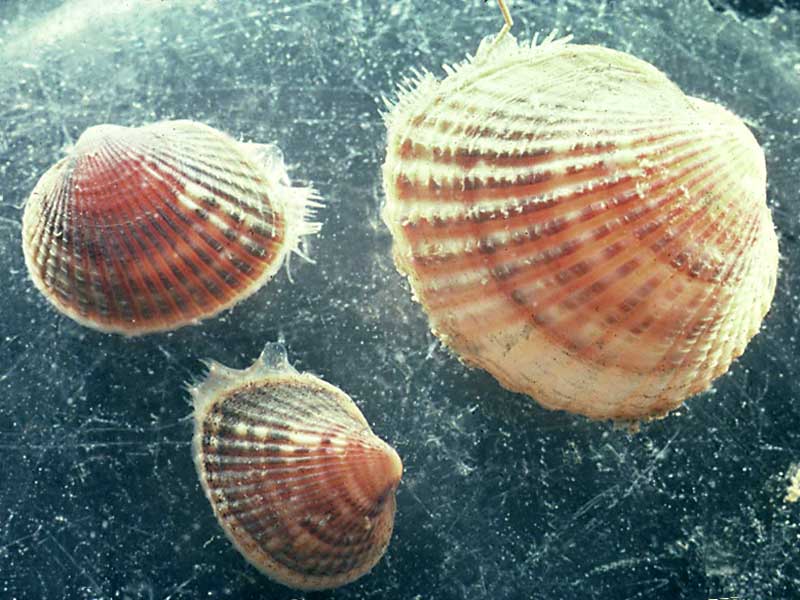
Three Cerastoderma glaucum with siphons extended.
Photographer: Dennis R. Seaward Copyright: Dennis R. Seaward
Distribution data supplied by the Ocean Biodiversity Information System (OBIS). To interrogate UK data visit the NBN Atlas.Map Help
| Researched by | Nicola White | Refereed by | Dr Richard S.K. Barnes |
| Authority | (Bruguière, 1789) | ||
| Other common names | - | Synonyms | Cardium lamarckii (Bruguière, 1789) |
Summary
Description
The cockle, Cerastoderma glaucum is a filter feeding bivalve which burrows shallowly in soft sediments. The species exists in two forms, a typical thin-shelled variety found in brackish lagoon habitats and a thicker shelled variety occurring in estuaries. It is widely distributed in north-west Europe.
Recorded distribution in Britain and Ireland
Orkney, Firth of Forth, East Anglia, Deben & Orwell estuaries, south coast of England, south Wales, the west coast of Scotland, and south and west coasts of Ireland.Global distribution
Occurs from Norway and the Baltic to the Mediterranean and Black Seas.Habitat
The species is found submerged in saline lagoons or more rarely on the low shore of estuaries. Adults usually burrow shallowly in soft sediments. The failure of the species to colonize the higher shore is believed to be due to an inability to tolerate aerial exposure and it's consequent conditions. The species' distribution is believed to be restricted by the damaging effect of wave action on the newly settled spat.Depth range
ShallowIdentifying features
- Rounded globular shell with 22-28 conspicuous radiating ribs.
- Anterior margin of shell crenulate, posterior margin smooth.
- Hinge line with cardinal and lateral teeth.
- Adductor muscle scars roughly the same size.
- Pallial sinus absent.
Additional information
No text entered
Listed by
Biology review
Taxonomy
| Level | Scientific name | Common name |
|---|---|---|
| Phylum | Mollusca | Snails, slugs, mussels, cockles, clams & squid |
| Class | Bivalvia | Clams, cockles, mussels, oysters, and scallops |
| Order | Cardiida | |
| Family | Cardiidae | |
| Genus | Cerastoderma | |
| Authority | (Bruguière, 1789) | |
| Recent Synonyms | Cardium lamarckii (Bruguière, 1789) | |
Biology
| Parameter | Data | ||
|---|---|---|---|
| Typical abundance | Low density | ||
| Male size range | Up to 5cm | ||
| Male size at maturity | |||
| Female size range | Small-medium(3-10cm) | ||
| Female size at maturity | |||
| Growth form | Bivalved | ||
| Growth rate | 9.6mm/year | ||
| Body flexibility | |||
| Mobility | |||
| Characteristic feeding method | Active suspension feeder, No information | ||
| Diet/food source | Planktotroph | ||
| Typically feeds on | |||
| Sociability | |||
| Environmental position | Infaunal | ||
| Dependency | No information found. | ||
| Supports | No information | ||
| Is the species harmful? | No | ||
Biology information
The species exists in two forms, a typical thin-shelled variety found in brackish lagoon habitats and a thicker shelled variety occurring in estuaries. Growth rate during the first year takes place at a mean of 9.6 mm per year in Essex. Thereafter growth rate decreases to 4.9 mm in the second year and 2.5 mm in the third year (Boyden, 1972).
Habitat preferences
| Parameter | Data |
|---|---|
| Physiographic preferences | Estuary, Isolated saline water (Lagoon) |
| Biological zone preferences | Lower eulittoral, Sublittoral fringe |
| Substratum / habitat preferences | Coarse clean sand, Fine clean sand, Mud, Muddy sand, Sandy mud |
| Tidal strength preferences | Weak < 1 knot (<0.5 m/sec.) |
| Wave exposure preferences | Sheltered, Very sheltered |
| Salinity preferences | Low (<18 psu), Variable (18-40 psu) |
| Depth range | Shallow |
| Other preferences | No text entered |
| Migration Pattern | Non-migratory or resident |
Habitat Information
The adult and juvenile populations are distributed differently. Juveniles (0.5-10 mm) attach to filamentous algae by means of byssus threads. When they reach a certain age, they migrate to the adult free-living sediment population (Labourg & Lasserre, 1980).Life history
Adult characteristics
| Parameter | Data |
|---|---|
| Reproductive type | Gonochoristic (dioecious) |
| Reproductive frequency | Annual episodic |
| Fecundity (number of eggs) | No information |
| Generation time | Insufficient information |
| Age at maturity | Insufficient information |
| Season | May - July |
| Life span | 2-5 years |
Larval characteristics
| Parameter | Data |
|---|---|
| Larval/propagule type | - |
| Larval/juvenile development | Planktotrophic |
| Duration of larval stage | 11-30 days |
| Larval dispersal potential | No information |
| Larval settlement period | Insufficient information |
Life history information
Veliger larvae have a pelagic life of from 11 to 30 days. Newly settled young attach temporarily by byssus threads to filamentous algae before becoming buried in the top few centimetres of sediment. Gametogenesis occurs in early spring and spawning takes place from May to July. Individuals live for about five years.Sensitivity review
The MarLIN sensitivity assessment approach used below has been superseded by the MarESA (Marine Evidence-based Sensitivity Assessment) approach (see menu). The MarLIN approach was used for assessments from 1999-2010. The MarESA approach reflects the recent conservation imperatives and terminology and is used for sensitivity assessments from 2014 onwards.
Physical pressures
Use / to open/close text displayed
| Intolerance | Recoverability | Sensitivity | Evidence / Confidence | |
Substratum loss [Show more]Substratum lossBenchmark. All of the substratum occupied by the species or biotope under consideration is removed. A single event is assumed for sensitivity assessment. Once the activity or event has stopped (or between regular events) suitable substratum remains or is deposited. Species or community recovery assumes that the substratum within the habitat preferences of the original species or community is present. Further details EvidenceCerastoderma glaucum lives embedded within the substratum and would be removed upon substratum loss. The species has slow recovery due to its restricted distribution. | High | Low | High | Low |
Smothering [Show more]SmotheringBenchmark. All of the population of a species or an area of a biotope is smothered by sediment to a depth of 5 cm above the substratum for one month. Impermeable materials, such as concrete, oil, or tar, are likely to have a greater effect. Further details. EvidenceBivalves have rather limited ability to burrow upwards so the species would be buried upon smothering. Cerastoderma glaucum has slow recovery due to it's restricted distribution. | High | Low | High | Low |
Increase in suspended sediment [Show more]Increase in suspended sedimentBenchmark. An arbitrary short-term, acute change in background suspended sediment concentration e.g., a change of 100 mg/l for one month. The resultant light attenuation effects are addressed under turbidity, and the effects of rapid settling out of suspended sediment are addressed under smothering. Further details EvidenceThe species is probably tolerant of siltation because it lives in estuaries and lagoons where siltation frequently occurs. | Tolerant | Not relevant | Not sensitive | Low |
Decrease in suspended sediment [Show more]Decrease in suspended sedimentBenchmark. An arbitrary short-term, acute change in background suspended sediment concentration e.g., a change of 100 mg/l for one month. The resultant light attenuation effects are addressed under turbidity, and the effects of rapid settling out of suspended sediment are addressed under smothering. Further details Evidence | No information | |||
Desiccation [Show more]Desiccation
EvidenceThe low shore position of Cerastoderma glaucum suggests that it has a low tolerance of desiccation. Boyden (1972) observed that the species can tolerate 33 percent water loss and that death occurs between 33 and 38 percent water loss. Recovery would be low due to the restricted distribution of this species. | High | Low | High | Moderate |
Increase in emergence regime [Show more]Increase in emergence regimeBenchmark. A one hour change in the time covered or not covered by the sea for a period of one year. Further details EvidenceThe low shore position of Cerastoderma glaucum suggests that its has an inability to tolerate exposure to air and it's consequent conditions. Unlike Cerastoderma edule the shells of Cerastoderma glaucum remain closed upon exposure to air. The species may suffer desiccation, increased metabolic cost and exposure to predation by birds. Recovery would be low due to the restricted distribution of this species. | High | Low | High | Low |
Decrease in emergence regime [Show more]Decrease in emergence regimeBenchmark. A one hour change in the time covered or not covered by the sea for a period of one year. Further details Evidence | No information | |||
Increase in water flow rate [Show more]Increase in water flow rateA change of two categories in water flow rate (view glossary) for 1 year, for example, from moderately strong (1-3 knots) to very weak (negligible). Further details EvidenceThe species and its preferred habitat could be washed away by increased water flow rate. Recovery would be slow due to the restricted distribution of the species. | Intermediate | Low | High | Very low |
Decrease in water flow rate [Show more]Decrease in water flow rateA change of two categories in water flow rate (view glossary) for 1 year, for example, from moderately strong (1-3 knots) to very weak (negligible). Further details Evidence | No information | |||
Increase in temperature [Show more]Increase in temperature
For intertidal species or communities, the range of temperatures includes the air temperature regime for that species or community. Further details EvidenceCerastoderma glaucum can tolerate a wide range of temperatures. Populations have been observed to survive in lagoons in conditions from almost freezing to more than 30 degree C. However, a high mortality of cockles was observed in South East England after the exceptionally cold winter of 1962/3. Boyden (1972) observed that Cerastoderma glaucum has a LD50 of 62.3 hours at 20 degrees C in air. | Low | High | Low | Moderate |
Decrease in temperature [Show more]Decrease in temperature
For intertidal species or communities, the range of temperatures includes the air temperature regime for that species or community. Further details Evidence | No information | |||
Increase in turbidity [Show more]Increase in turbidity
EvidenceThe species is a suspension feeder so may benefit from increased turbidity by a greater food supply. However, if turbidity is caused by silt particles additional feeding costs would be imposed. | Low | High | Low | Low |
Decrease in turbidity [Show more]Decrease in turbidity
Evidence | No information | |||
Increase in wave exposure [Show more]Increase in wave exposureA change of two ranks on the wave exposure scale (view glossary) e.g., from Exposed to Extremely exposed for a period of one year. Further details EvidenceIt has been suggested that the juveniles of Cerastoderma glaucum are very intolerant of wave exposure which controls the species' distribution. The species is restricted to sheltered sites which suggests it is intolerant of increased wave exposure. Increased wave exposure may also remove the species preferred habitat. Recovery would be low due to the species' limited distribution. | High | Low | High | Low |
Decrease in wave exposure [Show more]Decrease in wave exposureA change of two ranks on the wave exposure scale (view glossary) e.g., from Exposed to Extremely exposed for a period of one year. Further details Evidence | No information | |||
Noise [Show more]Noise
EvidenceInsufficientinformation | No information | Not relevant | No information | Not relevant |
Visual presence [Show more]Visual presenceBenchmark. The continuous presence for one month of moving objects not naturally found in the marine environment (e.g., boats, machinery, and humans) within the visual envelope of the species or community under consideration. Further details EvidenceInsufficientinformation | No information | Not relevant | No information | Not relevant |
Abrasion & physical disturbance [Show more]Abrasion & physical disturbanceBenchmark. Force equivalent to a standard scallop dredge landing on or being dragged across the organism. A single event is assumed for assessment. This factor includes mechanical interference, crushing, physical blows against, or rubbing and erosion of the organism or habitat of interest. Where trampling is relevant, the evidence and trampling intensity will be reported in the rationale. Further details. EvidenceThe shells of Cerastoderma glaucum are rather thin and brittle, so it is probably quite intolerant of abrasion. | Intermediate | Moderate | Moderate | Very low |
Displacement [Show more]DisplacementBenchmark. Removal of the organism from the substratum and displacement from its original position onto a suitable substratum. A single event is assumed for assessment. Further details EvidenceThe species is not sensitive to displacement. A population of Cerastoderma glaucum established itself in Emsworth Harbour by displacement of animals from adjacent lagoon habitats (Barnes, 1973). | Tolerant | Very high | Not sensitive | Moderate |
Chemical pressures
Use [show more] / [show less] to open/close text displayed
| Intolerance | Recoverability | Sensitivity | Evidence / Confidence | |
Synthetic compound contamination [Show more]Synthetic compound contaminationSensitivity is assessed against the available evidence for the effects of contaminants on the species (or closely related species at low confidence) or community of interest. For example:
The evidence used is stated in the rationale. Where the assessment can be based on a known activity then this is stated. The tolerance to contaminants of species of interest will be included in the rationale when available; together with relevant supporting material. Further details. EvidenceInsufficientinformation | No information | No information | No information | Not relevant |
Heavy metal contamination [Show more]Heavy metal contaminationEvidenceInsufficientinformation | No information | No information | No information | Not relevant |
Hydrocarbon contamination [Show more]Hydrocarbon contaminationEvidenceInsufficientinformation | No information | No information | No information | Not relevant |
Radionuclide contamination [Show more]Radionuclide contaminationEvidenceInsufficientinformation | No information | Not relevant | No information | Not relevant |
Changes in nutrient levels [Show more]Changes in nutrient levelsEvidenceAn increase in nutrients may lead to eutrophication and reduced oxygen levels. Juveniles of the species are very intolerant of reduced oxygen concentration. Recovery would be low due to the restricted distribution of this species. | Intermediate | Low | High | Low |
Increase in salinity [Show more]Increase in salinity
EvidenceThe species can survive in lagoons where salinity varies from 7 psu to 84 psu, so it has a high tolerance of different salinities. | Low | High | Low | Moderate |
Decrease in salinity [Show more]Decrease in salinity
Evidence | No information | |||
Changes in oxygenation [Show more]Changes in oxygenationBenchmark. Exposure to a dissolved oxygen concentration of 2 mg/l for one week. Further details. EvidenceJuveniles of Cerastoderma glaucum are very intolerant of low oxygen concentrations. However adults can survive for 84 hours in oxygen free water (Boyden, 1972). | High | Low | High | Moderate |
Biological pressures
Use [show more] / [show less] to open/close text displayed
| Intolerance | Recoverability | Sensitivity | Evidence / Confidence | |
Introduction of microbial pathogens/parasites [Show more]Introduction of microbial pathogens/parasitesBenchmark. Sensitivity can only be assessed relative to a known, named disease, likely to cause partial loss of a species population or community. Further details. EvidenceInsufficientinformation | No information | Not relevant | No information | Not relevant |
Introduction of non-native species [Show more]Introduction of non-native speciesSensitivity assessed against the likely effect of the introduction of alien or non-native species in Britain or Ireland. Further details. EvidenceInsufficientinformation | No information | Not relevant | No information | Not relevant |
Extraction of this species [Show more]Extraction of this speciesBenchmark. Extraction removes 50% of the species or community from the area under consideration. Sensitivity will be assessed as 'intermediate'. The habitat remains intact or recovers rapidly. Any effects of the extraction process on the habitat itself are addressed under other factors, e.g. displacement, abrasion and physical disturbance, and substratum loss. Further details. EvidenceInsufficientinformation | No information | Not relevant | No information | Not relevant |
Extraction of other species [Show more]Extraction of other speciesBenchmark. A species that is a required host or prey for the species under consideration (and assuming that no alternative host exists) or a keystone species in a biotope is removed. Any effects of the extraction process on the habitat itself are addressed under other factors, e.g. displacement, abrasion and physical disturbance, and substratum loss. Further details. EvidenceInsufficientinformation | No information | Not relevant | No information | Not relevant |
Additional information
NoneImportance review
Policy/legislation
| Designation | Support |
|---|---|
| Northern Ireland Priority Species | Yes |
Status
| National (GB) importance | Not rare or scarce | Global red list (IUCN) category | - |
Non-native
| Parameter | Data |
|---|---|
| Native | - |
| Origin | - |
| Date Arrived | - |
Importance information
The species is harvested in Yugoslavia for human consumption, and may be harvested elsewhere.Bibliography
Anonymous, 1999s. Saline lagoons. Habitat Action Plan. In UK Biodiversity Group. Tranche 2 Action Plans. English Nature for the UK Biodiversity Group, Peterborough., English Nature for the UK Biodiversity Group, Peterborough.
Ansell, A.D., Barnett, P.R.O., Bodoy, A. & Masse, H., 1981. Upper temperature tolerances of some European Mollusca III. Cardium glaucum, C. tuberculata and C. edule. Marine Biology, 65, 177-183.
Barnes, R.S.K., 1973. The intertidal lamellibranchs of Southampton Water, with particular reference to Cerastoderma edule and C. glaucum. Proceedings of the Malacological Society of London, 40, 413-433.
Barnes, R.S.K., 1980b. Coastal lagoons. The natural history of a neglected habitat. Cambridge: Cambridge University Press.
Barnes, R.S.K., 1994. The brackish-water fauna of northwestern Europe. Cambridge: Cambridge University Press.
Boyden, C.R. & Russel, P.J.C., 1972. The distribution and habitat range of the brackish water cockle (Cardium (Cerastoderma) edule) in the British Isles. Journal of Animal Ecology, 41, 719-734.
Boyden, C.R., 1972. Behaviour, survival and respiration of the cockles Cerastoderma edule and C. glaucum in air. Journal of the Marine Biological Association of the United Kingdom, 52, 661-680.
Brock, V., 1979. Habitat selection of two congeneric bivalves, Cardium edule and C. glaucum in sympatric and allopatric populations. Marine Biology, 54, 149-156.
Howson, C.M. & Picton, B.E., 1997. The species directory of the marine fauna and flora of the British Isles and surrounding seas. Belfast: Ulster Museum. [Ulster Museum publication, no. 276.]
Labourg, P.J., Lasserre, G., 1980. Population Dynamics of Cerastoderma glaucum in an Artificial Lagoon of the Arcachon Region. Marine Biology, 60, 147-157.
Rygg, B., 1970. Studies on Cerastoderma edule (L.) and Cerastoderma glaucum (Poiret). Sarsia, 43, 65-80.
Seaward, D.R., 1982. Sea area atlas of the marine molluscs of Britain and Ireland. Peterborough: Nature Conservancy Council.
Seaward, D.R., 1990. Distribution of marine molluscs of north west Europe. Peterborough: Nature Conservancy Council.
Datasets
Bristol Regional Environmental Records Centre, 2017. BRERC species records recorded over 15 years ago. Occurrence dataset: https://doi.org/10.15468/h1ln5p accessed via GBIF.org on 2018-09-25.
Centre for Environmental Data and Recording, 2018. Ulster Museum Marine Surveys of Northern Ireland Coastal Waters. Occurrence dataset https://www.nmni.com/CEDaR/CEDaR-Centre-for-Environmental-Data-and-Recording.aspx accessed via NBNAtlas.org on 2018-09-25.
Cofnod – North Wales Environmental Information Service, 2018. Miscellaneous records held on the Cofnod database. Occurrence dataset: https://doi.org/10.15468/hcgqsi accessed via GBIF.org on 2018-09-25.
Conchological Society of Great Britain & Ireland, 2018. Mollusc (marine) data for Great Britain and Ireland - restricted access. Occurrence dataset: https://doi.org/10.15468/4bsawx accessed via GBIF.org on 2018-09-25.
Conchological Society of Great Britain & Ireland, 2023. Mollusc (marine) records for Great Britain and Ireland. Occurrence dataset: https://doi.org/10.15468/aurwcz accessed via GBIF.org on 2024-09-27.
Environmental Records Information Centre North East, 2018. ERIC NE Combined dataset to 2017. Occurrence dataset: http://www.ericnortheast.org.ukl accessed via NBNAtlas.org on 2018-09-38
Fenwick, 2018. Aphotomarine. Occurrence dataset http://www.aphotomarine.com/index.html Accessed via NBNAtlas.org on 2018-10-01
Kent Wildlife Trust, 2018. Kent Wildlife Trust Shoresearch Intertidal Survey 2004 onwards. Occurrence dataset: https://www.kentwildlifetrust.org.uk/ accessed via NBNAtlas.org on 2018-10-01.
Lancashire Environment Record Network, 2018. LERN Records. Occurrence dataset: https://doi.org/10.15468/esxc9a accessed via GBIF.org on 2018-10-01.
National Trust, 2017. National Trust Species Records. Occurrence dataset: https://doi.org/10.15468/opc6g1 accessed via GBIF.org on 2018-10-01.
NBN (National Biodiversity Network) Atlas. Available from: https://www.nbnatlas.org.
Norfolk Biodiversity Information Service, 2017. NBIS Records to December 2016. Occurrence dataset: https://doi.org/10.15468/jca5lo accessed via GBIF.org on 2018-10-01.
North East Scotland Biological Records Centre, 2017. NE Scotland mollusc records 1800-2010. Occurrence dataset: https://doi.org/10.15468/qsluwv accessed via GBIF.org on 2018-10-01.
OBIS (Ocean Biodiversity Information System), 2025. Global map of species distribution using gridded data. Available from: Ocean Biogeographic Information System. www.iobis.org. Accessed: 2025-08-02
Outer Hebrides Biological Recording, 2018. Invertebrates (except insects), Outer Hebrides. Occurrence dataset: https://doi.org/10.15468/hpavud accessed via GBIF.org on 2018-10-01.
South East Wales Biodiversity Records Centre, 2018. SEWBReC Molluscs (South East Wales). Occurrence dataset: https://doi.org/10.15468/jos5ga accessed via GBIF.org on 2018-10-02.
South East Wales Biodiversity Records Centre, 2018. Dr Mary Gillham Archive Project. Occurance dataset: http://www.sewbrec.org.uk/ accessed via NBNAtlas.org on 2018-10-02
Suffolk Biodiversity Information Service., 2017. Suffolk Biodiversity Information Service (SBIS) Dataset. Occurrence dataset: https://doi.org/10.15468/ab4vwo accessed via GBIF.org on 2018-10-02.
Citation
This review can be cited as:
Last Updated: 15/07/2002