
Common skate (Dipturus batis)
Distribution data supplied by the Ocean Biodiversity Information System (OBIS). To interrogate UK data visit the NBN Atlas.Map Help
| Researched by | Ken Neal & Paolo Pizzolla | Refereed by | This information is not refereed |
| Authority | (Linnaeus, 1758) | ||
| Other common names | - | Synonyms | Raja batis (Linnaeus, 1758) |
Summary
Description
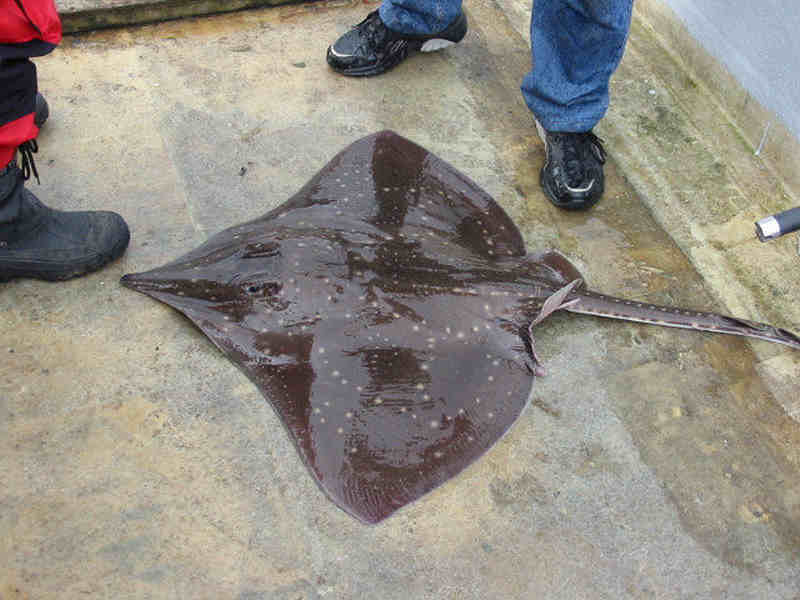
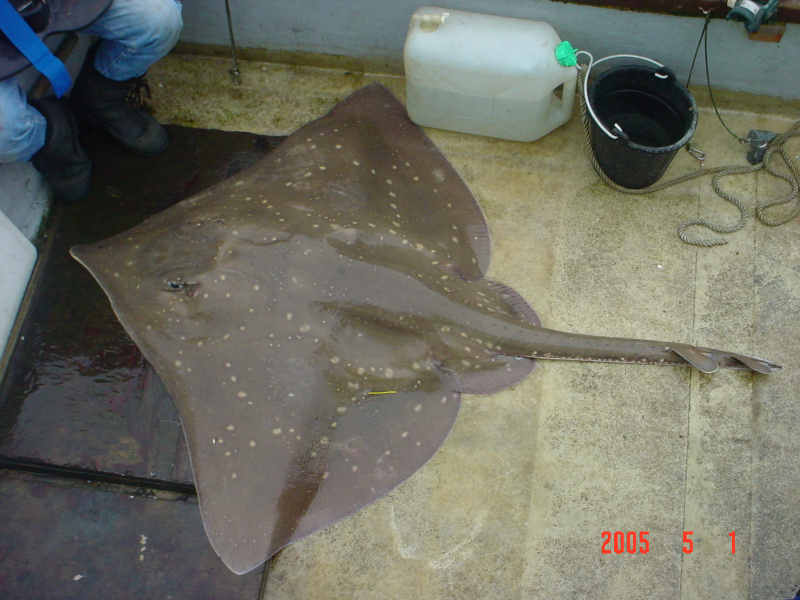
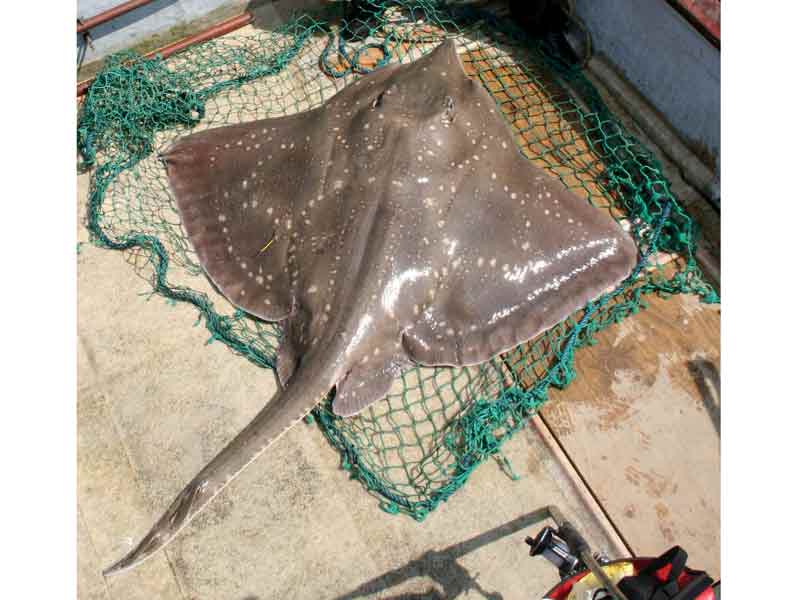
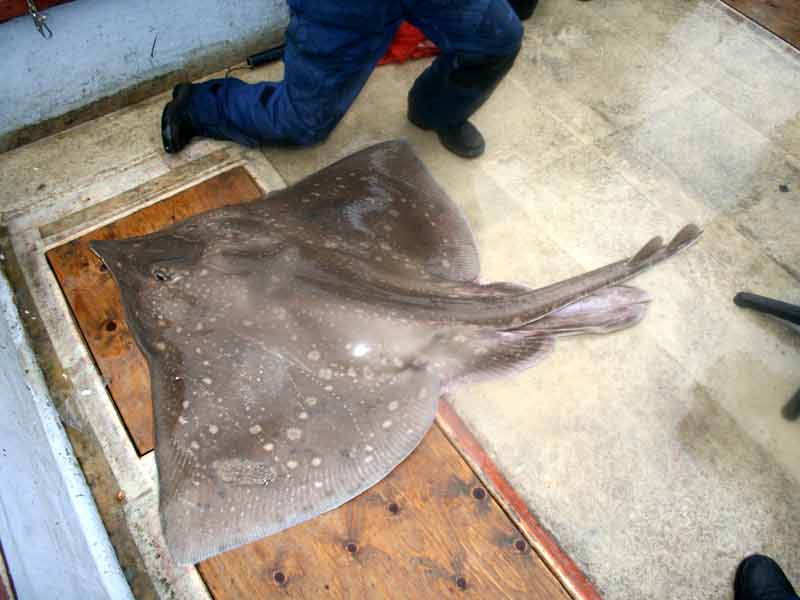
A large ray with a long pointed snout. Males growing up to 2 m in length, while females may reach up to 3 m in length. The leading edge of the wings is slightly concave and the small dorsal fins near the tip of the tail almost touch. The young have large thorns near the eyes and one row of thorns along the back of the tail, while older specimens lack the thorns near the eyes but have two rows of along the tail. The upper (dorsal) side is brownish-green with lighter spots and the underside dark grey, sometimes with black stripes, spots or marbling. Immature skate under 40lb in weight are jet black underneath which fades to grey as they get larger (Davy Holt, pers. comm.).
Recorded distribution in Britain and Ireland
Populations of Dipturus batis are found off the coasts of Isles of Scilly, western British Channel, west and north Ireland and west Scotland.Global distribution
Atlantic coasts from Madeira and northern Morocco northward to Iceland including the North Sea. Also in western parts of the Baltic and western and northern Mediterranean.Habitat
The skate lives on sandy and muddy bottoms. The adults live in depths of 10 to 600 m while younger specimens prefer shallower waters.Depth range
down to 600 mIdentifying features
- Up to 3 m in length.
- Long, pointed snout.
- Juveniles have large thorns near their eyes and one row of thorns along the back of tail.
- Adults lack the eye thorns but have two rows of thorns along the tail.
- Dorsal surface is brownish green with lighter spots, the underside is dark grey, sometimes with spots, stripes or marbling.
Additional information
Following a report in recent taxonomic literature, this species now belongs to the genus Dipturus, although may still be referred to as Raja in some texts, (see McEachran & Dunn, 1988).
Listed by
Biology review
Taxonomy
| Level | Scientific name | Common name |
|---|---|---|
| Phylum | Chordata | Sea squirts, fish, reptiles, birds and mammals |
| Class | Elasmobranchii | Sharks, rays and skates |
| Order | Rajiformes | |
| Family | Rajidae | |
| Genus | Dipturus | |
| Authority | (Linnaeus, 1758) | |
| Recent Synonyms | Raja batis (Linnaeus, 1758) | |
Biology
| Parameter | Data | ||
|---|---|---|---|
| Typical abundance | |||
| Male size range | 22 - 200 cm | ||
| Male size at maturity | 150 cm | ||
| Female size range | 180 cm | ||
| Female size at maturity | |||
| Growth form | Pisciform | ||
| Growth rate | 0.9 - 14kg/year | ||
| Body flexibility | Not relevant | ||
| Mobility | |||
| Characteristic feeding method | Predator | ||
| Diet/food source | |||
| Typically feeds on | Bristle worms, sand eels, crabs and flatfish | ||
| Sociability | |||
| Environmental position | Demersal | ||
| Dependency | No text entered. | ||
| Supports | Host the copepod Acanthochondrites annulatus which attaches to the gills of the skate. | ||
| Is the species harmful? | No | ||
Biology information
The growth rate listed above may seem quite rapid but if weight at maturity is taken into consideration, 54 kg for males (Muus & Dahlstrom, 1974) and 94 kg for females (Walker & Hislop 1998) it can be seen that it takes many years to reach maturity. The data for growth rate came from tag and release studies off the west coast of Scotland (Sutcliffe, 1994; Little, 1995, 1998) by comparing weight change of skate between captures. Skates seem to have a start-and-stop growth pattern, where they have rapid growth for a short period and then remain at that weight for some time with no growth until they have another episode of rapid growth (Sutcliffe, 1994).
Habitat preferences
| Parameter | Data |
|---|---|
| Physiographic preferences | Open coast, Offshore seabed |
| Biological zone preferences | Lower circalittoral, Lower infralittoral, Upper circalittoral, Upper infralittoral |
| Substratum / habitat preferences | Coarse clean sand, Fine clean sand, Mixed, Mud, Muddy gravel, Muddy sand, Sandy mud |
| Tidal strength preferences | Moderately strong 1 to 3 knots (0.5-1.5 m/sec.), Strong 3 to 6 knots (1.5-3 m/sec.), Very weak (negligible), Weak < 1 knot (<0.5 m/sec.) |
| Wave exposure preferences | Exposed, Moderately exposed, Sheltered, Very exposed, Very sheltered |
| Salinity preferences | Full (30-40 psu) |
| Depth range | down to 600 m |
| Other preferences | None known |
| Migration Pattern | Non-migratory or resident |
Habitat Information
Dipturus batis was found around all British and Irish coasts except the south east. However, it has disappeared from much of its former range due to fishing pressure (Brander, 1981, Walker & Hislop, 1998; Jennings et al., 1999; Rogers & Ellis, 2000). Remnant populations occur in areas unsuitable for commercial fishing (Shark Trust pers. comm.).Life history
Adult characteristics
| Parameter | Data |
|---|---|
| Reproductive type | Gonochoristic (dioecious) |
| Reproductive frequency | See additional information |
| Fecundity (number of eggs) | 11-100 |
| Generation time | 10-20 years |
| Age at maturity | 11 years |
| Season | Insufficient information |
| Life span | 21-100 years |
Larval characteristics
| Parameter | Data |
|---|---|
| Larval/propagule type | - |
| Larval/juvenile development | Oviparous |
| Duration of larval stage | Not relevant |
| Larval dispersal potential | No information |
| Larval settlement period | Not relevant |
Life history information
Females breed every other year (Little, 1997) and produce up to 40 eggs (Walker & Hislop, 1998) which are laid in the spring and summer (Whitehead et al., 1984). The egg case is large, 15-25 cm long and 8-15 cm wide (Dipper, 2001). It is rectangular and similar to 'mermaids purses' that are often found on the strandline. Eggcases are laid on the seabed and have been reported as being 'loose' on the seabed and perhaps very vaguely 'wedged' in between rocks (Paul Kay, pers. comm.). The young hatch after 2-5 months (depending on temperature) (Muus & Dahlstrom, 1974) at about 22 cm in length (Brander, 1981).
Dipturus batis is vulnerable to overfishing because of its slow growth, late maturity and low fecundity (Brander, 1981; Jennings et al, 1999). Only about 40 eggs are laid every other year and each generation takes 11 years to reach maturity, therefore populations cannot recover quickly from large mortalities. It has been estimated that a mortality of greater than 38% per year will lead to a continual decline in the population and recovery is unlikely to occur until mortality is relaxed (Walker & Hislop, 1998). The number of common skate caught in trawls began to decline in the 1920s and again in the 1950s after a recovery period during the Second World War and disappeared from the North Sea between the mid-1950s and early 1980s (Walker & Hislop, 1998). However, it has been shown that Dipturus batis can survive being trawled if it is released after capture (Little, 1995). Dipturus batis was recorded as 'not uncommon in trawls' in the Marine fauna of the Isle of Man (Bruce et al., 1963) and was regarded as a common species by Hureau & Monod (1979). However, the common skate had become all but extinct by the late 1970s (Brander, 1981). Similarly, between 1901 and 1907, the common skate made up 4% of all elasmobranchs caught in trawls in southwest England but between 1989 and 1997 none were caught (Rogers & Ellis, 2000). A tag and recapture program has been implemented in northeastern Scotland. Of 147 recaptured individuals, only 5 had travelled more than 20 km (Little, 1998), which suggests that Dipturus batis is vulnerable to local extinction by fishing with little chance of re-population from adjacent areas.
Sensitivity review
The MarLIN sensitivity assessment approach used below has been superseded by the MarESA (Marine Evidence-based Sensitivity Assessment) approach (see menu). The MarLIN approach was used for assessments from 1999-2010. The MarESA approach reflects the recent conservation imperatives and terminology and is used for sensitivity assessments from 2014 onwards.
Physical pressures
Use / to open/close text displayed
| Intolerance | Recoverability | Sensitivity | Evidence / Confidence | |
Substratum loss [Show more]Substratum lossBenchmark. All of the substratum occupied by the species or biotope under consideration is removed. A single event is assumed for sensitivity assessment. Once the activity or event has stopped (or between regular events) suitable substratum remains or is deposited. Species or community recovery assumes that the substratum within the habitat preferences of the original species or community is present. Further details EvidenceAs Dipturus batis is highly motile, it would move away from an area that lost a suitable substratum and return when the area was back to normal. A certain amount of stress maybe caused by loss of food items with the substratum and because of the need to find new foraging/spawning areas. Therefore an intolerance of low has been recorded. Recoverability is likely to be high, resulting in a sensitivity assessment of low. Substrate removal is likely to destroy egg cases, but the location of important breeding and nursery grounds is poorly understood. | Low | High | Low | Very low |
Smothering [Show more]SmotheringBenchmark. All of the population of a species or an area of a biotope is smothered by sediment to a depth of 5 cm above the substratum for one month. Impermeable materials, such as concrete, oil, or tar, are likely to have a greater effect. Further details. EvidenceDipturus batis would move away from an area that was being smothered but with some stress due to loss of food and energetic costs of migrating to new foraging areas. Therefore an intolerance of low has been recorded. Recoverability is likely to be high, resulting in a sensitivity assessment of low. Egg cases on the sea bed are likely to be more sensitive. | Low | High | Low | Very low |
Increase in suspended sediment [Show more]Increase in suspended sedimentBenchmark. An arbitrary short-term, acute change in background suspended sediment concentration e.g., a change of 100 mg/l for one month. The resultant light attenuation effects are addressed under turbidity, and the effects of rapid settling out of suspended sediment are addressed under smothering. Further details EvidenceIt is not known whether an increase in suspended sediment will have an effect on Dipturus batis. Not relevant has been recorded because the skate is mobile enough to avoid local adverse effects. | Not relevant | Not relevant | Not relevant | Not relevant |
Decrease in suspended sediment [Show more]Decrease in suspended sedimentBenchmark. An arbitrary short-term, acute change in background suspended sediment concentration e.g., a change of 100 mg/l for one month. The resultant light attenuation effects are addressed under turbidity, and the effects of rapid settling out of suspended sediment are addressed under smothering. Further details EvidenceIt is not known whether an decrease in suspended sediment will have an effect on Dipturus batis. Not relevant has been recorded because the skate is mobile enough to avoid local adverse effects. | Not relevant | Not relevant | Not relevant | Not relevant |
Desiccation [Show more]Desiccation
EvidenceDipturus batis is a sublittoral species unlikely to be subject to exposure to air. Therefore desiccation is not relevant. | Not relevant | Not relevant | Not relevant | Not relevant |
Increase in emergence regime [Show more]Increase in emergence regimeBenchmark. A one hour change in the time covered or not covered by the sea for a period of one year. Further details EvidenceDipturus batis is a sublittoral species unlikely to be subject to exposure to air. Therefore an increase in emergence is not relevant. | Not relevant | Not relevant | Not relevant | Not relevant |
Decrease in emergence regime [Show more]Decrease in emergence regimeBenchmark. A one hour change in the time covered or not covered by the sea for a period of one year. Further details EvidenceDipturus batis is a sublittoral species unlikely to be subject to exposure to air. Therefore a decrease in emergence is not relevant. | Not relevant | Not relevant | Not relevant | Not relevant |
Increase in water flow rate [Show more]Increase in water flow rateA change of two categories in water flow rate (view glossary) for 1 year, for example, from moderately strong (1-3 knots) to very weak (negligible). Further details EvidenceDipturus batis has been recorded from sites around the UK with varying hydrodynamic conditions (see adult distribution) and therefore is unlikely to be affected by changes in flow rate (JNCC, 1999). | Low | High | Low | Low |
Decrease in water flow rate [Show more]Decrease in water flow rateA change of two categories in water flow rate (view glossary) for 1 year, for example, from moderately strong (1-3 knots) to very weak (negligible). Further details EvidenceDipturus batis has been recorded from sites around the UK with varying hydrodynamic conditions (see adult distribution) and therefore is unlikely to be affected by changes in flow rate (JNCC, 1999). | Low | High | Low | Not relevant |
Increase in temperature [Show more]Increase in temperature
For intertidal species or communities, the range of temperatures includes the air temperature regime for that species or community. Further details EvidenceSudden changes in temperature are unlikely to affect adults because they can move away but developing young may be affected. A study on a related species, Raja eglanteria, found that the embryos of this species do not develop at temperatures over 24 °C (Whitehead et al., 1984). As such intolerance is assessed as intermediate. Chronic changes in temperature would also have little effect as the adults experience large temperature changes when moving between deep and shallow water. In addition, the world distribution of Dipturus batis is from the coasts of north-western Africa to the North coast of Norway so it is unlikely to experience temperatures outside of its tolerance range in British and Irish waters. Therefore recoverability of adults is likely to be high, however due to a lack of information on the effects on developing young, recoverability is assessed as moderate, resulting in a moderate sensitivity rating. | Intermediate | Moderate | Moderate | Very low |
Decrease in temperature [Show more]Decrease in temperature
For intertidal species or communities, the range of temperatures includes the air temperature regime for that species or community. Further details EvidenceSudden changes in temperature are unlikely to affect adults because they can move away but developing young may be affected. As such intolerance is assessed as intermediate. Chronic changes in temperature would have little effect as the adults experience large temperature changes when moving between deep and shallow water. In addition, the world distribution of Dipturus batis is from the coasts of north-western Africa to the North coast of Norway so it is unlikely to experience temperatures outside of its tolerance range in British and Irish waters. Therefore recoverability of adults is likely to be high, however due to a deficit of information on the effects on developing young, recoverability is assessed as moderate, resulting in a moderate sensitivity rating. | Intermediate | Moderate | Moderate | |
Increase in turbidity [Show more]Increase in turbidity
EvidenceAn increase in turbidity could potentially interfere with foraging by inhibiting visual location of prey. However, Dipturus batis is a bottom feeder that is probably adapted to murky, silty water and utilize smell and electromagnetic cues to locate prey. Therefore the species is considered tolerant, and not sensitive has been recorded. | Tolerant | Not relevant | Not sensitive | Very low |
Decrease in turbidity [Show more]Decrease in turbidity
EvidenceA decrease in turbidity may aid predators. However, since man is the main threat to Dipturus batis, a decrease in turbidity is unlikely to increase the predation rate on this species. A decrease in turbidity may however, influence foraging success, either because prey gain an earlier warning of the skates' approach or because the skates' visual acquisition of prey is improved. Therefore the species is considered tolerant, and not sensitive has been recorded. | Tolerant | Not relevant | Not sensitive | |
Increase in wave exposure [Show more]Increase in wave exposureA change of two ranks on the wave exposure scale (view glossary) e.g., from Exposed to Extremely exposed for a period of one year. Further details EvidenceDipturus batis has been recorded at sites all over the UK which vary from very sheltered to very exposed (see adult distribution) and anyway can swim to deeper areas if wave action increases to the extent that oscillatory movements on the seabed become excessive. As a result Dipturus batis is unlikely to be affected by an increase or decrease in wave exposure, so is considered tolerant, and not sensitive has been recorded. | Tolerant | Not relevant | Not sensitive | Low |
Decrease in wave exposure [Show more]Decrease in wave exposureA change of two ranks on the wave exposure scale (view glossary) e.g., from Exposed to Extremely exposed for a period of one year. Further details EvidenceDipturus batis has been recorded at sites all over the UK which vary from very sheltered to very exposed (see adult distribution). Therefore the species is unlikely to be affected by an increase or decrease in wave exposure, so is considered tolerant, and not sensitive has been recorded. | Tolerant | Not relevant | Not sensitive | Low |
Noise [Show more]Noise
EvidenceFish with swimbladders have been reported to be the most sensitive to noise (Vella et al., 2001). Dipturus batis is an elasmobranch and therefore does not have a swimbladder so is among the fish that are less sensitive to noise. However, sudden loud noises of low frequency have been shown to elicit an avoidance response in most fish (Vella et al. 2001). Noise rarely has a physiological affect on fish so Dipturus batis has been deemed tolerant, and therefore not sensitive to noise. | Tolerant | Not relevant | Not sensitive | Not relevant |
Visual presence [Show more]Visual presenceBenchmark. The continuous presence for one month of moving objects not naturally found in the marine environment (e.g., boats, machinery, and humans) within the visual envelope of the species or community under consideration. Further details EvidenceAdult Dipturus batis can be found at depths from the shallow sublittoral down to 600 m so are unlikely to be disturbed by boats or divers, although divers might disturb young skate in shallow water. Recoverability is likely to be immediate, however, since the skate can swim away from the disturbance and return when it has gone. Therefore an intolerance of low has been recorded, and the species is deemed not sensitive. | Low | Immediate | Not sensitive | Very low |
Abrasion & physical disturbance [Show more]Abrasion & physical disturbanceBenchmark. Force equivalent to a standard scallop dredge landing on or being dragged across the organism. A single event is assumed for assessment. This factor includes mechanical interference, crushing, physical blows against, or rubbing and erosion of the organism or habitat of interest. Where trampling is relevant, the evidence and trampling intensity will be reported in the rationale. Further details. EvidenceDipturus batis has a high resilience when trawled or caught by rod and line and then released again (Little, 1995). Therefore adults are probably tolerant of abrasion and physical disturbance at the benchmark level. Because of the shape of rays, they cannot escape trawl nets once they have been captured. A newborn skate is about 22 cm long and almost as wide, therefore is unable to pass through the mesh of fishing nets. Because of their small size there is a greater chance a juvenile skate will be damaged in a net than an adult skate. This could lead to high mortality/stress in the juveniles and affect the processes maintaining the population. Therefore an intolerance of intermediate has been recorded. Recoverability is probably moderate (see information below) hence sensitivity is assessed as moderate. | Intermediate | Moderate | Moderate | Very low |
Displacement [Show more]DisplacementBenchmark. Removal of the organism from the substratum and displacement from its original position onto a suitable substratum. A single event is assumed for assessment. Further details EvidenceDipturus batis has a high resilience when trawled or caught by rod and line and then released again (Little, 1995). In addition, this species is found on a variety of substrata all around the UK and therefore is probably quite tolerant of displacement. Recoverability is likely to be high, resulting in a low sensitivity recording. | Low | High | Low | Very low |
Chemical pressures
Use [show more] / [show less] to open/close text displayed
| Intolerance | Recoverability | Sensitivity | Evidence / Confidence | |
Synthetic compound contamination [Show more]Synthetic compound contaminationSensitivity is assessed against the available evidence for the effects of contaminants on the species (or closely related species at low confidence) or community of interest. For example:
The evidence used is stated in the rationale. Where the assessment can be based on a known activity then this is stated. The tolerance to contaminants of species of interest will be included in the rationale when available; together with relevant supporting material. Further details. EvidenceNo information found. | No information | Not relevant | No information | Not relevant |
Heavy metal contamination [Show more]Heavy metal contaminationEvidenceGeneral information on the tolerance of fish to metal contamination reveals that part per billion concentrations are not lethal but may reduce gill activity, growth and hatching success of eggs. Copper was reported to be the most toxic of metals and suppressed egg hatching at concentrations of 10 parts per billion in certain teleost fish (Bryan, 1984). The leathery egg case of rays may make them less susceptible to metal contamination. However, in the absence of evidence on the effects in Dipturus batis no assessment can be made. | No information | Not relevant | No information | Very low |
Hydrocarbon contamination [Show more]Hydrocarbon contaminationEvidenceNo information found. | No information | Not relevant | No information | Not relevant |
Radionuclide contamination [Show more]Radionuclide contaminationEvidenceNo information found. | No information | Not relevant | No information | Not relevant |
Changes in nutrient levels [Show more]Changes in nutrient levelsEvidenceNo information was found on the effect of nutrient enrichment or algal blooms was found. | No information | Not relevant | No information | Not relevant |
Increase in salinity [Show more]Increase in salinity
EvidenceAs with many of the other factors, the high motility of this species allows it to escape adverse changes in salinity. Therefore intolerance is recorded as low and recoverability is likely to be high, resulting in a sensitivity assessment of low. | Low | High | Low | Very low |
Decrease in salinity [Show more]Decrease in salinity
EvidenceAs with many of the other factors, the high motility of this species allows it to escape adverse changes in salinity. Therefore intolerance is recorded as low and recoverability is likely to be high, resulting in a sensitivity assessment of low. | Low | High | Low | |
Changes in oxygenation [Show more]Changes in oxygenationBenchmark. Exposure to a dissolved oxygen concentration of 2 mg/l for one week. Further details. EvidenceNo information was found on the effects of hypoxia on Dipturus batis. | No information | Not relevant | No information | Not relevant |
Biological pressures
Use [show more] / [show less] to open/close text displayed
| Intolerance | Recoverability | Sensitivity | Evidence / Confidence | |
Introduction of microbial pathogens/parasites [Show more]Introduction of microbial pathogens/parasitesBenchmark. Sensitivity can only be assessed relative to a known, named disease, likely to cause partial loss of a species population or community. Further details. EvidenceNo information found. | No information | Not relevant | No information | Not relevant |
Introduction of non-native species [Show more]Introduction of non-native speciesSensitivity assessed against the likely effect of the introduction of alien or non-native species in Britain or Ireland. Further details. EvidenceNo non-native species are known to compete with the common skate. | No information | Not relevant | No information | Not relevant |
Extraction of this species [Show more]Extraction of this speciesBenchmark. Extraction removes 50% of the species or community from the area under consideration. Sensitivity will be assessed as 'intermediate'. The habitat remains intact or recovers rapidly. Any effects of the extraction process on the habitat itself are addressed under other factors, e.g. displacement, abrasion and physical disturbance, and substratum loss. Further details. EvidenceThe slow growth rate, late maturity and low fecundity make Dipturus batis vulnerable to overfishing and it has disappeared from much of its former range due to fishing pressure (Brander; 1981; Walker & Hislop, 1998; Jennings et al. 1999; Rogers & Ellis, 2000). Only about 40 eggs are laid every other year and each generation takes 11 years to reach maturity, therefore populations cannot recover quickly from large mortalities. It has been estimated that a mortality of greater than 38% per year will lead to continual decline in the population and recovery is unlikely to occur until mortality is relaxed (Walker & Hislop, 1998). Numbers of common skate caught in trawls began to decline in the 1920s and again in the 1950s after a recovery period during the second world war and disappeared from the North Sea between the mid 1950s and early 1980s (Walker & Hislop, 1998). Dipturus batis was recorded as 'not uncommon in trawls' in the Marine fauna of the Isle of Man (Bruce et al., 1963) and was regarded as a common species by Hureau & Monod (1979). However the common skate had become all but extinct by the late 1970s due to overfishing (Brander, 1981). Similarly, between 1901 and 1907, the common skate made up 4% of all elasmobranchs caught in trawls in southwest England but between 1989 and 1997 none were caught (Rogers & Ellis, 2000). Therefore an intolerance of high and a recoverability of low has been recorded. The species is highly sensitive to this factor. | High | Low | High | High |
Extraction of other species [Show more]Extraction of other speciesBenchmark. A species that is a required host or prey for the species under consideration (and assuming that no alternative host exists) or a keystone species in a biotope is removed. Any effects of the extraction process on the habitat itself are addressed under other factors, e.g. displacement, abrasion and physical disturbance, and substratum loss. Further details. EvidenceDipturus batis feeds on flatfish and some of the larger individuals take cod, haddock and herring (Dipper, 2001), and fishing pressure on these species may affect the skates food supply. Therefore an intolerance of low has been recorded. Recovery is dependant on the recovery of prey stocks, for which insufficient information has been found to make an assessment. Hence a moderate sensitivity has been recorded. | Low | No information | No information | Low |
Additional information
Recoverability. In general, the recoverability of Dipturus batis after a mortality event from any source is very slow. Skates live for at least twenty years, reach maturity at 11 years and the females produce a clutch of about 40 eggs every other year (see reproduction). This means that a female produces a minimum of about 160 eggs in its lifetime, a very low fecundity. Even if every juvenile born after a mortality event survived, it is evident that it would take many years for a population to recover to its original numbers.
Importance review
Policy/legislation
| Designation | Support |
|---|---|
| UK Biodiversity Action Plan Priority | Yes |
| Species of principal importance (England) | Yes |
| Species of principal importance (Wales) | Yes |
| Scottish Biodiversity List | Yes |
| OSPAR Annex V | Yes |
| IUCN Red List | Critically Endangered (CR) |
| Priority Marine Features (Scotland) | Yes |
Status
| National (GB) importance | Not rare or scarce | Global red list (IUCN) category | Critically Endangered (CR) |
Non-native
| Parameter | Data |
|---|---|
| Native | - |
| Origin | - |
| Date Arrived | - |
Importance information
When it was common, skate used to taken as bycatch in trawls and the 'wings' were sold for human consumption.Dipturus batis is listed under the UK Biodiversity Action Plan (Anon, 1999vii) and on the OSPAR Annex V list of threatened and declining species and habitats. Although listed as 'endangered' in the IUCN Red list, it is considered to be 'critically endangered' in coastal waters (IUCN, 2003). In addition, Dipturus batis has been proposed for protection under Schedule 5 of the Wildlife & Countryside Act 1981.
Bibliography
Anonymous, 1999vii. Common skate (Raja batis). Species Action Plan. http://www.ukbap.org.uk/asp/UKPlans.asp?UKListID=543, 2004-01-20
Brander, K., 1981. Disappearance of common skate Raja batis from Irish Sea. Nature, 290, 48-49.
Bruce, J.R., Colman, J.S. & Jones, N.S., 1963. Marine fauna of the Isle of Man. Liverpool: Liverpool University Press.
Bryan, G.W., 1984. Pollution due to heavy metals and their compounds. In Marine Ecology: A Comprehensive, Integrated Treatise on Life in the Oceans and Coastal Waters, vol. 5. Ocean Management, part 3, (ed. O. Kinne), pp.1289-1431. New York: John Wiley & Sons.
Dipper, F., 2001. British sea fishes (2nd edn). Teddington: Underwater World Publications Ltd.
Dolgov, A.V., Drevetnyak, K.V. & Gusev, E.V., 2005. The Status of Skate Stocks in the Barents Sea Journal of Northwest Atlantic Fisheries Science, 35, 249-260
Hayward, P.J. & Ryland, J.S. (ed.) 1995b. Handbook of the marine fauna of North-West Europe. Oxford: Oxford University Press.
Howson, C.M. & Picton, B.E., 1997. The species directory of the marine fauna and flora of the British Isles and surrounding seas. Belfast: Ulster Museum. [Ulster Museum publication, no. 276.]
Hureau, J.C. & Monod, T., (ed.) 1973. Check-list of the fishes of the north-eastern Atlantic and of the Mediterranean. Paris: Unesco
IUCN, 2006. 2006 IUCN Red List of Threatened Species. [On-line] http://www.redlist.org, 2003-01-01
Jennings, S., Greenstreet, S.P.R. & Reynolds, J.D., 1999. Structural change in an exploited fish community: a consequence of different fishing effects on species with contrasting life histories. Journal of Animal Ecology, 68, 617-627.
JNCC (Joint Nature Conservation Committee), 1999. Marine Environment Resource Mapping And Information Database (MERMAID): Marine Nature Conservation Review Survey Database. [on-line] http://www.jncc.gov.uk/mermaid
Little, W., 1995. Common skate and tope: first results of Glasgow museum's tagging study. Glasgow Naturalist, 22, 455-466.
Little, W., 1997. Common skate in the Sound of Mull. Glaucus, 8, 42-43.
Little, W., 1998. Tope and skate tagging off west Scotland. Glaucus, 9, 36-38.
McEachran, J.D. & Dunn, K.A., 1988. Phylogenetic analysis of skates, a morphologically conservative clade of elasmobranchs (Chondrichthyes: Rajidae). Copeia, 2, 271-290.
Mitchell, S. & Gallagher, M., 2000. The parasitic copepod Acanthochondrites annulatus (Olsson, 1869) from the blue skate Raja batis. Irish Naturalists' Journal, 26, 323-323.
Muus, B.J. & Dahlstrom, P., 1974. Collins guide to the sea fishes of Britain and North-Western Europe. Wm Collins Sons & Co. Ltd: London.
Rogers, S.I. & Ellis, J.R., 2000. Changes in demersal fish assemblages of British coastal waters during the 20th century. ICES Journal of Marine Science, 57, 866-881.
Sutcliffe, R., 1994. Twenty years of tagging common skate and tope off the west coast of Scotland. In Tag and release schemes and shark and ray management plans. Proceedings of the second European Shark and Ray Workshop, Natural History Museum, London, 15-16 February 1994 (ed. R.C. Earll & S.L. Fowler), pp. 14-16., Peterborough, Joint Nature Conservation Committee
Vella, G., Rushforth, I., Mason, E., Hough, A., England, R., Styles, P, Holt, T & Thorne, P., 2001. Assessment of the effects of noise and vibration from offshore windfarms on marine wildlife. Department of Trade and Industry (DTI) contract report, ETSU W/13/00566/REP. Liverpool: University of Liverpool., Department of Trade and Industry (DTI) contract report, ETSU W/13/00566/REP. Liverpool: University of Liverpool.
Walker, P.A. & Hislop, J.R.G., 1998. Sensitive skates or resilient rays? Spatial and temporal shifts in ray species composition in the central north-western North Sea between 1930 and the present day. ICES Journal of Marine Science, 55, 392-402.
Whitehead, P.J.P., Bauchot, M.-L., Hureau, J.-C., Nielson, J. & Tortonese, E. 1986. Fishes of the North-eastern Atlantic and the Mediterranean. Vol. I, II & III. Paris: United Nations Educational, Scientific and Cultural Organisation (UNESCO).
Datasets
Centre for Environmental Data and Recording, 2018. Ulster Museum Marine Surveys of Northern Ireland Coastal Waters. Occurrence dataset https://www.nmni.com/CEDaR/CEDaR-Centre-for-Environmental-Data-and-Recording.aspx accessed via NBNAtlas.org on 2018-09-25.
Isle of Wight Local Records Centre, 2017. IOW Natural History & Archaeological Society Marine Records. Occurrence dataset: https://doi.org/10.15468/7axhcw accessed via GBIF.org on 2018-09-27.
Kent & Medway Biological Records Centre, 2017. Fish: Records for Kent. Occurrence dataset https://doi.org/10.15468/kd1utk accessed via GBIF.org on 2018-09-27.
Manx Biological Recording Partnership, 2022. Isle of Man historical wildlife records 1990 to 1994. Occurrence dataset:https://doi.org/10.15468/aru16v accessed via GBIF.org on 2024-09-27.
Merseyside BioBank., 2018. Merseyside BioBank (unverified). Occurrence dataset: https://doi.org/10.15468/iou2ld accessed via GBIF.org on 2018-10-01.
NBN (National Biodiversity Network) Atlas. Available from: https://www.nbnatlas.org.
OBIS (Ocean Biodiversity Information System), 2025. Global map of species distribution using gridded data. Available from: Ocean Biogeographic Information System. www.iobis.org. Accessed: 2025-07-12
Outer Hebrides Biological Recording, 2018. Vertebrates (except birds, INNS and restricted records), Outer Hebrides. Occurrence dataset: https://doi.org/10.15468/dax3tf accessed via GBIF.org on 2018-10-01.
Scottish Shark Tagging Programme, 2018. Capture Mark Recapture Data for Scottish Elasmobranchs: 2009-2018. Occurrence dataset: https://doi.org/10.15468/znol4z accessed via GBIF.org on 2018-10-02.
Citation
This review can be cited as:
Last Updated: 13/12/2006
- fish
- skate
- ray