
Sunset cup coral (Leptopsammia pruvoti)
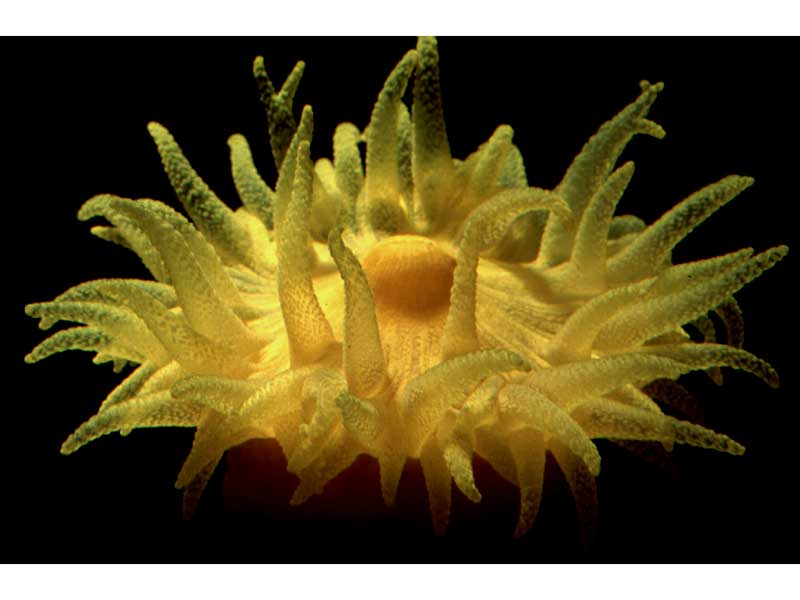
Leptopsammia pruvoti.
Photographer: Sue Scott Copyright: Sue Scott
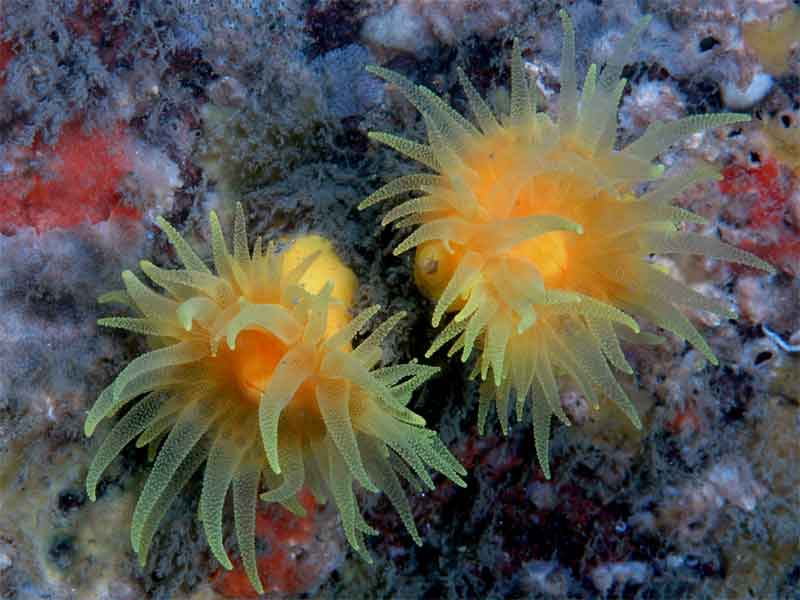
Leptopsammia pruvoti
Photographer: Dr Keith Hiscock Copyright: Dr Keith Hiscock
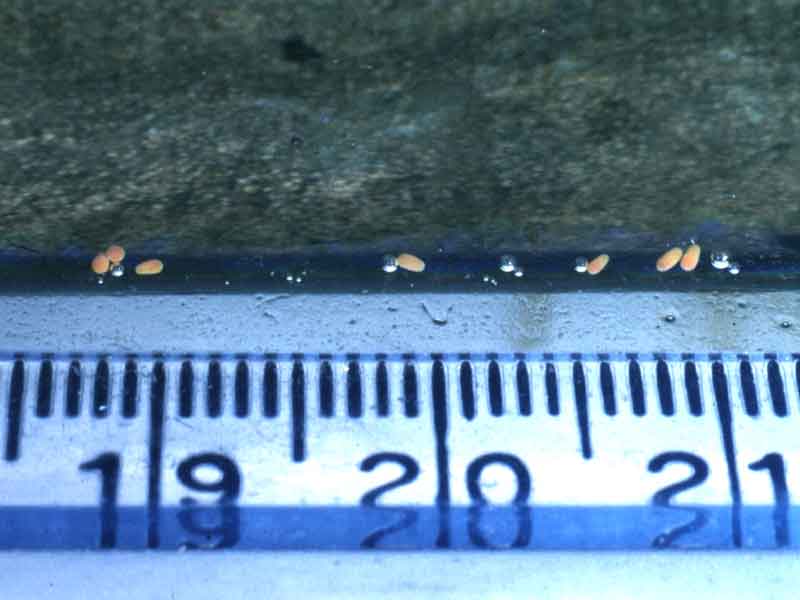
Leptopsammia pruvoti eggs / larvae at water surface in aquarium.
Photographer: Dr Keith Hiscock Copyright: Dr Keith Hiscock
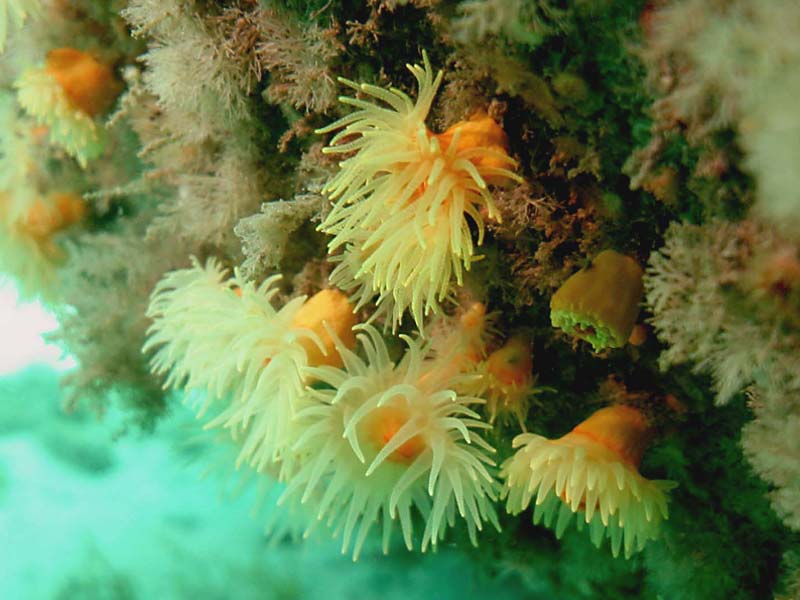
Leptopsammia pruvoti in the Channel Isles.
Photographer: Sue Daly Copyright: Sue Daly
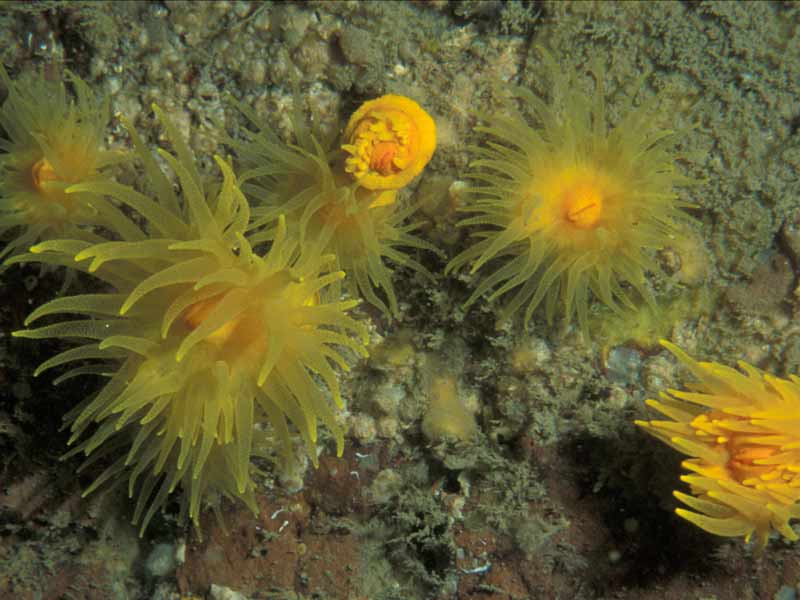
Group of sunset cup corals Leptopsammia pruvoti on vertical rock at depth 30 m, Plymouth Sound old cliff-line.
Photographer: Dr Keith Hiscock Copyright: Dr Keith Hiscock
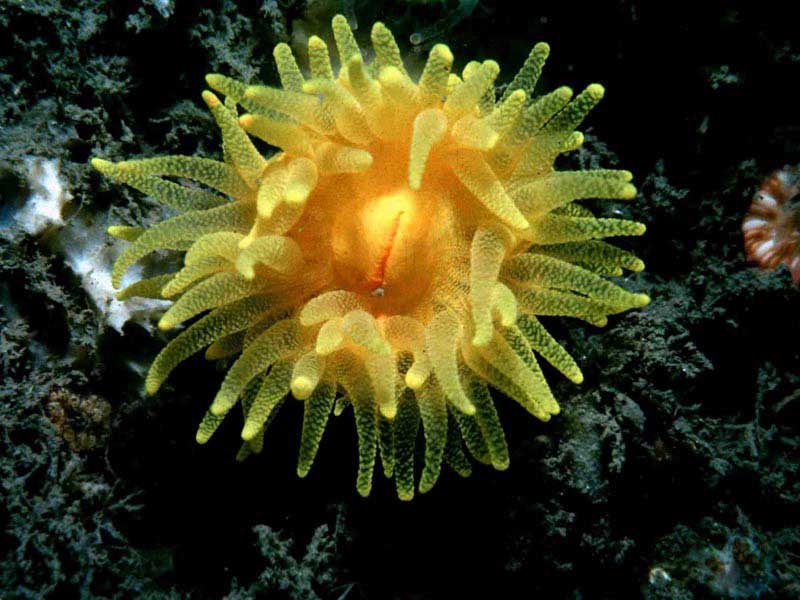
Oral view of Leptopsammia pruvoti.
Photographer: Dr Keith Hiscock Copyright: Dr Keith Hiscock
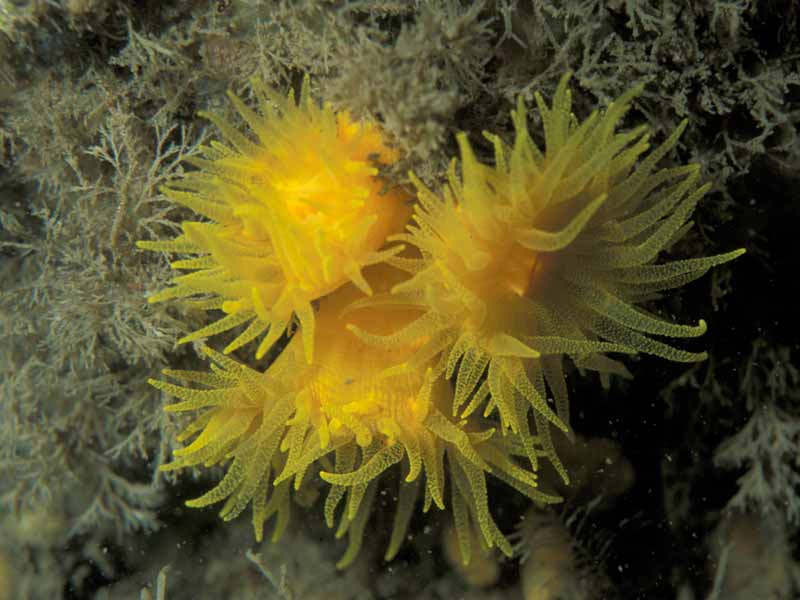
Sunset cup coral Leptopsammia pruvoti group on vertical rock below overhang at the Knoll Pins, Lundy.
Photographer: Dr Keith Hiscock Copyright: Dr Keith Hiscock
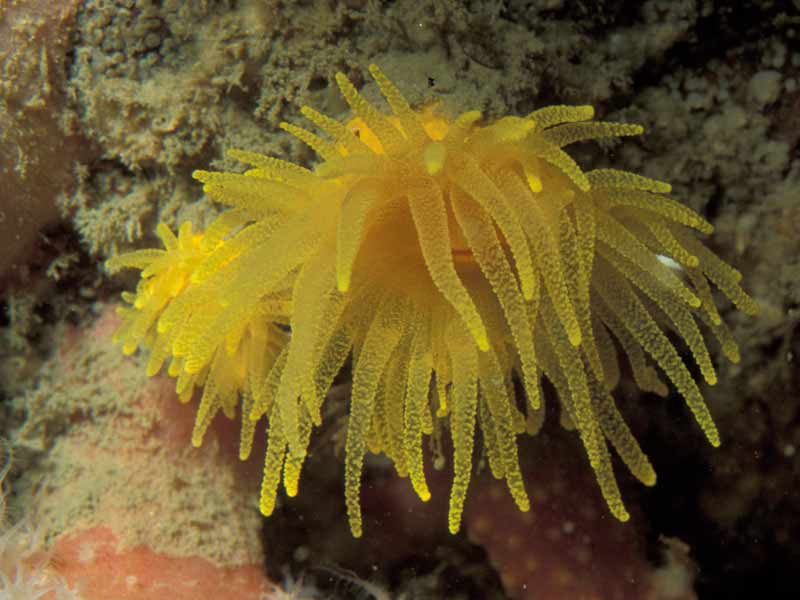
Sunset cup coral Leptopsammia pruvoti on vertical rock on submerged cliff-line offshore of Plymouth Sound.
Photographer: Dr Keith Hiscock Copyright: Dr Keith Hiscock
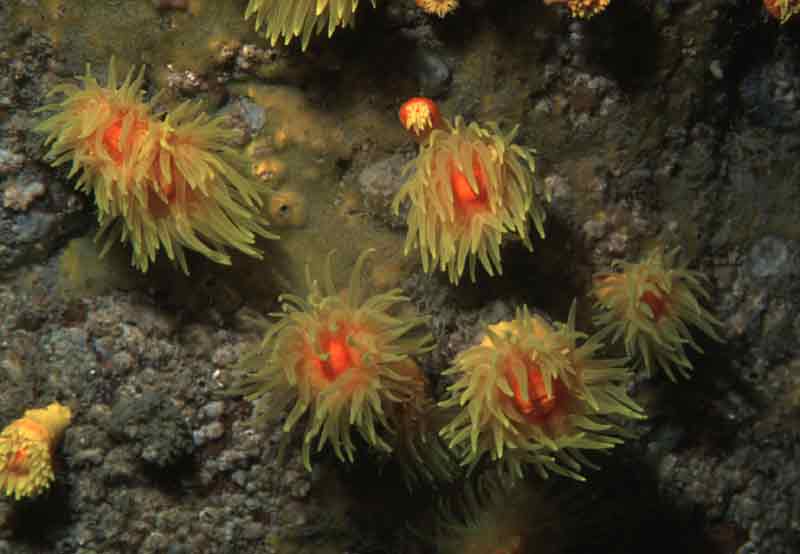
Typical group of the solitary coral Leptopsammia pruvoti.
Photographer: Dr Keith Hiscock Copyright: Dr Keith Hiscock
Distribution data supplied by the Ocean Biodiversity Information System (OBIS). To interrogate UK data visit the NBN Atlas.Map Help
| Researched by | Angus Jackson | Refereed by | Paul Tranter |
| Authority | Lacaze-Duthiers, 1897 | ||
| Other common names | - | Synonyms | Leptopsammia microcardia Lacaze-Duthiers, 1897 |
Summary
Description
The sunset cup coral is a bright yellow or orange stony coral. It has a tentacular polyp that emerges from a porous, calcareous skeleton. The skeleton may be short and cylindrical or tall and inversely conical. It is typically solitary but is rarely found in small groups forming 'pseudocolonies'. The tentacles are quite long and number around 96. When fully retracted the tentacles are barely visible inside the skeleton.
Recorded distribution in Britain and Ireland
Portland Bill, Lyme Bay, off Plymouth Sound, the Isles of Scilly and Lundy only. Believed to no longer occur in North Devon near Ilfracombe where it was present in 1969 (K. Hiscock, pers. comm.)Global distribution
Found throughout the Mediterranean west of Cyprus and in the Adriatic. Also on the Atlantic coasts of SW England, the Channel Isles, Brittany and Portugal. It has not been recorded despite targeted survey in Madeira, the Azores, or the Canary Isles.Habitat
Leptopsammia pruvoti prefers shaded bedrock or stable boulders and is typically found in caves and gullies or under overhangs. Found at open coast locations mainly facing away from prevailing winds. It is commonest between 10 and 30 m with a maximum depth of 40 m recorded in the western Mediterranean.Depth range
10-40Identifying features
- Almost always solitary but sometimes found as small groups of corallia arising from one base (pseudocolonies).
- The disk and tentacles are usually yellow, sometimes with an orange disk.
- The polyp sits in a porous calcified skeleton.
- Possesses about 96 tentacles.
- Attached to bedrock or stable boulders in crevices, caves or overhangs.
- The corallum may be from short and cylindrical to tall and inversely conical, height to 60 mm, diameter of the calyx to 17 mm.
Additional information
The synonym Leptopsammia microcardia was last used by Abel (1959) and Rutzler, 1966 despite the general recognition of their synonymy since 1954.
Listed by
Biology review
Taxonomy
| Level | Scientific name | Common name |
|---|---|---|
| Phylum | Cnidaria | Sea anemones, corals, sea firs & jellyfish |
| Class | Anthozoa | Sea anemones, soft & cup corals, sea pens & sea pansies |
| Order | Scleractinia | |
| Family | Dendrophylliidae | |
| Genus | Leptopsammia | |
| Authority | Lacaze-Duthiers, 1897 | |
| Recent Synonyms | Leptopsammia microcardia Lacaze-Duthiers, 1897 | |
Biology
| Parameter | Data | ||
|---|---|---|---|
| Typical abundance | Low density | ||
| Male size range | up to 6 cm | ||
| Male size at maturity | |||
| Female size range | Small-medium(3-10cm) | ||
| Female size at maturity | |||
| Growth form | Cylindrical | ||
| Growth rate | 1.3mm/year | ||
| Body flexibility | |||
| Mobility | Sessile, permanent attachment | ||
| Characteristic feeding method | No information | ||
| Diet/food source | |||
| Typically feeds on | |||
| Sociability | |||
| Environmental position | Epifaunal | ||
| Dependency | Independent. | ||
| Supports | Substratum the barnacle Boscia anglica, the horseshoe worm Phoronis hippocrepia, the fan worm Potamilla reniformis and the bivalve Hiatella arctica. | ||
| Is the species harmful? | No | ||
Biology information
Younger individuals have a round calice which becomes elliptical with age. The skeleton is porous. It is not known whether the species is hermaphroditic or gonochoristic. The size range applies to maximum height of the corallum. The longest diameter of the calyx is 17 mm. The growth rate has been observed to be very slow in aquarium specimens which are little fed and in the same seawater for several months (2 mm across calice after 18 months) but can be fast if fed and in continuous seawater supply (to 10 mm across calice after one year. (Paul Tranter, pers. comm.). Typically found as solitary individuals but may occur as several corallia from the same base forming 'pseudocolonies': during culture experiments, if any of the tissue overlying the skeletal column was lost, there would eventually appear, over a matter of weeks, one or more small polyps which would eventually form part of the 'parent' skeleton and give the impression of a naturally formed colony (Paul Tranter, pers. comm.). Leptopsammia pruvoti is known to have the ability to control and possibly 'farm' the bacterial content of its coelenteric cavity (Herndl & Velimirov, 1985). These bacteria could be used as an additional food source. The horseshoe worm Phoronis hippocrepia and the fan worm Potamilla reniformis bore into the base of the skeleton of Leptopsammia pruvoti and the bivalve Hiatella arctica further enlarges these boreholes. Once bored, the skeleton is weakened and corals may be easily detached.
Habitat preferences
| Parameter | Data |
|---|---|
| Physiographic preferences | Open coast |
| Biological zone preferences | Lower circalittoral, Lower infralittoral, Upper circalittoral |
| Substratum / habitat preferences | Bedrock, Large to very large boulders, Small boulders |
| Tidal strength preferences | Moderately strong 1 to 3 knots (0.5-1.5 m/sec.), Very weak (negligible), Weak < 1 knot (<0.5 m/sec.) |
| Wave exposure preferences | Exposed, Moderately exposed, Sheltered |
| Salinity preferences | Full (30-40 psu) |
| Depth range | 10-40 |
| Other preferences | No text entered |
| Migration Pattern | Non-migratory or resident |
Habitat Information
This species is at the northern limit of its range possibly forming a relict from a larger previous distribution. It is now restricted to 'ideal' locations.Life history
Adult characteristics
| Parameter | Data |
|---|---|
| Reproductive type | Gonochoristic (dioecious) |
| Reproductive frequency | No information |
| Fecundity (number of eggs) | 11-100 |
| Generation time | Insufficient information |
| Age at maturity | Insufficient information |
| Season | July - September |
| Life span | Insufficient information |
Larval characteristics
| Parameter | Data |
|---|---|
| Larval/propagule type | - |
| Larval/juvenile development | Lecithotrophic |
| Duration of larval stage | 1 day |
| Larval dispersal potential | <10 m |
| Larval settlement period | Insufficient information |
Life history information
Lifespan has not been established for this species but it is probably quite long lived. Individuals tend to die through weakening of the skeleton by boring organisms and subsequent detachment by agents such as foraging fish or careless divers. However, skeletons (dead individuals) have been found still attached to rocks (K. Hiscock, pers. comm.) Populations tend to become extinct through lack of recruitment. Lacaze-Duthiers, (1897) suggests that the sexes are separate. Eggs are laid in succession , at indefinite, fairly well-spaced intervals over a period of time that must be substantial (Lacaze-Duthiers, 1897). Larvae have been successfully produced in aquaria. The eggs are released from the female stomach cavity and those that are unfertilised may float to the surface. Fertilised eggs (young larvae) swim actively in the water column (K. Hiscock pers. comm..) but settle rapidly to the substratum close to the adult, where after a period of freedom they attach themselves in the shape of an ovoid or a ciliated worm (Lacaze-Duthiers, 1897). The larval settling time is generally short but observations from aquaria suggest that the larval stage may exist for up to six weeks before settling. Recruitment is very sporadic. Over 12 years of monitoring on Lundy has shown little or no recruitment and the population there declined by 22 percent between 1993 and 1997. Recruitment may fail for several reasons. Environmental conditions (primarily temperature) are unsuitable for gamete production to occur or to occur synchronously. Alternatively larvae may be swept away into unsuitable habitat by water currents or be consumed by predators before metamorphosing. Recruitment in the Mediterranean is also sporadic. Some recruitment may occur through influx of southern water bodies bringing with it larvae.Sensitivity review
The MarLIN sensitivity assessment approach used below has been superseded by the MarESA (Marine Evidence-based Sensitivity Assessment) approach (see menu). The MarLIN approach was used for assessments from 1999-2010. The MarESA approach reflects the recent conservation imperatives and terminology and is used for sensitivity assessments from 2014 onwards.
Physical pressures
Use / to open/close text displayed
| Intolerance | Recoverability | Sensitivity | Evidence / Confidence | |
Substratum loss [Show more]Substratum lossBenchmark. All of the substratum occupied by the species or biotope under consideration is removed. A single event is assumed for sensitivity assessment. Once the activity or event has stopped (or between regular events) suitable substratum remains or is deposited. Species or community recovery assumes that the substratum within the habitat preferences of the original species or community is present. Further details EvidenceThis species is permanently attached to the substratum so substratum loss would cause death. Gamete production, synchronous gamete production or successful recruitment are very unpredictable and sporadic primarily due to unfavourable environmental conditions. Local recruitment has not been recorded at Lundy during more than 12 years of monitoring but occurred to a small extent in 1998. Local recruitment is most likely but may also be from distant water bodies perhaps every 25-30 years. There has been no observation of colonization of wrecks or new natural surfaces near to existing colonies such as the breakwater at Plymouth Sound constructed in the early 1800's. Recovery will take a very long time or may not occur at all. | High | Very low / none | Very High | High |
Smothering [Show more]SmotheringBenchmark. All of the population of a species or an area of a biotope is smothered by sediment to a depth of 5 cm above the substratum for one month. Impermeable materials, such as concrete, oil, or tar, are likely to have a greater effect. Further details. EvidenceThis species is permanently attached to the substratum and would be unable to avoid or 'dig-out' from smothering. Gamete production, synchronous gamete production or successful recruitment are very unpredictable and sporadic primarily due to unfavourable environmental conditions. Local recruitment has not been recorded at Lundy during more than 12 years of monitoring but occurred to a small extent in 1998. Local recruitment is most likely but may also be from distant water bodies perhaps every 25-30 years. There has been no observation of colonization of wrecks or new natural surfaces near to existing colonies such as the breakwater at Plymouth Sound constructed in the early 1800's. Recovery will take a very long time or may not occur at all. | High | Very low / none | Very High | Moderate |
Increase in suspended sediment [Show more]Increase in suspended sedimentBenchmark. An arbitrary short-term, acute change in background suspended sediment concentration e.g., a change of 100 mg/l for one month. The resultant light attenuation effects are addressed under turbidity, and the effects of rapid settling out of suspended sediment are addressed under smothering. Further details EvidenceThis species is permanently attached to the substratum and would be unable to avoid changes in siltation. However, the species tends to inhabit caves or overhangs which are less likely to be exposed to suspended material settling out. The polyp will most likely 'inflate' with water to expand above the silt if briefly covered. Increased siltation may clog feeding apparatus and there would be an energetic cost to clearing this sediment. Gamete production, synchronous gamete production or successful recruitment are very unpredictable and sporadic primarily due to unfavourable environmental conditions. Local recruitment has not been recorded at Lundy during more than 12 years of monitoring but occurred to a small extent in 1998. Local recruitment is most likely but may also be from distant water bodies perhaps every 25-30 years. There has been no observation of colonization of wrecks or new natural surfaces near to existing colonies such as the breakwater at Plymouth Sound constructed in the early 1800's. Recovery will take a very long time or may not occur at all. | Intermediate | Very low / none | High | Moderate |
Decrease in suspended sediment [Show more]Decrease in suspended sedimentBenchmark. An arbitrary short-term, acute change in background suspended sediment concentration e.g., a change of 100 mg/l for one month. The resultant light attenuation effects are addressed under turbidity, and the effects of rapid settling out of suspended sediment are addressed under smothering. Further details Evidence | No information | |||
Desiccation [Show more]Desiccation
EvidenceThe species is only found subtidally (typically 10-30 m) and the polyp is soft bodied. Exposure to desiccating influences would cause death. Gamete production, synchronous gamete production or successful recruitment are very unpredictable and sporadic primarily due to unfavourable environmental conditions. Local recruitment has not been recorded at Lundy during more than 12 years of monitoring but occurred to a small extent in 1998. Local recruitment is most likely but may also be from distant water bodies perhaps every 25-30 years. There has been no observation of colonization of wrecks or new natural surfaces near to existing colonies such as the breakwater at Plymouth Sound constructed in the early 1800's. Recovery will take a very long time or may not occur at all. | High | Very low / none | Very High | High |
Increase in emergence regime [Show more]Increase in emergence regimeBenchmark. A one hour change in the time covered or not covered by the sea for a period of one year. Further details EvidenceThe species is only found subtidally (typically 10-30m) and the polyp is soft bodied. Emersion from the water would cause death. Gamete production, synchronous gamete production or successful recruitment are very unpredictable and sporadic primarily due to unfavourable environmental conditions. Local recruitment has not been recorded at Lundy during more than 12 years of monitoring. Recruitment from distant water bodies may occur every 25-30 years. Recovery will take a very long time or may not occur at all. | High | Very High | High | |
Decrease in emergence regime [Show more]Decrease in emergence regimeBenchmark. A one hour change in the time covered or not covered by the sea for a period of one year. Further details Evidence | No information | |||
Increase in water flow rate [Show more]Increase in water flow rateA change of two categories in water flow rate (view glossary) for 1 year, for example, from moderately strong (1-3 knots) to very weak (negligible). Further details EvidenceDecreases in flow rate are unlikely to have any effect as Leptopsammia pruvoti can be found in areas with negligible water flow. Increases in water flow rate may interfere with the ability to feed or to hold the tentacles out in the current. However, a thriving population has been found on the wave exposed west coast of Lundy. Reproduction may be restricted and body condition may be lost as a result of increases in water flow rate. On resumption of 'normal' water flow rates recovery will probably occur within a few months. | Low | Very high | Very Low | Moderate |
Decrease in water flow rate [Show more]Decrease in water flow rateA change of two categories in water flow rate (view glossary) for 1 year, for example, from moderately strong (1-3 knots) to very weak (negligible). Further details Evidence | No information | |||
Increase in temperature [Show more]Increase in temperature
For intertidal species or communities, the range of temperatures includes the air temperature regime for that species or community. Further details EvidenceObservations from aquaria suggest that the species is very tolerant to temperature increases, tolerating up to about 30 ° C for several days. Similarly, observations from aquaria suggest that, once established it survives in temperatures below its normal range. Leptopsammia pruvoti distribution extends south into the Mediterranean where water temperatures are considerably warmer than in the British Isles. However, the species is at the northern limit of its range and long term chronic decreases in temperature would probably cause death. Gamete production, synchronous gamete production or successful recruitment are very unpredictable and sporadic primarily due to unfavourable environmental conditions. Local recruitment has not been recorded at Lundy during more than 12 years of monitoring but occurred to a small extent in 1998. Local recruitment is most likely but may also be from distant water bodies perhaps every 25-30 years. There has been no observation of colonization of wrecks or new natural surfaces near to existing colonies such as the breakwater at Plymouth Sound constructed in the early 1800's. Recovery will take a very long time or may not occur at all. | Intermediate | High | Moderate | |
Decrease in temperature [Show more]Decrease in temperature
For intertidal species or communities, the range of temperatures includes the air temperature regime for that species or community. Further details Evidence | No information | |||
Increase in turbidity [Show more]Increase in turbidity
EvidenceLeptopsammia pruvoti tends to inhabit low light environments such as caves, crevices and overhangs. In the Mediterranean the species is found in very dark conditions (Riedl, 1966). If the presence of some light is of critical importance, increased light transmission may mean that (if recruitment occurs) the species can extend its depth range (In the clear waters of the western Mediterranean the lower depth limit is 40m as opposed to 30m elsewhere. | Tolerant | Not relevant | Not sensitive | Low |
Decrease in turbidity [Show more]Decrease in turbidity
Evidence | No information | |||
Increase in wave exposure [Show more]Increase in wave exposureA change of two ranks on the wave exposure scale (view glossary) e.g., from Exposed to Extremely exposed for a period of one year. Further details EvidenceThe species inhabits a range of wave exposures from exposed to sheltered. Decreases in wave exposure may not have any effect on the species but increases in wave exposure may affect the ability to feed and extend tentacles. However, a thriving population has been found on the wave exposed west coast of Lundy. Gamete production, synchronous gamete production or successful recruitment are very unpredictable and sporadic primarily due to unfavourable environmental conditions. Local recruitment has not been recorded at Lundy during more than 12 years of monitoring but occurred to a small extent in 1998. Local recruitment is most likely but may also be from distant water bodies perhaps every 25-30 years. There has been no observation of colonization of wrecks or new natural surfaces near to existing colonies such as the breakwater at Plymouth Sound constructed in the early 1800's. Recovery will take a very long time or may not occur at all. | Intermediate | High | Low | |
Decrease in wave exposure [Show more]Decrease in wave exposureA change of two ranks on the wave exposure scale (view glossary) e.g., from Exposed to Extremely exposed for a period of one year. Further details Evidence | No information | |||
Noise [Show more]Noise
EvidenceThis species probably has very limited facility for vibration detection and as such is unlikely to be sensitive to noise. | Tolerant | Not relevant | Not sensitive | Moderate |
Visual presence [Show more]Visual presenceBenchmark. The continuous presence for one month of moving objects not naturally found in the marine environment (e.g., boats, machinery, and humans) within the visual envelope of the species or community under consideration. Further details EvidenceThis species has very limited ability to detect changes in light levels and no visual perception and as such is unlikely to be sensitive to visual disturbance. | Tolerant | Not relevant | Not sensitive | High |
Abrasion & physical disturbance [Show more]Abrasion & physical disturbanceBenchmark. Force equivalent to a standard scallop dredge landing on or being dragged across the organism. A single event is assumed for assessment. This factor includes mechanical interference, crushing, physical blows against, or rubbing and erosion of the organism or habitat of interest. Where trampling is relevant, the evidence and trampling intensity will be reported in the rationale. Further details. EvidenceThe calcified skeleton of this species is brittle. Physical disturbance or abrasion would cause detachment and death. Gamete production, synchronous gamete production, or successful recruitment are very unpredictable and sporadic primarily due to unfavourable environmental conditions. Local recruitment was not recorded at Lundy during more than 12 years of monitoring but occurred to a small extent in 1998. Local recruitment is likely but may also occur from distant water bodies perhaps every 25-30 years. There has been no observation of colonization of wrecks or new natural surfaces near to existing colonies such as the breakwater at Plymouth Sound constructed in the early 1800's (Keith Hiscock pers obs.). Recovery will take a very long time or may not occur at all. | High | Very High | Moderate | |
Displacement [Show more]DisplacementBenchmark. Removal of the organism from the substratum and displacement from its original position onto a suitable substratum. A single event is assumed for assessment. Further details EvidenceThis species is permanently fixed to boulders or bedrock - displacement would certainly cause death. Gamete production, synchronous gamete production or successful recruitment are very unpredictable and sporadic primarily due to unfavourable environmental conditions. Local recruitment has not been recorded at Lundy during more than 12 years of monitoring but occurred to a small extent in 1998. Local recruitment is most likely but may also be from distant water bodies perhaps every 25-30 years. There has been no observation of colonization of wrecks or new natural surfaces near to existing colonies such as the breakwater at Plymouth Sound constructed in the early 1800's. Recovery will take a very long time or may not occur at all. | High | Very High | High |
Chemical pressures
Use [show more] / [show less] to open/close text displayed
| Intolerance | Recoverability | Sensitivity | Evidence / Confidence | |
Synthetic compound contamination [Show more]Synthetic compound contaminationSensitivity is assessed against the available evidence for the effects of contaminants on the species (or closely related species at low confidence) or community of interest. For example:
The evidence used is stated in the rationale. Where the assessment can be based on a known activity then this is stated. The tolerance to contaminants of species of interest will be included in the rationale when available; together with relevant supporting material. Further details. EvidenceInsufficientinformation | No information | No information | No information | Not relevant |
Heavy metal contamination [Show more]Heavy metal contaminationEvidenceInsufficientinformation | No information | No information | No information | Not relevant |
Hydrocarbon contamination [Show more]Hydrocarbon contaminationEvidenceInsufficientinformation | No information | No information | No information | Not relevant |
Radionuclide contamination [Show more]Radionuclide contaminationEvidenceInsufficientinformation | No information | No information | No information | Not relevant |
Changes in nutrient levels [Show more]Changes in nutrient levelsEvidenceChanges in nutrient concentration are unlikely to affect this species greatly unless there is a smothering effect through enhanced growth of ephemeral algae. High calcium levels may benefit skeleton construction. On removal of the factor, death of the algae etc and resumption of normal feeding, water flow etc, return to original condition should take only a short time. | Low | Very high | Very Low | Very low |
Increase in salinity [Show more]Increase in salinity
EvidenceThe species is only found in fully saline environments and at depths unlikely to be affected by freshwater surface runoff (10-30m). Observations from aquaria suggest that these animals are quite tolerant to slight changes in salinity but reductions of one or two salinity bands are likely to cause death. Gamete production, synchronous gamete production or successful recruitment are very unpredictable and sporadic primarily due to unfavourable environmental conditions. Local recruitment has not been recorded at Lundy during more than 12 years of monitoring but occurred to a small extent in 1998. Local recruitment is most likely but may also be from distant water bodies perhaps every 25-30 years. There has been no observation of colonization of wrecks or new natural surfaces near to existing colonies such as the breakwater at Plymouth Sound constructed in the early 1800's. Recovery will take a very long time or may not occur at all. | High | Very High | Moderate | |
Decrease in salinity [Show more]Decrease in salinity
Evidence | No information | |||
Changes in oxygenation [Show more]Changes in oxygenationBenchmark. Exposure to a dissolved oxygen concentration of 2 mg/l for one week. Further details. EvidenceCole et al. (1999) suggest possible adverse effects on marine species below 4 mg/l and probable adverse effects below 2mg/l. A reduction in oxygen concentration may cause some individuals of a population to die although observations from aquaria suggest that these animals are quite hardy. Gamete production, synchronous gamete production or successful recruitment are very unpredictable and sporadic primarily due to unfavourable environmental conditions. Local recruitment has not been recorded at Lundy during more than 12 years of monitoring but occurred to a small extent in 1998. Local recruitment is most likely but may also be from distant water bodies perhaps every 25-30 years. There has been no observation of colonization of wrecks or new natural surfaces near to existing colonies such as the breakwater at Plymouth Sound constructed in the early 1800's. Recovery will take a very long time or may not occur at all. | Intermediate | High | Moderate |
Biological pressures
Use [show more] / [show less] to open/close text displayed
| Intolerance | Recoverability | Sensitivity | Evidence / Confidence | |
Introduction of microbial pathogens/parasites [Show more]Introduction of microbial pathogens/parasitesBenchmark. Sensitivity can only be assessed relative to a known, named disease, likely to cause partial loss of a species population or community. Further details. EvidenceInsufficientinformation | No information | No information | No information | Not relevant |
Introduction of non-native species [Show more]Introduction of non-native speciesSensitivity assessed against the likely effect of the introduction of alien or non-native species in Britain or Ireland. Further details. EvidenceInsufficientinformation | No information | No information | No information | Not relevant |
Extraction of this species [Show more]Extraction of this speciesBenchmark. Extraction removes 50% of the species or community from the area under consideration. Sensitivity will be assessed as 'intermediate'. The habitat remains intact or recovers rapidly. Any effects of the extraction process on the habitat itself are addressed under other factors, e.g. displacement, abrasion and physical disturbance, and substratum loss. Further details. EvidenceIt is extremely unlikely that Leptopsammia pruvoti would be extracted. The species is the subject of a UK Biodiversity Action Plan. | Not relevant | Not relevant | Not relevant | Moderate |
Extraction of other species [Show more]Extraction of other speciesBenchmark. A species that is a required host or prey for the species under consideration (and assuming that no alternative host exists) or a keystone species in a biotope is removed. Any effects of the extraction process on the habitat itself are addressed under other factors, e.g. displacement, abrasion and physical disturbance, and substratum loss. Further details. EvidenceLeptopsammia pruvoti has no known obligate relationships so removal of other species is unlikely to have any effect on the population. | Not relevant | Not relevant | Not relevant | Low |
Additional information
Importance review
Policy/legislation
| Designation | Support |
|---|---|
| UK Biodiversity Action Plan Priority | Yes |
| Species of principal importance (England) | Yes |
| Features of Conservation Importance (England & Wales) | Yes |
Status
| National (GB) importance | Nationally rare | Global red list (IUCN) category | - |
Non-native
| Parameter | Data |
|---|---|
| Native | - |
| Origin | - |
| Date Arrived | - |
Importance information
Leptopsammia pruvoti provides a substratum for the barnacle Boscia anglica and is also bored into by the horseshoe worm Phoronis hippocrepia and the fan worm Potamilla reniformis. The holes created by these worms are then enlarged by the bivalve Hiatella arctica.Bibliography
Anonymous, 1999f. Sunset cup coral (Leptopsammia pruvoti). Species Action Plan. In UK Biodiversity Group. Tranche 2 Action Plans. English Nature for the UK Biodiversity Group, Peterborough., English Nature for the UK Biodiversity Group, Peterborough.
Hayward, P., Nelson-Smith, T. & Shields, C. 1996. Collins pocket guide. Sea shore of Britain and northern Europe. London: HarperCollins.
Herndl, G.J. & Velimirov, B., 1985. Bacteria in the coelenteron of Anthozoa: control of coelomic bacterial density by the coelenteric fluid. Journal of Experimental Marine Biology and Ecology, 93, 115-130.
Howson, C.M. & Picton, B.E., 1997. The species directory of the marine fauna and flora of the British Isles and surrounding seas. Belfast: Ulster Museum. [Ulster Museum publication, no. 276.]
Lacaze-Duthiers, H. de, 1897. Faune du Golfe du Lion.
Manuel, R.L., 1988. British Anthozoa. Synopses of the British Fauna (New Series) (ed. D.M. Kermack & R.S.K. Barnes). The Linnean Society of London [Synopses of the British Fauna No. 18.]. DOI https://doi.org/10.1002/iroh.19810660505
Riedl, R., 1966. Biologie der Meereshöhlen. Topographie, faunistik und okologie eines unterseeischen lebensraumes. Eine monographie. 636 pp. Berlin: Verlag Paul Parey.
Sanderson, W.G., 1996. Rare benthic marine flora and fauna in Great Britain: the development of criteria for assessment. Joint Nature Conservation Committee, Peterborough. JNCC Report, no. 240.
Zibrowius, H., 1980. Les scleractiniaires de la Mediterranee et de l'Atlantique nord oriental. Memoires de l'Institut Oceanograhique, Monaco. 11, 391 pp.
Datasets
NBN (National Biodiversity Network) Atlas. Available from: https://www.nbnatlas.org.
OBIS (Ocean Biodiversity Information System), 2025. Global map of species distribution using gridded data. Available from: Ocean Biogeographic Information System. www.iobis.org. Accessed: 2025-07-31
Citation
This review can be cited as:
Last Updated: 17/04/2008