
Bootlace worm (Lineus longissimus)
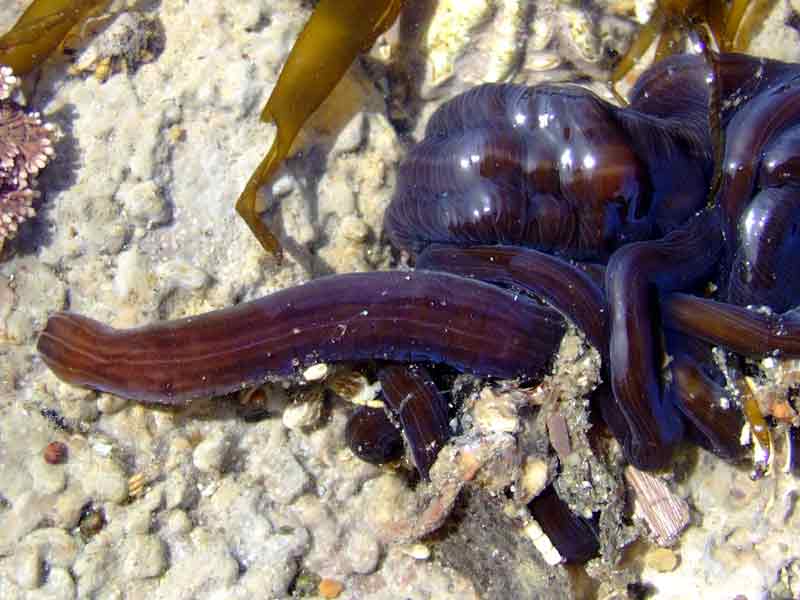
The ribbonworm Lineus longissimus partially exposed in a tide pool.
Photographer: David Fenwick Copyright: David Fenwick Snr.
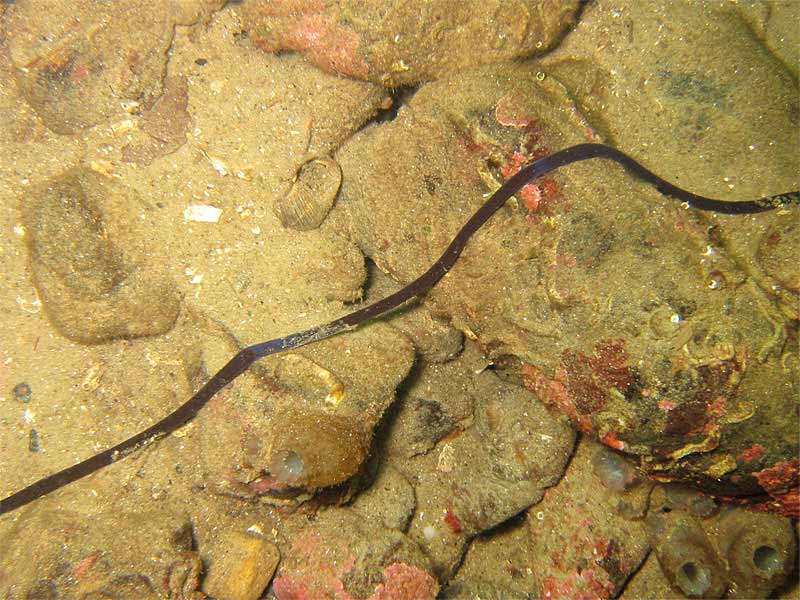
Lineus longissimus
Photographer: Gordon Lang Copyright: Gordon Lang
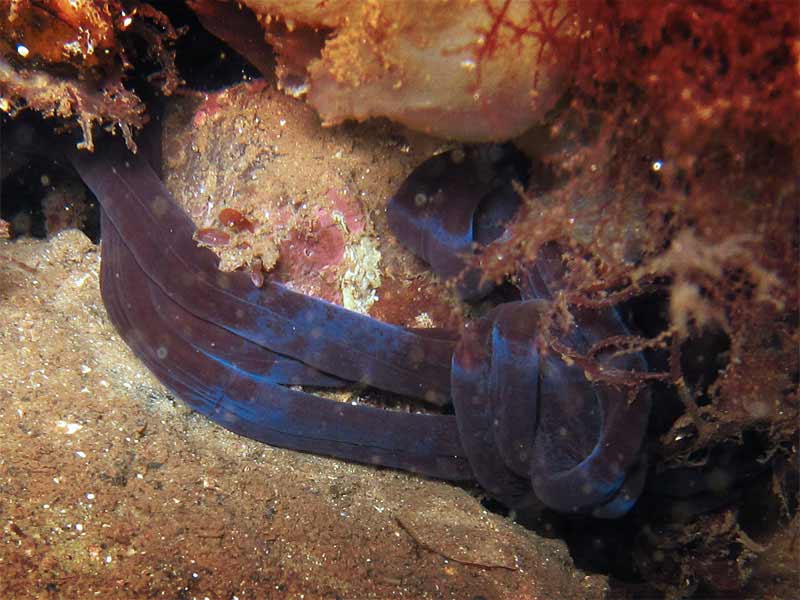
Lineus longissimus
Photographer: Gordon Lang Copyright: Gordon Lang
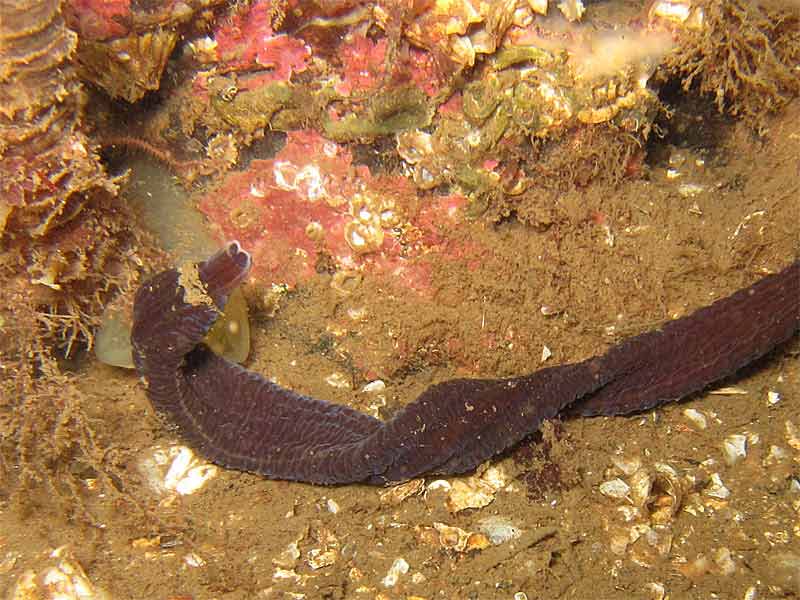
A bootlace worm.
Photographer: Gordon Lang Copyright: Gordon Lang
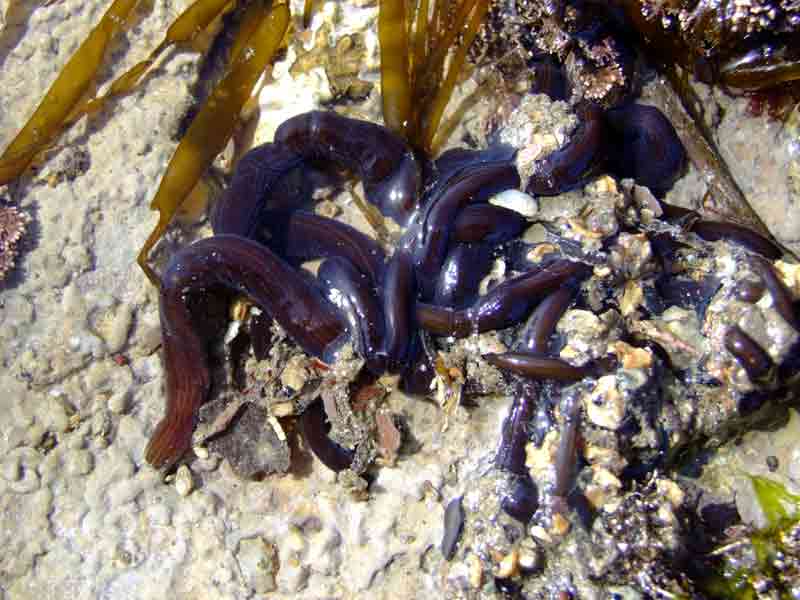
The ribbonworm Lineus longissimus partially exposed in a tide pool.
Photographer: David Fenwick Copyright: David Fenwick Snr.
Distribution data supplied by the Ocean Biodiversity Information System (OBIS). To interrogate UK data visit the NBN Atlas.Map Help
| Researched by | Judith Oakley | Refereed by | Admin |
| Authority | (Gunnerus, 1770) | ||
| Other common names | - | Synonyms | - |
Summary
Description
Recorded distribution in Britain and Ireland
Most likely present all around Britain and Ireland, except perhaps eastern Scotland and England.Global distribution
Ranging from Iceland eastwards to the Atlantic, North Sea and Baltic Coasts of Europe.Habitat
Lineus longissimus is found on the lower shore coiled in writhing knots beneath boulders and on muddy sand. This species can often be found in rockpools entangled amongst Laminaria holdfasts or in rock fissures. In deeper sub-littoral areas, it occurs on muddy, sandy, stony or shelly substrata.Depth range
-Identifying features
- Ventral surface may be same colour or paler than dorsal.
- Body may be streaked with pale longitudinal lines especially on anterior dorsal surface.
- Rectangular head with pale colour tip.
- 10-20 deep set reddish brown or black eyes in a row either side of snout, which may be obscured by dark body colour.
- Body unsegmented and ciliated, giving purplish irridescence.
Additional information
Lineus longissimus is the most commonly recorded nemertean in Britain. When handled, the animal produces large amounts of thick mucus with a faint pungent smell.Listed by
- none -
Bibliography
Bruce, J.R., Colman, J.S. & Jones, N.S., 1963. Marine fauna of the Isle of Man. Liverpool: Liverpool University Press.
Crothers, J.H. (ed.), 1966. Dale Fort Marine Fauna. London: Field Studies Council.
Gibson, R., 1982. British Nemerteans. Cambridge: Cambridge University Press
Hayward, P., Nelson-Smith, T. & Shields, C. 1996. Collins pocket guide. Sea shore of Britain and northern Europe. London: HarperCollins.
Hayward, P.J. & Ryland, J.S. 1994. The marine fauna of the British Isles and north-west Europe. Volume 1. Introduction and Protozoans to Arthropods. Oxford: Clarendon Press.
Howson, C.M. & Picton, B.E., 1997. The species directory of the marine fauna and flora of the British Isles and surrounding seas. Belfast: Ulster Museum. [Ulster Museum publication, no. 276.]
JNCC (Joint Nature Conservation Committee), 1999. Marine Environment Resource Mapping And Information Database (MERMAID): Marine Nature Conservation Review Survey Database. [on-line] http://www.jncc.gov.uk/mermaid
Datasets
Centre for Environmental Data and Recording, 2018. IBIS Project Data. Occurrence dataset: https://www.nmni.com/CEDaR/CEDaR-Centre-for-Environmental-Data-and-Recording.aspx accessed via NBNAtlas.org on 2018-09-25.
Centre for Environmental Data and Recording, 2018. Ulster Museum Marine Surveys of Northern Ireland Coastal Waters. Occurrence dataset https://www.nmni.com/CEDaR/CEDaR-Centre-for-Environmental-Data-and-Recording.aspx accessed via NBNAtlas.org on 2018-09-25.
Environmental Records Information Centre North East, 2018. ERIC NE Combined dataset to 2017. Occurrence dataset: http://www.ericnortheast.org.ukl accessed via NBNAtlas.org on 2018-09-38
Fenwick, 2018. Aphotomarine. Occurrence dataset http://www.aphotomarine.com/index.html Accessed via NBNAtlas.org on 2018-10-01
Fife Nature Records Centre, 2018. St Andrews BioBlitz 2015. Occurrence dataset: https://doi.org/10.15468/xtrbvy accessed via GBIF.org on 2018-09-27.
Kent Wildlife Trust, 2018. Kent Wildlife Trust Shoresearch Intertidal Survey 2004 onwards. Occurrence dataset: https://www.kentwildlifetrust.org.uk/ accessed via NBNAtlas.org on 2018-10-01.
Lancashire Environment Record Network, 2018. LERN Records. Occurrence dataset: https://doi.org/10.15468/esxc9a accessed via GBIF.org on 2018-10-01.
Manx Biological Recording Partnership, 2018. Isle of Man historical wildlife records 1990 to 1994. Occurrence dataset:https://doi.org/10.15468/aru16v accessed via GBIF.org on 2018-10-01.
NBN (National Biodiversity Network) Atlas. Available from: https://www.nbnatlas.org.
OBIS (Ocean Biodiversity Information System), 2024. Global map of species distribution using gridded data. Available from: Ocean Biogeographic Information System. www.iobis.org. Accessed: 2024-05-13
South East Wales Biodiversity Records Centre, 2018. Dr Mary Gillham Archive Project. Occurance dataset: http://www.sewbrec.org.uk/ accessed via NBNAtlas.org on 2018-10-02
Citation
This review can be cited as:
Last Updated: 23/06/2005