
Red tubeworm (Serpula vermicularis)
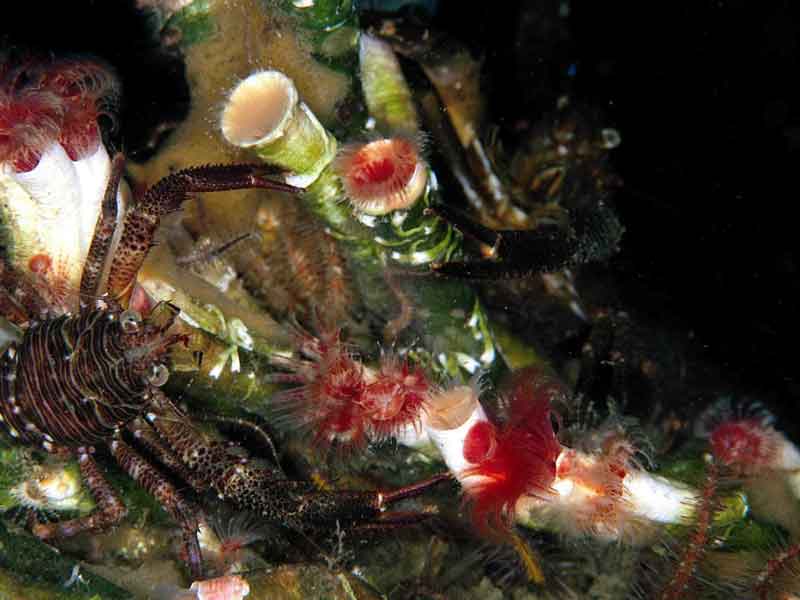
A tube worm Serpula vermicularis.
Photographer: Paul Naylor Copyright: Paul Naylor
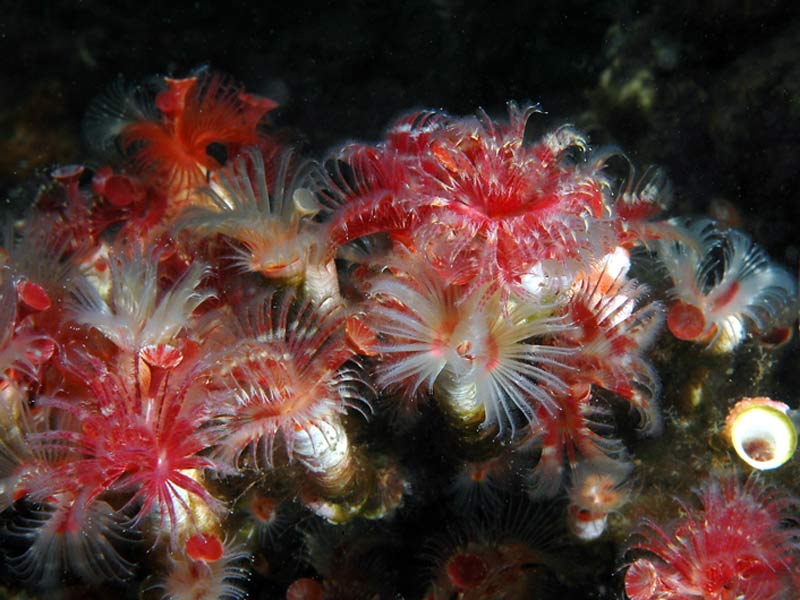
Serpula vermicularis colony at Loch Creran, an SAC on the west coast of Scotland.
Photographer: Dr Keith Hiscock Copyright: Dr Keith Hiscock
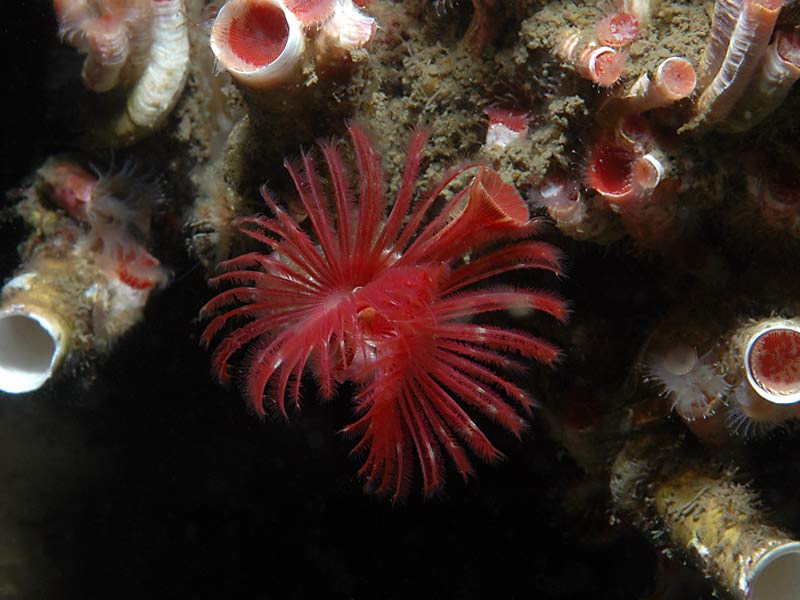
Serpula vermicularis colony at Loch Creran, an SAC on the west coast of Scotland.
Photographer: Dr Keith Hiscock Copyright: Dr Keith Hiscock
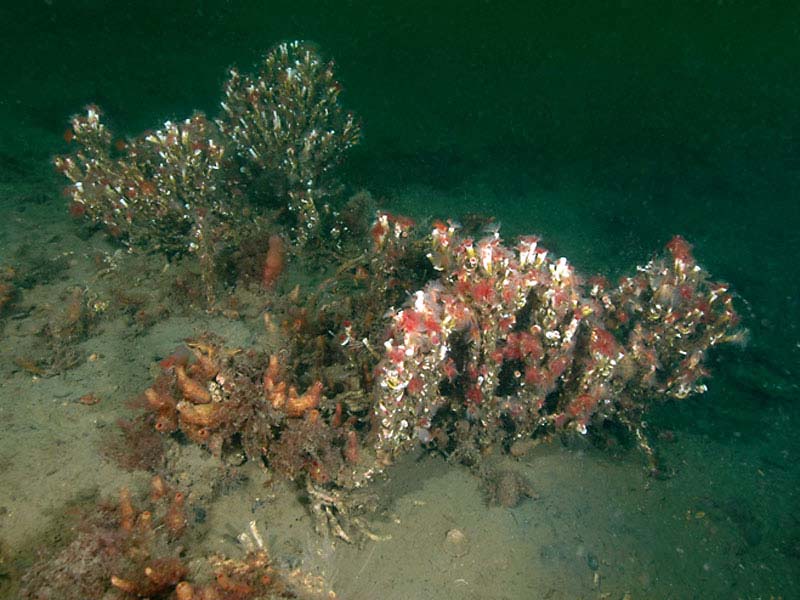
A colony of Serpula vermicularis forming a small reef, Loch Creran, an SAC on the west coast of Scotland.
Photographer: Dr Keith Hiscock Copyright: Dr Keith Hiscock
Distribution data supplied by the Ocean Biodiversity Information System (OBIS). To interrogate UK data visit the NBN Atlas.Map Help
| Researched by | Jacqueline Hill | Refereed by | Dr Elvira Poloczanska |
| Authority | Linnaeus, 1767 | ||
| Other common names | - | Synonyms | - |
Summary
Description
Serpula vermicularis is a slender, tube-dwelling polychaete between 5 and 7 cm in length with about 200 segments. The tubes are cylindrical with occasional rings and irregular lengthwise ridges cut into blunt teeth. The operculum is calcareous and funnel shaped with radial grooves and a serrated circumference. The colour of the body of the worm varies from pale yellow to brick red. The tube is pinkish-white and the operculum is patterned with red and white rays.
Recorded distribution in Britain and Ireland
Distributed mainly around the north-west coast of Scotland. Also present on the north-east coast of England and the north-west coast of Ireland with scattered records around much of the coast of Britain and Ireland.
Global distribution
Thought to be distributed in the north east Atlantic and the Mediterranean.
Habitat
The calcareous tubes of Serpula vermicularis can be found attached to hard substrata such as rocks, stones, bivalve shells and ship hull's from low water to the sublittoral in depths up to 250 m. In some very sheltered areas the tubes aggregate together to form small reefs.
Depth range
0 - 250mIdentifying features
- Head bears crown of pinnate projections called radioles which project from the tube when feeding. Palps are absent.
- Head with two lobes, each with 30-40 radioles united at the base.
- Single, funnel like operculum (a plug to close the tube when the crown is withdrawn) about 4mm across with serrated circumference and red and white rays.
- Crown is red, white, orange or yellow and may be solid coloured or banded.
Additional information
The tube is attached to hard substrata at the base but in reef aggregations is often free for much of its length.
Listed by
- none -
Biology review
Taxonomy
| Level | Scientific name | Common name |
|---|---|---|
| Phylum | Annelida | Segmented worms e.g. ragworms, tubeworms, fanworms and spoon worms |
| Class | Polychaeta | Bristleworms, e.g. ragworms, scaleworms, paddleworms, fanworms, tubeworms and spoon worms |
| Order | Sabellida | |
| Family | Serpulidae | |
| Genus | Serpula | |
| Authority | Linnaeus, 1767 | |
| Recent Synonyms | ||
Biology
| Parameter | Data | ||
|---|---|---|---|
| Typical abundance | |||
| Male size range | Body length up to 7cm | ||
| Male size at maturity | |||
| Female size range | Small-medium(3-10cm) | ||
| Female size at maturity | |||
| Growth form | Vermiform segmented | ||
| Growth rate | |||
| Body flexibility | No information | ||
| Mobility | Sessile, permanent attachment | ||
| Characteristic feeding method | Active suspension feeder | ||
| Diet/food source | Planktotroph | ||
| Typically feeds on | Detritus | ||
| Sociability | See additional information | ||
| Environmental position | Epifaunal | ||
| Dependency | Independent. | ||
| Supports | None | ||
| Is the species harmful? | |||
Biology information
Sociability. Dense aggregations of Serpula vermicularis tubes occur in enclosed and sheltered locations. These dense settlements of larvae on adult tubes may indicate larval gregarity but Bosence (1979(b)) suggests that aggregations only occur in locations with larval retention and few other hard substrates available for larval settlement. In the open marine environment, Serpula vermicularis is not normally gregarious.
Feeding. Serpula vermicularis is a suspension feeder that can actively create its own feeding current and so can inhabit areas with little water movement.
Habitat preferences
| Parameter | Data |
|---|---|
| Physiographic preferences | Estuary, Offshore seabed, Open coast, Sea loch or Sea lough, Strait or Sound |
| Biological zone preferences | Circalittoral offshore, Lower circalittoral, Lower infralittoral, Sublittoral fringe, Upper circalittoral, Upper infralittoral |
| Substratum / habitat preferences | Artificial (man-made), Bedrock, Biogenic reef, Cobbles, Large to very large boulders, Other species, Pebbles, Small boulders |
| Tidal strength preferences | Weak < 1 knot (<0.5 m/sec.) |
| Wave exposure preferences | Moderately exposed, Sheltered, Very sheltered |
| Salinity preferences | Full (30-40 psu) |
| Depth range | 0 - 250m |
| Other preferences | No text entered |
| Migration Pattern | Non-migratory or resident |
Habitat Information
Global distribution. Although it is reported that Serpula vermicularis has a worldwide distribution, there is a great deal of taxonomic confusion and it is currently thought that the species is limited to the North East Atlantic and the Mediterranean (Holt et al., 1997). There is also the possibility that within the Mediterranean it is actually part of a complex of two or three species (ten Hove pers. comm. cited in Holt et al., 1997).
Life history
Adult characteristics
| Parameter | Data |
|---|---|
| Reproductive type | Gonochoristic (dioecious) |
| Reproductive frequency | Annual episodic |
| Fecundity (number of eggs) | No information |
| Generation time | |
| Age at maturity | 1 year |
| Season | See additional text |
| Life span | 2-5 years |
Larval characteristics
| Parameter | Data |
|---|---|
| Larval/propagule type | - |
| Larval/juvenile development | Planktotrophic |
| Duration of larval stage | See additional information |
| Larval dispersal potential | - |
| Larval settlement period | See additional text |
Life history information
Age at maturity and lifespan. Orton (1914) observed that ten-month-old individuals of Serpula vermicularis in the southwest of England could successfully reproduce.
Larval settling time. The length of the planktonic stage is unknown but comparison with other serpulid species suggests it may be between six days and two months (Holt et al., 1997).
Spawning season. Spawning seems to occur in the summer. In the Clyde area, Elmhirst (1922) observed spawning to occur from June to August and in Plymouth ripe individuals were seen in August and September (Allen, 1915).
Sensitivity review
The MarLIN sensitivity assessment approach used below has been superseded by the MarESA (Marine Evidence-based Sensitivity Assessment) approach (see menu). The MarLIN approach was used for assessments from 1999-2010. The MarESA approach reflects the recent conservation imperatives and terminology and is used for sensitivity assessments from 2014 onwards.
Physical pressures
Use / to open/close text displayed
| Intolerance | Recoverability | Sensitivity | Evidence / Confidence | |
Substratum loss [Show more]Substratum lossBenchmark. All of the substratum occupied by the species or biotope under consideration is removed. A single event is assumed for sensitivity assessment. Once the activity or event has stopped (or between regular events) suitable substratum remains or is deposited. Species or community recovery assumes that the substratum within the habitat preferences of the original species or community is present. Further details EvidenceSerpula vermicularis tubes are permanently attached to the substratum and so will be lost if substratum is removed. Intolerance is therefore, high. Recovery is high but only in relation to individual recruitment. Recovery of Serpula reefs may not be possible. See additional information below for full rationale. | High | High | Moderate | Low |
Smothering [Show more]SmotheringBenchmark. All of the population of a species or an area of a biotope is smothered by sediment to a depth of 5 cm above the substratum for one month. Impermeable materials, such as concrete, oil, or tar, are likely to have a greater effect. Further details. EvidenceSerpula vermicularis is permanently attached to the substratum by a calcareous tube which may be encrusting or in aggregating individuals may extend above the substratum and avoid smothering material. Thus, encrusting individuals are not likely to survive smothering by 5cm of sediment. It is also likely that too much sediment on the surface of rocks or shells would prevent settlement of larvae (Holt et al., 1998) and impair the long term survival of populations. Intolerance is therefore reported to be high. Serpula vermicularis reefs may be less intolerant as animals in the highest points may be clear of smothering material. | High | High | Moderate | Very low |
Increase in suspended sediment [Show more]Increase in suspended sedimentBenchmark. An arbitrary short-term, acute change in background suspended sediment concentration e.g., a change of 100 mg/l for one month. The resultant light attenuation effects are addressed under turbidity, and the effects of rapid settling out of suspended sediment are addressed under smothering. Further details EvidenceBosence (1979b) concluded from observations and from transplant experiments that the lower depth limit of Serpula vermicularis was probably determined by suspended sediment and de-oxygenation. However, Moore et al. (1998) found no horizontal layers of suspended mud in Loch Creran in Scotland to explain distribution of reefs, although the authors do not rule out the possibility that storm-generated, suspended mud may inhibit reef development (but the lower limit could also be due to inadequate current velocities for suspension feeding). The species is recorded in areas where suspended sediment levels can be high, for instance in the Tamar estuary. A supply of suspended sediment will probably be important to Serpula vermicularis because the species requires a supply of particulate matter for suspension feeding. At the benchmark level of an increase of 100mg/l for one month, the likely impact would be an increase in cleaning costs. Thus, the species is not likely to be significantly affected and an intolerance of low is reported. Recovery will be immediate as normal feeding returns on the resumption of pre-impact conditions. | Low | High | Low | Low |
Decrease in suspended sediment [Show more]Decrease in suspended sedimentBenchmark. An arbitrary short-term, acute change in background suspended sediment concentration e.g., a change of 100 mg/l for one month. The resultant light attenuation effects are addressed under turbidity, and the effects of rapid settling out of suspended sediment are addressed under smothering. Further details EvidenceA supply of suspended sediment will be important to Serpula vermicularis because the species requires a supply of particulate matter for suspension feeding. However, the species is an active suspension feeder creating its own feeding currents so is not likely to be highly intolerant of changes in suspended sediment. Therefore, an intolerance of low is reported. | Low | High | Low | Low |
Desiccation [Show more]Desiccation
EvidenceSerpula vermicularis is a predominantly subtidal species but does occur in the lower intertidal as scattered specimens and so will have some tolerance to desiccating conditions. Reef specimens have been recorded as being exposed at low tide (Anderson-Smith, 1887). The species probably survives exposure to air by closing the operculum of the tube to retain water and inhabiting damp areas such as small cracks and crevices in the rock. However, feeding opportunities will be lost during this time which may affect growth and fecundity of individuals compared to those in the subtidal. An increase in desiccation at the level of the benchmark, where the species is continuously exposed to air and sunshine for one hour in each tidal cycle, may be tolerated by some individuals. However, it is expected that some would not survive, either from the direct effects of desiccation or from the longer term impact of reduced growth and fecundity, and so intolerance is reported to be intermediate. | Intermediate | High | Low | Low |
Increase in emergence regime [Show more]Increase in emergence regimeBenchmark. A one hour change in the time covered or not covered by the sea for a period of one year. Further details EvidenceThe species is predominantly subtidal, with scattered specimens in the low intertidal. An increase in emergence will increase the time the lower shore species are exposed to air and may result in the death of some individuals. Intolerance is reported to be intermediate. | Intermediate | High | Low | Low |
Decrease in emergence regime [Show more]Decrease in emergence regimeBenchmark. A one hour change in the time covered or not covered by the sea for a period of one year. Further details EvidenceThe species is predominantly subtidal, with scattered specimens in the low intertidal so a decrease in emergence will have a favourable effect on those normally exposed at very low tides. | Tolerant* | Not relevant | Not sensitive* | Moderate |
Increase in water flow rate [Show more]Increase in water flow rateA change of two categories in water flow rate (view glossary) for 1 year, for example, from moderately strong (1-3 knots) to very weak (negligible). Further details EvidenceAn increase in water flow rate, by two categories (see glossary) for a period of a year, is likely to prevent feeding for significant lengths of time and may result in the death of Serpula vermicularis and so intolerance is reported to be high. On return to normal conditions recovery is likely to be high - see additional information. | High | High | Moderate | Low |
Decrease in water flow rate [Show more]Decrease in water flow rateA change of two categories in water flow rate (view glossary) for 1 year, for example, from moderately strong (1-3 knots) to very weak (negligible). Further details EvidenceAlthough a reduction in water flow is likely to reduce food supply this will probably not have a huge impact on the suspension feeding Serpula vermicularis because the species can generate it's own feeding currents. However, it may allow the deposition of silt which may provide unfavourable conditions for the settlement of larvae. In some sheltered areas where there is little water movement and larvae are prevented from being dispersed aggregations of Serpula vermicularis tubes can occur creating large reefs (see biotope CMS.Ser). Therefore, since populations can survive in low water flow environments intolerance is reported to be low. | Low | Very high | Very Low | Moderate |
Increase in temperature [Show more]Increase in temperature
For intertidal species or communities, the range of temperatures includes the air temperature regime for that species or community. Further details EvidenceThere was no information found on the temperature tolerance of Serpula vermicularis. However, the species is distributed to the north and south of British waters which suggests that it is unlikely to be very intolerant of a long term change of 2°C. Serpula vermicularis is also found in large aggregations in shallow waters (0-14m) of enclosed and sheltered sea lochs where temperatures are likely to vary widely over a period of a year. The species may be more intolerant of a short term increase. | Low | High | Low | Low |
Decrease in temperature [Show more]Decrease in temperature
For intertidal species or communities, the range of temperatures includes the air temperature regime for that species or community. Further details EvidenceThere was no information found on the temperature tolerance of Serpula vermicularis. However, the species is distributed to the north and south of British waters which suggests that it is unlikely to be very intolerant of a long term change of 2°C. Serpula vermicularis is also found in large aggregations in shallow waters (0-14m) of enclosed and sheltered sea lochs where temperatures are likely to vary widely over a period of a year. The species may be more intolerant of a short term increase. | Low | High | Low | Low |
Increase in turbidity [Show more]Increase in turbidity
EvidenceAn increase in turbidity, reducing light availability may reduce primary production by phytoplankton in the water column which could reduce food availability. However, the species is likely to feed on a variety of particulate matter so effects at the level of the benchmark are likely to be minimal and an intolerance of low is reported. | Low | Very high | Very Low | Moderate |
Decrease in turbidity [Show more]Decrease in turbidity
EvidenceA decrease in turbidity, increasing light availability may increase primary production by phytoplankton in the water column which could improve food availability. However, the species is likely to feed on a variety of particulate matter so effects at the level of the benchmark are likely to be minimal and an intolerance of low is reported. However, the larvae of Serpula vermicularis may be intolerant of increased light. Bosence (1979(b)) and other workers found that Serpula vermicularis settles on the underside of experimental plates in preference to brightly lit areas. Although this may be due to phototropism, other factors such as temperature, siltation and algal growth, may be important. | Low | Very high | Very Low | Moderate |
Increase in wave exposure [Show more]Increase in wave exposureA change of two ranks on the wave exposure scale (view glossary) e.g., from Exposed to Extremely exposed for a period of one year. Further details EvidenceThe species probably does not tolerate high levels of wave exposure because it will interfere with feeding. However, Serpula vermicularis is capable of retreating into its tube when strong wave action occurs. Intolerance is therefore, set to intermediate. In sheltered areas such as sea lochs, where Serpula vermicularis aggregates to create reefs, the species is likely to be more intolerant of wave exposure because the tubes grow upwards and outwards rather than the encrusting form in the open ocean. Moore et al. (1998) suggest that the upper limit of reef distribution in Loch Creran may be influenced by wave action. See additional information for recovery. | Intermediate | High | Low | Moderate |
Decrease in wave exposure [Show more]Decrease in wave exposureA change of two ranks on the wave exposure scale (view glossary) e.g., from Exposed to Extremely exposed for a period of one year. Further details EvidenceSerpula vermicularis occurs in very sheltered sea lochs were wave exposure is minimal so the species is likely to tolerate a decrease. | Tolerant | Not relevant | Not sensitive | Moderate |
Noise [Show more]Noise
EvidenceAt the level of the benchmark Serpula vermicularis is not likely to be sensitive to noise but may respond to vibrations associated with noise as a predator avoidance mechanism. | Tolerant | Not relevant | Not sensitive | Not relevant |
Visual presence [Show more]Visual presenceBenchmark. The continuous presence for one month of moving objects not naturally found in the marine environment (e.g., boats, machinery, and humans) within the visual envelope of the species or community under consideration. Further details EvidenceThe species has been observed to react to the visual presence of moving objects not naturally found in the marine environment (e.g., boats, machinery, and humans). It is sensitive to a sudden decrease in light levels as a predator avoidance mechanisms (Poloczanska et al., 2004). However, at the level of the benchmark it is unlikely that this will have an adverse effect on the animal and tolerant has been suggested. | Tolerant | Not relevant | Not sensitive | Not relevant |
Abrasion & physical disturbance [Show more]Abrasion & physical disturbanceBenchmark. Force equivalent to a standard scallop dredge landing on or being dragged across the organism. A single event is assumed for assessment. This factor includes mechanical interference, crushing, physical blows against, or rubbing and erosion of the organism or habitat of interest. Where trampling is relevant, the evidence and trampling intensity will be reported in the rationale. Further details. EvidenceThe calcareous tubes of Serpula vermicularis are likely to be damaged by physical disturbance For example, in Loch Creran Serpula vermicularis reefs have been severely damaged by the movement of mooring blocks and chains (Holt et al., 1998). Although the effects were localized, in one instance, mooring had reduced colonies to rubble within a radius of 10 m, and extensive damage was reported within 50 m of salmon cages (Holt et al., 1998). Holt et al. (1998) suggested that fishing activity could be very damaging but that no evidence of damage had yet been observed. A passing scallop dredge is likely to result in greater damage. Therefore, intolerance is reported to be high. See additional information below for recovery. For information on the intolerance of Serpula vermicularis reefs see CMS.Ser. | High | High | Moderate | High |
Displacement [Show more]DisplacementBenchmark. Removal of the organism from the substratum and displacement from its original position onto a suitable substratum. A single event is assumed for assessment. Further details EvidenceThe species lives in a calcareous tube that is permanently attached to the substratum. It is unlikely that the worm is able to reattach the tube if displaced and so would probably die. Intolerance is therefore, reported to be high. See additional information for recovery. | High | High | Moderate | Low |
Chemical pressures
Use [show more] / [show less] to open/close text displayed
| Intolerance | Recoverability | Sensitivity | Evidence / Confidence | |
Synthetic compound contamination [Show more]Synthetic compound contaminationSensitivity is assessed against the available evidence for the effects of contaminants on the species (or closely related species at low confidence) or community of interest. For example:
The evidence used is stated in the rationale. Where the assessment can be based on a known activity then this is stated. The tolerance to contaminants of species of interest will be included in the rationale when available; together with relevant supporting material. Further details. EvidenceInsufficient | No information | No information | No information | Not relevant |
Heavy metal contamination [Show more]Heavy metal contaminationEvidenceSerpula vermicularis was found at Garrick Roads, close to Restronguet Creek in the Fal estuary, that is contaminated with high levels of metals, in particular copper, zinc and arsenic (Bryan & Gibbs, 1983). Therefore, it appears that the species can tolerate some enhanced heavy metal concentrations and so intolerance is reported to be low. | Low | Very high | Very Low | Low |
Hydrocarbon contamination [Show more]Hydrocarbon contaminationEvidenceInsufficient | No information | No information | No information | Not relevant |
Radionuclide contamination [Show more]Radionuclide contaminationEvidenceInsufficient | No information | No information | No information | Not relevant |
Changes in nutrient levels [Show more]Changes in nutrient levelsEvidenceIn Loch Creran in Scotland, where Serpula vermicularis forms extensive reefs, organic effluent from an alginate factory appeared to have been responsible for eliminating reefs for a distance of about 1km and may have reduced reef development at greater distances (Moore et al., 1998). Intolerance is set to intermediate with a very low confidence. | Intermediate | High | Low | Very low |
Increase in salinity [Show more]Increase in salinity
EvidenceSerpula vermicularis is not found in areas where hypersaline conditions may occur, such as rock pools or lagoons, so it seems likely that the species would be intolerant of increases in salinity. See additional information below for recovery. | Intermediate | High | Low | Low |
Decrease in salinity [Show more]Decrease in salinity
EvidenceNo information was found on the effect of lowered salinity on Serpula vermicularis. Bosence (1979(b)) suggests that the layer of lower salinity water in the upper layers of the water in Ardbear Loch in Galway, Eire is partly responsible for the lack of individuals above a depth of 2m. However, Serpula vermicularis is known to tolerate reduced salinities (Hartmann-Schröder, 1971 and Mastrangelo & Passeri, 1975 cited in Moore et al., 1998) and in Loch Creran in Scotland individual specimens of Serpula vermicularis were commonly observed in shallow waters where salinities can fall to around 23psu. Small enclosed lochs such as Ardbear Loch are often subject to extremely variable salinity so the species seems to be tolerant of shorter term changes. Serpula vermicularis reefs were also observed in intertidal areas of Loch Creran, where salinity is likely to vary, during the last century. Therefore, it seems likely that the species can tolerate some decreases in salinity. However, long term reductions would probably reduce abundance so intolerance is set to intermediate. See additional information below for recovery. | Intermediate | High | Low | Low |
Changes in oxygenation [Show more]Changes in oxygenationBenchmark. Exposure to a dissolved oxygen concentration of 2 mg/l for one week. Further details. EvidenceThere is no information regarding the tolerance of Serpula vermicularis to deoxygenation. Cole et al. (1999) suggest possible adverse effects on marine species below 4 mg/l and probable adverse effects below 2mg/l. Bosence (1980) observed that the lower limit of larval settlement in Ardbear Lough, Eire coincided with mud-rich and possibly oxygen poor water. Therefore, the species, and the larvae in particular, may be intolerant of deoxygenated water and an intolerance of intermediate is reported. | Intermediate | High | Low | Very low |
Biological pressures
Use [show more] / [show less] to open/close text displayed
| Intolerance | Recoverability | Sensitivity | Evidence / Confidence | |
Introduction of microbial pathogens/parasites [Show more]Introduction of microbial pathogens/parasitesBenchmark. Sensitivity can only be assessed relative to a known, named disease, likely to cause partial loss of a species population or community. Further details. EvidenceNo information on diseases of Serpula vermicularis was found. However, the species is known to be parasitized by the protozoan Haplosporidium parisi (Ormieres, 1980) but the effects of this infestation are unknown. | No information | No information | No information | Not relevant |
Introduction of non-native species [Show more]Introduction of non-native speciesSensitivity assessed against the likely effect of the introduction of alien or non-native species in Britain or Ireland. Further details. EvidenceAlthough several species of serpulid polychaetes have been introduced into British waters none are reported to compete with Serpula vermicularis (Eno et al., 1997). However, there is always the potential for introduced species to either prey upon or compete with Serpula vermicularis. | Tolerant | Not relevant | Not sensitive | Moderate |
Extraction of this species [Show more]Extraction of this speciesBenchmark. Extraction removes 50% of the species or community from the area under consideration. Sensitivity will be assessed as 'intermediate'. The habitat remains intact or recovers rapidly. Any effects of the extraction process on the habitat itself are addressed under other factors, e.g. displacement, abrasion and physical disturbance, and substratum loss. Further details. EvidenceThe species is not likely to be extracted for it has no commercial or research value. Recovery from removal of 50% of the population is likely to be high - see additional information below. | Intermediate | High | Low | Moderate |
Extraction of other species [Show more]Extraction of other speciesBenchmark. A species that is a required host or prey for the species under consideration (and assuming that no alternative host exists) or a keystone species in a biotope is removed. Any effects of the extraction process on the habitat itself are addressed under other factors, e.g. displacement, abrasion and physical disturbance, and substratum loss. Further details. EvidenceSerpula vermicularis does not depend on other species so the extraction of other species is not likely to have any effect. However, when Serpula vermicularis forms reefs in enclosed and sheltered locations some species may play a key role in the strengthening of the reef (Moore, 1995(b)). | Tolerant | Not relevant | Not sensitive | Low |
Additional information
Recoverability. Recolonization by individual Serpula vermicularis is expected to be high, provided there is a suitable substratum for the settlement of larvae. The species is fairly widespread, probably reaches sexual maturity in its first year and reproduces every year thereafter. The planktonic larvae, which are thought to stay in the water column for one to eight weeks, may be able to disperse widely. Recovery is high only for individuals and reefs will take longer to recover (see the CMS.Ser biotope review for more information on reefs). Also, in sheltered and enclosed areas where Serpula vermicularis forms reefs recovery may not be possible if populations are lost. This is because hard substrata is a sparse feature in these locations and if, as suggested, limited water exchange keeps larvae in the local system, recruitment may not occur because the supply of larvae from outside the system is minimal.
Importance review
Policy/legislation
- no data -
Status
| National (GB) importance | - | Global red list (IUCN) category | - |
Non-native
| Parameter | Data |
|---|---|
| Native | - |
| Origin | - |
| Date Arrived | - |
Importance information
When Serpula vermicularis forms reefs in sheltered locations the species creates a habitat for many other species. The aggregated tubes provide a substratum for a sessile macrofaunal community dominated by other tube worms, bryozoans, ascidians and sponges (Moore et al., 1998b). See the CMS.Ser biotope review for more information on Serpula vermicularis reefs.Bibliography
Allen, E.R. 1915. Polychaeta of Plymouth and the south Devon coast, including a list of the Archiannelida. Journal of the Marine Biological Association of the United Kingdom, 10, 592-646.
Anderson-Smith, W., 1887. Loch Creran: Notes from the West Highlands. Paisley.
Bosence, D.W.J., 1979b. The factors leading to aggregation and reef formation in Serpula vermicularis L. In Proceedings of an International Symposium held at the University of Durham, April 1976. Biology and Systematics of Colonial Organisms (ed. G. Larwood & B.R. Rosen), pp. 299-318. London: Academic Press.
Elmhirst, R., 1922. Notes on the breeding and growth of marine animals in the Clyde Sea area. Report of the Scottish Marine Biological Association, 19-43.
Eno, N.C., Clark, R.A. & Sanderson, W.G. (ed.) 1997. Non-native marine species in British waters: a review and directory. Peterborough: Joint Nature Conservation Committee.
Fish, J.D. & Fish, S., 1996. A student's guide to the seashore. Cambridge: Cambridge University Press.
Hayward, P., Nelson-Smith, T. & Shields, C. 1996. Collins pocket guide. Sea shore of Britain and northern Europe. London: HarperCollins.
Hayward, P.J. & Ryland, J.S. (ed.) 1995b. Handbook of the marine fauna of North-West Europe. Oxford: Oxford University Press.
Holt, T.J., Rees, E.I., Hawkins, S.J. & Seed, R., 1998. Biogenic reefs (Volume IX). An overview of dynamic and sensitivity characteristics for conservation management of marine SACs. Scottish Association for Marine Science (UK Marine SACs Project), 174 pp. Available from: http://ukmpa.marinebiodiversity.org/uk_sacs/pdfs/biogreef.pdf
Howson, C.M. & Picton, B.E., 1997. The species directory of the marine fauna and flora of the British Isles and surrounding seas. Belfast: Ulster Museum. [Ulster Museum publication, no. 276.]
Moore, C.G., Saunders, G.R. & Harries, D.B., 1998b. The status and ecology of reefs of Serpula vermicularis L. (Polychaeta: Serpulidae) in Scotland. Aquatic Conservation: Marine and Freshwater Ecosystems, 8 (5), 645-656. DOI https://doi.org/10.1002/(sici)1099-0755(199809/10)8:5<645>3.0.co;2-g
Ormieres, R., 1980. Haplosporidium parisi sp. nov., a parasite of Serpula vermicularis. Ultrastructural study of the spore. Protistologica, 16, 467-474.
Orton, J.H., 1914. Preliminary account of a contribution to an evaluation of the sea. Journal of the Marine Biological Association of the United Kingdom, X, 312-320.
Poloczanska, E.S., Hughes, D.J. & Burrows, M.T., 2004. Underwater television observations of Serpula vermicularis (L.) reefs and associated mobile fauna in Loch Creran, Scotland. Estuarine, Coastal and Shelf Science, 61, 425-435. DOI https://doi.org/10.1016/j.ecss.2004.06.008
Datasets
Centre for Environmental Data and Recording, 2018. Ulster Museum Marine Surveys of Northern Ireland Coastal Waters. Occurrence dataset https://www.nmni.com/CEDaR/CEDaR-Centre-for-Environmental-Data-and-Recording.aspx accessed via NBNAtlas.org on 2018-09-25.
Fenwick, 2018. Aphotomarine. Occurrence dataset http://www.aphotomarine.com/index.html Accessed via NBNAtlas.org on 2018-10-01
Manx Biological Recording Partnership, 2022. Isle of Man historical wildlife records 1990 to 1994. Occurrence dataset:https://doi.org/10.15468/aru16v accessed via GBIF.org on 2024-09-27.
National Trust, 2017. National Trust Species Records. Occurrence dataset: https://doi.org/10.15468/opc6g1 accessed via GBIF.org on 2018-10-01.
NBN (National Biodiversity Network) Atlas. Available from: https://www.nbnatlas.org.
OBIS (Ocean Biodiversity Information System), 2025. Global map of species distribution using gridded data. Available from: Ocean Biogeographic Information System. www.iobis.org. Accessed: 2025-07-24
Citation
This review can be cited as:
Last Updated: 30/11/2006