
A bristleworm (Spiophanes bombyx)
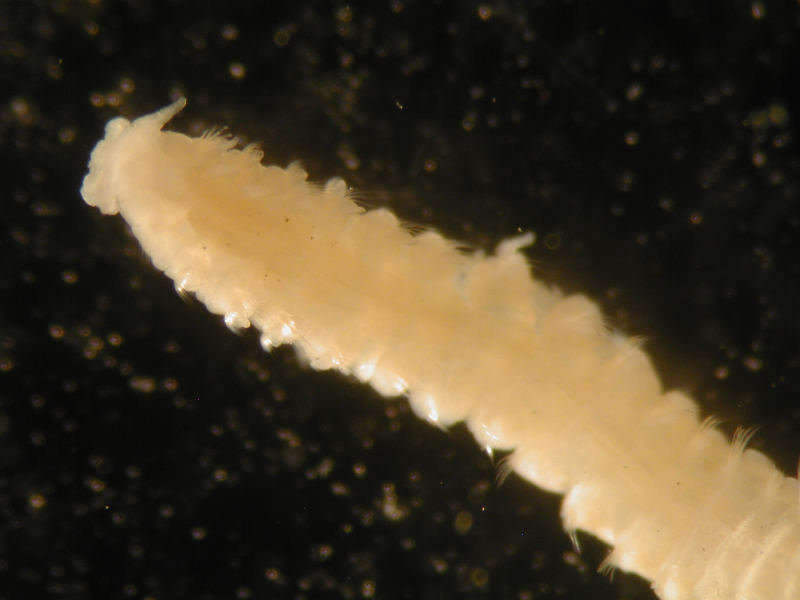
Spiophanes bombyx.
Photographer: Crown copyright Copyright: Crown copyright
Distribution data supplied by the Ocean Biodiversity Information System (OBIS). To interrogate UK data visit the NBN Atlas.Map Help
| Researched by | Olwen Ager | Refereed by | This information is not refereed |
| Authority | (Claparède, 1870) | ||
| Other common names | - | Synonyms | - |
Summary
Description
Spiophanes bombyx is a small, slender bristleworm (5-6 cm long by 0.15 cm wide). Its body is divided into approximately 180 chaetae bearing segments (chaetigers). Chaetigers 5-15 have tufts of long, silky threads laterally along them. Spiophanes bombyx has two long frontal horns on the prostomium and a stout rearward pointing horn. Its palps are short. Spiophanes bombyx has no gills or anal funnel. It is bright pink in colour turning greenish brown at the rear end. Spiophanes bombyx inhabits a stiff sandy tube which usually protrudes slightly above the surface.
Recorded distribution in Britain and Ireland
Spiophanes bombyx is found off most British coasts.
Global distribution
Spiophanes bombyx is found in the Mediterranean, the north Pacific and the north-east and North American coasts of the Atlantic.
Habitat
Spiophanes bombyx is found in clean sand from the low water mark to over 60 m. It may occupy depths down to over 1 km and may penetrate into estuaries.
Depth range
0-60 mIdentifying features
- Flattened body, 5-6 cm long, 0.15 cm wide.
- Up to 180 chaetae bearing segments.
- Tufts of long, silky threads laterally on chaetigers 5-15.
- Short palps.
- Prostomium with 2 long frontal horns.
- Gills absent
- Two longitudinal ciliated sensory grooves.
- Bright pink to red, greenish brown at rear.
Additional information
-none-Listed by
- none -
Biology review
Taxonomy
| Level | Scientific name | Common name |
|---|---|---|
| Phylum | Annelida | Segmented worms e.g. ragworms, tubeworms, fanworms and spoon worms |
| Class | Polychaeta | Bristleworms, e.g. ragworms, scaleworms, paddleworms, fanworms, tubeworms and spoon worms |
| Order | Spionida | |
| Family | Spionidae | |
| Genus | Spiophanes | |
| Authority | (Claparède, 1870) | |
| Recent Synonyms | ||
Biology
| Parameter | Data | ||
|---|---|---|---|
| Typical abundance | High density | ||
| Male size range | 1-6cm | ||
| Male size at maturity | |||
| Female size range | Small-medium(3-10cm) | ||
| Female size at maturity | |||
| Growth form | Tubicolous | ||
| Growth rate | No information found | ||
| Body flexibility | High (greater than 45 degrees) | ||
| Mobility | Burrower | ||
| Characteristic feeding method | Passive suspension feeder, Surface deposit feeder | ||
| Diet/food source | Detritivore | ||
| Typically feeds on | Sediment particles, planktonic organisms, meiobenthic organisms (Dauer et al., 1981). | ||
| Sociability | No information | ||
| Environmental position | Infaunal | ||
| Dependency | Independent. | ||
| Supports | None | ||
| Is the species harmful? | No information | ||
Biology information
Feeding. During suspension feeding captured particles are accumulated in a ciliated groove before being transported to the pharynx, this is termed 'basal' food groove accumulation behaviour (Dauer et al., 1981). Spiophanes bombyx is thought to be the only spionid that displays this unique behaviour.
Habitat preferences
| Parameter | Data |
|---|---|
| Physiographic preferences | Enclosed coast or Embayment, Estuary, Open coast, Sea loch or Sea lough, Strait or Sound |
| Biological zone preferences | Lower eulittoral, Lower infralittoral, Sublittoral fringe, Upper infralittoral |
| Substratum / habitat preferences | Fine clean sand, Sandy mud |
| Tidal strength preferences | Moderately strong 1 to 3 knots (0.5-1.5 m/sec.), Very weak (negligible), Weak < 1 knot (<0.5 m/sec.) |
| Wave exposure preferences | Extremely sheltered, Sheltered, Ultra sheltered, Very sheltered |
| Salinity preferences | Full (30-40 psu), Variable (18-40 psu) |
| Depth range | 0-60 m |
| Other preferences | |
| Migration Pattern | Non-migratory or resident |
Habitat Information
-
Life history
Adult characteristics
| Parameter | Data |
|---|---|
| Reproductive type | Gonochoristic (dioecious) |
| Reproductive frequency | Annual protracted |
| Fecundity (number of eggs) | No information |
| Generation time | |
| Age at maturity | Insufficient information |
| Season | April - December |
| Life span | See additional information |
Larval characteristics
| Parameter | Data |
|---|---|
| Larval/propagule type | - |
| Larval/juvenile development | Planktotrophic |
| Duration of larval stage | See additional information |
| Larval dispersal potential | See additional information |
| Larval settlement period | Insufficient information |
Life history information
Spiophanes bombyx is regarded as a typical 'r' selecting species with a short lifespan, high dispersal potential and high reproductive rate (Kröncke, 1990; Niermann et al., 1990). It is often found at the early successional stages of variable, unstable habitats that it is quick to colonize following perturbation (Pearson & Rosenberg, 1978). Its larval dispersal phase may allow the species to colonize remote habitats.
Sensitivity review
The MarLIN sensitivity assessment approach used below has been superseded by the MarESA (Marine Evidence-based Sensitivity Assessment) approach (see menu). The MarLIN approach was used for assessments from 1999-2010. The MarESA approach reflects the recent conservation imperatives and terminology and is used for sensitivity assessments from 2014 onwards.
Physical pressures
Use / to open/close text displayed
| Intolerance | Recoverability | Sensitivity | Evidence / Confidence | |
Substratum loss [Show more]Substratum lossBenchmark. All of the substratum occupied by the species or biotope under consideration is removed. A single event is assumed for sensitivity assessment. Once the activity or event has stopped (or between regular events) suitable substratum remains or is deposited. Species or community recovery assumes that the substratum within the habitat preferences of the original species or community is present. Further details EvidenceSpiophanes bombyx lives in the sediment and a loss of substratum would cause a loss of population. Therefore, an intolerance of high has been recorded. Recoverability has been recorded as high (see additional information below). | High | High | Moderate | Low |
Smothering [Show more]SmotheringBenchmark. All of the population of a species or an area of a biotope is smothered by sediment to a depth of 5 cm above the substratum for one month. Impermeable materials, such as concrete, oil, or tar, are likely to have a greater effect. Further details. EvidenceSpiophanes bombyx lives in the sediment and uses sediment grains to make its tube. It is likely that Spiophanes bombyx will be able to move up through any extra sediment, therefore, intolerance has been recorded as low. However, smothering by impermeable material is likely to result in anoxic conditions and have a greater impact. | Low | High | Low | Low |
Increase in suspended sediment [Show more]Increase in suspended sedimentBenchmark. An arbitrary short-term, acute change in background suspended sediment concentration e.g., a change of 100 mg/l for one month. The resultant light attenuation effects are addressed under turbidity, and the effects of rapid settling out of suspended sediment are addressed under smothering. Further details EvidenceSpiophanes bombyx lives in the sediment and is unlikely to be perturbed by an increase in suspended sediment. Therefore, tolerant has been recorded. | Tolerant | Not relevant | Not sensitive | Low |
Decrease in suspended sediment [Show more]Decrease in suspended sedimentBenchmark. An arbitrary short-term, acute change in background suspended sediment concentration e.g., a change of 100 mg/l for one month. The resultant light attenuation effects are addressed under turbidity, and the effects of rapid settling out of suspended sediment are addressed under smothering. Further details EvidenceSpiophanes bombyx is a surface deposit feeder and relies on a supply of nutrients at the sediment surface. A decrease in suspended sediment is likely to lead to a reduction in the amount of available food. A reduction in food availability may impair growth and reproduction but is unlikely to cause mortality. Intolerance has, therefore, been recorded as low. The benchmark states the decrease in siltation would only happen for a month. Once the level of suspended sediment increases normal feeding could resume and recoverability has therefore been recorded as immediate. | Low | Immediate | Not sensitive | Low |
Desiccation [Show more]Desiccation
EvidenceSpiophanes bombyx is an infaunal species and is therefore, likely to be protected from desiccation by water retained in the sediment. Spiophanes bombyx is found in the intertidal suggesting some level of tolerance to emersion of the substratum. If an individual was removed from the substratum and was unable to reburrow it is likely to result in mortality. Intertidal populations are likely to be adversely affected by an increase in desiccation equivalent to a movement from low to mid shore. Therefore, intolerance has been recorded as intermediate. A recoverability of high has been recorded (see additional information below). | Intermediate | High | Low | Low |
Increase in emergence regime [Show more]Increase in emergence regimeBenchmark. A one hour change in the time covered or not covered by the sea for a period of one year. Further details EvidenceAn increase in emergence will lead to an increase in desiccation stress. Spiophanes bombyx is found in the intertidal so may be tolerant to some emersion of the substratum. Spiophanes bombyx will probably retract into its tube to reduce the effects of desiccation. Intolerance has, therefore, been recorded as intermediate. A recoverability of high has been recorded (see additional information below). | Intermediate | High | Low | Low |
Decrease in emergence regime [Show more]Decrease in emergence regimeBenchmark. A one hour change in the time covered or not covered by the sea for a period of one year. Further details EvidenceSpiophanes bombyx is found subtidally and a decrease in emergence is unlikely to have any detrimental effects. It is possible that decreased emergence may allow the species to colonize further up the shore. Hence, not sensitve* has been recorded. | Tolerant* | Not relevant | Not sensitive* | Low |
Increase in water flow rate [Show more]Increase in water flow rateA change of two categories in water flow rate (view glossary) for 1 year, for example, from moderately strong (1-3 knots) to very weak (negligible). Further details EvidenceA change in water flow rate will change sediment characteristics. An increase in water flow rate will increase deposits of coarser sediments. Spiophanes bombyx preferred substratum is fine sands, therefore a change in sediment characteristics may result in a reduced distribution and extent of the population. A recoverability of high has been recorded (see additional information below). | High | High | Moderate | Low |
Decrease in water flow rate [Show more]Decrease in water flow rateA change of two categories in water flow rate (view glossary) for 1 year, for example, from moderately strong (1-3 knots) to very weak (negligible). Further details EvidenceA change in water flow rate will change sediment characteristics. A decrease in water flow rate will increase the deposit of finer sediments. The preferred substratum of Spiophanes bombyx is finer sands, therefore, a change in the sediment characteristics may lead to an increase in the distribution and extent of the population. Therefore, tolerant* has been recorded. | Tolerant* | Not relevant | Not sensitive* | Low |
Increase in temperature [Show more]Increase in temperature
For intertidal species or communities, the range of temperatures includes the air temperature regime for that species or community. Further details EvidenceNo information was found regarding the intolerance of Spiophanes bombyx to temperature. However, inferences can be made from its geographical distribution. Spiophanes bombyx is found in the Mediterranean (Hayward & Ryland, 1995), which is likely to be warmer than the waters around Britain and Ireland. Chronic temperature change is likely to have little, or no effect. An acute change in temperature at the benchmark level may cause physiological stress but is unlikely to lead to mortality. Intolerance has, therefore, been recorded as low. A recoverability of very high has been recorded (see additional information below). | Low | Very high | Very Low | Low |
Decrease in temperature [Show more]Decrease in temperature
For intertidal species or communities, the range of temperatures includes the air temperature regime for that species or community. Further details EvidenceNo information was found regarding the intolerance of Spiophanes bombyx to temperature. However inferences can be made from its geographical distribution. Spiophanes bombyx is found in water off Denmark (Thorson, 1946) which are likely to be colder than British and Irish waters. Chronic temperature change is likely to have little, or no effect. An acute change in temperature at the benchmark level may result in physiological stress, but is unlikely to lead to mortality. Intolerance has, therefore, been recorded as low. A recoverability of very high has been recorded (see additional information below). | Low | Very high | Very Low | Low |
Increase in turbidity [Show more]Increase in turbidity
EvidenceSpiophanes bombyx is found in estuarine regions which experience high levels of turbidity. An increase in turbidity will lead to reduced light penetration of the water column. Spiophanes bombyx is not affected by light availability, therefore, tolerant has been recorded. | Tolerant | Not relevant | Not sensitive | Not relevant |
Decrease in turbidity [Show more]Decrease in turbidity
EvidenceSpiophanes bombyx is not affected by light availability, therefore, tolerant has been recorded. | Tolerant | Not relevant | Not sensitive | Not relevant |
Increase in wave exposure [Show more]Increase in wave exposureA change of two ranks on the wave exposure scale (view glossary) e.g., from Exposed to Extremely exposed for a period of one year. Further details EvidenceSpiophanes bombyx inhabits low energy depositional environments. An increase in wave exposure will lead to erosion of the substratum, which will alter the extent of suitable habitats available for Spiophanes bombyx. Intolerance has, therefore, been recorded as high. Recoverability has been recorded as high (see additional information below). | High | High | Moderate | Low |
Decrease in wave exposure [Show more]Decrease in wave exposureA change of two ranks on the wave exposure scale (view glossary) e.g., from Exposed to Extremely exposed for a period of one year. Further details EvidenceSpiophanes bombyx occurs from sheltered to ultra sheltered habitats. A decrease in wave exposure is unlikely to adversely affect Spiophanes bombyx and, therefore, tolerant has been recorded. | Tolerant | Not relevant | Not sensitive | Not relevant |
Noise [Show more]Noise
EvidenceNo information was found concerning intolerance of Spiophanes bombyx to noise. However, it is unlikely to be affected by noise and vibrations at the level of the benchmark. | No information | Not relevant | No information | Not relevant |
Visual presence [Show more]Visual presenceBenchmark. The continuous presence for one month of moving objects not naturally found in the marine environment (e.g., boats, machinery, and humans) within the visual envelope of the species or community under consideration. Further details EvidenceSpiophanes bombyx inhabits a tube and its visual range is probably very limited. Not sensitive has, therefore, been recorded. | No information | Not relevant | No information | Not relevant |
Abrasion & physical disturbance [Show more]Abrasion & physical disturbanceBenchmark. Force equivalent to a standard scallop dredge landing on or being dragged across the organism. A single event is assumed for assessment. This factor includes mechanical interference, crushing, physical blows against, or rubbing and erosion of the organism or habitat of interest. Where trampling is relevant, the evidence and trampling intensity will be reported in the rationale. Further details. EvidenceSpiophanes bombyx is a soft bodied organism that exposes its palps at the surface while feeding. It lives infaunally in sandy sediment and any physical disturbance that penetrates the sediment, for example dredging or dragging an anchor, would lead to physical damage of Spiophanes bombyx. Bergman & Hup (1992) reported a 40-60% decrease in the total density of Spiophanes bombyx after 3 trawling events. Therefore, an intolerance of intermediate has been recorded. Hall et al. (1990) investigated the impact of hydraulic dredging for razor clams. They reported that any effects only persist for a short time, with the community restored after approximately 40 days. Similarly, Jennings & Kaiser (1995) suggested that the top few centimetres of the sediment were usually occupied by opportunistic species, such as spionids, capitellid polychaetes and amphipods, which were able to recolonize disturbed areas quickly. They further suggested that this surface community would probably recover within 6 -12 months. Therefore, a recoverability of very high has been recorded (see additional information below). | Intermediate | Very high | Low | High |
Displacement [Show more]DisplacementBenchmark. Removal of the organism from the substratum and displacement from its original position onto a suitable substratum. A single event is assumed for assessment. Further details EvidenceIf Spiophanes bombyx is displaced from the substratum it is likely that it could burrow back into the sediment. It would however, be more susceptible to predation. Therefore, intolerance has been recorded as low. A recoverability of very high has been recorded (see additional information below). | Low | Very high | Very Low | Low |
Chemical pressures
Use [show more] / [show less] to open/close text displayed
| Intolerance | Recoverability | Sensitivity | Evidence / Confidence | |
Synthetic compound contamination [Show more]Synthetic compound contaminationSensitivity is assessed against the available evidence for the effects of contaminants on the species (or closely related species at low confidence) or community of interest. For example:
The evidence used is stated in the rationale. Where the assessment can be based on a known activity then this is stated. The tolerance to contaminants of species of interest will be included in the rationale when available; together with relevant supporting material. Further details. EvidenceNo information was found directly relating to the effects of synthetic chemicals on Spiophanes bombyx . However, there is evidence from other polychaete species. Collier & Pinn (1998) investigated the effect on the benthos of ivermectin, treatment for infestations of sea-lice on farmed salmonids. The ragworm Hediste diversicolor exhibited 100% mortality after 14 days when exposed to 8mg/m2 of Ivermectin in a microcosm. The blow lug, Arenicola marina, was also intolerant of Ivermectin through ingestion of contaminated sediment (Thain et al., 1998; cited in Collier & Pinn 1998) and it was suggested that deposit feeding was an important route for exposure to toxins. Beaumont et al. (1989) investigated the effects of tri-butyl tin (TBT) on benthic organisms. At concentrations of 1-3µg/l there was no significant effect on the abundance of Hediste diversicolor or Cirratulus cirratus after 9 weeks in a microcosm. However, no juvenile polychaetes were retrieved from the substratum so TBT may have had an effect on the larval and/or juvenile stages of these polychaetes. The high mortality rate of polychaetes due to exposure to Ivermectin suggests a high intolerance to synthetic chemicals. Therefore, an intolerance of high has been recorded at a very low level of confidence. Recoverability has been recorded as high (see additional information below). | High | High | Moderate | Very low |
Heavy metal contamination [Show more]Heavy metal contaminationEvidenceNo direct information was found regarding the intolerance of Spiophanes bombyx to heavy metals. However, Crompton (1997) suggests the following concentrations of heavy metals would result in the mortality of annelids after short term (4-14 days) exposure:
Bryan (1984) suggests polychaetes are fairly resistant to heavy metals, therefore, intolerance has been recorded as intermediate. A recoverability of high has been recorded (see additional information below). | Intermediate | High | Low | Low |
Hydrocarbon contamination [Show more]Hydrocarbon contaminationEvidenceGenerally soft sediment inhabitants, especially infaunal polychaetes, are particularly effected by oil pollution (Suchanek, 1993). Jacobs (1980) investigated the effects of the Amoco Cadiz oil spill in 1978. The numbers of spionidae polychaetes decreased after the spill. Capitellid polychaetes recovered very quickly, spionids took slightly longer but did recover quickly. Intolerance has, therefore, been recorded as intermediate. A recoverability of high has been recorded (see additional information below). | Intermediate | High | Low | Moderate |
Radionuclide contamination [Show more]Radionuclide contaminationEvidenceNo evidence was found regarding the intolerance of Spiophanes bombyx to radionuclide contamination. | No information | Not relevant | No information | Not relevant |
Changes in nutrient levels [Show more]Changes in nutrient levelsEvidenceModerate nutrient levels may be beneficial to Spiophanes bombyx but increased nutrient enrichment may result in a community dominated by opportunist species (e.g. capitellids followed by spionids). This results in an increase of abundance but a decrease in species richness eventually leading to abiotic, anoxic sediments (Pearson & Rosenberg, 1978). Intolerance, has therefore been recorded as low. A recoverability of high has been recorded (see additional information below). | Low | High | Low | Moderate |
Increase in salinity [Show more]Increase in salinity
EvidenceNo information was found concerning the reaction of Spiophanes bombyx to hypersaline conditions (>40psu). It is unlikely that Spiophanes bombyx would experience hypersaline conditions, therefore, not relevant has been recorded. | Not relevant | Not relevant | Not relevant | Not relevant |
Decrease in salinity [Show more]Decrease in salinity
EvidenceSpiophanes bombyx is a euryhaline species (Bailey-Brook, 1976; Maurer & Lethem, 1980), inhabiting fully saline and estuarine habitats. Intolerance has, therefore, been recorded as low, at the benchmark level. | Low | High | Low | Moderate |
Changes in oxygenation [Show more]Changes in oxygenationBenchmark. Exposure to a dissolved oxygen concentration of 2 mg/l for one week. Further details. EvidenceNierman et al. (1990) reported changes in a fine sand community for the German Bight in an area with regular seasonal hypoxia. In 1983, oxygen levels were exceptionally low <3mg O2/l in large areas and < 1mg O2/l in some areas. Species richness decrease by 30-50% and overall biomass fell. Spiophanes bombyx was found in small numbers at some, but not all areas, during the period of hypoxia. Once oxygen levels returned to normal Spiophanes bombyx increased in abundance. The benchmark is for 2mg O2/l for 1 week. The evidence suggests that at least some Spiophanes bombyx would survive hypoxic conditions, therefore, intolerance has been recorded as intermediate. A recoverability of high has been recorded (see additional information below). | Intermediate | High | Low | Moderate |
Biological pressures
Use [show more] / [show less] to open/close text displayed
| Intolerance | Recoverability | Sensitivity | Evidence / Confidence | |
Introduction of microbial pathogens/parasites [Show more]Introduction of microbial pathogens/parasitesBenchmark. Sensitivity can only be assessed relative to a known, named disease, likely to cause partial loss of a species population or community. Further details. EvidenceNo information was found on diseases of Spiophanes bombyx. | No information | Not relevant | No information | Not relevant |
Introduction of non-native species [Show more]Introduction of non-native speciesSensitivity assessed against the likely effect of the introduction of alien or non-native species in Britain or Ireland. Further details. EvidenceNo information was found on non-native species that may compete with Spiophanes bombyx. | No information | Not relevant | No information | Not relevant |
Extraction of this species [Show more]Extraction of this speciesBenchmark. Extraction removes 50% of the species or community from the area under consideration. Sensitivity will be assessed as 'intermediate'. The habitat remains intact or recovers rapidly. Any effects of the extraction process on the habitat itself are addressed under other factors, e.g. displacement, abrasion and physical disturbance, and substratum loss. Further details. EvidenceNo information was found that Spiophanes bombyx is extracted deliberately, therefore, not relevant has been recorded. | No information | Not relevant | No information | Not relevant |
Extraction of other species [Show more]Extraction of other speciesBenchmark. A species that is a required host or prey for the species under consideration (and assuming that no alternative host exists) or a keystone species in a biotope is removed. Any effects of the extraction process on the habitat itself are addressed under other factors, e.g. displacement, abrasion and physical disturbance, and substratum loss. Further details. EvidenceBergman & Hup (1992) found that there was a 40-60% decrease in the density of Spiophanes bombyx after beam trawling. Hall et al. (1990) investigated the impact of hydraulic dredging for razor clams. They reported that any effects only persist for a short time, after 40 days there was no significant difference in the infaunal community. Intolerance has therefore been recorded as intermediate. A recoverability of high has been recorded (see additional information below). | Intermediate | High | Low | High |
Additional information
Recoverability. Spiophanes bombyx is regarded as a typical 'r' selecting species with a short life span, high dispersal potential and high reproductive rate (Kröencke, 1980; Niermann et al., 1990). It is often found at the early successional stages of variable, unstable habitats that it is quick to colonize following perturbation (Pearson & Rosenberg, 1978). Its larval dispersal phase may allow the species to colonize remote habitats.
Importance review
Policy/legislation
- no data -
Status
| National (GB) importance | - | Global red list (IUCN) category | - |
Non-native
| Parameter | Data |
|---|---|
| Native | - |
| Origin | - |
| Date Arrived | - |
Importance information
Tube-building worms, including Spiophanes bombyx, modify the sediment making it suitable for later colonization and succession (Gallagher et al., 1983)
Bibliography
Bailey-Brook, J.H., 1976. Habitats of tubicolous polychaetes from the Hawaiian Islands and Johnston Atoll. Pacific Science, 30, 69-81.
Beaumont, A.R., Newman, P.B., Mills, D.K., Waldock, M.J., Miller, D. & Waite, M.E., 1989. Sandy-substrate microcosm studies on tributyl tin (TBT) toxicity to marine organisms. Scientia Marina, 53, 737-743.
Bergman, M.J.N. & Hup, M., 1992. Direct effects of beam trawling on macrofauna in a sandy sediment in the southern North Sea. ICES Journal of Marine Science, 49, 5-11. DOI https://doi.org/10.1093/icesjms/49.1.5
Bryan, G.W., 1984. Pollution due to heavy metals and their compounds. In Marine Ecology: A Comprehensive, Integrated Treatise on Life in the Oceans and Coastal Waters, vol. 5. Ocean Management, part 3, (ed. O. Kinne), pp.1289-1431. New York: John Wiley & Sons.
Collier, L.M. & Pinn, E.H., 1998. An assessment of the acute impact of the sea lice treatment Ivermectin on a benthic community. Journal of Experimental Marine Biology and Ecology, 230 (1), 131-147. DOI https://doi.org/10.1016/s0022-0981(98)00081-1
Crompton, T.R., 1997. Toxicants in the aqueous ecosystem. New York: John Wiley & Sons.
Dauer, D.M., Maybury, C.A. & Ewing, R.M., 1981. Feeding behaviour and general ecology of several spionid polychaetes from the Chesapeake Bay. Journal of Experimental Marine Biology and Ecology, 54, 21-38.
Fauchald, J. & Jumars, P.A., 1979. The diet of worms: a study of polychaete feeding guilds. Oceanography and Marine Biology: an Annual Review, 17, 193-284.
Fauvel, P., 1927. Polychètea sédentaires. In Faune de France, 16, 494 pp. Paris: P. Lechevalier.
Gage, J., 1972. A preliminary survey of the benthic macrofauna and sediments in Lochs Etive and Creran, sea-lochs along the west coast of Scotland. Journal of the Marine Biological Association of the United Kingdom, 52, 237-276.
Hall, S.J., Basford, D.J. & Robertson, M.R., 1990. The impact of hydraulic dredging for razor clams Ensis spp. on an infaunal community. Netherlands Journal of Sea Research, 27, 119-125.
Hayward, P., Nelson-Smith, T. & Shields, C. 1996. Collins pocket guide. Sea shore of Britain and northern Europe. London: HarperCollins.
Hayward, P.J. & Ryland, J.S. (ed.) 1995b. Handbook of the marine fauna of North-West Europe. Oxford: Oxford University Press.
Hayward, P.J. & Ryland, J.S. 1990. The marine fauna of the British Isles and north-west Europe. Oxford: Oxford University Press.
Howson, C.M. & Picton, B.E., 1997. The species directory of the marine fauna and flora of the British Isles and surrounding seas. Belfast: Ulster Museum. [Ulster Museum publication, no. 276.]
Jacobs, R.P.W.M., 1980. Effects of the Amoco Cadiz oil spill on the seagrass community at Roscoff with special reference to the benthic infauna. Marine Ecology Progress Series, 2, 207-212.
Jennings, S. & Kaiser, M.J., 1998. The effects of fishing on marine ecosystems. Advances in Marine Biology, 34, 201-352.
JNCC (Joint Nature Conservation Committee), 1999. Marine Environment Resource Mapping And Information Database (MERMAID): Marine Nature Conservation Review Survey Database. [on-line] http://www.jncc.gov.uk/mermaid
Kröncke, I., 1990. Macrofauna standing stock of the Dogger Bank. A comparison: II. 1951 - 1952 versus 1985 - 1987. Are changes in the community of the northeastern part of the Dogger Bank due to environmental changes? Netherlands Journal of Sea Research, 25, 189-198.
Maurer, D. & Lethem, W., 1980. Dominant species of polychaetous annelids of Georges Bank. Marine Ecology Progress Series, 3, 135-144.
Niermann, U., Bauerfeind, E., Hickel, W. & Westernhagen, H.V., 1990. The recovery of benthos following the impact of low oxygen content in the German Bight. Netherlands Journal of Sea Research, 25 (1), 215-226. DOI https://doi.org/10.1016/0077-7579(90)90023-A
Pearson, T.H. & Rosenberg, R., 1978. Macrobenthic succession in relation to organic enrichment and pollution of the marine environment. Oceanography and Marine Biology: an Annual Review, 16, 229-311.
Suchanek, T.H., 1993. Oil impacts on marine invertebrate populations and communities. American Zoologist, 33, 510-523. DOI https://doi.org/10.1093/icb/33.6.510
Thorson, G., 1946. Reproduction and larval development of Danish marine bottom invertebrates, with special reference to the planktonic larvae in the Sound (Øresund). Meddelelser fra Kommissionen for Danmarks Fiskeri- Og Havundersögelser, Serie: Plankton, 4, 1-523.
Wolff, W.J., 1973. The estuary as a habitat. An analysis of the data in the soft-bottom macrofauna of the estuarine area of the rivers Rhine, Meuse, and Scheldt. Zoologische Verhandelingen, 126, 1-242.
Datasets
Centre for Environmental Data and Recording, 2018. Ulster Museum Marine Surveys of Northern Ireland Coastal Waters. Occurrence dataset https://www.nmni.com/CEDaR/CEDaR-Centre-for-Environmental-Data-and-Recording.aspx accessed via NBNAtlas.org on 2018-09-25.
Environmental Records Information Centre North East, 2018. ERIC NE Combined dataset to 2017. Occurrence dataset: http://www.ericnortheast.org.ukl accessed via NBNAtlas.org on 2018-09-38
Kent Wildlife Trust, 2018. Kent Wildlife Trust Shoresearch Intertidal Survey 2004 onwards. Occurrence dataset: https://www.kentwildlifetrust.org.uk/ accessed via NBNAtlas.org on 2018-10-01.
Merseyside BioBank., 2018. Merseyside BioBank (unverified). Occurrence dataset: https://doi.org/10.15468/iou2ld accessed via GBIF.org on 2018-10-01.
NBN (National Biodiversity Network) Atlas. Available from: https://www.nbnatlas.org.
OBIS (Ocean Biodiversity Information System), 2024. Global map of species distribution using gridded data. Available from: Ocean Biogeographic Information System. www.iobis.org. Accessed: 2024-05-18
South East Wales Biodiversity Records Centre, 2018. SEWBReC Worms (South East Wales). Occurrence dataset: https://doi.org/10.15468/5vh0w8 accessed via GBIF.org on 2018-10-02.
Citation
This review can be cited as:
Last Updated: 24/11/2005