
River worm (Tubifex tubifex)
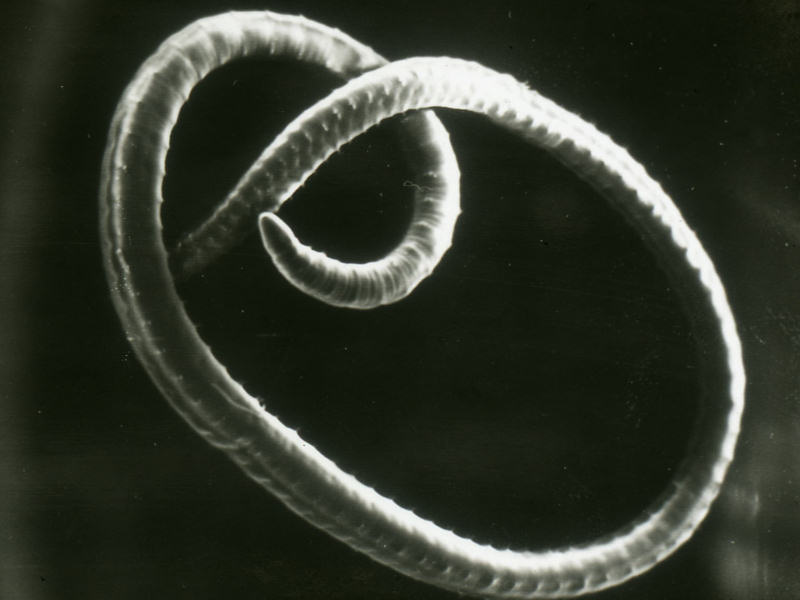
Tubifex tubifex.
Photographer: Whirling Disease Foundation Copyright: Whirling Disease Foundation
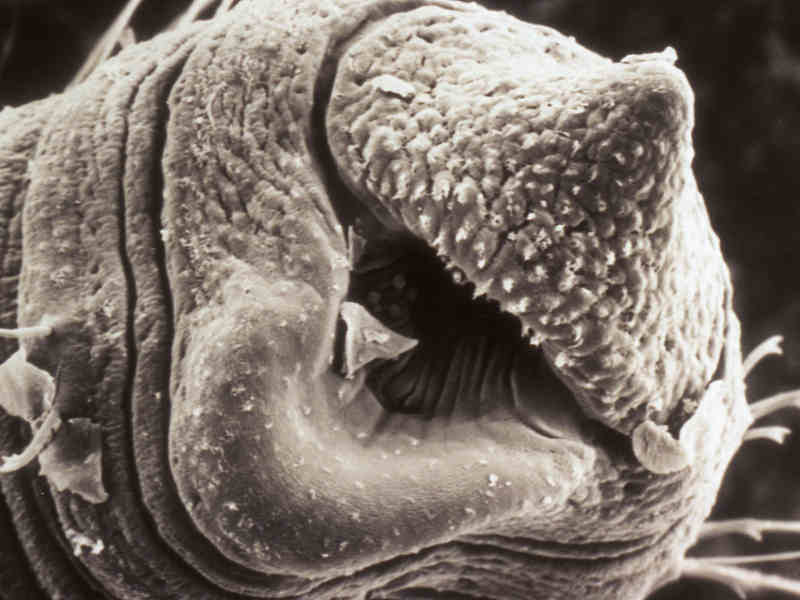
Electron micrograph of the head of Tubifex tubifex.
Photographer: Whirling Disease Foundation Copyright: Whirling Disease Foundation
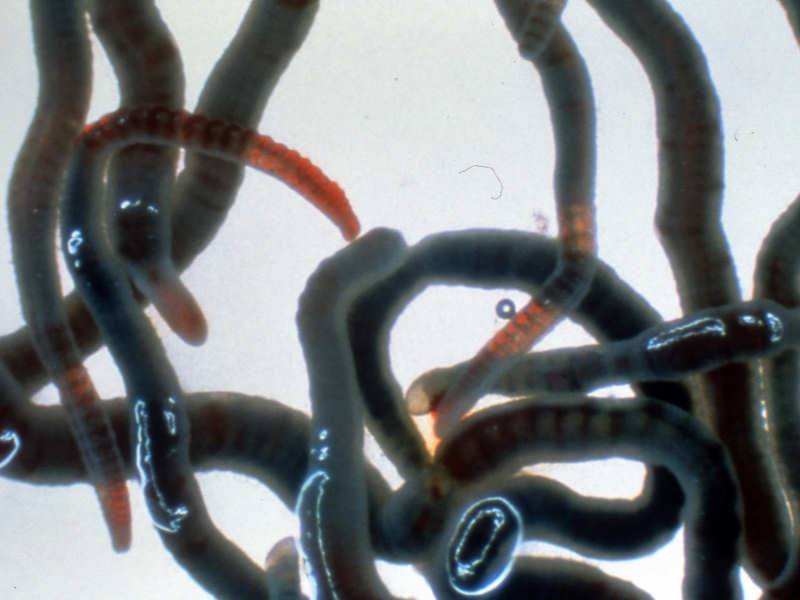
Group of Tubifex tubifex worms.
Photographer: Whirling Disease Foundation Copyright: Whirling Disease Foundation
Distribution data supplied by the Ocean Biodiversity Information System (OBIS). To interrogate UK data visit the NBN Atlas.Map Help
| Researched by | Georgina Budd | Refereed by | Admin |
| Authority | (Müller, 1774) | ||
| Other common names | Sewage worm | Synonyms | - |
Summary
Description
Tubifex tubifex is a slender segmented worm that may grow up to 20 cm in length. The number of body segments may number between 34-120 and have on each side an upper and lower bundle of chitinous bristles (setae), these are used for burrowing. The worm may appear red in colour owing to the possession of the respiratory pigment haemoglobin. The species is a hermaphrodite, with a complex reproductive system.
Recorded distribution in Britain and Ireland
Widely distributed around Britain and Ireland, but probably under recorded in surveys. Reported in the upper Forth, Humber, Thames, Tamar and Severn estuaries, also on the Norfolk coast east of Blyford, from mud in the Menai Strait, and from Belfast LoughGlobal distribution
-Habitat
Inhabits cohesive muds in a variety of habitats and is tolerant of oxygen deficiency. It is especially abundant in polluted sediments and marginal habitats not occupied by many other species, e.g. upper estuaries where interstitial salinity is less than 5 psu.Depth range
-Identifying features
Reference to Brinkhurst (1982) and Brinkhurst & Jamieson (1971) is recommended.
- Long, thin, segmented worm, that is red in colour.
- Eyespots absent.
- Testes in body segment X and male pore in segment XI.
- Ovaries in body segment XI and spermatheca (sac-shaped invagination of body wall for receiving sperm during copulation) in segment X.
- Dorsal setae hairs and pectinate setae occur from body segment II.
- Hair setae (slender and tapering) and pectinate setae (double-pointed with a series of fine intermediate teeth between the two points) are present in the dorsal bundles of bristles.
- Bifid (double-pointed) setae are present in ventral bundles of bristles.
- Hair setae may be serrate.
- There are no genital setae on mature specimens.
- The penis sheaths are short, tub-shaped, thin and covered in wrinkles.
Additional information
Oligochaetes are segmented, bilaterally symmetrical, cylindrical worms, with tapering ends. Typically each body segment possesses four bundles of setae (chitinous bristles projecting from the body). The setae vary considerably in size and shape, and between families, so are consequently used extensively in identification. Examination under a microscope and of internal anatomy is likely to be required for accurate identification (see Brinkhurst, 1982), and attention paid to the rather complex reproductive organs. The number of gonads, the position of one gonad relative to the other, and the body segments in which they occur are used to define families. In the Tubificidae the form of the male duct is used to define genera.
Listed by
- none -
Bibliography
Birtwell, I.K. & Arthur, D.R., 1980. The ecology of tubificids in the Thames Estuary with particular reference to Tubifex costatus (Claparède). In Proceedings of the first international symposium on aquatic oligochaete biology, Sydney, British Colombia, Canada, May 1-4, 1979. Aquatic oligochaete biology (ed. R.O. Brinkhurst & D.G. Cook), pp. 331-382. New York: Plenum Press
Brinkhurst, R.O. & Jamieson, B.G.M., 1971. Aquatic Oligochaeta of the world. Edinburgh: Oliver & Boyd.
Brinkhurst, R.O., 1982. British and other marine and estuarine oligochaetes. Cambridge University Press, [Synopses of the British Fauna, No. 21].
Howson, C.M. & Picton, B.E., 1997. The species directory of the marine fauna and flora of the British Isles and surrounding seas. Belfast: Ulster Museum. [Ulster Museum publication, no. 276.]
MBA (Marine Biological Association), 1957. Plymouth Marine Fauna. Plymouth: Marine Biological Association of the United Kingdom.
Datasets
Merseyside BioBank., 2018. Merseyside BioBank (unverified). Occurrence dataset: https://doi.org/10.15468/iou2ld accessed via GBIF.org on 2018-10-01.
NBN (National Biodiversity Network) Atlas. Available from: https://www.nbnatlas.org.
North East Scotland Biological Records Centre, 2017. NE Scotland other invertebrate records 1800-2010. Occurrence dataset: https://doi.org/10.15468/ifjfxz accessed via GBIF.org on 2018-10-01.
OBIS (Ocean Biodiversity Information System), 2025. Global map of species distribution using gridded data. Available from: Ocean Biogeographic Information System. www.iobis.org. Accessed: 2025-07-01
Rotherham Biological Records Centre, 2017. Rotherham Biological Records Centre - Non-sensitive Records from all taxonomic groups. Occurrence dataset: https://doi.org/10.15468/d3tufo accessed via GBIF.org on 2018-10-02.
South East Wales Biodiversity Records Centre, 2018. SEWBReC Worms (South East Wales). Occurrence dataset: https://doi.org/10.15468/5vh0w8 accessed via GBIF.org on 2018-10-02.
South East Wales Biodiversity Records Centre, 2018. Dr Mary Gillham Archive Project. Occurance dataset: http://www.sewbrec.org.uk/ accessed via NBNAtlas.org on 2018-10-02
Staffordshire Ecological Record, 2017. SER Species-based Surveys. Occurrence dataset: https://doi.org/10.15468/q8qen3 accessed via GBIF.org on 2018-10-02.
Citation
This review can be cited as:
Last Updated: 06/12/2005