
Trembling sea mat (Victorella pavida)
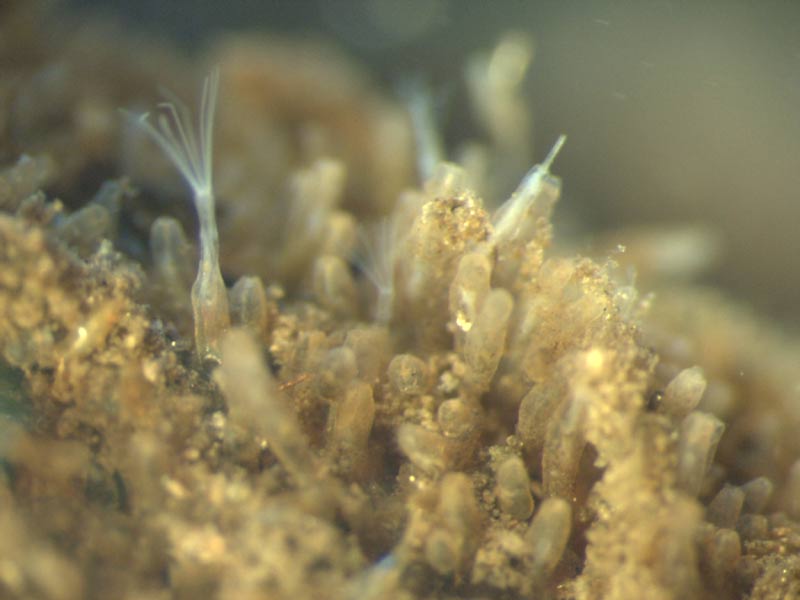
Zooids of Victorella pavida with lophophores everted.
Photographer: Michelle Carter Copyright: Marine Biological Association of the UK (MBA)
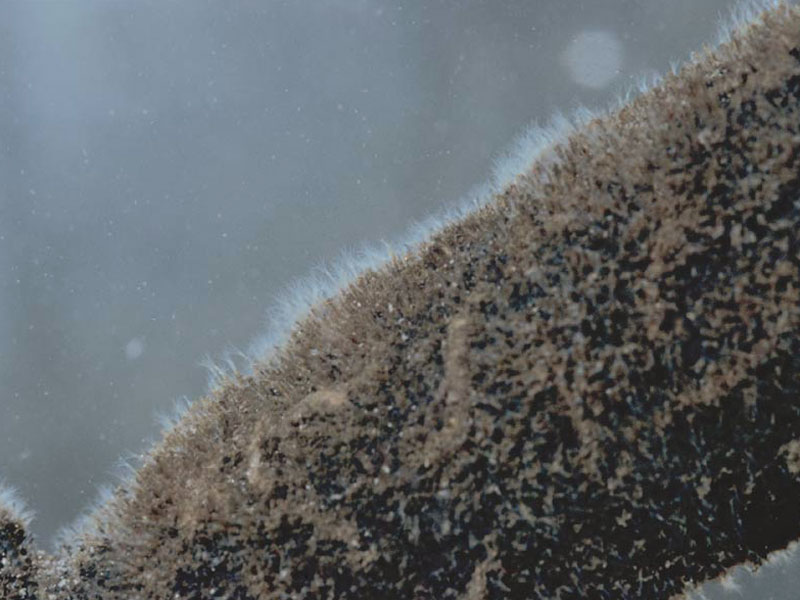
Colonies of Victorella pavida on plant stem.
Photographer: Dr Keith Hiscock Copyright: Dr Keith Hiscock
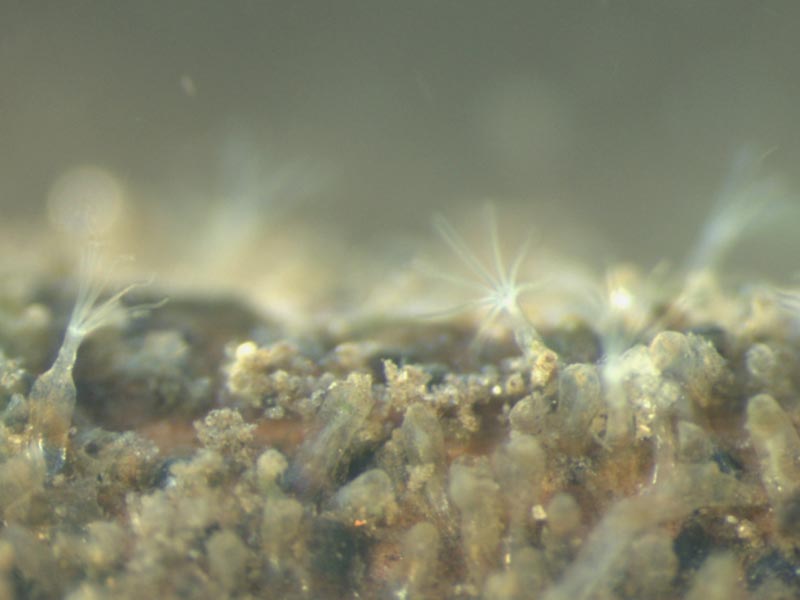
Lophophores and zooids of Victorella pavida.
Photographer: Michelle Carter Copyright: Marine Biological Association of the UK (MBA)
Distribution data supplied by the Ocean Biodiversity Information System (OBIS). To interrogate UK data visit the NBN Atlas.Map Help
| Researched by | Michelle Carter & Angus Jackson | Refereed by | This information is not refereed |
| Authority | Saville-Kent, 1870 | ||
| Other common names | - | Synonyms | - |
Summary
Description
This creature looks more like a plant than an animal. It is a colonial bryozoan that may form either diffuse branching chains or develop into dense clumps. During the peak of the growth season (summer), colonies have the appearance and texture of velvet. Individuals within a colony vary in shape and size. Attached zooids posses a roughly oval base and a cylindrical peristome (erect tube). Erect zooids may be cylindrical of slightly bulbous at the base. In dense colonies the zooids may be as short as 0.3 mm and in diffuse colonies they may reach 1 mm long.
Recorded distribution in Britain and Ireland
In the British Isles, Victorella pavida is only found in Swanpool: a brackish water lagoon near Falmouth in Cornwall.
Global distribution
Various sites on the southern shores of the North Sea on the European Mainland. Common in the Mediterranean. Also reported from India, the Black Sea, the Baltic, Brazil, the eastern United States and Japan.
Habitat
Found in areas of low and fluctuating salinity such as estuaries and lagoons. The trembling sea mat grows in shallow water on submerged stones, plants and wood as well as artificial substrata such as concrete.
Depth range
5 mIdentifying features
- Colonies may consist of dense clumps or chains of zooids.
- Individual zooids may be up to 1 mm in size.
- Attached zooids posses a cylindrical base with a tubular extension (peristome).
- The sphincter is situated at the base of the gut.
- Gizzard absent.
- Eight tentacles.
- Embryos released through special intertentacular organ.
Produces dark brown/black hibernacula (dormant resting buds).
Additional information
No text entered
Listed by
Biology review
Taxonomy
| Level | Scientific name | Common name |
|---|---|---|
| Phylum | Bryozoa | Sea mats, horn wrack & lace corals |
| Class | Gymnolaemata | Naked throat bryozoans |
| Order | Ctenostomatida | |
| Family | Victorellidae | |
| Genus | Victorella | |
| Authority | Saville-Kent, 1870 | |
| Recent Synonyms | ||
Biology
| Parameter | Data | ||
|---|---|---|---|
| Typical abundance | High density | ||
| Male size range | |||
| Male size at maturity | |||
| Female size range | Very small(<1cm) | ||
| Female size at maturity | |||
| Growth form | Mat | ||
| Growth rate | 8cm/month | ||
| Body flexibility | No information | ||
| Mobility | Sessile, permanent attachment | ||
| Characteristic feeding method | Active suspension feeder | ||
| Diet/food source | Planktotroph | ||
| Typically feeds on | Microalgae, rotifers. | ||
| Sociability | Colonial | ||
| Environmental position | Epifaunal | ||
| Dependency | See additional information. | ||
| Supports | No information | ||
| Is the species harmful? | No | ||
Biology information
Environmental position. At Swanpool, the trembling sea mat can be found growing on any hard surfaces such as stones, traffic cones, and concrete structures but has a particular predilection for submerged stems and rhizomes of Phragmites australis.
Associated fauna. Several taxa are consistently present living amongst Victorella pavida colonies, and on the Phragmites reeds, forming a community of aquatic organisms collectively termed 'Aufwuchs'. Taxa typically present include: chironomid larvae, nematodes, protozoans Stentor spp. and Zoothamnium spp., green and brown algae, mites, Nais spp., freshwater bryozoan Plumatella repens, and various small freshwater crustaceans including Gammarus chevreuxi.
Growth rate. Approximately 8 cm of linear growth over one month was observed in cultured colonies of Victorella pavida (Carter, 2004).
Habitat preferences
| Parameter | Data |
|---|---|
| Physiographic preferences | Isolated saline water (Lagoon) |
| Biological zone preferences | Not relevant |
| Substratum / habitat preferences | Artificial (man-made), Mixed, Other species (see additional information) |
| Tidal strength preferences | No information |
| Wave exposure preferences | Ultra sheltered |
| Salinity preferences | See additional Information |
| Depth range | 5 m |
| Other preferences | None known |
| Migration Pattern | Non-migratory or resident |
Habitat Information
Salinity. The salinity of Swanpool is highly variable (0.5-22 psu) (Carter, 2004). A culvert connects the lagoon to the sea, with the incursion of seawater occurring on very high tides such as spring tides. At the northern end of Swanpool, the lagoon is fed freshwater from the Tregoniggie stream as well as diffuse drainage from a local catchment (Gainey, 1997; Evans, 2003).
Substratum. Victorella pavida can grow on any hard surface and in Swanpool can be found growing on concrete surfaces, stones, traffic cones and mainly Phragmites australis.
Life history
Adult characteristics
| Parameter | Data |
|---|---|
| Reproductive type | Protandrous hermaphrodite |
| Reproductive frequency | See additional information |
| Fecundity (number of eggs) | See additional information |
| Generation time | <1 year |
| Age at maturity | 8 weeks |
| Season | June - September |
| Life span | See additional information |
Larval characteristics
| Parameter | Data |
|---|---|
| Larval/propagule type | - |
| Larval/juvenile development | Lecithotrophic |
| Duration of larval stage | < 1 day |
| Larval dispersal potential | No information |
| Larval settlement period |
Life history information
Lifespan. The lifespan of an individual zooid has not been researched in this species. Generally, the polypides (combined lophophore and gut) of individual zooids within a bryozoan colony have the potential to undergo a cyclical degeneration and regeneration process. Polypides may last for one week up to 10 weeks (Reed, 1991). With respect to the lifespan of a Victorella pavida colony, new colonies emerge from dormancy during the spring and when temperatures are approximately 13°C. By November and the onset of winter, zooids begin to degenerate and eventually only the asexually produced dormant resting bodies (hibernacula) remain. The hibernacula germinate again in the spring and the cycle begins again (Carter, 2004).
Reproduction frequency. Reproduction is seasonal and eggs were observed in zooids from June to September. The colony degenerates after reproduction, in preparation for winter dormancy (Carter, 2004).
Fecundity. Approximately 25 eggs can be produced per gravid zooid (Carter, 2004). Overall colony fecundity, therefore, varies with the size of the colony.
Sensitivity review
The MarLIN sensitivity assessment approach used below has been superseded by the MarESA (Marine Evidence-based Sensitivity Assessment) approach (see menu). The MarLIN approach was used for assessments from 1999-2010. The MarESA approach reflects the recent conservation imperatives and terminology and is used for sensitivity assessments from 2014 onwards.
Physical pressures
Use / to open/close text displayed
| Intolerance | Recoverability | Sensitivity | Evidence / Confidence | |
Substratum loss [Show more]Substratum lossBenchmark. All of the substratum occupied by the species or biotope under consideration is removed. A single event is assumed for sensitivity assessment. Once the activity or event has stopped (or between regular events) suitable substratum remains or is deposited. Species or community recovery assumes that the substratum within the habitat preferences of the original species or community is present. Further details EvidenceVictorella pavida requires hard substrata for larval settlement and growth and can grow on stones but has a particular predilection for Phragmites australis. Removal of any hard substrata could potentially remove a significant proportion of the Swanpool population permanently and is therefore considered highly intolerant of substratum loss. However, recoverability is considered moderate on the basis that it may be possible for residual hibernacula to germinate and any remaining colonies can potentially undergo clonal propagation. The possibility that Phragmites australis will be partially or fully removed is low due to the level of protection imposed on reedbed habitats (see IMU.NVC_S4) and Swanpool lagoon. | High | Moderate | Moderate | Moderate |
Smothering [Show more]SmotheringBenchmark. All of the population of a species or an area of a biotope is smothered by sediment to a depth of 5 cm above the substratum for one month. Impermeable materials, such as concrete, oil, or tar, are likely to have a greater effect. Further details. EvidenceThe ability of Victorella pavida to tolerate or recover from a smothering incident would be dependent on the nature and duration of smothering event. As an active suspension feeder this sea mat is dependent on the orifice of the zooid remaining clear in order to evert a ring of tentacles to feed. Culturing Victorella pavida in low salinities (e.g. <18 psu) can promote the growth of a gromiid freshwater amoeba of the genus Lecythium. This organism produces a matrix of branching pseudopodia that extends between and over the zooids rendering the zooids unable to evert their tentacles to feed. Eventually all colonies died (Carter, 2004). No evidence of such activity exists in the wild population. Therefore, intolerance to smothering is recorded as intermediate and recoverability as moderate. | Intermediate | Moderate | Moderate | Moderate |
Increase in suspended sediment [Show more]Increase in suspended sedimentBenchmark. An arbitrary short-term, acute change in background suspended sediment concentration e.g., a change of 100 mg/l for one month. The resultant light attenuation effects are addressed under turbidity, and the effects of rapid settling out of suspended sediment are addressed under smothering. Further details EvidenceIn the event of high siltation due to severe disturbance, particles of silt can attach to the feeding tentacles or block the orifice and prevent the eversion of the tentacles. The freshwater run-off was diverted into Swanpool, by South West Water, from a new housing development in 1983. Subsequent development around Swanpool increased the freshwater input with a concomitant decrease in salinity, which may have a detrimental effect on the population (Gainey, 1997), as the trembling sea mat is intolerant of low salinity (<3.5 psu) for lengthy periods (see Salinity below). After rain, the freshwater stream entering Swanpool lagoon is heavily laden with silt. Additional silt enters the lagoon as run-off from surrounding roads. Trembling sea mat populations are at risk from smothering in the long term as a result of increased siltation (Gainey, 1997). During a survey of the lagoon in 2003 it was confirmed that the greatest sedimentation occurred at the freshwater inlet site at 500-5000 g/m-2 (Evans et al., 2003). The authors indicated such levels of sedimentation appear to have no detrimental effect on the abundance of Victorella pavida at the freshwater inlet site. However, any possible adverse effect of sedimentation on abundance at the freshwater inlet site is compounded by a reduction in salinity. Overall, it appears that siltation alone would not have a detrimental effect at the benchmark level and, therefore, tolerant has been suggested. | Tolerant | Not relevant | Not sensitive | Moderate |
Decrease in suspended sediment [Show more]Decrease in suspended sedimentBenchmark. An arbitrary short-term, acute change in background suspended sediment concentration e.g., a change of 100 mg/l for one month. The resultant light attenuation effects are addressed under turbidity, and the effects of rapid settling out of suspended sediment are addressed under smothering. Further details EvidenceAs an active suspension feeder this sea mat is dependent on the orifice of the zooid remaining clear in order to evert a ring of tentacles to feed. An increase in suspended sediment could potentially smother the colony rendering the zooids unable to evert their tentacles to feed. On this basis a decrease in suspended sediment would be beneficial to the growth colony. In addition, a reduction of particles is likely to encourage larval settlement and subsequent growth of the colony. Therefore, the trembling sea mat is considered tolerant. | Tolerant | Not relevant | Not sensitive | Low |
Desiccation [Show more]Desiccation
EvidenceVictorella pavida would be unable to tolerate emersion for extended periods of time. A permanent or semi-permanent reduction in water level in Swanpool, even by 1 metre, could have lethal implications with a severe decline in abundance. Devoid of any passing food particles, zooids would be unable to feed and grow and will eventually die. On this basis Victorella pavida is considered as highly intolerant of desiccation. However, this sea mat does have a 'safety net' in the form of hibernacula (asexually produced dormant resting buds), which provides a means of refuge for the duration of unfavourable conditions. Upon resumption of favourable conditions the hibernaculum will germinate giving rise to a new colony (Evans et al, 2003). Recoverability is defined as moderate and dependent on length of emersion as hibernacula are only short-term resting bodies, losing 80% viability in 10 months (Carter, 2004, pers. obs.). | High | Moderate | Moderate | Moderate |
Increase in emergence regime [Show more]Increase in emergence regimeBenchmark. A one hour change in the time covered or not covered by the sea for a period of one year. Further details EvidenceIncreased emergence will expose populations to increased risk of desiccation (see above), increased extremes of temperature, and decreased length of time for feeding. Hence, a high intolerance of increased emergence has been recorded. During unfavourable conditions, Victorella pavida has the potential to regress into dormancy by producing resting buds called hibernacula, and re-emerge during favourable conditions. On this basis, recoverability is recorded as moderate and dependent on the length of emergence as hibernacula are short-term resting bodies and can potentially lose 50% viability in five months). | High | Moderate | Moderate | Moderate |
Decrease in emergence regime [Show more]Decrease in emergence regimeBenchmark. A one hour change in the time covered or not covered by the sea for a period of one year. Further details EvidenceA decrease in emersion will decrease the risk of desiccation and effectively provide additional substrata for colonization, potentially allowing the Victorella pavida population to increase. Therefore, tolerant* has been recorded. | Tolerant* | Not relevant | Not sensitive* | High |
Increase in water flow rate [Show more]Increase in water flow rateA change of two categories in water flow rate (view glossary) for 1 year, for example, from moderately strong (1-3 knots) to very weak (negligible). Further details EvidenceThe major source of water flow arises from the freshwater stream inlet. The flow rate at the inlet is low in the summer reaching a peak of 200 m3.h-1 in November (Evans et al., 2003). Evans et al. (2003) found a significant positive correlation between flow rate and cumulative rainfall over 28 days. An increase in flow rate would disturb the sediment and increase the amount of suspended silt and particles, which may have deleterious consequences for feeding and growth (see suspended sediment above). The abundance of Victorella pavida is 30% less at the freshwater inlet site compared with the rest of the lagoon, any effect of increased flow rate and/ or increased silt as a result of heavy rain, would be compounded by decreases in salinity (Carter, 2004). <p>The incursion of seawater into the lagoon, via a culvert, tends to occur at very high tides (i.e. tides of a height >+5.64 m CD) (Evans et al., 2003). The inflow of seawater into the lagoon has been recorded to be between 1100-3500 m3 (Dorey et al., 1973). Gainey (1997) recorded the abundance of the trembling sea mat as common to frequent around the culvert. Intolerance is recorded as intermediate, due to the dynamics of the lagoon extensive fluctuations in flow rate do not effect the whole lagoon. Recoverability is therefore recorded as high. </p> | Intermediate | High | Low | Moderate |
Decrease in water flow rate [Show more]Decrease in water flow rateA change of two categories in water flow rate (view glossary) for 1 year, for example, from moderately strong (1-3 knots) to very weak (negligible). Further details EvidenceA degree of water flow is required for transportation of food particles. However, due to the dynamic nature of the lagoon (see above) the water in the lagoon is rarely stagnant for extended periods. Bryozoans have tiny hairs, or cilia, on each tentacle which beat and create a localised current around the colony (Ryland, 1970). This action provides a current to draw food towards the mouth. On this basis, tolerant has been recorded. | Tolerant | Not relevant | Not sensitive | Low |
Increase in temperature [Show more]Increase in temperature
For intertidal species or communities, the range of temperatures includes the air temperature regime for that species or community. Further details EvidenceThe growth rate of Victorella pavida increases with temperature. During laboratory culture, a two-fold increase in growth rate was observed in colonies initially cultured at 15°C followed by 19°C (Carter, 2004). In the Cochin Waters of India, Victorella pavida can survive monsoon and post-monsoon conditions and was recorded as occurring commonly during the post-monsoon season and surviving temperatures of around 30°C (Menon & Nair, 1971). The growth cycle of Victorella pavida is seasonal and therefore temperature dependent. In the winter, colonies are dormant in the form of hibernacula; when temperatures reach 13°C, the hibernaculum will germinate giving rise to a new colony (Carter, 2004). It would be intuitive to suggest that a permanent/semi-permanent increase in temperature above 13°C would be conducive to the existence of a permanently active population. Menon & Nair (1967) examined the abundance of Victorella pavida in Cochin Waters. The temperature over a year ranged from 21.1 to 32.4, however, the abundance of Victorella pavida appeared to be influenced by the monsoon and hence salinity fluctuations; colonies were abundant during the monsoon and post-monsoon periods, which coincides with a low salinity but absent during pre-monsoon periods when a full salinity was recorded, therefore, a complete absence during pre-monsoon periods is due to salinity and not temperature (Menon & Nair, 1967). Victorella pavida appears tolerant of increases in temperature and no data exists to suggest that acute temperature change is detrimental. Recoverability is recorded as high. | Tolerant | Not relevant | Not sensitive | Moderate |
Decrease in temperature [Show more]Decrease in temperature
For intertidal species or communities, the range of temperatures includes the air temperature regime for that species or community. Further details EvidenceIn Swanpool, colonies of Victorella pavida die-off when exposed to temperatures below 12°C (Carter, 2004). However, this species produces resting stages called hibernacula that enable colonies to remain dormant for the duration of the winter (Ryland, 1970; Bushnell & Rao, 1974; Silen, 1977; Evans et al., 2003). Therefore, whilst this species may be tolerant of low temperatures an ability to recover from a period of cold would depend on the length of time in dormancy and whether favourable temperatures resume to allow for germination. Therefore recoverability is recorded as moderate. | Tolerant | Not relevant | Not sensitive | High |
Increase in turbidity [Show more]Increase in turbidity
EvidenceAn increase in turbidity is likely to result in a decrease in phytoplankton which may reduce food availability for Victorella pavida. Therefore an intolerance of low has been recorded. | Low | Not relevant | NR | Moderate |
Decrease in turbidity [Show more]Decrease in turbidity
EvidenceA decrease in turbidity is likely to increase primary productivity and food availability for Victorella pavida and is unlikely to be adversely effected by a decrease in turbidity, so tolerant has been recorded. | Tolerant | Not relevant | Not sensitive | Moderate |
Increase in wave exposure [Show more]Increase in wave exposureA change of two ranks on the wave exposure scale (view glossary) e.g., from Exposed to Extremely exposed for a period of one year. Further details EvidenceSwanpool is considered as an extremely sheltered site and the movement of water as a result of high winds would be negligible. An increase in exposure, and therefore wind/wave exposure, as a result of habitat degradation is also unlikely due to the protected status of the reed bed and lagoon. | Not relevant | Not relevant | Not relevant | Not relevant |
Decrease in wave exposure [Show more]Decrease in wave exposureA change of two ranks on the wave exposure scale (view glossary) e.g., from Exposed to Extremely exposed for a period of one year. Further details EvidenceA decrease in wave exposure would have no impact on Victorella pavida. Swanpool lagoon is a very sheltered site and a further decrease in wave exposure is unlikely. | Not relevant | Not relevant | Not relevant | Not relevant |
Noise [Show more]Noise
EvidenceThe trembling sea mat is very sensitive to touch and vibration (Carter, 2004. pers. obs) and will retract their tentacles as a result, disrupting feeding. Therefore, colonies may react to local vibrations as a result of acute transmissions of sound. On this basis a intolerance of low has been recorded. | Intermediate | Immediate | Very Low | Moderate |
Visual presence [Show more]Visual presenceBenchmark. The continuous presence for one month of moving objects not naturally found in the marine environment (e.g., boats, machinery, and humans) within the visual envelope of the species or community under consideration. Further details EvidenceSome bryozoans may posses photoreceptors as evidence has shown that germination of the dormant resting buds of some freshwater bryozoans is dependent on light (Mukai, 1974; Oda, 1980). However, the visual acuity of bryozoans would be negligible. | Not relevant | Not relevant | Not relevant | Not relevant |
Abrasion & physical disturbance [Show more]Abrasion & physical disturbanceBenchmark. Force equivalent to a standard scallop dredge landing on or being dragged across the organism. A single event is assumed for assessment. This factor includes mechanical interference, crushing, physical blows against, or rubbing and erosion of the organism or habitat of interest. Where trampling is relevant, the evidence and trampling intensity will be reported in the rationale. Further details. EvidenceAs a ctenostome bryozoan, the body wall of Victorella pavida is composed of a non-calcified, flexible cuticle (Hayward, 1985). The body wall is potentially easily penetrable and any contact with a firm object will have lethal consequences therefore an intolerance of intermediate has been recorded. Recoverability is likely to be high. | Intermediate | High | Moderate | Moderate |
Displacement [Show more]DisplacementBenchmark. Removal of the organism from the substratum and displacement from its original position onto a suitable substratum. A single event is assumed for assessment. Further details EvidenceRemoval of a colony from its substratum would probably be fatal, yet Victorella pavida can potentially extend the growth of the pseudostolon towards the substratum to re-attach. Intolerance has been assessed as high with a moderate recoverability. | High | Moderate | Moderate | Moderate |
Chemical pressures
Use [show more] / [show less] to open/close text displayed
| Intolerance | Recoverability | Sensitivity | Evidence / Confidence | |
Synthetic compound contamination [Show more]Synthetic compound contaminationSensitivity is assessed against the available evidence for the effects of contaminants on the species (or closely related species at low confidence) or community of interest. For example:
The evidence used is stated in the rationale. Where the assessment can be based on a known activity then this is stated. The tolerance to contaminants of species of interest will be included in the rationale when available; together with relevant supporting material. Further details. EvidenceBryozoans are common members of the fouling community, and amongst those organisms most resistant to antifouling measures, such as copper containing anti-fouling paints (Soule & Soule, 1977; Holt et al., 1995). Bryan & Gibbs (1991) reported that there was little evidence regarding TBT toxicity in Bryozoa with the exception of the encrusting Schizoporella errata, which suffered 50% mortality when exposed for 63 days to 100ng/l TBT. Rees et al. (2001) reported that the abundance of epifauna (including bryozoans) had increased in the Crouch estuary in the five years after TBT was banned from use on small vessels. This last report suggests that bryozoans may be at least inhibited by the presence of TBT. Therefore, an intolerance of intermediate has been recorded. Recoverability is probably high. | Intermediate | Very high | Low | Low |
Heavy metal contamination [Show more]Heavy metal contaminationEvidenceBryozoans are common members of the fouling community, and amongst those organisms most resistant to antifouling measures, such as copper containing anti-fouling paints (Soule & Soule, 1977; Holt et al., 1995). Bryozoans were shown to bioaccumulate heavy metals to a certain extent (Holt et al., 1995). For example, Bowerbankia gracialis and Nolella pusilla accumulated Cd, exhibiting sublethal effects (reduced sexual reproduction and inhibited resting spore formation) between 10-100 g Cd /l and fatality above 500 g Cd/l (Kayser, 1990). Given the tolerance of bryozoans to copper based anti-fouling treatments, and assuming similar physiology between species, an intolerance of low has been recorded albeit with very low confidence. | Low | Immediate | Not sensitive | Low |
Hydrocarbon contamination [Show more]Hydrocarbon contaminationEvidenceLittle information on the effects of hydrocarbons on bryozoans was found. Ryland & de Putron (1998) did not detect adverse effects of oil contamination on the bryozoan Alcyonidium spp. or other sessile fauna in Milford Haven or St. Catherine's Island, south Pembrokeshire. Houghton et al. (1996) reported a reduction in the abundance of intertidal encrusting Bryozoa (no species given) at oiled sites after the Exxon Valdez oil spill. Soule & Soule (1979) reported that the encrusting bryozoan Membranipora villosa was not found in the impacted area for 7 months after the December 1976 Bunker C oil spill in Los Angeles Harbour. Of the eight species of bryozoan recorded on the nearby breakwater two weeks after the incident, only three were present in April and by June all had been replaced by dense growths of the erect bryozoan Scrupocellaria diegensis. Mohammad (1974) reported that Bugula spp. and Membranipora spp. were excluded from settlement panels near a Kuwait oil terminal subject to minor but frequent oil spills. Encrusting bryozoans are also probably intolerant of the smothering effects of oil pollution, resulting in suffocation of colonies. Therefore, given the above evidence of intolerance in other bryozoans, a intolerance of high has been recorded, albeit at low confidence. Recoverability is probably moderate. | High | Moderate | Moderate | Very low |
Radionuclide contamination [Show more]Radionuclide contaminationEvidenceInsufficient | No information | Not relevant | No information | Not relevant |
Changes in nutrient levels [Show more]Changes in nutrient levelsEvidenceA moderate increase in nutrient levels may increase the food available to Victorella pavida, either in the form of phytoplankton or detritus. However, no effects of nutrient enrichment were found. | No information | Not relevant | No information | Not relevant |
Increase in salinity [Show more]Increase in salinity
EvidenceVictorella pavida is considered to be a euryhaline species (Ryland, 1970). The salinity in Swanpool is highly variable, ranging from zero to 22 psu (Evans et al., 2003). Recent experiments on hibernacula germination found that germination will occur quite readily in 3.5 and 18 psu (68 and 69% respectively) but is severely retarded in 36 psu (20%). However, after a month exposed to the three salinities, extensive colony growth occurred in 18 psu and also in the 36 psu whilst zooids exposed to 3.5 psu all died (Carter, 2004). Whilst hibernacula germination is severely retarded in 36 psu, subsequent colony growth is quite extensive and therefore zooids are very tolerant of full salinity. | Tolerant | Very high | Not sensitive | High |
Decrease in salinity [Show more]Decrease in salinity
EvidenceIn Swanpool, colonies of Victorella pavida are 30% less abundant at the freshwater stream inlet than other sites around the lagoon (Carter, 2004). This decrease in abundance may be due to the periodic low salinity in that area as a result of increased freshwater input from heavy rainfall. Experiments on the germination of hibernacula (see above) found that zooids of Victorella pavida are highly intolerant of low salinities (<3.5 psu) for extended periods. Whilst hibernacula will germinate readily in 3.5 psu, colony growth did not extend beyond the primary zooid and after 20 days, all zooids had died (Carter, 2004). Further experimentation found 5 psu to be lethal also, and the optimum salinity for germination and growth appeared to be 13 psu (Carter, 2004). On this basis, intolerance to decreased salinity is low and also recoverability would be high. | Low | High | Moderate | High |
Changes in oxygenation [Show more]Changes in oxygenationBenchmark. Exposure to a dissolved oxygen concentration of 2 mg/l for one week. Further details. EvidenceNo information on the tolerance of Victorella pavida to changes in oxygen was found. | Not relevant | Not relevant | Not relevant | Not relevant |
Biological pressures
Use [show more] / [show less] to open/close text displayed
| Intolerance | Recoverability | Sensitivity | Evidence / Confidence | |
Introduction of microbial pathogens/parasites [Show more]Introduction of microbial pathogens/parasitesBenchmark. Sensitivity can only be assessed relative to a known, named disease, likely to cause partial loss of a species population or community. Further details. EvidenceDuring culturing of wild populations of Victorella pavida at low salinities (3.5 and 5 psu), the colony can be overcome by a freshwater gromiid amoeba of the genus Lecythium. The Lecythium sp. produces branching pseudopodia that extend between and over the zooids to the extent that the zooids are unable to evert their tentacles to feed and subsequently died (Carter, 2004). However, there is no information available on the impact of microbes on wild populations of Victorella pavida. | No information | Not relevant | No information | Not relevant |
Introduction of non-native species [Show more]Introduction of non-native speciesSensitivity assessed against the likely effect of the introduction of alien or non-native species in Britain or Ireland. Further details. EvidenceNo information found. | No information | Not relevant | No information | Not relevant |
Extraction of this species [Show more]Extraction of this speciesBenchmark. Extraction removes 50% of the species or community from the area under consideration. Sensitivity will be assessed as 'intermediate'. The habitat remains intact or recovers rapidly. Any effects of the extraction process on the habitat itself are addressed under other factors, e.g. displacement, abrasion and physical disturbance, and substratum loss. Further details. EvidenceAs a protected species, Victorella pavida is unlikely to be removed to the extent of the benchmark level. | Not relevant | Not relevant | Not relevant | Not relevant |
Extraction of other species [Show more]Extraction of other speciesBenchmark. A species that is a required host or prey for the species under consideration (and assuming that no alternative host exists) or a keystone species in a biotope is removed. Any effects of the extraction process on the habitat itself are addressed under other factors, e.g. displacement, abrasion and physical disturbance, and substratum loss. Further details. EvidenceVictorella pavida is commonly found growing on Phragmites australis, which extends around the periphery of Swanpool. Complete removal of this habitat would effectively be a removal of approximately 70% of available substrata for Victorella pavida, this would certainly have deleterious consequences for the population. Therefore intolerance of extraction is high and recoverability is low. However, extraction of this reedbed is unlikely to occur due to the protected status of the lagoon (County Wildlife Site, SSSI, and Local Nature Reserve). | High | Low | High | Low |
Additional information
Recoverability. Victorella pavida has a short-lived planktonic larvae, which probably settle from July to September. Victorella pavida can colonize a wide variety of substrata and is a common member of the fouling communities. Therefore, it is able to colonize new habitats or free space rapidly, probably in 6 months or less. Upon emergence from dormancy during the spring, subsequent growth and development is rapid and by approximately 8 weeks from emergence, sexual reproduction commences. Subsequent expansion can then be quite rapid and a new population can be established within a year.
Importance review
Policy/legislation
| Designation | Support |
|---|---|
| Wildlife & Countryside Act | Schedule 5, section 9 |
| UK Biodiversity Action Plan Priority | Yes |
| Species of principal importance (England) | Yes |
| Features of Conservation Importance (England & Wales) | Yes |
Status
| National (GB) importance | Nationally rare | Global red list (IUCN) category | - |
Non-native
| Parameter | Data |
|---|---|
| Native | Non-native |
| Origin | Unknown |
| Date Arrived | 1868 |
Importance information
There is insufficient information available to give an IUCN category but the species has been listed as a Red Data Book species. However, Victorella pavida is listed in the UK Biodiversity Action Plan long list of species of conservation concern (Biodiversity Steering Group, 1995).Bibliography
Bushnell, J.H. & Rao, K.S., 1974. Dormant or quiescent stages and structures among the ectoprocta: physical and chemical factors affecting viability and germination of statoblasts. Transactions of the American Microscopical Society, 93, 524-543.
Carter, M. C. 2004. The biology and genetic diversity of the trembling sea mat Victorella pavida (Bryozoa: Ctenostomata) from Swanpool, Falmouth. , M.Res Thesis, University of Plymouth.
Dorey, A.E., Little, C. & Barnes, R.S.K., 1973. An ecological study of the Swanpool, Falmouth. II. Hydrography and its relation to animal distributions. Estuarine, Coastal and Shelf Science, 1, 153-176.
Eagle, R.A. & Rees, E.I.S., 1973. Indicator species - a case for caution. Marine Pollution Bulletin, 4, 25.
Evans, N.J., Bamber, R.N., Smith, B.D., Clark, P.F., Taylor, H., Lund, P. & Chimonides, P.J., 2003. Swanpool ecological study, Falmouth, Cornwall. Final Report (No. ECM 775/03).
Gainey, P.A. 1997. Trembling sea-mat. Baseline distribution in England and species action plan. English Nature Research Report, no. 225.
Hayward, P.J. 1985. Ctenostome Bryozoans. Bath: Pitman Press. [Synopses of the British Fauna, no. 33.]
Howson, C.M. & Picton, B.E., 1997. The species directory of the marine fauna and flora of the British Isles and surrounding seas. Belfast: Ulster Museum. [Ulster Museum publication, no. 276.]
Menon, N.R. & Nair, N.B. 1967. Observations on the structure and ecology of Victorella pavida Kent (Bryozoa) for the south west coast of India. Internationale Revue der Gesamten Hydrobiologie, 52, 237-256.
Menon, N.R. & Nair, N.B. 1971. Ecology of fouling bryozoans in Cochin waters. Marine Biology, 8, 280-307.
Mukai, H. 1974. Germination of the statoblasts of a freshwater bryozoan, Pectinatella gelatinosa. Journal of Experimental Zoology, 187, 27-39.
Oda, S., 1979. Germination of the statoblasts of Pectinatella magnifica, a freshwater bryozoan. In Advances in Bryozoology (ed. G.P. Larwood & M.B. Abbott), pp. 93-112. London: Academic Press. [Systematics Association Special vol. 13.]
Reed, C.G., 1991. Bryozoa. In Reproduction of marine invertebrates, vol. VI. Echinoderms and Lophophorates (ed. A.C. Geise, J.S. Pearse & V.B. Pearse), pp. 85-245. California: Boxwood Press.
Datasets
NBN (National Biodiversity Network) Atlas. Available from: https://www.nbnatlas.org.
OBIS (Ocean Biodiversity Information System), 2025. Global map of species distribution using gridded data. Available from: Ocean Biogeographic Information System. www.iobis.org. Accessed: 2025-07-01
Citation
This review can be cited as:
Last Updated: 03/09/2007