
A springtail (Anurida maritima)
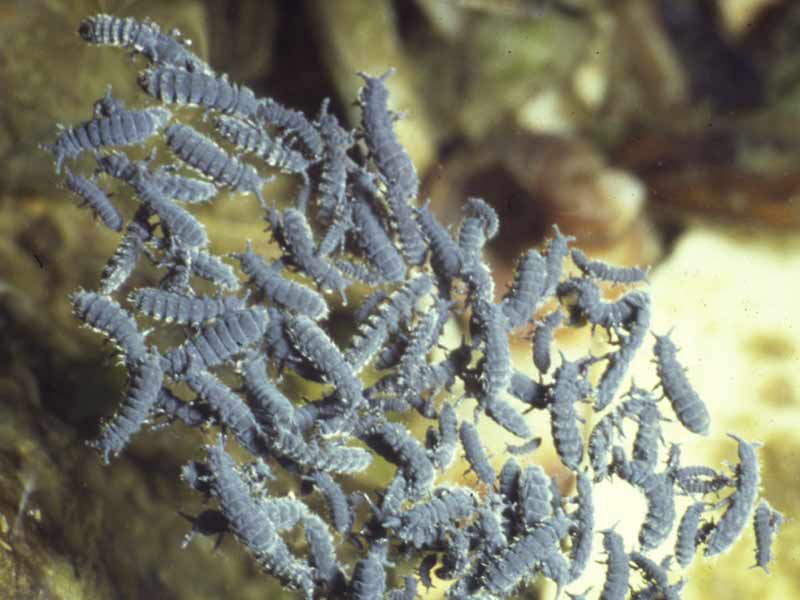
Anurida maritima on water surface.
Photographer: Marco Faasse Copyright: Marco Faasse
Distribution data supplied by the Ocean Biodiversity Information System (OBIS). To interrogate UK data visit the NBN Atlas.Map Help
| Researched by | Sonia Rowley | Refereed by | Admin |
| Authority | (Guérin-Méneville, 1836) | ||
| Other common names | - | Synonyms | Lipura maritima |
Summary
Description
Recorded distribution in Britain and Ireland
This species can be found about the coasts of Britain and Ireland, but has not been recorded on the north east Scottish and south east Irish coasts. However, it may be under recorded.Global distribution
-Habitat
Anurida maritima is abundant and primarily limited to the upper intertidal zone. It can be found in large clusters of 20-100's wandering over rocks in search of food or floating on the surface film of upper shore rock pools (only when the water is still). This species retreats into rocky crevices, or shelters under weeds during high tide: retreating one hour before the tide begins to rise.Depth range
-Identifying features
- Segmented body with 6 legs and no wings.
- Cylindrical body covered in short hairs.
- Up to 3 mm in length.
- Blackish-blue to slate-blue in colour.
- Small black eyes on head.
Additional information
This species is hydrophobic, the whitish coating of small hairs on the body acting as a waterproof layer. The trapped air is used for respiration. This enables Anurida maritima to withstand submersion for 2 days (and in vivo up to 5 days).Anurida maritima feeds on dead marine animals, primarily molluscs and crustaceans. It may also feed on the inside of dead barnacles, and occasionally vegetable matter.
Females lay eggs in sites with available free water. Eggs increase in size by water uptake, increasing their resistance to mechanical disturbances and dry conditions. The eggs are pale yellow when freshly layed, turning dark orange as the developmental process proceeds. They can be found in crevices (overwintering from August to April), which provide protection from wave action. Unlike the majority of springtails (Collembola), Anurida maritima does not leap due to the atrophy of its springing organ, therefore only performing a moderate crawling motion.
Listed by
- none -
Bibliography
Bruce, J.R., Colman, J.S. & Jones, N.S., 1963. Marine fauna of the Isle of Man. Liverpool: Liverpool University Press.
Cheng, L. (ed.), 1976. Marine insects. Amsterdam: North-Holland Publishing Company.
Gibson, R., Hextall, B. & Rogers, A., 2001. Photographic guide to the sea and seashore life of Britain and north-west Europe. Oxford: Oxford University Press.
Hayward, P., Nelson-Smith, T. & Shields, C. 1996. Collins pocket guide. Sea shore of Britain and northern Europe. London: HarperCollins.
Hayward, P.J. & Ryland, J.S. (ed.) 1995b. Handbook of the marine fauna of North-West Europe. Oxford: Oxford University Press.
Hopkin, S., 2004. Anurida maritima: Distribution maps http://www.ams.rdg.ac.uk/zoology/collembola/maps/068ANmar/, 2005-01-12
Imms, A.D., 1906. Anurida (A Springtail). Williams & Norgate.
MBA (Marine Biological Association), 1957. Plymouth Marine Fauna. Plymouth: Marine Biological Association of the United Kingdom.
Datasets
Bristol Regional Environmental Records Centre, 2017. BRERC species records recorded over 15 years ago. Occurrence dataset: https://doi.org/10.15468/h1ln5p accessed via GBIF.org on 2018-09-25.
Bristol Regional Environmental Records Centre, 2017. BRERC species records within last 15 years. Occurrence dataset: https://doi.org/10.15468/vntgox accessed via GBIF.org on 2018-09-25.
Centre for Environmental Data and Recording, 2018. Ulster Museum Marine Surveys of Northern Ireland Coastal Waters. Occurrence dataset https://www.nmni.com/CEDaR/CEDaR-Centre-for-Environmental-Data-and-Recording.aspx accessed via NBNAtlas.org on 2018-09-25.
Cofnod – North Wales Environmental Information Service, 2018. Miscellaneous records held on the Cofnod database. Occurrence dataset: https://doi.org/10.15468/hcgqsi accessed via GBIF.org on 2018-09-25.
Environmental Records Information Centre North East, 2018. ERIC NE Combined dataset to 2017. Occurrence dataset: http://www.ericnortheast.org.ukl accessed via NBNAtlas.org on 2018-09-38
Fenwick, 2018. Aphotomarine. Occurrence dataset http://www.aphotomarine.com/index.html Accessed via NBNAtlas.org on 2018-10-01
Fife Nature Records Centre, 2018. St Andrews BioBlitz 2015. Occurrence dataset: https://doi.org/10.15468/xtrbvy accessed via GBIF.org on 2018-09-27.
Kent Wildlife Trust, 2018. Biological survey of the intertidal chalk reefs between Folkestone Warren and Kingsdown, Kent 2009-2011. Occurrence dataset: https://www.kentwildlifetrust.org.uk/ accessed via NBNAtlas.org on 2018-10-01.
Kent Wildlife Trust, 2018. Kent Wildlife Trust Shoresearch Intertidal Survey 2004 onwards. Occurrence dataset: https://www.kentwildlifetrust.org.uk/ accessed via NBNAtlas.org on 2018-10-01.
Manx Biological Recording Partnership, 2017. Isle of Man wildlife records from 01/01/2000 to 13/02/2017. Occurrence dataset: https://doi.org/10.15468/mopwow accessed via GBIF.org on 2018-10-01.
Manx Biological Recording Partnership, 2018. Isle of Man historical wildlife records 1995 to 1999. Occurrence dataset: https://doi.org/10.15468/lo2tge accessed via GBIF.org on 2018-10-01.
NBN (National Biodiversity Network) Atlas. Available from: https://www.nbnatlas.org.
OBIS (Ocean Biodiversity Information System), 2025. Global map of species distribution using gridded data. Available from: Ocean Biogeographic Information System. www.iobis.org. Accessed: 2025-07-14
Outer Hebrides Biological Recording, 2018. Invertebrates (except insects), Outer Hebrides. Occurrence dataset: https://doi.org/10.15468/hpavud accessed via GBIF.org on 2018-10-01.
South East Wales Biodiversity Records Centre, 2018. SEWBReC Springtails and allies (South East Wales). Occurrence dataset: https://doi.org/10.15468/sbb8t8 accessed via GBIF.org on 2018-10-02.
South East Wales Biodiversity Records Centre, 2018. Dr Mary Gillham Archive Project. Occurance dataset: http://www.sewbrec.org.uk/ accessed via NBNAtlas.org on 2018-10-02
Citation
This review can be cited as:
Last Updated: 08/08/2007