
Circular crab (Atelecyclus rotundatus)
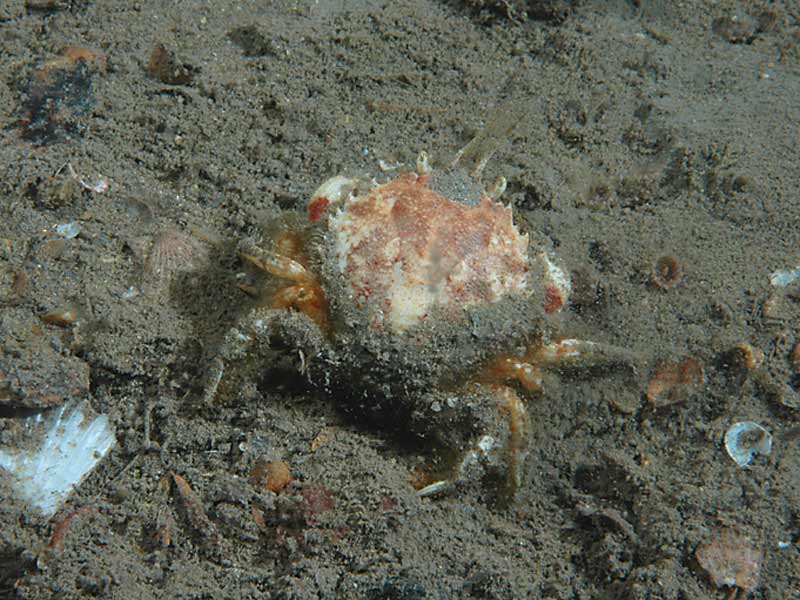
Atelecyclus rotundatus on the east coast of Lundy.
Photographer: Dr Keith Hiscock Copyright: Dr Keith Hiscock
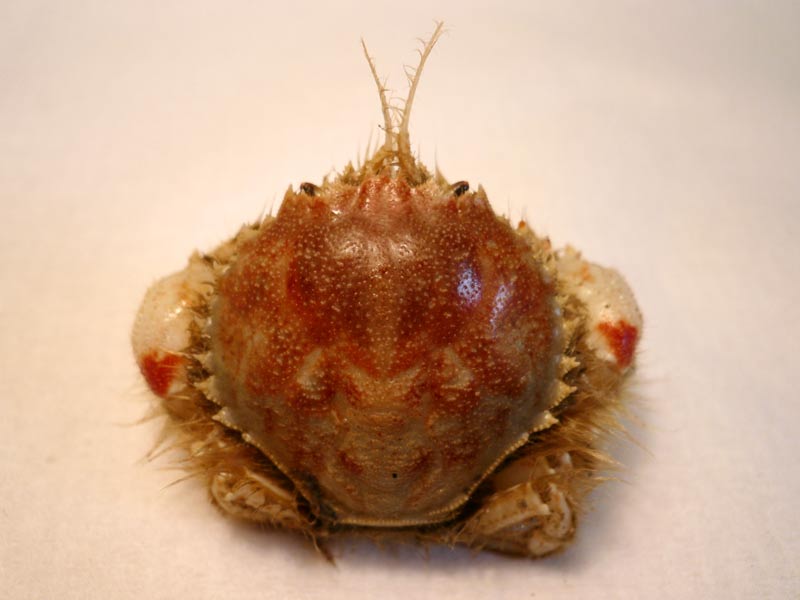
Captive Atelecyclus rotundatus.
Photographer: Holly Latham Copyright: Holly Latham
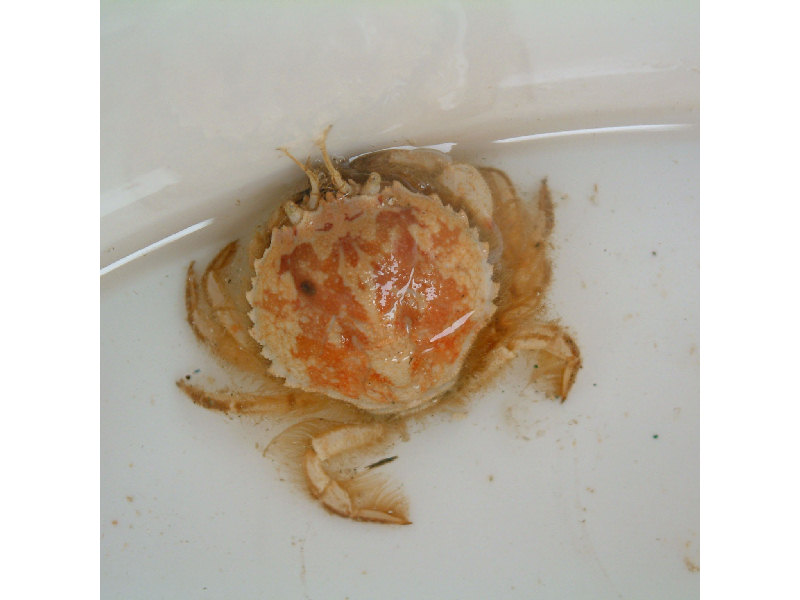
The circular crab Atelecyclus rotundatus.
Photographer: Marine Ecological Surveys Ltd Copyright: Marine Ecological Surveys Ltd
Distribution data supplied by the Ocean Biodiversity Information System (OBIS). To interrogate UK data visit the NBN Atlas.Map Help
| Researched by | Sonia Rowley | Refereed by | Admin |
| Authority | (Olivi, 1792) | ||
| Other common names | - | Synonyms | - |
Summary
Description
Recorded distribution in Britain and Ireland
This is a common species with records throughout the British Isles.Global distribution
-Habitat
This species can be found from the shallow sublittoral down to >300 m depth off shore. It can be on sand or gravel substrates.Depth range
-Identifying features
- Reddish-brown, almost circular carapace up to 5 cm in diameter.
- Light brown limbs and black chelae.
- Carapace and limb margins are very hairy.
- Three teeth between the eyes, central one distinctly longer.
- Long second antenna.
Additional information
Atelecyclus rotundatus bears eggs from February to September with planktonic larvae present from February to November. This species is eaten by Gadus morhua and Raja spp. Atelecyclus rotundatus may also be mistaken for the less common Atelecyclus undecimdentatus. But Atelecyclus undecimdendatus has a much broader carapace and coarser granulations than Atelecyclus rotundatus. The thumbnail crab, Thia scutellata is also similar, but lacks teeth on the front of its carapace.Interestingly, Atelecyclus rotundatus buries itself by digging backwards into the substrata, and reverses its respiratory water flow through its branchial chambers to prevent suffocation (Tayor, 1984). In order to maintain sufficient respiratory currents, this species (akin to Carcinus maenas, Cancer pagurus, Crangon crangon, Bathynectes longipes, Corystes cassivelaunus for example) holds its chelipeds close to its body creating a respiratory channel with the larger second antenna. Taylor (1984) noted that when burried, its gill bailer (scaphognathite) beats in the opposite direction to normal, pumping water out at the base of the limbs instead of drawing water in.
Listed by
Bibliography
Bruce, J.R., Colman, J.S. & Jones, N.S., 1963. Marine fauna of the Isle of Man. Liverpool: Liverpool University Press.
Costello, M.J., Bouchet, P., Boxshall, G., Emblow, C. & Vanden Berghe, E., 2004. European Register of Marine Species [On-line]. http://www.marbef.org/data/erms.php,
Crothers, J. & Crothers, M., 1988. A key to the crabs and crab-like animals of British inshore waters. Somerset, England: Field Studies Council. [AIDGAP guide, no. 155.]
Crothers, J.H. (ed.), 1966. Dale Fort Marine Fauna. London: Field Studies Council.
Foster-Smith, J. (ed.), 2000. The marine fauna and flora of the Cullercoats District. Marine species records for the North East Coast of England. Sunderland: Penshaw Press, for the Dove Marine Laboratory, University of Newcastle upon Tyne.
Gibson, R., Hextall, B. & Rogers, A., 2001. Photographic guide to the sea and seashore life of Britain and north-west Europe. Oxford: Oxford University Press.
Hayward, P., Nelson-Smith, T. & Shields, C. 1996. Collins pocket guide. Sea shore of Britain and northern Europe. London: HarperCollins.
Hayward, P.J. & Ryland, J.S. (ed.) 1995b. Handbook of the marine fauna of North-West Europe. Oxford: Oxford University Press.
Howson, C.M. & Picton, B.E., 1997. The species directory of the marine fauna and flora of the British Isles and surrounding seas. Belfast: Ulster Museum. [Ulster Museum publication, no. 276.]
Ingle, R., 1997. Crayfishes, lobsters and crabs of Europe. An illustrated guide to common and traded species. London: Chapman and Hall.
Ingle, R.W., 1983. Shallow-water Crabs. Cambridge: Cambridge University Press.[Synopses of the British Fauna No. 25].
MarLIN (Marine Life Information Network), 2005. SEArchable BEnthic Data (SEABED) Map [on-line]. Data Access Sub-programme, Marine Life Information Network for Britian and Ireland http://www.marlin.ac.uk,
Taylor, A.C., 1984. Branchial ventilation in the burrowing crab, Atelecyclus rotundatus. Journal of the Marine Biological Association. 64(1), 7-20
Datasets
Centre for Environmental Data and Recording, 2018. Ulster Museum Marine Surveys of Northern Ireland Coastal Waters. Occurrence dataset https://www.nmni.com/CEDaR/CEDaR-Centre-for-Environmental-Data-and-Recording.aspx accessed via NBNAtlas.org on 2018-09-25.
Environmental Records Information Centre North East, 2018. ERIC NE Combined dataset to 2017. Occurrence dataset: http://www.ericnortheast.org.ukl accessed via NBNAtlas.org on 2018-09-38
Fenwick, 2018. Aphotomarine. Occurrence dataset http://www.aphotomarine.com/index.html Accessed via NBNAtlas.org on 2018-10-01
Kent Wildlife Trust, 2018. Kent Wildlife Trust Shoresearch Intertidal Survey 2004 onwards. Occurrence dataset: https://www.kentwildlifetrust.org.uk/ accessed via NBNAtlas.org on 2018-10-01.
NBN (National Biodiversity Network) Atlas. Available from: https://www.nbnatlas.org.
OBIS (Ocean Biodiversity Information System), 2025. Global map of species distribution using gridded data. Available from: Ocean Biogeographic Information System. www.iobis.org. Accessed: 2025-07-31
Citation
This review can be cited as:
Last Updated: 03/07/2007