
Minke whale (Balaenoptera acutorostrata)
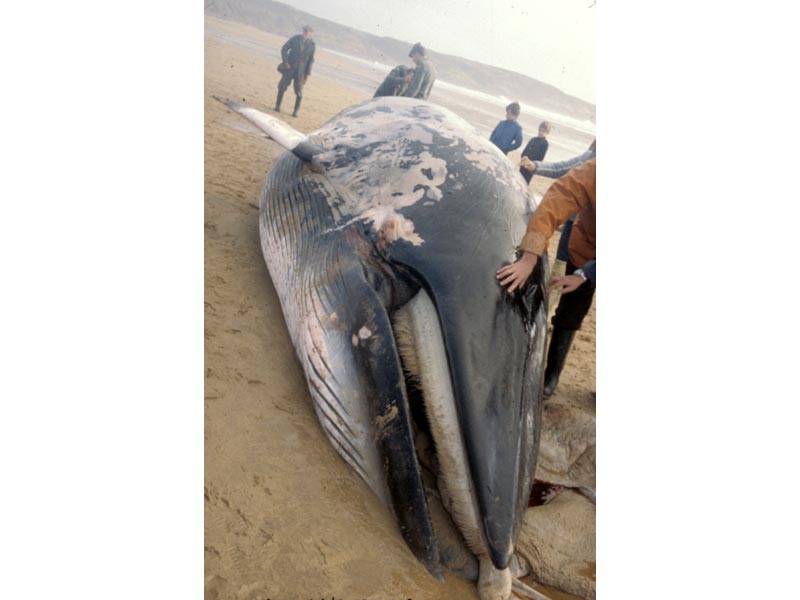
Dead minke whale stranded at Freshwater West beach, Pembrokeshire.
Photographer: Dr Keith Hiscock Copyright: Dr Keith Hiscock
Distribution data supplied by the Ocean Biodiversity Information System (OBIS). To interrogate UK data visit the NBN Atlas.Map Help
| Researched by | Rose Edwards | Refereed by | Admin |
| Authority | Lacépède, 1804 | ||
| Other common names | - | Synonyms | - |
Summary
Description
Recorded distribution in Britain and Ireland
Recorded along the Atlantic coasts of Britain and Ireland, and the northern and central North Sea, south to the Yorkshire coast. Rare in the English Channel, with localised records in the Irish Sea.Global distribution
Recorded throughout the North Atlantic, Norwegian coast, the White Sea, Iceland, the Faeroes, the northern North Sea, Skagerrak. Occasionally in the Baltic Sea, north African coast, western Mediterranean, west Greenland and the east coast of America.Habitat
An open water species, most often seen in coastal and inshore areas but sometimes enters inlets, bays or estuaries.Depth range
-Identifying features
- Dark grey-black back with a curved dorsal fins and a white band on the outer part of the flippers.
- 30-70 throat grooves present, ending before the naval.
- A double blow hole and short baleen plates present. Very pointed head.
- Medium size; up to 10 m long.
Additional information
The blow is very weak and can been seen at the same time as the dorsal fin appears. Spyhopping and breaching are common for this species, which forms small groups of up to 3 individuals. The Minke can remain submerged for up to 20 minutes (Kinze, 2002).This whale could be confused at a distance with the Sei whale and the Bryde's whale as they are relatively the same size, however the weak blow of the Minke whale and dorsal fin appearing at the same time as the blow is characteristic. At close range the white bands on the Minke's flippers are diagnostic (Jefferson et al., 1993; Kinze, 2002).
Baleen whales are included in group species action plan under the UK Biodiversity Action Plan (Anon, 1999v). All baleen whales are protected under schedule 5 in the Wildlife and Countryside Act 1981, the Wildlife (Northern Ireland) Order 1985. All whales are listed on Annex A of EU Council Regulation 338/97 and therefore treated by the EU as if they are on CITES, Appendix I, thus prohibiting their commercial trade (Anon, 1999v). Whales are listed in Appendix I of CITES, Appendix II of the Bern Convention and Annex IV of the EC Habitats Directive (Anon, 1999v).Listed by
Bibliography
Bruyns, W.F.J.M., 1971. Field guide of whales and dolphins. Amsterdam: Publishing Company Tors.
Howson, C.M. & Picton, B.E., 1997. The species directory of the marine fauna and flora of the British Isles and surrounding seas. Belfast: Ulster Museum. [Ulster Museum publication, no. 276.]
Jefferson, T.A., Leatherwood, S. & Webber, M.A., 1994. FAO species identification guide. Marine mammals of the world. Rome: United Nations Environment Programme, Food and Agriculture Organization of the United Nations.
Kinze, C. C., 2002. Photographic Guide to the Marine Mammals of the North Atlantic. Oxford: Oxford University Press.
Reid. J.B., Evans. P.G.H., Northridge. S.P. (ed.), 2003. Atlas of Cetacean Distribution in North-west European Waters. Peterborough: Joint Nature Conservation Committee.
Datasets
British Trust for Ornithology, 2018. Non-avian taxa (BTO+partners). Occurrence dataset: https://www.bto.org/ accessed via NBNAtlas.org on 2018-09-25.
Dumfries and Galloway Environmental Resources Centre, 2017. Mammal records for Dumfries and Galloway. Occurrence dataset: https://doi.org/10.15468/oirkpx accessed via GBIF.org on 2018-09-27
Environmental Records Information Centre North East, 2018. ERIC NE Combined dataset to 2017. Occurrence dataset: http://www.ericnortheast.org.ukl accessed via NBNAtlas.org on 2018-09-38
Glasgow Museums BRC, 2017. Mammal records for Clyde Faunal Area, 1850 to 2007. Occurrence dataset: https://doi.org/10.15468/fphygc accessed via GBIF.org on 2018-09-27.
Hebridean Whale and Dolphin Trust, 2018. Visual sightings data set 2003-2017. Occurrence dataset: https://hwdt.org/ accessed via NBNAtlas.org on 2018-09-27.
Isle of Wight Local Records Centre, 2017. Isle of Wight Notable Species. Occurrence dataset: https://doi.org/10.15468/sm4ety accessed via GBIF.org on 2018-09-27.
John Muir Trust, 2017. Species Records for John Muir Trust Properties 2007-2009. Occurrence dataset: https://doi.org/10.15468/p5lw5z accessed via GBIF.org on 2018-09-27.
Manx Biological Recording Partnership, 2017. Isle of Man wildlife records from 01/01/2000 to 13/02/2017. Occurrence dataset: https://doi.org/10.15468/mopwow accessed via GBIF.org on 2018-10-01.
Merseyside BioBank., 2017. Merseyside BioBank (verified). Occurrence dataset: https://doi.org/10.15468/ar0p6s accessed via GBIF.org on 2018-10-01.
National Trust, 2017. National Trust Species Records. Occurrence dataset: https://doi.org/10.15468/opc6g1 accessed via GBIF.org on 2018-10-01.
NBN (National Biodiversity Network) Atlas. Available from: https://www.nbnatlas.org.
Norfolk Biodiversity Information Service, 2017. NBIS Records to December 2016. Occurrence dataset: https://doi.org/10.15468/jca5lo accessed via GBIF.org on 2018-10-01.
North East Scotland Biological Records Centre, 2017. NE Scotland marine mammal records 1800-2010. Occurrence dataset: https://doi.org/10.15468/suphju accessed via GBIF.org on 2018-10-01.
OBIS (Ocean Biodiversity Information System), 2025. Global map of species distribution using gridded data. Available from: Ocean Biogeographic Information System. www.iobis.org. Accessed: 2025-05-09
Outer Hebrides Biological Recording, 2018. Vertebrates (except birds, INNS and restricted records), Outer Hebrides. Occurrence dataset: https://doi.org/10.15468/dax3tf accessed via GBIF.org on 2018-10-01.
South East Wales Biodiversity Records Centre, 2018. SEWBReC Mammals (South East Wales). Occurrence dataset: https://doi.org/10.15468/atlxpp accessed via GBIF.org on 2018-10-02.
South East Wales Biodiversity Records Centre, 2018. Dr Mary Gillham Archive Project. Occurance dataset: http://www.sewbrec.org.uk/ accessed via NBNAtlas.org on 2018-10-02
Suffolk Biodiversity Information Service., 2017. Suffolk Biodiversity Information Service (SBIS) Dataset. Occurrence dataset: https://doi.org/10.15468/ab4vwo accessed via GBIF.org on 2018-10-02.
The Mammal Society., 2017. National Mammal Atlas Project, online recording. Occurrence dataset: https://doi.org/10.15468/i2eosa accessed via GBIF.org on 2018-10-02.
West Wales Biodiversity Information Centre, 2018. Seatrust Cetacean Records West Wales. Occurrence dataset: https://doi.org/10.15468/ecsmqh accessed via GBIF.org on 2018-10-02.
Whale and Dolphin Conservation, 2018. WDC Shorewatch Sightings. Occurrence dataset: https://doi.org/10.15468/9vuieb accessed via GBIF.org on 2018-10-02.
Citation
This review can be cited as:
Last Updated: 19/04/2006