
Melon comb jelly (Beroe cucumis)
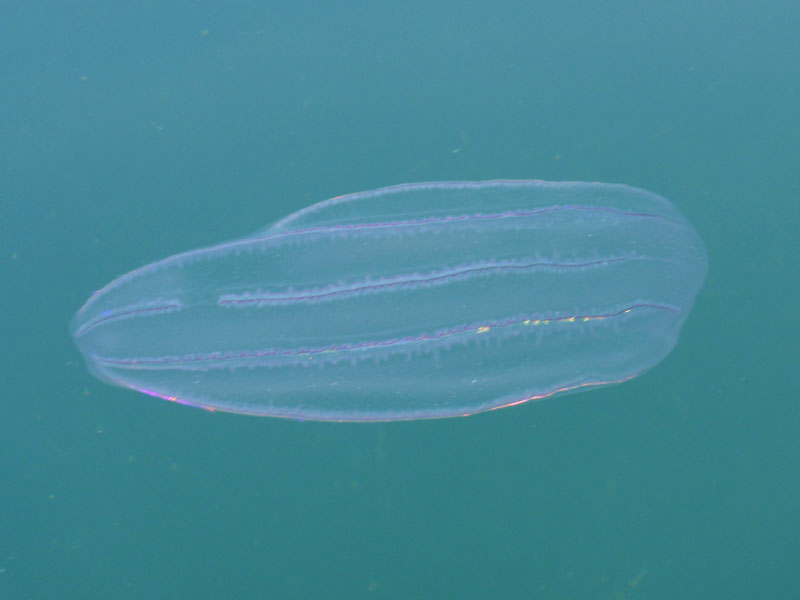
Beroe cucumis is open water at Raasay, Scotland
Photographer: Steve Bell Copyright: Steve Bell
Distribution data supplied by the Ocean Biodiversity Information System (OBIS). To interrogate UK data visit the NBN Atlas.Map Help
| Researched by | Morvan Barnes | Refereed by | Admin |
| Authority | Fabricius, 1780 | ||
| Other common names | Melon jellyfish | Synonyms | - |
Summary
Description
Beroe cucumis is a medium-sized, sack-shaped comb jelly. It may reach up to 15 cm in length. It is completely transparent in colour. It swims with eight longitudinal combs that give the comb jellies (ctenophores) their characteristic shimmering appearance. These combs consist of plates of transverse rows of hairs that beat in waves downwards, which produces the shimmering effect. These plates are phosphorescent at night.
Recorded distribution in Britain and Ireland
Recorded off the west and northern coasts of Scotland and the coasts of Wales. Possibly under recorded.Global distribution
-Habitat
The comb jelly Beroe cucumis is a pelagic species.Depth range
-Identifying features
- Transparent sack-shaped body up to 15 cm in length.
- Radially symmetrical with secondary bilateral symmetry.
- Eight longitudinal rows of combs of equal length.
- No tentacles.
- Branched gastrovascular system unlike Beroe gracilis.
Additional information
Beroe cucumis is carnivorous and feeds on other comb jellies, particularly Bolinopsis infundibulum. Instead of sticky tentacles or large oral lobes, the large mouth is used to engulf prey whole (Greve, 1975).
Listed by
- none -
Bibliography
Greve, W., 1975. Ctenophora. ICES Plankton Identification Leaflets, 146.
Howson, C.M. & Picton, B.E., 1997. The species directory of the marine fauna and flora of the British Isles and surrounding seas. Belfast: Ulster Museum. [Ulster Museum publication, no. 276.]
Datasets
Centre for Environmental Data and Recording, 2018. Ulster Museum Marine Surveys of Northern Ireland Coastal Waters. Occurrence dataset https://www.nmni.com/CEDaR/CEDaR-Centre-for-Environmental-Data-and-Recording.aspx accessed via NBNAtlas.org on 2018-09-25.
Cofnod – North Wales Environmental Information Service, 2018. Miscellaneous records held on the Cofnod database. Occurrence dataset: https://doi.org/10.15468/hcgqsi accessed via GBIF.org on 2018-09-25.
Fife Nature Records Centre, 2018. St Andrews BioBlitz 2014. Occurrence dataset: https://doi.org/10.15468/erweal accessed via GBIF.org on 2018-09-27.
Kent Wildlife Trust, 2018. Kent Wildlife Trust Shoresearch Intertidal Survey 2004 onwards. Occurrence dataset: https://www.kentwildlifetrust.org.uk/ accessed via NBNAtlas.org on 2018-10-01.
National Trust, 2017. National Trust Species Records. Occurrence dataset: https://doi.org/10.15468/opc6g1 accessed via GBIF.org on 2018-10-01.
NBN (National Biodiversity Network) Atlas. Available from: https://www.nbnatlas.org.
OBIS (Ocean Biodiversity Information System), 2025. Global map of species distribution using gridded data. Available from: Ocean Biogeographic Information System. www.iobis.org. Accessed: 2025-08-05
Outer Hebrides Biological Recording, 2018. Invertebrates (except insects), Outer Hebrides. Occurrence dataset: https://doi.org/10.15468/hpavud accessed via GBIF.org on 2018-10-01.
Suffolk Biodiversity Information Service., 2017. Suffolk Biodiversity Information Service (SBIS) Dataset. Occurrence dataset: https://doi.org/10.15468/ab4vwo accessed via GBIF.org on 2018-10-02.
Citation
This review can be cited as:
Last Updated: 07/04/2008