
A colonial sea squirt (Botrylloides violaceus)
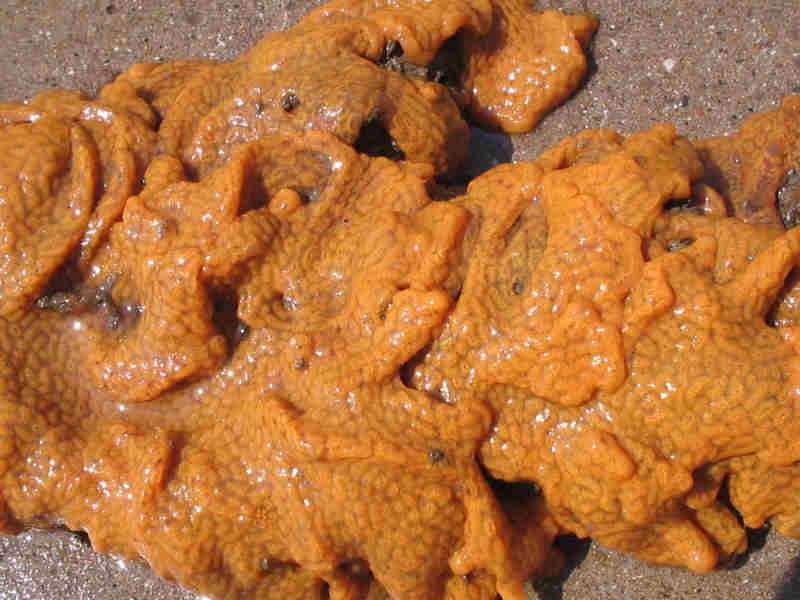
Botrylloides violaceus from marina pontoon.
Photographer: Judith Oakley Copyright: Judith Oakley
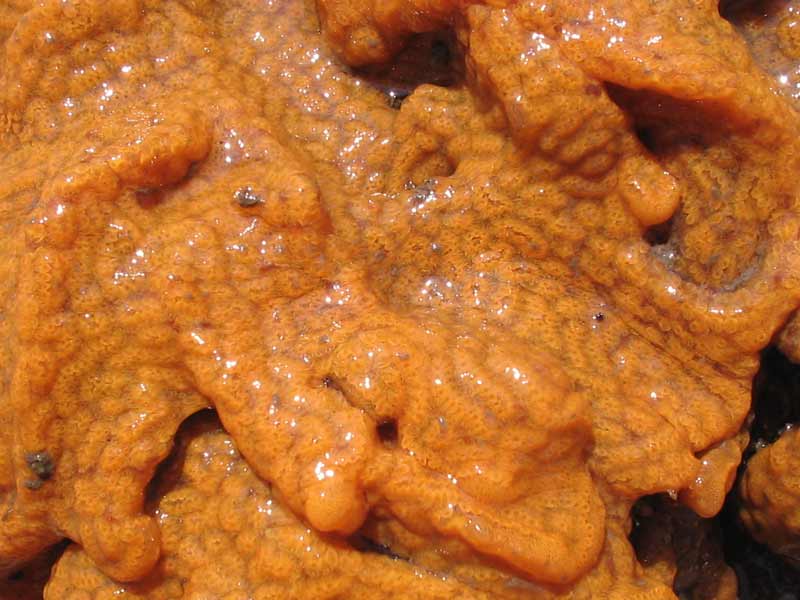
Botrylloides violaceus from marina pontoon.
Photographer: Judith Oakley Copyright: Judith Oakley
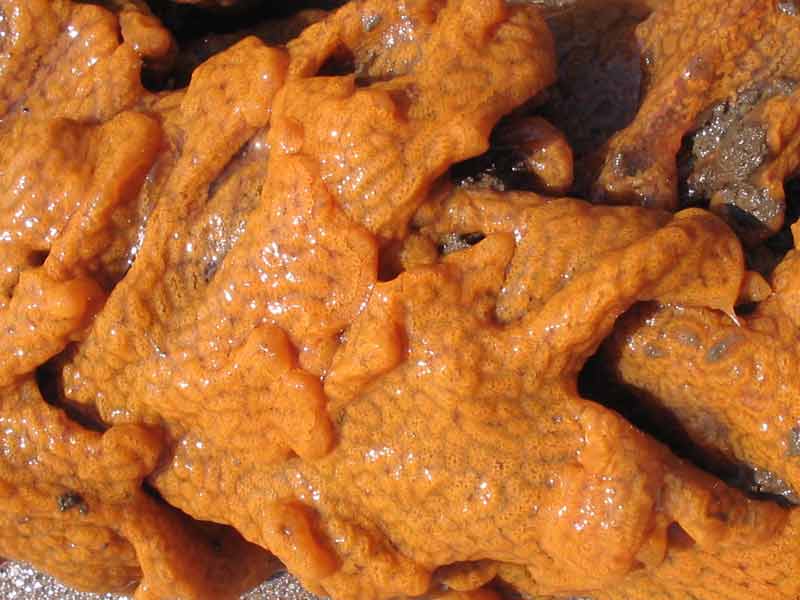
Exposed Botrylloides violaceus.
Photographer: Judith Oakley Copyright: Judith Oakley
Distribution data supplied by the Ocean Biodiversity Information System (OBIS). To interrogate UK data visit the NBN Atlas.Map Help
| Researched by | Emma Snowden | Refereed by | Dr Harvey Tyler-Walters |
| Authority | Oka, 1927 | ||
| Other common names | - | Synonyms | - |
Summary
Description
Botrylloides violaceus is a colonial sea squirt forming lobed sheets usually 2-3 mm in thickness. Individual colonies are always one colour. The colonies can be different colours, e.g. dark brown, brick red, orange, purple or yellow. The zooids are arranged in a variety of ways, roughly oval groups or meandering, occasionally branching, double rows or chains.
Recorded distribution in Britain and Ireland
Recorded from the southern coast of the UK at the following locations in 2004: Gosport, Southampton, Hamble, Poole, Exmouth & Queen Anne's Battery in Plymouth. Also recorded from Milford Haven.Global distribution
A few records on the coast between Brussels and The Netherlands. Observed along the east and west coast of Ameria up into Canada. Has also been recorded scattered around Japan and indonesia.Habitat
Found on artificial surfaces in shallow water, especially in harbours and marinas. Also found attached to macroalgae and other unitary sea squirts.Depth range
Lower shore - 10 mIdentifying features
- Thick sheets or lobes adhering to the surface that may grow back-to-back.
- Uniform in colour, can be dark brown, brick red, orange, purple or yellow.
- Zooids arranged in roughly oval groups or meandering, occasionally branching, double-rows or chains.
- The form and structure of the larva is an aid to identification.
Additional information
A non-native species from Japan recorded in the UK for the first time in 2004. The one-toned colouration of Botrylloides violaceus distinguishes it from Botrylloides leachi and Botrylloides schlosseri. Furthermore, Botryllus schlosseri has star-like zooid arrangements.
Depending on the season (July to September) it is possible to see the larvae within the colony due to their large size and spherical shape. The larvae are brooded separately from the zooids and are usually a dark pink or purple regardless of the colony colour so stand out and are large enough to see without a hand lens. (Larval information; G. Lambert pers. comm.). The released tadpole larvae have a ring of 25-30 vascular ampullae around the trunk (see image).
Listed by
- none -
Bibliography
Arenas, F., Bishop, J.D.D., Carlton, J.T., Dyrynda, P.J., Farnham, W.F., Gonzalez, D.J., Jacobs, M.W., Lambert, C., Lambert, G., Nielsen, S.E., Pederson, J.A., Porter, J.S., Ward, S. & Wood, C.A., 2006. Alien species and other notable records from a rapid assessment survey of marinas on the south coast of England. Journal of the Marine Biological Association of the United Kingdom, 86, 1329-1337.
Howson, C.M. & Picton, B.E., 1997. The species directory of the marine fauna and flora of the British Isles and surrounding seas. Belfast: Ulster Museum. [Ulster Museum publication, no. 276.]
Saito, Y., Mukai, H. & Watanabe, H., 1981. Studies on Japanese compound styelid ascidians II. A new species of the genus Botrylloides and redescription of B. violaceus Oka. Publications of the Seto Marine Biological Laboratory, XXVI , 357-368.
Datasets
Centre for Environmental Data and Recording, 2018. Ulster Museum Marine Surveys of Northern Ireland Coastal Waters. Occurrence dataset https://www.nmni.com/CEDaR/CEDaR-Centre-for-Environmental-Data-and-Recording.aspx accessed via NBNAtlas.org on 2018-09-25.
Fenwick, 2018. Aphotomarine. Occurrence dataset http://www.aphotomarine.com/index.html Accessed via NBNAtlas.org on 2018-10-01
Merseyside BioBank., 2018. Merseyside BioBank (unverified). Occurrence dataset: https://doi.org/10.15468/iou2ld accessed via GBIF.org on 2018-10-01.
NBN (National Biodiversity Network) Atlas. Available from: https://www.nbnatlas.org.
OBIS (Ocean Biodiversity Information System), 2025. Global map of species distribution using gridded data. Available from: Ocean Biogeographic Information System. www.iobis.org. Accessed: 2025-07-12
Citation
This review can be cited as:
Last Updated: 29/04/2008