
Iridescent cartilage weed (Chondria coerulescens)
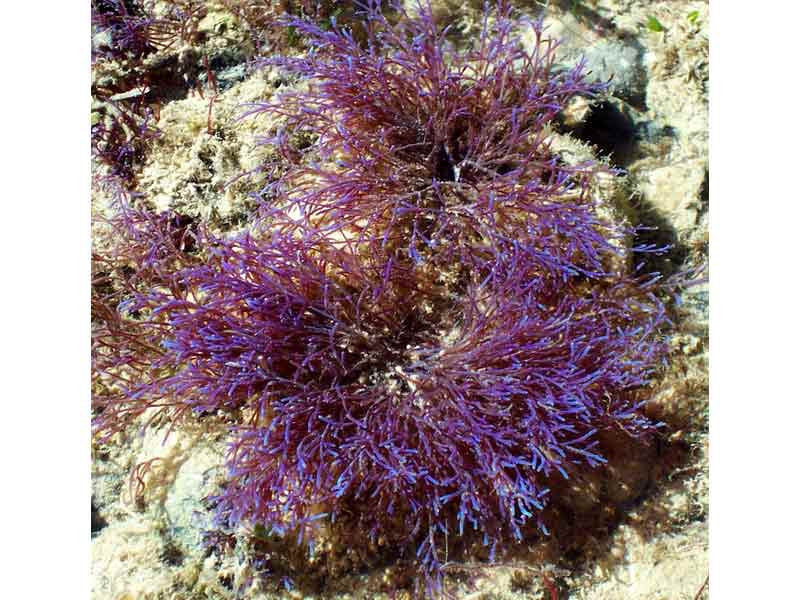
Chondria coerulescens.
Photographer: Alan Thurbon Copyright: Alan Thurbon
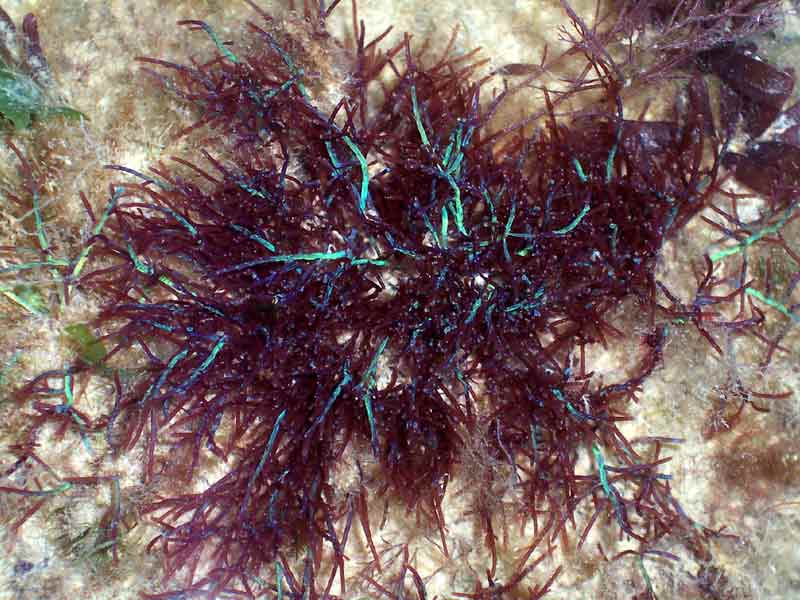
Chondria coerulescens.
Photographer: Alan Thurbon Copyright: Alan Thurbon
Distribution data supplied by the Ocean Biodiversity Information System (OBIS). To interrogate UK data visit the NBN Atlas.Map Help
| Researched by | Rose Edwards | Refereed by | Admin |
| Authority | (J.Agardh) Falkenberg, 1901 | ||
| Other common names | - | Synonyms | - |
Summary
Description
Chondria coerulescens has bluish or yellowish fronds with blue iridescence. The fronds are flexible and cartilaginous in texture, turning black when dry. Young axes show a striking turquoise iridescence when alive. The thalli consist of cylindrical erect axes or trailing tufts, and is 3-8 cm high when erect. The distinct main axis is 0.4-0.5 mm in diameter, branching sparsely at irregular intervals in a spiral pattern to 1-3 orders of branching. Branches are linear, often long and curve downwards gradually tapering to a slender point, and reattach by secondary holdfast. The morphology shows relatively little variation except that some thalli consist only of inconspicuous isolated erect axes whereas others form dense tufts.
Recorded distribution in Britain and Ireland
Recorded from the Salcombe Estuary, The Isle of Wight, Milford Haven, Exmouth and Portsmouth.Global distribution
England to Morocco; MediterraneanHabitat
Chondria coerulescens is a subtidal species, growing on pebbles in mud from extreme low water to 4 m depth. It inhabits extremely wave sheltered sites, usually in inlets with moderate to strong current exposure.Depth range
-Identifying features
- Small species, up to 8 cm high.
- Branched cylindrical axes.
- Distinctive bright blue iridescence.
- Sparsely branched at irregular intervals in a spiral pattern.
Additional information
Chondria coerulescens may be confused with Laurencia obtusa. Microscope examination of the periaxial (surrounding the axis) cells would be needed to separate them. Although Chondria coerulescens is nationally rare, it can be abundant in favourable habitats.
Listed by
- none -
Bibliography
Hardy, F.G. & Guiry, M.D., 2003. A check-list and atlas of the seaweeds of Britain and Ireland. London: British Phycological Society
Hiscock, S., 1986b. A field key to the British Red Seaweeds. Taunton: Field Studies Council. [Occasional Publication No.13]
JNCC (Joint Nature Conservation Committee), 1999. Marine Environment Resource Mapping And Information Database (MERMAID): Marine Nature Conservation Review Survey Database. [on-line] http://www.jncc.gov.uk/mermaid
Maggs, C.A. & Hommersand, M.H., 1993. Seaweeds of the British Isles: Volume 1 Rhodophycota Part 3A Ceramiales. London: Natural History Museum, Her Majesty's Stationary Office.
Picton, B.E. & Costello, M.J., 1998. BioMar biotope viewer: a guide to marine habitats, fauna and flora of Britain and Ireland. [CD-ROM] Environmental Sciences Unit, Trinity College, Dublin.
Datasets
National Trust, 2017. National Trust Species Records. Occurrence dataset: https://doi.org/10.15468/opc6g1 accessed via GBIF.org on 2018-10-01.
NBN (National Biodiversity Network) Atlas. Available from: https://www.nbnatlas.org.
OBIS (Ocean Biodiversity Information System), 2025. Global map of species distribution using gridded data. Available from: Ocean Biogeographic Information System. www.iobis.org. Accessed: 2025-08-02
Royal Botanic Garden Edinburgh, 2018. Royal Botanic Garden Edinburgh Herbarium (E). Occurrence dataset: https://doi.org/10.15468/ypoair accessed via GBIF.org on 2018-10-02.
Citation
This review can be cited as:
Last Updated: 04/07/2005