
Compass jellyfish (Chrysaora hysoscella)
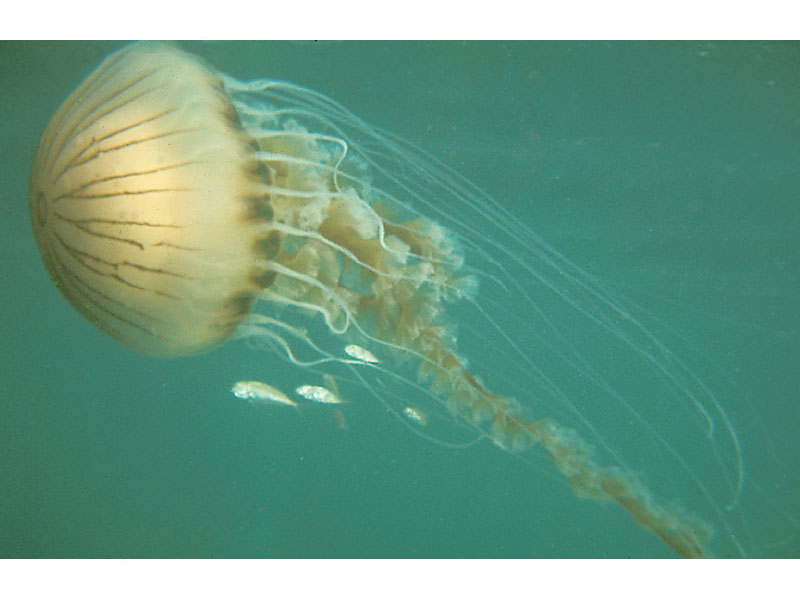
Chrysaora hysoscella.
Photographer: Dr Keith Hiscock Copyright: Dr Keith Hiscock
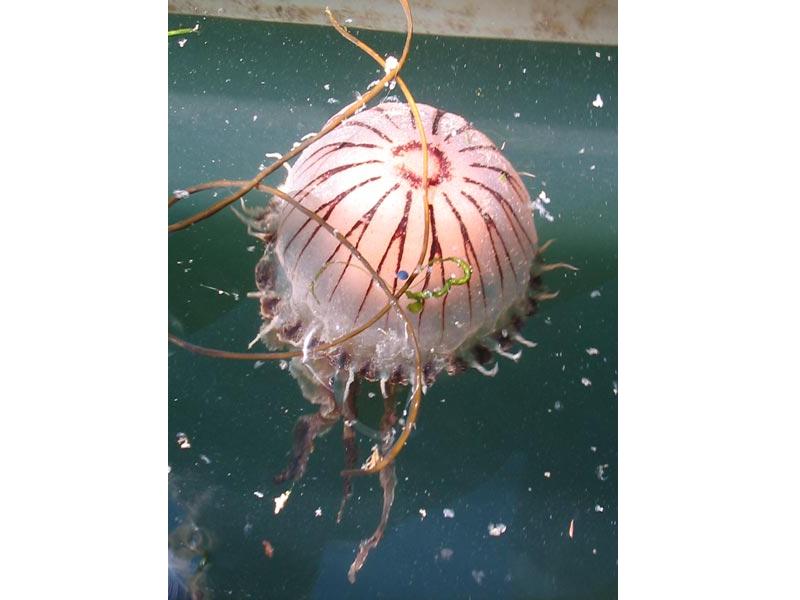
Chrysaora hysoscella in a harbour.
Photographer: Judith Oakley Copyright: Judith Oakley
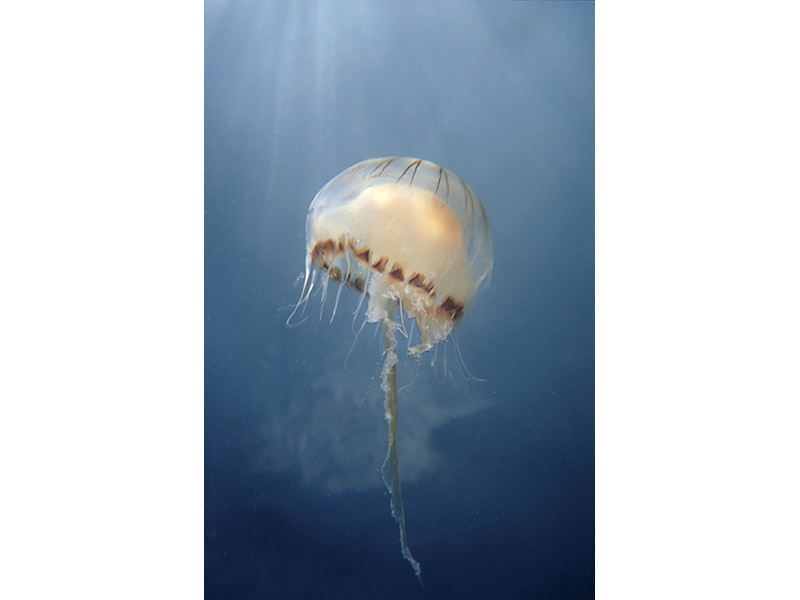
Chrysaora hysoscella in the Channel Isles.
Photographer: Sue Daly Copyright: Sue Daly
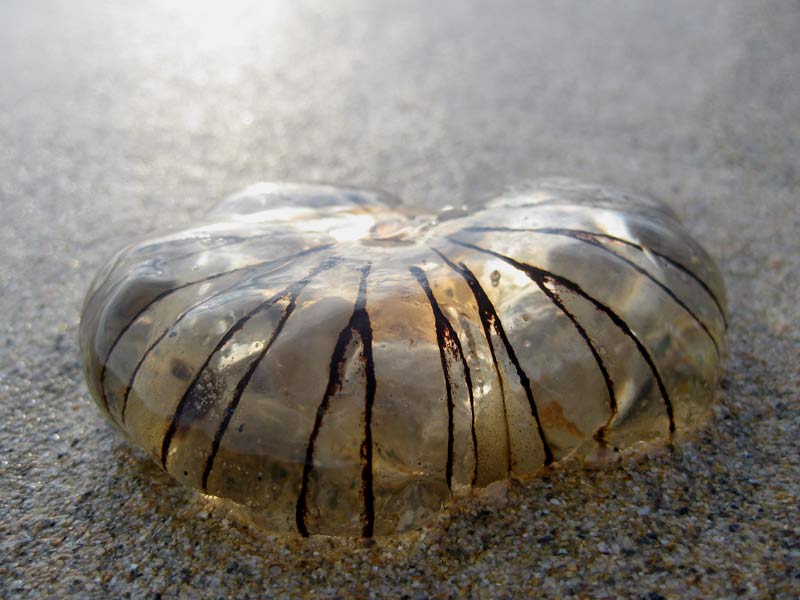
A recently stranded Chrysaora hysoscella.
Photographer: Becky Seeley Copyright: Becky Seeley
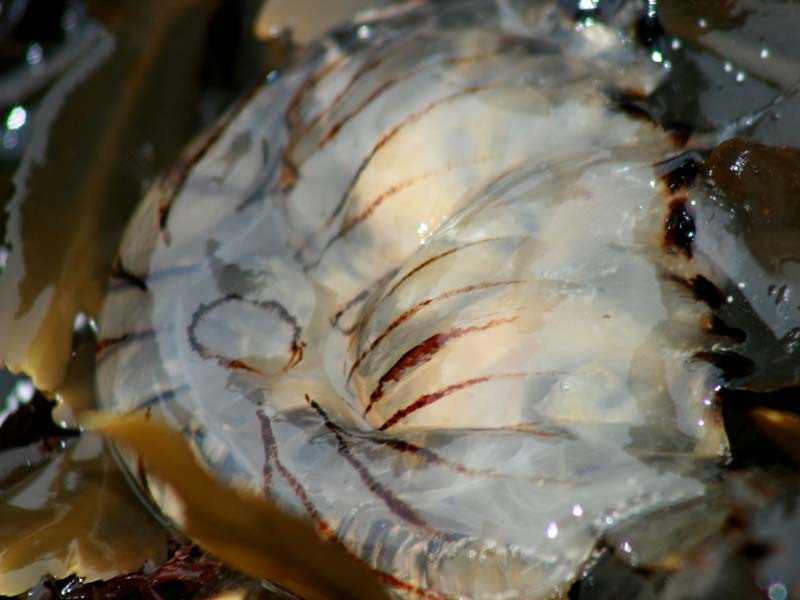
A standed Chrysaora hysoscella at Skomer Island.
Photographer: Judith Oakley Copyright: Judith Oakley
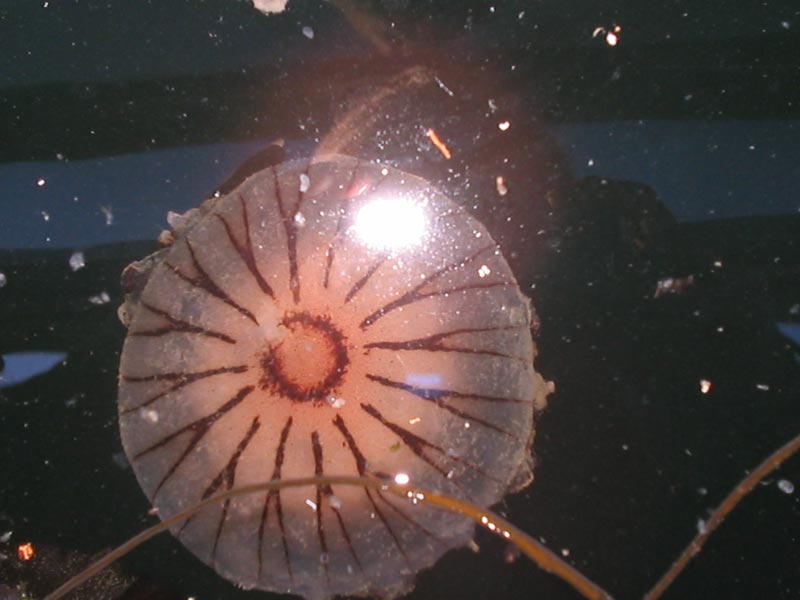
Dome of Chrysaora hysoscella.
Photographer: Judith Oakley Copyright: Judith Oakley
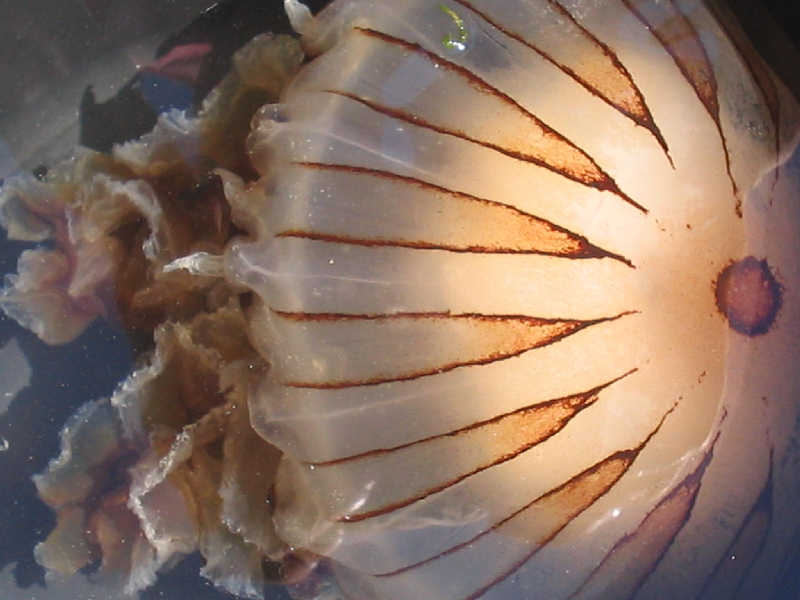
The compass jellyfish Chrysaora hysoscella swimming in a marina.
Photographer: Judith Oakley Copyright: Judith Oakley
Distribution data supplied by the Ocean Biodiversity Information System (OBIS). To interrogate UK data visit the NBN Atlas.Map Help
| Researched by | Marisa Sabatini | Refereed by | Admin |
| Authority | (Linnaeus, 1767) | ||
| Other common names | - | Synonyms | - |
Summary
Description
Recorded distribution in Britain and Ireland
Chrysaora hysoscella occurs in coastal waters all round the British Isles. It is prevalent off the south and west coasts of England and Wales. It has been recorded off the Cumbrian coast, the Isle of Man and off the north coast of Ireland.Global distribution
-Habitat
Chrysaora hysoscella is a pelagic species. Young Chrysaora appear in British waters in May.Depth range
-Identifying features
- Flattened umbrella or saucer shaped bell.
- Four frilly oral arms that are longer than the bell tentacles, these may also coil up at their tips.
- Upper surface of the bell has 16 v-shaped brown markings radiating from a dark apical circle or spot at the centre.
Additional information
May be confused with the common jellyfish Aurelia aurita when stranded. Aurelia aurita however, has shorter tentacles with no brown v-shaped markings on the bell. Instead it has 4 purplish-blue horseshoe shaped gonads that are easily distinguished through the upper surface of the bell. The stinging cells and venom of Chrysaora hysoscella are strong and can produce painful, long lasting weals in humans.Listed by
- none -
Bibliography
Bruce, J.R., Colman, J.S. & Jones, N.S., 1963. Marine fauna of the Isle of Man. Liverpool: Liverpool University Press.
Fish, J.D. & Fish, S., 1996. A student's guide to the seashore. Cambridge: Cambridge University Press.
Gibson, R., Hextall, B. & Rogers, A., 2001. Photographic guide to the sea and seashore life of Britain and north-west Europe. Oxford: Oxford University Press.
Hayward, P., Nelson-Smith, T. & Shields, C. 1996. Collins pocket guide. Sea shore of Britain and northern Europe. London: HarperCollins.
Howson, C.M. & Picton, B.E., 1997. The species directory of the marine fauna and flora of the British Isles and surrounding seas. Belfast: Ulster Museum. [Ulster Museum publication, no. 276.]
MarLIN (Marine Life Information Network), 2005. SEArchable BEnthic Data (SEABED) Map [on-line]. Data Access Sub-programme, Marine Life Information Network for Britian and Ireland http://www.marlin.ac.uk,
Russell, F.S., 1970. The medusae of the British Isles. Vol II - Pelagic Scyphozoa, with a supplement to the first volume on hydromedusae. Cambridge University Press
Datasets
Centre for Environmental Data and Recording, 2018. Ulster Museum Marine Surveys of Northern Ireland Coastal Waters. Occurrence dataset https://www.nmni.com/CEDaR/CEDaR-Centre-for-Environmental-Data-and-Recording.aspx accessed via NBNAtlas.org on 2018-09-25.
Cofnod – North Wales Environmental Information Service, 2018. Miscellaneous records held on the Cofnod database. Occurrence dataset: https://doi.org/10.15468/hcgqsi accessed via GBIF.org on 2018-09-25.
Fenwick, 2018. Aphotomarine. Occurrence dataset http://www.aphotomarine.com/index.html Accessed via NBNAtlas.org on 2018-10-01
Isle of Wight Local Records Centre, 2017. IOW Natural History & Archaeological Society Marine Invertebrate Records 1853- 2011. Occurrence dataset: https://doi.org/10.15468/d9amhg accessed via GBIF.org on 2018-09-27.
Kent Wildlife Trust, 2018. Kent Wildlife Trust Shoresearch Intertidal Survey 2004 onwards. Occurrence dataset: https://www.kentwildlifetrust.org.uk/ accessed via NBNAtlas.org on 2018-10-01.
Marine Conservation Society, 2018. UK Jellyfish Sightings from 2003 to 2015. Occurrence dataset: https://www.mcsuk.org/ accessed via NBNAtlas.org on 2018-10-01.
Merseyside BioBank., 2018. Merseyside BioBank (unverified). Occurrence dataset: https://doi.org/10.15468/iou2ld accessed via GBIF.org on 2018-10-01.
National Trust, 2017. National Trust Species Records. Occurrence dataset: https://doi.org/10.15468/opc6g1 accessed via GBIF.org on 2018-10-01.
NBN (National Biodiversity Network) Atlas. Available from: https://www.nbnatlas.org.
OBIS (Ocean Biodiversity Information System), 2025. Global map of species distribution using gridded data. Available from: Ocean Biogeographic Information System. www.iobis.org. Accessed: 2025-08-13
Outer Hebrides Biological Recording, 2018. Invertebrates (except insects), Outer Hebrides. Occurrence dataset: https://doi.org/10.15468/hpavud accessed via GBIF.org on 2018-10-01.
South East Wales Biodiversity Records Centre, 2023. SEWBReC Marine and other Aquatic Invertebrates (South East Wales). Occurrence dataset:https://doi.org/10.15468/zxy1n6 accessed via GBIF.org on 2024-09-27.
Suffolk Biodiversity Information Service., 2017. Suffolk Biodiversity Information Service (SBIS) Dataset. Occurrence dataset: https://doi.org/10.15468/ab4vwo accessed via GBIF.org on 2018-10-02.
Citation
This review can be cited as:
Last Updated: 08/05/2008