
Velvet horn (Codium tomentosum)
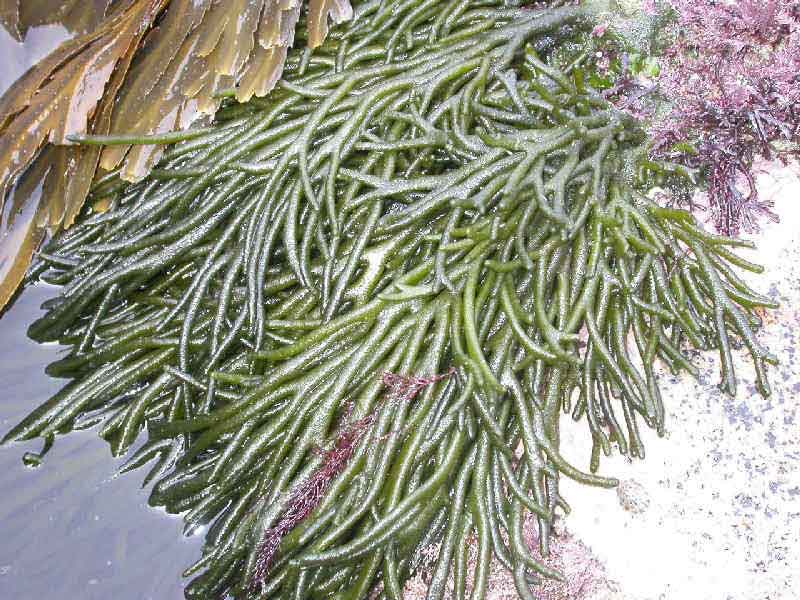
Codium tomentosum with Fucus serratus and red seaweeds.
Photographer: John Kelly Copyright: John Kelly
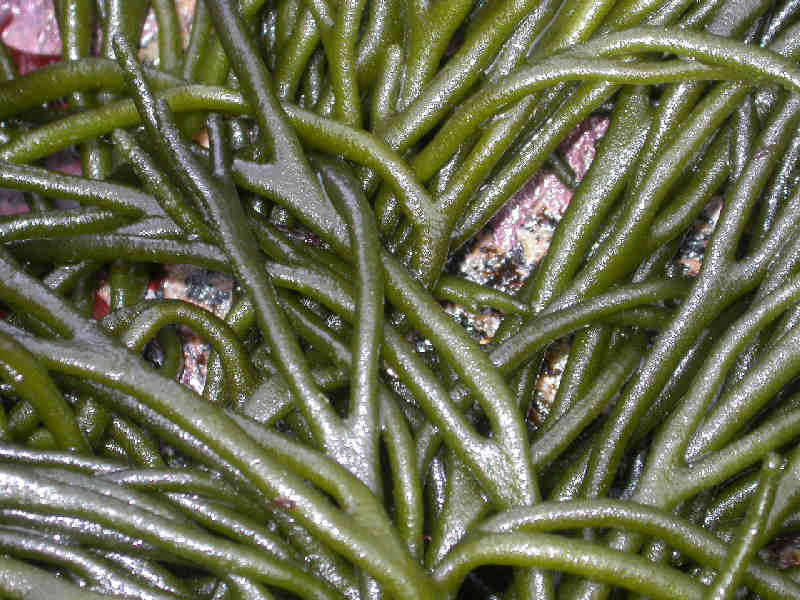
Close up of Codium tomentosum illustrating its spongy fronds.
Photographer: John Kelly Copyright: John Kelly
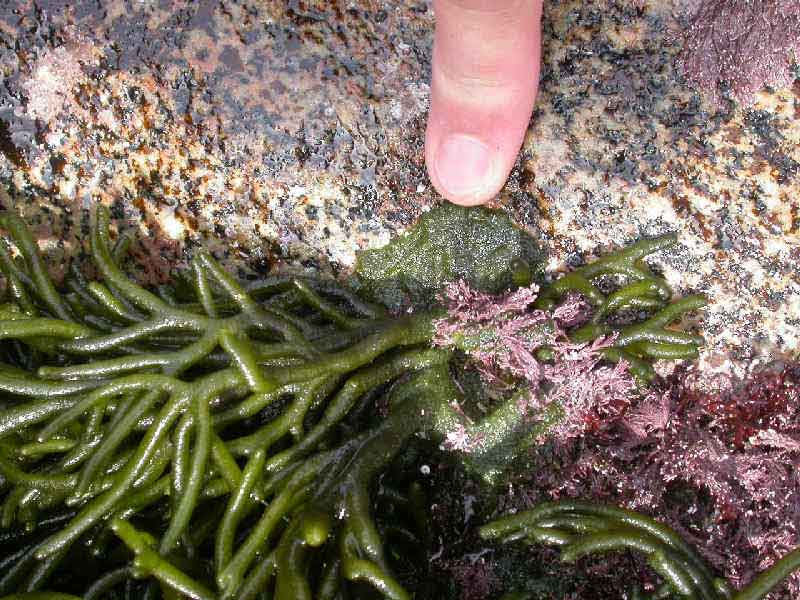
Holdfast of Codium tomentosum.
Photographer: John Kelly Copyright: John Kelly
Distribution data supplied by the Ocean Biodiversity Information System (OBIS). To interrogate UK data visit the NBN Atlas.Map Help
| Researched by | Paolo Pizzolla | Refereed by | Admin |
| Authority | Stackhouse, 1797 | ||
| Other common names | - | Synonyms | - |
Summary
Description
Recorded distribution in Britain and Ireland
Codium tomentosum occurs mainly in the south west of the UK and is becoming quite rare. Both pollution and competition with Codium fragile have been suggested as potential causes of its decline.Global distribution
-Habitat
It attaches to exposed rocks and occurs in rock pools on the lower shore.Depth range
-Identifying features
- Small green seaweed, up to 30 cm long.
- Dichotomously branching with a cylindrical frond.
- Felt-like to the touch.
- Disc like holdfast made from fine threads.
Additional information
Codium tomentosum can be confused with Codium fragile. However, Codium tomentosum tends to have a more slender frond with rounded tips whereas Codium fragile has pointed tips to the frond.Listed by
- none -
Bibliography
Burrows, E.M., 1991. Seaweeds of the British Isles. Volume 2. Chlorophyta. London: British Museum (Natural History).
Fish, J.D. & Fish, S., 1996. A student's guide to the seashore. Cambridge: Cambridge University Press.
Hayward, P., Nelson-Smith, T. & Shields, C. 1996. Collins pocket guide. Sea shore of Britain and northern Europe. London: HarperCollins.
Howson, C.M. & Picton, B.E., 1997. The species directory of the marine fauna and flora of the British Isles and surrounding seas. Belfast: Ulster Museum. [Ulster Museum publication, no. 276.]
JNCC (Joint Nature Conservation Committee), 1999. Marine Environment Resource Mapping And Information Database (MERMAID): Marine Nature Conservation Review Survey Database. [on-line] http://www.jncc.gov.uk/mermaid
Trowbridge, C.D., 1998. Ecology of the green macroalga Codium fragile (Suringar) Hariot 1889: invasive or non-invasive subspecies. Oceanography and Marine Biology: an Annual Review, 36, 1-64.
Datasets
Centre for Environmental Data and Recording, 2018. Ulster Museum Marine Surveys of Northern Ireland Coastal Waters. Occurrence dataset https://www.nmni.com/CEDaR/CEDaR-Centre-for-Environmental-Data-and-Recording.aspx accessed via NBNAtlas.org on 2018-09-25.
Fenwick, 2018. Aphotomarine. Occurrence dataset http://www.aphotomarine.com/index.html Accessed via NBNAtlas.org on 2018-10-01
Manx Biological Recording Partnership, 2017. Isle of Man wildlife records from 01/01/2000 to 13/02/2017. Occurrence dataset: https://doi.org/10.15468/mopwow accessed via GBIF.org on 2018-10-01.
Manx Biological Recording Partnership, 2018. Isle of Man historical wildlife records 1995 to 1999. Occurrence dataset: https://doi.org/10.15468/lo2tge accessed via GBIF.org on 2018-10-01.
NBN (National Biodiversity Network) Atlas. Available from: https://www.nbnatlas.org.
OBIS (Ocean Biodiversity Information System), 2025. Global map of species distribution using gridded data. Available from: Ocean Biogeographic Information System. www.iobis.org. Accessed: 2025-07-31
Royal Botanic Garden Edinburgh, 2018. Royal Botanic Garden Edinburgh Herbarium (E). Occurrence dataset: https://doi.org/10.15468/ypoair accessed via GBIF.org on 2018-10-02.
Citation
This review can be cited as:
Last Updated: 13/08/2007