
Jewel anemone (Corynactis viridis)
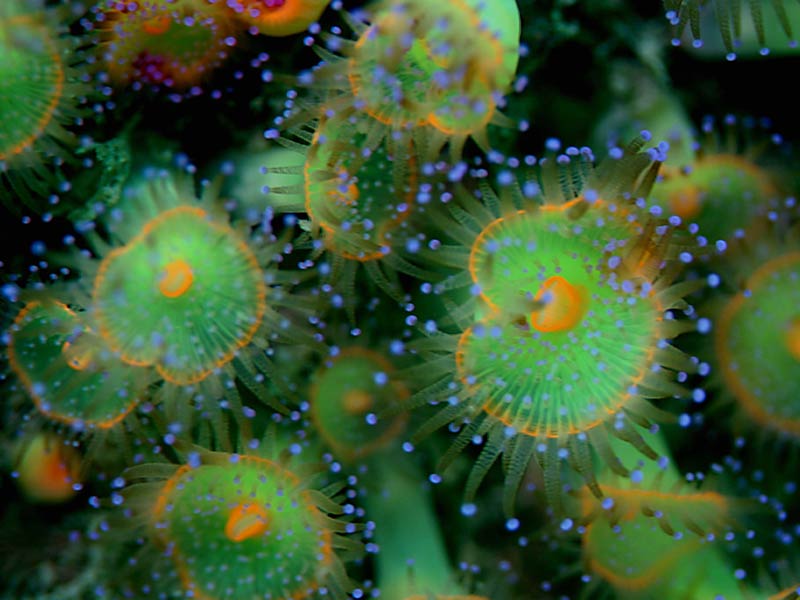
Close up of green and orange Corynactis viridis in the Channel Isles.
Photographer: Sue Daly Copyright: Sue Daly
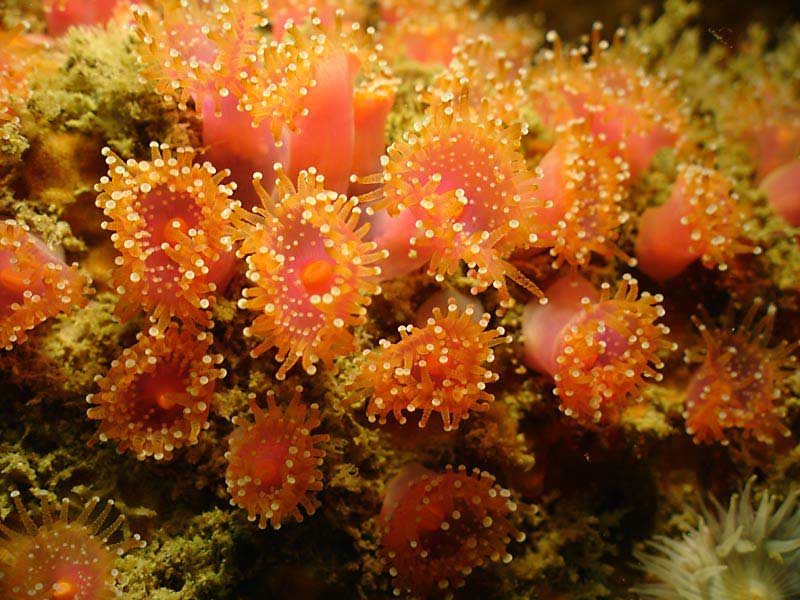
Corynactis viridis at Doune, Scotland.
Photographer: Fiona Crouch Copyright: Fiona Crouch
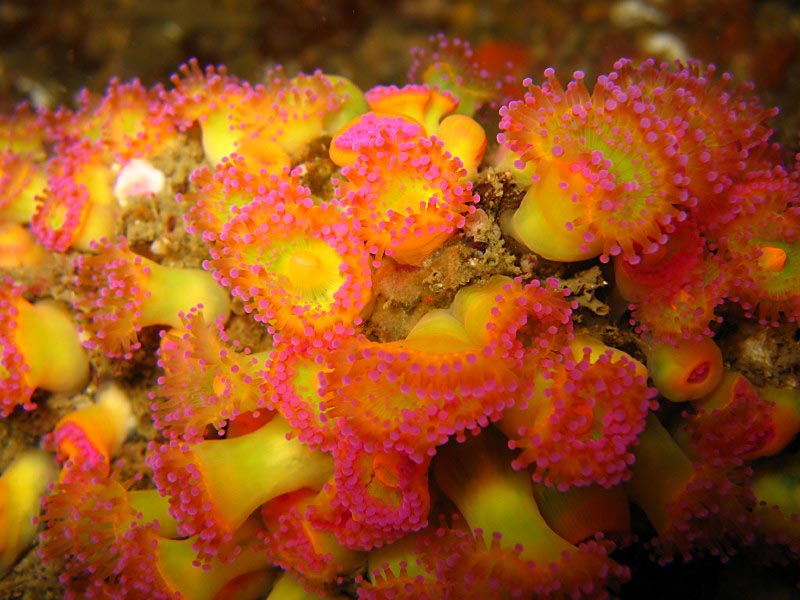
Corynactis viridis on Penryn Reef, Manacles, southwest Cornwall.
Photographer: Robert Keen Copyright: Robert Keen
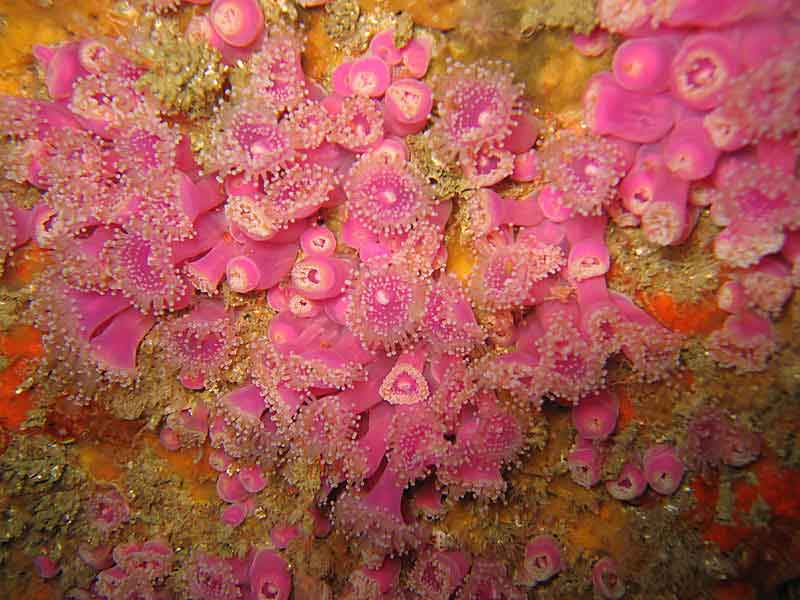
Corynactis viridis on the hull of the wreck of the City of Westminster, Manacles, southwest Cornwall.
Photographer: Robert Keen Copyright: Robert Keen
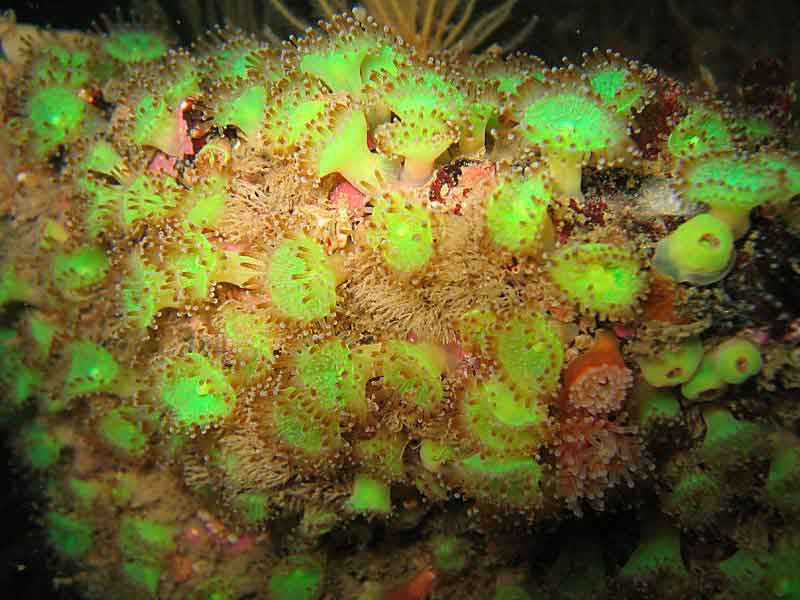
Corynactis viridis on the wreck of the Mohegan at the Manacles, southwest Cornwall.
Photographer: Robert Keen Copyright: Robert Keen
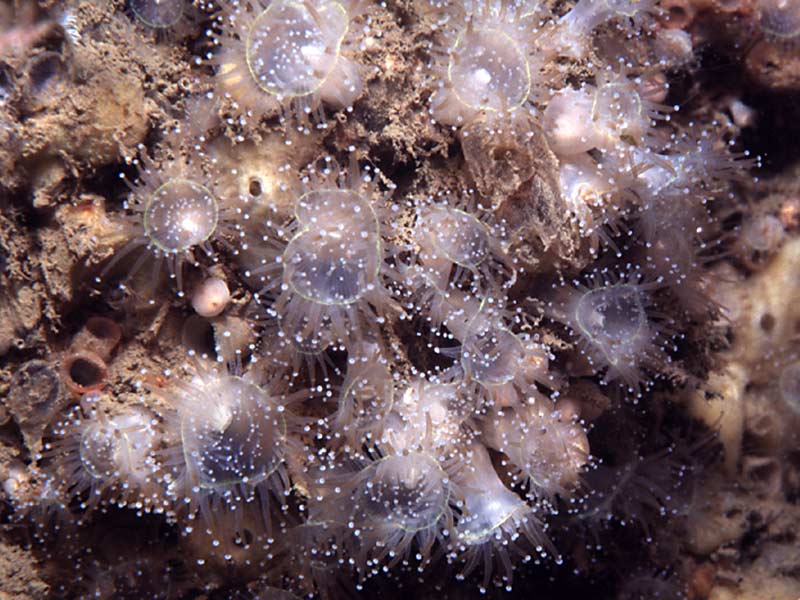
Corynactis viridis.
Photographer: Dr Keith Hiscock Copyright: Dr Keith Hiscock
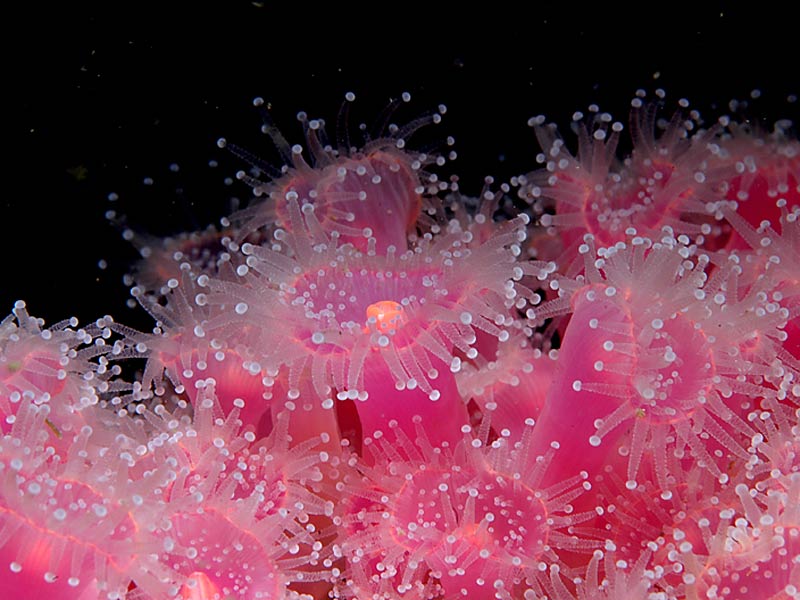
Close up of Corynactis viridis at Firestone Bay in Plymouth Sound.
Photographer: Dr Keith Hiscock Copyright: Dr Keith Hiscock
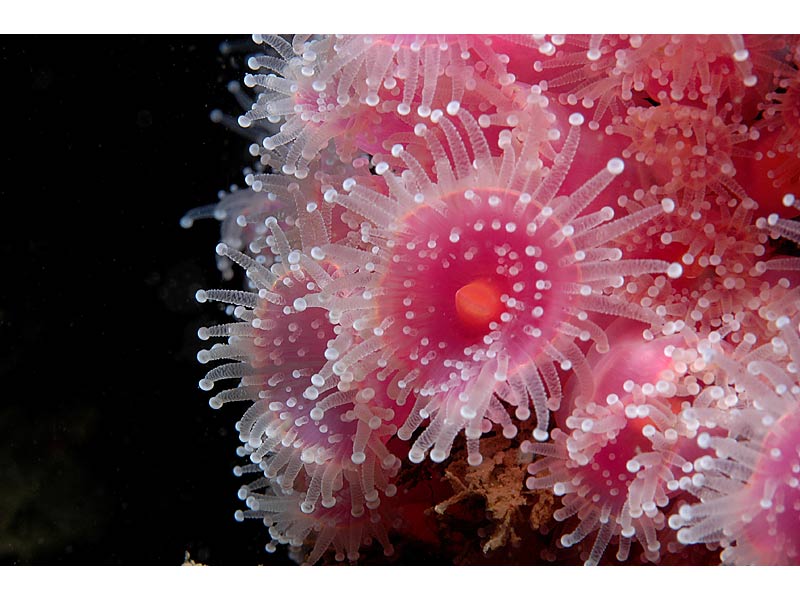
Close up view of Corynactis viridis at Firestone Bay in Plymouth Sound.
Photographer: Dr Keith Hiscock Copyright: Dr Keith Hiscock
Distribution data supplied by the Ocean Biodiversity Information System (OBIS). To interrogate UK data visit the NBN Atlas.Map Help
| Researched by | Olwen Ager | Refereed by | Admin |
| Authority | Allman, 1846 | ||
| Other common names | - | Synonyms | - |
Summary
Description
Recorded distribution in Britain and Ireland
Corynactis viridis reaches its northern limit in Shetland. It is found around the south and west coasts of Britain and all around Ireland.Global distribution
Recorded around the British Isles, south-west Europe and into the Mediterranean.Habitat
Corynactis viridis occurs from the lower shore and into the subtidal to about 50 m (sometimes to 80 m) on rocks, in caves and beneath overhangs where it is shaded from light. The anemone is often found in dense aggregations especially on vertical rock faces.Depth range
Up to 80mIdentifying features
- Base up to 10 mm in diameter and up to 15 mm in height.
- Smooth column.
- Up to 100 knobbed tentacles.
- Variety of colours including green, pink, red, orange and white.
- Often found in dense aggregations on vertical rock faces
Additional information
-none-Listed by
- none -
Bibliography
Fish, J.D. & Fish, S., 1996. A student's guide to the seashore. Cambridge: Cambridge University Press.
Hayward, P., Nelson-Smith, T. & Shields, C. 1996. Collins pocket guide. Sea shore of Britain and northern Europe. London: HarperCollins.
Hayward, P.J. & Ryland, J.S. (ed.) 1995b. Handbook of the marine fauna of North-West Europe. Oxford: Oxford University Press.
Howson, C.M. & Picton, B.E., 1997. The species directory of the marine fauna and flora of the British Isles and surrounding seas. Belfast: Ulster Museum. [Ulster Museum publication, no. 276.]
JNCC (Joint Nature Conservation Committee), 1999. Marine Environment Resource Mapping And Information Database (MERMAID): Marine Nature Conservation Review Survey Database. [on-line] http://www.jncc.gov.uk/mermaid
Manuel, R.L., 1988. British Anthozoa. Synopses of the British Fauna (New Series) (ed. D.M. Kermack & R.S.K. Barnes). The Linnean Society of London [Synopses of the British Fauna No. 18.]. DOI https://doi.org/10.1002/iroh.19810660505
Picton, B.E. & Costello, M.J., 1998. BioMar biotope viewer: a guide to marine habitats, fauna and flora of Britain and Ireland. [CD-ROM] Environmental Sciences Unit, Trinity College, Dublin.
Datasets
Centre for Environmental Data and Recording, 2018. Ulster Museum Marine Surveys of Northern Ireland Coastal Waters. Occurrence dataset https://www.nmni.com/CEDaR/CEDaR-Centre-for-Environmental-Data-and-Recording.aspx accessed via NBNAtlas.org on 2018-09-25.
Fenwick, 2018. Aphotomarine. Occurrence dataset http://www.aphotomarine.com/index.html Accessed via NBNAtlas.org on 2018-10-01
Manx Biological Recording Partnership, 2018. Isle of Man historical wildlife records 1990 to 1994. Occurrence dataset: https://doi.org/10.15468/aru16v accessed via GBIF.org on 2018-10-01.
Manx Biological Recording Partnership, 2018. Isle of Man historical wildlife records 1995 to 1999. Occurrence dataset: https://doi.org/10.15468/lo2tge accessed via GBIF.org on 2018-10-01.
Manx Biological Recording Partnership, 2022. Isle of Man historical wildlife records 1990 to 1994. Occurrence dataset:https://doi.org/10.15468/aru16v accessed via GBIF.org on 2024-09-27.
NBN (National Biodiversity Network) Atlas. Available from: https://www.nbnatlas.org.
OBIS (Ocean Biodiversity Information System), 2025. Global map of species distribution using gridded data. Available from: Ocean Biogeographic Information System. www.iobis.org. Accessed: 2025-07-01
Citation
This review can be cited as:
Last Updated: 19/02/2007