
Fine-veined crinkle weed (Cryptopleura ramosa)
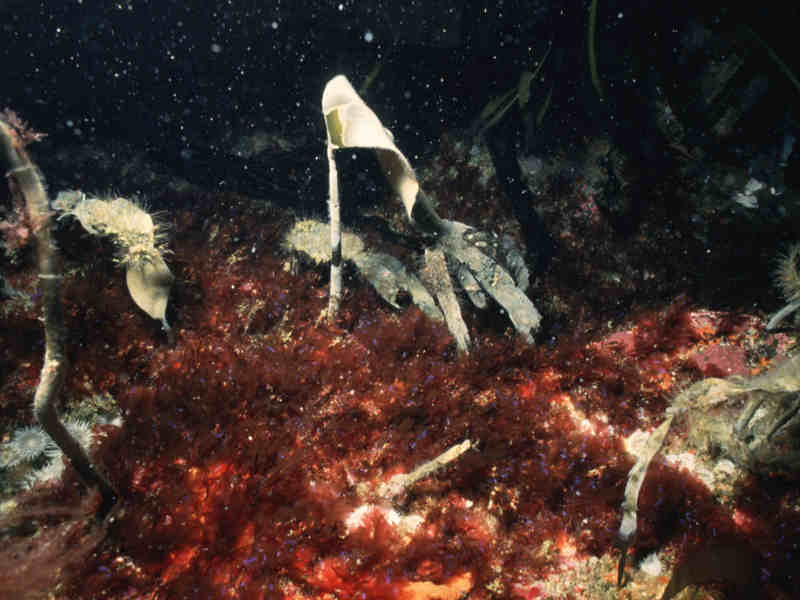
A rock shelf dominated by Cryptopleura ramosa with Laminaria sp. at 20 m depth.
Photographer: Dr Keith Hiscock Copyright: Scottish Natural Heritage (SNH)
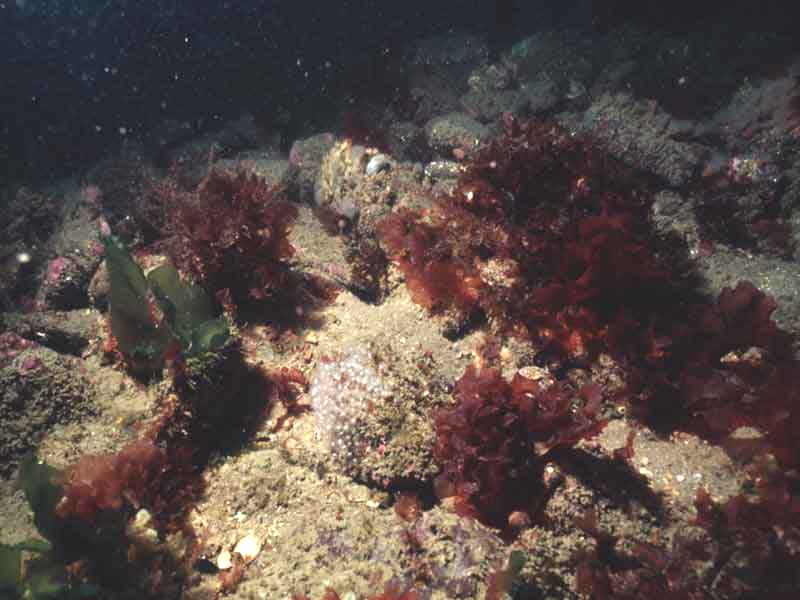
Cryptopleura ramosa and horse shoe worms on shallow boulders.
Photographer: Dr Keith Hiscock Copyright: Dr Keith Hiscock
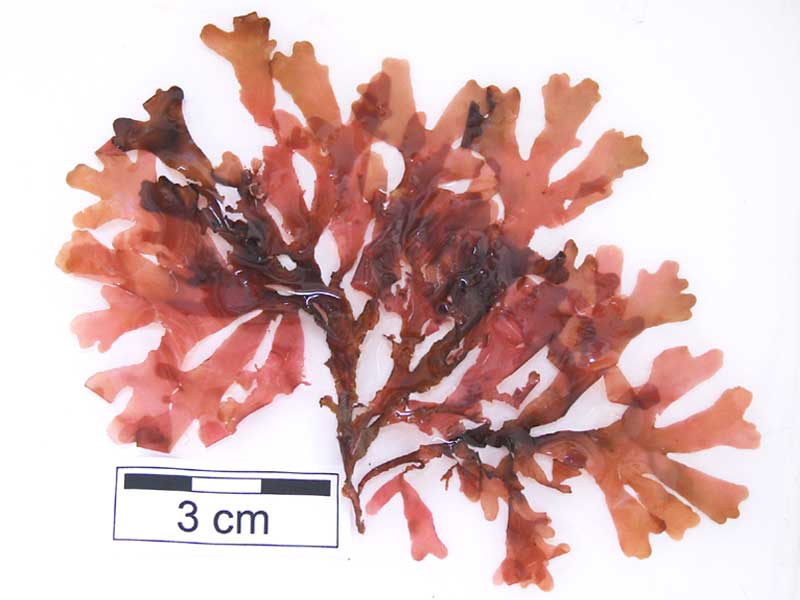
Specimen of Cryptopleura ramosa.
Photographer: Dr F. Arenas Copyright: Marine Biological Association of the UK (MBA)
Distribution data supplied by the Ocean Biodiversity Information System (OBIS). To interrogate UK data visit the NBN Atlas.Map Help
| Researched by | Joelene Hughes | Refereed by | Admin |
| Authority | (Hudson) L.Newton, 1931 | ||
| Other common names | - | Synonyms | - |
Summary
Description
A short thallus with a stout midrib arises from a discoid holdfast, widening as it branches into flattened red-brown or red-purple fronds to a height of 20 cm. The fronds are thin and membranous, around 2.5 cm in width and may have a slight blue iridescence under water. Repeated branching gives it a bushy tangled appearance with the branches tapering to rounded tips. Morphology is variable and blades can be either erect or prostrate and broadly-wedged or strap-shaped. Margins may be smooth, undulating, denticulate or hooked. frequently with a blue iridescence underwater.
Recorded distribution in Britain and Ireland
Distributed around Britain and Ireland, being recorded more commonly in the south and sparsely in the east.Global distribution
Found from southern Norway and the Faeroe Isles to Spain. Also recorded in the Mediterranean and Brazil.Habitat
Found subtidally growing on rock and Laminaria hyperborea stipes. Grows on shaded areas on the sides of deep pools or under the cover of Fucus species in the intertidal.Depth range
-Identifying features
- Cryptopleura ramosa has numerous subdivided strap-like to broad, wedge-shaped blades.
- Prostate blades are secured to the substratum by numerous haptera (a specialised, multicellular attachment structure).
- The erect blades are attached with a stipe-like structure resulting from basal erosion of the lamina exposing the midrib.
- The midrib divides with the branches but becomes indistinct in the upper regions.
- The veins are approximately parallel and visible under bright light.
- Cystocarps are strewn all over the thallus and the tetrasporangia occur in broken lines along the margin or lateral proliferations.
- The male is distinguishable from the female as it is smaller and has pale antheridial patches near the tips of its branches.
Additional information
Cryptopleura ramosa var. uncinata has characteristic hooked margins. The marginal hooks distinguish it from the similar Acrosorium venulosum that has both terminal and marginal hooks. When fan-shaped, Cryptopleura ramosa may closely resemble Erythroglossum laciniatum but may be distinguished by the margins and venation. Polyneura bonnemaisonii, another similar species, differs from Cryptopleaura ramosa in the more scattered distribution of the tetrasporangia and spiny outer wall to the cystocarps. Polyneura bonnemaisonii infrequently displays prostate blades, and the haptera attaching them to the substrate, are marginal as opposed to the peg-like haptera seen in Cryptopleura ramosa.
Listed by
- none -
Bibliography
Dickinson, C.I., 1963. British seaweeds. London & Frome: Butler & Tanner Ltd.
Hardy, F.G. & Guiry, M.D., 2003. A check-list and atlas of the seaweeds of Britain and Ireland. London: British Phycological Society
Hayward, P., Nelson-Smith, T. & Shields, C. 1996. Collins pocket guide. Sea shore of Britain and northern Europe. London: HarperCollins.
Hiscock, S., 1986b. A field key to the British Red Seaweeds. Taunton: Field Studies Council. [Occasional Publication No.13]
Maggs, C.A. & Hommersand, M.H., 1993. Seaweeds of the British Isles: Volume 1 Rhodophycota Part 3A Ceramiales. London: Natural History Museum, Her Majesty's Stationary Office.
Norton, T.A. (ed.), 1985. Provisional Atlas of the Marine Algae of Britain and Ireland. Huntingdon: Biological Records Centre, Institute of Terrestrial Ecology.
Datasets
Centre for Environmental Data and Recording, 2018. Ulster Museum Marine Surveys of Northern Ireland Coastal Waters. Occurrence dataset https://www.nmni.com/CEDaR/CEDaR-Centre-for-Environmental-Data-and-Recording.aspx accessed via NBNAtlas.org on 2018-09-25.
Cofnod – North Wales Environmental Information Service, 2018. Miscellaneous records held on the Cofnod database. Occurrence dataset: https://doi.org/10.15468/hcgqsi accessed via GBIF.org on 2018-09-25.
Fenwick, 2018. Aphotomarine. Occurrence dataset http://www.aphotomarine.com/index.html Accessed via NBNAtlas.org on 2018-10-01
Fife Nature Records Centre, 2018. St Andrews BioBlitz 2014. Occurrence dataset: https://doi.org/10.15468/erweal accessed via GBIF.org on 2018-09-27.
Kent Wildlife Trust, 2018. Biological survey of the intertidal chalk reefs between Folkestone Warren and Kingsdown, Kent 2009-2011. Occurrence dataset: https://www.kentwildlifetrust.org.uk/ accessed via NBNAtlas.org on 2018-10-01.
Kent Wildlife Trust, 2018. Kent Wildlife Trust Shoresearch Intertidal Survey 2004 onwards. Occurrence dataset: https://www.kentwildlifetrust.org.uk/ accessed via NBNAtlas.org on 2018-10-01.
Manx Biological Recording Partnership, 2017. Isle of Man wildlife records from 01/01/2000 to 13/02/2017. Occurrence dataset: https://doi.org/10.15468/mopwow accessed via GBIF.org on 2018-10-01.
Manx Biological Recording Partnership, 2018. Isle of Man historical wildlife records 1995 to 1999. Occurrence dataset: https://doi.org/10.15468/lo2tge accessed via GBIF.org on 2018-10-01.
Manx Biological Recording Partnership, 2022. Isle of Man historical wildlife records 1990 to 1994. Occurrence dataset:https://doi.org/10.15468/aru16v accessed via GBIF.org on 2024-09-27.
Merseyside BioBank., 2018. Merseyside BioBank (unverified). Occurrence dataset: https://doi.org/10.15468/iou2ld accessed via GBIF.org on 2018-10-01.
National Trust, 2017. National Trust Species Records. Occurrence dataset: https://doi.org/10.15468/opc6g1 accessed via GBIF.org on 2018-10-01.
NBN (National Biodiversity Network) Atlas. Available from: https://www.nbnatlas.org.
OBIS (Ocean Biodiversity Information System), 2025. Global map of species distribution using gridded data. Available from: Ocean Biogeographic Information System. www.iobis.org. Accessed: 2025-08-02
Outer Hebrides Biological Recording, 2018. Non-vascular Plants, Outer Hebrides. Occurrence dataset: https://doi.org/10.15468/goidos accessed via GBIF.org on 2018-10-01.
Royal Botanic Garden Edinburgh, 2018. Royal Botanic Garden Edinburgh Herbarium (E). Occurrence dataset: https://doi.org/10.15468/ypoair accessed via GBIF.org on 2018-10-02.
South East Wales Biodiversity Records Centre, 2018. SEWBReC Algae and allied species (South East Wales). Occurrence dataset: https://doi.org/10.15468/55albd accessed via GBIF.org on 2018-10-02.
Citation
This review can be cited as:
Last Updated: 01/07/2003