
Lion's mane jellyfish (Cyanea capillata)
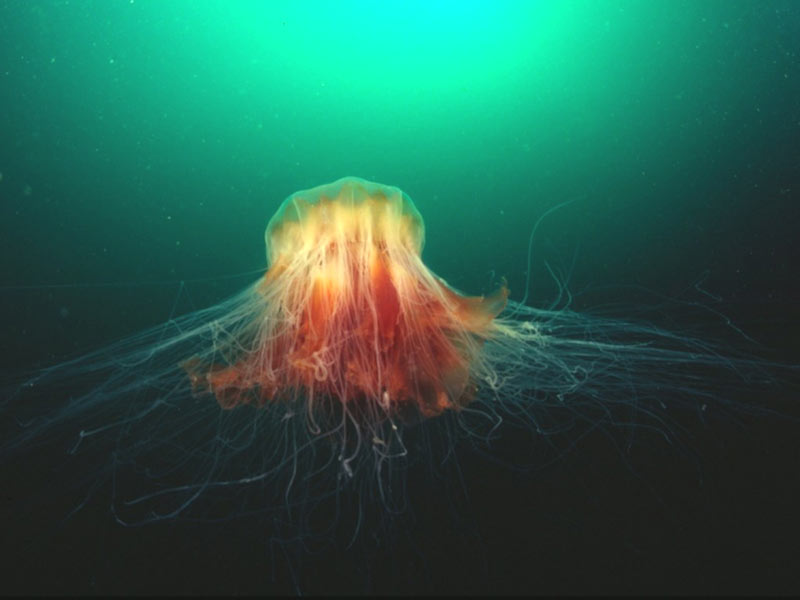
Cyanea capillata at the Isle of Man.
Photographer: Tim Nicholson Copyright: Tim Nicholson
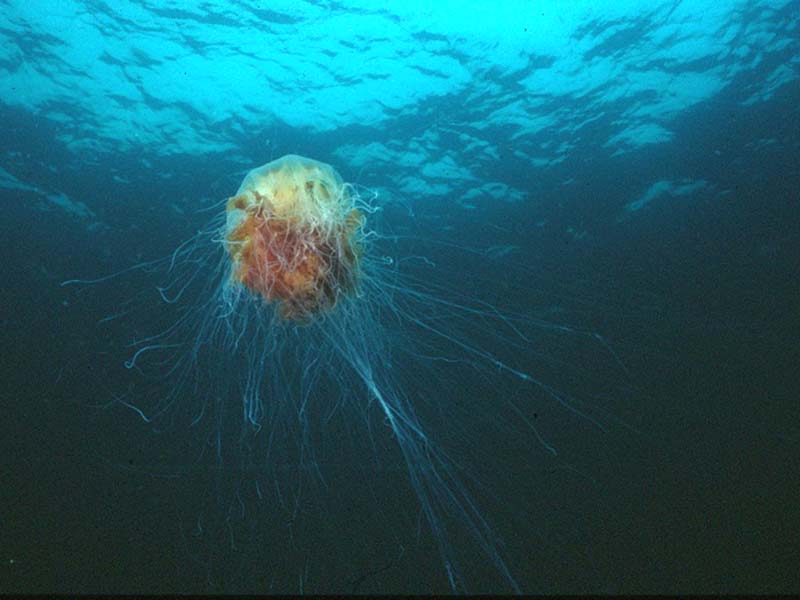
Cyanea capillata off the Isle of Man.
Photographer: Tim Nicholson Copyright: Tim Nicholson
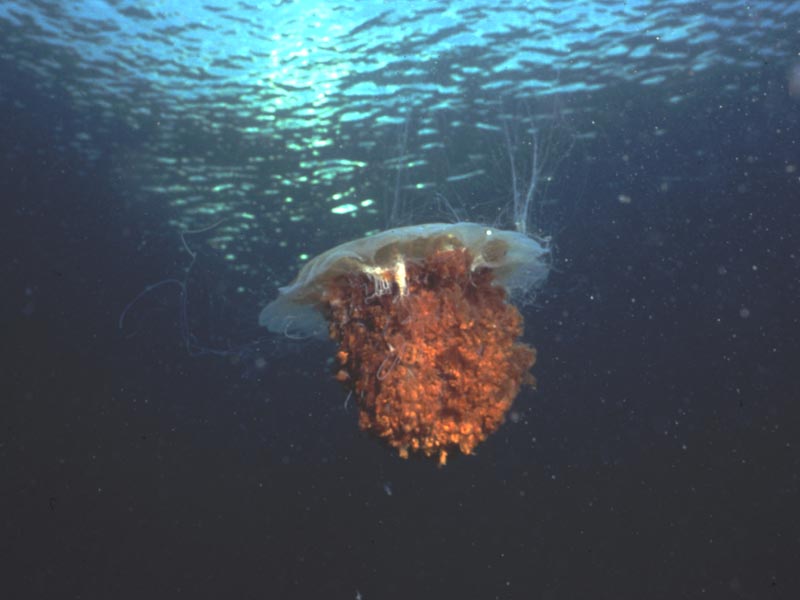
Cyanea capillata off the Isle of Man.
Photographer: Tim Nicholson Copyright: Tim Nicholson
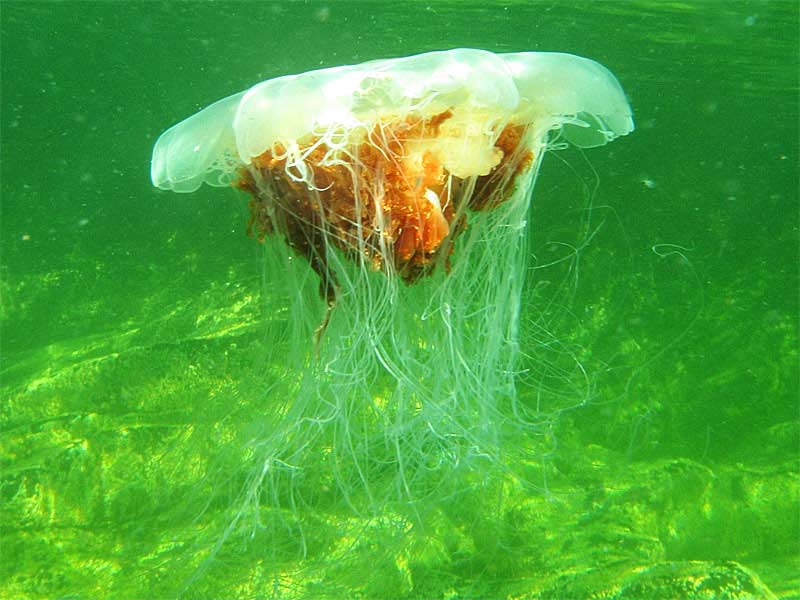
A Lion's mane jellyfish near the surface.
Photographer: Gordon Lang Copyright: Gordon Lang
Distribution data supplied by the Ocean Biodiversity Information System (OBIS). To interrogate UK data visit the NBN Atlas.Map Help
| Researched by | Jessica Heard | Refereed by | Admin |
| Authority | (Linnaeus, 1758) | ||
| Other common names | - | Synonyms | - |
Summary
Description
Recorded distribution in Britain and Ireland
Found around the coasts of the British Isles, most commonly along the east coast of England and Scotland. Also common in the Irish Sea.Global distribution
-Habitat
Cyanea capillata is pelagic species that can be found washed up on beaches.Depth range
-Identifying features
- Cyanea capillata has a diameter 30 cm or more.
- Usually yellow brown or red in colour.
- It is easily distinguished by a mass of long, hair-like tentacles.
- There at least 65 tentacles in each of the eight groups of tentacles.
Additional information
Young Cyanea capillata may be found as early as February in British waters, although the main period of abundance for larger individuals is June to September. This species does occasionally occur in large swarms, largely thought to be due to storms and tides that concentrate individuals together (Russell, 1970). They have a very severe sting that can produce blisters, irritation, and muscular cramp and may even affect respiratory and heart function. Cyanea capillata can still sting long after being stranded on the shore.Listed by
- none -
Bibliography
Hayward, P.J. & Ryland, J.S. (ed.), 1995. The marine fauna of the British Isles and north-west Europe. Volume 2. Molluscs to Chordates. Oxford Science Publications. Oxford: Clarendon Press.
Howson, C.M. & Picton, B.E., 1997. The species directory of the marine fauna and flora of the British Isles and surrounding seas. Belfast: Ulster Museum. [Ulster Museum publication, no. 276.]
JNCC (Joint Nature Conservation Committee), 1999. Marine Environment Resource Mapping And Information Database (MERMAID): Marine Nature Conservation Review Survey Database. [on-line] http://www.jncc.gov.uk/mermaid
Picton, B.E. & Costello, M.J., 1998. BioMar biotope viewer: a guide to marine habitats, fauna and flora of Britain and Ireland. [CD-ROM] Environmental Sciences Unit, Trinity College, Dublin.
Russell, F.S., 1970. The medusae of the British Isles. Vol II - Pelagic Scyphozoa, with a supplement to the first volume on hydromedusae. Cambridge University Press
Datasets
Centre for Environmental Data and Recording, 2018. Ulster Museum Marine Surveys of Northern Ireland Coastal Waters. Occurrence dataset https://www.nmni.com/CEDaR/CEDaR-Centre-for-Environmental-Data-and-Recording.aspx accessed via NBNAtlas.org on 2018-09-25.
Cofnod – North Wales Environmental Information Service, 2018. Miscellaneous records held on the Cofnod database. Occurrence dataset: https://doi.org/10.15468/hcgqsi accessed via GBIF.org on 2018-09-25.
Environmental Records Information Centre North East, 2018. ERIC NE Combined dataset to 2017. Occurrence dataset: http://www.ericnortheast.org.ukl accessed via NBNAtlas.org on 2018-09-38
Fenwick, 2018. Aphotomarine. Occurrence dataset http://www.aphotomarine.com/index.html Accessed via NBNAtlas.org on 2018-10-01
Fife Nature Records Centre, 2018. Fife Nature Records Centre combined dataset. Occurrence dataset: https://doi.org/10.15468/ccc1ip accessed via GBIF.org on 2018-09-27.
Kent Wildlife Trust, 2018. Kent Wildlife Trust Shoresearch Intertidal Survey 2004 onwards. Occurrence dataset: https://www.kentwildlifetrust.org.uk/ accessed via NBNAtlas.org on 2018-10-01.
Lancashire Environment Record Network, 2018. LERN Records. Occurrence dataset: https://doi.org/10.15468/esxc9a accessed via GBIF.org on 2018-10-01.
Manx Biological Recording Partnership, 2017. Isle of Man wildlife records from 01/01/2000 to 13/02/2017. Occurrence dataset: https://doi.org/10.15468/mopwow accessed via GBIF.org on 2018-10-01.
Marine Conservation Society, 2018. UK Jellyfish Sightings from 2003 to 2015. Occurrence dataset: https://www.mcsuk.org/ accessed via NBNAtlas.org on 2018-10-01.
Merseyside BioBank., 2018. Merseyside BioBank (unverified). Occurrence dataset: https://doi.org/10.15468/iou2ld accessed via GBIF.org on 2018-10-01.
National Trust, 2017. National Trust Species Records. Occurrence dataset: https://doi.org/10.15468/opc6g1 accessed via GBIF.org on 2018-10-01.
NBN (National Biodiversity Network) Atlas. Available from: https://www.nbnatlas.org.
North East Scotland Biological Records Centre, 2017. NE Scotland other invertebrate records 1800-2010. Occurrence dataset: https://doi.org/10.15468/ifjfxz accessed via GBIF.org on 2018-10-01.
OBIS (Ocean Biodiversity Information System), 2025. Global map of species distribution using gridded data. Available from: Ocean Biogeographic Information System. www.iobis.org. Accessed: 2025-06-21
Outer Hebrides Biological Recording, 2018. Invertebrates (except insects), Outer Hebrides. Occurrence dataset: https://doi.org/10.15468/hpavud accessed via GBIF.org on 2018-10-01.
Citation
This review can be cited as:
Last Updated: 03/05/2005