
Leatherback turtle (Dermochelys coriacea)
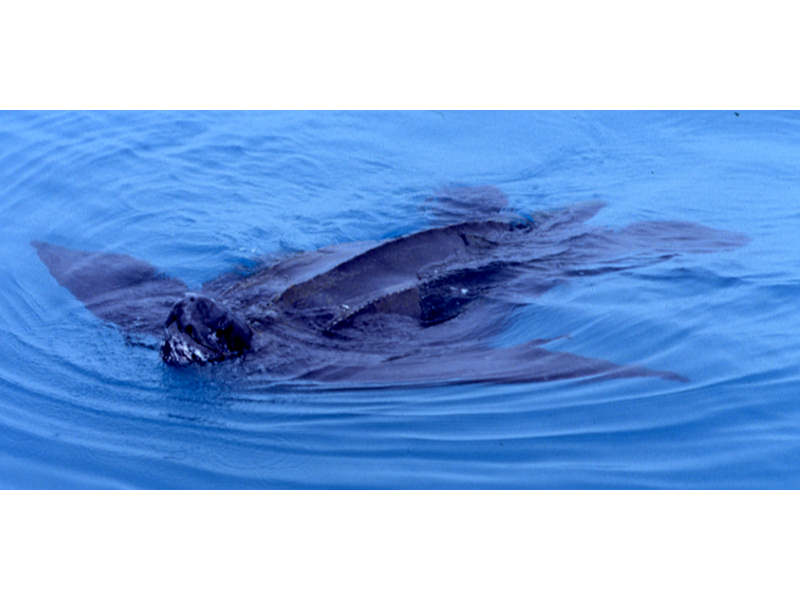
Leatherback turtle swimming at the surface.
Photographer: Mike Daines Copyright: Mike Daines
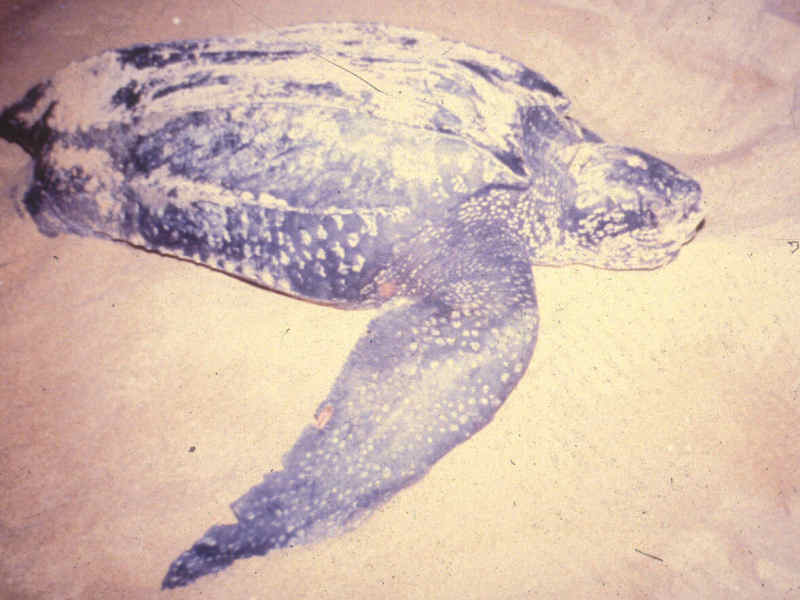
Leatherback turtle on egg laying beach at Terrengganu in Malaysia.
Photographer: John Davenport Copyright: Prof. John Davenport
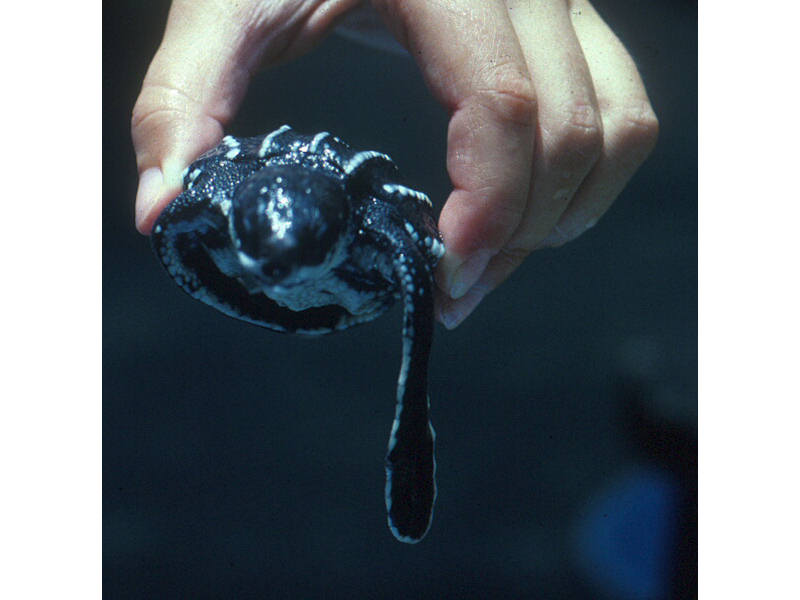
Recently hatched leatherback turtle.
Photographer: John Davenport Copyright: Prof. John Davenport
Distribution data supplied by the Ocean Biodiversity Information System (OBIS). To interrogate UK data visit the NBN Atlas.Map Help
| Researched by | Kate Reeds | Refereed by | Admin |
| Authority | (Vandelli, 1761) | ||
| Other common names | - | Synonyms | - |
Summary
Description
Recorded distribution in Britain and Ireland
Present mostly in August and September off the south and west coasts of Britain and Ireland. Also recorded off Shetland, the Firth of Forth and Humberside.Global distribution
-Habitat
This species generally inhabits open seas and is capable of diving to 1200 m.Depth range
-Identifying features
- Up to 2 m in length, weighs up to 0.5 tonnes.
- 7 ridges along back.
- Blackish leathery shell, with pale spotting under skin.
Additional information
The leatherback is the sole living representative of the family Dermochelyidae. It is clear that the leatherbacks extensive migrations to British waters are to follow swarms of jellyfish which are the leatherbacks main prey item. Breeding occurs in shallow tropical waters, although female leatherbacks will come high up on the shore to deposit their eggs. Populations of leatherbacks are in serious decline due to a number of factors. These include loss of nesting habitats, destruction of nests by poachers, propeller wounds, interaction with commercial fisheries and ingestion of marine debris.Dermochelys coriacea is listed as Critically endangered on the Red list of Threatened animals 2000 and, therefore, considered to be of extremely high risk of extinction in the wild in the immediate future. It is listed under the UK Biodiversity Action Plan and is addressed under a marine turtles Species Action Plan. Dermochelys coriacia is listed on Appendix I of the Convention on the International Trade in Endangered Species of Flora and Fauna (CITES) 1975, Appendix II of the Bern Convention 1979, Appendices I and II of the Bonn Convention 1979 and Annex IV of the EC Habitats Directive. The loggerhead is also listed as a priority species on Annex II of the EC Habitats Directive. All five species are protected under Schedule 5 of the Wildlife and Countryside Act 1981 and the Conservation (Natural Habitats & c.) Regulations 1994 (Anon, 1999(ii)).
Listed by
Bibliography
Anonymous, 1999ii. Marine turtles. Grouped Species Action Plan http://www.ukbap.org.uk/UKPlans.aspx?ID=335, 2001-07-09
Bustard, R., 1972. Sea turtles, their natural history and conservation. London: Collins.
CRESLI (Coastal Research and Education Society of Long Island), 2001. The leatherback sea turtle (Dermochelys coracia). [cited on 2001-06-19]. Available from: http://www.cresli.org/cresli
Howson, C.M. & Picton, B.E., 1997. The species directory of the marine fauna and flora of the British Isles and surrounding seas. Belfast: Ulster Museum. [Ulster Museum publication, no. 276.]
Datasets
Cofnod – North Wales Environmental Information Service, 2018. Miscellaneous records held on the Cofnod database. Occurrence dataset: https://doi.org/10.15468/hcgqsi accessed via GBIF.org on 2018-09-25.
Dumfries and Galloway Environmental Resources Centre, 2017. Amphibian and reptile data for Dumfries and Galloway. Occurrence dataset: https://doi.org/10.15468/016wkv accessed via GBIF.org on 2018-09-27.
Froglife, 2018. Amphibian and reptile records for Great Britain in 2016. Occurrence dataset: https://doi.org/10.15468/niyja0 accessed via GBIF.org on 2018-09-27.
Lancashire Environment Record Network, 2018. LERN Records. Occurrence dataset: https://doi.org/10.15468/esxc9a accessed via GBIF.org on 2018-10-01.
Manx Biological Recording Partnership, 2017. Isle of Man wildlife records from 01/01/2000 to 13/02/2017. Occurrence dataset: https://doi.org/10.15468/mopwow accessed via GBIF.org on 2018-10-01.
Marine Environmental Monitoring, 2018. Marine Turtles. Occurrence dataset: https://doi.org/10.15468/xy69ku accessed via GBIF.org on 2018-10-01.
National Trust, 2017. National Trust Species Records. Occurrence dataset: https://doi.org/10.15468/opc6g1 accessed via GBIF.org on 2018-10-01.
NBN (National Biodiversity Network) Atlas. Available from: https://www.nbnatlas.org.
OBIS (Ocean Biodiversity Information System), 2025. Global map of species distribution using gridded data. Available from: Ocean Biogeographic Information System. www.iobis.org. Accessed: 2025-07-01
Outer Hebrides Biological Recording, 2018. Vertebrates (except birds, INNS and restricted records), Outer Hebrides. Occurrence dataset: https://doi.org/10.15468/dax3tf accessed via GBIF.org on 2018-10-01.
South East Wales Biodiversity Records Centre, 2018. SEWBReC Reptiles (South East Wales). Occurrence dataset: https://doi.org/10.15468/mkesjf accessed via GBIF.org on 2018-10-02.
Suffolk Biodiversity Information Service., 2017. Suffolk Biodiversity Information Service (SBIS) Dataset. Occurrence dataset: https://doi.org/10.15468/ab4vwo accessed via GBIF.org on 2018-10-02.
Citation
This review can be cited as:
Last Updated: 13/07/2004