
Banded wedge shell (Donax vittatus)
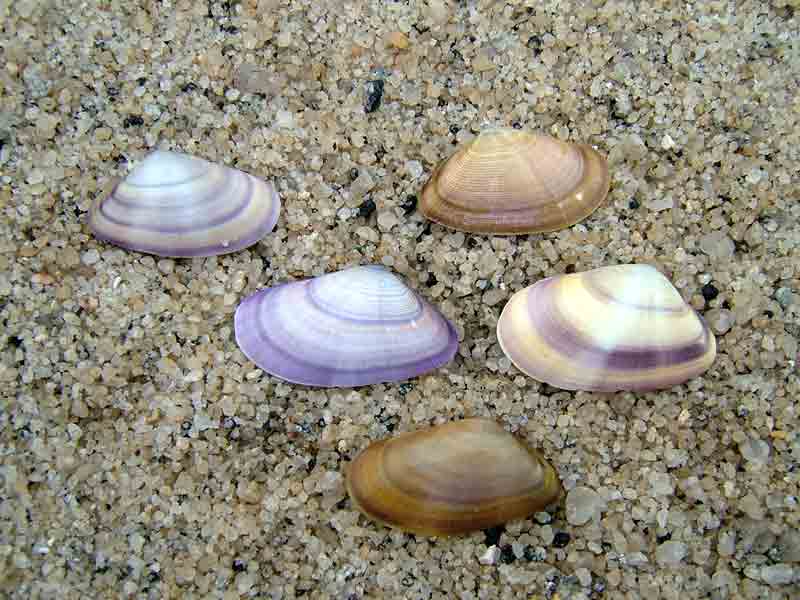
Assorted colours and shapes of banded wedge shells
Photographer: David Fenwick Copyright: David Fenwick Snr.
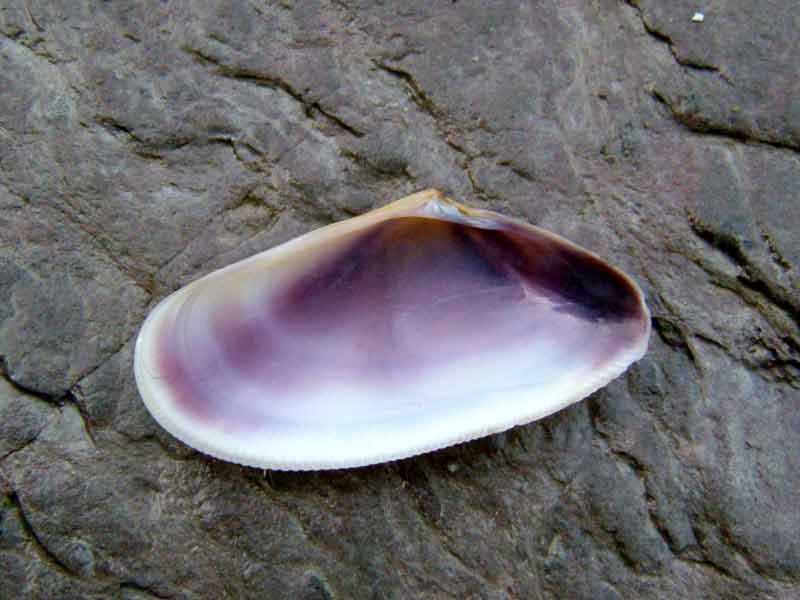
Inside of shell half of the banded wedge shell
Photographer: David Fenwick Copyright: David Fenwick Snr.
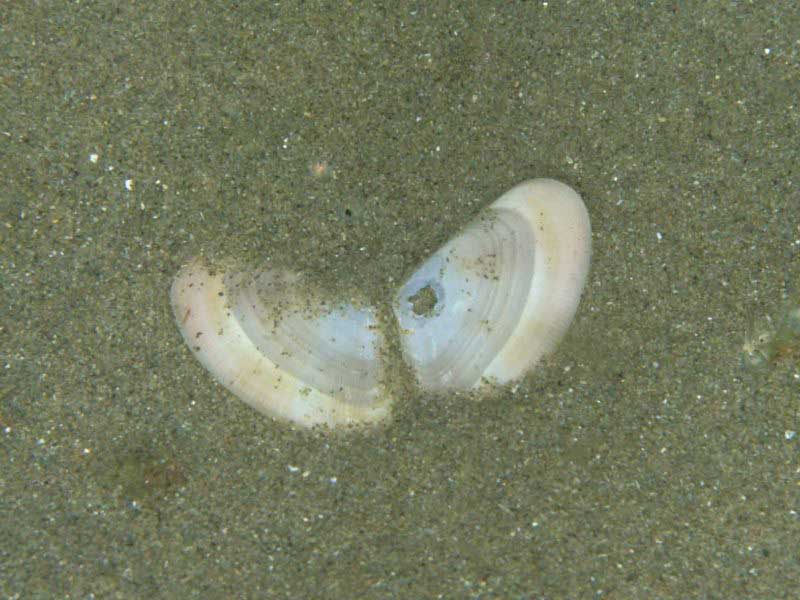
Open empty shell of Donax vittatus.
Photographer: Paul Naylor Copyright: Paul Naylor
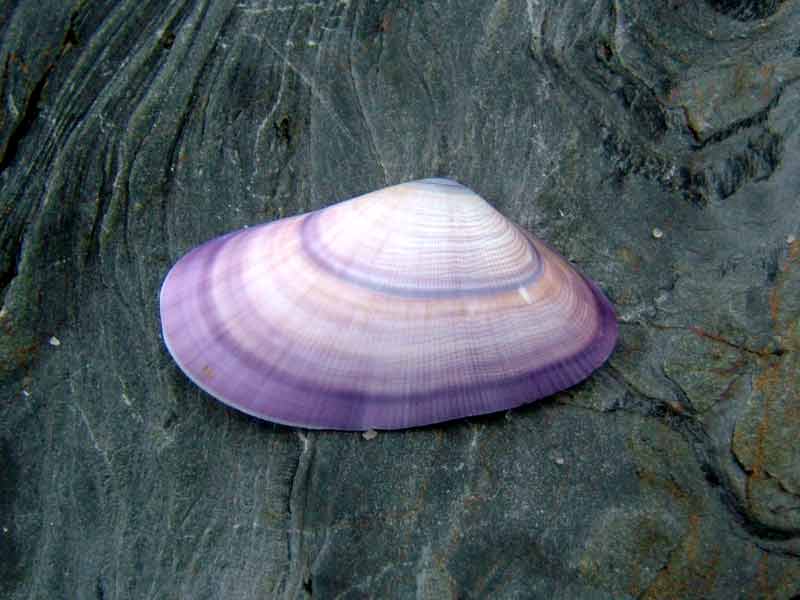
Shell half of the banded wedge shell
Photographer: David Fenwick Copyright: David Fenwick Snr.
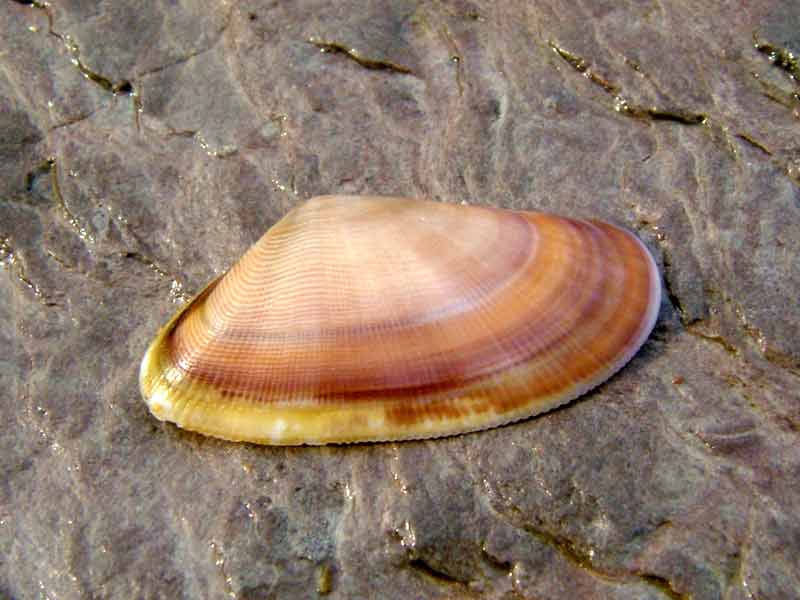
Shell half of the banded wedge shell
Photographer: David Fenwick Copyright: David Fenwick Snr.
Distribution data supplied by the Ocean Biodiversity Information System (OBIS). To interrogate UK data visit the NBN Atlas.Map Help
| Researched by | Caroline Farrell | Refereed by | Admin |
| Authority | (da Costa, 1778) | ||
| Other common names | - | Synonyms | - |
Summary
Description
Recorded distribution in Britain and Ireland
Common on all British and Irish coasts, although records are sparse for the north-west of England and much of Ireland and Scotland.Global distribution
-Habitat
Occurs intertidally, from mid-shore to depths of around 20 m, burrowing in sandy sediments. It is often abundant on moderately exposed sandy shores and bays.Depth range
-Identifying features
- Slender wedge shaped shell.
- Umbones posterior of the midline.
- Two shells eqivalve; anterior side broadly rounded, posterior side more steeply rounded.
- Ventral margin crenulate on its inner edge.
- Each valve has two cardinal teeth.
- Right valve has one anterior and two posterior lateral teeth.
- Left valve has single, small anterior and posterior lateral teeth.
- Outer shell surfaces with numerous, fine concentric ridges and grooves, and fine lines radiating from the umbones.
- White, yellowish, light brown or purple, often lighter round the umbones, with pale radiating rays and often with pigmented bands along growth lines.
- Inner surface smooth, white with purple or yellow areas.
- Pallial sinus broadly oval, extending to the midline of the shell.
Additional information
Donax variegatus occurs in similar habitats to Donax vittatus around the south and south-west coasts of Britain but is more regularly oval than Donax vittatus and is distinguished principally by the marginal crenulations which are much finer and feel smooth to the touch. Donax vittatus lives just under the surface of the sediment and is often dislodged by rough seas but the presence of a large, powerful foot enables it to reburrow as soon as disturbance is over and so reduce the dangers of desiccation and predation. If growth is rapid, Donax vittatus can live for two to three years but where growth is slow it may live for up to seven years (Fish & Fish, 1996).Listed by
- none -
Bibliography
Allen, J.A. 1962. The fauna of the Clyde Sea area. Mollusca. Millport: Scottish Marine Biological Association.
Bruce, J.R., Colman, J.S. & Jones, N.S., 1963. Marine fauna of the Isle of Man. Liverpool: Liverpool University Press.
Crothers, J.H. (ed.), 1966. Dale Fort Marine Fauna. London: Field Studies Council.
Fish, J.D. & Fish, S., 1996. A student's guide to the seashore. Cambridge: Cambridge University Press.
Foster-Smith, J. (ed.), 2000. The marine fauna and flora of the Cullercoats District. Marine species records for the North East Coast of England. Sunderland: Penshaw Press, for the Dove Marine Laboratory, University of Newcastle upon Tyne.
Gibson, R., Hextall, B. & Rogers, A., 2001. Photographic guide to the sea and seashore life of Britain and north-west Europe. Oxford: Oxford University Press.
Hayward, P., Nelson-Smith, T. & Shields, C. 1996. Collins pocket guide. Sea shore of Britain and northern Europe. London: HarperCollins.
Hayward, P.J. & Ryland, J.S. (ed.) 1995b. Handbook of the marine fauna of North-West Europe. Oxford: Oxford University Press.
Howson, C.M. & Picton, B.E., 1997. The species directory of the marine fauna and flora of the British Isles and surrounding seas. Belfast: Ulster Museum. [Ulster Museum publication, no. 276.]
JNCC (Joint Nature Conservation Committee), 1999. Marine Environment Resource Mapping And Information Database (MERMAID): Marine Nature Conservation Review Survey Database. [on-line] http://www.jncc.gov.uk/mermaid
Laverack, M.S. & Blackler, D.M., 1974. Fauna & Flora of St. Andrews Bay. Scottish Academic Press (Edinburgh & London).
MBA (Marine Biological Association), 1957. Plymouth Marine Fauna. Plymouth: Marine Biological Association of the United Kingdom.
Picton, B.E. & Costello, M.J., 1998. BioMar biotope viewer: a guide to marine habitats, fauna and flora of Britain and Ireland. [CD-ROM] Environmental Sciences Unit, Trinity College, Dublin.
Tebble, N., 1976. British Bivalve Seashells. A Handbook for Identification, 2nd ed. Edinburgh: British Museum (Natural History), Her Majesty's Stationary Office.
Datasets
Centre for Environmental Data and Recording, 2018. Ulster Museum Marine Surveys of Northern Ireland Coastal Waters. Occurrence dataset https://www.nmni.com/CEDaR/CEDaR-Centre-for-Environmental-Data-and-Recording.aspx accessed via NBNAtlas.org on 2018-09-25.
Cofnod – North Wales Environmental Information Service, 2018. Miscellaneous records held on the Cofnod database. Occurrence dataset: https://doi.org/10.15468/hcgqsi accessed via GBIF.org on 2018-09-25.
Conchological Society of Great Britain & Ireland, 2018. Mollusc (marine) data for Great Britain and Ireland - restricted access. Occurrence dataset: https://doi.org/10.15468/4bsawx accessed via GBIF.org on 2018-09-25.
Conchological Society of Great Britain & Ireland, 2023. Mollusc (marine) records for Great Britain and Ireland. Occurrence dataset: https://doi.org/10.15468/aurwcz accessed via GBIF.org on 2024-09-27.
Fenwick, 2018. Aphotomarine. Occurrence dataset http://www.aphotomarine.com/index.html Accessed via NBNAtlas.org on 2018-10-01
Fife Nature Records Centre, 2018. St Andrews BioBlitz 2014. Occurrence dataset: https://doi.org/10.15468/erweal accessed via GBIF.org on 2018-09-27.
Kent Wildlife Trust, 2018. Kent Wildlife Trust Shoresearch Intertidal Survey 2004 onwards. Occurrence dataset: https://www.kentwildlifetrust.org.uk/ accessed via NBNAtlas.org on 2018-10-01.
Lancashire Environment Record Network, 2018. LERN Records. Occurrence dataset: https://doi.org/10.15468/esxc9a accessed via GBIF.org on 2018-10-01.
Merseyside BioBank., 2018. Merseyside BioBank (unverified). Occurrence dataset: https://doi.org/10.15468/iou2ld accessed via GBIF.org on 2018-10-01.
Merseyside BioBank., 2018. Merseyside BioBank Active Naturalists (unverified). Occurrence dataset: https://doi.org/10.15468/smzyqf accessed via GBIF.org on 2018-10-01.
National Trust, 2017. National Trust Species Records. Occurrence dataset: https://doi.org/10.15468/opc6g1 accessed via GBIF.org on 2018-10-01.
NBN (National Biodiversity Network) Atlas. Available from: https://www.nbnatlas.org.
OBIS (Ocean Biodiversity Information System), 2025. Global map of species distribution using gridded data. Available from: Ocean Biogeographic Information System. www.iobis.org. Accessed: 2025-08-02
Outer Hebrides Biological Recording, 2018. Invertebrates (except insects), Outer Hebrides. Occurrence dataset: https://doi.org/10.15468/hpavud accessed via GBIF.org on 2018-10-01.
South East Wales Biodiversity Records Centre, 2018. SEWBReC Molluscs (South East Wales). Occurrence dataset: https://doi.org/10.15468/jos5ga accessed via GBIF.org on 2018-10-02.
Citation
This review can be cited as:
Last Updated: 17/04/2008