
Lesser weever fish (Echiichthys vipera)
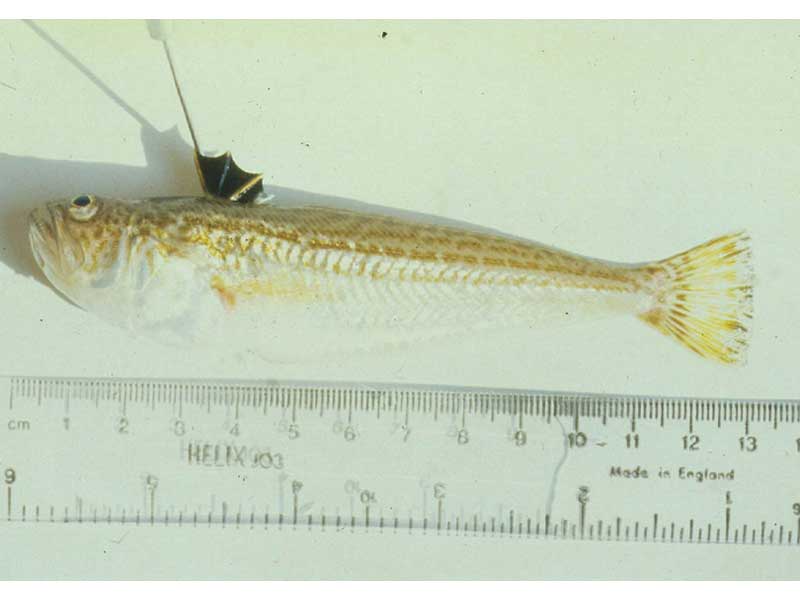
Echiichthys vipera with dorsal fin held extended with a mounting needle.
Photographer: Tammy Horton Copyright: Dr Tammy Horton
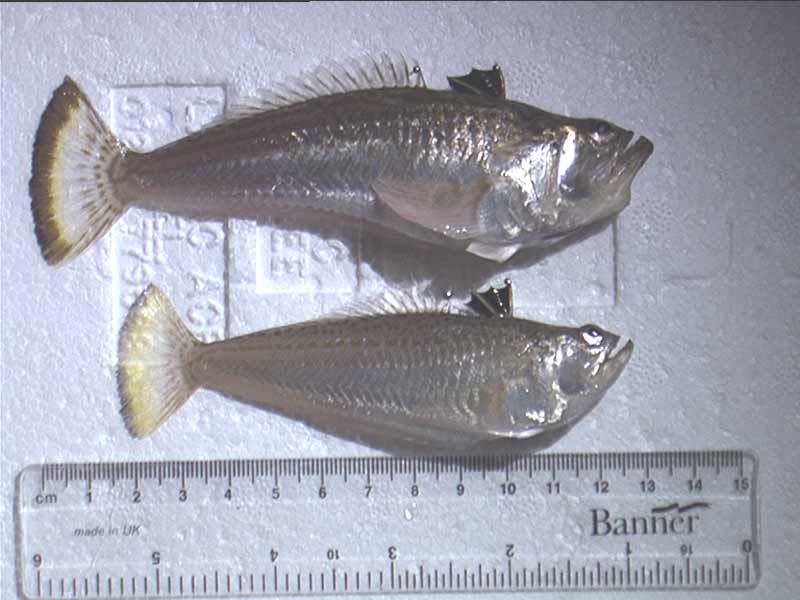
Echiichthys vipera containing the oral parasite Ceratothoa steindachneri (an isopod) above compared to an un-parasitised specimen below.
Photographer: Tammy Horton Copyright: Dr Tammy Horton
Distribution data supplied by the Ocean Biodiversity Information System (OBIS). To interrogate UK data visit the NBN Atlas.Map Help
| Researched by | Paolo Pizzolla | Refereed by | Admin |
| Authority | (Cuvier, 1829) | ||
| Other common names | - | Synonyms | Trachinus vipera (Cuvier, 1829) |
Summary
Description
Recorded distribution in Britain and Ireland
Found all around Britain, most abundant in the south and west.Global distribution
-Habitat
Common on clean sandy bottoms from the low water mark to the shallow sub-littoral down to 50 m. The species lives buried in the sand with only the head and back uncovered. The species is probably most active at night.Depth range
-Identifying features
- Oblique upward pointing mouth.
- Small, black first dorsal fin.
- Long second dorsal fin.
- Large paddle shaped pectoral fins.
- Yellowish brown in colour with a paler underside.
Additional information
The spines of the first dorsal fin and gill covers release a poison that give an extremely painful sting to bathers or fishermen treading on the buried fish. The name weever is derived from the Anglo-saxon word meaning viper and reflects the venomous nature of the fish.Listed by
- none -
Bibliography
Dipper, F., 2001. British sea fishes (2nd edn). Teddington: Underwater World Publications Ltd.
Fish, J.D. & Fish, S., 1996. A student's guide to the seashore. Cambridge: Cambridge University Press.
Hayward, P., Nelson-Smith, T. & Shields, C. 1996. Collins pocket guide. Sea shore of Britain and northern Europe. London: HarperCollins.
Hayward, P.J. & Ryland, J.S. (ed.) 1995b. Handbook of the marine fauna of North-West Europe. Oxford: Oxford University Press.
Howson, C.M. & Picton, B.E., 1997. The species directory of the marine fauna and flora of the British Isles and surrounding seas. Belfast: Ulster Museum. [Ulster Museum publication, no. 276.]
JNCC (Joint Nature Conservation Committee), 1999. Marine Environment Resource Mapping And Information Database (MERMAID): Marine Nature Conservation Review Survey Database. [on-line] http://www.jncc.gov.uk/mermaid
Datasets
Environmental Records Information Centre North East, 2018. ERIC NE Combined dataset to 2017. Occurrence dataset: http://www.ericnortheast.org.ukl accessed via NBNAtlas.org on 2018-09-38
Fenwick, 2018. Aphotomarine. Occurrence dataset http://www.aphotomarine.com/index.html Accessed via NBNAtlas.org on 2018-10-01
Fife Nature Records Centre, 2018. St Andrews BioBlitz 2014. Occurrence dataset: https://doi.org/10.15468/erweal accessed via GBIF.org on 2018-09-27.
Isle of Wight Local Records Centre, 2017. IOW Natural History & Archaeological Society Marine Records. Occurrence dataset: https://doi.org/10.15468/7axhcw accessed via GBIF.org on 2018-09-27.
Kent & Medway Biological Records Centre, 2017. Fish: Records for Kent. Occurrence dataset https://doi.org/10.15468/kd1utk accessed via GBIF.org on 2018-09-27.
Kent Wildlife Trust, 2018. Kent Wildlife Trust Shoresearch Intertidal Survey 2004 onwards. Occurrence dataset: https://www.kentwildlifetrust.org.uk/ accessed via NBNAtlas.org on 2018-10-01.
Merseyside BioBank., 2018. Merseyside BioBank (unverified). Occurrence dataset: https://doi.org/10.15468/iou2ld accessed via GBIF.org on 2018-10-01.
National Trust, 2017. National Trust Species Records. Occurrence dataset: https://doi.org/10.15468/opc6g1 accessed via GBIF.org on 2018-10-01.
NBN (National Biodiversity Network) Atlas. Available from: https://www.nbnatlas.org.
OBIS (Ocean Biodiversity Information System), 2025. Global map of species distribution using gridded data. Available from: Ocean Biogeographic Information System. www.iobis.org. Accessed: 2025-05-09
Citation
This review can be cited as:
Last Updated: 11/10/2002