
Speckled sea louse (Eurydice pulchra)
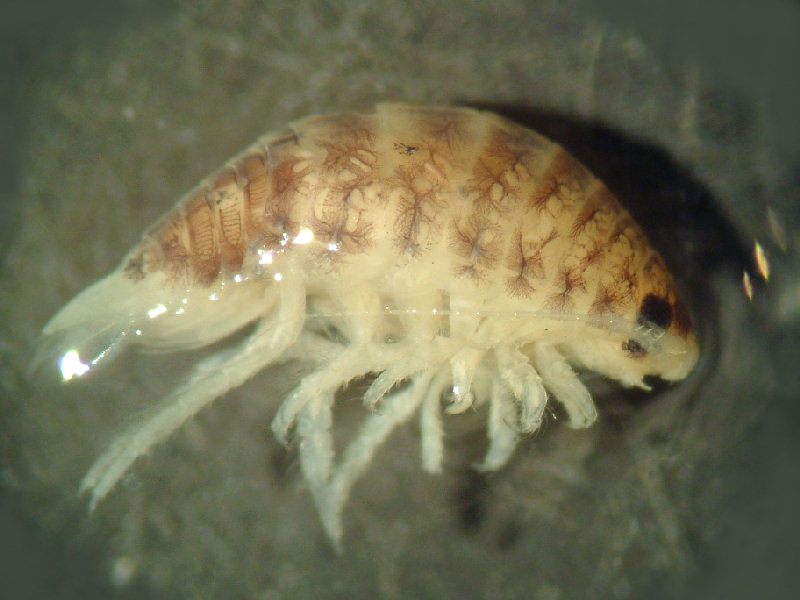
Eurydice pulchra.
Photographer: Marine Ecological Surveys Ltd Copyright: Marine Ecological Surveys Ltd
Distribution data supplied by the Ocean Biodiversity Information System (OBIS). To interrogate UK data visit the NBN Atlas.Map Help
| Researched by | Georgina Budd | Refereed by | This information is not refereed |
| Authority | Leach, 1815 | ||
| Other common names | - | Synonyms | - |
Summary
Description
A small and distinctive 'louse-like' isopod. The body is flattened with an oval outline. It has large eyes, positioned laterally and a long second pair of antennae. It may be pale grey to brown in colour, with black spots covering all surfaces of the body.
Recorded distribution in Britain and Ireland
Widespread on open coast and estuarine sandy beaches, with reduced abundance in south-east England.
Global distribution
Eurydice pulchra is found from Norway and the outer Baltic to the Atlantic coast of Morocco, but not in the Mediterranean (Soika, 1955).
Habitat
Found in the intertidal zone, on fine to medium grained sandy shores. Eurydice pulchra occupies a middle shore zone, but its distribution shifts up shore on spring tides and down shore on neap tides.
Depth range
-Identifying features
- Chitinous body dorso-ventrally flattened, up to 8 mm in length.
- Thorax broader than abdomen giving oval outline.
- Large lateral eyes.
- One pair of short antennae, second pair about two thirds of body length, with 4 segments in basal region.
- All thoracic (pereon) segments except the first, have conspicuous lateral expansions (Coxal plates).
- Coxal plate on 6th thoracic segment, extends sharply backwards.
- Telson (tail piece) is rounded, fringed with long setae, flanked on each side by two short spines.
- Uropods (flat plates) lie on underside of tail piece and conceal pleopods (respiratory plates, that also beat to create a current of water for swimming).
- Pale grey or brown in colour.
- Black spots (chromatophores) on upper and lower surface of body, and along the sides are particularly characteristic.
Additional information
British coastal isopods have been described by Naylor (1972, 1990). A second intertidal species of Eurydice, Eurydice affinis Hansen, is also found on British shores. It is distinguished from Eurydice pulchra by an overall paler appearance, with black spots only on its dorsal surface. In Britain it has a more restricted distribution than Eurydice pulchra, from south-west England into North Wales, where it occurs amongst populations of Eurydice pulchra.
Listed by
- none -
Biology review
Taxonomy
| Level | Scientific name | Common name |
|---|---|---|
| Phylum | Arthropoda | Arthropods, joint-legged animals, e.g. insects, crustaceans & spiders |
| Class | Malacostraca | Crabs, lobsters, sand hoppers and sea slaters |
| Order | Isopoda | Sea slaters and gribbles |
| Family | Cirolanidae | |
| Genus | Eurydice | |
| Authority | Leach, 1815 | |
| Recent Synonyms | ||
Biology
| Parameter | Data | ||
|---|---|---|---|
| Typical abundance | |||
| Male size range | <8 mm | ||
| Male size at maturity | 5.0 mm | ||
| Female size range | 5.9 mm | ||
| Female size at maturity | |||
| Growth form | Articulate | ||
| Growth rate | 0.3 mm/month | ||
| Body flexibility | High (greater than 45 degrees) | ||
| Mobility | Swimmer (appendages, paddles), Swimmer | ||
| Characteristic feeding method | Predator, Scavenger | ||
| Diet/food source | Carnivore | ||
| Typically feeds on | Other infaunal invertebrates associated with sandy shores and dead organic material. | ||
| Sociability | No information | ||
| Environmental position | Infaunal | ||
| Dependency | Host for. | ||
| Supports | No information found | ||
| Is the species harmful? | No | ||
Biology information
Feeding. Eurydice pulchra is a highly predatory carnivore, its mouthparts are adapted for tearing and macerating animal tissue (Naylor, 1972).
Endogenous swimming rhythm. Eurydice pulchra has been shown to have an endogenously controlled circatidal rhythm cycle of swimming that is coupled to a circasemilunar pattern of emergence from the substratum (Alheit & Naylor, 1976; Jones & Naylor, 1970). On the beach, the animals rely on the cue of increasing water agitation caused by the flood tide to swim from the sand, the endogenous component of the rhythm ensuring that they swim for up to 5-6 hours before reburying in the sand in a restricted zone between mean tide level (MTL) and high water neaps (HWN). Eurydice pulchra swims mostly at night. Animals emerging from the sand, or washed out by turbulence during the day show photonegative behaviour and immediately bury themselves again.
Habitat preferences
| Parameter | Data |
|---|---|
| Physiographic preferences | Enclosed coast or Embayment, Estuary, Open coast, Strait or Sound |
| Biological zone preferences | Lower eulittoral, Mid eulittoral, Sublittoral fringe, Upper eulittoral |
| Substratum / habitat preferences | Coarse clean sand, Fine clean sand |
| Tidal strength preferences | |
| Wave exposure preferences | Exposed, Moderately exposed |
| Salinity preferences | Full (30-40 psu) |
| Depth range | |
| Other preferences | No text entered |
| Migration Pattern | Diel |
Habitat Information
Population density. Eurydice pulchra populations may occur at densities of 1500 per m² or more and, on a South Wales beach studied by Jones (1970b), the population exceeded 4000 per m².
Intertidal distribution. Eurydice pulchra lives on the upper half of the shore, generally being most abundant between mean tide level (MTL) and mean high water of neap tides (MHWN). Eurydice pulchra relies upon the cue of increasing wave action caused by the flood tide (Jones, 1970b) to initiate swimming from the substratum. It swims in search of food and buries itself in the sand again as the tide ebbs. As the fortnightly spring tides carry water further up the shore, so Eurydice pulchra moves up, and it can be found in the sand right up to the mean high water of spring tides. When the tidal cycle swings again towards neaps, the Eurydice population also moves down shore again and avoids being stranded above the neap high water mark (Fish, 1970).
Life history
Adult characteristics
| Parameter | Data |
|---|---|
| Reproductive type | Gonochoristic (dioecious) |
| Reproductive frequency | Annual episodic |
| Fecundity (number of eggs) | See additional information |
| Generation time | See additional information |
| Age at maturity | See additional information. |
| Season | March - August |
| Life span | 1-2 years |
Larval characteristics
| Parameter | Data |
|---|---|
| Larval/propagule type | - |
| Larval/juvenile development | Ovoviviparous |
| Duration of larval stage | Not relevant |
| Larval dispersal potential | 100 -1000 m |
| Larval settlement period | Not relevant |
Life history information
Fecundity. The number of eggs carried by females of Eurydice pulchra was reported to vary in populations from different localities. In a population from the Dovey Estuary, west Wales, Fish (1970) observed the total number of eggs in any one female to vary between 22 to 54. Jones (1970) found that small females, 4.5 mm body length, carried a minimum of 10 eggs, whilst larger females, 7 mm body length, carried up to 40 eggs. In France, Salvat (1966) reported females of 6.0 mm body length to carry at least 45 eggs.
Reproduction. Fish (1970) and Jones (1970) describe the reproductive cycle of two British populations of Eurydice pulchra from an estuarine and open coast location respectively. Some differences concerning the duration of the breeding period and the number of eggs carried by females of a particular size were found.
The sexes are separate and they pair whilst swimming. Development of the embryo occurs within the internal brood pouch (marsupium) of the female, and the incubation period takes seven to eight weeks. Embryonic development is similar to that of other isopods (Forsman, 1944; Kjennerud, 1950; Naylor, 1955b, cited in Fish, 1970), and four distinct stages are recognised, the last stage being a miniature version of the adult. The minimum recorded length of newly emerged juveniles is 1.7 mm and they are able to swim and feed immediately.
Early broods released during July were reported by Jones (1970), to reach maturity before winter within the same year, breed early during the following spring and consequently provide the first broods of that year, before dying in their second autumn after a total lifespan of approximately 15 months. Broods released in August and September initially grew as rapidly as the early spring brood but did not reach maturity and consequently overwintered as juveniles. overwintering juveniles matured as late as July and themselves produced the late broods of the following year. In contrast, on the west coast of Wales, sexually immature specimens of Eurydice pulchra were overwintered twice and took 20 months to attain sexual maturity, produced only one brood per year and had a lifespan of about two years (Fish, 1970). Furthermore, Salvat (1966) reported a population of Eurydice pulchra from Arcachon, France, to have an annual reproductive cycle with sexual maturity being reached within 8 months. It is suspected (Fish, 1970; Jones, 1970; Salvat, 1966), that these variations in the reproductive life cycle are related to the significant temperature differences between localities. The effect of temperature is reflected in the duration of the post-hatching growth stages, which are accelerated at higher temperatures.
Sensitivity review
The MarLIN sensitivity assessment approach used below has been superseded by the MarESA (Marine Evidence-based Sensitivity Assessment) approach (see menu). The MarLIN approach was used for assessments from 1999-2010. The MarESA approach reflects the recent conservation imperatives and terminology and is used for sensitivity assessments from 2014 onwards.
Physical pressures
Use / to open/close text displayed
| Intolerance | Recoverability | Sensitivity | Evidence / Confidence | |
Substratum loss [Show more]Substratum lossBenchmark. All of the substratum occupied by the species or biotope under consideration is removed. A single event is assumed for sensitivity assessment. Once the activity or event has stopped (or between regular events) suitable substratum remains or is deposited. Species or community recovery assumes that the substratum within the habitat preferences of the original species or community is present. Further details EvidenceDuring its inactive (non-feeding) phase Eurydice pulchra buries infaunally in the uppermost 10 cm of sandy substrata, and the removal of the substratum would also remove the resident population. Intolerance has been assessed to be high. It is likely that the species would re-populate on return to prior conditions, including by immigration, and recovery has been assessed to be very high. | High | Very high | Low | High |
Smothering [Show more]SmotheringBenchmark. All of the population of a species or an area of a biotope is smothered by sediment to a depth of 5 cm above the substratum for one month. Impermeable materials, such as concrete, oil, or tar, are likely to have a greater effect. Further details. EvidenceEurydice pulchra would probably be unaffected by an additional covering of sediment of a texture within its preference. In an experiment to determine if Eurydice pulchra was selective of substratum particle size, Jones (1970b) observed Eurydice pulchra to demonstrate a strong preference for coarse particles (1.0 - 0.5 mm median diameter). It is likely that the grade of the substratum is an important factor determining the zonation and relative geographical distribution of the species. Jones (1970b, Table 6) also observed differences in the speed of burrowing and depth attained by Eurydice pulchra, which varied according to particle size. In the finest grades of particles (0.157 - 0.031 mm median diameter (silts, Wentworth scale)), Eurydice pulchra made little progress in its attempts at burial, achieving a depth of only 1 cm after 3 hours. Thus if Eurydice pulchra experienced difficulty when trying to bury into finer substrata, it is also likely that it would experience difficulty in burying out after smothering by fine particulate matter and would have to rely on displacement by tidal wave action. Furthermore, smothering by fine particulate matter would not only alter the physical properties of the substratum, but also the chemical properties, especially the degree of oxygenation. Eurydice pulchra was considered to be intolerant of poorly oxygenated substrata (see oxygenation below), and smaller juveniles may be easily smothered by accretion of fine material. Therefore Eurydice pulchra has been assessed to have a high intolerance to smothering by fine particulate matter and viscous materials such as oil, through which burrowing is likely to be hindered and cause changes to the habitat which are outside the species preference. The species is likely to have a high capacity for recovery on return to prior conditions (see additional information below). | High | High | Moderate | High |
Increase in suspended sediment [Show more]Increase in suspended sedimentBenchmark. An arbitrary short-term, acute change in background suspended sediment concentration e.g., a change of 100 mg/l for one month. The resultant light attenuation effects are addressed under turbidity, and the effects of rapid settling out of suspended sediment are addressed under smothering. Further details EvidenceIt is unlikely that the swimming and hunting activity of Eurydice pulchra would be affected by an increase in the suspended matter in the water column for a period of one month, as it is a regular swimmer in the surf plankton, where the concentration of suspended particles would be expected to be higher and variable according to the strength of wave action. The species has been assessed to be tolerant. The resultant light attenuation effects have been addressed under turbidity, end the effects of rapid settling out of suspended sediment have been addressed under smothering. | Tolerant | Not relevant | Not sensitive | Low |
Decrease in suspended sediment [Show more]Decrease in suspended sedimentBenchmark. An arbitrary short-term, acute change in background suspended sediment concentration e.g., a change of 100 mg/l for one month. The resultant light attenuation effects are addressed under turbidity, and the effects of rapid settling out of suspended sediment are addressed under smothering. Further details EvidenceEurydice pulchra is a regular swimmer in the surf plankton, where the concentration of suspended sediment would be expected to be variable according to wave action. The resultant light attenuation effects have been addressed under turbidity. | Tolerant | Not relevant | Not sensitive | Low |
Desiccation [Show more]Desiccation
EvidenceShould the species be stranded, it is likely to be adversely affected by desiccation. However, desiccation is unlikely to prove a lethal factor to a species of an established beach fauna since the risk of drying up follows a regular pattern to which the species have evolved e.g. the development of behavioural and/or physiological adaptations (Eltringham, 1971). Eurydice pulchra is an intertidal species which lives on the upper half of the shore, generally being most abundant between mean tide level (MTL) and mean high water of neap tides (MHWN). It relies upon the cue of increasing wave action caused by the flood tide (Jones, 1970b) to initiate swimming from the substratum. It swims in search of food, and buries itself in the sand again as the tide ebbs. As the fortnightly spring tides carry water further up the shore, so Eurydice pulchra moves up, and it can be found in the sand up to the mean high water of spring tides. When the tidal cycles swings again towards neaps, the Eurydice population also moves downshore, and avoids being stranded above the neap high water mark (Fish, 1970), the synchronisation with the tide is maintained by its endogenous rhythm (see adult general biology). Therefore the behaviour of Eurydice pulchra is likely to prevent it from being exposed to the benchmark change (see benchmark) in desiccation, and it has been assessed to be tolerant. | Tolerant | Not relevant | Not sensitive | High |
Increase in emergence regime [Show more]Increase in emergence regimeBenchmark. A one hour change in the time covered or not covered by the sea for a period of one year. Further details EvidenceEurydice pulchra is an intertidal, infaunal species, that is most abundant between mean tide level (MTL) and mean high water of neap tides (MHWN), consequently it experiences regular periods of emersion. During periods of emergence, birds such as the ringed plover, Charadrius hiaticula, and grey plover, Pluvialis squatarola, exploit populations of intertidal animals (Pienkowski, 1983). An additional hour of emergence may allow the birds to feed for longer and the viability of the population, especially where it occurs in lower abundance, may be reduced. Intolerance has been assessed to be intermediate, and recovery expected to be very high (see additional information below). | Intermediate | Very high | Low | Moderate |
Decrease in emergence regime [Show more]Decrease in emergence regimeBenchmark. A one hour change in the time covered or not covered by the sea for a period of one year. Further details EvidenceEurydice pulchra is an intertidal species, which during periods of immersion swims amongst the surf plankton in order to hunt for food (see general biology). Consequently, an additional hour of immersion may benefit the species and it has been assessed to be not sensitive. | Tolerant* | Not relevant | Not sensitive* | Moderate |
Increase in water flow rate [Show more]Increase in water flow rateA change of two categories in water flow rate (view glossary) for 1 year, for example, from moderately strong (1-3 knots) to very weak (negligible). Further details EvidenceEurydice pulchra demonstrated a preference for specific grades of sandy substrata (Jones, 1970b) (see smothering above). It is likely that Eurydice pulchra would be highly intolerant of an increase of two categories in the water flow rate for the duration of one year, e.g. owing to a straightening of channel flow over the sand flats at an estuary mouth. Although the species may not be directly exposed to the increased current, the effect would probably be to cause a redistribution/reduction of suitable substrata and the species population may become restricted or lost from a location. Re-population of an area is likely on return to prior conditions, and recovery has been assessed to be very high (see additional information below). | High | Very high | Low | Low |
Decrease in water flow rate [Show more]Decrease in water flow rateA change of two categories in water flow rate (view glossary) for 1 year, for example, from moderately strong (1-3 knots) to very weak (negligible). Further details EvidenceEurydice pulchra demonstrated a preference for specific grades of sandy substrata (Jones, 1970b) (see smothering above). It is likely that Eurydice pulchra would be highly intolerant of a decrease of two categories in the water flow rate for the duration of one year, e.g. channel flow over the sand flats becoming more sinuous, sea defences shielding beaches. Although the species may not directly experience the decreased current, the effect would probably be to cause accretion of finer particulate matter to which the species is intolerant e.g. smothering (see smothering above). Re-population of an area is likely on return to prior conditions, and recovery has been assessed to be very high (see additional information below). | High | Very high | Low | Low |
Increase in temperature [Show more]Increase in temperature
For intertidal species or communities, the range of temperatures includes the air temperature regime for that species or community. Further details EvidenceThe geographic range of Eurydice pulchra extends to the south of Britain and Ireland, suggesting that the species would be tolerant of a long term chronic change in temperature of 2°C. At low tide air temperature becomes critically important to intertidal animals, and on sandy beaches the substratum, from the surface to a depth of several centimetres, can experience large variations in temperature during a single cycle and throughout the year (Hayward, 1994). For instance, Khayrallah & Jones (1978b) reported the temperature range of sand at a depth of 1 cm during neap tides to be from -2°C in February 1973, to a maximum of 25°C in July 1977. Jones (1970b) observed some differences in survival rate in Eurydice pulchra in response to extreme temperatures e.g. individuals started dying after 18 hours at 30°C and all specimens died after 12 hours at 38°C (fully aerated seawater). The effects of a temperature increase on the species are not necessarily direct and may be related more to the resultant changes in other factors, especially oxygen (Hayward, 1994; Eltringham, 1971). For infaunal sand dwellers, such as Eurydice pulchra, increased temperatures may become stressful through an effect upon oxygen levels, owing to enhanced bacterial growth and utilization of oxygen. However, since Eurydice pulchra prefers coarse grained, typically well oxygenated sand, oxygen is unlikely to become limiting in the period between low and high tide. In view of the experiment showing survival at high temperatures, the evidence of high temperatures in the usual habitat of Eurydice pulchra and the coarse well oxygenated nature of the sediment, intolerance has been assessed to be low. | Low | High | Low | Moderate |
Decrease in temperature [Show more]Decrease in temperature
For intertidal species or communities, the range of temperatures includes the air temperature regime for that species or community. Further details EvidenceThe geographic range of Eurydice pulchra extends to the north of Britain and Ireland, suggesting that the species would be tolerant of a long term chronic change in temperature of 2°C. | Low | High | Low | Moderate |
Increase in turbidity [Show more]Increase in turbidity
EvidenceThe light attenuating effects of an increase in turbidity may be beneficial to Eurydice pulchra during its active feeding phase. In the clearer waters of south-west France, Salvat (1966) noted that the feeding activity of Eurydice pulchra was suppressed during daylight. The isopod appeared in greater abundance on the night time tide, possibly as a behavioural mechanism to avoid predation by fish that hunt intertidally by sight. Eurydice pulchra has been assessed as tolerant of an increase in turbidity. | Tolerant* | Not relevant | Not sensitive* | Low |
Decrease in turbidity [Show more]Decrease in turbidity
EvidenceIn British waters Eurydice pulchra feeds during high tide, both day and night, relying upon the wave action of the flood tide to wash it out of the sand. A decrease in turbidity, perhaps associated with reduced wave action, may allow fish that hunt by sight to prey upon Eurydice pulchra more efficiently. Intolerance has been assessed to be intermediate. Recovery has been assessed to be very high (see additional information below). | Low | Very high | Very Low | |
Increase in wave exposure [Show more]Increase in wave exposureA change of two ranks on the wave exposure scale (view glossary) e.g., from Exposed to Extremely exposed for a period of one year. Further details EvidenceWhilst wave action operates indirectly upon small infaunal animals during their inactive phase through its control of particle size and beach oxygenation, wave action also has a direct effect upon them during their active phase (Jones, 1970b). The active feeding phase is initiated as the rising tide reaches the sand in which the isopod is buried (Elmhirst, 1932; Watkin 1942; Salvat, 1966). In trying to confirm that wave action controls the emergence of Eurydice pulchra, Jones (1970b) found a direct relationship between the numbers of Eurydice pulchra swimming and the height of the waves. The depth of disturbance of sand by a wave is in direct proportion to its height, providing that the slope and the median particle size of the sand remain constant. King (1959) calculated that for a beach with a median grain diameter of 0.23 mm there is an approximate increase of 1 cm depth for every 1 ft of wave height, and that for a beach with a median grain diameter of 0.4 mm the increase of disturbance is about 3 cm depth for every 1 ft of wave height. Since Eurydice pulchra relies upon wave action to initiate swimming, it occurs in greatest abundance within the range of deepest penetration by wave action. The beaches populated by Eurydice pulchra tend to be moderately exposed in the first instance (see distribution) and the benchmark increase would result in the exposure of Eurydice pulchra to very wave exposed conditions. A greater proportion of the population would be washed out as the waves eroded the substratum. Whilst the higher concentration of suspended particulate matter and prey items resulting from the increased turbulence may result in enhanced feeding, ultimately the nature of the substratum would change becoming coarser and forming deposits of gravel or shingle rather than sand, creating conditions outside the species habitat preference. Intolerance has been assessed to be high as the species would probably no longer be found. Recovery has been assessed to be very high, for instance, at Village Bay in St Kilda, an island group far out into the Atlantic west of Britain, an expanse of sandy beach was removed offshore as a result of winter storms to reveal an underlying rocky shore (Scott, 1960). Yet in the following summer the beach was gradually replaced when wave action was less severe. Eurydice pulchra was a species reported to be a frequent member of the re-colonizing fauna, its recovery being aided by the ability to survive in the shallow sublittoral zone where substrata may be deposited. | High | Very high | Low | Moderate |
Decrease in wave exposure [Show more]Decrease in wave exposureA change of two ranks on the wave exposure scale (view glossary) e.g., from Exposed to Extremely exposed for a period of one year. Further details EvidenceWhilst wave action operates indirectly upon small infaunal animals during their inactive phase through its control of particle size and beach oxygenation, wave action will also have a direct effect upon the species during their active phase (Jones, 1970b) (see increase in wave exposure for additional information). The beaches populated by Eurydice pulchra tend to be moderately exposed in the first instance (see distribution) and the benchmark decrease would decrease exposure to very sheltered conditions. A smaller proportion of the population would be washed from the substratum on each flood tide, consequently limiting feeding activity. Jones (1970b) suggested that reduced wave action resulting in shortened available feeding times, allowed Eurydice affinis to compete more successfully with Eurydice pulchra on semi-exposed beaches in Britain and Ireland. In addition, the nature of the substratum would change becoming finer with deposits of finer sands and silts (see smothering). Intolerance has been assessed to be high owing to the creation of conditions outside the habitat preference of Eurydice pulchra. Recovery has been assessed to be very high on return to prior conditions (see additional information, below). | High | Very high | Low | Moderate |
Noise [Show more]Noise
EvidenceEurydice pulchra may respond to vibrations caused by noise, but it is unlikely to be directly sensitive to noise at the benchmark level. | Tolerant | Not relevant | Not sensitive | Low |
Visual presence [Show more]Visual presenceBenchmark. The continuous presence for one month of moving objects not naturally found in the marine environment (e.g., boats, machinery, and humans) within the visual envelope of the species or community under consideration. Further details EvidenceEurydice pulchra is able to detect changes in light. During the day, if disturbed, the species demonstrates photonegative behaviour and immediately buries back into the sand. Furthermore, as a predator it probably has sufficient visual acuity to distinguish between prey items in the surf plankton. However, at the benchmark level, it is unlikely that Eurydice pulchra would be sensitive to the visual presence of boats, machinery or humans, and has been assessed to be not sensitive. | Tolerant | Not relevant | Not sensitive | Low |
Abrasion & physical disturbance [Show more]Abrasion & physical disturbanceBenchmark. Force equivalent to a standard scallop dredge landing on or being dragged across the organism. A single event is assumed for assessment. This factor includes mechanical interference, crushing, physical blows against, or rubbing and erosion of the organism or habitat of interest. Where trampling is relevant, the evidence and trampling intensity will be reported in the rationale. Further details. EvidenceEurydice pulchra is a small, infaunal but highly mobile species that is regularly washed from the substratum by wave action of the flood tide and re-buries itself on the ebb tide. It is unlikely to be damaged by a passing scallop dredge or similar effect since it can readily avoid the impact and/or pass through the dredge, only to rebury rapidly. Therefore, it has been assessed as tolerant. | Tolerant | Not relevant | Not sensitive | Low |
Displacement [Show more]DisplacementBenchmark. Removal of the organism from the substratum and displacement from its original position onto a suitable substratum. A single event is assumed for assessment. Further details EvidenceEurydice pulchra is a mobile species, which is regularly washed from the substratum by wave action of the flood tide and swims in response to its circasemilunar endogenous rhythm, it re-buries itself on the ebb tide. As displacement is a regular feature in the life of Eurydice pulchra it has been assessed to be not sensitive to displacement from the substratum. | Tolerant | Not relevant | Not sensitive | High |
Chemical pressures
Use [show more] / [show less] to open/close text displayed
| Intolerance | Recoverability | Sensitivity | Evidence / Confidence | |
Synthetic compound contamination [Show more]Synthetic compound contaminationSensitivity is assessed against the available evidence for the effects of contaminants on the species (or closely related species at low confidence) or community of interest. For example:
The evidence used is stated in the rationale. Where the assessment can be based on a known activity then this is stated. The tolerance to contaminants of species of interest will be included in the rationale when available; together with relevant supporting material. Further details. EvidenceIn general, crustaceans are widely reported to be sensitive to synthetic chemicals (Cole et al., 1999). Powell (1979) infers from the known susceptibility of Crustacea to synthetic chemicals and other non-lethal effects, that there would probably also be a deleterious effect on isopod fauna as a direct result of synthetic chemical application. | High | Very high | Low | Moderate |
Heavy metal contamination [Show more]Heavy metal contaminationEvidenceJones, (1975b; 1973) found that mercury (Hg) and copper (Cu) react synergistically with changes in salinity and temperature, resulting in increased toxicity of the metals to marine and brackish water isopods. In an extensive study of six species of isopod, including Eurydice pulchra, Jones (1975) examined mortality caused by Cadmium (Cd) at two temperatures (5 & 10°C), two concentrations (10 and 20 mg/l), and at seven salinities (0.34-34psu). Maximum mortality for Eurydice pulchra occurred at the lowest salinities (20.4 & 13.6 psu) at both concentrations and at the higher temperature. At full salinity (34psu) at 5°C, with 10 mg/Cd/l 60% of Eurydice pulchra died within 4 days. However, Eurydice pulchra was more tolerant of zinc (Zn) at concentrations of 10 and 20 mg/Zn/l, even at the higher temperature of 10°C. Whilst the concentrations of heavy metals used in the work by Jones (1975, 1975b) are higher than those typically occurring in British waters (e.g. Preston (1973) gives values for heavy metal 'hotspots' e.g. Severn Estuary 7.7 µg/Cd/l and 26.6 µg/Zn/l; Tyne-Tees 0.8µg/Cd/l and 11.7 µg/Zn/l), the point was to obtain a comparative study of species over a short time scale. However, Jones (1975) suggested that owing to the accumulative nature of heavy metals, his experiments would provide a reasonable basis for predictions about the comparative effects of various metals at lower environmental concentrations. Intolerance has been assessed to be intermediate owing to the fact that alterations in salinity and temperature influence the effects of heavy metals on the species. The entire population may not be killed but could experience sublethal effects which may reduce the viability of the population. Recovery has been assessed to be moderate owing to the possible persistence of contaminants in the substratum. | Intermediate | Moderate | Moderate | Moderate |
Hydrocarbon contamination [Show more]Hydrocarbon contaminationEvidenceToxic effects: | Intermediate | Moderate | Moderate | Moderate |
Radionuclide contamination [Show more]Radionuclide contaminationEvidenceInsufficient | No information | Not relevant | No information | Not relevant |
Changes in nutrient levels [Show more]Changes in nutrient levelsEvidenceThe sandy shore environment inhabited by Eurydice pulchra has a characteristically low level of organic matter. Enhanced levels of organic matter would usually increase the secondary production of the shore, and on sandy shores organic enrichment may be revealed by a shift in species composition towards polychaetes and oligochaetes (Pearson & Rosenberg, 1978). However, the effects of organic enrichment are usually seen earlier and more obviously in meiofaunal populations. From survey work by Read et al. (1983) it may be inferred that Eurydice pulchra had a high intolerance to organic enrichment in the Firth of Forth, as it became established on the beaches of Seafield East and Portobello, only after the introduction of a new sewage treatment scheme for Edinburgh, which reduced the suspended solids content of the liquid effluent by 60%. Recovery has been assessed to be moderate owing to the fact that partial recovery occurred within five years, the pollution community was reduced to isolated patches and gradually replaced by species previously found, in the ten year period after the opening of the sewage works. | High | Moderate | Moderate | High |
Increase in salinity [Show more]Increase in salinity
EvidenceSalinities higher than those of natural seawater are less common, although they can occur in surface pools of interstitial water on sand and mud flats in summer owing to surface evaporation. However as a burrower Eurydice pulchra is probably sufficiently mobile to avoid increased surface salinities resulting from evaporation and intolerance has been assessed to be low. | Low | High | Low | Low |
Decrease in salinity [Show more]Decrease in salinity
EvidenceJones (1970b) conducted salinity tolerance experiments with Eurydice pulchra and found that to some extent the species was euryhaline, tolerating a reduced salinity of 17psu for up to 5 days before death. Therefore, the species is likely to be highly intolerant of an acute change in salinity of two categories, from full salinity to low salinity (< 18psu) for the period of a week. However, an intolerance assessment of intermediate has been made owing to the fact that Eurydice pulchra is a mobile species and may avoid conditions outside its tolerance by migration e.g. Salvat (1966) observed the abundance of Eurydice spp. to decline where a freshwater stream crossed a beach in France. Recovery has been assessed to be very high (see additional information, below). | Intermediate | Very high | Low | High |
Changes in oxygenation [Show more]Changes in oxygenationBenchmark. Exposure to a dissolved oxygen concentration of 2 mg/l for one week. Further details. EvidenceBrafield (1964) concluded that the most significant factor influencing the oxygenation is the drainage of the beach which, in turn, is determined by the slope and particle size. Oxygen depletion becomes a severe problem at all states of the tide on only the finest grained beaches and as a general rule, if the percentage of particles of less than 0.25 mm in diameter exceeds 10% of a sand, then the oxygen concentration of its interstitial water will be less than 20% of the air saturation level, and will drop rapidly during low tide periods. | High | High | Moderate | Low |
Biological pressures
Use [show more] / [show less] to open/close text displayed
| Intolerance | Recoverability | Sensitivity | Evidence / Confidence | |
Introduction of microbial pathogens/parasites [Show more]Introduction of microbial pathogens/parasitesBenchmark. Sensitivity can only be assessed relative to a known, named disease, likely to cause partial loss of a species population or community. Further details. EvidenceNo information concerning infestation or disease related mortalities was found. | No information | Not relevant | No information | Not relevant |
Introduction of non-native species [Show more]Introduction of non-native speciesSensitivity assessed against the likely effect of the introduction of alien or non-native species in Britain or Ireland. Further details. EvidenceNo information concerning non-native species was found. | No information | Not relevant | No information | Not relevant |
Extraction of this species [Show more]Extraction of this speciesBenchmark. Extraction removes 50% of the species or community from the area under consideration. Sensitivity will be assessed as 'intermediate'. The habitat remains intact or recovers rapidly. Any effects of the extraction process on the habitat itself are addressed under other factors, e.g. displacement, abrasion and physical disturbance, and substratum loss. Further details. EvidenceEurydice pulchra is not a species targeted for extraction. | Not relevant | Not relevant | Not relevant | Not relevant |
Extraction of other species [Show more]Extraction of other speciesBenchmark. A species that is a required host or prey for the species under consideration (and assuming that no alternative host exists) or a keystone species in a biotope is removed. Any effects of the extraction process on the habitat itself are addressed under other factors, e.g. displacement, abrasion and physical disturbance, and substratum loss. Further details. EvidenceNo other species are extracted from the habitat of Eurydice pulchra. | Not relevant | Not relevant | Not relevant | Not relevant |
Additional information
Recoverability. Eurydice pulchra is likely to have a high capacity, and even very high in some instances, for recovery from many factors of disturbance. It is a widespread and abundant species, occurring at densities of up to and over 1500 per m² so it is probably likely that a proportion of the population may survive an impact. In addition, the population structure consists of three distinct overlapping cohorts which reach maturity at different stages (see reproduction and longevity). Furthermore, as a swimmer in the high tide surf plankton the species has the potential for migration and Elmhirst (1931) showed that during the winter, populations of Eurydice pulchra often migrate downshore into the shallow water below low-water springs in order to seek shelter from disturbance.
Importance review
Policy/legislation
- no data -
Status
| National (GB) importance | - | Global red list (IUCN) category | - |
Non-native
| Parameter | Data |
|---|---|
| Native | - |
| Origin | - |
| Date Arrived | - |
Importance information
Eurydice pulchra, Bathyporeia pelagica and various polychaetes such as Arenicola marina, form an important component of the diet of shore birds such as the ringed plover, Charadrius hiaticula, and the grey plover, Pluvialis squatarola. The plovers detect and catch their prey by watching for, and exploiting the brief periods of surface activity. When such activity is low the birds use foot-vibration to stimulate movement of these animals, in order to make them visible (Pienkowski, 1983).Bibliography
Alheit, J. & Naylor, E., 1976. Behavioural basis of intertidal zonation in Eurydice pulchra Leach. Journal of Experimental Marine Biology and Ecology, 23, 135-144.
Brafield, A.E., 1964. The oxygen content of interstitial water in sandy shores. Journal of Animal Ecology, 33, 97-116.
Cole, S., Codling, I.D., Parr, W. & Zabel, T., 1999. Guidelines for managing water quality impacts within UK European Marine sites. Natura 2000 report prepared for the UK Marine SACs Project. 441 pp., Swindon: Water Research Council on behalf of EN, SNH, CCW, JNCC, SAMS and EHS. [UK Marine SACs Project.]. Available from: http://ukmpa.marinebiodiversity.org/uk_sacs/pdfs/water_quality.pdf
Elmhirst, R., 1932. Quantitative studies between tidemarks. Glasgow Naturalist, 10, 56-62.
Eltringham, S.K., 1971. Life in mud and sand. London: The English Universities Press Ltd.
Fish, J.D. & Fish, S., 1996. A student's guide to the seashore. Cambridge: Cambridge University Press.
Fish, S., 1970. The biology of Eurydice pulchra (Crustacea: Isopoda). Journal of the Marine Biological Association of the United Kingdom, 50, 753-768.
Hayward, P., Nelson-Smith, T. & Shields, C. 1996. Collins pocket guide. Sea shore of Britain and northern Europe. London: HarperCollins.
Hayward, P.J. & Ryland, J.S. (ed.) 1995b. Handbook of the marine fauna of North-West Europe. Oxford: Oxford University Press.
Hayward, P.J. 1994. Animals of sandy shores. Slough, England: The Richmond Publishing Co. Ltd. [Naturalists' Handbook 21.]
Howson, C.M. & Picton, B.E., 1997. The species directory of the marine fauna and flora of the British Isles and surrounding seas. Belfast: Ulster Museum. [Ulster Museum publication, no. 276.]
Jones, D.A. & Naylor, E., 1970. The swimming rhythm of the sand beach isopod Eurydice pulchra. Journal of Experimental Marine Biology and Ecology, 4, 188-199.
Jones, D.A., 1970. Population densities and breeding in Eurydice pulchra and Eurydice affinis in Britain. Journal of the Marine Biological Association of the United Kingdom, 50, 635-655.
Jones, D.A., 1970b. Factors affecting the distribution of the intertidal isopods Eurydice pulchra Leach and E. affinis Hansen in Britain. Journal of Animal Ecology, 39, 455-472.
Jones, M.B. & Naylor, E., 1967. The distribution of Eurydice (Crustacea: Isopoda) in British waters, including E. affinis new to Britain. Journal of the Marine Biological Association of the United Kingdom, 47, 373-382.
Jones, M.B., 1973. Influence of salinity and temperature on the toxicity of mercury to marine and brackish water isopods (Crustacea). Estuarine and Coastal Marine Science, 1, 425-431.
Jones, M.B., 1975. Synergistic effects of salinity, temperature and heavy metals on mortality and osmoregulation in marine and estuarine isopods (Crustacea). Marine Biology, 30, 13-20.
Jones, M.B., 1975b. Effects of copper on the survival and osmoregulation in marine and brackish water isopods (Crustacea). In Proceedings of the 9th European Marine Biological Symposium (ed. H. Barnes), 419-431. Scotland: University of Aberdeen Press.
King, C.A.M., 1959. Beaches and coasts. London.
Naylor, E., 1972. British marine isopods. London: Academic Press. [Synopses of the British Fauna, no. 3.]
Naylor, E., 1990. Isopoda. In The Marine Fauna of the British Isles and North-west Europe, (eds. P.J. Hayward & J.S. Ryland), Vol. 1, Ch.6., Oxford, Clarendon Press.
Pearson, T.H. & Rosenberg, R., 1978. Macrobenthic succession in relation to organic enrichment and pollution of the marine environment. Oceanography and Marine Biology: an Annual Review, 16, 229-311.
Pienkowski, M.W., 1983. Surface activity of some intertidal invertebrates in relation to temperature and the foraging behaviour of their shorebird predators. Marine Ecology Progress Series, 11, 141-150.
Powell, C.E., 1979. Isopods other than cyathura (Arthropoda: Crustacea: Isopoda). In Pollution ecology of estuarine invertebrates (ed. C.W. Hart & S.L.H. Fuller), 325-338. New York: Academic Press.
Preston, A., 1973. Heavy metals in British Waters. Nature, 242, 95-97.
Read, P.A., Anderson, K.J., Matthews, J.E., Watson, P.G., Halliday, M.C. & Shiells, G.M., 1983. Effects of pollution on the benthos of the Firth of Forth. Marine Pollution Bulletin, 14, 12-16.
Salvat, B., 1966. Eurydice pulchra (Leach 1815), Eurydice affinis (Hansen 1905) Isopodes Cirolanidae, taxonomie, éthologie, écologie, répartition verticale et cycle reproducteur. Acta Societé Linnean. Bordeaux, 103 (A), 1-77.
Scott, A., 1960. The fauna of the sandy beach, Village Bay, St. Kilda. A dynamical relationship. Oikos, 11, 153-160.
Smith, J.E. (ed.), 1968. 'Torrey Canyon'. Pollution and marine life. Cambridge: Cambridge University Press.
Soika, G.A., 1955. Ethologie, ecologie, systematique et biogeographie des Eurydice. Vie et Milieu, 6, 38-52.
Suchanek, T.H., 1993. Oil impacts on marine invertebrate populations and communities. American Zoologist, 33, 510-523. DOI https://doi.org/10.1093/icb/33.6.510
Watkin, E.E., 1942. The macrofauna of the intertidal sand of Kames Bay, Millport, Buteshire. Transactions of the Royal Society Edinburgh, 60, 543-561.
Datasets
Bristol Regional Environmental Records Centre, 2017. BRERC species records recorded over 15 years ago. Occurrence dataset: https://doi.org/10.15468/h1ln5p accessed via GBIF.org on 2018-09-25.
Environmental Records Information Centre North East, 2018. ERIC NE Combined dataset to 2017. Occurrence dataset: http://www.ericnortheast.org.ukl accessed via NBNAtlas.org on 2018-09-38
Fenwick, 2018. Aphotomarine. Occurrence dataset http://www.aphotomarine.com/index.html Accessed via NBNAtlas.org on 2018-10-01
Fife Nature Records Centre, 2018. St Andrews BioBlitz 2014. Occurrence dataset: https://doi.org/10.15468/erweal accessed via GBIF.org on 2018-09-27.
Lancashire Environment Record Network, 2018. LERN Records. Occurrence dataset: https://doi.org/10.15468/esxc9a accessed via GBIF.org on 2018-10-01.
Manx Biological Recording Partnership, 2017. Isle of Man wildlife records from 01/01/2000 to 13/02/2017. Occurrence dataset: https://doi.org/10.15468/mopwow accessed via GBIF.org on 2018-10-01.
Merseyside BioBank., 2018. Merseyside BioBank (unverified). Occurrence dataset: https://doi.org/10.15468/iou2ld accessed via GBIF.org on 2018-10-01.
NBN (National Biodiversity Network) Atlas. Available from: https://www.nbnatlas.org.
OBIS (Ocean Biodiversity Information System), 2025. Global map of species distribution using gridded data. Available from: Ocean Biogeographic Information System. www.iobis.org. Accessed: 2025-07-01
South East Wales Biodiversity Records Centre, 2018. SEWBReC Myriapods, Isopods, and allied species (South East Wales). Occurrence dataset: https://doi.org/10.15468/rvxsqs accessed via GBIF.org on 2018-10-02.
South East Wales Biodiversity Records Centre, 2018. Dr Mary Gillham Archive Project. Occurance dataset: http://www.sewbrec.org.uk/ accessed via NBNAtlas.org on 2018-10-02
Citation
This review can be cited as:
Last Updated: 28/06/2007