
Risso's dolphin (Grampus griseus)
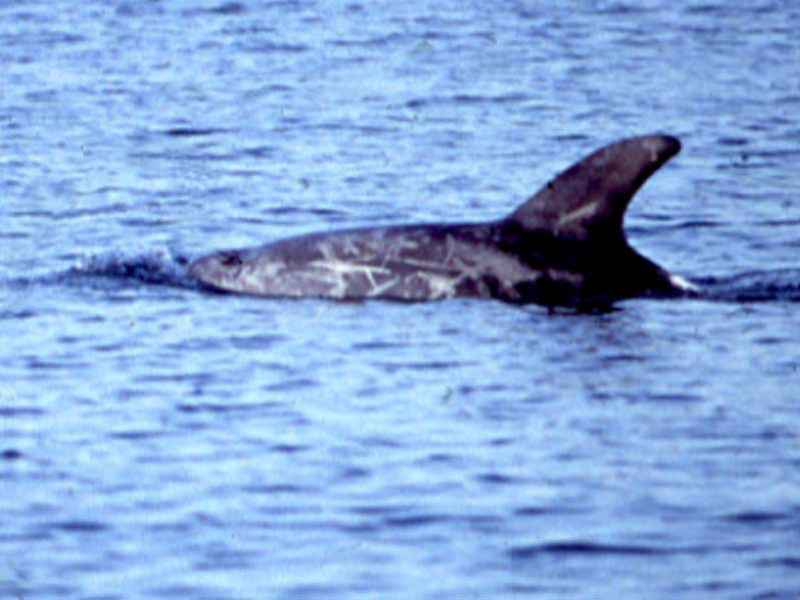
Risso's dolphin at Coverack.
Photographer: Colin Speedie Copyright: Colin Speedie
Distribution data supplied by the Ocean Biodiversity Information System (OBIS). To interrogate UK data visit the NBN Atlas.Map Help
| Researched by | Sonia Rowley | Refereed by | Admin |
| Authority | (G. Cuvier, 1812) | ||
| Other common names | - | Synonyms | - |
Summary
Description
Recorded distribution in Britain and Ireland
This species has been recorded off the Hebrides, Scottish Minches and in the Irish Sea, especially near Bardsey Island off the north Welsh coast. It may also be expected off the Shetland Isles and west coasts of the British Isles and Ireland.Global distribution
-Habitat
Grampus griseus is a deep water species sighted close to shore where the continental shelf is narrow and around oceanic islands. It prefers tropical and warm temperate water migrating north in the summer months.Depth range
-Identifying features
- Blunt nose.
- Vertical crease on front of head.
- Up to 4 meters in length.
- Grey robust body appearing white with age due to scarring.
- Dark gray fin, flippers an flukes.
- Tall dorsal fin up to 60 cm high.
- Strong oval teeth at the tip of lower jaw.
Additional information
Grampus griseus is one of the largest members of the Delphinidae family. 'Grampus' meaning 'grand fish', and 'griseus' referring to its grey colouration. At birth this species has a muted anchor shaped patch on its belly, and is uniformly gray becoming lighter with age. This is due to the extensive teeth scarring caused by Grampus griseus during play, aggression and sexual behaviour, as well as confrontations with cephalopod species (to a lesser degree) (Carwardine, 2000). The white colouration in older species may confuse it with Beluga whales (Delphinapterus leucas), however Risso's tall dorsal fin is the main distinguishing feature (Martin, 1990; Carwardine, 2000). Gestation is 13-14 months, and sexual maturity around 3-4 years for both sexes. Calves can be up to 1.7 meters long and weight approximately 20 kg. Grampus griseus dives for 1-2 minutes but can stay submerged for up to 30 minutes. It also takes a dozen breaths every 15-20 seconds, and seldom bow-rides. Full breaching occurs in the young and half breaching in adults (Carwardine, 2000). This species occurs in groups of about 12, and can aggregate into large of herds, up to 4000 individuals has been recorded. This species feeds on pelagic fish and cephalopods, favouring squid. Hybrids of Grampus griseus and Bottlenose dolphin, Tursiops truncatus, have also been reported in the wild (Kinze, 2002).This species is subject to by-catch, and is included in the UK Biodiversity Action Plan list of species of conservation concern (Biodiversity Steering Group, 1995). All species of cetaceans are given protection under the Wildlife and Countryside Act 1981 and the Wildlife (Northern Ireland) Order 1985. All cetacean species are listed on Annex A of EU Council Regulation 338/97 and therefore treated by the EU as if they are on CITES Appendix I therefore prohibiting their commercial trade. Risso's dolphin is also listed on Annex IV of the EC Habitats Directive, which prohibits all killing, capture, disturbance, sale, exchange or keeping of the animials. The directive requires that all accidental killing and capture be monitored by all member states. Also this species is listed under Appendix II of the Bonn Convention (North and Baltic Sea populations), and Appendix II of the Bern Convention. The Bonn Convention is the parent Convention to the 'Agreement on the Conservation of Small Cetaceans in the Baltic and the North Seas' (ASCOBANS) formulated in 1992. The UK is one of seven European countries which have signed the agreement which includes the protection of specific areas, monitoring, research, information exchange, pollution control and heightened public awareness. Measures included are specifically aimed at protecting dolphins and porpoises in the North Baltic Seas (Anon, 1999e).
Listed by
Bibliography
Anonymous, 1999e. Small dolphins. Grouped Species Action Plan. http://www.ukbap.org.uk/UKPlans.aspx?ID=337, 2002-01-25
Bruce, J.R., Colman, J.S. & Jones, N.S., 1963. Marine fauna of the Isle of Man. Liverpool: Liverpool University Press.
Carwardine, M., 2000. Whales Dolphins and Porpoises. Dorling Kindersley Limited.
Crothers, J.H. (ed.), 1966. Dale Fort Marine Fauna. London: Field Studies Council.
Evans, P.G.H. & Raga, J. A. (ed.), 2001. Marine mammals: biology and conservation New York: Kluwer Academic / Plenum Publishers
Howson, C.M. & Picton, B.E., 1997. The species directory of the marine fauna and flora of the British Isles and surrounding seas. Belfast: Ulster Museum. [Ulster Museum publication, no. 276.]
JNCC (Joint Nature Conservation Committee), 1999. Marine Environment Resource Mapping And Information Database (MERMAID): Marine Nature Conservation Review Survey Database. [on-line] http://www.jncc.gov.uk/mermaid
Kinze, C. C., 2002. Photographic Guide to the Marine Mammals of the North Atlantic. Oxford: Oxford University Press.
Martin, A.R., 1990. The Illustrated Encyclopedia of Whales and Dolphins. New York: Portland House.
Nowak, R.M., 2003. Walker's Marine Mammals of the World. Baltimore: John Hopkins University Press.
Reid. J.B., Evans. P.G.H., Northridge. S.P. (ed.), 2003. Atlas of Cetacean Distribution in North-west European Waters. Peterborough: Joint Nature Conservation Committee.
Wood, E. (ed.), 1988. Sea Life of Britain and Ireland. Marine Conservation Society. IMMEL Publishing, London
Datasets
Cofnod – North Wales Environmental Information Service, 2018. Miscellaneous records held on the Cofnod database. Occurrence dataset: https://doi.org/10.15468/hcgqsi accessed via GBIF.org on 2018-09-25.
Dumfries and Galloway Environmental Resources Centre, 2017. Mammal records for Dumfries and Galloway. Occurrence dataset: https://doi.org/10.15468/oirkpx accessed via GBIF.org on 2018-09-27
Environmental Records Information Centre North East, 2018. ERIC NE Combined dataset to 2017. Occurrence dataset: http://www.ericnortheast.org.ukl accessed via NBNAtlas.org on 2018-09-38
Hebridean Whale and Dolphin Trust, 2018. Visual sightings data set 2003-2017. Occurrence dataset: https://hwdt.org/ accessed via NBNAtlas.org on 2018-09-27.
Isle of Wight Local Records Centre, 2017. Isle of Wight Notable Species. Occurrence dataset: https://doi.org/10.15468/sm4ety accessed via GBIF.org on 2018-09-27.
John Muir Trust, 2017. Species Records for John Muir Trust Properties 2007-2009. Occurrence dataset: https://doi.org/10.15468/p5lw5z accessed via GBIF.org on 2018-09-27.
Manx Biological Recording Partnership, 2017. Isle of Man wildlife records from 01/01/2000 to 13/02/2017. Occurrence dataset: https://doi.org/10.15468/mopwow accessed via GBIF.org on 2018-10-01.
Manx Biological Recording Partnership, 2018. Isle of Man historical wildlife records 1995 to 1999. Occurrence dataset: https://doi.org/10.15468/lo2tge accessed via GBIF.org on 2018-10-01.
National Trust, 2017. National Trust Species Records. Occurrence dataset: https://doi.org/10.15468/opc6g1 accessed via GBIF.org on 2018-10-01.
NBN (National Biodiversity Network) Atlas. Available from: https://www.nbnatlas.org.
North East Scotland Biological Records Centre, 2017. NE Scotland marine mammal records 1800-2010. Occurrence dataset: https://doi.org/10.15468/suphju accessed via GBIF.org on 2018-10-01.
OBIS (Ocean Biodiversity Information System), 2025. Global map of species distribution using gridded data. Available from: Ocean Biogeographic Information System. www.iobis.org. Accessed: 2025-05-09
Outer Hebrides Biological Recording, 2018. Vertebrates (except birds, INNS and restricted records), Outer Hebrides. Occurrence dataset: https://doi.org/10.15468/dax3tf accessed via GBIF.org on 2018-10-01.
South East Wales Biodiversity Records Centre, 2018. SEWBReC Mammals (South East Wales). Occurrence dataset: https://doi.org/10.15468/atlxpp accessed via GBIF.org on 2018-10-02.
The Mammal Society., 2017. National Mammal Atlas Project, online recording. Occurrence dataset: https://doi.org/10.15468/i2eosa accessed via GBIF.org on 2018-10-02.
West Wales Biodiversity Information Centre, 2018. Seatrust Cetacean Records West Wales. Occurrence dataset: https://doi.org/10.15468/ecsmqh accessed via GBIF.org on 2018-10-02.
Whale and Dolphin Conservation, 2018. WDC Shorewatch Sightings. Occurrence dataset: https://doi.org/10.15468/9vuieb accessed via GBIF.org on 2018-10-02.
Citation
This review can be cited as:
Last Updated: 01/07/2005