
Long snouted seahorse (Hippocampus guttulatus)
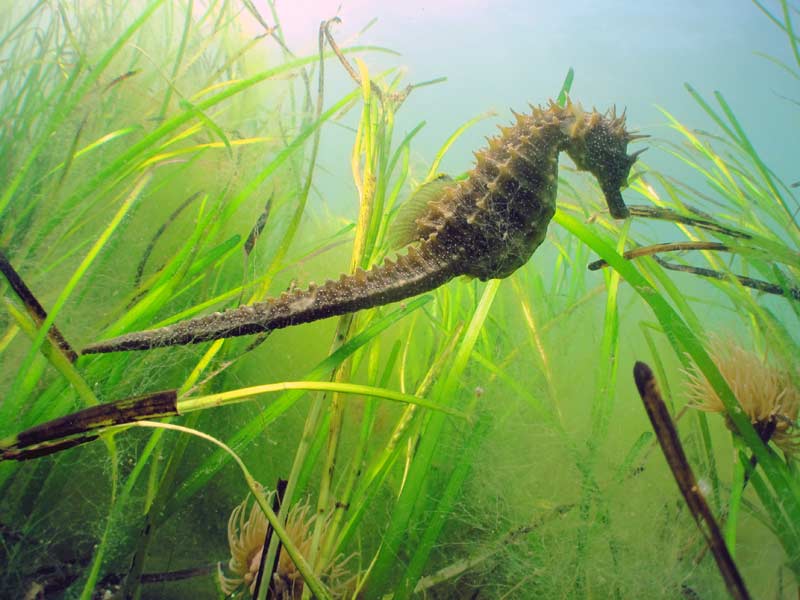
Hippocampus guttulatus with snakelocks anemone (Anemonia viridis) attached to eelgrass
Photographer: Andy Pearson Copyright: Andrew Pearson
Distribution data supplied by the Ocean Biodiversity Information System (OBIS). To interrogate UK data visit the NBN Atlas.Map Help
| Researched by | Anna Neish | Refereed by | Admin |
| Authority | Cuvier, 1829 | ||
| Other common names | - | Synonyms | Hippocampus ramulosus Cuvier, 1829 |
Summary
Description
Hippocampus guttulatus can be up to 15 cm in length and has a long snout. The fleshy protuberances on the back of the neck, from the head to dorsal fin, give an appearance of a 'mane'. It can be coloured from greenish-yellow through to reddish-brown and often mimics the colour of associated vegetation. It is speckled with bluish-white spots and flecks and its body rings carry bony tubercles giving it an angular, knobbly appearance.
Recorded distribution in Britain and Ireland
Recorded from the south coast of England and south west coasts of Wales.
Global distribution
Recorded from the Netherlands, along the east Atlantic coast of Europe south to Morocco and Senegal, and from Italy, Malta, Croatia, Greece and Cyprus in the Mediterranean.
Habitat
Present in shallow waters, especially amongst algae and seagrasses, clinging by the tail or swimming upright.
Depth range
-Identifying features
- Body up to 15 cm in length.
- Long snout, more than one third the length of the head.
- Fleshy strands, mane from head to dorsal fin.
- Pectoral fin has 15-18 rays.
- Dorsal fin has 18-21 rays.
- Anal fin minute and not at deepest part of belly but more towards tail.
- Bony tubercles on body.
Additional information
Other common names include the 'spiny seahorse' or the 'many branched seahorse'. The long snouted seahorse is one of two species of seahorses found in the British Isles; the other is Hippocampus hippocampus, which can be distinguished by a shorter snout and the lack of elongated protuberances along the back of the neck. Their distribution around the British Isles has been recently revised by the British Seahorse Survey (Garrick-Maidment & Jones, 2004).
Listed by
Bibliography
Garrick-Maidment, N. & Jones, L., 2004. British seahorse survey report 2004. Report by the Seahorse Trust, Devon, England.
Lourie, S.A., Vincent, A.C.J. & Hall, H.J., 1999. Seahorses: an identification guide to the world's species and their conservation. London: Project Seahorse.
Datasets
National Trust, 2017. National Trust Species Records. Occurrence dataset: https://doi.org/10.15468/opc6g1 accessed via GBIF.org on 2018-10-01.
NBN (National Biodiversity Network) Atlas. Available from: https://www.nbnatlas.org.
OBIS (Ocean Biodiversity Information System), 2025. Global map of species distribution using gridded data. Available from: Ocean Biogeographic Information System. www.iobis.org. Accessed: 2025-07-01
Citation
This review can be cited as:
Last Updated: 03/09/2007
- sea horse