
Common squid (Loligo vulgaris)
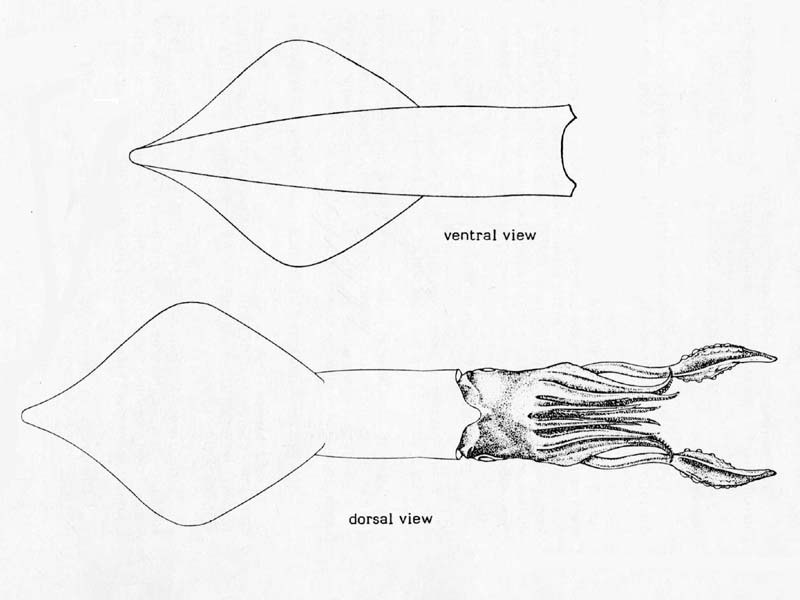
Line drawing of Loligo vulgaris.
Photographer: Copyright: FAO (Food and Agriculture Organization of the United Nations)
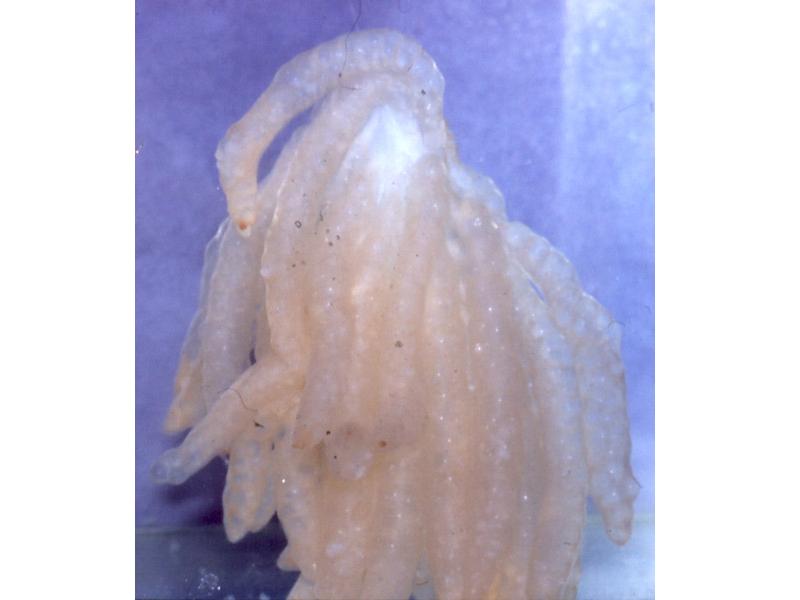
Eggs of Loligo vulgaris in a laboratory.
Photographer: John Rundle Copyright: John Rundle
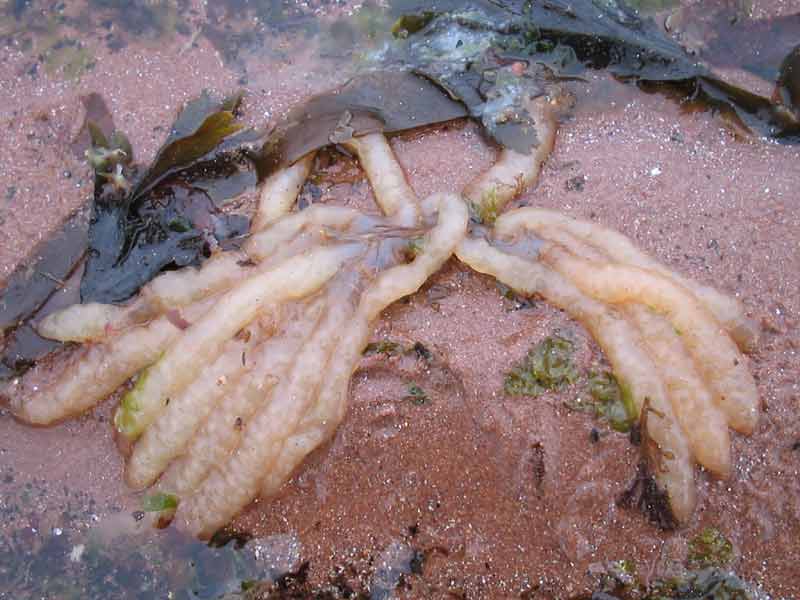
Eggs of the common squid washed up on the shore.
Photographer: Judith Oakley Copyright: Judith Oakley
Distribution data supplied by the Ocean Biodiversity Information System (OBIS). To interrogate UK data visit the NBN Atlas.Map Help
| Researched by | Emily Wilson | Refereed by | Admin |
| Authority | Lamarck, 1798 | ||
| Other common names | - | Synonyms | - |
Summary
Description
Recorded distribution in Britain and Ireland
Found on all British and Irish coasts.Global distribution
Eastern Atlantic; from approximately 20 degrees S to 55 degrees N; around the British Isles, North Sea; Mediterranean Sea.Habitat
Has no preference for a particular bottom type, the only requirement seems to be the presence of substrata for the attachment of egg strings during the spawning period.Depth range
0-500mIdentifying features
- Mantle long, moderately slender, cylindrical.
- Fins rhomboid, their length two thirds of mantle length, their posterior border slightly concave.
- Tentacle club with especially large median suckers, up to four times diameter of marginal suckers.
- Colour - variable often pink to white with purple brown mottling dorsally.
Additional information
Also commonly known as the European squid.Listed by
- none -
Bibliography
Boyle, P.R. & Pierce, G.J., 1994. Fishery biology of northeast Atlantic squid: an overview. Fisheries Research, 21(Special Issue), 1-15.
Boyle, P.R. (ed.), 1983. Cephalopod Life Cycles, vol 1. Species Accounts. London: Academic Press Inc. (London) Ltd.
Campbell, A., 1994. Seashores and shallow seas of Britain and Europe. London: Hamlyn.
Guerra, A. & Rocha, F., 1994. The life history of Loligo vulgaris and Loligo forbesi (Cephalopoda: Loliginidae) in Galician waters (NW Spain) Special Issue: Fishery Biology of Northeast Atlantic Squid, Fisheries Research, 21, 43-69.
Hayward, P., Nelson-Smith, T. & Shields, C. 1996. Collins pocket guide. Sea shore of Britain and northern Europe. London: HarperCollins.
Howson, C.M. & Picton, B.E., 1997. The species directory of the marine fauna and flora of the British Isles and surrounding seas. Belfast: Ulster Museum. [Ulster Museum publication, no. 276.]
ICES, 1994. Report of the study group on the life history assessment of Cephalopods. Copenhagen-Denmark ICES, K:7, 32.
Miramand, P. & Bentley, D., 1992. Concentration and distribution of heavy metals in tissues of two cephalopods, Eledone cirrhosa and Sepia officinalis, from the French coast of the English Channel. Marine Biology, 114, 407-414.
Roper, C.F.E., Sweeney, M.J. & Nauen, C.E., 1984. FAO species catalogue. Vol. 3. Cephalopods of the world. An annotated and illustrated catalogue of species of interest to fisheries. FAO Fisheries Synopsis, 125, 3, 277. Avaliable: http://www.fao.org/docrep/009/ac479e/ac479e00.htm
Datasets
Conchological Society of Great Britain & Ireland, 2018. Mollusc (marine) records for Great Britain and Ireland. Occurrence dataset: https://doi.org/10.15468/aurwcz accessed via GBIF.org on 2018-09-25.
Fenwick, 2018. Aphotomarine. Occurrence dataset http://www.aphotomarine.com/index.html Accessed via NBNAtlas.org on 2018-10-01
NBN (National Biodiversity Network) Atlas. Available from: https://www.nbnatlas.org.
OBIS (Ocean Biodiversity Information System), 2024. Global map of species distribution using gridded data. Available from: Ocean Biogeographic Information System. www.iobis.org. Accessed: 2024-05-13
Citation
This review can be cited as:
Last Updated: 24/04/2008