
A cold water coral (Lophelia pertusa)
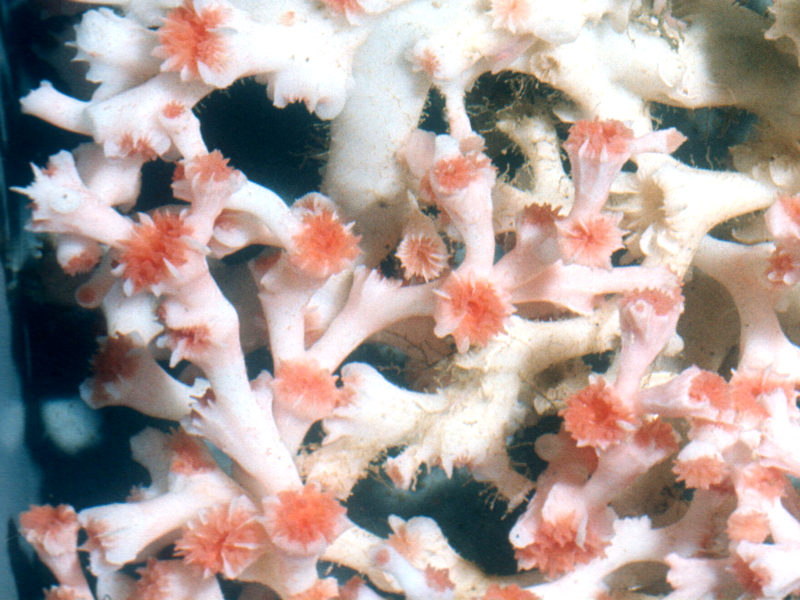
Lophelia pertusa photographed in 1971
Photographer: Alan J. Southward Copyright: Marine Biological Association of the UK (MBA)
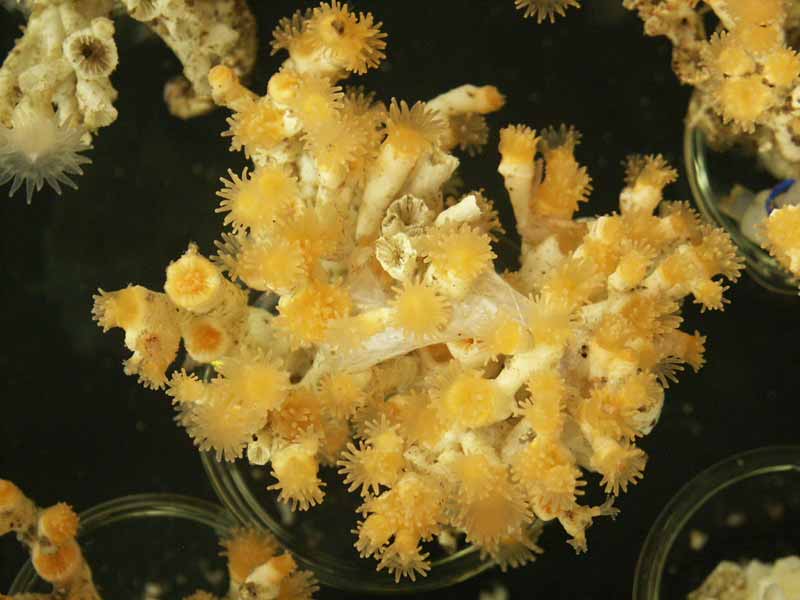
Polyps of the cold-water coral Lophelia pertusa.
Photographer: Murray Roberts Copyright: Dr Murray Roberts
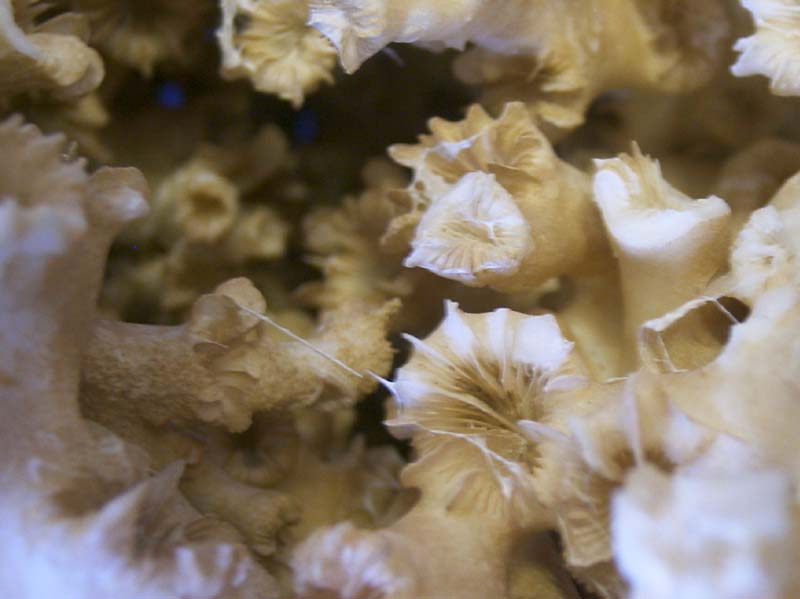
Close up of the skeletal framework of a Lophelia pertusa colony.
Photographer: Dan Lear Copyright: Dan Lear
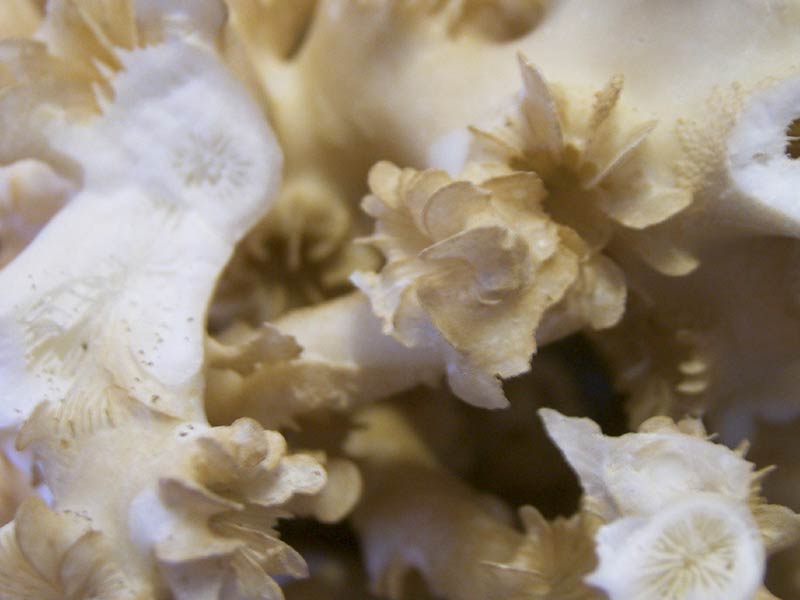
Close up the skeletal cups (corallites) of Lophelia pertusa.
Photographer: Dan Lear Copyright: Dan Lear
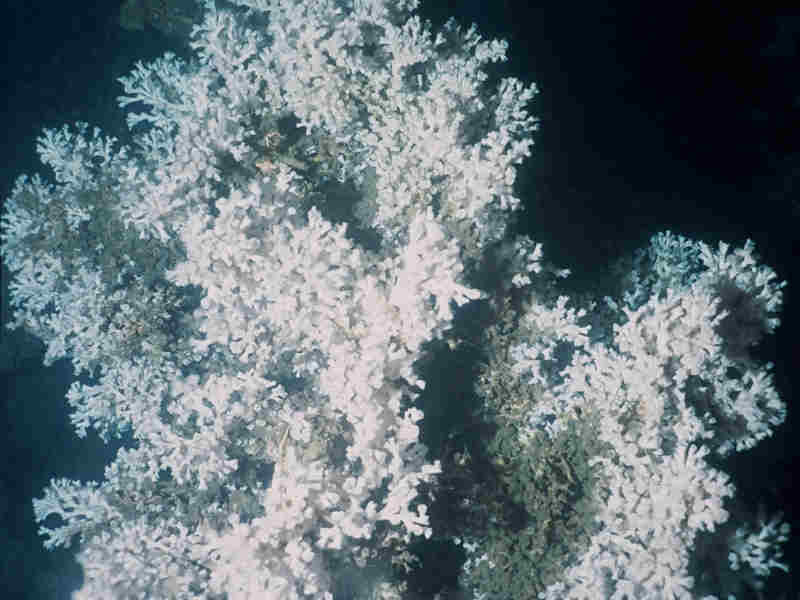
Colony of Lophelia pertusa from Mingulay Reef complex.
Photographer: Murray Roberts Copyright: Dr Murray Roberts
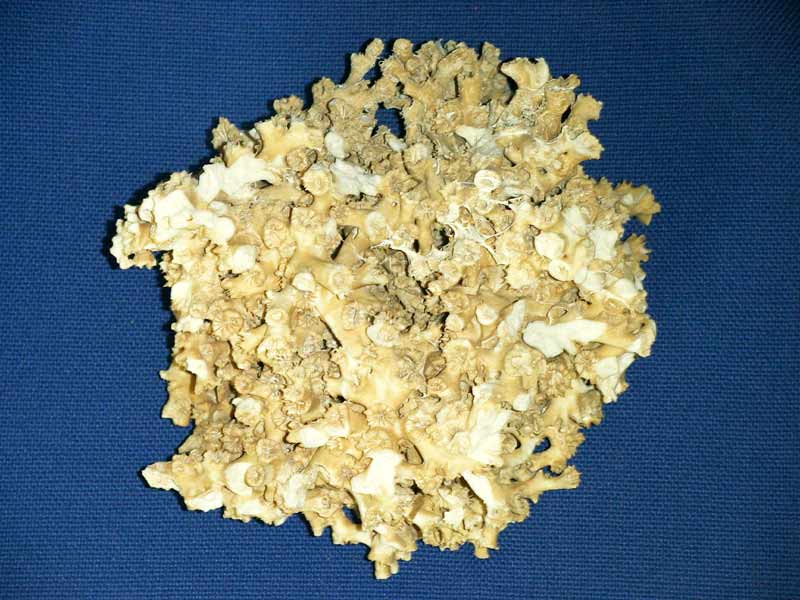
Skeleton of a small colony of Lophelia pertusa.
Photographer: Dan Lear Copyright: Dan Lear
Distribution data supplied by the Ocean Biodiversity Information System (OBIS). To interrogate UK data visit the NBN Atlas.Map Help
| Researched by | Frances Peckett & Dr Samantha Garrard | Refereed by | Admin |
| Authority | Linnaeus, 1758 | ||
| Other common names | - | Synonyms | Lophelia prolifera (Linnaeus, 1758) |
Summary
Description
The coral forms large bushy colonies which can be fixed to the substratum or free. The polyps are translucent and have up to 50 tentacles with obsolete terminal knobs. The colour is white, pink or yellowish. In British and Irish waters, Lophelia pertusa colonies occur in groups which are no more than 5-10 m in diameter and often smaller. Individual polyps are connected by their external calcareous skeletons. The skeletons of individual polyps are up to 12 mm in diameter.
Recorded distribution in Britain and Ireland
Recorded mainly off the continental shelf. Most records are from west Scotland and Ireland. Some specimens recorded from deep (ca. 50-100 m) inshore waters in Scotland. Also known from the North Sea attached to oil industry structures.Global distribution
In the North Atlantic, Mediterranean, along the east and west Atlantic coasts, around the mid-Atlantic islands south to Tristan da Cunha, from southern California and Cobb Seamount in the Pacific, the Indian Ocean and the Macquarie Ridge off New Zealand.Habitat
Occurs on soft bottoms usually in excess of 150 m and occasionally in shallower inshore waters. Rarely found attached to solid substrata.Depth range
-Identifying features
- Forms bushy colonies which are generally no larger than 5-10 m in diameter, but may join together to form larger reefs.
- Polyps have up to 50 tentacles.
- Translucent polyps which are white, pink or yellowish in colour.
- Generally found in areas with strong currents.
Additional information
Recent molecular studies have suggested that the genus Lophelia is synonymised with Desmophyllum so that Lophelia pertusa becomes a synonym of Desmophyllum pertusum (see WoRMS). However, the molecular evidence is uncertain at present (2021) so that we have not applied the revision. We will revise this page once further evidence becomes available.
Lophelia pertusa reefs provide a habitat for a variety of species and the living and dead coral skeletons provide a biodiversity 'hot spot' on the edge of the continental shelf (Jensen & Frederiksen, 1992; Mortensen, 2001). The deep waters where Lophelia pertusa reefs occur were undisturbed by human activity until recently. Fishing trawlers are now operating in the deeper water where Lophelia pertusa occurs and causing damage to the reefs (e.g., Hall-Spencer et al., 2002). Oil extraction from deeper waters may possibly cause damage to the reefs (see e.g., Roberts, 1997; Rogers, 1997, 1999). The implementation of the Habitats Directive to the limits of the EEZ and the adoption in 1998 of a new Annex to the OSPAR Convention (1992 Convention for the Protection of the Marine Environment of the North East Atlantic) may offer an opportunity to protect important deeper water or offshore habitats and species, such as Lophelia pertusa. For further information see COR.Lop.
Listed by
- none -
Bibliography
Bett, B.J., 2001. UK Atlantic Margin environmental survey: introduction and overview of bathyal benthic ecology. Continental Shelf Research, 21, 917-956.
De Mol, B., Van Rensbergen, P., Pillen, S., Van Herreweghe, K., Van Rooij, D., McDonnell, A., Huvenne, V., Ivanov, M., Swennen, R. & Henriet, J.P., 2002. Large deep-water coral banks in the Porcupine Basin, southwest of Ireland. Marine Geology, 188, 193-231.
Fosså, J.H., Mortensen, P.B. & Furevik, D.M., 2002. The deep-water coral Lophelia pertusa in Norwegian waters: distribution and fishery impacts. Hydrobiologia, 471, 1-12. DOI https://doi.org/10.1023/a:1016504430684
Fosså, J.H., 2003. Coral reefs in Norway. [On-line] http://www.imr.no/coral/index.php, 2003-03-27
Frederiksen, R., Jensen, A. & Westerberg, H., 1992. The distribution of the Scleractinian coral Lophelia pertusa around the Faroe Islands and the relation to internal tidal mixing. Sarsia, 77, 157-171.
Freiwald, A., 2002. Tiefwasser-Riffe [On-line]. http://www.uni-tuebingen.de/geo/gpi/ag-freiwald/exp/dw-reefs/img/lophelia.jpg, 2002-07-04
Freiwald, A., Henrich, R. & Pätzold, J., 1997. Anatomy of a deep-water coral reef mound from Stjernsund, West Finmark, North Norway. In Cool-water carbonates (ed. N.P. James & J.A.O., Clarke), pp. 141-162. [Society for Sedimentary Geology, Special Volume, no. 56.]
Gubbay, S., Baker, C.M. & Bett, B.J., 2002. The Darwin Mounds and Dogger Bank. Case studies of the management of two potential Special Areas of Conservation in the offshore environment. A report to WWF-UK., 72 pp.
Hall-Spencer, J.M., Allain, V. & Fosså, J.H., 2002. Trawling damage to Northeast Atlantic ancient coral reefs. Proceedings of the Royal Society of London, Series B: Biological Sciences, 269, 507-511. DOI https://dx.doi.org/10.1098/rspb.2001.1910
Howson, C.M. & Picton, B.E., 1997. The species directory of the marine fauna and flora of the British Isles and surrounding seas. Belfast: Ulster Museum. [Ulster Museum publication, no. 276.]
ICES, 2002. Study group on mapping the occurrence of cold water corals. Interim Report. Report to the Advisory Committee on Ecosystems of the International Council for the Exploration of the Sea (ICES), ICES CM 2002/ACE:05 Ref: E, WGECO.
Jensen, A. & Frederiksen, R., 1992. The fauna associated with the bank-forming deepwater coral Lophelia pertusa (Scleractinaria) on the Faroe Shelf. Sarsia, 77, 53-69.
Manuel, R.L., 1988. British Anthozoa. Synopses of the British Fauna (New Series) (ed. D.M. Kermack & R.S.K. Barnes). The Linnean Society of London [Synopses of the British Fauna No. 18.]. DOI https://doi.org/10.1002/iroh.19810660505
Masson, D.G., Bett, B.J., Billet, D.S.M., Jacobs, C.L., Wheeler, A.J. & Wynn, R.B., 2003. The origin of deep-water, coral topped mounds in the northern Rockall Trough, Northeast Atlantic. Marine Geology, 194, 159-180.
Mortensen, P.B., 2001. Aquarium observations on the deep-water coral Lophelia pertusa (L., 1758) (Scleractinia) and selected associated invertebrates. Ophelia, 54, 84-104.
Roberts, J.M., 2002a. The occurrence of the coral Lophelia pertusa and other conspicuous epifauna around an oil platform in the North Sea. Journal for the Society for Underwater Technology, 25, 83-91.
Roberts, M., 1997. Coral in deep water. New Scientist, 155, 40-43.
Rogers, A.D., 1997. The biology of Lophelia pertusa (Linnaeus, 1758) and oil exploration west of Shetland. London: Greenpeace, 67p.
Rogers, A.D., 1999. The biology of Lophelia pertusa (Linnaeus, 1758) and other deep-water reef-forming corals and impacts from human activities. International Review of Hydrobiology, 84, 315-406. DOI https://doi.org/10.1002/iroh.199900032
Wilson, J.B., 1979a. The distribution of the coral Lophelia pertusa (L.) [L. prolifera (Pallas)] in the North-east Atlantic. Journal of the Marine Biological Association of the United Kingdom, 59, 149-164.
World Wide Fund for Nature, 1998. Lophelia pertusa - a cold water coral. Marine Fact sheet, 2p., Goldalming, Surrey: WWF-UK., http://www.wwf-uk.org
Zibrowius, H., 1980. Les scleractiniaires de la Mediterranee et de l'Atlantique nord oriental. Memoires de l'Institut Oceanograhique, Monaco. 11, 391 pp.
Datasets
Fenwick, 2018. Aphotomarine. Occurrence dataset http://www.aphotomarine.com/index.html Accessed via NBNAtlas.org on 2018-10-01
NBN (National Biodiversity Network) Atlas. Available from: https://www.nbnatlas.org.
OBIS (Ocean Biodiversity Information System), 2025. Global map of species distribution using gridded data. Available from: Ocean Biogeographic Information System. www.iobis.org. Accessed: 2025-08-02
Citation
This review can be cited as:
Last Updated: 23/07/2003