
Angler fish (Lophius piscatorius)
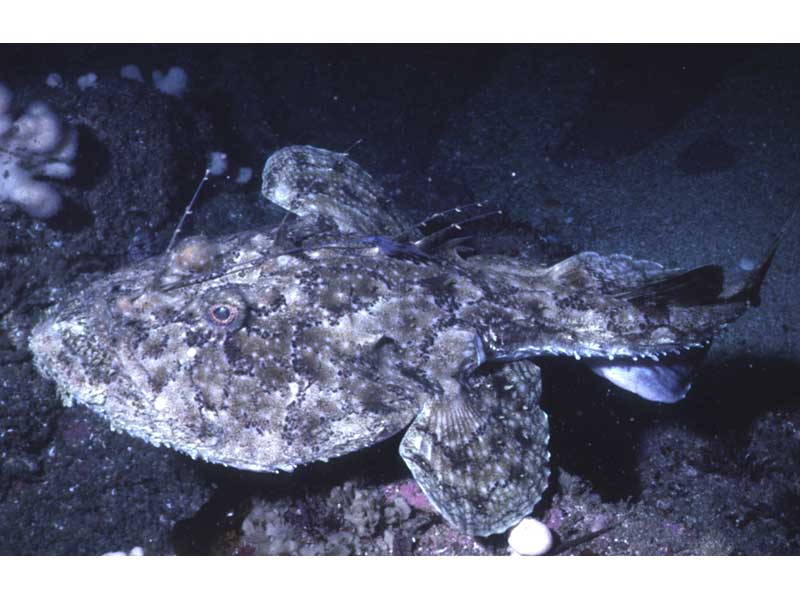
Angler fish.
Photographer: Dr Keith Hiscock Copyright: Dr Keith Hiscock
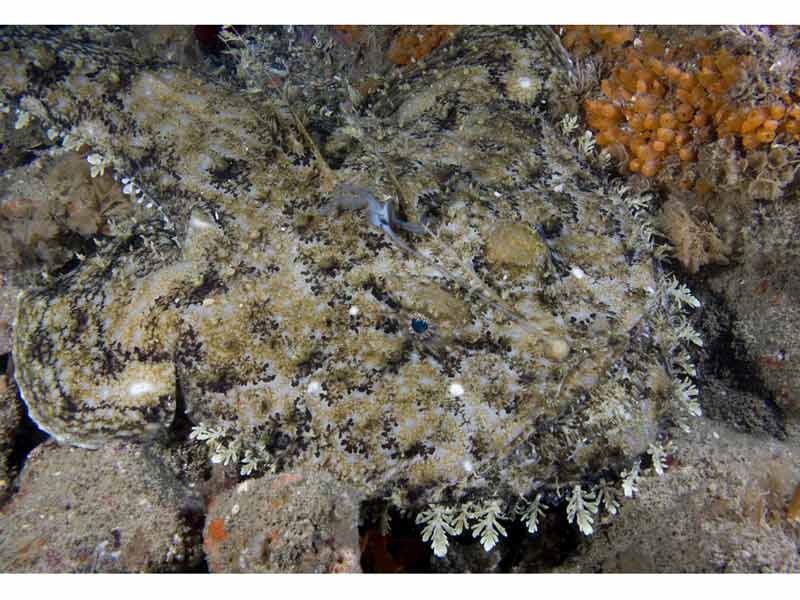
A camouflaged angler fish on the seabed.
Photographer: Sue Daly Copyright: Sue Daly
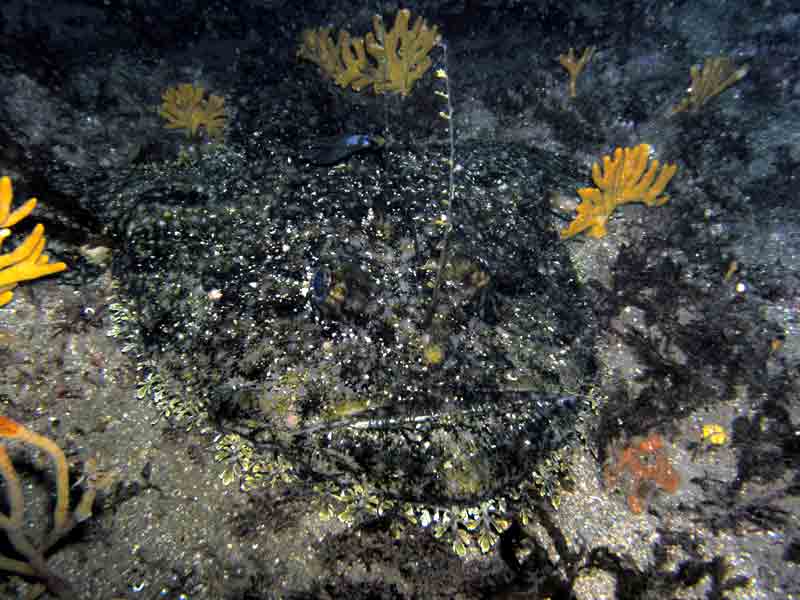
A large anglerfish camoflaged with substratum.
Photographer: Paul Newland Copyright: Paul Newland
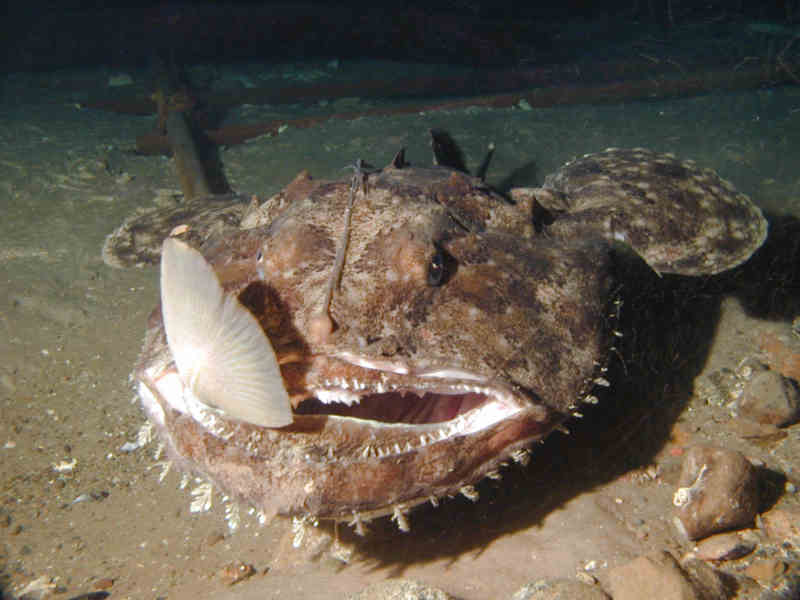
Angler fish feeding on cod.
Photographer: SERPENT Project, the DEEPSEAS Group at NOC Copyright: SERPENT Project, the DEEPSEAS Group at NOC
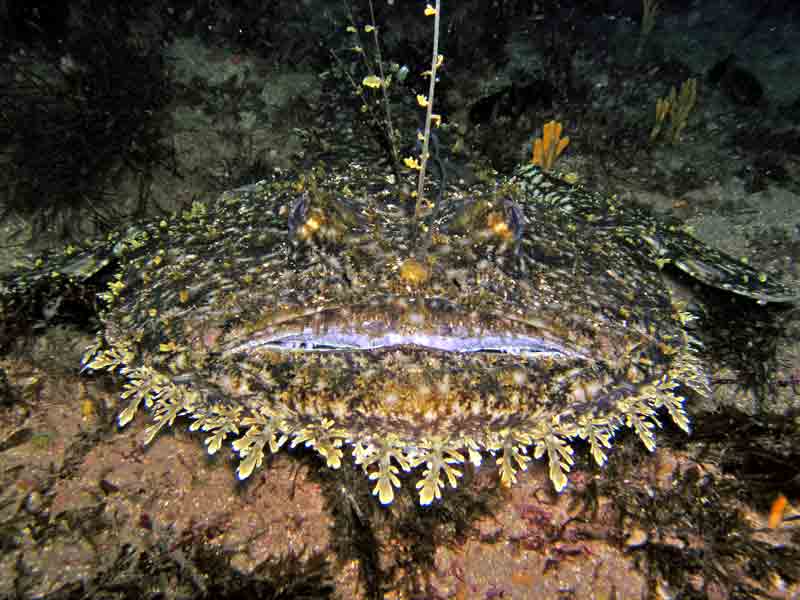
Anterior end of a moving anglerfish.
Photographer: Paul Newland Copyright: Paul Newland
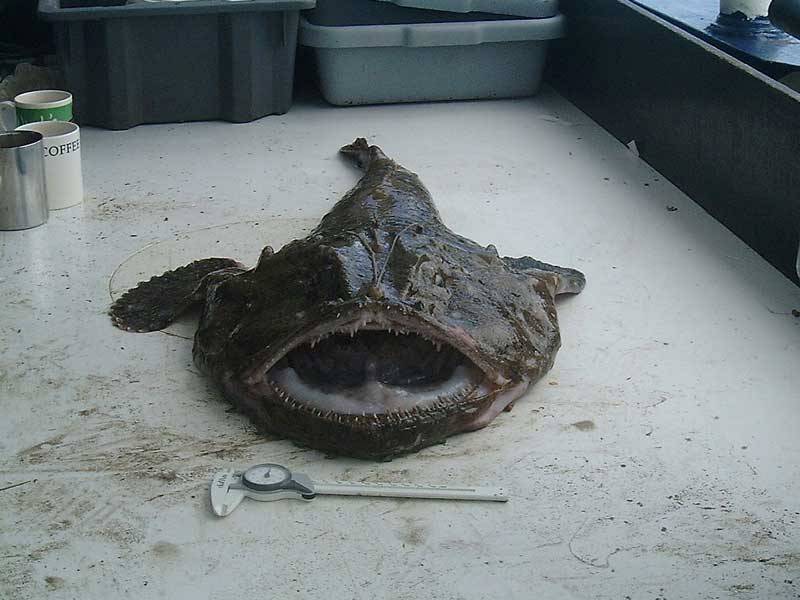
Freshly caught specimen of Lophius piscatorius: head view.
Photographer: Hilmar Hinz Copyright: Dr Hilmar Hinz
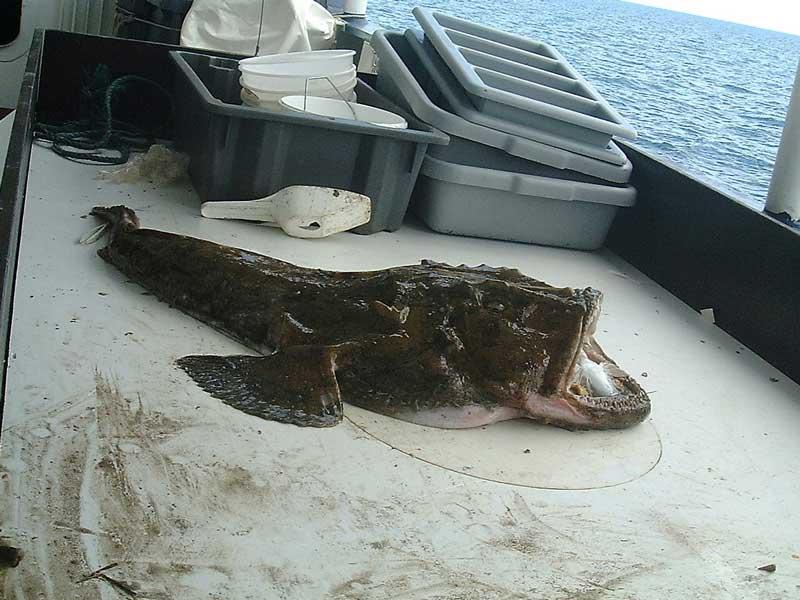
Freshly caught specimen of Lophius piscatorius: lateral view.
Photographer: Hilmar Hinz Copyright: Dr Hilmar Hinz
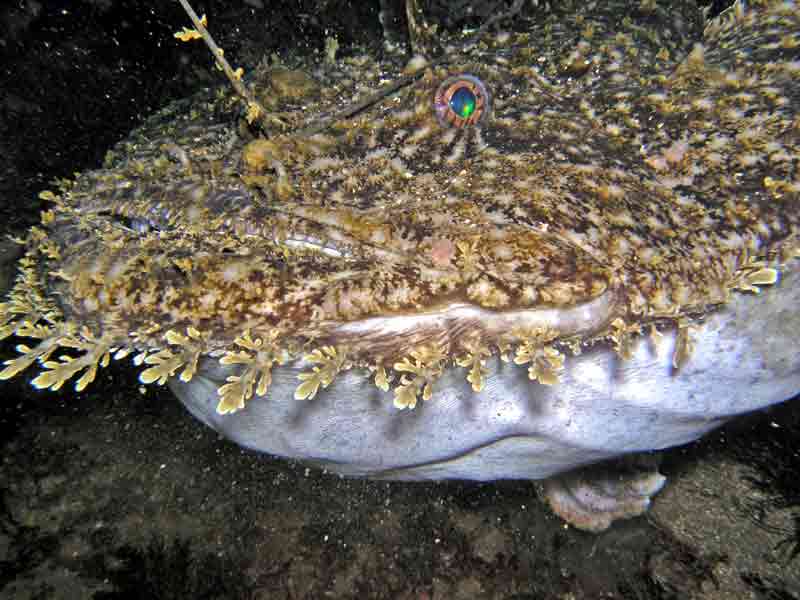
Head of a large anglerfish showing dorsal and ventral surfaces.
Photographer: Paul Newland Copyright: Paul Newland
Distribution data supplied by the Ocean Biodiversity Information System (OBIS). To interrogate UK data visit the NBN Atlas.Map Help
| Researched by | Al Reeve | Refereed by | Admin |
| Authority | Linnaeus, 1758 | ||
| Other common names | - | Synonyms | - |
Summary
Description
Recorded distribution in Britain and Ireland
Lophius piscatorius occurs in coastal waters all around Britain and Ireland. It is predominantly recorded on the west coast of England, Wales and Scotland and the north, south and east coasts of Ireland.Global distribution
-Habitat
Lophius piscatorius is present in waters from the low intertidal down to depths of 550 m. It is uncommon to see an angler fish in water shallower than 18 m though it may migrate down to as deep as 2000 m in offshore waters in order to spawn. It is found mostly on sandy or muddy bottoms but is also present on shell, gravel and occasionally rocky areas.Depth range
-Identifying features
- Large, rounded pectoral fins and approximately equally sized dorsal and anal fins.
- Broad head and wide mouth with large curved teeth in both jaws.
- Body dorso-ventrally flattened.
- Skin loose and scaleless with many fringed flaps mostly around the mid line of the fish.
- Variable colour but basically brown or greeny brown with reddish or dark brown mottlings and white underside.
- Fleshy 'lure' at the end of the first dorsal spine.
- Grows up to 200 cm in length.
Additional information
The angler fish uses its lure to attract prey to within reach. Prey items are usually smaller fish (such as spurdogs, rays, sand eels, sculpins, sea snails, cod, whiting, pouting, haddock, flatfishes) but a range of items have been found in angler fish stomachs including; lobsters, crabs, squids and occasionally seabirds. Lophius piscatorius is otherwise known as monkfish and is an important commercial fish. It can be confused with the angelshark, Squatina squatina, a cartilaginous fish which, is also known as monkfish. Lophius piscatorius is included in the UK Biodiversity Action Plan for deep-water fish.Listed by
Bibliography
Dipper, F., 2001. British sea fishes (2nd edn). Teddington: Underwater World Publications Ltd.
FishBase, 2000. FishBase. A global information system on fishes. [On-line] http://www.fishbase.org, 2001-05-03
Howson, C.M. & Picton, B.E., 1997. The species directory of the marine fauna and flora of the British Isles and surrounding seas. Belfast: Ulster Museum. [Ulster Museum publication, no. 276.]
JNCC (Joint Nature Conservation Committee), 1999. Marine Environment Resource Mapping And Information Database (MERMAID): Marine Nature Conservation Review Survey Database. [on-line] http://www.jncc.gov.uk/mermaid
MarLIN (Marine Life Information Network), 2005. SEArchable BEnthic Data (SEABED) Map [on-line]. Data Access Sub-programme, Marine Life Information Network for Britian and Ireland http://www.marlin.ac.uk,
Picton, B.E. & Costello, M.J., 1998. BioMar biotope viewer: a guide to marine habitats, fauna and flora of Britain and Ireland. [CD-ROM] Environmental Sciences Unit, Trinity College, Dublin.
Wheeler, A., 1969. The fishes of the British Isles and north-west Europe. London: Macmillan.
Whitehead, P.J.P., Bauchot, M.-L., Hureau, J.-C., Nielson, J. & Tortonese, E. 1986. Fishes of the North-eastern Atlantic and the Mediterranean. Vol. I, II & III. Paris: United Nations Educational, Scientific and Cultural Organisation (UNESCO).
Datasets
Centre for Environmental Data and Recording, 2018. Ulster Museum Marine Surveys of Northern Ireland Coastal Waters. Occurrence dataset https://www.nmni.com/CEDaR/CEDaR-Centre-for-Environmental-Data-and-Recording.aspx accessed via NBNAtlas.org on 2018-09-25.
Environmental Records Information Centre North East, 2018. ERIC NE Combined dataset to 2017. Occurrence dataset: http://www.ericnortheast.org.ukl accessed via NBNAtlas.org on 2018-09-38
Fenwick, 2018. Aphotomarine. Occurrence dataset http://www.aphotomarine.com/index.html Accessed via NBNAtlas.org on 2018-10-01
Isle of Wight Local Records Centre, 2017. IOW Natural History & Archaeological Society Marine Records. Occurrence dataset: https://doi.org/10.15468/7axhcw accessed via GBIF.org on 2018-09-27.
Kent & Medway Biological Records Centre, 2017. Fish: Records for Kent. Occurrence dataset https://doi.org/10.15468/kd1utk accessed via GBIF.org on 2018-09-27.
NBN (National Biodiversity Network) Atlas. Available from: https://www.nbnatlas.org.
OBIS (Ocean Biodiversity Information System), 2025. Global map of species distribution using gridded data. Available from: Ocean Biogeographic Information System. www.iobis.org. Accessed: 2025-07-01
South East Wales Biodiversity Records Centre, 2018. SEWBReC Fish (South East Wales). Occurrence dataset: https://doi.org/10.15468/htsfiy accessed via GBIF.org on 2018-10-02.
Citation
This review can be cited as:
Last Updated: 17/04/2008