
An opossum shrimp (Neomysis integer)
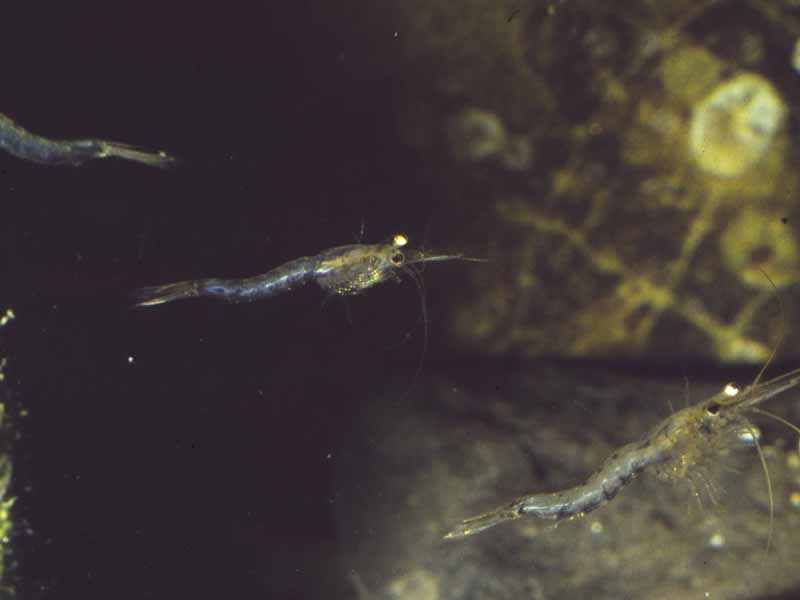
Neomysis integer.
Photographer: Marco Faasse Copyright: Marco Faasse
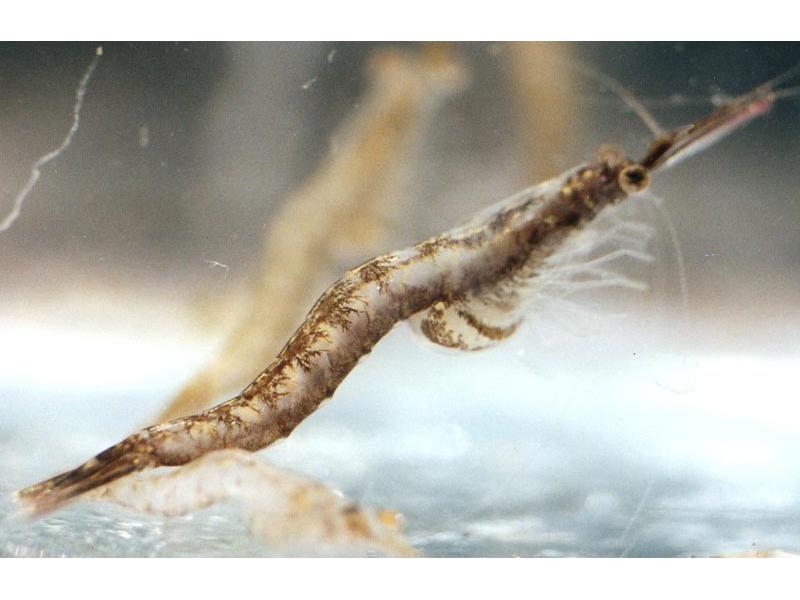
Female Neomysis integer in a laboratory.
Photographer: John Rundle Copyright: John Rundle
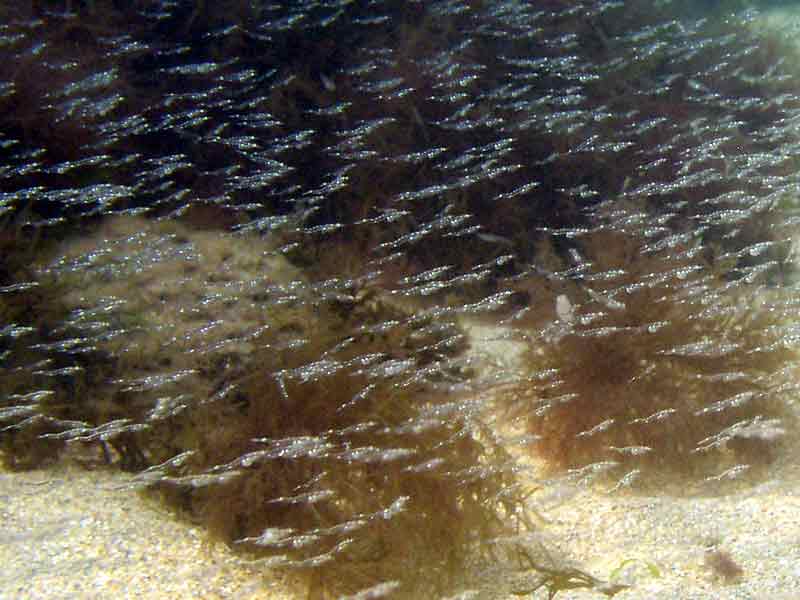
School of opposum shrimp.
Photographer: Paul Newland Copyright: Paul Newland
Distribution data supplied by the Ocean Biodiversity Information System (OBIS). To interrogate UK data visit the NBN Atlas.Map Help
| Researched by | Georgina Budd | Refereed by | This information is not refereed |
| Authority | (Leach, 1814) | ||
| Other common names | - | Synonyms | - |
Summary
Description
A slender, free-swimming, shrimp that grows up to 17 mm in length. Its body is almost transparent, with occasional brown pigmentation. The species has a well developed carapace, which protects the large stalked eyes, head and thorax. The rostrum of the head is distinctly pointed but short. Its antennae are conspicuous and biramous (having an inner and outer extension), the outer extension (exopod) of the second pair of antennae, takes the form of a flattened plate, known as the antennal scale. The antennal scale is bordered along its margin with setae and is an important diagnostic characteristic. Thoracic limbs are well developed and also biramous, the outer set have a distinctly feathery appearance. Abdominal limbs are less developed and finger-like, with the exception of the last pair which are biramous and flattened, and form the tail fan (uropods).
Recorded distribution in Britain and Ireland
Records indicate Neomysis integer to have a widespread, but patchy distribution on all British and Irish coasts in locations of lowered salinity, usually estuaries or brackish water enclosures.
Global distribution
Distributed from Artic Norway to the Atlantic coast of Spain.
Habitat
Neomysis integer is the dominant mysid shrimp in the upper reaches of estuaries. It is also found in non-tidal lagoons, isolated bodies of nearly freshwater, and in high shore hypersaline pools, but is rare in fully marine habitats.
Depth range
5 - 10 mIdentifying features
- Body almost transparent; up to 17 mm in length.
- Large eyes on stalks.
- Well developed carapace with distinctly pointed but short rostrum.
- Two pairs of conspicuous antennae, both biramous.
- First pair of antennae are long. Outer limb of second antenna, forms antennal scale, which is very long and narrow, tapering to a point.
- Thoracic appendages all biramous, the outer limbs (exopods) are fringed (appear feather like).
- Abdominal appendages (pleopods) also biramous. Male pleopods are small, the 4th pair are elongated with a terminal pair of barbed setae.
- The telson (tail blade) is long, triangular in outline with narrow truncated tip; short spines around margin.
Additional information
The species seems to be particularly susceptible to injury, causing atypical morphology which may lead to misidentification (Hayward & Ryland, 1995). Synonyms of Mysis or Neomysis vulgaris were in use in the early and continental literature, though Tattersall & Tattersall (1951) considered the specific integer (Leach) to have priority (Parker, 1979).
Listed by
- none -
Biology review
Taxonomy
| Level | Scientific name | Common name |
|---|---|---|
| Phylum | Arthropoda | Arthropods, joint-legged animals, e.g. insects, crustaceans & spiders |
| Class | Malacostraca | Crabs, lobsters, sand hoppers and sea slaters |
| Order | Mysida | Opossum shrimps and mysids |
| Family | Mysidae | |
| Genus | Neomysis | |
| Authority | (Leach, 1814) | |
| Recent Synonyms | ||
Biology
| Parameter | Data | ||
|---|---|---|---|
| Typical abundance | |||
| Male size range | 10-17mm | ||
| Male size at maturity | |||
| Female size range | >9mm | ||
| Female size at maturity | |||
| Growth form | Articulate | ||
| Growth rate | 1-2mm/month | ||
| Body flexibility | High (greater than 45 degrees) | ||
| Mobility | Swimmer (appendages, paddles), Swimmer | ||
| Characteristic feeding method | Active suspension feeder, Predator | ||
| Diet/food source | |||
| Typically feeds on | Detritus, diatoms, filamentous algae and small crustaceans. | ||
| Sociability | Solitary | ||
| Environmental position | Epibenthic | ||
| Dependency | No information found. | ||
| Supports | No information | ||
| Is the species harmful? | No | ||
Biology information
Growth rate. In mature adults from the Ythan Estuary, Scotland, growth rate was recorded to be 1-2 mm per month in the field, which followed a rapid period of growth, of 4-5 mm per month in the summer juveniles (Astthorsson, 1980). The winter generation had a growth rate of 3-4 mm monthly for juveniles and about 1 mm per month for mature adults. During the winter there was a period of about 3 months when growth ceased (Astthorsson & Ralph, 1984).
Swimming behaviour. Neomysis integer performs a diel vertical migration, rising towards the surface waters during the night and returning to the deeper waters at daylight where it remains throughout the day (Hough & Naylor, 1992). Normal diurnal light levels are inhibitory and produce a negatively phototactic response in most species; the 24-hour cycle of change in ambient light intensity is the dominant factor controlling the diel vertical migration of mysids, such as Neomysis integer (Mauchline, 1980).
Maintenance of position. As a pelagic organism, Neomysis integer faces the problem of retaining its position within the estuarine environment, against conditions of net seaward transport (Hough & Naylor, 1992). In general, there are three main controls of the positioning of pelagic invertebrate populations in estuarine systems: reproductive compensation of seaward losses (a relatively large number of juveniles are produced per brood, behavioural adaptations (alterations in swimming activity at different tidal phases) and hydrodynamic process (distribution directly related to patterns of water circulation) (Schlacher & Wooldridge, 1994).
In laboratory experiments, Hough & Naylor (1992) found Neomysis integer to have an endogenously controlled circa-tidal swimming activity, with peak swimming activity expressed during the ebb tide. In the investigation of the significance of its endogenously controlled ebb tide swimming, Hough & Naylor (1992) observed Neomysis integer to demonstrate rheotaxic behaviour. Typically on the ebb tide in the Conway Estuary, shallow pools of isolated water are left as the tide ebbs. Aggregations of Neomysis integer in imminent risk of stranding initially headed into the current, but as the water level dropped, and before a pool was completely cut off, the species swam with the current draining from the pool and entered the stream before finally re-orientating and swimming into the current. Hough & Naylor (1992) suggested that such rheotaxic behaviour coupled with a continuous ebb-phased swimming rhythm, may be of importance in the avoidance of stranding on the shore at low tide.
The maximum swimming speed of the mysid is also important since it dictates in which flow velocities the species can maintain its position. Specimens studied by Roast et al. (1998b) from the East Looe River Estuary (Cornwall) tolerated current velocities of 6 and 9 cm/sec. A few could swim at speeds of up to 27 cm/sec but not for more than a few seconds. Roast et al. (1998b) found the swimming speeds of Neomysis integer correlated well with the distribution of the species in the East Looe River Estuary, where mysids were found consistently in slower-moving water (<15 cm/sec) and were absent in faster-flowing water (>20 cm/sec). Roast et al. (1998b) stated that if swimming speed is an important factor in the position maintenance of the species, it is likely to be beneficial for the mysid to utilize any available shelter in order to conserve energy. In experimental conditions, Roast et al. (1998b) observed Neomysis integer to attach themselves to the substratum, thereby entering the boundary layer where lower velocity flows are experienced. This corresponds with field studies, for instance in the Conway Estuary, North Wales, Neomysis integer was always caught in greatest abundance in near-bottom plankton samples (Hough & Naylor, 1992). On the ebb tide, during flood and high-tide periods in the Ythan Estuary, Scotland, the species was concentrated in a band toward the moving tide edge where flows were typically lower. Also on the ebb tide and at low tide, the species aggregated in shallower water and in the lee of rocks and macroalgal clumps where water flow rates were less than 10 cm/sec (Lawrie et al.,1999). Shallow burrowing into the sediment is also a common means of position maintenance in moving waters, and is a common behaviour of mysids inhabiting areas subject to tidal disturbance (Roast et al., 1998b).
Habitat preferences
| Parameter | Data |
|---|---|
| Physiographic preferences | Estuary, Isolated saline water (Lagoon), Sea loch or Sea lough |
| Biological zone preferences | Lower infralittoral, Upper infralittoral |
| Substratum / habitat preferences | Coarse clean sand, Gravel / shingle |
| Tidal strength preferences | Moderately strong 1 to 3 knots (0.5-1.5 m/sec.), Strong 3 to 6 knots (1.5-3 m/sec.) |
| Wave exposure preferences | Sheltered, Very sheltered |
| Salinity preferences | Low (<18 psu), Reduced (18-30 psu), See additional Information |
| Depth range | 5 - 10 m |
| Other preferences | No text entered |
| Migration Pattern | Diel |
Habitat Information
Salinity tolerance. Neomysis integer is a euryhaline species normally found in locations with salinities in the range of 0.5 to 20 psu. However, it may be found more rarely in adjacent isolated waters of salinities greater than 20 psu, and in freshwaters. For instance, Neomysis integer adapted successfully to the transition from brackish lagoon to freshwater lagoon in the case of Loch Mor Barvas, Isle of Lewis, Scotland (Barnes, 1994).
Life history
Adult characteristics
| Parameter | Data |
|---|---|
| Reproductive type | Gonochoristic (dioecious) |
| Reproductive frequency | Annual protracted |
| Fecundity (number of eggs) | 11-100 |
| Generation time | See additional information |
| Age at maturity | 2-3 months |
| Season | Spring - Autumn |
| Life span | <1 year |
Larval characteristics
| Parameter | Data |
|---|---|
| Larval/propagule type | - |
| Larval/juvenile development | Ovoviviparous |
| Duration of larval stage | Not relevant |
| Larval dispersal potential | 100 -1000 m |
| Larval settlement period | Not relevant |
Life history information
The life history and biology of Neomysis integer differs slightly between localities (Mees et al., 1994; Astthorsson, 1980; Parker & West, 1979; Mauchline, 1971; Ralph, 1965; Kinne, 1955; Vorstman, 1951). Local environmental factors, especially temperature, have an influential role in determining the duration of the breeding season and the number of generations produced per year. Typically there are three generations per year. For instance, in a population from Loch Etive, studied by Mauchline (1971), the overwintering members consisted predominantly of juveniles and immature males and females. Once mature they began an intensive period of breeding in the spring. The spring generation matured rapidly and bred during late June and early July, which consequently produced a third generation in the autumn. These intensive periods of breeding were set against a background of continuous breeding throughout the year so that discrete generations were not evident, but modal age groups within the population could be traced over weeks, or in the case of the overwintering population, a few months. However, outside periods of intensive breeding the recruitment rate was lower: < 1% of females carried eggs and broods were smaller. Brood size in mysid shrimps has been found to be related to female body length and season (Mauchline, 1971). A winter brood of Neomysis integer from Loch Etive consisted of between 10-25 juveniles compared to 20-50 in the summer. In contrast, to the population of Neomysis integer from Loch Etive, a population from the Ythan estuary on the east coast of Scotland studied by Astthorsson (1980), produced only two generations per year with a complete cessation of breeding during winter. Temperature differences between the two locations were implicated as the Ythan estuary had a much lower summer maximum temperature than Loch Etive (17°C cf. 20°C; Leach, 1971; Gage, 1974).
Sensitivity review
The MarLIN sensitivity assessment approach used below has been superseded by the MarESA (Marine Evidence-based Sensitivity Assessment) approach (see menu). The MarLIN approach was used for assessments from 1999-2010. The MarESA approach reflects the recent conservation imperatives and terminology and is used for sensitivity assessments from 2014 onwards.
Physical pressures
Use / to open/close text displayed
| Intolerance | Recoverability | Sensitivity | Evidence / Confidence | |
Substratum loss [Show more]Substratum lossBenchmark. All of the substratum occupied by the species or biotope under consideration is removed. A single event is assumed for sensitivity assessment. Once the activity or event has stopped (or between regular events) suitable substratum remains or is deposited. Species or community recovery assumes that the substratum within the habitat preferences of the original species or community is present. Further details EvidenceNeomysis integer is a free-swimming mysid shrimp, which may rest on the surface of the substratum, but does not live within it. Therefore it has been assessed to be tolerant of substratum loss. | Tolerant | Not relevant | Not sensitive | Not relevant |
Smothering [Show more]SmotheringBenchmark. All of the population of a species or an area of a biotope is smothered by sediment to a depth of 5 cm above the substratum for one month. Impermeable materials, such as concrete, oil, or tar, are likely to have a greater effect. Further details. EvidenceNeomysis integer is a free-swimming mysid shrimp, which may rest on the surface of the substratum, but does not live within it and it is sufficiently mobile to avoid the deposition of smothering materials. Therefore Neomysis integer has been assessed to be not sensitive to smothering at the benchmark level. | Tolerant | Not relevant | Not sensitive | Not relevant |
Increase in suspended sediment [Show more]Increase in suspended sedimentBenchmark. An arbitrary short-term, acute change in background suspended sediment concentration e.g., a change of 100 mg/l for one month. The resultant light attenuation effects are addressed under turbidity, and the effects of rapid settling out of suspended sediment are addressed under smothering. Further details EvidenceNeomysis integer is omnivorous and employs one or both of two distinct methods of feeding. It may filter phytoplankton and suspended detrital material or feed as an active carnivore on zooplankton or benthic invertebrates. Consequently, increased concentrations of suspended matter in the water column may be indicative of an enhanced food supply and the species has been assessed not to be 'tolerant*'. | Tolerant* | Not relevant | Not sensitive* | Low |
Decrease in suspended sediment [Show more]Decrease in suspended sedimentBenchmark. An arbitrary short-term, acute change in background suspended sediment concentration e.g., a change of 100 mg/l for one month. The resultant light attenuation effects are addressed under turbidity, and the effects of rapid settling out of suspended sediment are addressed under smothering. Further details EvidenceNeomysis integer is omnivorous and employs one or both of two distinct methods of feeding. It may filter phytoplankton and suspended detrital material or feed as an active carnivore on zooplankton or benthic invertebrates. A reduction in the concentration of suspended matter in the water column may reduce the species viability as a consequence of reduced food supply. Therefore intolerance has been assessed to be low. On return to prior conditions, recovery is likely to be immediate as the shrimp commences optimal feeding. | Low | Immediate | Not sensitive | Low |
Desiccation [Show more]Desiccation
EvidenceNeomysis integer is likely to be very intolerant of continual exposure to air and sunshine for one hour and any individuals washed ashore would undoubtedly die. But the estuarine environment its endogenous swimming rhythm, coupled with a rheotaxic behaviour serves to prevent stranding on the substratum at low tide (Hough & Naylor, 1992) (see general adult biology). Therefore, dessication is probably not relevant. | Not relevant | Not relevant | Not relevant | Not relevant |
Increase in emergence regime [Show more]Increase in emergence regimeBenchmark. A one hour change in the time covered or not covered by the sea for a period of one year. Further details EvidenceNeomysis integer is a free-swimming mysid shrimp, which is sufficiently mobile to avoid a change in the emergence regime in its estuarine environment. Therefore an intolerance assessment was not considered to be relevant. | Not relevant | Not relevant | Not relevant | Not relevant |
Decrease in emergence regime [Show more]Decrease in emergence regimeBenchmark. A one hour change in the time covered or not covered by the sea for a period of one year. Further details EvidenceNeomysis integer is a free-swimming mysid shrimp, which is sufficiently mobile to avoid a change in the emergence regime in its estuarine environment. Therefore an intolerance assessment was not considered to be relevant. | Not relevant | Not relevant | Not relevant | Not relevant |
Increase in water flow rate [Show more]Increase in water flow rateA change of two categories in water flow rate (view glossary) for 1 year, for example, from moderately strong (1-3 knots) to very weak (negligible). Further details EvidenceIn the field, where flows in the open channel over the tidal cycle were greater than that which Neomysis integer can swim against or maintain position, Lawrie et al., (1999) observed Neomysis integer to aggregate in low-flow areas, such as in the lee of rocks and macroalgal clumps, in the shallowest edge waters and at the 'boundary layer' (sediment-water interface), where water flow rates were not in excess of 10 cm/sec (0.2 of a knot). Intolerance of Neomysis integer to the benchmark increase in water flow rate has been assessed to be intermediate. The species would be exposed to flow rates of between 0.5-1.5 m/sec and in the absence of objects behind which to shelter the species would be washed rapidly seawards. Some individuals may die following exposure to fully saline conditions (see increase in salinity) but the abundance of the population is more likely to be reduced as other coastal currents disperse the population and fewer may be washed back into the estuary on the flood tide. On return to prior conditions the species is likely to have a very high capacity for recovery (see additional information below). | Intermediate | Very high | Low | Moderate |
Decrease in water flow rate [Show more]Decrease in water flow rateA change of two categories in water flow rate (view glossary) for 1 year, for example, from moderately strong (1-3 knots) to very weak (negligible). Further details EvidenceThe benchmark decrease in water flow rate would create areas where water flow was negligible and the species may be better able to maintain position in open water, potentially enabling enhanced periods of feeding with reduced risk of displacement from the estuarine environment. Therefore an assessment of tolerant* has been made. | Tolerant* | Not relevant | Not sensitive* | Not relevant |
Increase in temperature [Show more]Increase in temperature
For intertidal species or communities, the range of temperatures includes the air temperature regime for that species or community. Further details EvidenceEnvironmental temperature exerts an influence on many of the physiological processes of mysid shrimps (Mauchline, 1980). However, the tolerance of mysid shrimps to changes in environmental temperatures varies between species and, to a lesser extent, between populations of the same species in different environments (Mauchline, 1980). Very little information concerning environmental temperatures and the distribution of mysid shrimps is available. However, the distribution of Neomysis integer extends to the south of the UK, along the Atlantic coast of Spain, so the species may be able to tolerate a chronic change of 2 °C. Kinne (1955) found that juveniles of Neomysis integer had a different tolerance to temperature changes than adults. Kuhlman (1984) also found that over-wintering and summer generations of Neomysis integer demonstrated distinct differences to increasing temperature, the upper tolerance of the winter generation being 10-12 °C in comparison to 20-25 °C for the summer generation. Consequently, an acute increase in temperature may be more damaging to the population during the spring, when the over wintering population commences breeding, than at other times and intolerance has been assessed to be intermediate. Following a decrease in population, Neomysis integer is likely to recover within a few weeks or at most six months following summer recruitment and probable migration between suitable habitats, therefore recoverability has been assessed to be very high. | Intermediate | Very high | Low | Moderate |
Decrease in temperature [Show more]Decrease in temperature
For intertidal species or communities, the range of temperatures includes the air temperature regime for that species or community. Further details EvidenceThe distribution of Neomysis integer extends to the north of the UK, along the Arctic coast of Norway, so the species may be able to tolerate a chronic change of 2 °C. Acute decreases in temperature may cause death of some vulnerable individuals, such as those that are parasitized owing to additional stress and intolerance has therefore been assessed to be intermediate. Following a decrease in population, Neomysis integer is likely to recover within a few weeks or at most six months following summer recruitment and probable migration between suitable habitats, therefore recoverability has been assessed to be very high. | Intermediate | Very high | Low | |
Increase in turbidity [Show more]Increase in turbidity
EvidenceIn general, mysids are attracted to weak sources of light, but avoid bright light (Mauchline, 1980). Bright light often inhibits swimming activity. Normal diurnal light levels are inhibitory and produce a negatively phototactic response in most species and the 24 hour cycle of change in ambient light intensity is the dominant factor controlling the diel vertical migration of mysids. The nocturnal period of darkness stimulates the upward migration into the pelagic zone (Beeton, 1960; McNaught & Hasler, 1966; Heubach, 1969; Teraguchi et al., 1975; cited in Mauchline, 1980). Increased turbidity may serve to extend the nocturnal vertical migration period of Neomysis integer during dawn and dusk, as turbidity inhibits light penetration. As diel migration is a normal behavioural pattern of Neomysis integer an increase in turbidity is unlikely to affect the species. Furthermore, increased turbidity may hinder predatory fish which feed upon Neomysis integer. | Tolerant* | Not relevant | Not sensitive* | Not relevant |
Decrease in turbidity [Show more]Decrease in turbidity
EvidenceIn general, mysids are attracted to weak sources of light, but avoid bright light (Mauchline, 1980). Bright light often inhibits swimming activity. Normal diurnal light levels are inhibitory and produce a negatively phototactic response in most species and the 24 hour cycle of change in ambient light intensity is the dominant factor controlling the diel vertical migration of mysids. The nocturnal period of darkness stimulates the upward migration into the pelagic zone (Beeton, 1960; McNaught & Hasler, 1966; Heubach, 1969; Teraguchi et al., 1975; cited in Mauchline, 1980). Decreased turbidity may serve to reduce the extent of the nocturnal vertical migration of Neomysis integer, as light penetration of the water column increases, and possibly limit feeding. Furthermore, fish may exploit populations of Neomysis integer more effectively as Neomysis integer probably becomes more easily distinguishable. Intolerance has been assessed to be low and on return to prior conditions recovery is likely to be very high (see additional information below). | Low | Very high | Very Low | Low |
Increase in wave exposure [Show more]Increase in wave exposureA change of two ranks on the wave exposure scale (view glossary) e.g., from Exposed to Extremely exposed for a period of one year. Further details EvidenceWave action in the littoral region affects the distribution of many intertidal species and for mysids in particular it tends to depress their vertical range on the shore, they move offshore into deeper water in order to avoid the effects of breaking waves (Mauchline, 1980). Neomysis integer avoids water flow rates against which it cannot maintain position by sheltering in the lee of rock, macroalgal clumps and in the 'boundary layer' (see increased water flow rate). Increased wave exposure would increase the turbulence of water flow around objects used for shelter and may displace the object. Furthermore, mysids such as Neomysis integer demonstrate rheotaxis (orientate in flowing water, facing into the current) and such behaviour may become energetically exhausting if caught in the wash and back-wash of waves. Intolerance has therefore been assessed to be high. Recovery, following loss of the population is likely to be very high (see additional information, below). | High | Very high | Low | Very low |
Decrease in wave exposure [Show more]Decrease in wave exposureA change of two ranks on the wave exposure scale (view glossary) e.g., from Exposed to Extremely exposed for a period of one year. Further details EvidenceThe estuarine environment inhabited by Neomysis integer is typically very/extremely wave sheltered and an assessment for a decrease in wave exposure was not considered relevant. | Not relevant | Not relevant | Not relevant | Not relevant |
Noise [Show more]Noise
EvidenceNeomysis integer may respond to vibrations caused by noise, but it is unlikely to be directly sensitive to noise at the benchmark level. | Tolerant | Not relevant | Not sensitive | Not relevant |
Visual presence [Show more]Visual presenceBenchmark. The continuous presence for one month of moving objects not naturally found in the marine environment (e.g., boats, machinery, and humans) within the visual envelope of the species or community under consideration. Further details EvidenceNeomysis integer is unlikely to have the visual acuity to detect the presence of boats, machinery present in its environment, and it has been assessed not to be sensitive to the factor. | Tolerant | Not relevant | Not sensitive | Not relevant |
Abrasion & physical disturbance [Show more]Abrasion & physical disturbanceBenchmark. Force equivalent to a standard scallop dredge landing on or being dragged across the organism. A single event is assumed for assessment. This factor includes mechanical interference, crushing, physical blows against, or rubbing and erosion of the organism or habitat of interest. Where trampling is relevant, the evidence and trampling intensity will be reported in the rationale. Further details. EvidenceNeomysis integer is a free-swimming mysid shrimp and not likely to be damaged by a passing scallop dredge as it will probably avoid its effects. (see benchmark). Therefore, an intolerance assessment was not considered to be relevant. | Not relevant | Not relevant | Not relevant | Not relevant |
Displacement [Show more]DisplacementBenchmark. Removal of the organism from the substratum and displacement from its original position onto a suitable substratum. A single event is assumed for assessment. Further details EvidenceNeomysis integer is a free-swimming mysid shrimp and therefore cannot be physically displaced from the substratum. An intolerance assessment was considered not to be relevant. | Not relevant | Not relevant | Not relevant | Not relevant |
Chemical pressures
Use [show more] / [show less] to open/close text displayed
| Intolerance | Recoverability | Sensitivity | Evidence / Confidence | |
Synthetic compound contamination [Show more]Synthetic compound contaminationSensitivity is assessed against the available evidence for the effects of contaminants on the species (or closely related species at low confidence) or community of interest. For example:
The evidence used is stated in the rationale. Where the assessment can be based on a known activity then this is stated. The tolerance to contaminants of species of interest will be included in the rationale when available; together with relevant supporting material. Further details. EvidenceSeveral synthetic chemicals have been reported to have a toxic effect on Neomysis integer:
intolerance has been assessed to be intermediate. Sub-lethal effects (disruption of swimming) are experienced at low concentrations but are likely to cause the loss or reduce the abundance of estuarine populations owing to the inability of Neomysis integer to maintain position following contaminant exposure. The species is likely to have a very high capacity for recovery (see additional information, below) assuming the decay of the synthetic contaminant. | Intermediate | Very high | Low | High |
Heavy metal contamination [Show more]Heavy metal contaminationEvidenceRoast et al., (2000a) examined the effects of cadmium (Cd) on the swimming behaviour of Neomysis integer. Mysid shrimps such as Neomysis integer, maintain their optimum position in their habitat independent of the forces of river flow and tides; therefore any disruption of swimming behaviour will have significant implications for their survival and position maintenance (Roast et al., 2000a). Following 7 day exposure cadmium, swimming behaviour (ability and orientation) in Neomysis integer was disrupted at 0.5 µg Cd (aq)2+ per litre, a significantly lower cadmium concentration than that causing mortality (7 day LC50 of 2.58 µg Cd (aq)2+ per litre). | Intermediate | Very high | Low | High |
Hydrocarbon contamination [Show more]Hydrocarbon contaminationEvidenceFollowing the sinking of the tanker 'Sefir' during February, 1981, in the Baltic Sea, extreme mortality of littoral fauna, including mysids, was observed after the light fuel oil had washed ashore (Lindén et al., 1983). Laughlin & Linden (1983) exposed Neomysis integer to water-soluble fractions (WSF) of light fuel oil under two different regimes. The first, a chronic exposure scheme, employed concentrations of between 200-500 ng WSF per litre and lasted two weeks. The second, acute exposure, employed concentrations of between 200 and 1000 µg WSF per litre, concentrations that the authors thought representative of oil escaping from a sunken ship or in the vicinity of a spill, especially in sheltered conditions. During the acute exposures, physiological parameters of oxygen consumption, ammonium excretion rate and oxygen : nitrogen ratios were calculated. Exposure of Neomysis integer to WSF oil at concentrations between 200-1000 µg per litre produced increases in oxygen consumption and decreases in ammonia excretion, which were strongly influenced by temperature. Oil exposure had greatest effect on the species at higher temperature, especially 21.5 °C. In contrast, changes in the physiological parameters did not occur to such an extent during the chronic exposure, Laughlin & Linden (1983) considered that the oil doses were probably too low. Furthermore, Laughlin & Linden (1983) suspected that during the chronic exposures, increased temperature alone exerted an effect on Neomysis integer (mortality at time of moults) and the chronic effects of WSF were not measurable. However, in contrast, at temperature < 10 °C, the WSF did qualitatively affect the mysid shrimp. Intolerance has been assessed to be intermediate as some mortality arising from hydrocarbon exposure was reported in the field, and that the species may experience sub-lethal stress in physiological parameters. Neomysis integer is likely to have a very high capability for recovery following degradation of the oil in the environment (see additional information below). | Intermediate | Very high | Low | High |
Radionuclide contamination [Show more]Radionuclide contaminationEvidenceInsufficient | No information | Not relevant | No information | Not relevant |
Changes in nutrient levels [Show more]Changes in nutrient levelsEvidenceNeomysis integer is normally resident in estuarine and lagoon environments with comparatively higher nutrient concentrations than that of the open coast. Nutrient enrichment that stimulates phytoplankton productivity may benefit Neomysis integer, as it is omnivorous and suspension feeds on both phytoplankton and suspended detrital material. Furthermore, Neomysis integer is sufficiently mobile to avoid inhospitable conditions that may result from eutrophication, and therefore it has been assessed to be tolerant*. | Tolerant* | Not relevant | Not sensitive* | Not relevant |
Increase in salinity [Show more]Increase in salinity
EvidenceNeomysis integer is a euryhaline species which typically occurs in brackish water habitats, and occasionally in freshwater habitats, but more rarely in fully marine conditions. In laboratory experiments, Kuhlman (1984) found the upper salinity tolerance of Neomysis integer to be between 20 psu to 25 psu, and mortality increased significantly at 30 psu. Under normal circumstances the species is typically found in waters of up to 20 psu, both the acute and chronic benchmark increases in salinity would expose Neomysis integer to a salinity to which it is intolerant. Therefore intolerance has been assessed to be high. | High | Very high | Low | High |
Decrease in salinity [Show more]Decrease in salinity
EvidenceNeomysis integer is a euryhaline species which typically occurs in brackish water habitats, and occasionally in freshwater habitats which were once connected to the sea. For instance, Neomysis integer adapted successfully to the transition from brackish lagoon to freshwater lagoon in the case of Loch Mor Barvas, Isle of Lewis, Scotland (Barnes, 1994). In laboratory experiments, Kuhlman (1984) reported the lowest salinity tolerance of the species to be lower than 5 psu, and in other texts it is suggested that Neomysis integer tolerates salinities down to 0.5 psu (Koepcke & Kausch, 1996; Barnes, 1994). Therefore Neomysis integer has been assessed as not sensitive at the benchmark leve decrease in salinity. | Tolerant | Not relevant | Not sensitive | High |
Changes in oxygenation [Show more]Changes in oxygenationBenchmark. Exposure to a dissolved oxygen concentration of 2 mg/l for one week. Further details. EvidenceIn laboratory experiments, Kuhlman (1984), lowered the oxygen saturation of seawater in which specimens of Neomysis integer were held over two days, to 20 % (approximately 6.5 mg /O2 per litre with no negative influence on behaviour or survival. A narrow sublethal and lethal threshold was determined between 20% (6.5 mg /O2 per litre) and 13 % (4.23 mg/O2 per litre) saturation (Kuhlman, 1984). However, the species is sufficiently mobile to avoid sub optimal concentrations of oxygen and therefore an intolerance assessment of not relevant has been made. | Not relevant | Not relevant | Not relevant | Not relevant |
Biological pressures
Use [show more] / [show less] to open/close text displayed
| Intolerance | Recoverability | Sensitivity | Evidence / Confidence | |
Introduction of microbial pathogens/parasites [Show more]Introduction of microbial pathogens/parasitesBenchmark. Sensitivity can only be assessed relative to a known, named disease, likely to cause partial loss of a species population or community. Further details. EvidenceAstthorsson (1980) found specimens of Neomysis integer collected from the Ythan Estuary, Scotland, to be parasitized by the third larval stage of the nematode Thynnascaria adunca. The nematodes were found in both the thorax and the abdomen, usually coiled. In some instances, the total length of the Thynnascaria adunca larvae was almost the same length as the Neomysis integer hosting it. Astthorsson (1980) suspected that the larvae would probably have an influence on the internal physiology of the host, but there is insufficient information concerning any effect upon the population that such parasitization may have. | No information | Not relevant | No information | Not relevant |
Introduction of non-native species [Show more]Introduction of non-native speciesSensitivity assessed against the likely effect of the introduction of alien or non-native species in Britain or Ireland. Further details. EvidenceNo information concerning non-native species that might affect the abundance or survival of Neomysis integer was found. | No information | Not relevant | No information | Not relevant |
Extraction of this species [Show more]Extraction of this speciesBenchmark. Extraction removes 50% of the species or community from the area under consideration. Sensitivity will be assessed as 'intermediate'. The habitat remains intact or recovers rapidly. Any effects of the extraction process on the habitat itself are addressed under other factors, e.g. displacement, abrasion and physical disturbance, and substratum loss. Further details. EvidenceNeomysis integer is not a species targeted for extraction. However, other mysid species have been harvested for human consumption and in Japan there is a commercial fishery of several species e.g. Neomysis intermedia, Neomysis japonica, Acanthomysis mitsukurii (Astthorsson, 1980). | Not relevant | Not relevant | Not relevant | Not relevant |
Extraction of other species [Show more]Extraction of other speciesBenchmark. A species that is a required host or prey for the species under consideration (and assuming that no alternative host exists) or a keystone species in a biotope is removed. Any effects of the extraction process on the habitat itself are addressed under other factors, e.g. displacement, abrasion and physical disturbance, and substratum loss. Further details. EvidenceNo information concerning the extraction of other species that might affect the abundance or survival of Neomysis integer was found. | No information | Not relevant | No information | Not relevant |
Additional information
Recoverability. Leuchs & Nehring (1996) described Neomysis integer as a rapidly growing species, with a high reproduction rate. It was able to rapidly recolonize and maintain a population over a 2 km stretch of the Elbe Estuary, Germany, that received dredged mud daily from the Brunsbuettel locks and had an otherwise impoverished fauna. Parker & West (1979) interpreted the ecology of Neomysis integer in the brackish Lough Furnace to be a compromise between r- and K-strategies. The reproductive strategy of mysid species is apparently K-selected, in that a relatively small number of offspring are produced which are released from the female brood pouch at an advanced stage. Thereafter, Neomysis integer lives a short r-selected lifespan, is small in size and reproduces intensively during the most favourable period of the year. However, as Parker & West (1979) pointed out, the compromise between the two strategies is fallible, and Neomysis integer experiences large fluctuations in population density. However, being planktonic, Neomysis integer can escape (at least partly) from adverse conditions by migration, for instance, seasonality in the abundance of Neomysis integer was observed in the Swanpool Lagoon, Cornwall, into which the species migrated for the summer (Barnes et al., 1979), and in the Severn Estuary where Neomysis integer over-wintered at comparatively low densities, but swarmed inshore during the summer with most females carrying eggs or embryos (Moore et al., 1979). This evidence suggests that Neomysis integer would have a very high capacity for recruitment, recovery, and re-population via migration after an impact.
Importance review
Policy/legislation
- no data -
Status
| National (GB) importance | - | Global red list (IUCN) category | - |
Non-native
| Parameter | Data |
|---|---|
| Native | - |
| Origin | - |
| Date Arrived | - |
Importance information
- Neomysis integer has been studied as a potential food organism for mariculture purposes (Kuhlmann, 1984).
- Mysids are used routinely by regulatory authorities for conducting 96 hour LC50 toxicity tests to evaluate the potential hazards of pollutants to aquatic ecosystems. Neomysis integer has been reported to be comparatively sensitive to trace metals and organophosphate pesticides (Roast et al.,2001; Roast et al., 2000, 2000b; Roast et al., 1999, 1999b; Roast et al., 1998; Wildgust & Jones, 1998) and it has been suggested that Neomysis integer may be a suitable alternative to the frequently used sub-tropical American mysid Americamysis (=Mysidopsis) bahia for testing the toxicity of chemical contaminants to European estuarine biota. Furthermore, Neomysis integer exhibits disrupted swimming activity in the presence of contaminants, which is a more sensitive endpoint for assessing the effects of contaminants on aquatic biota than mortality.
- Mysid shrimps such as Neomysis integer are ubiquitous members of the permanent, endemic hyperbenthic fauna of estuarine and other coastal systems. Mysid shrimps occurs in high numbers and their ecological importance, particularly their role in food chains as a link between the benthic and pelagic systems is becoming increasingly apparent (Roast et al., 1998). Estuaries function as nurseries for several important demersal fish species, and Neomysis integer is known to be important in the diets of; Pomatoschistus minutus, Trisopterus luscus, Merlangius merlangus, Platichthys flesus, Trigla lucerna, Clupea harengus and Pleuronectes platessa (Hostens & Mees, 1999).
Bibliography
Astthorsson, O.S. & Ralph, R., 1984. Growth and moulting of Neomysis integer (Crustacea; Mysidacea). Marine Biology, 79, 55-61.
Astthorsson, O.S., 1980. The life history and ecological energetics of Neomysis integer (Leach) (Crustacea, Mysidacea). , Ph.D. thesis, University of Aberdeen.
Barnes, R.S.K., 1994. The brackish-water fauna of northwestern Europe. Cambridge: Cambridge University Press.
Barnes, R.S.K., Williams, A., Little, C. & Dorey, A.E., 1979. An ecological study of the Swanpool, Falmouth. IV. Population fluctuations of some dominant macrofauna. In: Ecological processes in coastal environments, (ed. R.L. Jefferies & A. J. Davy), pp. 177-197. Oxford: Blackwell.
Davies, I.M., McHenery, J.G. & Rae, G.H., 1997. Environmental risk from dissolved Ivermectin to marine organisms. Aquaculture, 158, 263-275.
Gage, J., 1974. Shallow-water zonation of sea-loch benthos and its relation to hydrographic and other physical features. Journal of the Marine Biological Association of the United Kingdom, 54, 223-249.
Hayward, P.J. & Ryland, J.S. (ed.) 1995b. Handbook of the marine fauna of North-West Europe. Oxford: Oxford University Press.
Hostens, K. & Mees, J., 1999. The mysid-feeding guild of demersal fishes in the brackish zone of the Westerschelde Estuary. Journal of Fish Biology, 55, 704-719.
Hough, A.R. & Naylor, E., 1992. Distribution and position maintenance behaviour of the estuarine mysid Neomysis integer. Journal of the Marine Biological Association of the United Kingdom, 72, 869-876.
JNCC (Joint Nature Conservation Committee), 1999. Marine Environment Resource Mapping And Information Database (MERMAID): Marine Nature Conservation Review Survey Database. [on-line] http://www.jncc.gov.uk/mermaid
Kinne, O., 1955. Neomysis vulgaris Thompson eine autökologisch-biologische studie. Biologisches Zentralblatt., 74, 160-202.
Koepcke, B. & Kausch, H., 1996. Distribution and variability in abundance of Neomysis integer and Mesopodopsis slabberi (Mysidacea; Crustacea) in relation to environmental factors in the Elbe Estuary. Archiv fur Hydrobiologie. Supplementband. Untersuchungen des Elbe-Aestuars. Stuggart, 110, 263-282.
Kuhlmann, D., 1984. Effects of temperature, salinity, oxygen and ammonia on the mortality and growth of Neomysis integer Leach. Limnologica, 15, 479-485.
Laughlin, R. & Linden, O., 1983. Oil pollution and Baltic mysids: Acute and chronic effects of the water soluble fractions of light fuel oil on the mysid shrimp Neomysis integer. Marine Ecology Progress Series, 12, 29-41.
Lawrie, S.M, Speirs, D.C., Raffaelli, D.G., Gurney, W.S.C., Paterson, D.M. & Ford, R., 1999. The swimming behaviour and distribution of Neomysis integer in relation to tidal flow. Journal of Experimental Marine Biology and Ecology, 242, 95-106.
Leach, J.H., 1971. Hydrology of the Ythan Estuary with reference to distribution of major nutrients and detritus. Journal of the Marine Biological Association of the United Kingdom, 51, 137-157.
Leuchs, H. & Nehring, S., 1996. Effects of dredging and dumping on macrozoobenthos in coastal areas, represented by an example from the Elbe Estuary. (Actual problems of the marine environment. Lectures at the 6th Scientific Symposium 14 & 15 May 1996 in Hamburg), Deutsche Hydrographische Zeitschrift, Supplement, 6, 177-186.
Lindén, O., Mattson, J. & Notini, M., 1983. A spill of light fuel oil in the Baltic Sea. In 1983 oil spill conference, pp. 517-520., Washington. D.C., American Petroleum Institute.
Makings, P., 1977. A guide to the British coastal Mysidacea. Field Studies, 4, 575-595.
Mauchline, J., 1971. The biology of Neomysis integer (Crustacea; Mysidacea). Journal of the Marine Biological Association of the United Kingdom, 51, 347-354.
Mauchline, J., 1980. The biology of Mysids. Advances in Marine Biology, 18, 1-369.
Mees, J., Abdulkerim, Z. & Hamerlynck, O., 1994. Life history, growth and production of Neomysis integer in the Westerschelde Estuary (SW Netherlands). Marine Ecology Progress Series, 109, 43-57.
Moore, J.W., Moore, I.A. & Claridge, P.N., 1979. Seasonal changes in density, composition and reproductive biology of crustacean populations in the Severn Estuary. Crustaceana, 36, 113-122.
Parker, M. & West, B., 1979. The natural history of Neomysis integer (Leach) in Lough Furnace, Co. Mayo, a brackish lough on the west coast of Ireland. Estuarine and Coastal Marine Science, 8, 157-167.
Parker, M., 1979. Neomysis integer (Leach) (Crustacea: Mysidacea): Records and distribution in Ireland. Irish Naturalists' Journal, 19, 339-342.
Picton, B.E. & Costello, M.J., 1998. BioMar biotope viewer: a guide to marine habitats, fauna and flora of Britain and Ireland. [CD-ROM] Environmental Sciences Unit, Trinity College, Dublin.
Ralph, R., 1965. Some aspects of the ecology and osmotic regulation of Neomysis integer Leach. , Ph.D. thesis, Southampton University.
Roast, S.D., Thompson, R.S., Donkin, P., Widdows, J. & Jones, M.B., 1999b. Toxicity of the organophosphate pesticides chlorpyrifos and dimethoate to Neomysis integer (Crustacea: Mysidacea). Water Research, 33, 319-326.
Roast, S.D., Thompson, R.S., Widdows, J. & Jones, M.B., 1998. Mysids and environmental monitoring: a case for their use in estuaries. Marine and Freshwater Research, 49, 827-932.
Roast, S.D., Widdows, J. & Jones, M.B., 1998b. The position maintenance behaviour of Neomysis integer (Peracarida: Mysidacea) in response to current velocity, substratum and salinity. Journal of Experimental Marine Biology and Ecology, 220, 25-45.
Roast, S.D., Widdows, J. & Jones, M.B., 1999. Scope for growth of the estuarine mysid Neomysis integer (Peracarida: Mysidacea): effects of the organophosphate pesticide chlorpyrifos. Marine Ecology Progress Series, 191, 233-241.
Roast, S.D., Widdows, J. & Jones, M.B., 1999c. Respiratory responses of the estuarine mysid Neomysis integer (Peracarida: Mysidacea) in relation to a variable environment. Marine Biology, 133, 643-649.
Roast, S.D., Widdows, J. & Jones, M.B., 2000. Mysids and trace metals: disruption of swimming as a behavioural indicator of environmental contamination. Marine Environmental Research, 50, 107-112.
Roast, S.D., Widdows, J. & Jones, M.B., 2000b. Disruption of swimming in the hyperbenthic mysid Neomysis integer (Peracarida: Mysidacea) by the organophosphate pesticide chlorpyrifos. Aquatic Toxicology, 47, 227-241.
Roast, S.D., Widdows, J. & Jones, M.B., 2001. Impairment of mysid (Neomysis integer) swimming ability: an environmentally realistic assessment of the impact of cadmium exposure. Aquatic Toxicology, 52 , 217-227.
Schlacher, T.A. & Wooldridge, T.H., 1994. Tidal influence on distribution and behaviour of the estuarine opossum shrimp Gastrosaccus brevifissura. In: Changes in fluxes in estuaries: implications from science to management, (ed. K.D. Dyer & R.J. Orth), pp.307-312. Fredesborg: Olsen & Olsen.
Tattersall, W.M. & Tattersall, O.S., 1951. The British Mysidacea. London: Ray Society.
Vorstman, A.G., 1951. A year's investigation on the life cycle of Neomysis vulgaris Thompson. Verhandlungen der Internationalen Vereinigung fur Theoretische und Angewandte Limnologie, 11, 437-445.
Wildgust, M.A. & Jones, M.B., 1998. Salinity change and the toxicity of the free cadmium ion [Cd2+(aq)] to Neomysis integer (Crustacea: Mysidacea). Aquatic Toxicology, 41, 187-192.
Datasets
Bristol Regional Environmental Records Centre, 2017. BRERC species records recorded over 15 years ago. Occurrence dataset: https://doi.org/10.15468/h1ln5p accessed via GBIF.org on 2018-09-25.
Centre for Environmental Data and Recording, 2018. Ulster Museum Marine Surveys of Northern Ireland Coastal Waters. Occurrence dataset https://www.nmni.com/CEDaR/CEDaR-Centre-for-Environmental-Data-and-Recording.aspx accessed via NBNAtlas.org on 2018-09-25.
Environmental Records Information Centre North East, 2018. ERIC NE Combined dataset to 2017. Occurrence dataset: http://www.ericnortheast.org.ukl accessed via NBNAtlas.org on 2018-09-38
Fenwick, 2018. Aphotomarine. Occurrence dataset http://www.aphotomarine.com/index.html Accessed via NBNAtlas.org on 2018-10-01
Merseyside BioBank., 2017. Merseyside BioBank (verified). Occurrence dataset: https://doi.org/10.15468/ar0p6s accessed via GBIF.org on 2018-10-01.
Merseyside BioBank., 2018. Merseyside BioBank (unverified). Occurrence dataset: https://doi.org/10.15468/iou2ld accessed via GBIF.org on 2018-10-01.
NBN (National Biodiversity Network) Atlas. Available from: https://www.nbnatlas.org.
Norfolk Biodiversity Information Service, 2017. NBIS Records to December 2016. Occurrence dataset: https://doi.org/10.15468/jca5lo accessed via GBIF.org on 2018-10-01.
OBIS (Ocean Biodiversity Information System), 2025. Global map of species distribution using gridded data. Available from: Ocean Biogeographic Information System. www.iobis.org. Accessed: 2025-07-31
South East Wales Biodiversity Records Centre, 2018. SEWBReC Myriapods, Isopods, and allied species (South East Wales). Occurrence dataset: https://doi.org/10.15468/rvxsqs accessed via GBIF.org on 2018-10-02.
South East Wales Biodiversity Records Centre, 2018. Dr Mary Gillham Archive Project. Occurance dataset: http://www.sewbrec.org.uk/ accessed via NBNAtlas.org on 2018-10-02
Suffolk Biodiversity Information Service., 2017. Suffolk Biodiversity Information Service (SBIS) Dataset. Occurrence dataset: https://doi.org/10.15468/ab4vwo accessed via GBIF.org on 2018-10-02.
Citation
This review can be cited as:
Last Updated: 24/04/2008