
White horseshoe worm (Phoronis hippocrepia)
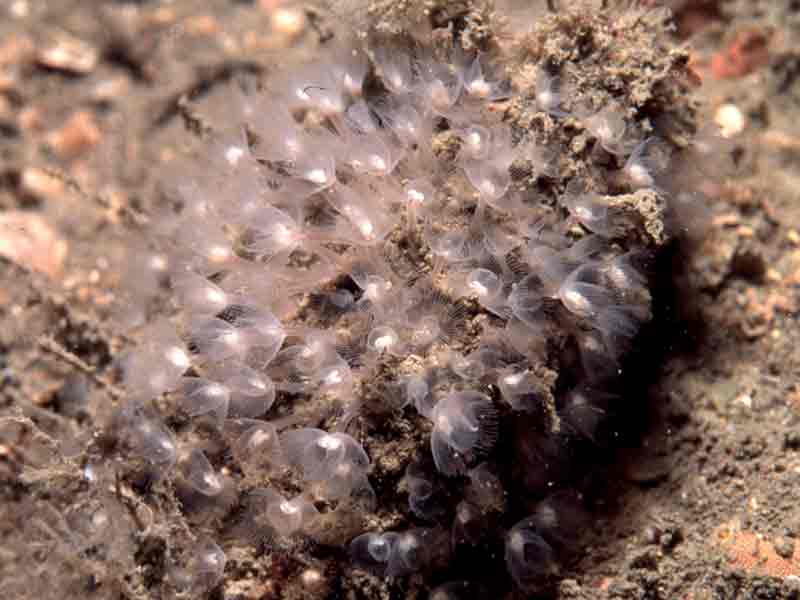
Horseshoe worm, Phoronis hippocrepia in limestone.
Photographer: Dr Keith Hiscock Copyright: Dr Keith Hiscock
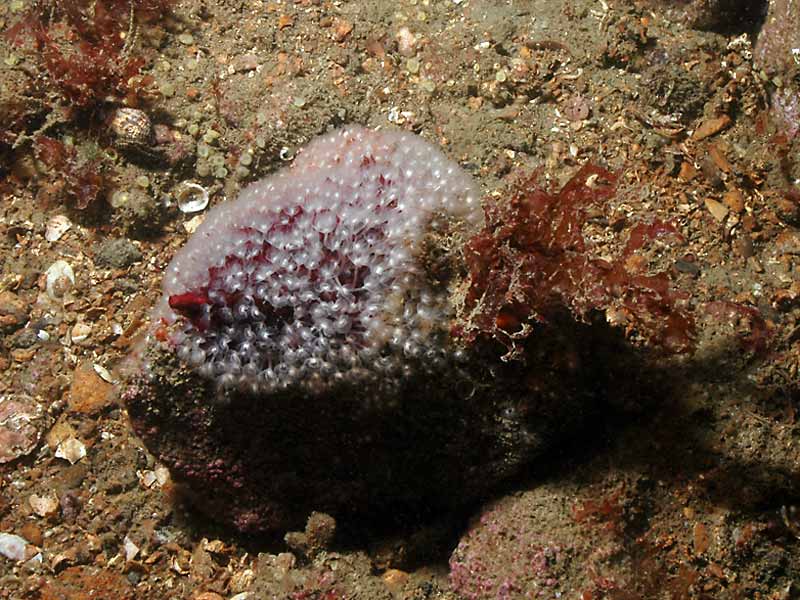
Phoronis hippocrepia at Firestone Bay, Plymouth sound.
Photographer: Dr Keith Hiscock Copyright: Dr Keith Hiscock
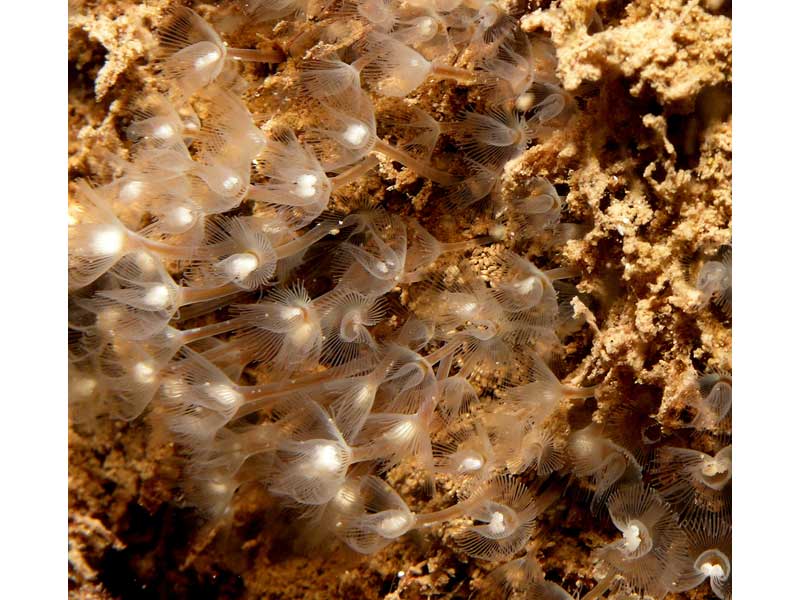
Phoronis hippocrepia colony at Babbacombe, Devon
Photographer: Paul Newland Copyright: Paul Newland
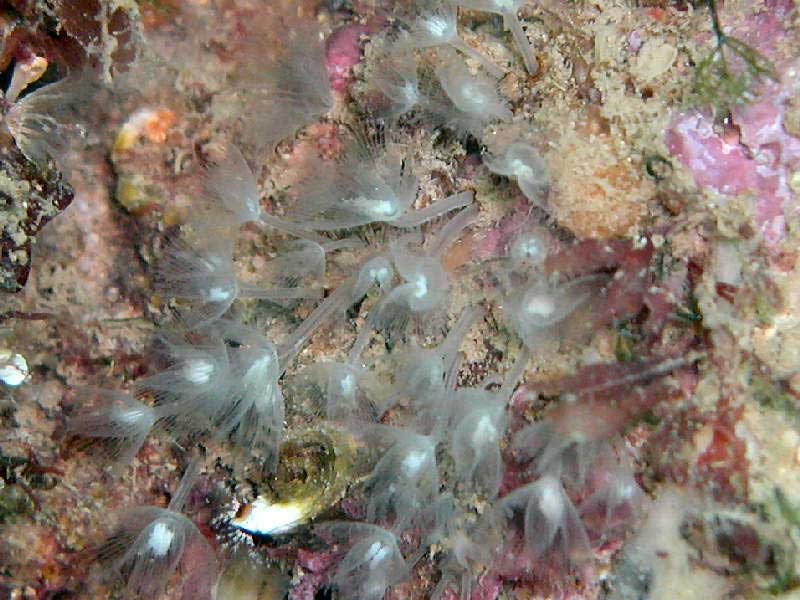
Close up of Phoronis hippocrepia in limestone rock at Babbacombe Bay, Torquay.
Photographer: Paul Newland Copyright: Paul Newland
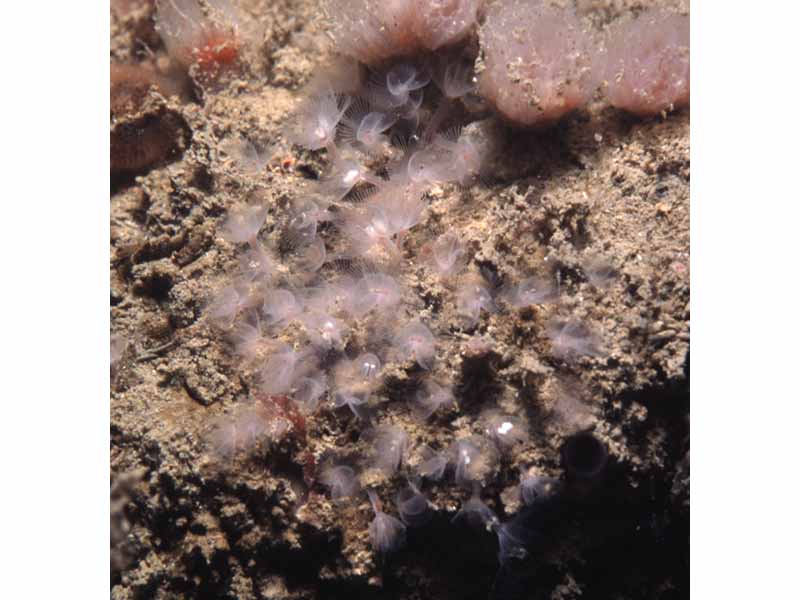
The horse shoe worm living in limestone bedrock.
Photographer: Dr Keith Hiscock Copyright: Dr Keith Hiscock
Distribution data supplied by the Ocean Biodiversity Information System (OBIS). To interrogate UK data visit the NBN Atlas.Map Help
| Researched by | Susie Ballerstedt | Refereed by | Admin |
| Authority | Wright, 1856 | ||
| Other common names | A horseshoe worm | Synonyms | Larva originally described as Actinotropha hippocrepia Silén 1954 |
Summary
Description
Phoronis hippocrepia secretes and lives in a membranous, cylindrical tube, and occur in either boring or encrusting forms. Individuals are 0.3-1.5 mm in diameter and can grow up to 10 cm in height, although more commonly attain 4 cm. The body is cylindrical and elongate with a slender trunk (metasome) and a bulbous posterior (ampulla). Tentacles (terminal lophophore) occur entirely on the 'head' region, numbering 50-150. The tentacles are 2-3 mm in length and are arranged in a 'horse-shoe' shape. Individuals are translucent white greenish grey, yellowish or fleshy in colour.
Recorded distribution in Britain and Ireland
Found on all British and Irish coasts, especially common where rock is limestone.Global distribution
Known in Hawaii, west coast of Panama, Mexico, Brazil, France, Belgium, German, Sweden, Italy and South Africa.Habitat
Recorded from the intertidal zone near low tide mark to a maximum depth of 48 m. Both boring and encrusting forms inhabit similar substrata: rock, empty mollusc shells, coral skeletons, encrusting coralline algae and wood, although this species is commonly associated with calcareous substrata. Phoronis hippocrepia generally occurs under poor light conditions.Depth range
-Identifying features
- Burrowing or encrusting worms within membranous, cylindrical tubes.
- Body up to 10 cm in length.
- Between 50-150 tentacles on the 'head' region.
- Tentacles 2-3 mm long and arranged in a 'horse-shoe' shape.
- Greenish grey, yellowish or fleshy in colour.
- The nephridia (kidney-like organ) has two long tubes and two giant nerves on either side.
Additional information
Phoronis hippocrepia can occur in densities of more than 20,000 individuals/m². Identification on this species may require microscopic work and dissection (see Emig, 1979). The only other known genus in this phylum is Phoronopsis. The genus Phoronis can be distinguished from Phoronopsis by the absence of a collar-fold below the lophophore (see Emig, 1979).
Listed by
- none -
Bibliography
Emig, C.C., 1979. British and other phoronids. London, Academic Press
Hayward, P., Nelson-Smith, T. & Shields, C. 1996. Collins pocket guide. Sea shore of Britain and northern Europe. London: HarperCollins.
Hayward, P.J. & Ryland, J.S. (ed.) 1995b. Handbook of the marine fauna of North-West Europe. Oxford: Oxford University Press.
Hayward, P.J. & Ryland, J.S. (ed.), 1995. The marine fauna of the British Isles and north-west Europe. Volume 2. Molluscs to Chordates. Oxford Science Publications. Oxford: Clarendon Press.
Howson, C.M. & Picton, B.E., 1997. The species directory of the marine fauna and flora of the British Isles and surrounding seas. Belfast: Ulster Museum. [Ulster Museum publication, no. 276.]
JNCC (Joint Nature Conservation Committee), 1999. Marine Environment Resource Mapping And Information Database (MERMAID): Marine Nature Conservation Review Survey Database. [on-line] http://www.jncc.gov.uk/mermaid
Picton, B.E. & Costello, M.J., 1998. BioMar biotope viewer: a guide to marine habitats, fauna and flora of Britain and Ireland. [CD-ROM] Environmental Sciences Unit, Trinity College, Dublin.
Datasets
NBN (National Biodiversity Network) Atlas. Available from: https://www.nbnatlas.org.
OBIS (Ocean Biodiversity Information System), 2025. Global map of species distribution using gridded data. Available from: Ocean Biogeographic Information System. www.iobis.org. Accessed: 2025-05-10
South East Wales Biodiversity Records Centre, 2018. SEWBReC Worms (South East Wales). Occurrence dataset: https://doi.org/10.15468/5vh0w8 accessed via GBIF.org on 2018-10-02.
Citation
This review can be cited as:
Last Updated: 05/12/2006