
Armoured bristleworm (Scoloplos armiger)
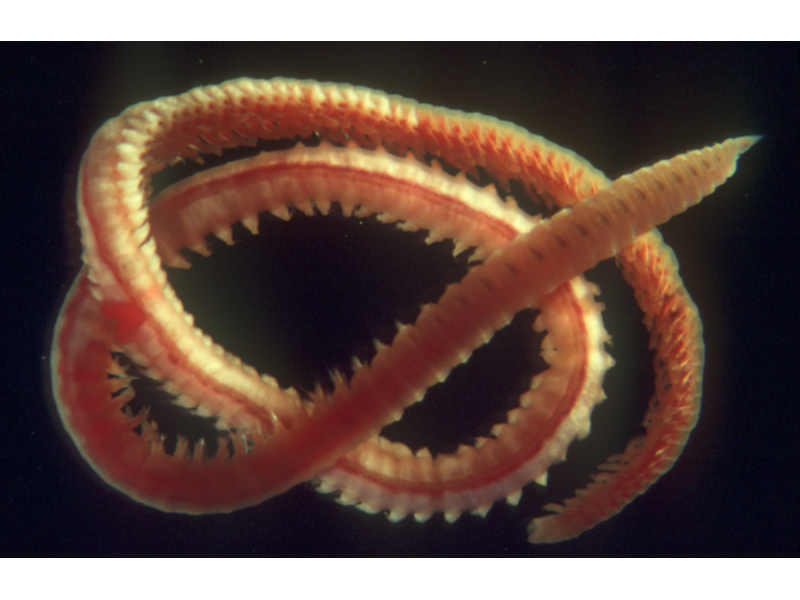
Specimen of Scoloplos (Scoloplos) armiger.
Photographer: Dr Inken Kruse Copyright: Dr Inken Kruse
Distribution data supplied by the Ocean Biodiversity Information System (OBIS). To interrogate UK data visit the NBN Atlas.Map Help
| Researched by | Susie Ballerstedt | Refereed by | Admin |
| Authority | (Müller, 1776) | ||
| Other common names | - | Synonyms | - |
Summary
Description
Scoloplos armiger reaches lengths of 12 cm with 200 or more body segments. The front region of the body is swollen and sharply pointed, giving the head a cone-shaped appearance. The eyes are not easily detectable. Gills occur dorsally from segments 9 to 17 onwards and the tip of the posterior has 2 long cirri. Scoloplos armiger is red or reddish brown in colour, and has prominent red blood vessels running down the length of the body.
Recorded distribution in Britain and Ireland
Widely distributed around the coasts of Britain and Ireland.
Global distribution
-Habitat
Occurs on the low shore and shallow sublittoral in fine, muddy sand, often amongst seagrasses. May be found in the lower reaches of estuaries.
Depth range
-Identifying features
- Red to bright orange-pink in colour.
- Sharply pointed, cone-shaped head.
- Up to 12 cm in length with 200 or more body segments.
- The posterior has 2 long cirri.
- Prominent red blood vessels.
Additional information
-none-Listed by
- none -
Bibliography
Datasets
Bristol Regional Environmental Records Centre, 2017. BRERC species records recorded over 15 years ago. Occurrence dataset: https://doi.org/10.15468/h1ln5p accessed via GBIF.org on 2018-09-25.
Kent Wildlife Trust, 2018. Kent Wildlife Trust Shoresearch Intertidal Survey 2004 onwards. Occurrence dataset: https://www.kentwildlifetrust.org.uk/ accessed via NBNAtlas.org on 2018-10-01.
Manx Biological Recording Partnership, 2017. Isle of Man wildlife records from 01/01/2000 to 13/02/2017. Occurrence dataset: https://doi.org/10.15468/mopwow accessed via GBIF.org on 2018-10-01.
Manx Biological Recording Partnership, 2018. Isle of Man historical wildlife records 1995 to 1999. Occurrence dataset: https://doi.org/10.15468/lo2tge accessed via GBIF.org on 2018-10-01.
NBN (National Biodiversity Network) Atlas. Available from: https://www.nbnatlas.org.
OBIS (Ocean Biodiversity Information System), 2025. Global map of species distribution using gridded data. Available from: Ocean Biogeographic Information System. www.iobis.org. Accessed: 2025-06-22
South East Wales Biodiversity Records Centre, 2018. SEWBReC Worms (South East Wales). Occurrence dataset: https://doi.org/10.15468/5vh0w8 accessed via GBIF.org on 2018-10-02.
Citation
This review can be cited as:
Last Updated: 27/10/2005