
Angel Shark (Squatina squatina)
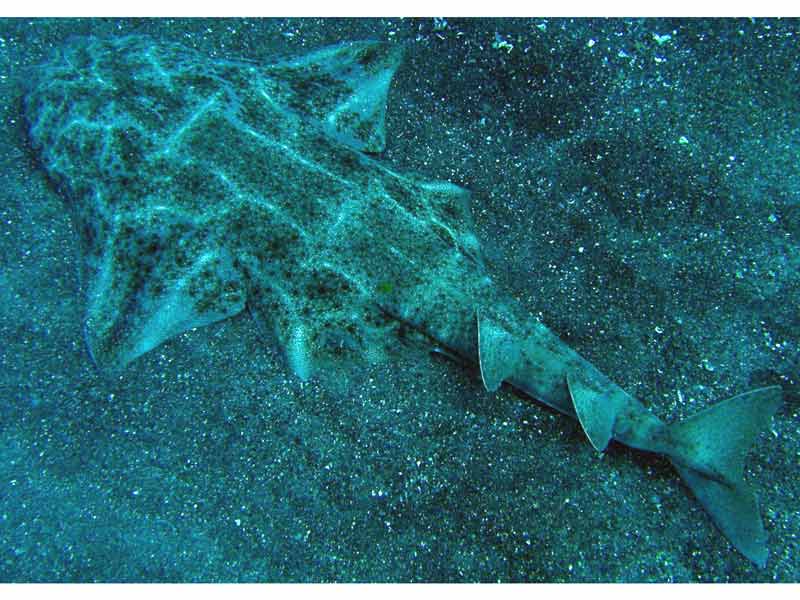
A resting angel shark on sandy substrate
Photographer: Paul Newland Copyright: Paul Newland
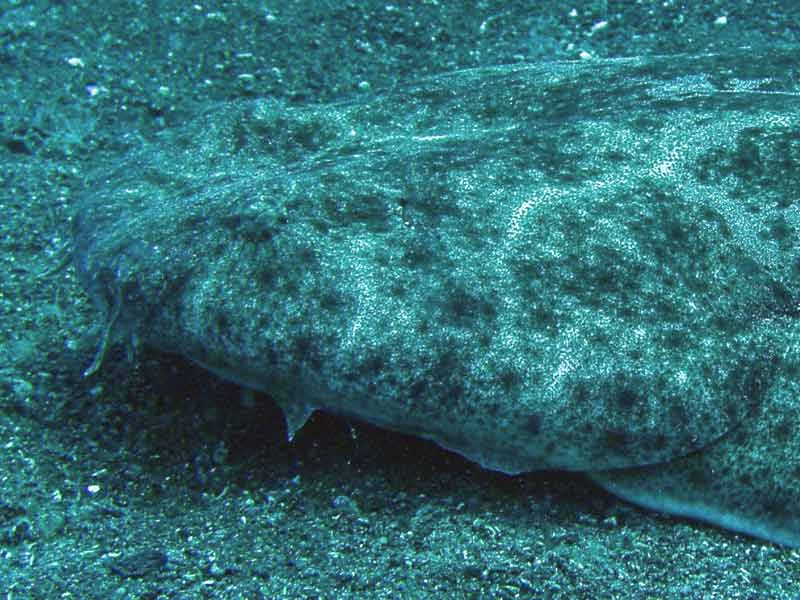
A close up of the face of Squatina squatina.
Photographer: Paul Newland Copyright: Paul Newland
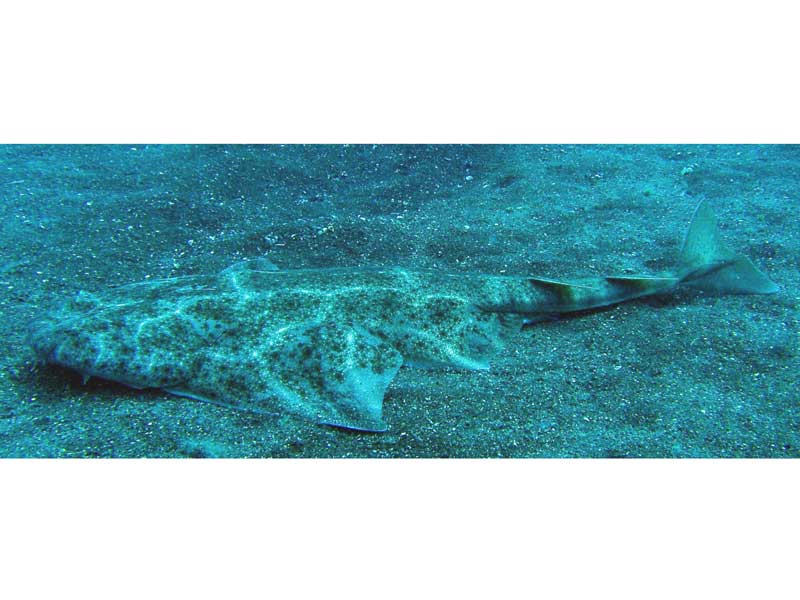
An angel shark on the sea floor.
Photographer: Paul Newland Copyright: Paul Newland
Distribution data supplied by the Ocean Biodiversity Information System (OBIS). To interrogate UK data visit the NBN Atlas.Map Help
| Researched by | Morvan Barnes | Refereed by | Admin |
| Authority | (Linnaeus, 1758) | ||
| Other common names | - | Synonyms | - |
Summary
Description
Recorded distribution in Britain and Ireland
Expected distribution all around the offshore coast of Ireland and Britain as far north as the Shetland Isles and as far south as southern Ireland.Global distribution
-Habitat
Found on the continental shelves from close inshore to at least 150 m depth. During day time, found almost buried in a mud or sandy bottom often with hardly more than its eyes protruding. Will often be seen swimming off the bottom at night time.Depth range
-Identifying features
- Flat, ray-like body, broad trunk and large, high pectoral fins.
- Grey to reddish or greenish-brown with white spots and blackish dots.
- Up to 1.8 m in length.
- Nasal barbels and large round eyes.
- No ocelli on body.
Additional information
Young angel sharks may also have white net-like markings and large, dark blotches, whilst adults are plainer (Compagno, 1984).Listed by
Bibliography
Compagno, L.J.V., 1984. FAO species catalogue. Vol. 4. Sharks of the world. An annotated and illustrated catalogue of shark species known to date. Part 1 - Hexanchiformes to Lamniformes. FAO Fisheries Synopsies, 125, 1-249
Froese, R. & Pauly, D., 2007. Fishbase. A global information system on fishes. [On-line] http://www.fishbase.org, 2008-02-18
Howson, C.M. & Picton, B.E., 1997. The species directory of the marine fauna and flora of the British Isles and surrounding seas. Belfast: Ulster Museum. [Ulster Museum publication, no. 276.]
Whitehead, P.J.P., Bauchot, M.-L., Hureau, J.-C., Nielson, J. & Tortonese, E. 1986. Fishes of the North-eastern Atlantic and the Mediterranean. Vol. I, II & III. Paris: United Nations Educational, Scientific and Cultural Organisation (UNESCO).
Datasets
Isle of Wight Local Records Centre, 2017. IOW Natural History & Archaeological Society Marine Records. Occurrence dataset: https://doi.org/10.15468/7axhcw accessed via GBIF.org on 2018-09-27.
NBN (National Biodiversity Network) Atlas. Available from: https://www.nbnatlas.org.
OBIS (Ocean Biodiversity Information System), 2025. Global map of species distribution using gridded data. Available from: Ocean Biogeographic Information System. www.iobis.org. Accessed: 2025-07-01
Citation
This review can be cited as:
Last Updated: 25/03/2008