
A sand hopper (Talitrus saltator)
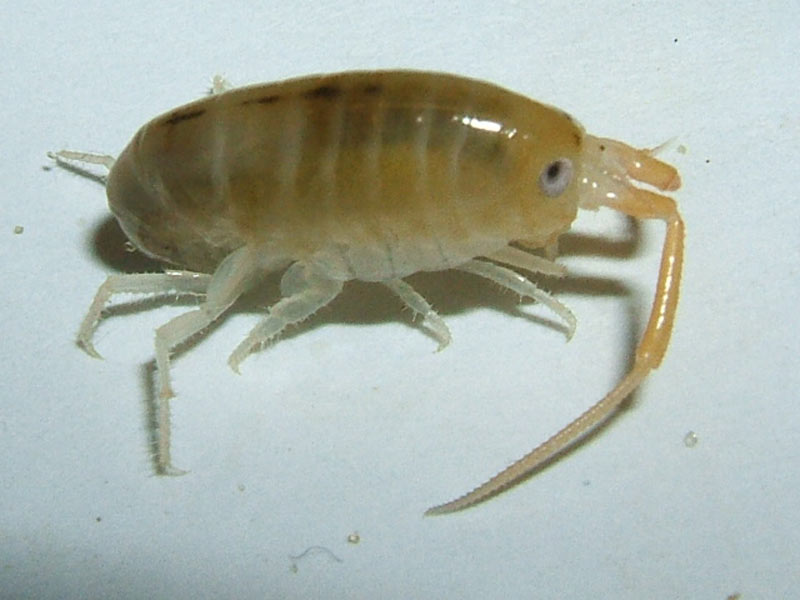
Talitrus saltator
Photographer: Christopher Mcaskie Copyright: Christopher McAskie
Distribution data supplied by the Ocean Biodiversity Information System (OBIS). To interrogate UK data visit the NBN Atlas.Map Help
| Researched by | Georgina Budd | Refereed by | This information is not refereed |
| Authority | (Montagu, 1808) | ||
| Other common names | - | Synonyms | Talitrus locusta |
Summary
Description
Talitrus saltator is an active supralittoral sand-hopper, growing up to 20 mm in length. It has a typical gammaridean body-plan, dorso-laterally compressed with three main divisions, head, pereon (thorax) and pleon (abdomen), both pereon and pleon are segmented and smooth. Antennae are distinct and one is much longer and robust than the other. Eyes are round and black, the body being grey-brown in colour.
Recorded distribution in Britain and Ireland
Locally common on all coasts of Britain and Ireland.Global distribution
In the N.E. Atlantic and North Sea, along European coasts from southern Norway to the western Mediterranean.Habitat
Talitrus saltator is a supralittoral amphipod usually found beneath or amongst debris and decaying algae deposited at the high water mark or during the day it may be buried at depths between 10-30 cm in the substratum.Depth range
SupralittoralIdentifying features
- A laterally compressed robust body; pereon is broad, pleon rather compressed.
- Large head without rostrum, mouth-parts pendant (hang down) and mandible without palp.
- Antenna 1 much shorter than peduncle of antenna 2; antenna 2 more robust and flagellum appears serrated.
- In females, antenna 2, although longer than antenna 1, is much shorter and less robust than in males.
- Seven pairs of thoracic limbs, the first two pairs are modified as gnathopods.
- Gnathopods 1 and 2 are similar in both sexes. Gnathopod 1 simple but robust with an elongated 5th limb segment (carpus). The final segment of gnathopod 2 (the propodus) is 'mitten' shaped.
- Walking legs (pereopods) are robust and spined.
- Telson (flap-like tail structure) slightly wider than long with several spines.
- Talitrus saltator is immediately distinguishable from Talorchestia by examination of the ramus of the 3rd uropod (appendage of the pleon). In Talitrus the ramus has 4 strong dorsal spines and terminates in a spine almost as long as the ramus.
Additional information
An extensive review of the Talitridae was published by Bulycheva (1957) in which the concept of the family was reconsidered and a number of genera removed to newly erected families, Hyalidae and Hyalellidae. The separation provides a convenient ecological grouping with the truly terrestrial genera in the Talitridae, a family consisting of five genera (Talitrus, Orchestia, Talorchestia, Talitroides and Brevitalitrus), all of which are recorded in the British Isles. Talitrus are a small circumtropical genus comprising about 10 recognized species but Talitrus saltator is the only species that extends into the north east Atlantic area (Lincoln, 1979).
Listed by
- none -
Biology review
Taxonomy
| Level | Scientific name | Common name |
|---|---|---|
| Class | Malacostraca | Crabs, lobsters, sand hoppers and sea slaters |
| Order | Amphipoda | Sand hoppers and skeleton shrimps |
| Family | Talitridae | |
| Genus | Talitrus | |
| Authority | (Montagu, 1808) | |
| Recent Synonyms | Talitrus locusta | |
Biology
| Parameter | Data | ||
|---|---|---|---|
| Typical abundance | |||
| Male size range | 8.2-16.5 mm | ||
| Male size at maturity | > 8.0 mm | ||
| Female size range | > 8.0 mm | ||
| Female size at maturity | |||
| Growth form | Articulate | ||
| Growth rate | See additional information | ||
| Body flexibility | High (greater than 45 degrees) | ||
| Mobility | Jumper or Hopper | ||
| Characteristic feeding method | Scavenger | ||
| Diet/food source | Omnivore | ||
| Typically feeds on | Partly decayed seaweed and other vegetation. | ||
| Sociability | No information | ||
| Environmental position | Epibenthic | ||
| Dependency | No information found. | ||
| Supports | No information | ||
| Is the species harmful? | No | ||
Biology information
Growth rate. Williams (1978) reported that juvenile growth rates averaged 5.5 mm in 100 days decreasing to 1.3 mm in 100 days after sexual differentiation at around 8 mm.
Mobility. The leaping habit of the Talitridae is confined to the family and is achieved by the sudden extension of the intucked, short posterior end of the body. In order to achieve a leap, the species has to stand on its legs in a manner not characteristic of the Amphipoda, which normally move on their side. The sudden tail flick is undirected and it may land anywhere. Hopping is repeated until a safe place is found (Reid, 1947).
Pattern of activity. Despite the widespread occurrence of Talitrus saltator in the supralittoral zone of sandy beaches along the Atlantic coasts of Europe and the Mediterranean (Dahl, 1952), most work concerning the species has focused on its behaviour, in particular influences on the locomotor activity rhythm of the species e.g., Williams (1980, 1979, Williams, J.A., 1983). During the day, Talitrus saltator is found buried in the substratum above the high tide line but, at night it emerges on the ebb tide to forage intertidally on the strandline algae. It must, however, return to the high supralittoral before the flood tide. Williams, J.A. (1983) found that this activity was under a precise endogenously controlled rhythm, which in constant conditions will free-run for > 100 days without variation. Following specific light cues at dawn (a threshold light intensity of 1.5 lux, Williams, 1980), nocturnal surface foraging activity ceases and the sand hopper moves up shore in order to locate burrowing sites above the previous high tide level. This dawn up shore migration is also controlled by an endogenous circadian rhythm, probably independent of that controlling emergence and foraging (Hayward, 1994), as following peak nocturnal activity, the sand hopper quite suddenly switches to orientated movement in the direction of light/dark boundaries (horizon). A behaviour that Edwards & Naylor (1987) demonstrated experimentally. The activity cycle of Talitrus saltator is also entirely circadian. Its nocturnal activity in the intertidal zone occupies a six to eight-hour period which, peaks between 0100 and 0300 hours GMT regardless of tidal state and cycles over a period of 24.46 hours. Owing to the requirement for the activity pattern to be phased with the seasonally changing night/day ratio (nL/D) a perceptible daily shift is apparent (Hayward, 1994). Williams (1980) found that the dawn light transition, rather than dusk, was used by Talitrus saltator to synchronize its periods of activity with the nL/D cycle. The pattern of behaviour seems to serve two purposes. Firstly, it prevents the sand hoppers' burrow zone from being completely inundated during the next high tide and consequently, a semi-lunar horizontal displacement of the burrow zone occurs (Williams, 1979). Secondly, the activity is related to humidity. Moisture conservation is a major stress for crustaceans living a transition between marine and terrestrial lifestyles and behavioural mechanisms used to locate and maintain humid microhabitats during the diurnal quiescent phase of their circadian activity cycle is vital.
Population differences. Differences in physical morphology and behaviour are reported (Scapini et al., 1999). For instance, where tides are virtually absent in parts of the Mediterranean, the sand hopper moves landwards beyond high water to forage (Scapini et al., 1992). It navigates back to the supralittoral zone, using celestial orientation, with a circadian timing that is reinforced by visual clues (e.g. Mezzetti & Scapini, 1995; Ugolini & Scapini, 1988). In conclusion, endogenous behaviour rhythms are especially important in mobile intertidal organisms for the maintenance of a zoned distribution on the shore and for the synchronization of whole population behaviour, vital for reproduction.
Habitat preferences
| Parameter | Data |
|---|---|
| Physiographic preferences | Open coast, Strait or Sound, Sea loch or Sea lough, Enclosed coast or Embayment |
| Biological zone preferences | Supralittoral |
| Substratum / habitat preferences | Strandline |
| Tidal strength preferences | Not relevant |
| Wave exposure preferences | Not relevant |
| Salinity preferences | No information |
| Depth range | Supralittoral |
| Other preferences | The optimum sand particle diameter for Talitrus saltator is in the range of 330-600µm (Dahl, 1946; Williams, 1983b). |
| Migration Pattern | Non-migratory or resident |
Habitat Information
During the winter quiescent populations can be found burrowed above the extreme high water spring tide mark, at depths up to 50 cm (Bregazzi & Naylor, 1972; Williams, J.A.,1976). From field studies, Williams (1983b) found that the majority of adults burrowed down in to the substratum until sand with at least 2% moisture content is encountered. Recently hatched juveniles are considered to be physically incapable of burrowing in order to avoid desiccation (Williams, 1978) and are consequently found amongst freshly deposited seaweed that maintains a relatively high humidity of 85-90% over the low tide (Williamson, 1951).Life history
Adult characteristics
| Parameter | Data |
|---|---|
| Reproductive type | Gonochoristic (dioecious) |
| Reproductive frequency | Annual episodic |
| Fecundity (number of eggs) | See additional information |
| Generation time | <1 year |
| Age at maturity | See additional information |
| Season | May - August |
| Life span | 1-2 years |
Larval characteristics
| Parameter | Data |
|---|---|
| Larval/propagule type | - |
| Larval/juvenile development | Ovoviviparous |
| Duration of larval stage | Not relevant |
| Larval dispersal potential | 10 -100 m |
| Larval settlement period | Not relevant |
Life history information
Sexes are separate. It is possible to distinguish between sexes in specimens with a body length between 8.0 and 8.5 mm (Williams, 1978). For a description of embryonic development in Talitrus saltator see Williams (1978, Figure 1). All eggs within a single brood are at the same stage of morphological development. For a female of 12.6 mm in length, the mean number of eggs per brood is 13, larger females may carry a slightly larger brood of 15.
As in all crustaceans, mating and the release of juveniles, are synchronised with the moult cycle. Adults pair during their nightly migration down the beach and mate in the sand once the female has completed her moult. In the Isle of Man, Williams (1978) first caught egg-bearing females in samples during May with high reproductive activity occurring between May and late August so that by September all brood pouches were found to be empty. This breeding cycle is in contrast to those of other intertidal amphipods and isopods (Hayward, 1994) in that the breeding period is shorter and controlled by day length (Talitrus saltator breeds when the natural day length is in excess of 14 hours (Williams, 1985)) irrespective of air and sea temperature (Williams, 1978). Williams (1978) found two generations to be present over a year and females died during their second overwintering period, before the males. Williams (1978) calculated the lifespan of females to be ca 18 months and 21 months for males. Juveniles become sexually differentiated within three to four months of hatching and do not contribute to a precocious, secondary breeding population in the summer, they usually reach maturity by the autumn and do not breed until the following summer. The overwintering population consists of young adults, with an additional number of juveniles arising from the last brood of the season and a few large sexually mature adults that were the last to breed. Such adults die in February, so that the young adults and maturing juveniles that overwintered, constitute the new breeding population (Williams, 1987; Hayward, 1994).
Sensitivity review
The MarLIN sensitivity assessment approach used below has been superseded by the MarESA (Marine Evidence-based Sensitivity Assessment) approach (see menu). The MarLIN approach was used for assessments from 1999-2010. The MarESA approach reflects the recent conservation imperatives and terminology and is used for sensitivity assessments from 2014 onwards.
Physical pressures
Use / to open/close text displayed
| Intolerance | Recoverability | Sensitivity | Evidence / Confidence | |
Substratum loss [Show more]Substratum lossBenchmark. All of the substratum occupied by the species or biotope under consideration is removed. A single event is assumed for sensitivity assessment. Once the activity or event has stopped (or between regular events) suitable substratum remains or is deposited. Species or community recovery assumes that the substratum within the habitat preferences of the original species or community is present. Further details EvidenceTalitrus saltator lives in close association with the sandy substratum of the supralittoral and intertidal zones. During the day the inactive sand hopper remains burrowed within the substratum, emerging at night to forage in the intertidal or amongst strandline debris. Despite being mobile (specimens have been observed to travel 80 m at night (Williamson, 1951b)) the sand hopper is likely to have a high intolerance to substratum loss as it is reliant upon it for protection from desiccation and predators. Recoverability has been suggested to be very high as the species is locally widespread and young adults and maturing juveniles would probably remain in areas adjacent to the disturbance, so would colonize and breed. | High | Very high | Low | Moderate |
Smothering [Show more]SmotheringBenchmark. All of the population of a species or an area of a biotope is smothered by sediment to a depth of 5 cm above the substratum for one month. Impermeable materials, such as concrete, oil, or tar, are likely to have a greater effect. Further details. EvidenceTalitrus saltator inhabits a non-permanent burrow in sand just above the high-water strandline material or within strandline material itself. The species can burrow to depths of 50 cm where during daylight hours it remains inactive but emerges during the night to forage on strandline debris. Adults of the species are unlikely to be adversely affected by an additional covering of 5 cm of sediment consistent with that of the habitat, although juveniles are not considered physically robust enough to burrow up through an additional covering of sediment (Williams, 1978). Thus mortality of the most recent cohort might be expected. Intolerance has been assessed to be intermediate but recovery very high, as young adults and maturing juveniles are likely to survive.intolerance of the species would be expected to be higher if the smothering material was atypical for the habitat or if the material was impermeable or viscous e.g. oil. | Low | Very high | Very Low | Moderate |
Increase in suspended sediment [Show more]Increase in suspended sedimentBenchmark. An arbitrary short-term, acute change in background suspended sediment concentration e.g., a change of 100 mg/l for one month. The resultant light attenuation effects are addressed under turbidity, and the effects of rapid settling out of suspended sediment are addressed under smothering. Further details EvidenceIncreased suspended sediment is unlikely in the supralittoral. The factor has therefore been assessed not to be relevant. | Not relevant | Not relevant | Not relevant | Not relevant |
Decrease in suspended sediment [Show more]Decrease in suspended sedimentBenchmark. An arbitrary short-term, acute change in background suspended sediment concentration e.g., a change of 100 mg/l for one month. The resultant light attenuation effects are addressed under turbidity, and the effects of rapid settling out of suspended sediment are addressed under smothering. Further details EvidenceDecreased suspended sediment is unlikely in the supralittoral. The factor has therefore been assessed not to be relevant. | Not relevant | Not relevant | Not relevant | Not relevant |
Desiccation [Show more]Desiccation
EvidenceThe high water mark Talitridae are terrestrial but show little structural modification for their lifestyle, e.g. they have no obvious adaptations to limit water-loss, and their branchial method of respiration is typically aquatic. It is thus likely that the desiccating power of the air plays an important role in defining the species habitat and determining its habit (Williamson, 1951). Consequently the movement of Talitrus saltator between high water spring tide and high water neap tide marks is related to the sand hoppers efforts to reduce diurnal desiccation stress (Williams, 1996) as unprotected individuals above the substratum survive only approximately 0.5 -1 hour (Williamson, 1951). Intolerance of Talitrus saltator to desiccation would be reported to be high, except for its mobility and habit which protect it from the factor. Consequently, not relevant has been reported. | Not relevant | Not relevant | Not relevant | Not relevant |
Increase in emergence regime [Show more]Increase in emergence regimeBenchmark. A one hour change in the time covered or not covered by the sea for a period of one year. Further details EvidenceUnder stressful conditions such as finding itself on especially dry substrata the supralittoral talitrid Talitrus saltator demonstrates zonal orientation, which is the means by which it promptly regains the most optimal zone of the beach for itself. Thus Talitrus saltator has been assessed to be tolerant of an increase in emergence because the species is sufficiently mobile to avoid the change in the factor and has behavioural mechanisms to reduce diurnal desiccation stress that would be associated with an increase in emergence. | Tolerant | Not relevant | Not sensitive | Not relevant |
Decrease in emergence regime [Show more]Decrease in emergence regimeBenchmark. A one hour change in the time covered or not covered by the sea for a period of one year. Further details EvidenceTalitrus saltator is not found far from the sea, being confined to the region near the high-water mark in order to avoid desiccation and it is doubtful that the species enters the sea voluntarily, e.g. Walker (1895) (cited in Reid, 1947) observed that at very high tides, numbers of the species were driven into the Port Erin laboratory (Isle of Man). The species can swim with the help of its tail-flip if accidentally inundated by the tide (Vogel, 1985). Dahl (1946) experimented with the reactions of certain Talitridae to water and found that Talitrus saltator could tolerate immersion for over a week. If accidentally immersed it is likely that Talitrus saltator would be able to use its tail-flip to swim (Vogel, 1985) and exit the water. However, the circadian pattern of activity, under endogenous control, serves to prevent the species being inundated with water (see general biology) and consequently this factor has been assessed not to be relevant to the species. | Not relevant | Not relevant | Not relevant | Not relevant |
Increase in water flow rate [Show more]Increase in water flow rateA change of two categories in water flow rate (view glossary) for 1 year, for example, from moderately strong (1-3 knots) to very weak (negligible). Further details EvidenceIncreased water flow is not a factor of relevance in the supralittoral zone. The factor has therefore been assessed not to be relevant. | Not relevant | Not relevant | Not relevant | Not relevant |
Decrease in water flow rate [Show more]Decrease in water flow rateA change of two categories in water flow rate (view glossary) for 1 year, for example, from moderately strong (1-3 knots) to very weak (negligible). Further details EvidenceDecreased water flow is not a factor of relevance in the supralittoral zone. The factor has therefore been assessed not to be relevant. | Not relevant | Not relevant | Not relevant | Not relevant |
Increase in temperature [Show more]Increase in temperature
For intertidal species or communities, the range of temperatures includes the air temperature regime for that species or community. Further details EvidenceTalitrus saltator occurs to the south of the British Isles, so is likely to be tolerant of a chronic temperature increase of 2°C. Bregazzi & Naylor (1972) observed that the timing of activity was temporarily advanced by increased temperature but otherwise the activity pattern possessed a large measure of temperature independence. Specimens brought in to laboratory conditions from a field temperature of 10.5°C were introduced to (within 3 hours) and maintained for 15 days at constant temperatures of 15, 20 and 25°C. For Talitrus saltator maintained at the highest temperatures the activity mid-point advanced by as much as three hours to occur before midnight. However, alterations in activity were compensated for within two to ten days.Acute temperature increases may therefore temporarily disrupt activity of the sand hopper but owing to insufficient evidence for adverse effects in the field intolerance has been assessed to be low. Immediate recovery has been recorded as the locomotor activity rhythm is synchronized within a few days. | Low | Immediate | Not sensitive | Moderate |
Decrease in temperature [Show more]Decrease in temperature
For intertidal species or communities, the range of temperatures includes the air temperature regime for that species or community. Further details EvidenceTalitrus saltator remains inactive in high shore burrows for much of the winter in more northern latitudes. In the laboratory, exposure to low temperature (2 or 3 °C) was accompanied by the onset of inactivity, a precipitous decrease in oxygen uptake and a marked increase in the concentrations of the major ions in the haemolymph (Spicer et al., 1994). In addition to causing a complete cessation of activity, chilling (2-3°C for 8 hours) also causes a delay in the successive activity peaks following return to normal temperatures. Maximum delay occurred if chilling began during the inactive period of the sand hopper and was of equal duration to that of the chill. At other times the delay was less than that of the chill (Bregazzi, 1972). Thus it is possible that exposure to decreased temperatures in the field would enforce a period of inactivity causing disruption to the species normal behaviour with potential consequences for the maintenance of a position with appropriate moisture, e.g. the substratum may be come to dry or the temporary burrow become inundated with water. The effects of an unusually cold winter are likely to be a simple physical one, whereby quiescent sand hoppers freeze within the substratum, causing cell and tissue damage and eventually rupture of cell and body walls. Other supralittoral members of the Talitridae with a similar habit to Talitrus saltator were reported to be adversely affected by the severe winter of 1962/63 in particular sand hoppers of the genus Orchestia were found dead in considerable numbers (Crisp, 1964). Intolerance has been assessed to be intermediate as the behaviour of the sand hopper is likely to be disrupted by mild chilling, but death as a result of freezing is probable in severe winters. Recovery from mild chilling has been assessed to be immediate following an initial disruption to its activity. | Intermediate | Immediate | Very Low | Moderate |
Increase in turbidity [Show more]Increase in turbidity
EvidenceIncreased turbidity is not a factor of relevance in the supralittoral zone. The factor has therefore been assessed not to be relevant. | Not relevant | Not relevant | Not relevant | Not relevant |
Decrease in turbidity [Show more]Decrease in turbidity
EvidenceDecreased turbidity is not a factor of relevance in the supralittoral zone. The factor has therefore been assessed not to be relevant. | Not relevant | Not relevant | Not relevant | Not relevant |
Increase in wave exposure [Show more]Increase in wave exposureA change of two ranks on the wave exposure scale (view glossary) e.g., from Exposed to Extremely exposed for a period of one year. Further details EvidenceTalitrus saltator is sufficiently mobile to avoid exposure to wave action. The factor has therefore been assessed not to be relevant. | Not relevant | Not relevant | Not relevant | Not relevant |
Decrease in wave exposure [Show more]Decrease in wave exposureA change of two ranks on the wave exposure scale (view glossary) e.g., from Exposed to Extremely exposed for a period of one year. Further details EvidenceTalitrus saltator is sufficiently mobile to avoid exposure to wave action. The factor has therefore been assessed not to be relevant. | Not relevant | Not relevant | Not relevant | Not relevant |
Noise [Show more]Noise
EvidenceTalitrus saltator is unlikely to be able to detect environmental noise at levels sufficient to cause disturbance. | Tolerant | Not relevant | Not sensitive | Low |
Visual presence [Show more]Visual presenceBenchmark. The continuous presence for one month of moving objects not naturally found in the marine environment (e.g., boats, machinery, and humans) within the visual envelope of the species or community under consideration. Further details EvidenceTalitrus saltator demonstrates possession of 'form-vision', in that it shows a positive orientation to certain silhouettes. Williamson (1951b) demonstrated such visual orientation under experimental conditions in the laboratory, where the sand hopper showed positive orientation towards the foot of an incline and sometimes towards a vertical, dark-light boundary. Individuals Talitrus saltator become very agitated if uncovered and hop until they land in shelter. Part of the disturbance is probably a reaction to increased light rather than visual disturbance. Nevertheless, there is an energy consequence and a tentative low intolerance has been suggested. | Low | Immediate | Not sensitive | Low |
Abrasion & physical disturbance [Show more]Abrasion & physical disturbanceBenchmark. Force equivalent to a standard scallop dredge landing on or being dragged across the organism. A single event is assumed for assessment. This factor includes mechanical interference, crushing, physical blows against, or rubbing and erosion of the organism or habitat of interest. Where trampling is relevant, the evidence and trampling intensity will be reported in the rationale. Further details. EvidenceTalitrus saltator is a highly mobile species that is sufficiently mobile to avoid abrasion at the benchmark level. It occurs in the upper eulittoral where it is unlikely to be exposed to mooring or anchoring, and at low tide is protected from the effect of trampling in its burrows. However, the invertebrate communities of strandline debris, including amphipods (e.g. Talitrus saltator) was shown to be markedly affected by beach cleaning (Llewellyn & Shackley, 1996). Beach cleaning removes the strandline debris of seaweeds and other flotsam which provide food for Talitrus saltator and other amphipods and invertebrates. Juveniles amphipods may use the debris as protection against desiccation until old enough to burrow, so that the annual juvenile recruitment to the population may be lost if strandline debris is removed (Llewellyn & Shackley, 1996). In addition the use of tractors to pull automated rakes, compacts the sand and can crush infauna. Therefore, intolerance has been recorded as intermediate. Recoverability is likely to be very high. | Intermediate | High | Low | Not relevant |
Displacement [Show more]DisplacementBenchmark. Removal of the organism from the substratum and displacement from its original position onto a suitable substratum. A single event is assumed for assessment. Further details EvidenceTalitrus saltator is a mobile species which easily re-locates once physically removed from a substratum. The factor has therefore been assessed not to be relevant. | Not relevant | Not relevant | Not relevant | Not relevant |
Chemical pressures
Use [show more] / [show less] to open/close text displayed
| Intolerance | Recoverability | Sensitivity | Evidence / Confidence | |
Synthetic compound contamination [Show more]Synthetic compound contaminationSensitivity is assessed against the available evidence for the effects of contaminants on the species (or closely related species at low confidence) or community of interest. For example:
The evidence used is stated in the rationale. Where the assessment can be based on a known activity then this is stated. The tolerance to contaminants of species of interest will be included in the rationale when available; together with relevant supporting material. Further details. EvidenceIn general, crustaceans are widely reported to be sensitive to synthetic chemicals (Cole et al., 1999) and intolerance to some specific chemicals has been observed in amphipods. Amphipods have been reported to be sensitive to TBT and leachates from antifouling paints (Laughlin et al., 1982). Ten day LC50 values of 1-48ng/TBT/l were reported for gammaridean amphipods (Meador et al., 1993). Intolerance has been assessed to be high, assuming deterioration of the contaminant (in the absence of information to the contrary for this species) and recovery high as the species is widespread and likely to recruit rapidly. | High | High | Moderate | Very low |
Heavy metal contamination [Show more]Heavy metal contaminationEvidenceTalitrus saltator has been used as a spatial and temporal heavy metal biomonitor (Rainbow et al., 1989, 1998; Fialkowski et al., 2000). Bioavailable sources of trace metals to talitrids are available in solution and in food, the latter consisting of decaying macrophytic material on the strandline. Such material acts as an adsorption site for heavy metals locally, as sandy substrata does not adsorb contaminants as easily as other substrata.The species is an efficient bioaccumulator of heavy metals and whose moult cycle does not interfere with its biomonitoring potential. Specimens (0.01g) of the sand hopper from the Isle of Cumbrae, a non metal polluted site in the Clyde, Scotland, had zinc concentrations between 145-181 µg /Zn/g and copper concentrations of 35.8 µg/Cu/g (Rainbow & Moore, 1990). In comparison, Talitrus saltator (0.01g) from a heavy metal polluted site in Dulas Bay, Anglesey, Wales (Foster et al., 1978; Boult et al., 1994) had a zinc concentration of 306 µ g/Zn/g and a copper concentration of 112 µ g/Cu/g. In the Gulf of Gdansk, Poland, comparable concentrations for zinc were in the region of 200-400 µ g/Zn/g with bottom sediment zinc concentrations of 0-20 µg/g and 40µ g/g in the most polluted areas (Fialkowski et al., 2000). It is likely that the most significant contamination pathway to the amphipod is that of pollutants adsorbed to vegetative matter that is consumed rather than that concentrated in the water column. However, insufficient information has been recorded as no evidence concerning the effects of heavy metal contamination on the species was found. | No information | Not relevant | No information | Not relevant |
Hydrocarbon contamination [Show more]Hydrocarbon contaminationEvidenceOil deposits on the strand line and amongst seaweed would probably incapacitate and kill, e.g. by smothering, small crustaceans such as Talitrus saltator. Following the Torrey Canyon oil tanker spill in 1967 quantities of Talitrus saltator were found dead at Sennen, Cornwall, as were other scavengers of the strandline, e.g. Ligia and Orchestia. Signs of detergent damage were reported at Constantine Bay where sand hoppers were found in a lethargic state at the base of dunes after spraying (Smith, 1968). Intolerance has therefore been assessed to be high. Recoverability has been suggested to be very high. Smith (1968) suggested that because sand hoppers bury themselves in the sand that a proportion of the population would survive and act as a breeding population. | High | Very high | Low | Moderate |
Radionuclide contamination [Show more]Radionuclide contaminationEvidenceInsufficientinformation. | No information | Not relevant | No information | Not relevant |
Changes in nutrient levels [Show more]Changes in nutrient levelsEvidenceInsufficientinformation was found concerning effects of changes in nutrient concentrations for this species. The growth of Talitrus saltator is not directly dependent on the availability of nutrients in the water column. | No information | Not relevant | No information | Not relevant |
Increase in salinity [Show more]Increase in salinity
EvidenceTalitrus saltator demonstrated the ability to hypo-regulate at higher external concentrations (>800mOsm), it hyper-regulated at lower concentrations, maintaining a haemolymph concentration between 750-850 mOsm (Morritt, 1988). However, the benchmark assesses intolerance of species to changes of salinity in their preferred zone, which in this instance is the supralittoral fringe. Consequently increased salinity has been considered not to be relevant. | Not relevant | Not relevant | Not relevant | Not relevant |
Decrease in salinity [Show more]Decrease in salinity
EvidenceTalitrus saltator demonstrated the ability to hypo-regulate at higher external concentrations (>800mOsm), it hyper-regulated at lower concentrations, maintaining a haemolymph concentration between 750-850 mOsm (Morritt, 1988). However, the benchmark assesses intolerance of species to changes of salinity in their preferred zone, which in this instance is the supralittoral fringe. Consequently decreased salinity has been considered not to be relevant. | Not relevant | Not relevant | Not relevant | Not relevant |
Changes in oxygenation [Show more]Changes in oxygenationBenchmark. Exposure to a dissolved oxygen concentration of 2 mg/l for one week. Further details. EvidenceAt the benchmark level intolerance is assessed against changes in the amount of dissolved oxygen in water. Talitrus saltator is restricted to the supralittoral zone which experiences spray and splash only. Therefore an assessment of intolerance to changes in water column oxygenation was not considered relevant. | Not relevant | Not relevant | Not relevant | Not relevant |
Biological pressures
Use [show more] / [show less] to open/close text displayed
| Intolerance | Recoverability | Sensitivity | Evidence / Confidence | |
Introduction of microbial pathogens/parasites [Show more]Introduction of microbial pathogens/parasitesBenchmark. Sensitivity can only be assessed relative to a known, named disease, likely to cause partial loss of a species population or community. Further details. EvidenceNo information was found concerning microbial pathogens and Talitrus saltator. | No information | Not relevant | No information | Not relevant |
Introduction of non-native species [Show more]Introduction of non-native speciesSensitivity assessed against the likely effect of the introduction of alien or non-native species in Britain or Ireland. Further details. EvidenceNo known alien species are currently reported to have an adverse effect on the survival of Talitrus saltator. | Tolerant | Not relevant | Not sensitive | Very low |
Extraction of this species [Show more]Extraction of this speciesBenchmark. Extraction removes 50% of the species or community from the area under consideration. Sensitivity will be assessed as 'intermediate'. The habitat remains intact or recovers rapidly. Any effects of the extraction process on the habitat itself are addressed under other factors, e.g. displacement, abrasion and physical disturbance, and substratum loss. Further details. EvidenceTalitrus saltator is not a species targeted for extraction. | Not relevant | Not relevant | Not relevant | Not relevant |
Extraction of other species [Show more]Extraction of other speciesBenchmark. A species that is a required host or prey for the species under consideration (and assuming that no alternative host exists) or a keystone species in a biotope is removed. Any effects of the extraction process on the habitat itself are addressed under other factors, e.g. displacement, abrasion and physical disturbance, and substratum loss. Further details. EvidenceTalitrus saltator is not dependant on any other species that are specifically selected for extraction. | Not relevant | Not relevant | Not relevant | Not relevant |
Additional information
Importance review
Policy/legislation
- no data -
Status
| National (GB) importance | - | Global red list (IUCN) category | - |
Non-native
| Parameter | Data |
|---|---|
| Native | - |
| Origin | - |
| Date Arrived | - |
Importance information
The Talitridae act as scavengers by feeding on the decaying weed thrown up by the tide.Bibliography
Boult, S., Collins, D.N., White, K.N. & Curtis, C.D., 1994. Metal transport in a stream polluted by acid mine drainage - the Afon Goch, Anglesey, U.K. Environmental Pollution, 84, 279-284.
Bregazzi, P.K. & Naylor, E., 1972. The locomotor activity rhythm of Talitrus saltator (Montagu) (Crustacea, Amphipoda). Journal of Experimental Biology, 57, 375-391.
Bregazzi, P.K., 1972. The effects of low temperature upon the locomotor activity rhythm of Talitrus saltator (Montagu) (Crustacea: Amphipoda). Journal of Experimental Biology, 57, 393-399.
Brown, A.C., 1996. Behavioural plasticity as a key factor in the survival and evolution of the macrofauna on exposed sandy beaches. Revista Chilena De Historia Natural, 69, 469-474.
Bulycheva, A.I., 1957. Morskie bloxi morej SSSR i sopredel'nyx vod (Amphipoda-Talitroidea). Fauna SSSR, 65, 1-185.
Cole, S., Codling, I.D., Parr, W. & Zabel, T., 1999. Guidelines for managing water quality impacts within UK European Marine sites. Natura 2000 report prepared for the UK Marine SACs Project. 441 pp., Swindon: Water Research Council on behalf of EN, SNH, CCW, JNCC, SAMS and EHS. [UK Marine SACs Project.]. Available from: http://ukmpa.marinebiodiversity.org/uk_sacs/pdfs/water_quality.pdf
Crisp, D.J. (ed.), 1964. The effects of the severe winter of 1962-63 on marine life in Britain. Journal of Animal Ecology, 33, 165-210.
Dahl, E., 1946. The Amphipoda of the sound. I Terrestrial Amphipoda. Acta Universitatis Lundensis, 42, 1-53.
Dahl, E., 1952. Some aspects of the ecology and zonation of the fauna on sandy beaches. Oikos, 4, 1-27.
Edwards, J.M. & Naylor, E., 1987. Endogenous circadian changes in orientation behaviour of Talitrus saltator. Journal of the Marine Biological Association of the United Kingdom, 67, 17-26.
Fialkowski, W., Rainbow, P.S., Fialkowska, E. & Smith, B.D., 2000. Biomonitoring of trace metals along the Baltic coast of Poland using the sand hopper Talitrus saltator (Montagu) (Crustacea, Amphipoda). Ophelia, 52, 183-192.
Foster, P., Hunt, D.T.E. & Morris, A.W., 1978. Metals in an acid mine stream and estuary. Science of the Total Environment, 9, 75-86.
Hayward, P.J. 1994. Animals of sandy shores. Slough, England: The Richmond Publishing Co. Ltd. [Naturalists' Handbook 21.]
Howson, C.M. & Picton, B.E., 1997. The species directory of the marine fauna and flora of the British Isles and surrounding seas. Belfast: Ulster Museum. [Ulster Museum publication, no. 276.]
Hudson, A.V. & Reynolds, J.D., 1984. Distribution of Irish intertidal Talitridae. Bulletin of the Irish Biogeographical Society, 8, 63-78.
Laughlin, R., Linden, O. & Guard, H., 1982. Toxicity of tributyltins and leachates from antifouling paints on marine amphipods. , Karlskrona: Institutet for Vattenoch Luftvardsforskning.
Lincoln, R.J., 1979. British Marine Amphipoda: Gammaridea. London: British Museum (Natural History).
Llewellyn, P.J. & Shackley, S.E., 1996. The effects of mechanical beach-cleaning on invertebrate populations. British Wildlife, 7, 147-155.
Mezzetti, M.C. & Scapini, F., 1995. Aspects of spectral sensitivity in Talitrus saltator (Montagu) (Crustacea, Amphipoda). Marine and Freshwater Behaviour and Physiology, 26, 35-45.
Morritt, D., 1988. Osmoregulation in littoral and terrestrial talitroidean amphipods (Crustacea) from Britain. Journal of Experimental Marine Biology and Ecology, 123, 77-94.
Rainbow, P.S. & Moore, P.G., 1990. Seasonal variation in copper and zinc concentrations in three talitrid amphipods (Crustacea). Hydrobiologia, 196, 65-72.
Rainbow, P.S., Fialkowski, W. & Smith, B.D., 1998. The sand hopper Talitrus saltator as a trace metal biomonitor in the Gulf of Gdansk, Poland. Marine Pollution Bulletin, 36, 193-200.
Rainbow, P.S., Moore, P.G. & Watson, D., 1989. Talitrid amphipods (Crustacea) as biomonitors for copper and zinc. Estuarine, Coastal and Shelf Science, 28, 567-582.
Reid, D.M., 1947. Talitridae (Crustacea, Amphipoda)
Scapini, F., Campacci, F. & Audoglio, M., 1999. Variation among natural populations of Talitrus saltator (Amphipoda): Morphometric analysis. Crustaceana, 72, 659-672.
Scapini, F., Chelazzi, L., Colombini, I. & Fallaci, M., 1992. Surface activity, zonations and migrations of Talitrus saltator on a Mediterranean beach. Marine Biology, 112, 573-581.
Smith, J.E. (ed.), 1968. 'Torrey Canyon'. Pollution and marine life. Cambridge: Cambridge University Press.
Spicer, J.I., Morritt, D. & Taylor, A.C., 1994. Effect of low temperature on oxygen uptake and haemolymph ions in the sand hopper Talitrus saltator (Crustacea: Amphipoda). Journal of the Marine Biological Association of the United Kingdom, 74, 313-321.
Ugolini, A. & Scapini, F., 1988. Orientation of the sand hopper Talitrus saltator (Amphipoda, Talitridae) living on dynamic sandy shores. Journal of Comparative Physiology, 162, 453-462.
Vogel, F., 1985. The swimming of the Talitridae (Crustacea, Amphipoda): functional morphology, phenology and energetics. Helgolander Meeresuntersuchungen, 39, 303-339.
Williams, J.A., 1976. The effect of light on the locomotor activity and general biology of Talitrus saltator (Montagu). , Ph.D. thesis, Liverpool University, 258 pp.
Williams, J.A., 1978. The annual pattern of reproduction of Talitrus saltator (Crustacea: Amphipoda: Talitidae). Journal of Zoology, 184, 231-244.
Williams, J.A., 1979. A semi-lunar rhythm of locomotor activity and moult synchrony in the sand-beach amphipod Talitrus saltator. In Cyclic phenomena in marine plants and animals (ed. E. Naylor & Hartnoll, R.). London: Pergamon Press.
Williams, J.A., 1980. The light response rhythm and seasonal entrainment of the endogenous circadian locomotor of Talitrus saltator (Crustacea: Amphipoda). Journal of the Marine Biological Association of the United Kingdom, 60, 773-785.
Williams, J.A., 1983. The endogenous locomotor activity rhythm of four supralittoral peracarid crustaceans. Journal of the Marine Biological Association of the United Kingdom, 63, 481-492.
Williams, J.A., 1983b. Environmental regulation of the burrow depth distribution of the sand-beach amphipod Talitrus saltator. Estuarine, Coastal and Shelf Science, 16, 291-298.
Williams, J.A., 1985. The role of photoperiod in the initiation of breeding and brood development in the amphipod Talitrus saltator Montagu. Journal of Experimental Marine Biology and Ecology, 86, 59-72.
Williams, J.A., 1996b. Burrow-zone distribution of the supralittoral amphipod Talitrus saltator on Derbyhaven Beach, Isle of Man - a possible mechanism for regulating desiccation stress? Journal of Crustacean Biology, 15, 466-475.
Williamson, D.I., 1951. Studies in the biology of Talitridae (Crustacea, Amphipoda): effects of atmospheric humidity. Journal of the Marine Biological Association of the United Kingdom, 30, 73-90.
Williamson, D.I., 1951b. Studies in the biology of Talitidae (Crustacea, Amphipoda): visual orientation in Talitrus saltator. Journal of the Marine Biological Association of the United Kingdom, 30, 91-100.
Datasets
Bristol Regional Environmental Records Centre, 2017. BRERC species records recorded over 15 years ago. Occurrence dataset: https://doi.org/10.15468/h1ln5p accessed via GBIF.org on 2018-09-25.
Bristol Regional Environmental Records Centre, 2017. BRERC species records within last 15 years. Occurrence dataset: https://doi.org/10.15468/vntgox accessed via GBIF.org on 2018-09-25.
Buglife, 2017. Invertebrate records from sites that are mainly across Scotland. Occurrence dataset: https://doi.org/10.15468/aaxvmc accessed via GBIF.org on 2018-09-18.
Cofnod – North Wales Environmental Information Service, 2018. Miscellaneous records held on the Cofnod database. Occurrence dataset: https://doi.org/10.15468/hcgqsi accessed via GBIF.org on 2018-09-25.
Environmental Records Information Centre North East, 2018. ERIC NE Combined dataset to 2017. Occurrence dataset: http://www.ericnortheast.org.ukl accessed via NBNAtlas.org on 2018-09-38
Fenwick, 2018. Aphotomarine. Occurrence dataset http://www.aphotomarine.com/index.html Accessed via NBNAtlas.org on 2018-10-01
Fife Nature Records Centre, 2018. Fife Nature Records Centre combined dataset. Occurrence dataset: https://doi.org/10.15468/ccc1ip accessed via GBIF.org on 2018-09-27.
Lancashire Environment Record Network, 2018. LERN Records. Occurrence dataset: https://doi.org/10.15468/esxc9a accessed via GBIF.org on 2018-10-01.
Manx Biological Recording Partnership, 2017. Isle of Man wildlife records from 01/01/2000 to 13/02/2017. Occurrence dataset: https://doi.org/10.15468/mopwow accessed via GBIF.org on 2018-10-01.
Manx Biological Recording Partnership, 2018. Isle of Man historical wildlife records 1995 to 1999. Occurrence dataset: https://doi.org/10.15468/lo2tge accessed via GBIF.org on 2018-10-01.
Merseyside BioBank., 2018. Merseyside BioBank (unverified). Occurrence dataset: https://doi.org/10.15468/iou2ld accessed via GBIF.org on 2018-10-01.
National Trust, 2017. National Trust Species Records. Occurrence dataset: https://doi.org/10.15468/opc6g1 accessed via GBIF.org on 2018-10-01.
NBN (National Biodiversity Network) Atlas. Available from: https://www.nbnatlas.org.
OBIS (Ocean Biodiversity Information System), 2025. Global map of species distribution using gridded data. Available from: Ocean Biogeographic Information System. www.iobis.org. Accessed: 2025-07-01
South East Wales Biodiversity Records Centre, 2018. SEWBReC Myriapods, Isopods, and allied species (South East Wales). Occurrence dataset: https://doi.org/10.15468/rvxsqs accessed via GBIF.org on 2018-10-02.
South East Wales Biodiversity Records Centre, 2018. Dr Mary Gillham Archive Project. Occurance dataset: http://www.sewbrec.org.uk/ accessed via NBNAtlas.org on 2018-10-02
Suffolk Biodiversity Information Service., 2017. Suffolk Biodiversity Information Service (SBIS) Dataset. Occurrence dataset: https://doi.org/10.15468/ab4vwo accessed via GBIF.org on 2018-10-02.
Citation
This review can be cited as:
Last Updated: 04/04/2005