
Oaten pipes hydroid (Tubularia indivisa)
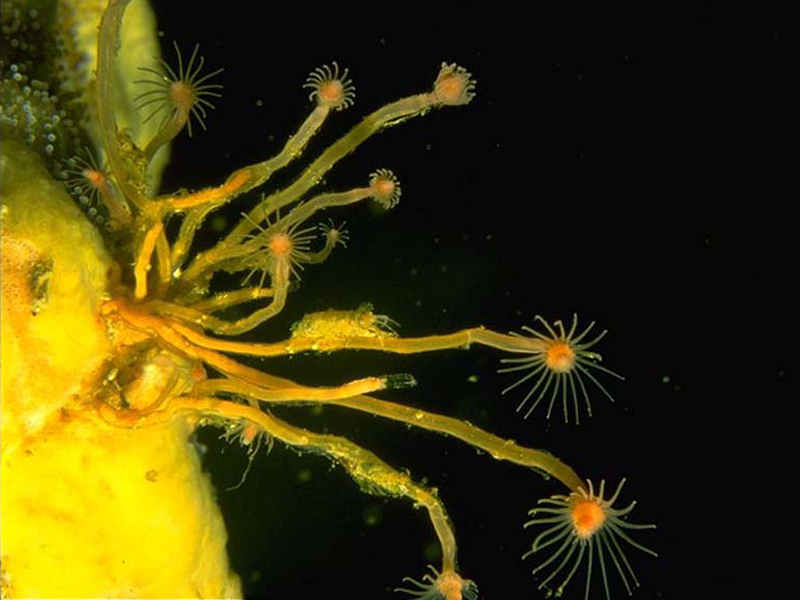
Group of Tubularia indivisa on rock, St Kilda.
Photographer: Sue Scott Copyright: Sue Scott
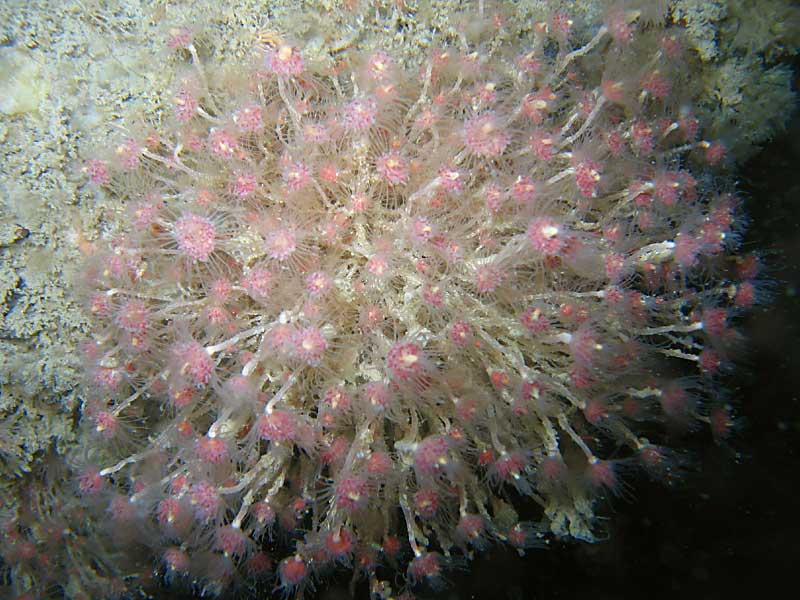
Tubularia indivisa bearing reproductive bodies in Lyme Bay, Devon.
Photographer: Robert Keen Copyright: Robert Keen
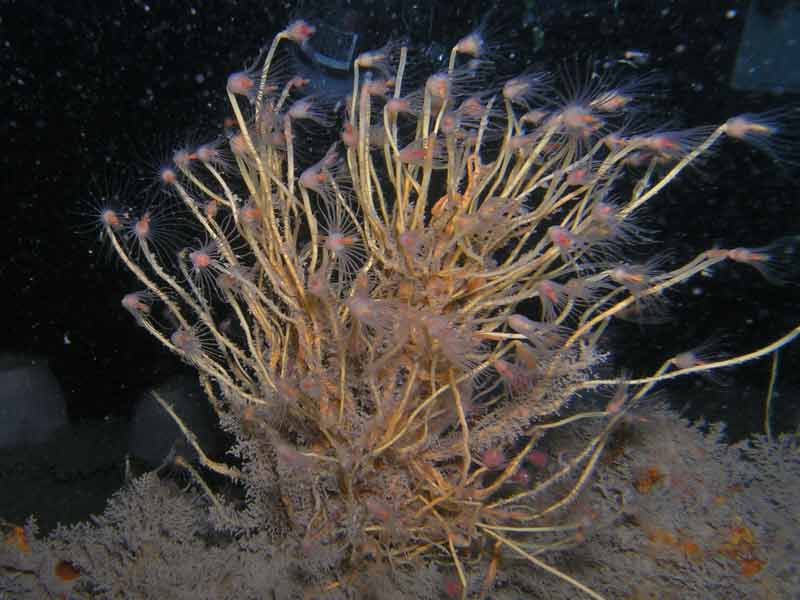
Tubularia indivisa experiencing relatively strong currents.
Photographer: Paul Newland Copyright: Paul Newland
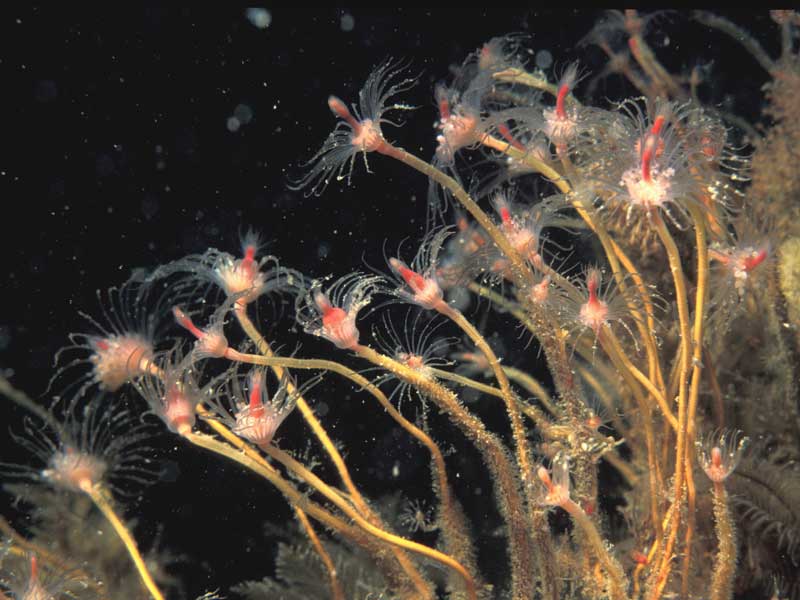
Tubularia indivisa heads over a dark background.
Photographer: Dr Keith Hiscock Copyright: Dr Keith Hiscock
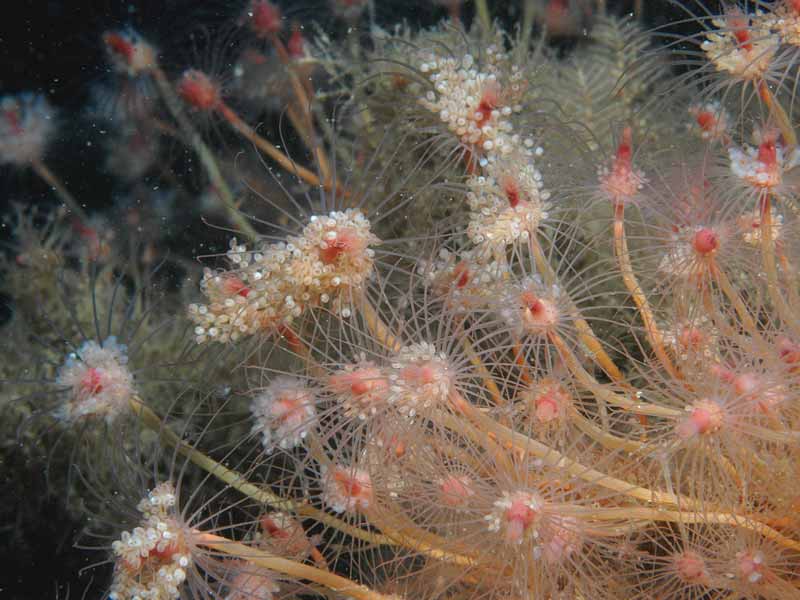
Tubularia indivisa patch at Firestone.
Photographer: Dr Keith Hiscock Copyright: Dr Keith Hiscock
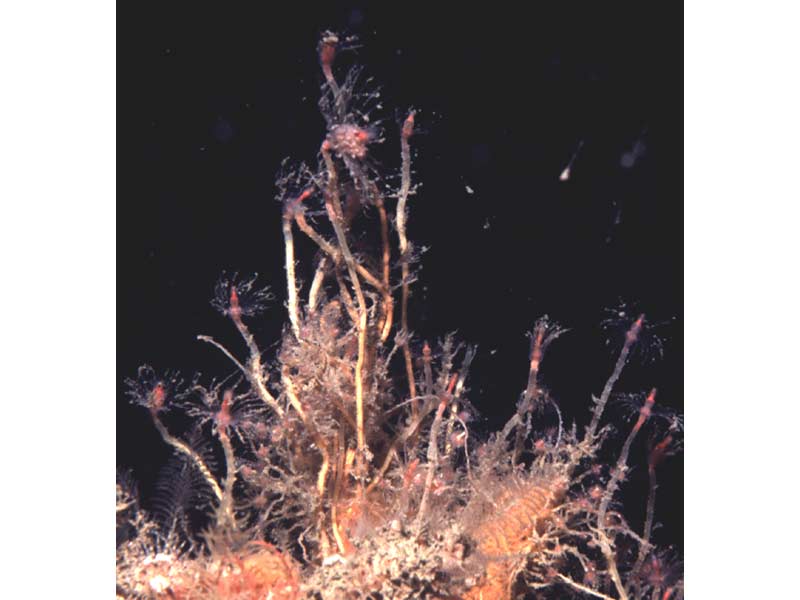
Oaten pipes hydroid.
Photographer: Dr Keith Hiscock Copyright: Dr Keith Hiscock
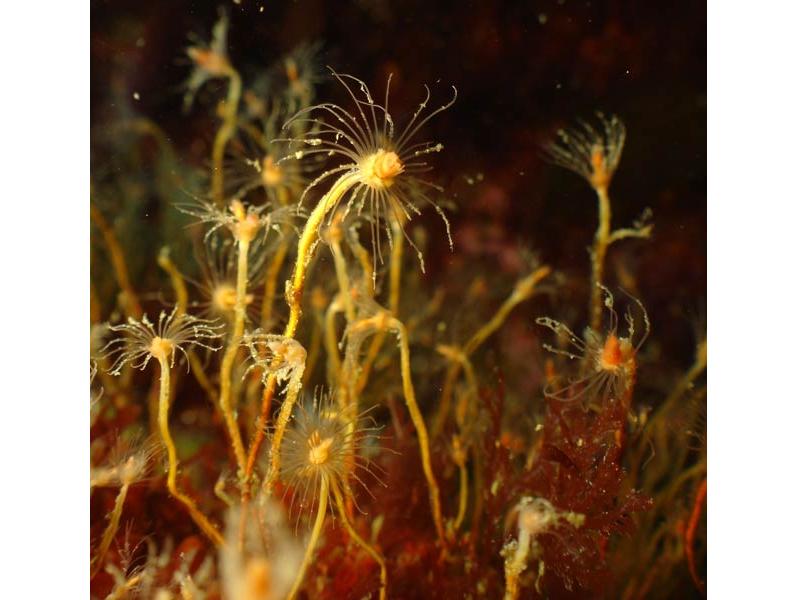
Tatty looking Tubularia indivisa individuals.
Photographer: Fiona Crouch Copyright: Fiona Crouch
Distribution data supplied by the Ocean Biodiversity Information System (OBIS). To interrogate UK data visit the NBN Atlas.Map Help
| Researched by | Rose Edwards | Refereed by | Admin |
| Authority | Linnaeus, 1758 | ||
| Other common names | - | Synonyms | - |
Summary
Description
Recorded distribution in Britain and Ireland
Widespread through Britain and Ireland.Global distribution
-Habitat
Tubularia indivisa grows on various hard substrata in a wide range of water depths from rocks in the intertidal, or in shallow water near shore, and at great depths. It is particularly abundant on exposed to strong tidal currents.Depth range
-Identifying features
- Large polyps with an outer ring of aboral tentacles and an inner cluster of oral tentacles.
- Single and unbranched stems arise from clustered mass at the base.
- Stems are 10-15 cm in height.
- Yellowish stems with pink to red polyps.
Additional information
No text enteredListed by
- none -
Bibliography
Allman, G.J., 1871-1872. A monograph of the Gymnoblastic or Tubularian hydroids, Vol. I & II. London: Ray Society.
BIOMAERL team, 1999. Biomaerl: maerl biodiversity; functional structure and anthropogenic impacts. EC Contract no. MAS3-CT95-0020, 973 pp.
Cornelius, P.F.S., 1990a. European Obelia (Cnidaria, Hydroida): systematics and identification. Journal of Natural History, 24, 535-578.
Hayward, P.J. & Ryland, J.S. (ed.) 1995b. Handbook of the marine fauna of North-West Europe. Oxford: Oxford University Press.
Hincks, T., 1868. A history of the British hydroid zoophytes, vol. I & II. London: van Voorst.
JNCC (Joint Nature Conservation Committee), 1999. Marine Environment Resource Mapping And Information Database (MERMAID): Marine Nature Conservation Review Survey Database. [on-line] http://www.jncc.gov.uk/mermaid
Datasets
Bristol Regional Environmental Records Centre, 2017. BRERC species records recorded over 15 years ago. Occurrence dataset: https://doi.org/10.15468/h1ln5p accessed via GBIF.org on 2018-09-25.
Centre for Environmental Data and Recording, 2018. Ulster Museum Marine Surveys of Northern Ireland Coastal Waters. Occurrence dataset https://www.nmni.com/CEDaR/CEDaR-Centre-for-Environmental-Data-and-Recording.aspx accessed via NBNAtlas.org on 2018-09-25.
Environmental Records Information Centre North East, 2018. ERIC NE Combined dataset to 2017. Occurrence dataset: http://www.ericnortheast.org.ukl accessed via NBNAtlas.org on 2018-09-38
Fenwick, 2018. Aphotomarine. Occurrence dataset http://www.aphotomarine.com/index.html Accessed via NBNAtlas.org on 2018-10-01
Kent Wildlife Trust, 2018. Kent Wildlife Trust Shoresearch Intertidal Survey 2004 onwards. Occurrence dataset: https://www.kentwildlifetrust.org.uk/ accessed via NBNAtlas.org on 2018-10-01.
Manx Biological Recording Partnership, 2022. Isle of Man historical wildlife records 1990 to 1994. Occurrence dataset:https://doi.org/10.15468/aru16v accessed via GBIF.org on 2024-09-27.
National Trust, 2017. National Trust Species Records. Occurrence dataset: https://doi.org/10.15468/opc6g1 accessed via GBIF.org on 2018-10-01.
NBN (National Biodiversity Network) Atlas. Available from: https://www.nbnatlas.org.
Norfolk Biodiversity Information Service, 2017. NBIS Records to December 2016. Occurrence dataset: https://doi.org/10.15468/jca5lo accessed via GBIF.org on 2018-10-01.
North East Scotland Biological Records Centre, 2017. NE Scotland other invertebrate records 1800-2010. Occurrence dataset: https://doi.org/10.15468/ifjfxz accessed via GBIF.org on 2018-10-01.
OBIS (Ocean Biodiversity Information System), 2025. Global map of species distribution using gridded data. Available from: Ocean Biogeographic Information System. www.iobis.org. Accessed: 2025-08-02
South East Wales Biodiversity Records Centre, 2023. SEWBReC Marine and other Aquatic Invertebrates (South East Wales). Occurrence dataset:https://doi.org/10.15468/zxy1n6 accessed via GBIF.org on 2024-09-27.
Suffolk Biodiversity Information Service., 2017. Suffolk Biodiversity Information Service (SBIS) Dataset. Occurrence dataset: https://doi.org/10.15468/ab4vwo accessed via GBIF.org on 2018-10-02.
Citation
This review can be cited as:
Last Updated: 08/05/2008