Wakame (Undaria pinnatifida)
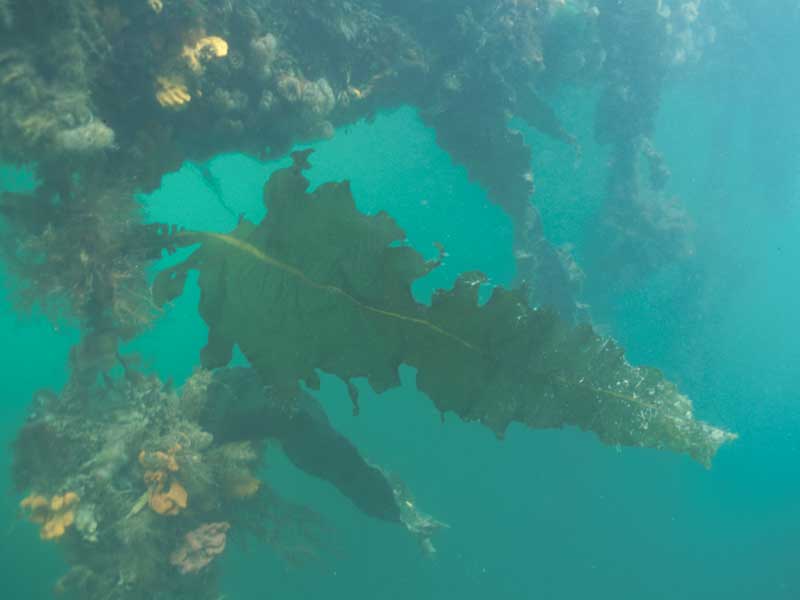
Undaria pinnatifida growing on pontoons at Queen Annes Battery, Plymouth Sound.
Photographer: Dr Keith Hiscock Copyright: Dr Keith Hiscock
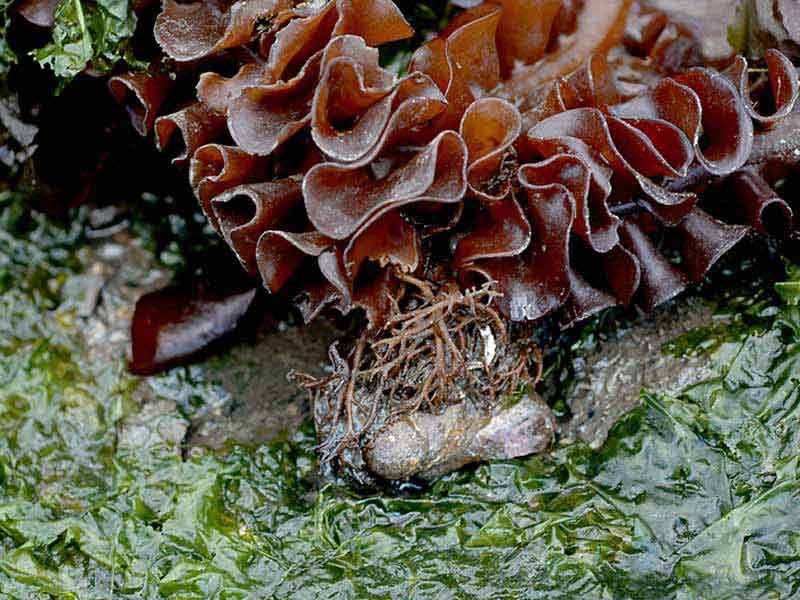
Undaria pinnatifida highlighting structure of fronds and holdfast.
Photographer: Dr Keith Hiscock Copyright: Dr Keith Hiscock
Distribution data supplied by the Ocean Biodiversity Information System (OBIS). To interrogate UK data visit the NBN Atlas.Map Help
| Researched by | Judith Oakley | Refereed by | Admin |
| Authority | (Harvey) Suringar, 1873 | ||
| Other common names | - | Synonyms | - |
Summary
Description
Recorded distribution in Britain and Ireland
Recorded from the Hamble (Solent), Isle of Wight, Torquay, Plymouth and Jersey.Global distribution
French Mediterranean, North and south Brittany, Atlantic coast of Spain.Habitat
Wakame is an introduced species of brown seaweed in Europe found subtidally, often growing on man-made structures such as marina pontoons. In its native habitat, it occurs in dense stands, forming a thick canopy on a wide range of shores from low tide level down to 15 m in clear waters.Depth range
-Identifying features
- Branched holdfast.
- Stipe wavy or corrugated above holdfast.
- Blade lanceolate and broad with a midrib.
- Usually 1.5-2 m long.
- Dark brown frond.
Additional information
Wakame is a laminarian kelp indigenous to the temperate regions of Japan, China and Korea (Stuart, 2003). It has been spread around the world by international shipping and mariculture. It has extended its range to include 12 countries on four continents since 1981 (Stuart, 2003). Wakame is a non-native species, which may cause displacement of native species. It was first recorded in the UK from the Hamble Estuary in the Solent on 15 June 1994 (Farell & Fletcher, 2000). It tolerates a wide salinity and temperature range. Its morphological and reproductive characteristics make it a very successful invasive species. Undaria pinnatifida possesses a heteromorphic life cycle with alternation of generations between a diploid sporophyte and a haploid gametophyte (Aguilar-Rosas et al., 2004). It may be confused with Alaria esculenta but the corrugated stipe is distinctive.
Wakame is economically important as a food crop but is also a fouling organism. It is able to compete with native kelp species in the shallow sublittoral/infralittoral zone (Farrell & Fletcher, 2000). It is also effective in providing habitats, nursery areas and protective cover for many species. It grows well in estuarine conditions unlike many of the native kelp species (Farrell & Fletcher, 2000) .Listed by
- none -
Bibliography
Aguilar-Rosas, R., Aguilar-Rosas, L.E., Ávila-Serrano, G. & Marcos-Ramírez, R., 2004. First record of Undaria pinnatifida (Harvey) Suringar (Laminariales, Phaeophyta) on the Pacific coast of Mexico. Botanica Marina, 47, 255-258.
Eno, N.C., Clark, R.A. & Sanderson, W.G. (ed.) 1997. Non-native marine species in British waters: a review and directory. Peterborough: Joint Nature Conservation Committee.
Farell, P. & Fletcher, R., 2000. The biology and distribution of the kelp, Undaria pinnatifida (Harvey) Suringar, in the Solent. In Solent Science - A Review (ed. M. Collins and K. Ansell), pp. 311-314. Amsterdam: Elsevier Science B.V.
Gibson, R., Hextall, B. & Rogers, A., 2001. Photographic guide to the sea and seashore life of Britain and north-west Europe. Oxford: Oxford University Press.
JNCC (Joint Nature Conservation Committee), 1999. Marine Environment Resource Mapping And Information Database (MERMAID): Marine Nature Conservation Review Survey Database. [on-line] http://www.jncc.gov.uk/mermaid
Maggs, C.A., 2005a. Wakame Undaria pinnatifida. Marine Aliens pages. [On-line] http://www.marlin.ac.uk/marine_aliens/marine_aliens.htm,
Stuart, M.D., 2003. Review of research on Undaria pinnatifida in New Zealand and its potential impacts on the eastern coast of the South Island. DOC Science Internal Series 166. Department of Conservation, Wellington. 40 pp.
Verlaque, M., 2005. Undaria pinnatifida (alga/seaweed) [On-line]. http://www.issg.org/database/species/ecology.asp?si=68&ver=print,
Datasets
Centre for Environmental Data and Recording, 2018. Ulster Museum Marine Surveys of Northern Ireland Coastal Waters. Occurrence dataset https://www.nmni.com/CEDaR/CEDaR-Centre-for-Environmental-Data-and-Recording.aspx accessed via NBNAtlas.org on 2018-09-25.
Cofnod – North Wales Environmental Information Service, 2018. Records of Invasive Non Native Species held on the Cofnod database. Occurrence dataset: https://doi.org/10.15468/nxdbhu accessed via GBIF.org on 2018-09-25.
Fenwick, 2018. Aphotomarine. Occurrence dataset http://www.aphotomarine.com/index.html Accessed via NBNAtlas.org on 2018-10-01
Kent Wildlife Trust, 2018. Kent Wildlife Trust Shoresearch Intertidal Survey 2004 onwards. Occurrence dataset: https://www.kentwildlifetrust.org.uk/ accessed via NBNAtlas.org on 2018-10-01.
National Trust, 2017. National Trust Species Records. Occurrence dataset: https://doi.org/10.15468/opc6g1 accessed via GBIF.org on 2018-10-01.
Nature Locator, 2017. Sealife Tracker. Occurrence dataset: https://doi.org/10.15468/qgk3pg accessed via GBIF.org on 2018-10-01.
NBN (National Biodiversity Network) Atlas. Available from: https://www.nbnatlas.org.
OBIS (Ocean Biodiversity Information System), 2025. Global map of species distribution using gridded data. Available from: Ocean Biogeographic Information System. www.iobis.org. Accessed: 2025-06-28
West Wales Biodiversity Information Centre, 2018. INNS Data: All Taxa (West Wales). Occurrence dataset: https://doi.org/10.15468/ydifzd accessed via GBIF.org on 2018-10-02.
Citation
This review can be cited as:
Last Updated: 03/07/2007