
Lancelet (Branchiostoma lanceolatum)
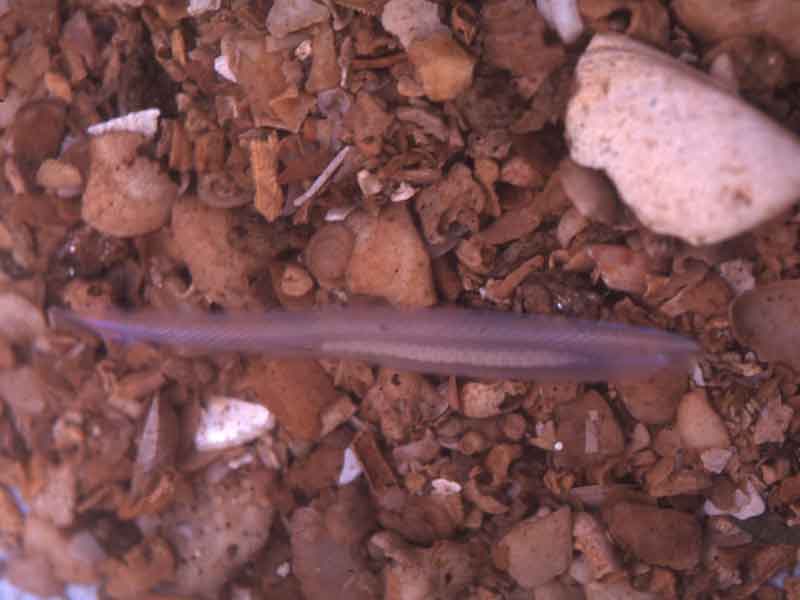
The lancet Branchiostoma lanceolatum (aquarium photograph).
Photographer: Keith Hiscock Copyright: Dr Keith Hiscock
Distribution data supplied by the Ocean Biodiversity Information System (OBIS). To interrogate UK data visit the NBN Atlas.Map Help
| Researched by | Morvan Barnes | Refereed by | Admin |
| Authority | (Pallas, 1774) | ||
| Other common names | - | Synonyms | Amphioxus lanceolatus Pallas, 1774 |
Summary
Description
The lancelet Branchiostoma lanceolatum is spindle-shaped and pointed at both ends. The body is segmented and flattened dorsoventrally with a membranous flipper along the dorsal side. The tail end has a lance-like flipper. It grows up to 8 cm in length and is semi-transparent pink in colour. The head is a mere continuation of the body. Multiple cirri project from the mouth.
Recorded distribution in Britain and Ireland
Most records are found off the southern coasts of Britain and Ireland as far north as Anglesea and Liverpool Bay, and along the southern North Sea, with scattered records around Scotland, and north east coast of England.
Global distribution
Most records are found in the southern North Sea and Kattegat, the Celtic Sea and Bay of Biscay, with scattered records in the Baltic Sea, Mediterranean and Black Sea. A few scattered records occur in the Atlantic coast of North and South America, the Indian Ocean and Pacific.
Habitat
The lancelet inhabits the sandy sublittoral zone at depths down to 30 m. It prefers sand mixed with shells rather than more muddy bottoms as it is not suited to penetrate ground with small particles.
Depth range
-Identifying features
- Up to 8 cm in length.
- Elongated body, pointed at both ends.
- Multiple cirri extend from the mouth.
- Lance-like flipper at tail end.
- Semi-transparent pink in colour.
Additional information
Although cephalochordates are able to swim, most of their time is spent partially buried in the sand filtering microscopic food particles from the water (Riisgård & Svane, 1999).
Listed by
- none -
Bibliography
Gans, C., Kemp, N. & Poss, S. (eds.), 1996. The lancelets (Cephalochordata): a new look at some old beasts. Modified proceedings of a workshop at the IVth International Congress of Vertebrate Morphology held at the University of Chicago in August, 1994 Israel Journal of Zoology, 42 (supplement)
NBN, 2015. National Biodiversity Network 2015(20/05/2015). https://data.nbn.org.uk/
Riisgård, H.U. & Svane, I., 1999. Filter feeding in lancelets (amphioxus), Branchiostoma lanceolatum. Invertebrate Biology, 118 (4), 423-432
Ruppert, E.E. & Barnes, R.D., 1994. Invertebrate zoology (6th ed.). Fort Worth, USA: Saunders College Publishing.
Datasets
NBN (National Biodiversity Network) Atlas. Available from: https://www.nbnatlas.org.
OBIS (Ocean Biodiversity Information System), 2024. Global map of species distribution using gridded data. Available from: Ocean Biogeographic Information System. www.iobis.org. Accessed: 2024-05-21
Citation
This review can be cited as:
Last Updated: 07/06/2015
- Amphioxus