
Seapens, including Funiculina quadrangularis, and burrowing megafauna in undisturbed circalittoral fine mud
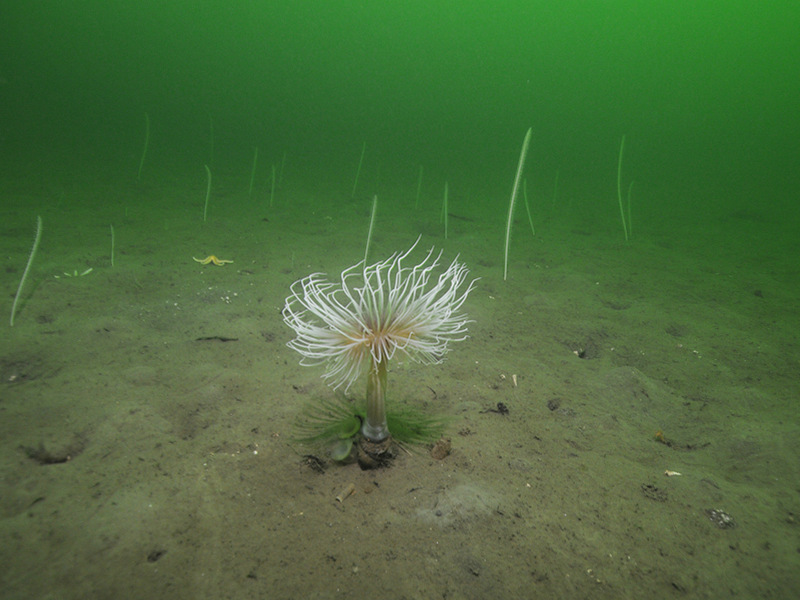
Seapens, including Funiculina quadrangularis, and burrowing megafauna in undisturbed circalittoral fine mud
Photographer: Dr Keith Hiscock Copyright: Dr Keith Hiscock

Map Key
- Orange points: Core Records
- Pale Blue points: Non-core, certain determination
- Black points: Non-core, uncertain determination
- Yellow areas: Predicted habitat extent
| Researched by | Emma Moyse, Dr Harvey Tyler-Walters & Amy Watson | Refereed by | Dr Clare Greathead |
|---|
Summary
UK and Ireland classification
Description
Deep muds, especially in sea lochs, support populations of sea pens such as Virgularia mirabilis and Pennatula phosphorea, but sometimes also with forests of the nationally scarce Funiculina quadrangularis. The sediment is usually extensively burrowed by crustaceans, the most common of which is Nephrops norvegicus, but Callianassa subterranea may also be present (the latter is likely to be under-recorded by grab sampling because it is deep burrowing). Lesueurigobius friesii is present at many sites. Amphiura spp. are usually present in high densities. (Information from Connor et al., 2004; JNCC, 2015, 2022).
Depth range
10-20 m, 20-30 m, 30-50 mAdditional information
Funiculina quadrangularis is also recorded in the Fladen Ground in the North Sea, and in the Minch, west Scotland (Greathead et al., 2007, 2011, 2015).
Sensitivity review
Sensitivity characteristics of the habitat and relevant characteristic species
CFiMu.SpnMeg and CFiMU.SpnMeg.Fun are similar to CFiMU.MegMax (Connor et al., 2004) but differ in the relative abundance of sea pens (SpnMeg) and burrowing megafauna (MegMax). Connor et al. (2004) noted that MegMax often occurs in deeper water than SpnMeg but that the environmental factors that separate the biotopes are unclear. Hughes (1998a) suggested that the sea pen and burrowing megafauna communities exhibit a mosaic of patches of megafaunal communities depending on the level of disturbance. Hughes (1998a) also noted that the interaction between burrowing megafauna and sea pens was unknown, although they clearly co-exist.
SpnMeg and MegMax support a rich infauna of polychaetes, bivalves, burrowing sea urchins, brittlestars, and sea cucumbers, and a mobile epifauna of crabs and starfish. While the infaunal species composition varies between the biotopes, the infaunal and mobile epifaunal community is probably found across a range of circalittoral mud and deep mud habitats. SpnMeg.Fun is found in slightly deeper waters, typical of the fjordic sea lochs and the Minch, and is characterized by the presence of Funiculina quadrangularis. SpnMeg and SpnMeg.Fun may both support local populations of the rare burrowing anemone Pachycerianthus multiplicatus and occasional Synarachnactis lloydii. Although Pachycerianthus multiplicatus is rare in the UK, loss of either burrowing anemone would not lead to a loss of the biotope.
Therefore, the sensitivity assessment of SpnMeg.Fun concentrates on the epifaunal, suspension feeding, sea pens because a significant reduction in their abundance, especially Funiculina quadrangularis, would result in the loss of the SpnMeg.Fun biotope. The sensitivity of burrowing megafauna and other species is discussed where relevant.
Resilience and recovery rates of habitat
Recovery from effects that remove a proportion of the sea pen population (e.g. bottom gears, hydrographic changes) will depend on recruitment processes. Little is known about the life history and population dynamics of sea pens (Hughes, 1998a). Hughes (1998a) suggested that patchy recruitment, slow growth and long lifespan were typical of sea pens. Larval settlement is likely to be patchy in space and highly episodic in time, with no recruitment to the population taking place for some years. Greathead et al. (2007) noted that patchy distribution is typical for sea pen populations. In Holyhead harbour, for example, animals show a patchy distribution, probably related to larval settlement (Hoare & Wilson, 1977).
Studies of oogenesis in Funiculina quadrangularis and Pennatula phosphorea in Loch Linnhe, Scotland, demonstrated that they were dioecious, with 1:1 sex ratios, highly fecund, with continuous, prolonged oocyte development and annual spawning (Edwards & Moore 2008; Edwards & Moore 2009). In Pennatula phosphorea, oogenesis exceeded 12 months in duration, with many small oocytes, typically 50 per polyp, giving an overall fecundity of ca 40,000 in medium to large specimens, depending on size. However, less than 30% matured (synchronously) and were spawned in summer (July-August). Mature oocytes were large (>500 µm), which suggested a lecithotrophic larval development (Edwards & Moore, 2008). In Funiculina quadrangularis, fecundity was again high, expressed as 500 to 2000 per one centimetre of midsection, but not correlated with size, and again, only a small proportion of the oocytes ( less than 10%) matured. Unlike Pennatula phosphorea, annual spawning occurred in autumn or winter (between October and January). Also, the mature oocytes were very large (>800 µm), which suggested a lecithotrophic larval development (Edwards & Moore, 2009).
The lecithotrophic larval stage of Funiculina quadrangularis may result in a relatively long period of time in the water column and high potential dispersal ability. It may explain the high gene flow observed between colonies of Funiculina quadrangularis in two Scottish sea lochs (Wright et al., 2015). Wright et al. (2015) found limited genetic population subdivision within and between populations of Funiculina quadrangularis in Loch Linnhe and Loch Duich. The high genetic diversity and unique genotypes supported the absence of asexual reproduction in this species (Wright et al., 2015).
No similar studies were available for Virgularia mirabilis, but Edwards & Moore (2009) noted that many sea pens exhibited similar characteristics. In a study of the intertidal Virgularia juncea, fecundity varied with length (46,000 at 50 cm and 87,000 at 70 cm), eggs reached a maximum size of 200 to 300 µm in May and were presumed to be spawned between August and September (Soong, 2005). Birkland (1974) found the lifespan of Ptilosarcus gurneyi to be 15 years, reaching sexual maturity between the ages of 5 and 6 years; while Wilson et al. (2002) noted that larger specimens of a tall sea pen (Halipteris willemoesi) in the Bering Sea were 44 years old, with a growth rate of 3.6 to 6.1 cm/year.
Sea pens were shown to recover rapidly from displacement and removal from the seabed. Funiculina quadrangularis and Pennatula phosphorea were found to right themselves when dislodged, with all Pennatula phosphorea individuals re-established and 50% of Funiculina quadrangularis after 72 hours (Eno et al., 2001). Virgularia mirabilis was found to withdraw into its burrow rapidly (ca 30 seconds) and could not be uprooted by dragged creels (Hoare & Wilson 1977; Eno et al., 2001; Ambroso et al. 2013). Pennatula phosphorea and Funiculina quadrangularis recovered with 72 to 96 hours after experimental smothering for 24 hours by pot or creel and after 96 to 144 hours of smothering for 48 hours (Kinnear et al. 1996; Eno et al. 2001). In summary, all three sea pen species were found to recover rapidly from the effects of dragging, uprooting and smothering (Eno et al., 2001).
However, a later study of the effects of experimental trawling damage in the sea whip Halipteris willemoesi suggested that recovery in Funinculina quadrangularis may have been overestimated. Halipteris willemoesi is a functionally similar species to Funiculina quadrangularis, as it is tall, thin, and cannot withdraw into the sediment. Malecha & Stone (2009) simulated trawl damage in field populations in Alaskan waters by abrading the sea whip with rubber disks (similar to rubber tyre punch-outs used on the footrope of many trawls), dislodging them from the sediment and breaking the axial rod manually. All the specimens abraded, repaired tissue damage and survived the experimental period. However, the authors noted that the experimental abrasion probably underestimated the effect of trawls, as it did not include the mechanical force of the mobile gear and that even the smallest amount of tissue damage probably decreased the sea whip's ability to reproduce. Fifty per cent of the dislodged sea whips were able to rebury and become erect within 18 days. Only 42% of the fractured sea whips were erect 18 days after treatment. However, only one specimen was erect after the 372 days of the experiment. There was no evidence to suggest that specimens could repair their damaged axial rods. After 372 days, 92% of the dislodged and 100% of the fractured specimens had substantial tissue loss and perished. Tissue loss was exaggerated by predation from nudibranchs, which appeared to be attracted to the experimental area, possibly due to the tissue damage suffered by the sea whips (Malecha & Stone, 2009).
Recent field evidence has demonstrated that Funiculina quadrangularis populations can respond rapidly to reductions in anthropogenic disturbance. After trawling activity in the Adriatic Sea stopped, their density increased from 0.0047 colonies/m² to 0.0266 colonies/m² after two years (a 466% increase). In addition, mean and maximum colony size increased by 41% and 54%, respectively, indicating recovery of both abundance and population structure (Chimienti et al., 2026). Similarly, long-term surveys in the Pomo/Jabuka Pits fishing ground, also in the Adriatic Sea, revealed increases in Funiculina quadrangularis density after fisheries restrictions were established, with detectable increases occurring over relatively short timeframes (around two years) after management measures were introduced (Martinelli et al., 2023).
The observed increases in Funiculina quadrangularis density following reductions in fishing pressure suggest that, where some individuals remain and disturbance is removed, recovery may occur through a combination of recruitment and/or survival and growth of remnant individuals over relatively short (multi-year) timescales (Martinelli et al., 2023; Chimienti et al., 2026).
Buchanan (1963) examined the population dynamics of Calocaris macandreae off the Northumberland coast. The oldest individuals in that population appeared to be nine years old. It was suggested that an age of almost ten years may be attained by a few (Buchanan, 1974). Calocaris macandreae are hermaphrodites, and eggs are produced at five years old. Around 50 eggs are attached to the pleopods and are carried for nine months until September to October of the sixth year. Annual moults follow, but the next batch of eggs takes two years to mature, and the second laying is at the end of the seventh year, with occasionally a third at the end of the ninth year. Mortality of a year group is almost wholly confined to the ninth and tenth years (Buchanan, 1974). Hughes (1998a) noted that age at maturity (five years), low fecundity (producing only two to three batches of eggs in their lifetime) and long lifespan contributed to the stability of the population studied, which was very stable in numbers over a 10-year period.
Callianassa subterrranea is sexually dimorphic, and the mature male bears an enlarged major chela. In the North Sea, females were found bearing eggs from April to September, and planktonic larvae were most abundant in August. Larvae spent about four weeks in the plankton before settlement. Large females may have a secondary breeding period in late winter. Their lifespan was two to three years (Rowden & Jones, 1994; Hughes, 1998a).
Nephrops norvegicus reach sexual maturity at 2.5 to 3 years of age in females and after three years in males (Hughes, 1998a). In the Irish Sea, Nephrops norvegicus individuals are not thought to live more than eight or nine years and become sexually mature at about 2.5 to 3 years. However, in deeper waters such as the Porcupine Bank, they may survive over 15 years (Marine Institute, 2001). In Scottish waters, eggs are spawned and fertilized between August and November and carried by the females until the larvae hatch in April to August (Hughes, 1998a). Local populations of Nephrops norvegicus may vary considerably in density, size and growth rate (Tuck et al., 1997), with fecundity also varying geographically (Eiriksson, 1970; Tuck et al., 1997). The percentage of eggs lost during development can range from 32 to 51%, with larval mortalities as high as 87% (Garrod & Harding, 1980), which could reduce recovery rates. As a result, Nephrops norvegicus do not produce large numbers of offspring. The pelagic larval stage lasts up to 50 days (Hughes, 1998a; Johnson et al., 2013; Powell and Eriksson, 2013). This may support long-range dispersal and recolonization of depleted populations, but water currents may prevent larvae from reaching locations away from source populations and may remove larvae from populations, preventing self-recruitment in small stocks (Johnson et al., 2013). Recolonization of depleted populations may also be limited by the requirement for existing burrows for successful recruitment (Tuck et al., 1994, cited in Johnson et al., 2013). Adults are essentially sedentary, as tagging studies have revealed movements of no more than 100 m from their burrow in adult life (Chapman & Rice, 1971). Therefore, potential recruitment from other populations of Nephrops norvegicus is low, as larvae do not have a high dispersal potential and adults show no evidence of migration (Marine Institute, 2001). The resilience of Nephrops populations is assessed as ‘Medium’ (2-10 years), although confidence in the quality of evidence for recovery is low as this assessment is based on expert judgement, taking into consideration the apparent long-term stability of Nephrops fishing grounds (Ungfors et al., 2013).
Resilience assessment
The recovery rates for mud shrimp and Nephrops are likely to be dependent on the spatial scale of impact and the ability of adults to survive exposure and provide a potential supply of colonists. Callianassa subterrranea is short-lived but produces numerous offspring with a high potential dispersal range, which suggests that recolonization and recovery may be rapid, e.g. within a few years. The evidence from fishing grounds indicates that Nephrops norvegicus can persist in areas where they are subject to targeted removal, which suggests that the population can withstand and recover from repeated disturbances, but it is not clear what proportion of the population is removed and hence what the recovery rate to an undisturbed state would be. The evidence above suggests that the mud shrimp and Nephrops component of the biotope would probably recover within 2-10 years (a resilience of Medium), depending on the scale of removal. Calocaris macandreae may be an exception. Calocaris macandreae is long-lived, reaches sexual maturity only after five years, has a low fecundity and lacks a pelagic stage. Therefore, where a population remains, local recruitment may be good. However, recovery of the abundance and age structure of a significantly reduced population would probably be prolonged, and where the population experienced a significant reduction in abundance (e.g. resistance is Low), then resilience is likely to be 'Low' (10 to 25 years).
Nevertheless, in SpnMeg (and SpnMeg.Fun), the resilience assessment is based on the recovery rates of the sea pens as the important characterizing epifauna species within the biotope. Where the sea pens survive impact undamaged, that is, resistance is ‘High’, recovery is probably rapid, and resilience is assessed as 'High' (<2 years). Where a proportion of the population is removed or killed, then the species has a high dispersal potential and long-lived benthic larvae, but larval recruitment is probably sporadic and patchy, and growth is slow, suggesting that recovery will take many years. Field studies have demonstrated that increases in Funiculina quadrangularis density and colony size can occur within a few years following cessation of trawling disturbance (Martinelli et al., 2023; Chimienti et al., 2026). However, these studies do not demonstrate recovery to pre-disturbance population structure or full colony size, and therefore do not provide evidence that complete biotope recovery would occur within shorter timeframes. Hence, resilience is assessed as 'Low' (>10 years). The resilience assessment is based on literature on the life history of the three sea pen species, but not their population dynamics or on information inferred from other species. Therefore, confidence (the quality, applicability and concordance of the evidence) is 'Medium'. An exception is made for permanent or ongoing (long-term) pressures where recovery is not possible, as the pressure is irreversible, in which case resilience is assessed as ‘Very low’ by default.
Hydrological Pressures
Use [show more] / [show less] to open/close text displayed
| Resistance | Resilience | Sensitivity | |
Temperature increase (local) [Show more]Temperature increase (local)Benchmark. A 5°C increase in temperature for one month, or 2°C for one year (Temperature change pressure definition). EvidenceIn shallow sea lochs, sedimentary biotopes typically experience seasonal changes in temperature between 5°C and 15°C (10°C) (Hughes, 1998a). Although unusually warm summers or cold winters may change the temperatures outside this range, benthic burrowing species will be buffered from extremes by their presence in the sediment. The sea pens typical of CFiMu.SpMeg (except Funiculina quadrangularis) can also withdraw into their burrows for protection. No information was found on the upper limit of sea pens' tolerance to temperature. Virgularia mirabilis is recorded from western Europe, the Mediterranean, from Norway and Iceland to Africa in the North Atlantic, and to the Gulf of Mexico in North America (Hughes, 1998a; OBIS, 2016). Pennatula phosphorea is recorded in the North Sea and western British coasts but is absent from southern Britain (Hughes, 1998a). Hughes (1998a) suggested that records from the Mediterranean and North Atlantic are confused with other species. Funiculina quadrangularis is only recorded from the north and west coasts of Scotland and Ireland in the British Isles (Hughes, 1998a), but is also recorded in the North Atlantic, the Mediterranean, North and South America, Japan and New Zealand (Manual 1981 cited in Hughes 1998a; OBIS, 2016). Species distribution modelling, using physical data and sea pen species records across the UK continental shelf, concluded that all three sea pen species (Funiculina quadrangularis, Pennatula phosphorea and Virgularia mirabilis) were found at bottom temperatures ranging from 7.8 to 12.9°C but occurred at warmer temperatures in the Celtic Sea than in the North Sea. The difference was clearest in Funiculina quadrangularis, which was most likely to occur between 8 and 9°C in the North Sea but extended to ca. 10.5°C in the Celtic Seas (Downie et al., 2021). Sensitivity assessmentThe distribution of sea pens suggests that they are probably resistant to a 2°C change in temperature, and seasonal changes greater than 5°C. However, sea pens are subtidal and occur at depth where rapid variations in temperature are not common, and so may be less resistant to a short-term increase of 5°C. Therefore, resistance is assessed as 'Medium', but with Low confidence. Resilience is probably 'Low', so sensitivity is assessed as 'Medium'. | MediumHelp | LowHelp | MediumHelp |
Temperature decrease (local) [Show more]Temperature decrease (local)Benchmark. A 5°C decrease in temperature for one month, or 2°C for one year (Temperature change pressure definition). EvidenceIn shallow sea lochs, sedimentary biotopes typically experience seasonal changes in temperature between 5°C and 15°C (10°C) (Hughes, 1998a). Although unusually warm summers or cold winters may change the temperatures outside this range, benthic burrowing species will be buffered from extremes by their presence in the sediment. The sea pens typical of CFiMu.SpMeg (except Funiculina quadrangularis) can also withdraw into their burrows for protection. No information was found on the upper limit of sea pens' tolerance to temperature. Virgularia mirabilis is recorded from western Europe, the Mediterranean, from Norway and Iceland to Africa in the North Atlantic, and to the Gulf of Mexico in North America (Hughes, 1998a; OBIS, 2016). Pennatula phosphorea is recorded in the North Sea and western British coasts but is absent from southern Britain (Hughes, 1998a). Hughes (1998a) suggested that records from the Mediterranean and North Atlantic are confused with other species. Funiculina quadrangularis is only recorded from the north and west coasts of Scotland and Ireland in the British Isles (Hughes, 1998a), but is also recorded in the North Atlantic, the Mediterranean, North and South America, Japan and New Zealand (Manual 1981 cited in Hughes 1998a; OBIS, 2016). Species distribution modelling, using physical data and sea pen species records across the UK continental shelf, concluded that all three sea pen species (Funiculina quadrangularis, Pennatula phosphorea and Virgularia mirabilis) were found at bottom temperatures ranging from 7.8 to 12.9°C but occurred at warmer temperatures in the Celtic Sea than in the North Sea. The difference was clearest in Funiculina quadrangularis, which was most likely to occur between 8 and 9°C in the North Sea but extended to ca. 10.5°C in the Celtic Seas (Downie et al., 2021). Sensitivity assessmentThe distribution of sea pens suggests that they are probably resistant to a 2°C change in temperature, and seasonal changes greater than 5°C. However, sea pens are subtidal and occur at depth where rapid variations in temperature are not common, and so may be less resistant to a short-term increase of 5°C. Therefore, resistance is assessed as 'Medium', but with Low confidence. Resilience is probably 'Low', so sensitivity is assessed as 'Medium'. | MediumHelp | LowHelp | MediumHelp |
Salinity increase (local) [Show more]Salinity increase (local)Benchmark. An increase in one MNCR salinity category above the usual range of the biotope or habitat (Salinity regime change pressure definition). EvidenceNo information on the salinity tolerance of the three sea pens was found. Jones et al. (2000) suggested that Virgularia mirabilis was more tolerant of reduced salinity due to its distribution in shallower waters. MNCR data recorded Virgularia mirabilis and Pennatula phosphorea species from biotopes (SS.SMu.IFiMu.PhiVir; SS.SMu.CFiMu.SpnMeg) that occur in full and variable salinity, but Funiculina quadrangularis was only recorded in biotopes at full salinity. Recent analysis of survey data by Greathead et al. (2007) demonstrated that Virgularia mirabilis was the most ubiquitous of all three of the sea pens in Scotland, found in habitats near coastal areas and inner sea lochs. For example, Virgularia mirabilis is characteristic of the SS.SMu.IFiMu.PhiVir biotope, which can occur at depths of only 0 to 5 m. Greathead et al. (2007) suggested that Pennatula phosphorea was found in areas further from coastal areas and inner sea lochs, except in Loch Broom. Funiculina quadrangularis demonstrated a preference for deeper waters rather than any other physicochemical factor (Greathead et al., 2007). Sensitivity assessmentPennatula phosphorea occurs in SS.SMu.CFiMu.SpnMeg at depths of >10 m, while Funiculina quadrangularis prefers deeper water (ca >20 m) where it is probably unexposed and hence intolerant to changes in salinity, while Virgularia mirabilis is the most likely of the three sea pens to be exposed to variable salinity. Nevertheless, an increase in salinity to hypersaline conditions (>40 psu) for a year is probably detrimental to the sea pens and other epifauna, while deep burrowing species may be protected by their depth in the substratum. Therefore, Funiculina quadrangularis and Pennatula phosphorea probably have a resistance of None, but the resistance of Virgularia mirabilis is probably Low. Resilience is likely to be at least Low, and the resultant sensitivity is ‘High’ for all three species. The assessment is made with Low confidence due to the lack of direct evidence. | NoneHelp | LowHelp | HighHelp |
Salinity decrease (local) [Show more]Salinity decrease (local)Benchmark. A decrease in one MNCR salinity category above the usual range of the biotope or habitat (Salinity regime change pressure definition detail). EvidenceNo information on the salinity tolerance of the three sea pens was found. Jones et al. (2000) suggested that Virgularia mirabilis was more tolerant of reduced salinity due to its distribution in shallower waters. MNCR data recorded Virgularia mirabilis and Pennatula phosphorea species from biotopes (SS.SMu.IFiMu.PhiVir; SS.SMu.CFiMu.SpnMeg) that occur in full and variable salinity, but Funiculina quadrangularis was only recorded in biotopes at full salinity. Analysis of survey data by Greathead et al. (2007) demonstrated that Virgularia mirabilis was the most ubiquitous of all three of the sea pens in Scotland, found in habitats nearer coastal areas and inner sea lochs. For example, Virgularia mirabilis is characteristic of the SS.SMu.IFiMu.PhiVir biotope, which can occur at depths of only 0 to 5 m. Greathead et al. (2007) suggested that Pennatula phosphorea was found in areas further from coastal areas and inner sea lochs, except in Loch Broom. Funiculina quadrangularis demonstrated a preference for deeper waters rather than any other physicochemical factor (Greathead et al., 2007). Sensitivity assessmentOverall, the evidence suggests that Virgularia mirabilis is the most likely of the three sea pens to be exposed to variable salinity, and its presence in shallow water biotopes suggests that it can tolerate occasionally reduced salinity, while Funiculina quadrangularis is probably unexposed and hence intolerant to changes in salinity. Pennatula phosphorea occurs in SS.SMu.CFiMu.SpnMeg at depths of >10 m, where it is probably unexposed and hence intolerant to changes in salinity. Therefore, Virgularia mirabilis is probably resistant to variable salinity. But a decrease from full to reduced salinity for a year (the benchmark), e.g. from 32 to 35 units to 22 to 25 units for a year, is probably more extreme. Therefore, Funiculina quadrangularis and Pennatula phosphorea probably have a resistance of None, but the resistance of Virgularia mirabilis is probably Low. Resilience is likely to be at least Low, and the resultant sensitivity is ‘High’ for all three species. | NoneHelp | LowHelp | HighHelp |
Water flow (tidal current) changes (local) [Show more]Water flow (tidal current) changes (local)Benchmark. A change in peak mean spring bed flow velocity of between 0.1 m/s and 0.2 m/s for more than one year (Water flow pressure definition). EvidenceSea pen biotopes (e.g. SS.SMu.CFiMu.SpnMeg) occur in low-energy environments with weak (<0.5 m/sec) to very weak tidal streams (Connor et al., 2004), which are a prerequisite for the fine mud sediments in which the sea pens occur (Hughes, 1998a). Of the three sea pens, Virgularia mirabilis occurs in coarser sandier muds with small stones and shell fragments, e.g. SS.SMu.CSaMu.VirOphPmax (Hughes, 1998a; Greathead et al., 2007), and is probably more tolerant of current or wave-induced flow than Funiculina quadrangularis and Pennatula phosphorea, but the entire group is probably intolerant of increased flow. This is supported by species distribution modelling, using physical data and sea pen species records across the UK continental shelf (Downie et al., 2021). Their study concluded that the distribution of all three sea pen species (Funiculina quadrangularis, Pennatula phosphorea and Virgularia mirabilis) was correlated with low current and wave velocity, and relatively low suspended matter concentrations typical of deep, depositional habitats (Downie et al., 2021). Ninety-five per cent of occurrences of Funiculina quadrangularis and Pennatula phosphorea were recorded at suspended matter concentrations of <2 g/m³ (2 mg/l) and current and wave velocities of 0.3 to 0.5 m/s. Virgularia mirabilis occurred across a broader range of conditions up to 5.5 g/m³ (5.5 mg/l) and up to 1.1 m/s (Downie et al., 2021). Hiscock (1983) examined the effects of water flow on Virgularia mirabilis. As the water flow rate increased, Virgularia mirabilis first responds by swinging polyps around the axial rod to face away from the current (at 0.12 m/s), then polyps face downstream. With further increase in flow, the stalk bends over, and the pinnae are pushed together to an increasing amount with increasing velocity of flow (at 0.33 m/s). Finally, tentacles retract, and at water speeds greater than 0.5 m/s (i.e. 1 knot), the stalk retracts into the mud (Hiscock, 1983). Best (1988) noted similar behaviour in the sea pen Ptilosarcus gurneyi and that filter efficiency, and hence feeding, increased with increased flow but then decreased once flow began to deform the shape of the sea pen. If water speeds remain at this level or above, the sea pen will be unable to extend above the sediment, unable to feed and could die. Pennatula phosphorea has a larger surface area due to its width, while Funiculina quadrangularis is larger and less flexible, suggesting both species may be less tolerant of increased flow than Virgularia mirabilis. Greathead et al. (2015) suggested that the large surface area of Funiculina quadrangularis (compared to the other two sea pens) was a hindrance in strong currents but a potential competitive advantage in deeper quiescent waters as the amount of organic matter in the water column decreases with depth. In addition, long-term increases in water flow are likely to modify the sediment, removing the fine sediments the sea pens require in favour of sandier, coarser sediments. A change in sediment type could also affect the burrowing megafauna (see a change in sediment type below). Sensitivity assessmentThe biotope occurs in weak to negligible flow, so that a decrease in flow is not relevant. An increase in flow is probably directly detrimental to sea pens and may alter the sediment type in the long term. An increase in water flow of 0.1 to 0.2 m/s for a year may increase overall flow outside the preferred range for the sea pens, depending on location. Therefore, an increase in water flow may result in the removal or death of a proportion of the population of Virgularia mirabilis, and as the other sea pens are probably less tolerant of change, a resistance of 'Low' is suggested, with a resilience of 'Low', resulting in a sensitivity of 'High'. | LowHelp | LowHelp | HighHelp |
Emergence regime changes [Show more]Emergence regime changesBenchmark. 1) A change in the time covered or not covered by the sea for a period of ≥1 year, or 2) an increase in relative sea level or decrease in high water level for ≥1 year. (Emergence regime change pressure definition). EvidenceChanges in emergence are Not relevant to the biotope, which is restricted to circalittoral below 10 metres. The pressure benchmark is relevant only to littoral and shallow sublittoral fringe biotopes. | Not relevant (NR)Help | Not relevant (NR)Help | Not relevant (NR)Help |
Wave exposure changes (local) [Show more]Wave exposure changes (local)Benchmark. A change in near shore significant wave height of >3% but <5% for more than one year (Wave action pressure definition). EvidenceSea pen biotopes (e.g. SS.SMu.CFiMu.SpnMeg) occur in low energy environments, moderately wave exposed, or extremely sheltered to sheltered from wave exposure but below 10 m in depth (Connor et al., 2004; JNCC, 2022), a prerequisite for the fine mud sediments in which the sea pens occur (Hughes, 1998a). Species distribution modelling supports this observation. All three sea pen species are associated with low wave velocity environments, with 95% of occurrences of Funiculina quadrangularis and Pennatula phosphorea on the UK continental shelf recorded at wave velocities ≤0.3 to 0.5 m/s, while Virgularia mirabilis occurs across a broader range of conditions up to 1.1 m/s (Downie et al., 2021). While Virgularia mirabilis occurs in coastal areas and inner sea lochs, these areas are still sheltered from wave action, and in sandier muds (e.g. the biotope SS.SMu.CSaMu.VirOphPmax), wave exposure was not recorded to be more than ‘sheltered’. Therefore, it is likely that all of the sea pens, characteristic of this biotope, are intolerant of an increase in wave action. Virgularia mirabilis is probably the most tolerant of the three species, while Funiculina quadrangularis is probably the most intolerant, as wave exposure is attenuated by depth, and Funiculina quadrangularis prefers deeper waters than the other sea pens. A decrease in wave exposure is unlikely in the sheltered habitats they inhabit. However, a decrease in wave exposure elsewhere may be beneficial by providing additional habitat for colonization and hence an increase in their distribution. Sensitivity assessmentAn increase in wave exposure is likely to affect all three species adversely, limiting or removing the shallower proportion of the population, and potentially modifying sediment and therefore habitat preferences in the longer term. In some cases, areas suitable for Pennatula phosphorea and Funiculina quadrangularis may become more suitable for Virgularia mirabilis. In the worst-case scenario, an increase in wave exposure from moderately exposed to exposed conditions could render the habitat unsuitable for the characteristic sea pens. However, within one year (the benchmark duration), the damage to the seabed would probably only be significant in shallow examples of the biotopes (10 to 20 m), depending on the situation. Therefore, resistance is assessed as 'Low' as a precaution at the benchmark level. Hence, resilience is assessed as 'Low', and sensitivity as 'High' at the benchmark level, albeit with 'Low' confidence. | LowHelp | LowHelp | HighHelp |
Chemical Pressures
Use [show more] / [show less] to open/close text displayed
| Resistance | Resilience | Sensitivity | |
Transition elements & organo-metal contamination [Show more]Transition elements & organo-metal contaminationBenchmark. Exposure of marine species or habitat to one or more relevant Transitional metal or organometal (e.g. TBT) contaminants via uncontrolled releases or incidental spills (Transitional metals and organometals pressure definition). EvidenceThe results of the Rapid Evidence Assessment on the effects of 'Transitional metals and organometal' contaminants on Anthozoa are summarised below. The full 'Anthozoa evidence review' should be consulted for details of the studies examined and their results. A sensitivity assessment is provided for each type or source of 'Transitional metals and organometal' contaminant examined, together with an overall pressure assessment. Transitional metals. The Actinaria were reported to experience ‘Severe’ or ‘Significant’ mortality due to transitional metal exposure, but to be of ’Medium’ sensitivity due to their reasonable recovery rates. Nematostella vectensis is an exception due to its inability to disperse over long distances or between sites without human intervention (see above). Therefore, while resistance is assessed as ‘Low’, resilience is probably ‘Medium’ and sensitivity is assessed as ‘Medium’, albeit with ‘Low’ confidence. The Scleractinia (true corals) also show a varied response to transitional metal exposure. However, resistance is probably ‘Low’ or ‘Very low’ based on the ‘worst-case’ mortality reported, the metals, and their dose. Hence, resilience is assessed as ‘Very low’ and sensitivity as ‘High’, albeit with ‘Low’ confidence due to the variation in response. The Octocorallia and Zoantharia were each represented by a single study, in which only sublethal effects were observed. Hence, no sensitivity assessment for these groups was suggested. No direct evidence of the effects of transitional metals on sea pens was found. Reichelt-Brushett & Michalek-Wagner (2005) reported that fertilization success in the Octocoral Lobophytum compactum was more resistant to copper exposure than other species studies, but also reported a significant decrease in fertilization success. A decrease in fertilization success due to copper might impair recruitment in sea pens. Overall, the effects of transitional metal exposure were varied, but metals have the potential to cause ‘severe’ or ‘Significant’ mortalities in Anthozoa as a group. Therefore, the worst-case resistance of Anthozoa and, hence, sea pens to transitional metal exposure is assessed as ‘Low’, resilience as ‘Low’ and sensitivity as ‘High’ but with ‘Low’ confidence due to the lack of direct evidence and the variation in response. In Norwegian fjords, Rygg (1985) found a relationship between species diversity in benthic fauna communities and sediment concentrations of the heavy metals Cu, Pb and Zn. Cu, in particular, showed a strong negative correlation, and the author suggested a cause-and-effect relationship. Those species not present at sites where Cu concentrations were greater than ten times higher than the background level, such as Calocaris macandreae, Amphiura filiformis and several bivalves, including Nucula sulcata and Thyasira equalis, were assessed as non-tolerant species. The tolerant species were all polychaete worms. Therefore, increased heavy metal contamination in sediments may change the faunal composition of the community and decrease overall species diversity. Some burrowing crustaceans, brittlestars and bivalves may disappear from the biotope and lead to increased dominance of polychaetes. Nanoparticulate metals. The effects of nanoparticulate copper oxide exposure on Aiptasia spp. were examined by Henderson & Salazar (1996) and Siddiqui et al. (2015). Only sublethal effects were reported. Therefore, the sensitivity of Actinaria is assessed as ‘Not sensitive’ but with ‘Low’ confidence due to the limited number of studies found. The evidence was probably too limited to assess the sensitivity of sea pen species or other groups of Anthozoa. Organometals. The Anthozoa (Actinaria and Scleractinia) were reported to experience ‘Severe’ or ‘Significant’ mortality from organometals (organozinc, organotin, and organocopper) exposure in 87% of the results reviewed. Therefore, the resistance of Anthozoa as a group to organometal exposure is assessed as ‘None.’ The resilience of Actinaria is probably ‘Medium’, so sensitivity is assessed as ‘Medium. However, the resilience of Scleractinia is probably ‘very low’, so sensitivity is assessed as ‘High.’ No direct evidence of the effects of organometals on sea pens was found. Resistance is assessed as ‘Low’, based on the assumption that Anthozoa share similar hormonal and biochemical pathways. Hence, resilience is assessed as ‘Low’ and sensitivity as ‘High’ but with ‘Low’ confidence due to the lack of direct evidence. Overall sensitivity assessmentNo direct evidence of the effects of 'transitional metals and organometals' on sea pens was found. However, the evidence from Anthozoa as a group suggests that the worst-case resistance of sea pen species, and hence the biotope, to transitional metals and organometals is ‘Low’, based on the assumption that Anthozoa share similar hormonal and biochemical pathways. Hence, resilience is assessed as ‘Low’ and sensitivity as ‘High’ but with ‘Low’ confidence due to the lack of direct evidence. The evidence of the effects of nanoparticulate metals was too limited to inform a sensitivity assessment. | LowHelp | LowHelp | HighHelp |
Hydrocarbon & PAH contamination [Show more]Hydrocarbon & PAH contaminationBenchmark. Exposure of marine species or habitat to one or more relevant hydrocarbon or polyaromatic hydrocarbon (PAH) contaminants via uncontrolled releases or incidental spills (Hydrocarbon & PAH pressure definition). EvidenceThe results of the Rapid Evidence Assessment on the effects of 'Hydrocarbons and PAH' contaminants on Anthozoa are summarised below. The full 'Anthozoa evidence review' should be consulted for details of the studies examined and their results. A sensitivity assessment is provided for each type or source of 'Hydrocarbon and PAH' contaminant examined, together with an overall pressure assessment. Oil spills. The effects of an oil spill on Anthozoa were only reported in two papers. It was unclear if the effects of the Torrey Canyon spill on Anthozoa (Smith, 1968) were due to the oil and dispersant or oil alone. Etnoyer et al. (2016) examined the health and condition of species of large gorgonian octocorals before and after the Deepwater Horizon (DWH) oil spill. Although the octocoral reefs occurred at depth below the resultant oil slick, they suggested that the octocorals could come into contact with contaminants in the form of particulates or contaminated phytoplankton in the water column. Etnoyer et al. (2016) reported a significant increase in injury to a number of species of octocoral after the spill (38-50% of large gorgonians) but no direct mortality at the end of their study in 2014, four years after the spill. They suggested that the chance of recovery from injury was unlikely, which implies that mortality may have occurred in the longer term. Therefore, although their paper reported only sublethal effects (resistance is ‘High’), it may be prudent to assess the resistance of Octocorals to oil spills as at least ‘Medium’ resistance, albeit with ‘Low’ confidence. Hence, resilience is assessed as ‘Medium and sensitivity as ‘Medium’. No direct evidence of the effects of oil spills on sea pens was found. However, the evidence of the effects of the DWH spill on Octocorals suggests that sea pens, even at depth, could be affected by an oil spill. The magnitude of the effect is likely to depend on the scale and duration of the spill, the depth of the sea pen biotope relative to the resultant slick, and the degree of vertical mixing in the water column. Nevertheless, it may be prudent to assess the resistance of sea pens to oil spills as at least ‘Medium’, albeit with ‘Low’ confidence. Hence, resilience is assessed as ‘Low’ and sensitivity as ‘Medium’. The shallowest examples of the sea pen (SpnMeg) biotopes are likely to be more vulnerable to oil spills than deeper examples. The best documented oil spill for protected habitats with soft mud/sand substrata is the West Falmouth, Florida, spill of 1969. Virtually the entire benthic fauna was eradicated immediately after the spill, and populations of the opportunistic polychaete Capitella capitata increased to abundances of over 200,000/m² (Sanders, 1978). Persistent toxicity of Amoco Cadiz oil in sediment prevented the start of the recovery period (Clark, 1997). Callinanassa subterranea appears to be highly intolerant of sediment contaminated by oil-based drilling muds (Daan et al., 1992). Petroleum hydrocarbons – oils and dispersed oils. Frometa et al. (2017) reported ‘no’ mortality in Swiftia exserta exposed to DWH WAF but ‘severe’ mortality after exposure to dispersant and oil mixtures (CEWAF). They concluded that combinations of dispersants and oils were more toxic to octocorals than oils alone. Smith (1968) reported that Actinia equina and Urticina (as Tealia) felina were the most common and the most resistant animals on the shore after the oil spill and clean up, while some specimens of Cereus pedunculatus, Sagartia elegans and Anemonia sulcata were found dead, and few survived. However, in the true coral examples, mortality ranged from ‘severe’ to ‘none’ depending on the study. Overall, in most of the studies reviewed, the resistance of true corals (Scleractinia) and Octocorals to petroleum hydrocarbons, oils, and dispersed oils would be assessed as ‘Low’ or ‘None’, and, due to their ‘Low’ resilience, sensitivity would be assessed as ‘High’ but with ‘Low’ confidence due to the limited number of studies examined. However, the resistance of Actinaria (sea anemones) to petroleum hydrocarbons, oils, and dispersed oils depends on species. No direct evidence of the effects of petroleum hydrocarbons, oils, and dispersed oils on sea pens was found. However, the evidence of the effects on Octocorals suggests that sea pens may be sensitive. Therefore, the resistance of sea pens to petroleum hydrocarbons, oils, and dispersed oils is assessed as ‘Low,’ resilience as ‘Low’ and sensitivity as ‘High’ but with ‘Low’ confidence due to the lack of direct evidence. Dispersants. All but one of the species examined in the articles reviewed (Acropora millepora) were reported to experience either ‘severe’ or ‘significant’ mortality due to exposure to dispersants. Therefore, the resistance of Anthozoa, as a group, to dispersants is assessed as ‘None’ or ‘Low’ depending on the species. Hence, resilience is assessed as ‘Low’ or ‘Very low’ in the Octocorals and true corals but ‘Medium’ in the Actinaria. Therefore, sensitivity to dispersants is assessed as ‘High’ in Octocorals and true corals but ‘Medium’ in the Actinaria, but with ‘Low’ confidence due to the limited number of studies examined. No direct evidence of the effects of dispersants on sea pens was found. However, the evidence of the effects on Octocorals suggests that sea pens may be sensitive. Therefore, the resistance of sea pens to dispersants is assessed as ‘Low’, resilience as ‘Low’ and sensitivity as ‘High’ but with ‘Low’ confidence due to the lack of direct evidence. Others. One study (Mercurio et al., 2004) examined the effects of vegetable oils on Acropora microphthalma, and one other (Farina et al., 2008) examined the effect of the PAH B[a]P on Porites astreoides. ‘Severe’ or ‘significant’ mortality was reported, respectively. Therefore, the resistance of true corals to vegetable oil or PAH exposure may be ‘Low’ or ‘None’, and sensitivity may be ‘High’. This assessment may represent the sensitivity of other Anthozoa, including sea pens, but with only ‘Low’ confidence due to the limited number of studies found. Overall sensitivity assessmentNo direct evidence of the effects of 'hydrocarbons or PAHs' on sea pens was found in the review of the effects of contaminants on Anthozoa. Oil from spills would have to be dispersed deep into the water column to affect the biotope, and since the biotope occurs in very sheltered conditions, this is unlikely. However, Etnoyer et al. (2016) reported that octocorals could be contaminated by oil spills even at depth, in the form of particulates or contaminated phytoplankton in the water column. Should the sediment become contaminated with oil, there is likely to be the loss of many species. In addition, the evidence suggested that Anthozoa and, possibly, sea pens were sensitive to petroleum hydrocarbons, oils, dispersed oils and dispersants. Therefore, the worst-case resistance of sea pens and their associated biotope to 'Hydrocarbons and PAHs' is assessed as 'Low' but with 'Low' confidence due to the lack of direct evidence. Hence, resilience is assessed as ‘Low’ and sensitivity as ‘High. | LowHelp | LowHelp | HighHelp |
Synthetic compound contamination [Show more]Synthetic compound contaminationBenchmark. Exposure of marine species or habitat to one or more synthetic compound contaminants via uncontrolled releases or incidental spills (Synthetic compound contamination pressure definition). EvidenceThe results of the Rapid Evidence Assessment on the effects of 'Synthetic compound' contaminants on Anthozoa are summarised below. The full 'Anthozoa evidence review' should be consulted for details of the studies examined and their results. A sensitivity assessment is provided for each type or source of 'Synthetic compound' contaminant examined, together with an overall pressure assessment. Pesticides/biocides. ‘Pesticides/biocides’ exposure was reported to result in mortality (‘Severe’, ‘Significant’ or ‘Some’ mortality) in only 23% of the worst-case results collated. The majority (77%) of studies reported ‘no’ mortality or sublethal effects. In the case of Actinaria, Aiptasia spp. was reported to experience significant mortality after exposure to 19 mg/l Diuron (Bao et al., 2011) but only sublethal effects to paraformaldehyde or the bactericide Suflo-B33 (Tagatz et al., 1979), while Anthopleura spp. was reported to experience only sublethal effects after exposure to Chlordane (Pridmore et al., 1992). Similarly, the Scleractinia were reported to experience only sublethal effects from pesticide/biocide exposure, except in a few species/pesticide combinations. Overall, the evidence suggests that pesticides/biocides may be toxic to some species of Anthozoa, depending on the dose and life stage and that sensitivity should be assessed on a species-specific and chemical-specific basis. Therefore, the ‘worst-case’ resistance of Actinaria as a group to pesticide/biocide exposure is potentially ‘Low’, so resilience is probably ‘Medium’, and sensitivity is assessed as ‘Medium. However, the ‘worst-case’ resistance of Scleractinia as a group to pesticide/biocide exposure is potentially ‘None’, and as the resilience of Scleractinia is probably ‘Very low’, sensitivity is assessed as ‘High’. However, confidence in the assessments is ‘Very low’. No direct evidence of the effects of pesticides/biocides on sea pens was found. In addition, the reported effects of pesticides on the Anthozoa are species and chemical-specific. It is precautionary to assume that sea pens may be affected adversely by some pesticides, in the same way as some Anthozoa. Therefore, the resistance of sea pens to pesticides/biocides is assessed as ‘Low’ as a precaution. Hence, resilience is assessed as ‘Low’ and sensitivity as ‘High’ but with ‘Low’ confidence. Further study is required. Personal Care Products (PCPs). The effects of UV filters (benzophenone-3 and benzophenone-2) on the planulae of true corals were examined by Downs et al. (2014, 2016). They reported significant mortality of planulae in all the species studied. Loss of planulae and hence recruitment may not be detrimental in the short term because true corals are long-lived. However, if unchecked, it may result in population decline in the long term, depending on the species. Therefore, resistance is assessed as ‘Low’, resilience as ‘Very low’ and sensitivity as ‘High’. No direct evidence of the effects of personal care products on sea pens was found. It is precautionary to assume that sea pens may be affected adversely by some personal care products. Therefore, the resistance of sea pens to personal care products is assessed as ‘Low’ as a precaution, so resilience is assessed as ‘Low’ and sensitivity as ‘High’ but with ‘Low’ confidence. Further study is required. Others. The effects of ‘Pharmaceuticals’, ‘Phthalates’, ‘PFAS/PFAS’ and other synthetics were examined by a limited number of studies in only four species. The evidence was not adequate to make an overall assessment of sensitivity or to inform an assessment of the effects on sea pen species. Overall sensitivity assessmentArthropods are very intolerant of the insecticide carbaryl (1-naphthol n-methyl carbamate; sold under the trade name Sevin®), which has been used to control burrowing shrimp in oyster farms (Feldman et al., 2000). Ivermectin, an anti-louse treatment that was used in the salmon fish farming industry, was shown to be highly toxic to sediment-dwelling polychaetes (Hughes, 1998b). Different species will be affected by different chemicals, but a general trend in areas of increasing pollution is a reduction in species diversity, with habitats becoming dominated by pollution-tolerant polychaete worms. The evidence for Anthozoa varies between species and the chemical contaminant studied. No direct evidence of the effects of 'Synthetic compounds' on sea pens was found. It is precautionary to assume that sea pens may be affected adversely by some pesticides, or PCPs, in the same way as some Anthozoa. Therefore, the resistance of sea pens to 'Synthetic compounds' is assessed as ‘Low’ as a precaution, so resilience is assessed as ‘Low’ and sensitivity as ‘High’ but with ‘Low’ confidence. | LowHelp | LowHelp | HighHelp |
Radionuclide contamination [Show more]Radionuclide contaminationBenchmark. An increase in 10µGy/h above background levels (Radionuclides contamination pressure definition). EvidenceIn an investigation of bioturbation in the northeastern Irish Sea, Hughes & Atkinson (1997) surveyed several sites close to the Sellafield (now Windscale) nuclear reprocessing plant. A community similar to the CMU.SpMeg biotope was present at a station immediately offshore from the Sellafield outfall pipeline. Burrow openings and shafts indicated the presence of the burrowing crustaceans Callianassa subterranea, Goneplax rhomboides and Upogobia deltaura. Epifauna were abundant, particularly Ophiura ophiura and Asterias rubens. The sea pen Virgularia mirabilis occurred at high density. Dragonets and small gobies were also common. Other species in the biotope, such as Nephrops norvegicus and the echiuran worm Maxmuelleria lankesteri, were also present at sites close to the outfall pipeline. Thus, the biotope occurred in bottom sediments that contain particles of long half-life radionuclides derived from the liquid effluent released from the reprocessing plant at Sellafield (now Windscale). 'No obvious effects' of the radionuclide effluent were observed (Hughes & Atkinson, 1997; Hughes, 1998a), but no information on the level of radiation was provided. Therefore, the biotope may be resistant to such effluent, but there is insufficient evidence to assess this pressure against the benchmark. | Insufficient evidence (IEv)Help | Not relevant (NR)Help | Help |
Introduction of other substances [Show more]Introduction of other substancesBenchmark. Exposure of marine species or habitat to one or more relevant "other" substances (solid, liquid or gas) contaminants via uncontrolled releases or incidental spills (Introduction of other substances pressure definition). EvidenceThe results of the Rapid Evidence Assessment on the effects of 'Other substance' contaminants on Anthozoa are summarised below. The full 'Anthozoa evidence review' should be consulted for details of the studies examined and their results. A sensitivity assessment is provided for each type or source of 'Other substance' contaminant examined, together with an overall pressure assessment. Exposure to cyanide was reported to result in ‘Severe’ mortality in both of the true corals examined. Therefore, it is assumed that cyanide is probably toxic to all Anthozoa, depending on concentration. Hence, resistance is assessed as ‘None’. Sensitivity assessment is dependent on resilience. Therefore, sensitivity is assessed as ‘Medium’ in Actinaria, but ‘High’ in Octocorallia and Scleractinia. The sensitivity of cyanide to sea pens is probably also ‘High’. The effects of wastewater or production formation water ‘effluent’ exposure (Negri & Heyward, 2000; Howe et al., 2015) are shown in the ‘Anthozoa evidence summary’. However, in both cases, the active ingredients of the effluents were not specified. Hence, no assessment was attempted. Carrerio-Silva et al. (2022) examined the effects of elevated suspended polymetallic sulphide (PMS) particles and suspended quartz particles on the cold water octocoral Dentomuricea meteor. These particulates may be generated during deep-sea mining activities for PMS. They reported ‘Severe’ mortality of the octocoral after exposure to PMS, together with an increase in the concentration of metals associated with the particulates in the water column and the tissue of the octocoral. Therefore, the resistance of Octocorallia to suspended polymetallic sulphide (PMS) particles is assessed as ‘None’, resilience as ‘Low’ and sensitivity as ‘High’. No direct evidence of the effects of suspended polymetallic sulphide (PMS) particles on sea pens was found. It is precautionary to assume that sea pens may be affected adversely. Therefore, the resistance of sea pens to suspended polymetallic sulphide (PMS) particles is assessed as ‘Low’ as a precaution, so resilience is assessed as ‘Low’ and sensitivity as ‘High’ but with ‘Low’ confidence. Further study is required. Overall sensitivity assessmentThe effects of 'Other substances' as a pressure will vary depending on the chemical contaminant and the species studied. The evidence above suggests that sea pens are likely to be sensitive to cyanide, depending on the concentration and duration of exposure. The evidence from the study of an Octocoral also suggests that sea pens are likely to be sensitive to exposure to suspended polymetallic sulphide (PMS) particles due to both physical damage and the chemical toxicity of associated metals. Therefore, the worst-case resistance of sea pens to 'other substances' is assessed as 'Low'. Hence, resilience is assessed as 'Low' and sensitivity as 'High'. The confidence in the assessment is 'low' due to the limited number of studies reviewed and the lack of direct evidence on the effects of the contaminants on sea pen species. | LowHelp | LowHelp | HighHelp |
De-oxygenation [Show more]De-oxygenationBenchmark. Exposure to dissolved oxygen concentration of less than or equal to 2 mg/l for one week (a change from WFD poor status to bad status) (deoxygenation pressure definition). EvidenceVirgularia mirabilis is often found in sea lochs, so it may be able to tolerate some reduction in oxygenation. However, Jones et al. (2000) reported that sea pen communities were absent from areas that were deoxygenated and characterized by a distinctive bacterial community. Hoare & Wilson (1977) reported that Virgularia mirabilis was absent from sewage-related anoxic areas of Holyhead harbour. Large active animals with high respiratory demands will be most affected by oxygen depletion. In moderately hypoxic conditions (1 mg/l), Nephrops norvegicus compensates by increasing production of haemocyanin (Baden et al., 1990). In the laboratory, this compensation lasted one week, so at the level of the benchmark, the species will not be killed. However, at levels of about 0.6 mg/l, the species died within four days. Catches of Nephrops norvegicus have been observed to be high when oxygenation in the water is low, probably because animals are forced out of their burrows (Hughes, 1998a). Thalassinidean mud-shrimps are very resistant to oxygen depletion and enriched sulphide levels, and many species can withstand total anoxia for several days (Hughes, 1998a). Sensitivity assessment.The evidence suggests that severe hypoxic or anoxic conditions are likely to be detrimental to sea pen communities. However, sea pens may be resistant to short-term hypoxia due to their presence at depth in sheltered sea lochs. Nevertheless, Cole et al. (1999) suggested that most species would be affected at an oxygen concentration below 2 mg/l. Therefore, a precautionary resistance of 'Medium' is suggested to represent the loss of a small proportion of the population, but at Low confidence, as the evidence is limited to a single observation, on only one of the British sea pen species. Resilience is probably 'Low', so sensitivity is assessed as 'Medium' but also with Low confidence. | MediumHelp | LowHelp | MediumHelp |
Nutrient enrichment [Show more]Nutrient enrichmentBenchmark. Increased levels of the elements nitrogen, phosphorus, silicon, and iron in the marine environment compared to background concentrations (Nutrient enrichment pressure definition). EvidenceHoare & Wilson (1977) noted that Virgularia mirabilis was absent from part of the Holyhead Harbour heavily affected by sewage pollution. However, the species was abundant near the head of Loch Harport, Skye, close to a distillery outfall discharging water enriched in malt and yeast residues and other soluble organic compounds (Nickell & Anderson, 1977; cited in Hughes, 1998a), where the organic content of the sediment was up to 5%. Virgularia mirabilis was also present in Loch Sween in Scotland in sites where organic content was as high as 4.5% (Atkinson, 1989). Wilding (2011) noted that the abundance of Pennatula phosphorea was inversely correlated with predicted Infaunal Trophic Index (a predicted estimate of organic waste build-up) around salmon farms in Scotland, but that the effect only extended for 50 m from the cages. Evidence from aquaculture-impacted sites indicates that Virgularia mirabilis can experience both sublethal and lethal effects under sustained deposition of organic material. Individuals located directly beneath fish farm cages exhibited tissue necrosis and, in some cases, complete tissue loss and mortality, with over 30% of individuals within 100 m of the farm showing necrosis and approximately 15% exhibiting complete necrosis (Taormina et al., 2024). However, populations persisted at the site despite long-term (>20 years) exposure, suggesting some capacity for recovery following periods of reduced input. Burrowing megafauna flourish in areas where the sediments are naturally high in organic matter, such as sheltered sea lochs (Hughes, 1998a). An increasing gradient of organic enrichment (e.g. in the vicinity of point sources of organic-rich effluent or sewage sludge dump sites) results in a decline in the suspension feeding fauna and an increase in the number of deposit feeders, in particular, polychaete worms (Pearson & Rosenberg, 1978). The effects of organic enrichment on burrowing megafauna and other infauna depended on the degree of enrichment and any resultant hypoxia, which depended on the sediment type and local hydrology. Sensitivity assessmentSublittoral muds may be expected to be high in organic matter (Hughes, 1998a) and nutrients, and the presence of Virgularia mirabilis in areas of up to 4.5% organic carbon (Atkinson, 1989) and distillery effluent suggests a resistance to nutrient enrichment. Similarly, the characteristic burrowing megafauna are probably resistant to all but gross enrichment. Therefore, the resistance is assessed as 'Medium' to represent the possible loss of a proportion of the population. Resilience is probably 'Low', so sensitvity is assessed as 'Medium', but with 'Low' confidence due to the limited evidence. | MediumHelp | LowHelp | MediumHelp |
Organic enrichment [Show more]Organic enrichmentBenchmark. A deposit of 100 gC/m2/yr (Organic enrichment pressure definition). EvidenceHoare & Wilson (1977) noted that Virgularia mirabilis was absent from part of the Holyhead Harbour heavily affected by sewage pollution. However, the species was abundant near the head of Loch Harport, Skye, close to a distillery outfall discharging water enriched in malt and yeast residues and other soluble organic compounds (Nickell & Anderson, 1977; cited in Hughes, 1998a), where the organic content of the sediment was up to 5%. Virgularia mirabilis was also present in Loch Sween in Scotland in sites where organic content was as high as 4.5% (Atkinson, 1989). Wilding (2011) noted that the abundance of Pennatula phosphorea was inversely correlated with predicted Infaunal Trophic Index (a predicted estimate of organic waste build-up) around salmon farms in Scotland, but that the effect only extended for 50 m from the cages. Evidence from aquaculture-impacted sites indicates that Virgularia mirabilis can experience both sublethal and lethal effects under sustained deposition of organic material. Individuals located directly beneath fish farm cages exhibited tissue necrosis and, in some cases, complete tissue loss and mortality, with over 30% of individuals within 100 m of the farm showing necrosis and approximately 15% exhibiting complete necrosis (Taormina et al., 2024). However, populations persisted at the site despite long-term (>20 years) exposure, suggesting some capacity for recovery following periods of reduced input. Burrowing megafauna flourish in areas where the sediments are naturally high in organic matter, such as sheltered sea lochs (Hughes, 1998a). An increasing gradient of organic enrichment (e.g. in the vicinity of point sources of organic-rich effluent or sewage sludge dump sites) results in a decline in the suspension feeding fauna and an increase in the number of deposit feeders, in particular, polychaete worms (Pearson & Rosenberg, 1978). The effects of organic enrichment on burrowing megafauna and other infauna depended on the degree of enrichment and any resultant hypoxia, which depended on the sediment type and local hydrology. For example, in a survey of Garoch Head sludge dumping grounds, Firth of Clyde, the burrowing megafauna (Nephrops norvegicus, Callianassa subterranean, Calocaris macandreae, Lumpenus lampraetiformis and Cepola rubsecens) were abundant where organic content was <4% but absent where the organic content exceeded 6% (Smith, 1988, cited in Hughes, 1998a). Calocaris macandreae did not extend as far into the gradient as Nephrops norvegicus or Lumpenus lampraetiformis (Smith, 1988, cited in Hughes, 1998a). In Caol Scotnish, Loch Sween, bacterial mats of Beggiatoa were reported in the immediate vicinity of salmon cages in 1987. The burrowing megafauna (Maxmuelleria lankesteri, Callianassa subterranea and Jaxea nocturna) were abundant in unimpacted areas. But by 1988, the bacterial mats covered most of the seabed in the basin, the sediment was close to anoxic, and the burrows of megafauna were restricted to small areas free of Beggiatoa. After the removal of salmon cages in 1989, some recovery was apparent by 1990, with more burrows apparent, although the size of the individuals of Maxmuelleria lankesteri, Callianassa subterranean, suggested that they had survived the loch basin during the peak of enrichment (Hughes, 1998a). Sensitivity assessment.Sublittoral muds may be expected to be high in organic nutrients, and the presence of Virgularia mirabilis in areas of up to 4.5% organic carbon (Atkinson, 1989) suggests a resistance to organic enrichment at the benchmark level. Similarly, the characteristic burrowing megafauna are probably resistant to all but gross enrichment. Therefore, a precautionary resistance of Medium is suggested, and as resilience is probably Low, a sensitivity of Medium is recorded. However, Pennatula phosphorea, and by inference Funiculina quadrangularis, may be more sensitive. | MediumHelp | LowHelp | MediumHelp |
Physical Pressures
Use [show more] / [show less] to open/close text displayed
| Resistance | Resilience | Sensitivity | |
Physical loss (to land or freshwater habitat) [Show more]Physical loss (to land or freshwater habitat)Benchmark. A permanent loss of existing saline habitat within the site (Physical loss pressure definition). EvidenceAll marine habitats and benthic species are considered to have a resistance of ‘None’ to this pressure and to be unable to recover from a permanent loss of habitat (resilience is ‘Very Low’). Sensitivity within the direct spatial footprint of this pressure is, therefore ‘High’. Although no specific evidence is described confidence in this assessment is ‘High’, due to the incontrovertible nature of this pressure. | NoneHelp | Very LowHelp | HighHelp |
Physical change (to another seabed type) [Show more]Physical change (to another seabed type)Benchmark. Permanent change from sedimentary or soft rock substrata to hard rock or artificial substrata, or vice versa (Physical change in subtratum type pressure definition). EvidenceIf sedimentary substrata were replaced with rock substrata, the biotope would be lost, as it would no longer be a sedimentary habitat and would no longer support sea pens and burrowing megafauna. Resistance to the pressure is considered ’None‘, and resilience ’Very low‘ or ‘None’ (as the pressure represents a permanent change) and the sensitivity of this biotope is assessed as ’High’. | NoneHelp | Very LowHelp | HighHelp |
Physical change (to another sediment type) [Show more]Physical change (to another sediment type)Benchmark. Permanent change in one Folk class (based on UK SeaMap simplified classification) (Physical change in sediment type pressure definition). EvidenceVirgularia mirabilis occurs in several biotopes, on substrata ranging from mud, sandy mud, and gravelly mud, with or without shell fragments or stones (Connor et al., 2004). Greathead et al. (2007) suggested that the muscular peduncle of Virgularia mirabilis allowed it to occupy coarser muds than the other sea pens, and explained its presence in the Moray Firth and Firth of Forth, and its wider distribution in Scotland. Greathead et al. (2007) noted that Pennatula phosphorea was absent in the North Minch while Funiculina quadrangularis and Virgularia mirabilis were present, but that Pennatula phosphorea was abundant in soft, adhesive mud with high silt-clay content in Loch Broom. This may suggest a preference for fine muds. The MNCR only recorded Pennatula phosphorea from biotopes in ‘mud’. Greathead et al. (2007) also noted that Funiculina quadrangularis had the most restricted distribution, probably due to a preference for depth and soft deep muds of sheltered loch basins, where it was abundant. Again, the MNCR only recorded Funiculina quadrangularis from biotopes in ‘mud’. However, it was also recorded from areas of muddy sand in the South and North Minches and in the Fladen Grounds, but in deep water. In addition, a 'mud' substratum was the most important factor in a habitat suitability index model for sea pens developed by Greathead et al. (2015). In their model, habitat suitability for Funiculina quadrangularis increased with mud content up to a maximum at 90-100% mud. Pennatula phosphorea and Virgularia mirabilis also had their maximum habitat suitability at 100% mud. All three species had zero habitat suitability at 0% mud. However, gravel content was also important. Virgularia mirabilis was the most tolerant of gravel content and was still recorded at 50% gravel, while there were no records of Pennatula phosphorea and Funiculina quadrangularis above 40% and 30% gravel, respectively (Greathead et al., 2015). Species distribution modelling, using physical data and sea pen species records across the UK continental shelf, concluded that all three sea pen species (Funiculina quadrangularis, Pennatula phosphorea and Virgularia mirabilis) had a strong affinity for muds and muddy sand habitats (Downie et al., 2021). Callianassa subterranea creates a complex lattice of galleries at 30-40 cm below the surface in the fine muds but burrows less deeply (9-23 cm) in coarse sediments (Rowden & Jones, 1995; Hughes, 1998a). Calocaris macandreae creates burrows with a total depth of 21 cm in muddy sediments with a high silt content, but is not found in sandy sediments (Buchanan, 1963; Hughes, 1998a). Nephrops norvegicus burrows to 20-30 cm and is found in soft mud sediments. The large echiuran Maxmuelleria lankesteri burrows up to 80 cm into the sediment and is found in fine muds and muddy sands in deep water (10-80 m) (Nickell et al., 1995; Hughes, 1998a). Sensitivity assessmentA change in sediment type by one Folk class (see benchmark) is likely to affect the sea pens adversely. A change from ‘mud and sandy mud’ to ‘sand and muddy sand’ or ‘mixed’ would probably exclude Pennatula phosphorea and Funiculina quadrangularis (except where Funiculina quadrangularis occurs in deep basins) but not adversely affect Virgularia mirabilis, based on their reported distribution. It is also likely to result in a reduction in the abundance of most of the characteristic burrowing megafauna. Conversely, a change of sediment from coarse or sandy sediments to ‘mud and sandy mud’ will not affect Virgularia mirabilis but may allow the other sea pens to colonise. In all cases, a change in the sediment type is likely to change the associated community and result in loss of the sea pen population. Sea pens have a narrow range of sediment type preferences, so their resistance to this pressure is 'Low' for Virgularia mirabilis and 'None' for the Pennatula phosphorea and Funiculina quadrangularis, and as resilience is 'Very low' (the pressure is a permanent change), sensitivity is, therefore, 'High'. | NoneHelp | Very LowHelp | HighHelp |
Habitat structure changes - removal of substratum (extraction) [Show more]Habitat structure changes - removal of substratum (extraction)Benchmark. The extraction of substratum to 30 cm (where substratum includes sediments and soft rock but excludes hard bedrock) (Removal of substratum pressure definition). EvidenceBenthic trawls (e.g. rock hopper ground gear, otter trawls) will remove and capture sea pens (Tuck et al., 1998; Kenchington et al., 2011), albeit with limited efficiency. Nevertheless, dredging and suction dredging penetrate to greater depth and are likely to remove sea pens. Although Virgularia mirabilis and Pennatula phosphorea can withdraw into the sediment, they will not be able to avoid activities that penetrate the sediment. Assuming their burrows are only deep enough to hold the entire animal (see Greathead et al., 2007 for sizes), then Virgularia mirabilis burrows are up to 40 cm deep, while Pennatula phosphorea burrows are only up to 25 cm. Funiculina quadrangularis can grow up to 150 cm in height above the sediment surface but cannot withdraw into a burrow. Extraction of sediment to 30 cm (the benchmark) could remove most of the resident sea pens. Hence, their resistance is probably 'None', and their resilience is at least 'Low', resulting in a sensitivity of 'High'. | NoneHelp | LowHelp | HighHelp |
Abrasion / disturbance of the surface of the substratum or seabed [Show more]Abrasion / disturbance of the surface of the substratum or seabedBenchmark. Damage to surface features (e.g. species and physical structures within the habitat) (Surface abrasion/disturbance pressure definition). EvidenceIn experimental studies (Kinnear et al., 1996; Eno et al., 2001), sea pens were found to be largely resilient to smothering, dragging or uprooting by creels or pots. In both Pennatula phosphorea and Funiculina quadrangularis, the pressure wave caused by approaching pots/creels bent the sea pen away, so that they were laid flat before contact. Kinnear et al. (1996) noted that Pennatula phosphorea and Funiculina quadrangularis were occasionally removed from the substratum by creels/pots. Virgularia mirabilis withdrew very quickly into the sediment when exposed to pots or creels, and so it was difficult to determine their response. However, all sea pens recovered from being dragged over by pots or creels within 24 to 72 h, except for one individual Funiculina quadrangularis. Both Pennatula phosphorea and Funiculina quadrangularis were able to reinsert themselves into the sediment if removed as long as the peduncle remained in contact with the sediment surface, except in one specimen in which the peduncle was damaged. Pennatula phosphorea and Funiculina quadrangularis recovered with 72 to 96 hours after experimental smothering for 24 hours by pot or creel and after 96 to 144 hours of smothering for 48 hours (Kinnear et al., 1996; Eno et al., 2001). However, a later study of the effects of experimental trawling damage in the sea whip Halipteris willemoesi suggests that recovery in Funiculina quadrangularis may have been overestimated. Halipteris willemoesi is a functionally similar species to Funiculina quadrangularis, as it is tall, thin, and cannot withdraw into the sediment. Malecha & Stone (2009) simulated trawl damage in field populations in Alaskan waters by abrading the sea whip with rubber disks (similar to rubber tyre punch-outs used on the footrope of many trawls), dislodging them from the sediment and breaking the axial rod manually. All the abraded specimens repaired tissue damage and survived the experimental period. However, the authors noted that the experimental abrasion probably underestimated the effect of trawls, as it did not include the mechanical force of the mobile gear and that even the smallest amount of tissue damage probably decreased the sea whip's ability to reproduce. Fifty per cent of the dislodged sea whips were able to rebury and become erect within 18 days. Only 42% of the fractured sea whips were erect 18 days after treatment. However, only one specimen was erect after the 372 days of the experiment. There was no evidence to suggest that specimens could repair their damaged axial rods. After 372 days, 92% of the dislodged and 100% of the fractured specimens had substantial tissue loss and perished. Tissue loss was exaggerated by predation from nudibranchs, which appeared to be attracted to the experimental area, possibly due to the tissue damage suffered by the sea whips (Malecha & Stone, 2009). Both Virgularia mirabilis and Pennatula phosphorea can withdraw into tubes in the sediment. In Virgularia mirabilis, withdrawal from physical stimulus is rapid (ca 30 seconds) (Hoare & Wilson, 1977; Ambroso et al., 2013). Birkland (1974) maintained that the only way to capture all of the sea pens in an area (quadrat) was to remove them slowly by hand until no more emerged. Several studies noted that their ability to withdraw into the sediment in response to bottom-towed or dropped gear (e.g. creels, pots, camera/video-mounted towed sleds, experimental grab, trawl, or dredge) meant that sea pen abundance could be difficult to estimate (Birkeland, 1974; Eno et al., 2001; Greathead et al., 2007; Greathead et al., 2011). The ability to withdraw also suggests that sea pens can avoid approaching demersal trawls and fishing gear. This was suggested as the explanation for the similarity in the densities of Virgularia mirabilis in trawled and untrawled sites in Loch Fyne, and the lack of change in sea pen density observed after experimental trawling (using modified rock hopper ground gear) over 18 months in Loch Gareloch (Howson & Davies, 1991; Hughes, 1998a; Tuck et al., 1998). Kenchington et al. (2011) estimated the gear efficiency of otter trawls for sea pens (Anthoptilum and Pennatula) to be in the range of 3.7 and 8.2%, based on estimates of sea pen biomass from (non-destructive) towed camera surveys. However, species obtained by dredges were invariably damaged (Hoare & Wilson, 1977). It should be noted that Funiculina quadrangularis cannot withdraw into the sediment. Hoare & Wilson (1977) noted that Virgularia was absent from areas of Holyhead Harbour disturbed by dragging or boat mooring, although no causal evidence was given (Hughes, 1998a). Sea pens are potentially vulnerable to longlining. Munoz et al. (2011) noted that small numbers of Pennatulids (inc. Pennatula sp.) were retrieved from experimental long-lining around the Hatton Bank in the North East Atlantic, presumably either attached to hooks or wrapped in line as it passed across the sediment. Hixon & Tissot (2007) noted that sea pens (Stylatula sp.) were four times more abundant in untrawled areas relative to trawled areas in the Coquille Bank, Oregon, although no causal relationship was shown. Greathead et al. (2011) noted that Funiculina quadrangularis was largely absent from Fladen fishing grounds in the northern North Sea, possibly due to its patchy distribution or fishing activities. A substantial body of field, observational and modelling evidence indicated consistent negative relationships between bottom trawling intensity and the density, abundance and distribution of Funiculina quadrangularis. Analysis of megabenthic assemblages in the Barents Sea demonstrated that Funiculina quadrangularis density was negatively correlated with fishing intensity and that it was among those taxa most characteristic of areas with low trawling activity (Buhl-Mortensen et al., 2016). Similarly, species distribution modelling across the UK continental shelf showed that presences were strongly skewed towards areas of low fishing impact, while absences frequently coincided with trawled areas despite suitable habitat being present (Downie et al., 2021). Comparable patterns have been reported elsewhere, including negative correlations between fishing intensity and species richness in assemblages containing Funiculina quadrangularis in Canadian waters (Murillo et al., 2016) and increases in Funiculina quadrangularis density following the implementation of fisheries restrictions in the Adriatic Sea (Martinelli et al., 2023). Surveys in the Ionian Sea recorded relatively low densities of Funiculina quadrangularis (0.024 ± 0.009 colonies/m²) and Virgularia mirabilis (0.029 ± 0.011 colonies/m²), alongside evidence of trawl marks and marine litter (Angiolillo et al., 2023). In the Gioia Canyon, Italy, Funiculina quadrangularis was restricted to less disturbed areas, with low abundances in locations affected by trawling and other physical disturbance (Pierdomenico et al., 2016). Several modelling studies also demonstrate reductions in biomass, spatial extent and habitat quality under trawling pressure. Trawling was identified as a significant predictor of both presence, absence and biomass of Funiculina quadrangularis in northern Spain, with reduced biomass and contraction of sea pen field extent under current fishing pressure compared to a no-trawling scenario (García-Alegre et al., 2025). Likewise, trawled areas in the Alboran Sea exhibited lower densities of habitat-forming species, including Funiculina quadrangularis, and reduced habitat complexity compared to untrawled areas (Grinyó et al., 2020). Fishing effort has been identified by habitat suitability models as a key driver of distribution, with higher abundances associated with low levels of fishing activity (Lauria et al., 2017), and trawling reducing habitat suitability for large octocorals and associated taxa (Lozano et al., 2024). However, responses are not uniform and may vary with fishing intensity and environmental context. In the Adriatic Sea, Funiculina quadrangularis density showed a non-linear relationship with trawling effort, with positive associations at low to moderate levels of effort and negative effects at higher intensities (Mačić et al., 2022). Similarly, in the Tyrrhenian Sea, canyon-margin assemblages showed the lowest abundances in heavily trawled areas, but relatively high abundances could persist under intermediate disturbance (Pierdomenico et al., 2018). Vulnerability differed between species. Funiculina quadrangularis, which cannot withdraw into the sediment, appeared particularly sensitive to trawling disturbance, with its distribution and realised niche (the areas actually occupied by the species, as opposed to the extent of all suitable habitat) potentially modified by fishing activity (Downie et al., 2021; Ross et al., 2021). In contrast, Pennatula phosphorea and Virgularia mirabilis show weaker or less consistent relationships with trawling in some studies (Downie et al., 2021), and Virgularia mirabilis may be under-represented in trawl bycatch due to its ability to withdraw into the sediment (Buhl-Mortensen et al., 2023). Nevertheless, Virgularia mirabilis is typically associated with areas of low trawling intensity, with recorded densities of 0.6 to 3 individuals per 100 m² primarily in areas with a less than 0.5 Swept Area Ratio (a measure of total seabed area trawled during fishing operations in a year) and <10% trawl mark coverage (Lozano et al., 2024). Both Virgularia mirabilis and Pennatula phosphorea are considered vulnerable to active fishing methods such as trawling (Le Joncour et al., 2023). More broadly, sea pen assemblages are widely recognised as Vulnerable Marine Ecosystems subject to decline under trawling pressure, with long-term reductions in sea pen abundance reported since the 1970s in heavily fished regions (Angiolillo et al., 2023). IUCN Red List global assessments indicate substantial regional declines in Funiculina quadrangularis, including near-total loss in the North Sea and declines of approximately 40% in the Mediterranean, attributed primarily to bottom trawling (Sigwart et al., 2021). Despite this vulnerability, sea pen habitats frequently overlap spatially with trawling activity, increasing exposure to abrasion pressures. A high proportion of predicted suitable habitat for Funiculina quadrangularis on the UK continental shelf is subject to bottom-contact fishing, with 71% of suitable habitat in the Greater North Sea and 39% in the Celtic Seas impacted by trawling from vessels ≥12 m in length (Downie et al., 2021). Sea pen fields dominated by Funiculina quadrangularis typically occur on trawlable muddy sediments that also support commercially important species, making them particularly susceptible to repeated disturbance (García-Alegre et al., 2025). Although the species may persist in some fished areas, including grounds where relatively high densities have been recorded (up to 0.83 colonies/m²), evidence of fishing-related stress and habitat disturbance is commonly observed in these environments (Mačić et al., 2022). Trawl caught Nephrops females were reported to have fewer eggs on average than creel caught females from the same area, during an experimental study, and it was likely that the eggs may be lost due to physical abrasion (Chapman & Ballantyne, 1980). The proportion of eggs lost to abrasion ranged from 11-22% in samples taken from the Clyde and West of Kintyre (Chapman & Ballantyne, 1980). Nephrops burrows are also likely to be damaged by abrasion. However, Marrs et al. (1998) reported that burrows were re-established within two days, provided that the occupant had remained unharmed (Marrs et al., 1998). The depth of the burrows constructed by characterizing megafauna (mud-shrimps and Maxmuelleria lankesteri) probably protects the species from surface abrasion and fishing activities. The burrow opening may be damaged (as above), but observations from Loch Sween suggest that they are re-established soon after experimental disturbance (Hughes,1998a). Atkinson (1989) suggested that trawling was unlikely to affect burrowing megafauna (other than Nephrops) to ‘any great extent’. Nevertheless, burrow density was lower in frequently trawled areas of Loch Fyne except in areas protected from trawling by submarine obstructions (Howson & Davies, 1991; Hughes, 1998a) Sensitivity assessmentVirgularia mirabilis and Pennatula phosphorea can avoid abrasion by withdrawing into the sediment, but a frequent disturbance will probably reduce feeding time and hence viability. Observational and modelling studies indicate that both Virgularia mirabilis and Pennatula phosphorea are more frequently associated with areas of low trawling intensity and are considered vulnerable to active fishing methods, suggesting that withdrawal behaviour may reduce but does not eliminate the effects of abrasion from bottom-contact gear (Downie et al., 2021; Le Joncour et al., 2023; Lozano et al., 2024). However, Funiculina quadrangularis cannot withdraw and is the tallest of all three of the sea pens (up to 2 m) and is the most likely to be displaced or removed by surface abrasion and towed gear. Surface abrasion by pots and creels is unlikely to affect the Virgularia mirabilis and Pennatula phosphorea adversely, but may abrade or dislodge Funiculina quadrangularis. A substantial body of field, modelling and observational evidence indicates that Funiculina quadrangularis is negatively affected by bottom trawling, with reductions in density, biomass and spatial extent, and strong associations with areas of low or no fishing activity (e.g. Buhl-Mortensen et al., 2016; Grinyó et al., 2020; Downie et al., 2021; García-Alegre et al., 2025). Global assessments also report substantial declines attributed to trawling pressure, including near-total loss in some areas (Sigwart et al., 2021). Towed gear is likely to remove a proportion of sea pens from the sediment, and if damaged, they are likely to die, but if undamaged, displaced, and/or returned to suitable sediment, Virgularia mirabilis and Pennatula phosphorea can probably recover relatively quickly. The evidence of the effect of abrasion on Halipteris willemoesi in Alaskan waters suggests that sea pens can recover from physical abrasion but that specimens that are dislodged or fractured are likely to die, especially in the presence of predators (Malecha & Stone, 2009). Therefore, bottom gears (e.g. otter trawls) may remove a proportion of the population. Hence, resistance is assessed as ‘Medium’ for Pennatula phosphorea and Virgularia mirabilis that can withdraw into the sediment and avoid direct impacts with bottom gears. However, because Funiculina quadrangularis cannot withdraw and is more likely to be removed by bottom gears, resistance is assessed as ‘Low’, where it is a dominant member of the community, as in CFiMu.SpnMeg.Fun. As the resilience is probably ‘Low’, the sensitivity of CFiMU.SpnMeg is assessed as ‘Medium’ (for Pennatula phosphorea and Virgularia mirabilis), but the sensitivity of CFiMU.SpnMeg.Fun is assessed as ‘High’. | LowHelp | LowHelp | HighHelp |
Penetration or disturbance of the substratum subsurface [Show more]Penetration or disturbance of the substratum subsurfaceBenchmark. Damage to sub-surface features (e.g. species and physical structures within the habitat) (Sub-surface penetration pressure definition). EvidenceThe relevant evidence on the effects of fishing activities is present above under abrasion. Penetrative gear is likely to remove a greater proportion of the sea pen population, as it may remove them from their burrows, within the footprint of the activity. Therefore, resistance is assessed as 'Low' for all three sea pen species. As resilience is probably 'Low', sensitivity is assessed as 'High'. | LowHelp | LowHelp | HighHelp |
Changes in suspended solids (water clarity) [Show more]Changes in suspended solids (water clarity)Benchmark. A change in one rank on the WFD (Water Framework Directive) scale, e.g. from clear to intermediate for one year (Suspended sediment pressure definition). EvidenceThe characteristic sea pen species live in fine sediments in sheltered areas. Species distribution modelling, using physical data and sea pen species records across the UK continental shelf, concluded that the distribution of all three sea pen species (Funiculina quadrangularis, Pennatula phosphorea and Virgularia mirabilis) was correlated with low current and wave velocity, and relatively low suspended matter concentrations typical of deep, depositional habitats (Downie et al., 2021). Ninety-five per cent of occurrences of Funiculina quadrangularis and Pennatula phosphorea were recorded at suspended matter concentrations of <2 g/m³ (2 mg/l) and current and wave velocities of 0.3 to 0.5 m/s. Virgularia mirabilis occurred across a broader range of conditions up to 5.5 g/m³ (5.5 mg/l) and up to 1.1 m/s (Downie et al., 2021). The effect of increased deposition of fine silt is uncertain, but it is possible that feeding structures may become clogged. When tested, Virgularia mirabilis quickly seized and rejected inert particles (Hoare & Wilson, 1977). Hiscock (1983) observed that Virgularia mirabilis secretes copious amounts of mucus, which could keep the polyps clear of silt. Kinnear et al. (1996) noted that Funiculina quadrangularis was quick to remove any adhering mud particles by the production of copious quantities of mucus. Virgularia mirabilis is also likely to be able to self-clean (Hiscock, 1983). Sensitivity assessmentIf feeding is reduced by increased suspended sediment, the viability of the population will be reduced. Once siltation levels return to normal, feeding will resume, and recovery will be immediate. However, the distribution of all three sea pens correlates with low suspended sediment between 2 and 5.5 mg/l, which equates to ‘clear’ (<10 mg/l) in the WFD water clarity scale (see benchmark). Hence, an increase from clear (10 mg/l) to intermediate (10 to 100 mg/l) for one year (see benchmark) may impact the resident sea pen species. Burrowing megafauna are unlikely to be adversely affected by changes in suspended sediment in the water column. Overall, resistance is assessed as ‘Medium’ to represent the possibility of some mortality, but with ‘Low’ confidence due to the lack of direct evidence. Hence, resilience is assessed as ‘Low’, and the sea pens are assessed as ‘Medium’ sensitivity at the benchmark level. | MediumHelp | LowHelp | MediumHelp |
Smothering and siltation rate changes (light) [Show more]Smothering and siltation rate changes (light)Benchmark. ‘Light’ deposition of up to 5 cm of fine material added to the seabed in a single discrete event (Smothering pressure definition). EvidencePennatula phosphorea and Funiculina quadrangularis were found to recover within 72 to 96 hours after experimental smothering by pots or creels for 24 hours and after 96 to 144 hours after 48 hours of smothering by pots or creels (Kinnear et al., 1996; Eno et al., 2001). However, smothering by a pot or creel differs significantly from 5 or 30 cm of fine sediment, which could clog their feeding apparatus and exclude oxygen. Kinnear et al. (1996) noted that Funiculina quadrangularis was quick to remove any adhering mud particles by the production of copious quantities of mucus, once the source of smothering (in this case, potting) was removed. Similarly, Hiscock (1983) observed Virgularia mirabilis secreted copious amounts of mucus, which could keep the polyps clear of silt, and it was also likely to be able to self-clean. Field observations indicate that Funiculina quadrangularis may be absent from areas subject to high sedimentation rates and physical disturbance, with occurrence restricted to less disturbed areas in submarine canyon ecosystems (Pierdomenico et al., 2016). This suggests that sustained or high rates of sediment deposition may inhibit colonization or persistence. Evidence from sites impacted by aquaculture indicated that Virgularia mirabilis can experience both sublethal and lethal effects under sustained deposition of organic material. Individuals located directly beneath fish farm cages exhibited tissue necrosis and, in some cases, complete tissue loss and mortality, with over 30% of individuals within 100 m of the farm showing necrosis and approximately 15% exhibiting complete necrosis (Taormina et al., 2024). However, populations persisted at the site despite long-term (>20 years) exposure, suggesting some capacity for recovery following periods of reduced input. Where present, the characteristic burrowing megafauna (mud-shrimp and Nephrops) are unlikely to be adversely affected as they are active burrowers. Nephrops norvegicus, Calocaris macandreae and Callianassa subterranea were reported within the Garroch Head (Firth of Clyde) sludge dumping ground (Smith, 1988; cited in Hughes, 1998a). In addition, if the deposited sediment occludes burrow openings, they would be reopened quickly. Observations from Loch Sween suggest that they are re-established soon after experimental disturbance (Hughes, 1998a). Sensitivity assessmentAll three sea pen species occur in deep, sheltered muddy habitats where the accretion rates are potentially high. Both Pennatula phosphorea and Virgularia mirabilis can burrow and move into and out of their own burrows. It is probable, therefore, that deposition of 5 cm of fine sediment will have little effect other than to temporarily suspend feeding and the energetic cost of burrowing. Funiculina quadrangularis cannot withdraw into a burrow but can stand up to two metres above the substratum, and so will probably not be affected adversely. However, evidence from field and aquaculture settings indicates that sustained or high levels of sedimentation and organic deposition may exceed the tolerance of some sea pen species, leading to reduced occurrence or, in severe cases, tissue necrosis and mortality, although such conditions are likely to exceed the benchmark of a single discrete smothering event (Pierdomenico et al., 2016; Taormina et al., 2024). Therefore, a resistance of 'High' is suggested, resulting in a resilience of 'High' and sensitivity of 'Not sensitive' at the benchmark level. | HighHelp | HighHelp | Not sensitiveHelp |
Smothering and siltation rate changes (heavy) [Show more]Smothering and siltation rate changes (heavy)Benchmark. ‘Heavy’ deposition of up to 30 cm of fine material added to the seabed in a single discrete event (Smothering pressure definition). EvidencePennatula phosphorea and Funiculina quadrangularis were found to recover within 72-96 hours after experimental smothering by pots or creels for 24 hours and after 96 to 144 hours after 48 hours of smothering by pots or creels (Kinnear et al., 1996; Eno et al., 2001). However, smothering by a pot or creel differs significantly from 30 cm of fine sediment, which could clog their feeding apparatus and exclude oxygen. Kinnear et al. (1996) noted that Funiculina quadrangularis was quick to remove any adhering mud particles by the production of copious quantities of mucus, once the source of smothering (in this case, potting) was removed. Similarly, Hiscock (1983) observed that Virgularia mirabilis secretes copious amounts of mucus, which could keep the polyps clear of silt and is also likely to be able to self-clean. Field observations indicate that Funiculina quadrangularis may be absent from areas subject to high sedimentation rates and physical disturbance, with occurrence restricted to less disturbed areas in submarine canyon ecosystems (Pierdomenico et al., 2016). This suggests that sustained or high rates of sediment deposition may inhibit colonisation or persistence. Evidence from aquaculture-impacted sites indicates that Virgularia mirabilis can experience both sublethal and lethal effects under sustained deposition of organic material. Individuals located directly beneath fish farm cages exhibited tissue necrosis and, in some cases, complete tissue loss and mortality, with over 30% of individuals within 100 m of the farm showing necrosis and approximately 15% exhibiting complete necrosis (Taormina et al., 2024). However, populations persisted at the site despite long-term (>20 years) exposure, suggesting some capacity for recovery following periods of reduced input. Where present, the characteristic burrowing megafauna (mud-shrimp and Nephrops) are unlikely to be affected adversely as they are active burrowers and Nephrops norvegicus, Calocaris macandreae and Callianassa subterranea were reported within the Garroch Head (Firth of Clyde) sludge dumping ground (Smith, 1988; cited in Hughes, 1998a). In addition, if the deposited sediment occludes burrow openings, they would be reopened quickly. Observations from Loch Sween suggest that they are re-established soon after experimental disturbance (Hughes, 1998a). Sensitivity assessmentAll three sea pen species occur in deep, sheltered muddy habitats where the accretion rates are potentially high. Both Pennatula phosphorea and Virgularia mirabilis can burrow and move into and out of their own burrows. It is probable, therefore, that deposition of 30 cm of fine sediment will have little effect other than to temporarily suspend feeding and the energetic cost of burrowing. Funiculina quadrangularis cannot withdraw into a burrow but can stand up to two metres above the substratum, and so will probably not be affected adversely. However, evidence from field and aquaculture settings indicates that sustained or high levels of sedimentation and organic deposition may exceed the tolerance of some sea pen species, leading to reduced occurrence or, in severe cases, tissue necrosis and mortality, although such conditions are likely to exceed the benchmark of a single discrete smothering event (Pierdomenico et al., 2016; Taormina et al., 2024). Therefore, a resistance of 'High' is suggested, resulting in a resilience of 'High' and sensitivity of 'Not sensitive' at the benchmark level. | HighHelp | HighHelp | Not sensitiveHelp |
Litter [Show more]LitterBenchmark. The introduction of man-made objects able to cause physical harm (surface, water column, seafloor or strandline) (Litter pressure definition). EvidenceNot assessed. | Not Assessed (NA)Help | Not assessed (NA)Help | Not assessed (NA)Help |
Electromagnetic changes [Show more]Electromagnetic changesBenchmark. A local electric field of 1 V/m or a local magnetic field of 10 µT (Electromagnetic pressure definition). EvidenceEvidence on the effect of electromagnetic fields (EMFs) on benthic organisms is still severely lacking. No studies examining the effect of EMFs on macroalgae were found. Some studies have investigated the effect of anthropogenically induced EMFs on benthic invertebrates at intensities ranging between 2 nT and 40 mT, which is often much higher than in-situ measurements from subsea cables. While some report changes to behaviour, physiology, reproduction, development, immunology, cytotoxicity and orientation, others demonstrate no effect from exposure to the EMF (Albert et al., 2020; Hutchison et al., 2020), depending on the study species and duration and intensity of exposure. No studies investigating the effect of EMFs at the population or community level for benthic organisms were found. Given the lack of data at the level of individual biotopes, resistance and resilience to EMFs cannot be robustly assessed. Sensitivity is therefore recorded as 'Insufficient evidence'. | Insufficient evidence (IEv)Help | Not relevant (NR)Help | Help |
Underwater noise changes [Show more]Underwater noise changesBenchmark. MSFD indicator levels (SEL or peak SPL) exceeded for 20% of days in a calendar year. Further detail EvidenceSome of the important characterizing species associated with this biotope, in particular, the sea pens, may respond to sound vibrations and can withdraw into the sediment. Feeding will resume once the disturbing factor has passed. However, most of the species are infaunal and unlikely to respond to a noise disturbance at the benchmark level. Therefore, this pressure is probably 'Not relevant' in this biotope. | Not relevant (NR)Help | Not relevant (NR)Help | Not relevant (NR)Help |
Introduction of light or shading [Show more]Introduction of light or shadingBenchmark. A change in incident light via anthropogenic means (Introduced light or shade pressure definition). EvidenceHughes (1998a) suggested that sea pens were insensitive to light. In shallow water, Nephrops only forages outside their burrows at night, but in deeper waters (ca 100 m), Nephrops are active during the day (Hughes, 1998a). while Maxmuelleria lankesteri is highly averse to light and its proboscis is only extended to the surface in the shallow waters of Loch Sween (Hughes, 1998a). Therefore, shading at the surface may alter the response of burrowing megafauna to daylight in the shaded area only but is otherwise unlikely to be detrimental. Since 2016, research on artificial light at night (ALAN) has expanded considerably in the marine and coastal environment. Light was previously assumed to be of low ecological significance in subtidal and intertidal habitats, but there is now evidence that ALAN is widespread in the marine environment, with biologically relevant levels of light penetrating to depths of up to 50 m (Davies et al., 2020; Smyth et al., 2021). ALAN can alter biological processes across taxa and at multiple levels of organisation. Documented responses include disruption of diel and circalunar rhythms, changes in activity and foraging, altered predator–prey interactions, shifts in community composition, and impacts on algal growth and phenology (Davies et al., 2014, 2015; Gaston et al., 2017; Tidau et al., 2021; Lynn et al., 2022; Marangoni et al., 2022; Miller & Rice, 2023; Ferretti et al., 2025). Evidence for benthic habitats and assemblages specifically is beginning to emerge (e.g. Trethewy et al., 2023; Schaefer et al., 2025), but remains limited and fragmented, often focusing on single taxa or short-term experiments. Mortality thresholds, long-term consequences, and responses at the biotope scale are rarely addressed, and there are major gaps around indirect effects such as trophic cascades or habitat modification. Therefore, given the rapid expansion of the evidence base but the continuing lack of data at the level of individual biotopes, resistance and resilience cannot be robustly assessed, so sensitivity is recorded as 'Insufficient evidence'. | Insufficient evidence (IEv)Help | Not relevant (NR)Help | Help |
Barrier to species movement [Show more]Barrier to species movementBenchmark. A permanent or temporary barrier to species movement over ≥50% of water body width or a 10% change in tidal excursion (Barrier to species movement pressure definition). EvidenceNot relevant–this pressure is considered applicable to mobile species, e.g. fish and marine mammals rather than seabed habitats. Physical and hydrographic barriers may limit the dispersal of seed. But seed dispersal is not considered under the pressure definition and benchmark. | Not relevant (NR)Help | Not relevant (NR)Help | Not relevant (NR)Help |
Death or injury by collision [Show more]Death or injury by collisionBenchmark. Injury or mortality from collisions of biota with both static or moving structures due to 0.1% of tidal volume on an average tide, passing through an artificial structure (Death for collision pressure definition). EvidenceNot relevant to seabed habitats. NB. Collision by grounding vessels is addressed under ‘surface abrasion’. | Not relevant (NR)Help | Not relevant (NR)Help | Not relevant (NR)Help |
Visual disturbance [Show more]Visual disturbanceBenchmark. The daily duration of transient visual cues exceeds 10% of the period of site occupancy by the feature (Visual disturbance pressure definition). EvidenceMost species within the biotope are burrowing and have no or poor visual perception, and are unlikely to be affected by visual disturbance such as shading. Epifauna such as crabs have well developed visual acuity and are likely to respond to movement in order to avoid predators. However, it is unlikely that the species will be affected by visual disturbance at the benchmark level. | Not relevant (NR)Help | Not relevant (NR)Help | Not relevant (NR)Help |
Biological Pressures
Use [show more] / [show less] to open/close text displayed
| Resistance | Resilience | Sensitivity | |
Genetic modification & translocation of indigenous species [Show more]Genetic modification & translocation of indigenous speciesBenchmark. Translocation of indigenous species or the introduction of genetically modified or genetically different populations of indigenous species may result in changes in the genetic structure of local populations, hybridization, or a change in community structure (Translocation pressure definition). EvidenceNo evidence of genetic modification, breeding, or translocation in sea pens or burrowing megafauna was found. | No evidence (NEv)Help | Not relevant (NR)Help | No evidence (NEv)Help |
Introduction of microbial pathogens [Show more]Introduction of microbial pathogensBenchmark. The introduction of relevant microbial pathogens or metazoan disease vectors to an area where they are currently not present (e.g. Martelia refringens and Bonamia, Avian influenza virus, viral Haemorrhagic Septicaemia virus) (pathogen or disease pressure definition). EvidenceThe only major disease-causing organism found in the biotope is the dinoflagellate parasite, Hematodinium sp., found in Nephrops populations from the west of Scotland, Irish Sea and North Sea (Hughes, 1998b). The parasite occurs in the blood and connective tissue spaces and appears to cause death by blocking the delivery of oxygen to the host's tissues (Taylor et al., 1996). Infection is at its highest in the spring and early summer when a dense concentration of parasite cells in the blood gives Nephrops an abnormal bright orange body and milky white ventral abdomen. Heavily infected animals become moribund, spend more time out of their burrows than healthy individuals, making them more vulnerable to predation and fishing gear. Heavy infestation is fatal. The ecological consequences of Hematodinium infection and host mortality in Nephrops populations are unknown, but there are potential economic implications since the disease adversely affects meat quality. However, so far, the Nephrops fishery has not suffered any serious decline. The infection appears to be cyclical. In the Clyde Sea, infection peaked in 1991-92 at 70% and had declined to 10 - 20% by 1996-7 (Hughes, 1998a). No evidence was found on pathogen or parasite-mediated disease in sea pens. | No evidence (NEv)Help | Not relevant (NR)Help | No evidence (NEv)Help |
Removal of target species [Show more]Removal of target speciesBenchmark. Removal of species targeted by fishery, shellfishery or harvesting at a commercial or recreational scale (targeted removal pressure definition). EvidenceNephrops norvegicus is a characterizing species, and Nephrops fisheries are of major economic importance. The species is fished throughout most of the geographic range of the biotopes in which it occurs, including CMU.SpMeg. In trawled areas, the density of Nephrops norvegicus has probably been reduced, but Hughes (1998a) reports that most stocks have the potential to recover even after heavy fishing pressure. Atkinson (1989) concluded that trawling for Nephrops was unlikely to affect other megafaunal burrowers to any great extent. The upper section of burrows will be disrupted by trawling, but observations in Loch Sween have shown that surface openings are soon re-established (Hughes, 1998a). Sensitivity assessmentThis pressure considers any biological effects resulting from the removal of target species. Sea pens are not targeted by commercial fisheries and hence are not directly affected by this pressure. Although Nephrops is targeted, the ecological relationships between sea pens and burrowing megafauna are unclear (Hughes, 1998a). Direct effects of static or mobile gears that are targeting other species are assessed under the abrasion and penetration of the seabed pressures. Therefore, the biotope is considered to be 'Not sensitive' (to the ecological effects only) to the targeted removal of other species. | HighHelp | HighHelp | Not sensitiveHelp |
Removal of non-target species [Show more]Removal of non-target speciesBenchmark. Removal of features or incidental non-targeted catch (by-catch) through targeted fishery, shellfishery or harvesting at a commercial or recreational scale (non-targeted removed pressure definition). EvidenceSea pens are not targeted by commercial or recreational fisheries but may be damaged or removed as bycatch. Loss of the sea pens would change the biological character of the biotope. In observations of the impact of creeling activities, all three British species proved able to re-anchor themselves provided the basal peduncle remained in contact with the sediment surface (Kinnear et al., 1996; Eno et al., 2001) (see abrasion above). Sea pens were shown to recover rapidly from displacement and removal from the seabed. Funiculina quadrangularis and Pennatula phosphorea were found to right themselves when dislodged, with all Pennatula phosphorea individuals re-established and 50% of Funiculina quadrangularis after 72 hours (Eno et al., 2001). Virgularia mirabilis was found to withdraw into its burrow rapidly (ca 30 seconds) and could not be uprooted by dragged creels (Hoare & Wilson 1977; Eno et al., 2001; Ambroso et al. 2013). Pennatula phosphorea and Funiculina quadrangularis recovered with 72 to 96 hours after experimental smothering for 24 hours by pot or creel and after 96 to 144 hours of smothering for 48 hours (Kinnear et al. 1996; Eno et al. 2001). In summary, all three sea pen species have been found to recover rapidly from the effects of dragging, uprooting and smothering (Eno et al., 2001). However, a later study of the effects of experimental trawling damage in the sea whip Halipteris willemoesi suggests that recovery in Funinculina quadrangularis may have been overestimated. Halipteris willemoesi is a functionally similar species to Funiculina quadrangularis, as it is tall, thin, and cannot withdraw into the sediment. Malecha & Stone (2009) simulated trawl damage in field populations in Alaskan waters, by abrading the sea whip with rubber disks (similar to rubber tyre punch-outs used on the footrope of many trawls), dislodging them from the sediment and breaking the axial rod manually. All the specimens abraded, repaired tissue damage and survived the experimental period. However, the authors noted that the experimental abrasion probably underestimated the effect of trawls, as it did not include the mechanical force of the mobile gear and that even the smallest amount of tissue damage probably decreased the sea whip's ability to reproduce. Fifty per cent of the dislodged sea whips were able to rebury and become erect within 18 days. Only 42% of the fractured sea whips were erect 18 days after treatment. However, only one specimen was erect after the 372 days of the experiment. There was no evidence to suggest that specimens could repair their damaged axial rods. After 372 days, 92% of the dislodged and 100% of the fractured specimens had substantial tissue loss and perished. Tissue loss was exaggerated by predation from nudibranchs, which appeared to be attracted to the experimental area, possibly due to the tissue damage suffered by the sea whips (Malecha & Stone, 2009). The ability to withdraw also suggests that sea pens can avoid approaching demersal trawls and fishing gear. This was suggested as the explanation for the similarity in the densities of Virgularia mirabilis in trawled and untrawled sites in Loch Fyne, and the lack of change in sea pen density observed after experimental trawling (using modified rock hopper ground gear) over 18 months in Loch Gareloch (Howson & Davies, 1991; Hughes, 1998a; Tuck et al., 1998). Kenchington et al. (2011) estimated the gear efficiency of otter trawls for sea pens (Anthoptilum and Pennatula) to be in the range of 3.7 to 8.2%, based on estimates of sea pen biomass from (non-destructive) towed camera surveys. However, species obtained by dredges were invariably damaged (Hoare & Wilson, 1977). It should be noted that Funiculina quadrangularis cannot withdraw into the sediment. A substantial body of field, observational and modelling evidence indicated consistent negative relationships between bottom trawling intensity and the density, abundance and distribution of Funiculina quadrangularis. Analysis of megabenthic assemblages in the Barents Sea demonstrated that Funiculina quadrangularis density was negatively correlated with fishing intensity and that it was among the taxa most characteristic of areas with low trawling activity (Buhl-Mortensen et al., 2016). Similarly, species distribution modelling across the UK continental shelf showed that presences were strongly skewed towards areas of low fishing impact, while absences frequently coincided with trawled areas despite suitable habitat being present (Downie et al., 2021). Comparable patterns have been reported elsewhere, including negative correlations between fishing intensity and species richness in assemblages containing Funiculina quadrangularis in Canadian waters (Murillo et al., 2016) and increases in Funiculina quadrangularis density following the implementation of fisheries restrictions in the Adriatic Sea (Martinelli et al., 2023). Surveys in the Ionian Sea recorded relatively low densities of Funiculina quadrangularis (0.024 ± 0.009 colonies/m²) and Virgularia mirabilis (0.029 ± 0.011 colonies/m²), alongside evidence of trawl marks and marine litter (Angiolillo et al., 2023). In the Gioia Canyon, Italy, Funiculina quadrangularis was restricted to less disturbed areas, with low abundances in locations affected by trawling and other physical disturbance (Pierdomenico et al., 2016). Several modelling studies also demonstrate reductions in biomass, spatial extent and habitat quality under trawling pressure. Trawling was identified as a significant predictor of both presence–absence and biomass of Funiculina quadrangularis in northern Spain, with reduced biomass and contraction of sea pen field extent under current fishing pressure compared to a no-trawling scenario (García-Alegre et al., 2025). Likewise, trawled areas in the Alboran Sea exhibited lower densities of habitat-forming species, including Funiculina quadrangularis, and reduced habitat complexity compared to untrawled areas (Grinyó et al., 2020). Fishing effort has been identified by habitat suitability models as a key driver of distribution, with higher abundances associated with low levels of fishing activity (Lauria et al., 2017), and trawling reducing habitat suitability for large octocorals and associated taxa (Lozano et al., 2024). However, responses are not uniform and may vary with fishing intensity and environmental context. In the Adriatic Sea, Funiculina quadrangularis density showed a non-linear relationship with trawling effort, with positive associations at low to moderate levels of effort and negative effects at higher intensities (Mačić et al., 2022). Similarly, in the Tyrrhenian Sea, canyon-margin assemblages showed the lowest abundances in heavily trawled areas, but relatively high abundances could persist under intermediate disturbance (Pierdomenico et al., 2018). Vulnerability differs between species. Funiculina quadrangularis, which cannot withdraw into the sediment, appears particularly sensitive to trawling disturbance, with its distribution and realised niche (the areas actually occupied by the species, as opposed to the extent of all suitable habitat) potentially modified by fishing activity (Downie et al., 2021; Ross et al., 2021). In contrast, Pennatula phosphorea and Virgularia mirabilis show weaker or less consistent relationships with trawling in some studies (Downie et al., 2021), and Virgularia mirabilis may be under-represented in trawl bycatch due to its ability to withdraw into the sediment (Buhl-Mortensen et al., 2023). Nevertheless, Virgularia mirabilis is typically associated with areas of low trawling intensity, with recorded densities of 0.6–3 individuals per 100 m² primarily in areas with <0.5 Swept Area Ratio (a measure of total seabed area trawled during fishing operations in a year) and <10% trawl mark coverage (Lozano et al., 2024), and both Virgularia mirabilis and Pennatula phosphorea are considered vulnerable to active fishing methods such as trawling (Le Joncour et al., 2023). More broadly, sea pen assemblages are widely recognised as Vulnerable Marine Ecosystems subject to decline under trawling pressure, with long-term reductions in sea pen abundance reported since the 1970s in heavily fished regions (Angiolillo et al., 2023). IUCN Red List global assessments indicate substantial regional declines in Funiculina quadrangularis, including near-total loss in the North Sea and declines of approximately 40% in the Mediterranean, attributed primarily to bottom trawling (Sigwart et al., 2021). Despite this vulnerability, sea pen habitats frequently overlap spatially with trawling activity, increasing exposure to abrasion pressures. A high proportion of predicted suitable habitat for Funiculina quadrangularis on the UK continental shelf is subject to bottom-contact fishing, with 71% of suitable habitat in the Greater North Sea and 39% in the Celtic Seas impacted by trawling from vessels ≥12 m in length (Downie et al., 2021). Sea pen fields dominated by Funiculina quadrangularis typically occur on trawlable muddy sediments that also support commercially important species, making them particularly susceptible to repeated disturbance (García-Alegre et al., 2025). Although the species may persist in some fished areas, including grounds where relatively high densities have been recorded (up to 0.83 colonies/m²), evidence of fishing-related stress and habitat disturbance is commonly observed in these environments (Mačić et al., 2022). Hoare & Wilson (1977) noted that Virgularia was absent from areas of Holyhead Harbour disturbed by dragging or boat mooring, although no causal evidence was given (Hughes, 1998a). Sea pens are potentially vulnerable to longlining. Munoz et al. (2011) noted that small numbers of Pennatulids (inc. Pennatula sp.) were retrieved from experimental long-lining around the Hatton Bank in the north east Atlantic, presumably either attached to hooks or wrapped in line as it passed across the sediment. Hixon & Tissot (2007) noted that sea pens (Stylatula sp.) were four times more abundant in untrawled areas relative to trawled areas in the Coquille Bank, Oregon, although no causal relationship was shown. Greathead et al. (2011) noted that Funiculina quadrangularis was largely absent from Fladen fishing grounds in the northern North Sea, possibly due to its patchy distribution or fishing activities. Sensitivity assessmentThe removal of a proportion of the sea pen population as bycatch would change the character of the biotope. Therefore, a resistance of ‘Medium’ is suggested for Pennatula phosphorea and Virgularia mirabilis. However, as Funiculina quadrangularis cannot withdraw and is more likely to be removed by bottom gears, a resistance of ‘Low’ is suggested where it is a dominant member of the community, as in CFiMu.SpnMeg.Fun. As the resilience is probably 'Low', the sensitivity of CFiMU.SpnMeg is assessed as 'Medium' (for Pennatula phosphorea and Virgularia mirabilis), but the sensitivity of CFiMU.SpnMeg.Fun is probably 'High'. | LowHelp | LowHelp | HighHelp |
Introduction or spread of invasive non-indigenous species (INIS) Pressures
Use [show more] / [show less] to open/close text displayed
| Resistance | Resilience | Sensitivity | |
The American slipper limpet, Crepidula fornicata [Show more]The American slipper limpet, Crepidula fornicataEvidenceThe American slipper limpet Crepidula fornicata was introduced to the UK and Europe in the 1870s from the Atlantic coasts of North America in imports of the eastern oyster Crassostrea virginica. It was recorded in Liverpool in 1870 and on the Essex coast in 1887-1890. It has spread through expansion and introductions along the full extent of the English Channel and into the European mainland (Blanchard, 1997, 2009; Bohn et al., 2012, 2013a, 2013b, 2015; De Montaudouin et al., 1999, 2018; Hinz et al., 2011; Helmer et al., 2019; McNeill et al., 2010; Powell-Jennings & Calloway, 2018; Preston et al., 2020; Stiger-Pouvreau & Thouzeau, 2015). It ranges from the Baltic Sea, the Kattegat and Skagerrak, the North Sea coasts of the UK, Germany, and Belgium, through the English Channel and into the Irish Sea coasts of Ireland and south Wales, with records in east and west Scotland, Northern Ireland, northwest France, Spain and south into the Mediterranean (NBN, 2023; OBIS, 2023). It is recorded from the lower intertidal to ca 160 m in depth, but it is most common in the shallow subtidal (above 50 m) and low water springs (Blanchard, 1997; Thieltges et al., 2003; Bohn et al., 2012, 2015; Hinz et al., 2011; OBIS, 2023; Tillin et al., 2020). Crepidula fornicata is recorded from shallow, sheltered bays, lagoons and estuaries or the sheltered sides of islands, in variable salinity (from 18 to 40), although it prefers ca 30 (Tillin et al., 2020). Larvae require hard substrata for settlement. It prefers muddy, gravelly, shell-rich substrata that include gravel, or shells of other Crepidula, or other species, e.g., oysters, and mussels. It is highly gregarious and seeks out adult shells for settlement, forming characteristic ‘stacks’ of adults. But it also recorded from rock, artificial substrata, and Sabellaria alveolata reefs (Blanchard, 1997, 2009; Bohn et al., 2012, 2013a, 2013b, 2015; De Montaudouin et al., 2018; Hinz et al., 2011; Helmer et al., 2019; Powell-Jennings & Calloway, 2018; Preston et al., 2020; Stiger-Pouvreau & Thouzeau, 2015; Tillin et al., 2020). For example, 75% to 98% of Crepidula larvae settled on dead Crepidula shells, in the eastern Solent harbours of Portsmouth, Langstone, and Chichester, while ca 4% settled on stone, 2.5% on live Crepidula, 0.3% oyster shell, 0.6% cockle shell, 0.3% winkle shell and 0.1% perwinkle shell (Preston et al., 2020). However, in the MHW, the highest densities of Crepidula were found in areas of sediment with hard substrata, e.g., mixed fine sediment with shell, or gravel or both. Crepidula density increased as gravel cover increased in the subtidal, but the reverse was found in the intertidal (Bohn et al., 2015). The availability of hard substrata (e.g., gravel) may only restrict initial colonization as higher densities of Crepidula function as substrata for subsequent colonization (Thieltges et al., 2004; Blanchard, 2009). However, Bohn et al. (2015) noted that Crepidula occurred at low density or was absent in areas of homogenous fine sediment and areas dominated by boulders. Blanchard (2009) noted that sandy areas in the Bay of Saint-Mont Michel were not colonized by Crepidula because of surface sand mobility. Thieltges et al. (2003) also noted that storm events removed some clumps of mussels and presumably Crepidula onto tidal flats where they disappeared, which caused their abundance to fluctuate. Similarly, Crepidula was absent from sandy substrata in Swansea Bay but was most abundant in the shelter of the breakwater at the Swansea east site (Powell-Jennings & Calloway, 2018). Powell-Jennings & Calloway (2018) noted that Crepidula is killed by sudden burial and, possibly, burial due to deposition, which could mitigate Crepidula density. Sensitivity assessmentThe circalittoral mud characterizing this biotope is likely to be unsuitable for the colonization by Crepidula fornicata due to substratum (fine mud) and depth (Tillin et al., 2020). Crepidula has been recorded from the lower intertidal to ca 160 m in depth but is most common in the shallow subtidal above 50 m (Blanchard, 1997; Thieltges et al., 2003; Bohn et al., 2012, 2015; Hinz et al., 2011; OBIS, 2023; Tillin et al., 2020). In addition, Crepidula requires some hard substratum (stones, gravel or shells) to successfully settle, which is lacking or rare in this fine mud biotope. Hence, this biotope is unlikely to be colonized by Crepidula and is assessed as 'Not sensitive' but with 'Low' confidence. | HighHelp | HighHelp | Not sensitiveHelp |
The carpet sea squirt, Didemnum vexillum [Show more]The carpet sea squirt, Didemnum vexillumEvidenceThe carpet sea squirt Didemnum vexillum (syn. Didemnum vestitum; Didemnum vestum) is a colonial ascidian with rapidly expanding populations that have invaded most temperate coastal regions around the world (Kleeman, 2009; Stefaniak et al., 2012; Tillin et al., 2020). It is an ‘ecosystem engineer’ that can change or modify invaded habitats and alter biodiversity (Griffith et al., 2009; Mercer et al., 2009). A lack of published descriptions and an incomplete historical record has led to the widespread misidentification of Didemnum vexillum, and it is often recorded as Didemnum spp. Hence, the native range of the species is not known conclusively (Lambert, 2009; Stefaniak et al., 2012; McKenzie et al., 2017; Holt, 2024). However, molecular data and limited historical evidence suggest that the species may be native to Japan, with its native range possibly extending into continental Asia and north-western Pacific (Stefaniak et al., 2012; Tillin et al., 2020; Holt, 2024). Previously unrecorded populations of a colonial ascidian have been recently identified as Didemnum vexillum (Tillin et al., 2020). Didemnum vexillum has colonized and established populations in the northeast Pacific, Canadian and USA coast; New Zealand; France, Spain, and the Wadden Sea, Netherlands; the Mediterranean Sea and Adriatic Sea (Bullard et al., 2007; Coutts & Forrest, 2007; Dijkstra et al., 2007; Valentine, Carman et al., 2007; Valentine, Collie et al., 2007; Lambert, 2009; Hitchin, 2012; Tagliapietra et al., 2012; Gittenberger et al., 2015; Vercaemer et al., 2015; Mckenzie et al., 2017; Cinar & Ozgul, 2023; Holt, 2024). In the UK, Didemnum vexillum has colonized Holyhead marina and Milford Haven, Wales; the west coast of Scotland (marinas around Largs, Clyde, Loch Creran and Loch Fyne), South Devon (Plymouth, Yealm, and Dartmouth estuaries), the Solent, northern Kent, Essex, and Suffolk coasts (Griffith et al., 2009; Lambert, 2009; Hitchin, 2012; Michin & Nunn, 2013; Bishop et al., 2015; Mckenzie et al., 2017; Tillin et al., 2020, Holt, 2024; NBN, 2024). Didemnum vexillum has been recorded from less than 1 m to at least 81 m deep (Bullard et al., 2007; Tagliapietra et al., 2012; Tillin et al., 2020). It is abundant across various shore heights, thriving in both nearshore and offshore sites, particularly in subtidal areas. For example, colonies of Didemnum vexillum were dominant at depths between 45 and 60 m, occupying 50 to 90% of available space in two gravelly areas (more than 230 km2) composed of immobile pebble and cobble pavement on Georges Bank fishing ground, USA (Bullard et al., 2007; Valentine et al., 2007b; Lengyel et al., 2009). In addition, patchy mats have been observed covering approximately 1 to 1.5 km2 of the pebble cobble seabed, which is interspersed with large boulders and 30 m deep in Long Island Sound, USA (Mercer et al., 2009). In an offshore scallop dredge survey, Didemnum sp. was found attached to cobbles and boulders at 10 to 34 m (Vercaemer et al., 2015). Didemnum vexillum requires suitable hard substrata for successful settlement and the establishment of colonies. It can grow quickly and can establish large colonies of dense encrusting mats on a variety of hard substrata (Valentine et al., 2007a; Griffith et al., 2009; Lambert, 2009; Groner et al., 2011; Cinar & Ozgul, 2023). Mats can be up to several meters in area, covering large portions of the seafloor (Mercer et al., 2009). Gittenberger (2007) stated that invasive Didemnum sp. was a threat to native ecosystems by its ability to overgrow virtually all hard substrata present. Suitable hard substrata can include rocky substrata such as bedrock, gravel, pebble, cobble, or boulders (Tillin et al., 2020). Didemnum vexillum has been reported colonizing these types of hard substrata in the USA, Canada, northern Kent and the Solent (Bullard et al., 2007; Valentine et al., 2007a; Valentine et al., 2007b; Hitchin, 2012; Vercaemer et al., 2015; Tillin et al., 2020). There are few observations of Didemnum vexillum on soft bottom habitats as evidence suggests it is unable to establish or grow easily on mud, mobile sand or other unstable substrata, and it is vulnerable to smothering by fine sediment (Bullard et al., 2007; Valentine et al., 2007a; Griffith et al., 2009). The species is usually found established in areas where the colony is protected from sedimentation and wave action (Valentine et al., 2007b; McKenzie et al., 2017; Tillin et al., 2020). For example, at Georges Bank, USA, the Didemnum vexillum mats were limited to gravelly areas and unable to colonize the sand ridges that bounded the site, which have a mobile surface that is moved daily by the strong tidal currents (Valentine et al., 2007b). In addition, the species can not survive being buried or smothered by coarse or fine-grained sediment. Furthermore, in Holyhead Marina, Didemnum vexillum colonies were contained in the harbour and established on artificial pontoons, and they were not present on the natural seabed under the pontoon, which is composed of silty mud or on deeper sections of mooring chains that are immersed in mud at low spring tides (Griffiths et al., 2009). However, some studies on Georges Bank, USA, and Sandwich, Massachusetts, observed colonies were able to survive partial covering by sand (Bullard et al., 2007; Valentine et al., 2007a). Gittenberger et al. (2015) reported that Didemnum vexillum was able to overgrow the sandy bottom (cited Gittenberger, 2007). In the Netherlands, the coastal zone is composed of mud and sand, with only shells as hard substrata. Didemnum sp. remained rare until 1996, when populations quickly expanded, and it became a dominant invasive species because of an increase in available hard substrata for colonization after a cold winter between 1995 and 1996 caused a decrease in the abundance of many marine animals (Gittenberger, 2007). Thus, Didemnum vexillum was able to colonize and establish in mud and sand habitats where hard substrata were present. Sensitivity assessmentThe above evidence suggests that Didemnum is unlikely to be able to colonize this biotope due to the fine mud substratum, and while the wave sheltered conditions may favour Didemnum, the resultant deposition on fine sediments would probably smother colonies. In addition, Didemnum requires some hard substratum (stones, gravel or shells) to successfully settle, which is lacking or rare in this fine mud biotope. Hence, this biotope is unlikely to be colonized by Didemnum and is assessed as 'Not sensitive', albeit with 'Low' confidence. | HighHelp | HighHelp | Not sensitiveHelp |
The Pacific oyster, Magallana gigas [Show more]The Pacific oyster, Magallana gigasEvidenceThe Pacific oyster, Magallana (syn. Crassostrea) gigas, is native to warm temperate regions from the northwest Pacific to Japan and northeast Asia, including Cape Mariya (Russia) to Hong Kong (China) (Carrasco & Baron, 2010; GBNNSIP, 2011, 2012). It is a fast-growing and tolerant species that has become a successful invader in the coastal waters of all continents, aside from Antarctica (Wrange et al., 2010; Carrasco & Baron, 2010; Padilla, 2010). Magallana gigas is recognised as a beneficial and important species in aquaculture worldwide (Padilla, 2010). It was initially introduced for aquaculture in Europe and the UK in the 1960s due to a decline in the Portuguese oyster (Crassostrea angulata) and the European flat oyster (Ostrea edulis) (Spencer et al., 1994; GBNNSIP, 2011, 2012; Humphreys et al., 2014, cited in Alves et al., 2021; Hansen et al., 2023). Since its introduction, the species has invaded and established self-sustaining natural populations throughout Europe from the North Sea, Wadden Sea and Scandinavian coastlines to the Atlantic coastlines of Spain and Portugal, as well as the Mediterranean and Adriatic Sea (Wrange et al., 2010; GBNNSIP, 2011, 2012; Ezgeta-Balic et al., 2019; Spagnolo et al., 2019; Bergstrom et al., 2021; Hansen et al., 2023). In the UK, the species predominantly occurs around the southern and western coastlines (OBIS, 2024; NBN, 2024). Shipping activity has also been associated with the introduction of Magallana gigas in the northeastern Adriatic Sea, where it was not introduced for aquaculture (Ezgeta-Balic et al., 2019) and possibly in southwest England from France, possibly via fouling on ships (GBNNSIP, 2011, 2012; Padilla, 2010; Ezgeta-Balic et al., 2019). The majority of the evidence indicates that infralittoral rock and other habitats that occur at depths more than 10 m are unlikely to be suitable for Magallana gigas because it is considered an intertidal and shallow subtidal species rarely recorded below extreme low water (Herbert et al., 2012, 2016; Tillin et al., 2020). However, in suitable situations (e.g. Oosterschelde) it may form beds down to 42 m. Magallana gigas requires hard substrata for successful settlement and establishment, including littoral rock, bedrock, chalk, bare boulders, cobbles and pebbles and shells (Kochmann, 2012; Kochmann et al., 2013; McKinstry & Jensen, 2013; Herbert et al., 2016; Tillin et al., 2020). It also prefers mudflats with mixed sediment composed of shingle and sand, attaching to whatever hard substrata are available within otherwise unsuitable fine muddy sediment (Spencer et al., 1994; McKinstry & Jensen, 2013; Tillin et al., 2020). Although shorelines comprised mainly of mud were suggested to be unsuitable for spat settlement (Spencer et al., 1994), the presence of smaller hard substrata, such as shells or pebbles, can enable larvae to settle (Tillin et al., 2020). For example, in the River Teign estuary, Pacific oyster settlement was observed on shell-covered ground mainly attached to mussel shells, and occasionally attached to cockles, stones and common periwinkle (Littorina littorea) shells on a mud flat in the estuarine intertidal zone, otherwise mainly comprised of sand and mud (Spencer et al., 1994). In addition, the Blue Lagoon on the north shore of Poole Harbour had the highest abundance of oysters on mud mixed with shingle and shell (McKinstry & Jensen, 2013). Outside of the Blue Lagoon, oysters were also recorded on mixed substrata composed of mud, gravel, and shell (McKinstry & Jensen, 2013). Tillin et al. (2020) concluded that while successful invasions occurred on mudflats, Magallana gigas prefers mixed substrata. Fine mud sediments without hard substrata (such as small stones, gravel, and shell) are unlikely to be suitable (Tillin et al., 2020). Sensitivity assessmentThe presence of fine mud and the lack of hard substrata in this biotope may be unsuitable for the colonization of Magallana gigas. The biotope's depth range (10 to 50 m) is likely too deep for colonization by Magallana gigas. Therefore, resistance is assessed as ‘High’, albeit with low confidence due to no direct evidence of colonization in this biotope. Hence, resilience is assessed as ‘High’, and sensitivity is assessed as ‘Not sensitive’. | HighHelp | HighHelp | Not sensitiveHelp |
Wireweed, Sargassum muticum [Show more]Wireweed, Sargassum muticumEvidenceSargassum muticum is a circumglobal invasive species (Engelen et al., 2015). It is recorded (2015) from Norway to Morocco and into the Mediterranean in the eastern Atlantic, from Alaska to Baja California in the eastern Pacific, and from southern Russia to southern China in the western Pacific (Engelen et al., 2015). It colonizes a variety of habitats and can tolerate -1°C to 30°C and survive salinities below 10 ppt. Although fertilization does not occur below 15 ppt and growth of germlings is limited below 10°C, it can complete its life cycle as long as temperatures are over 8°C for at least four months of the year (Engelen et al., 2015). However, its distribution is limited by the availability of hard substratum (e.g., stones >10 cm) and light (Staeher et al., 2000; Strong & Dring, 2011; Engelen et al., 2015). It is most abundant between 1 and 3 m below mean water, but it has been recorded at 18 m or 30 m in the clear waters of California. However, it is a poor competitor under low light and only develops dense canopies in shallow areas (Engelen et al., 2015). Sensitivity assessmentThe fine mud substratum, the lack of additional hard substratum, the depth and, hence, the lack of light will exclude Sargassum muticum from this biotope. Hence, sea pen-dominated biotopes are assessed as ‘Not sensitive’. | HighHelp | HighHelp | Not sensitiveHelp |
Wakame, Undaria pinnatifida [Show more]Wakame, Undaria pinnatifidaEvidenceUndaria pinnatifida (Wakame or Asian kelp) is a large brown seaweed and an Invasive Non-Indigenous Species (INIS) that could out-compete native UK kelp species (see Farrell & Fletcher, 2006; Thompson & Schiel, 2012; Brodie et al., 2014; Hieser et al., 2014; Arnold et al., 2016; Epstein & Smale, 2017; Epstein & Smale, 2018; Kraan, 2017; Epstein et al., 2019a,b; Tidbury, 2020). Undaria pinnatifida originates from Japan but is currently established on the coastlines of New Zealand, Australia, Northern France, Spain, Italy, the UK, Portugal, Belgium, the Netherlands, Argentina, Mexico, and the USA (De Leij et al., 2017). Undaria pinnatifida was first recorded in the UK in the Hamble Estuary in 1994 (Macleod et al., 2016) and has since proliferated along UK coastlines. One year after its discovery at the Queen Anne Battery marina, Plymouth, it had become a major fouling plant on pontoons (Minchin & Nunn, 2014). Although initially restricted to artificial habitats, such as marinas and ports, it is now widespread in natural habitats in several areas, including Plymouth Sound. Undaria pinnatifida seems to settle better on artificial substrata (e.g. floats, marinas or piers) than on natural rocky shores among local kelps (Vaz-Pinto et al., 2014). It is found predominantly in low intertidal to shallow subtidal habitats (Epstein et al., 2019b) and is significantly more abundant on artificial substrata compared to natural rocky substrata (Heiser et al., 2014; Epstein & Smale, 2018). James (2017) suggested that Undaria pinnatifida could out-compete native species on artificial substrata (such as marinas and wharf structures). De Leij et al. (2017) suggested that in natural substrata, Undaria pinnatifida can be inhibited by the presence of native competitors, such as large perennial species. The dense macroalgae canopies formed by native kelps result in limited space and light availability for Undaria pinnatifida recruits. However, it will not always completely prevent assimilation of Undaria pinnatifida (De Leij et al., 2017; Epstein & Smale, 2018). Undaria pinnatifida species behaves as a winter annual and recruitment occurs in winter, followed by rapid growth through spring, maturity and then senescence through summer, with only the microscopic life stages persisting through autumn. It exhibits multiple dispersal strategies, such as short-range spore dispersal and long-range dispersal as whole drift plants or fragments. Undaria pinnatifida has spread rapidly across the UK and Europe, resulting in community-wide responses and impacts (Vaz-Pinto et al., 2014; Epstein & Smale, 2017). Its impacts are complex and context-specific, depending on space, time, and taxa present in the introduced location (Epstein & Smale, 2017; Teagle et al., 2017; Tidbury, 2020). Undaria pinnatifida has a wide physiological niche, meaning it can occur in both coastal and estuarine environments, showing tolerance for varying salinities, turbidity and siltation (Heiser et al., 2014; Epstein & Smale, 2018). Undaria pinnatifida has a greater preference for sites sheltered with low wave exposure and weak tidal streams (Heiser et al, 2014; Epstein & Smale, 2018). In natural habitats, Undaria pinnatifida was not recorded if the wave fetch is greater than 642 km, but increased in abundance and cover in very sheltered sites (Epstein & Smale, 2018). Sensitivity assessmentThe fine mud substratum, the lack of additional hard substratum, the depth and, hence, the lack of light will exclude Undaria pinnatifida from this biotope. Hence, sea pen-dominated biotopes are assessed as ‘Not sensitive’. | HighHelp | HighHelp | Not sensitiveHelp |
Other INIS [Show more]Other INISEvidenceSternapsis scutata is a non-native polychaete that has extended its range into inshore muddy sediments in the south west of the UK (Shelley et al., 2008). However, in a mesocosm experiment, little effect on biological functioning was detected after the introduction of the polychaete and a doubling of its biomass (Shelley et al., 2008). The red king crab Paralithodes camtschaticus is a voracious, omnivorous benthic predator that has spread from the Barents Sea to the coast of Norway, where it is a threat to shell fisheries and demersal fisheries. It has not been recorded in UK waters to date (GBNNSIP, 2011). No direct evidence on the effect of non-native species on sea pen and burrowing megafauna communities was found. However, this assessment should be revisited in the light of new evidence. | No evidence (NEv)Help | Not relevant (NR)Help | No evidence (NEv)Help |
Bibliography
Acevedo, R., 1991. Preliminary observations on effects of pesticides Carbaryl, Naphthol, and Chlorpyrifos on planulae of the Hermatypic Coral Pocillopora damicornis. Pacific Science, 45 (3), 287-289. DOI http://hdl.handle.net/10125/1394
Albert, L., Deschamps, F., Jolivet, A., Olivier, F., Chauvaud, L. & Chauvaud, S., 2020. A current synthesis on the effects of electric and magnetic fields emitted by submarine power cables on invertebrates. Marine Environmental Research, 159. DOI https://doi.org/10.1016/j.marenvres.2020.104958
Altuna, A. & Poliseno, A., 2019. Taxonomy, Genetics and Biodiversity of Mediterranean Deep-Sea Corals and Cold-Water Corals. In Orejas, C. and Jiménez, C. (eds.). Mediterranean Cold-Water Corals: Past, Present and Future: Understanding the Deep-Sea Realms of Coral, Cham: Springer International Publishing, pp. 121-156
Alutoin, S., Boberg, J., Nyström, M. & Tedengren, M., 2001. Effects of the multiple stressors copper and reduced salinity on the metabolism of the hermatypic coral Porites lutea. Marine Environmental Research, 52 (3), 289-299. DOI https://doi.org/10.1016/S0141-1136(01)00105-2
Alves, M. T., Taylor, N. G. H. & Tidbury, H. J., 2021. Understanding drivers of wild oyster population persistence. Sci Rep, 11 (1), 7837. DOI https://doi.org/10.1038/s41598-021-87418-1
Ambroso, S., Dominguez-Carrió, C., Grinyó, J., López-González, P., Gili, J.-M., Purroy, A., Requena, S. & Madurell, T., 2013. In situ observations on withdrawal behaviour of the sea pen Virgularia mirabilis. Marine Biodiversity, 43 (4), 257-258.
Angiolillo, M., Bertasi, F., Grossi, L., Loia, M., Vani, D., Rende, S., Giusti, M. & Tunesi, L., 2023. Deep Aggregations of the Polychaete Amage adspersa (Grube, 1863) in the Ionian Sea (Central Mediterranean Sea) as Revealed via ROV Observations. Diversity, 15 (8). DOI http://doi.org/10.3390/d15080906
Armitage, C.S., Husa, V., Petelenz-Kurdziel, E.A. & Sjøtun, K., 2017. Growth and competition in a warmer ocean: a field experiment with a non-native and two native habitat-building seaweeds. Marine Ecology Progress Series, 573, 85–99. DOI https://doi.org/10.3354/meps12161
Arnold, M., Teagle, H., Brown, M.P. & Smale, D.A., 2016. The structure of biogenic habitat and epibiotic assemblages associated with the global invasive kelp Undaria pinnatifida in comparison to native macroalgae. Biological Invasions, 18 (3), 661-676. DOI https://doi.org/10.1007/s10530-015-1037-6
Aronson, R.B., 1990. Onshore-offshore patterns of human fishing activity. Palaios, 5, 88-93.
Atkinson, J., King, N., Wilmes, S.-B. & Moore, P., 2020. Summer and winter marine heatwaves favor an invasive over native seaweeds. Journal of Phycology, 56. DOI http://doi.org/10.1111/jpy.13051
Atkinson, R.J.A., 1989. Baseline survey of the burrowing megafauna of Loch Sween, proposed Marine Nature Reserve, and an investigation of the effects of trawling on the benthic megafauna. Report to the Nature Conservancy Council, Peterborough, from the University Marine Biological Station, Millport, pp.1-59.
Baden, S.P., Pihl, L. & Rosenberg, R., 1990. Effects of oxygen depletion on the ecology, blood physiology and fishery of the Norway lobster Nephrops norvegicus. Marine Ecology Progress Series, 67, 141-155.
Ball, B.J., Fox, G. & Munday, B.W., 2000. Long- and short-term consequences of a Nephrops trawl fishery on the benthos and environment of the Irish Sea. ICES Journal of Marine Science, 57, 1315-1320.
Bao, V.W., Leung, K.M., Qiu, J.W. & Lam, M.H., 2011. Acute toxicities of five commonly used antifouling booster biocides to selected subtropical and cosmopolitan marine species. Marine Pollution Bulletin, 62 (5), 1147-51. DOI https://doi.org/10.1016/j.marpolbul.2011.02.041
Bastari, A., Pica, D., Ferretti, F., Micheli, F. & Cerrano, C., 2018. Sea pens in the Mediterranean Sea: habitat suitability and opportunities for ecosystem recovery. ICES Journal of Marine Science, 75 (5), 1722-1732. DOI https://doi.org/10.1093/icesjms/fsy010
Bednarz, V.N., Choyke, S., Marangoni, L.F.B., Otto, E. I., Béraud, E., Metian, M., Tolosa, I. & Ferrier-Pagès, C., 2022. Acute exposure to perfluorooctane sulfonate exacerbates heat-induced oxidative stress in a tropical coral species. Environmental Pollution, 302, 119054. DOI https://doi.org/10.1016/j.envpol.2022.119054
Bergström, P., Thorngren, L., Strand, Å & Lindegarth, M., 2021. Identifying high-density areas of oysters using species distribution modeling: Lessons for conservation of the native Ostrea edulis and management of the invasive Magallana (Crassostrea) gigas in Sweden. Ecology and Evolution, 11 (10), 5522-5532. DOI https://doi.org/10.1002/ece3.7451
Best, B.A., 1988. Passive suspension feeding in a sea pen: effects of ambient flow on volume flow rate and filtering efficiency. Biological Bulletin, 175 (3), 332-342. DOI https://doi.org/10.2307/1541723
Bielmyer, G.K., Grosell, M., Bhagooli, R., Baker, A.C., Langdon, C., Gillette, P. & Capo, T.R., 2010. Differential effects of copper on three species of scleractinian corals and their algal symbionts (Symbiodinium spp.). Aquatic Toxicology, 97 (2), 125-33. DOI https://doi.org/10.1016/j.aquatox.2009.12.021
Birkeland, C., 1974. Interactions between a seapen and seven of its predators. Ecological Monographs, 44, 211-232. DOI https://doi.org/10.2307/1942312
Bishop, J. D. D., Wood, C. A., Yunnie, A. L. E. & Griffiths, C. A., 2015. Unheralded arrivals: non-native sessile invertebrates in marinas on the English coast. Aquatic Invasions, 10 (3), 249-264. DOI https://doi.org/10.3391/ai.2015.10.3.01
Blanchard, M., 2009. Recent expansion of the slipper limpet population (Crepidula fornicata) in the Bay of Mont-Saint-Michel (Western Channel, France). Aquatic Living Resources, 22 (1), 11-19. DOI https://doi.org/10.1051/alr/2009004
Blanchard, M., 1997. Spread of the slipper limpet Crepidula fornicata (L.1758) in Europe. Current state and consequences. Scientia Marina, 61, Supplement 9, 109-118. Available from: http://scimar.icm.csic.es/scimar/index.php/secId/6/IdArt/290/
Bohn, K., Richardson, C. & Jenkins, S., 2012. The invasive gastropod Crepidula fornicata: reproduction and recruitment in the intertidal at its northernmost range in Wales, UK, and implications for its secondary spread. Marine Biology, 159 (9), 2091-2103. DOI https://doi.org/10.1007/s00227-012-1997-3
Bohn, K., Richardson, C.A. & Jenkins, S.R., 2015. The distribution of the invasive non-native gastropod Crepidula fornicata in the Milford Haven Waterway, its northernmost population along the west coast of Britain. Helgoland Marine Research, 69 (4), 313.
Bohn, K., Richardson, C.A. & Jenkins, S.R., 2013a. Larval microhabitat associations of the non-native gastropod Crepidula fornicata and effects on recruitment success in the intertidal zone. Journal of Experimental Marine Biology and Ecology, 448, 289-297. DOI https://doi.org/10.1016/j.jembe.2013.07.020
Bohn, K., Richardson, C.A. & Jenkins, S.R., 2013b. The importance of larval supply, larval habitat selection and post-settlement mortality in determining intertidal adult abundance of the invasive gastropod Crepidula fornicata. Journal of Experimental Marine Biology and Ecology, 440, 132-140. DOI https://doi.org/10.1016/j.jembe.2012.12.008
Brodie J., Williamson, C.J., Smale, D.A., Kamenos, N.A., Mieszkowska, N., Santos, R., Cunliffe, M., Steinke, M., Yesson, C. & Anderson, K.M., 2014. The future of the northeast Atlantic benthic flora in a high CO2 world. Ecology and Evolution, 4 (13), 2787-2798. DOI https://doi.org/10.1002/ece3.1105
Bryan, G.W. & Gibbs, P.E., 1991. Impact of low concentrations of tributyltin (TBT) on marine organisms: a review. In: Metal ecotoxicology: concepts and applications (ed. M.C. Newman & A.W. McIntosh), pp. 323-361. Boston: Lewis Publishers Inc.
Buchanan, J.B., 1963. The biology of Calocaris macandreae (Crustacea: Thalassinidea). Journal of the Marine Biological Association of the United Kingdom, 43, 729-747. DOI https://doi.org/10.1017/S0025315400025650
Buhl-Mortensen, L., Ellingsen, K.E., Buhl-Mortensen, P., Skaar, K.L. & Gonzalez-Mirelis, G., 2016. Trawling disturbance on megabenthos and sediment in the Barents Sea: chronic effects on density, diversity, and composition. ICES Journal of Marine Science, 73, 98-114. DOI https://doi.org/10.1093/icesjms/fsv200
Buhl-Mortensen, L., Thangstad, T., Sovik, G. & Wehde, H., 2023. Sea pens and bamboo corals in Skagerrak and the Norwegian trench. Marine Biology Research, 19 (2-3), 191–206. DOI http://doi.org/10.1080/17451000.2023.2224967
Bullard, S. G., Lambert, G., Carman, M. R., Byrnes, J., Whitlatch, R. B., Ruiz, G., Miller, R. J., Harris, L., Valentine, P. C., Collie, J. S., Pederson, J., McNaught, D. C., Cohen, A. N., Asch, R. G., Dijkstra, J. & Heinonen, K., 2007. The colonial ascidian Didemnum sp. A: Current distribution, basic biology and potential threat to marine communities of the northeast and west coasts of North America. Journal of Experimental Marine Biology and Ecology, 342 (1), 99-108. DOI https://doi.org/10.1016/j.jembe.2006.10.020
Cantin, N., Negri, A. & Willis, B., 2007. Photoinhibition from chronic herbicide exposure reduces reproductive output of reef-building corals. Marine Ecology Progress Series, 344, 81-93. DOI https://doi.org/10.3354/meps07059
Carrasco, Mauro F. & Barón, Pedro J., 2010. Analysis of the potential geographic range of the Pacific oyster Crassostrea gigas (Thunberg, 1793) based on surface seawater temperature satellite data and climate charts: the coast of South America as a study case. Biological Invasions, 12 (8), 2597-2607. DOI https://doi.org/10.1007/s10530-009-9668-0
Carreiro-Silva, M., Martins, I., Riou, V., Raimundo, J., Caetano, M., Bettencourt, R., Rakka, M., Cerqueira, T., Godinho, A., Morato, T. & Colaco, A., 2022. Mechanical and toxicological effects of deep-sea mining sediment plumes on a habitat-forming cold-water octocoral. Frontiers in Marine Science, 9. DOI https://doi.org/10.3389/fmars.2022.915650
Cazenave, A. & Nerem, R.S., 2004. Present-day sea-level change: Observations and causes. Reviews of Geophysics, 42 (3). DOI https://doi.org/10.1029/2003rg000139
Cerrano, C., Cardini, U., Bianchelli, S., Corinaldesi, C., Pusceddu, A. & Danovaro, R., 2013. Red coral extinction risk enhanced by ocean acidification. Scientific Reports, 3 (1), 1457. DOI https://doi.org/10.1038/srep01457
Chapman, C.J. & Ballantyne, K.A., 1980. Some observations on the fecundity of Norway lobsters in Scottish waters. International Council for the Exploration of the Seas Council Meeting Papers, C.M.1980/K:25.
Chapman, C.J. & Rice, A.L., 1971. Some direct observations on the ecology and behaviour of the Norway lobster Nephrops norvegicus (L.). Marine Biology, 10, 321-329.
Chia, F.S. & Crawford, B.J., 1973. Some observations on gametogenesis, larval development and substratum selection of the sea pen Ptilosarcus guerneyi. Marine Biology, 23, 73-82. DOI https://doi.org/10.1007/BF00394113
Chimienti, G., Ferrigno, F., Tarantini, R., Tursi, A., Russo, G.F., Sandulli, R. & Mastrototaro, F., 2026. Recovery capability of the tall sea pen Funiculina quadrangularis after fishing ban in the Adriatic Sea. Marine Pollution Bulletin, 222. DOI https://doi.org/10.1016/j.marpolbul.2025.118906
Church, J.A. & White, N.J., 2006. A 20th century acceleration in global sea-level rise. Geophysical Research Letters, 33 (1). DOI https://doi.org/10.1029/2005gl024826
Church, J.A., White, N.J., Coleman, R., Lambeck, K. & Mitrovica, J.X., 2004. Estimates of the Regional Distribution of Sea Level Rise over the 1950–2000 Period. Journal of Climate, 17 (13), 2609-2625.
Cinar, M. E. & Ozgul, A., 2023. Clogging nets Didemnum vexillum (Tunicata: Ascidiacea) is in action in the eastern Mediterranean. Journal of the Marine Biological Association of the United Kingdom, 103. DOI https://doi.org/10.1017/s0025315423000802
Clark, R.B., 1997. Marine Pollution, 4th edition. Oxford: Carendon Press.
Colin, P.L., Suchanek, T.H. & McMurtry, G., 1986. Water pumping and particulate resuspension by callianassids (Crustacea: Thalassinidea)at Enewetak and Bikini Atolls, Marshall Islands. Bulletin of Marine Science, 38, 19-24.
Connor, D.W., Dalkin, M.J., Hill, T.O., Holt, R.H.F. & Sanderson, W.G., 1997a. Marine biotope classification for Britain and Ireland. Vol. 2. Sublittoral biotopes. Joint Nature Conservation Committee, Peterborough, JNCC Report no. 230, Version 97.06., Joint Nature Conservation Committee, Peterborough, JNCC Report no. 230, Version 97.06.
Conway Morris, S., 1995. A new phylum from the lobster's lips. Nature, 378, 661-662.
Coutts, A.D.M. & Forrest, B.M., 2007. Development and application of tools for incursion response: Lessons learned from the management of the fouling pest Didemnum vexillum. Journal of Experimental Marine Biology and Ecology, 342 (1), 154-162. DOI https://doi.org/10.1016/j.jembe.2006.10.042
Crisp, D.J. (ed.), 1964. The effects of the severe winter of 1962-63 on marine life in Britain. Journal of Animal Ecology, 33, 165-210.
Daan, R., Groenewould Van Het, H., Jong De, S.A. & Mulder, M., 1992. Physico-chemical and biological features of a drilling site in the North Sea, 1 year after discharges of oil-contaminated drill cuttings. Marine Ecology Progress Series, 91, 37-45.
Dahllöf, I., Blanck, H., Hall, P.O.J. & Molander, S., 1999. Long term effects of tri-n-butyl-tin on the function of a marine sediment system. Marine Ecology Progress Series, 188, 1-11.
Dauwe, B., Herman, P.M.J. & Heip, C.H.R., 1998. Community structure and bioturbation potential of macrofauna at four North Sea stations with contrasting food supply. Marine Ecology Progress Series, 173, 67-83.
Davies, C.E. & Moss, D., 1998. European Union Nature Information System (EUNIS) Habitat Classification. Report to European Topic Centre on Nature Conservation from the Institute of Terrestrial Ecology, Monks Wood, Cambridgeshire. [Final draft with further revisions to marine habitats.], Brussels: European Environment Agency.
Davies, J.S., Stewart, H.A., Narayanaswamy, B.E., Jacobs, C., Spicer, J., Golding, N. & Howell, K.L., 2015. Benthic Assemblages of the Anton Dohrn Seamount (NE Atlantic): defining deep-sea biotopes to support habitat mapping and management efforts with a focus on Vulnerable Marine Ecosystems. PLOS ONE, 10 (5), e0124815. DOI https://doi.org/10.1371/journal.pone.0124815
Davies, T.W., Duffy, J.P., Bennie, J. & Gaston, K.J., 2014. The nature, extent, and ecological implications of marine light pollution. Frontiers in Ecology and the Environment, 12 (6), 347–355. DOI https://doi.org/10.1890/130281
Davies, T.W., McKee, D., Fishwick, J., Tidau, S. & Smyth, T., 2020. Biologically important artificial light at night on the seafloor. Scientific Reports, 10 (1). DOI https://doi.org/10.1038/s41598-020-69461-6
De Leij, R., Epstein, G., Brown, M.P. & Smale, D.A., 2017. The influence of native macroalgal canopies on the distribution and abundance of the non-native kelp Undaria pinnatifida in natural reef habitats. Marine Biology, 164 (7). DOI https://doi.org/10.1007/s00227-017-3183-0
De Montaudouin, X., Andemard, C. & Labourg, P-J., 1999. Does the slipper limpet (Crepidula fornicata L.) impair oyster growth and zoobenthos diversity ? A revisited hypothesis. Journal of Experimental Marine Biology and Ecology, 235, 105-124.
Dijkstra, J., Harris, L.G. & Westerman, E., 2007. Distribution and long-term temporal patterns of four invasive colonial ascidians in the Gulf of Maine. Journal of Experimental Marine Biology and Ecology, 342 (1), 61-68. DOI https://doi.org/10.1016/j.jembe.2006.10.015
Doherty, S.D., Brophy, D. & Gosling, E., 2009. Synchronous reproduction may facilitate introgression in a hybrid mussel (Mytilus) population. Journal of Experimental Marine Biology and Ecology, 378, 1-7.
Downie, A., Noble-James, T., Chaverra, A. & Howell, K., 2021. Predicting sea pen (Pennatulacea) distribution on the UK continental shelf: evidence of range modification by benthic trawling. Marine Ecology Progress Series, 670, 75–91. DOI http://doi.org/10.3354/meps13744
Downs, C.A., Kramarsky-Winter, E., Fauth, J. E., Segal, R., Bronstein, O., Jeger, R., Lichtenfeld, Y., Woodley, C. M., Pennington, P., Kushmaro, A. & Loya, Y., 2014. Toxicological effects of the sunscreen UV filter, benzophenone-2, on planulae and in vitro cells of the coral, Stylophora pistillata. Ecotoxicology, 23 (2), 175-91. DOI https://doi.org/10.1007/s10646-013-1161-y
Downs, C.A., Kramarsky-Winter, E., Segal, R., Fauth, J., Knutson, S., Bronstein, O., Ciner, F.R., Jeger, R., Lichtenfeld, Y., Woodley, C.M., Pennington, P., Cadenas, K., Kushmaro, A. & Loya, Y., 2016. Toxicopathological effects of the sunscreen UV filter, Oxybenzone (benzophenone-3), on coral planulae and cultured primary cells and its environmental contamination in Hawaii and the U.S. Virgin Islands. Archives of Environmental Contamination and Toxicology, 70 (2), 265-88. DOI https://doi.org/10.1007/s00244-015-0227-7
Dyer, M.F., Fry, W.G., Fry, P.D. & Cranmer, G.J., 1982. A series of North Sea benthos surveys with trawl and headline camera. Journal of the Marine Biological Association of the United Kingdom, 62, 297-313.
Dyer, M.F., Fry, W.G., Fry, P.D. & Cranmer, G.J., 1983. Benthic regions within the North Sea. Journal of the Marine Biological Association of the United Kingdom, 63, 683-693.
Edwards, C.B. & Moore, C.G., 2008. Reproduction in the sea pen Pennatula phosphorea (Anthozoa: Pennatulacea) from the west coast of Scotland Marine Biology 155:303–314
Edwards, D.C.B. & Moore, C.G., 2009. Reproduction in the sea pen Funiculina quadrangularis (Anthozoa: Pennatulacea) from the west coast of Scotland. Estuarine, Coastal and Shelf Science, 82, 161-168.
Eiriksson, H., 1970. On the breeding cycle and fecundity of the Norway lobster in south west Iceland. International Council for the Exploration of the Seas Council Meeting Papers, C.M.1970/K:6.
Eisler, R., 1975. Acute toxicities of crude oils and oil-dispersant mixtures to Red Sea fishes and invertebrates. Israel Journal of Zoology, 24 (1-2), 16-27. DOI https://doi.org/10.1080/00212210.1975.10688408
Engelen, A.H., Serebryakova, A., Ang, P., Britton-Simmons, K., Mineur, F., Pedersen, M. F., & Toth, G., 2015. Circumglobal invasion by the brown seaweed Sargassum muticum. Oceanography and Marine Biology: An Annual Review, 53, 81-126.
Eno, N.C., MacDonald, D. & Amos, S.C., 1996. A study on the effects of fish (Crustacea/Molluscs) traps on benthic habitats and species. Final report to the European Commission. Study Contract, no. 94/076.
Eno, N.C., MacDonald, D.S., Kinnear, J.A.M., Amos, C.S., Chapman, C.J., Clark, R.A., Bunker, F.S.P.D. & Munro, C., 2001. Effects of crustacean traps on benthic fauna ICES Journal of Marine Science, 58, 11-20. DOI https://doi.org/10.1006/jmsc.2000.0984
Enochs, I.C., Manzello, D.P., Wirshing, H.H., Carlton, R. & Serafy, J., 2015. Micro-CT analysis of the Caribbean octocoral Eunicea flexuosa subjected to elevated pCO2. ICES Journal of Marine Science, 73 (3), 910-919. DOI https://doi.org/10.1093/icesjms/fsv159
Epstein, G. & Smale, D.A., 2017. Undaria pinnatifida: A case study to highlight challenges in marine invasion ecology and management. Ecology and Evolution, 7 (20), 8624-8642. DOI https://doi.org/10.1002/ece3.3430
Epstein, G. & Smale, D.A., 2018. Environmental and ecological factors influencing the spillover of the non-native kelp, Undaria pinnatifida, from marinas into natural rocky reef communities. Biological Invasions, 20 (4), 1049-1072. DOI https://doi.org/10.1007/s10530-017-1610-2
Epstein, G., Foggo, A. & Smale, D.A., 2019a. Inconspicuous impacts: Widespread marine invader causes subtle but significant changes in native macroalgal assemblages. Ecosphere, 10 (7). DOI https://doi.org/10.1002/ecs2.2814
Epstein, G., Hawkins, S.J. & Smale, D.A., 2019b. Identifying niche and fitness dissimilarities in invaded marine macroalgal canopies within the context of contemporary coexistence theory. Scientific Reports, 9. DOI https://doi.org/10.1038/s41598-019-45388-5
Esquivel, I.F., 1986. Short-term copper bioassay on the planula of the reef coral Pocillopora damicornis. In Jokiel, P.L., Richmond, R.H. and Rogers, R.A. (eds.). Coral reef population biology. Hawaii Institute of Marine Biology Technical Report, pp. 465-472.
Etnoyer, P.J., Wickes, L.N., Silva, M., Dubick, J.D., Balthis, L., Salgado, E. & MacDonald, I.R., 2016. Decline in condition of gorgonian octocorals on mesophotic reefs in the northern Gulf of Mexico: before and after the Deepwater Horizon oil spill. Coral Reefs, 35 (1), 77-90. DOI https://doi.org/10.1007/s00338-015-1363-2
Ezgeta-Balic, D., Segvic-Bubic, T., Staglicic, N., Lin, Y. P., Bojanic Varezic, D., Grubisic, L. & Briski, E., 2019. Distribution of non-native Pacific oyster Magallana gigas (Thunberg, 1793) along the eastern Adriatic coast. Acta Adriatica, 60 (2), 137-146. DOI https://doi.org/10.32582/aa.60.2.3
Farina, O., Ramos, R., Bastidas, C. & Garcia, E., 2008. Biochemical Responses of Cnidarian Larvae to Mercury and Benzo(a)pyrene Exposure. Bulletin of Environmental Contamination and Toxicology, 81 (6), 553-557. DOI https://doi.org/10.1007/s00128-008-9534-2
Farrell, P. & Fletcher, R., 2006. An investigation of dispersal of the introduced brown alga Undaria pinnatifida (Harvey) Suringar and its competition with some species on the man-made structures of Torquay Marina (Devon, UK). Journal of Experimental Marine Biology and Ecology, 334 (2), 236-243.
Feldman, K.L., Armstrong, D.A., Dumbauld, B.R., DeWitt, T.H. & Doty, D.C., 2000. Oysters, crabs, and burrowing shrimp: review of an environmental conflict over aquatic resources and pesticide use in Washington State's (USA) coastal estuaries. Estuaries, 23, 141-176. DOI https://doi.org/10.2307/1352824
Ferretti, M., Rossi, F., Benedetti-Cecchi, L. & Maggi, E., 2025. Ecological consequences of artificial light at night on coastal species in natural and artificial habitats: a review. Marine Biology, 172 (1). DOI https://doi.org/10.1007/s00227-024-04568-2
Frid, C.L.J., Clark, R.A. & Hall, J.A., 1999. Long-term changes in the benthos on a heavily fished ground off the NE coast of England. Marine Ecology Progress Series, 188, 13-20.
Frölicher, T.L., Fischer, E.M. & Gruber, N., 2018. Marine heatwaves under global warming. Nature, 560 (7718), 360-364. DOI https://doi.org/10.1038/s41586-018-0383-9
Frometa, Janessy, DeLorenzo, Marie E., Pisarski, Emily C. & Etnoyer, Peter J., 2017. Toxicity of oil and dispersant on the deep water gorgonian octocoral Swiftia exserta, with implications for the effects of the Deepwater Horizon oil spill. Marine Pollution Bulletin, 122 (1), 91-99. DOI https://doi.org/10.1016/j.marpolbul.2017.06.009
Gabay, Y., Benayahu, Y. & Fine, M., 2013. Does elevated pCO2 affect reef octocorals? Ecology and Evolution, 3 (3), 465-473. DOI https://doi.org/10.1002/ece3.351
Gabay, Y., Fine, M., Barkay, Z. & Benayahu, Y., 2014. Octocoral Tissue Provides Protection from Declining Oceanic pH. PLoS ONE, 9 (4), e91553. DOI https://doi.org/10.1371/journal.pone.0091553
García-Alegre, A., Ruiz-Pico, S., Plaza-Morlote, M., Punzón, A., Fernandez-Arcaya, U., Serrano, A. & González-Irusta, J.M., 2025. Mapping the distribution of Funiculina quadrangularis sea pen fields under two bottom trawling scenarios for delineating restoration areas. Ices Journal of Marine Science, 82 (7). DOI https://doi.org/10.1093/icesjms/fsaf121
Garrod, C. & Harding, D., 1980. Preliminary estimates of distribution, abundance and mortality of larvae and the size of the Nephrops norvegicus (L.) spring stock from larval surveys made off the north-east coast of England in 1976. International Council for the Exploration of the Seas, Council Meeting Papers, C.M.1980/K:18.
Gaston, K.J., Davies, T.W., Nedelec, S.L. & Holt, L.A., 2017. Impacts of artificial light at night on biological timings. In Futuyma, D.J. (eds.). Annual Review of Ecology, Evolution, and Systematics, Vol 48 (1), pp. 49-68. DOI https://doi.org/10.1146/annurev-ecolsys-110316-022745
GBNNSIP, 2011a. Red King Crab, Paralithodes camtschaticus. Factsheet. [online]. York, GB Nonnative Species Secretariat. Available from: http://www.nonnativespecies.org/factsheet/factsheet.cfm?speciesId=2533 [Accessed 05/05/2016]
GBNNSIP, 2011b. Risk assessment for Crassostrea gigas. GB Non-native Species Information Portal, GB Non-native Species Secretariat. Available from: https://www.nonnativespecies.org/assets/Uploads/RA_Crassostrea_gigas_finalpoc.pdf
GBNNSIP, 2012. Pacific oyster Magallana gigas. Factsheet. GB Non-native Species Information Portal, [online] GB Non-native Species Secretariat. [Accessed July 2024]. Available from: https://www.nonnativespecies.org/non-native-species/information-portal/view/1013
Giorgetti, A., 1999. Climatological analysis of the Adriatic Sea thermohaline characteristics. Bollettino di Geofisica Teorica ed Applicata, 40 (1), 53-73
Gissi, F., Stauber, J., Reichelt-Brushett, A., Harrison, P.L. & Jolley, D.F., 2017. Inhibition in fertilisation of coral gametes following exposure to nickel and copper. Ecotoxicology and Environmental Safety, 145, 32-41. DOI https://doi.org/10.1016/j.ecoenv.2017.07.009
Gittenberger, A, Rensing, M, Dekker, R, Niemantsverdriet, P, Schrieken, N & Stegenga, H, 2015. Native and non-native species of the Dutch Wadden Sea in 2014. Issued by Office for Risk Assessment and Research, The Netherlands Food and Consumer Product Safety Authority.
Goh, B., 1991. Mortality and settlement success of Pocillopora damicornis planula larvae during recovery from low levels of Nickel. Pacific Science, 45, 276-286. DOI http://hdl.handle.net/10125/1393
Gomez, C., Wickes, L., Deegan, D., Etnoyer, P. & Cordes, E., 2018. Growth and feeding of deep-sea coral Lophelia pertusa from the California margin under simulated ocean acidification conditions. PeerJ, 6, e5671. DOI https://doi.org/10.7717/peerj.5671
Goodbody-Gringley, Gretchen, Wetzel, Dana L., Gillon, Daniel, Pulster, Erin, Miller, Allison & Ritchie, Kim B., 2013. Toxicity of Deepwater Horizon Source Oil and the Chemical Dispersant, Corexit® 9500, to Coral Larvae. PLOS ONE, 8 (1), e45574. DOI https://doi.org/10.1371/journal.pone.0045574
Gray, J.S., 1974. Animal-sediment relationships. Oceanography and Marine Biology: an Annual Review, 12, 223-261.
Greathead, C., Demain, D., Dobby, H., Allan, L. & Weetman, A., 2011. Quantitative assessment of the distribution and abundance of the burrowing megafauna and large epifauna community in the Fladen fishing ground, northern North Sea. Scottish Government: Edinburgh (UK).
Greathead, C., González-Irusta, J.M., Clarke, J., Boulcott, P., Blackadder, L., Weetman, A. & Wright, P.J., 2015. Environmental requirements for three sea pen species: relevance to distribution and conservation. ICES Journal of Marine Science: Journal du Conseil, 72 (2), 576-586.
Greathead, C.F., Donnan, D.W., Mair, J.M. & Saunders, G.R., 2007. The sea pens Virgularia mirabilis, Pennatula phosphorea and Funiculina quadrangularis: distribution and conservation issues in Scottish waters. Journal of the Marine Biological Association, 87, 1095-1103. DOI https://doi.org/10.1017/S0025315407056238
Griffith, K., Mowat, S., Holt, R.H., Ramsay, K., Bishop, J.D., Lambert, G. & Jenkins, S.R., 2009. First records in Great Britain of the invasive colonial ascidian Didemnum vexillum Kott, 2002. Aquatic Invasions, 4 (4), 581-590. DOI https://doi.org/10.3391/ai.2009.4.4.3
Grinyó, J., Lo Iacono, C., Pierdomenico, M., Conlon, S., Corbera, G. & Gràcia, E., 2020. Evidences of human impact on megabenthic assemblages of bathyal sediments in the Alboran Sea (western Mediterranean). Deep-Sea Research Part I-Oceanographic Research Papers, 165. DOI https://doi.org/10.1016/j.dsr.2020.103369
Gunnarsson, J.S. & Skold, M., 1999. Accumulation of polychlorinated biphenyls by the infaunal brittle stars Amphiura filiformis and A. chiajei: effects of eutrophication and selective feeding. Marine Ecology Progress Series, 186, 173-185.
Hédouin, L. & Gates, R.D., 2013. Assessing fertilization success of the coral Montipora capitata under copper exposure: Does the night of spawning matter? Marine Pollution Bulletin, 66 (1), 221-224. DOI https://doi.org/10.1016/j.marpolbul.2012.11.020
Hall, S. J., 1994. Physical disturbance and marine benthic communities: life in unconsolidated sediments. Oceanography and Marine Biology: an Annual Review, 32, 179-239.
Hansen, B.W., Dolmer, P. & Vismann, B., 2023. Too late for regulatory management on Pacific oysters in European coastal waters? Journal of Sea Research, 191. DOI https://doi.org/10.1016/j.seares.2022.102331
Hansen, D.J., Mahony, J.D., Berry, W.J., Benyi, S.J., Corbin, J.M., Pratt, S.D., Di Toro, D.M. & Abel, M.B., 1996. Chronic effect of cadmium in sediments on colonization by benthic marine organisms: An evaluation of the role of interstitial cadmium and acid-volatile sulfide in biological availability. Environmental Toxicology and Chemistry, 15 (12), 2126-2137. DOI https://doi.org/10.1002/etc.5620151208
Harter, V.L. & Matthews, R.A., 2005. Acute and chronic toxicity test methods for Nematostella vectensis Stephenson. Bulletin of Environmental Contamination and Toxicology, 74 (5), 830-6. DOI https://doi.org/10.1007/s00128-005-0656-5
Heiser, S., Hall-Spencer, J.M. & Hiscock, K., 2014. Assessing the extent of establishment of Undaria pinnatifida in Plymouth Sound Special Area of Conservation, UK. Marine Biodiversity Records, 7, e93. DOI https://doi.org/10.1017/S1755267214000608
Helmer, L., Farrell, P., Hendy, I., Harding, S., Robertson, M. & Preston, J., 2019. Active management is required to turn the tide for depleted Ostrea edulis stocks from the effects of overfishing, disease and invasive species. Peerj, 7 (2). DOI https://doi.org/10.7717/peerj.6431
Henderson, R.S., 1988. Marine microcosm experiments on effects of copper and tributyltin-based antifouling paint leachates. Naval Ocean Systems Center, San Diego, California, 51 pp.
Henderson, R.S. & Salazar, S.M., 1996. Flowthrough Bioassay Studies on the Effects of Antifouling TBT Leachates. In Champ, M.A. and Seligman, P.F. (eds.). Organotin: Environmental fate and effects. Dordrecht: Springer Netherlands, pp. 281-303. DOI https://doi.org/10.1007/978-94-009-1507-7_14
Herbert, R.J.H., Humphreys, J., Davies, C.J., Roberts, C., Fletcher, S. & Crowe, T.P., 2016. Ecological impacts of non-native Pacific oysters (Crassostrea gigas) and management measures for protected areas in Europe. Biodiversity and Conservation, 25 (14), 2835-2865. DOI https://doi.org/10.1007/s10531-016-1209-4
Herbert, R.J.H., Roberts, C., Humphreys, J., & Fletcher, S. 2012. The Pacific oyster (Crassostrea gigas) in the UK: economic, legal and environmental issues associated with its cultivation, wild establishment and exploitation. Available from: https://www.daera-ni.gov.uk/publications/pacific-oyster-uk-issues-associated-its-cultivation-wild-establishment-and-exploitation
Heyward, A.J., 1988. Inhibitory effects of copper and zinc sulphates on fertilization in corals. In Choat, J.H., Proceedings of the 6th International Coral Reef Symposium, Townsville, Queensland, Australia, pp. 299-303.
Hinz, H., Tarrant, D., Ridgeway, A., Kaiser, M.J. & Hiddink, J.G., 2011a. Effects of scallop dredging on temperate reef fauna. Marine Ecology Progress Series, 432, 91-102.
Hiscock, K., 1983. Water movement. In Sublittoral ecology. The ecology of shallow sublittoral benthos (ed. R. Earll & D.G. Erwin), pp. 58-96. Oxford: Clarendon Press.
Hitchin, B., 2012. New outbreak of Didemnum vexillum in North Kent: on stranger shores. Porcupine Marine Natural History Society Newsletter, 31, 43-48.
Hixon, M.A. & Tissot, B.N., 2007. Comparison of trawled vs untrawled mud seafloor assemblages of fishes and macroinvertebrates at Coquille Bank, Oregon. Journal of Experimental Marine Biology and Ecology, 344 (1), 23-34. DOI https://doi.org/10.1016/j.jembe.2006.12.026
Hoare, R. & Wilson, E.H., 1977. Observations on the behaviour and distribution of Virgularia mirabilis O.F. Müller (Coelenterata: Pennatulacea) in Holyhead harbour. In Proceedings of the Eleventh European Symposium on Marine Biology, University College, Galway, 5-11 October 1976. Biology of Benthic Organisms, (ed. B.F. Keegan, P.O. Ceidigh & P.J.S. Boaden, pp. 329-337. Oxford: Pergamon Press. Oxford: Pergamon Press.
Holt, R., 2024. GB Non-native organism risk assessment for Didemnum vexillum. GB Non-native Species Information Portal, GB Non-native Species Secretariat. Available from: https://www.nonnativespecies.org/assets/Uploads/Didemnum-vexillum-final_forwebsite.pdf
Howe, P.L., Reichelt-Brushett, A.J. & Clark, M.W., 2012. Aiptasia pulchella: a tropical cnidarian representative for laboratory ecotoxicological research. Environmental Toxicology and Chemistry, 31 (11), 2653-2662. DOI https://doi.org/10.1002/etc.1993
Howe, P.L., Reichelt-Brushett, A.J. & Clark, M.W., 2014b. Investigating lethal and sublethal effects of the trace metals cadmium, cobalt, lead, nickel and zinc on the anemone Aiptasia pulchella, a cnidarian representative for ecotoxicology in tropical marine environments. Marine and Freshwater Research, 65 (6), 551-561. DOI https://doi.org/10.1071/mf13195
Howe, P.L., Reichelt-Brushett, A.J. & Clark, M.W., 2014. Effects of Cd, Co, Cu, Ni and Zn on asexual reproduction and early development of the tropical sea anemone Aiptasia pulchella. Ecotoxicology, 23 (9), 1593-606. DOI https://doi.org/10.1007/s10646-014-1299-2
Howe, P.L., Reichelt-Brushett, A.J., Krassoi, R. & Micevska, T., 2015. Comparative sensitivity of the cnidarian Exaiptasia pallida and a standard toxicity test suite: testing whole effluents intended for ocean disposal. Environmental Science and Pollution Research, 22 (17), 13225-13233. DOI https://doi.org/10.1007/s11356-015-4513-8
Howson, C.M. & Davies, L.M., 1991. Marine Nature Conservation Review, Surveys of Scottish Sea Lochs. A towed video survey of Loch Fyne. Vol. 1 - Report. Report to the Nature Conservancy Council from the University Marine Biological Station, Millport.
Howson, C.M., 1988. Marine Nature Conservation Review. Survey of Shetland, Foula and Fair Isle, 1987. Volume 1, Report. Report to the Nature Conservancy Council from the Field Studies Council of Oil Pollution Research Unit, Orielton, Pembroke, Dyfed.
Howson, C.M., Connor, D.W. & Holt, R.H.F., 1994. The Scottish sealochs - an account of surveys undertaken for the Marine Nature Conservation Review. Joint Nature Conservation Committee Report, No. 164 (Marine Nature Conservation Review Report MNCR/SR/27)., Joint Nature Conservation Committee Report, No. 164 (Marine Nature Conservation Review Report MNCR/SR/27).
Hughes, D.J. & Atkinson, R.J.A., 1997. A towed video survey of megafaunal bioturbation in the north-eastern Irish Sea. Journal of the Marine Biological Association of the United Kingdom, 77, 635-653.DOI https://doi.org/10.1017/s0025315400036122
Hughes, D.J., 1998a. Sea pens & burrowing megafauna (volume III). An overview of dynamics and sensitivity characteristics for conservation management of marine SACs. Natura 2000 report prepared for Scottish Association of Marine Science (SAMS) for the UK Marine SACs Project., Scottish Association for Marine Science. (UK Marine SACs Project). Available from: http://ukmpa.marinebiodiversity.org/uk_sacs/pdfs/seapens.pdf
Humphreys, J., Herbert, R. J. H., Roberts, C. & Fletcher, S., 2014. A reappraisal of the history and economics of the Pacific oyster in Britain. Aquaculture, 428-429, 117–124. DOI https://doi.org/10.1016/j.aquaculture.2014.02.034
Hutchison, Z.L., Secor, D.H. & Gill, A.B., 2020. The interaction between resource species an electromagnetic fields associated with electricity production by offshore wind farms. Oceanography, 33 (4), 96–107. DOI https://doi/org/10.5670/oceanog.2020.409
Jacobson, M.Z., 2005. Studying ocean acidification with conservative, stable numerical schemes for nonequilibrium air-ocean exchange and ocean equilibrium chemistry. Journal of Geophysical Research: Atmospheres, 110 (D7). DOI https://doi.org/10.1029/2004JD005220
James, K, 2017. A review of the impacts from invasion by the introduced kelp Undaria pinnatifida. Waikato Regional Council Technical Report 2016/40, Institute of Marine Science, University of Auckland, Hamilton, 40 pp. Available from: https://www.waikatoregion.govt.nz/assets/WRC/WRC-2019/TR201640.pdf
JNCC (Joint Nature Conservation Committee), 1999. Marine Environment Resource Mapping And Information Database (MERMAID): Marine Nature Conservation Review Survey Database. [on-line] http://www.jncc.gov.uk/mermaid
JNCC (Joint Nature Conservation Committee), 2022. The Marine Habitat Classification for Britain and Ireland Version 22.04. [Date accessed]. Available from: https://mhc.jncc.gov.uk/
Johnson, M.P., Lordan, C. & Power, A.M., 2013. Habitat and ecology of Nephrops norvegicus. In Johnson, M.L. and Johnson, M.P. (eds.). The Ecology and Biology of Nephrops norvegicus. Advances in Marine Biology, 64, 27-63. Academic Press.
Jones, L.A., Hiscock, K. & Connor, D.W., 2000. Marine habitat reviews. A summary of ecological requirements and sensitivity characteristics for the conservation and management of marine SACs. Joint Nature Conservation Committee, Peterborough. (UK Marine SACs Project report.). Available from: http://ukmpa.marinebiodiversity.org/uk_sacs/pdfs/marine-habitats-review.pdf
Jones, R.J., 1997. Zooxanthellae loss as a bioassay for assessing stress in corals. Marine Ecology Progress Series, 149 (1-3), 163-171. DOI https://doi.org/10.3354/meps149163
Jones, R. & Steven, A., 1997. Effects of cyanide on corals in relation to cyanide fishing on reefs. Marine and Freshwater Research, 48, 517-522. DOI https://doi.org/10.1071/MF97048
Kaiser, H., Chalmers, R. & Oellermann, L.K., 2003. The relationship between copper-related damage and population growth of the rock anemone Aiptasia spp. Journal of Applied Aquaculture, 14 (1-2), 53-67. DOI https://doi.org/10.1300/J028v14n01_04
Kenchington, E., Murillo, F.J., Cogswell, A. & Lirette, C., 2011. Development of encounter protocols and assessment of significant adverse impact by bottom trawling for sponge grounds and sea pen fields in the NAFO Regulatory Area. NAFO, Dartmouth, NS, Canada, 51 pp. Available from https://archive.nafo.int/open/sc/2011/scr11-075.pdf
Kinnear, J.A.M., Barkel, P.J., Mojseiwicz, W.R., Chapman, C.J., Holbrow, A.J., Barnes, C. & Greathead, C.F.F., 1996. Effects of Nephrops creels on the environment. Fisheries Research Services Report No. 2/96, 24 pp. Available from https://www2.gov.scot/Uploads/Documents/frsr296.pdf
Kleeman, S.N., 2009. Didemnum vexillum - Feasibility of Eradication and/or Control. CCW Contract Science report, 53 pp. Available from: https://www.nonnativespecies.org/assets/Management-documents/Kleeman_2009-1.pdf
Klein, S., Frazier, V., Readdean, T., Lucas, E., Diaz-Jimenez, E. P., Sogin, M., Ruff, E.S. & Echeverri, K., 2021. Common environmental pollutants negatively affect development and regeneration in the sea anemone Nematostella vectensis holobiont. Frontiers in Ecology and Evolution, 9. DOI https://doi.org/10.3389/fevo.2021.786037
Kochmann, J, 2012. Into the Wild Documenting and Predicting the Spread of Pacific Oysters (Crassostrea gigas) in Ireland. PhD Thesis, University College Dublin. Available from: https://www.tcd.ie/research/simbiosys/images/JKPhD.pdf
Kochmann, J., O’Beirn, F., Yearsley, J. & Crowe, T.P., 2013. Environmental factors associated with invasion: modelling occurrence data from a coordinated sampling programme for Pacific oysters. Biological Invasions, 15 (10), 2265-2279. DOI https://doi.org/10.1007/s10530-013-0452-9
Koike, I. & Mukai, H., 1983. Oxygen and inorganic nitrogen contents and fluxes in burrows of the shrimps Callianassa japonica and Upogebia major. Marine Ecology Progress Series, 12, 185-190.
Kraan, S., 2017. Undaria marching on; late arrival in the Republic of Ireland. Journal of Applied Phycology, 29 (2), 1107-1114. DOI https://doi.org/10.1007/s10811-016-0985-2
Kwok, C.K. & Ang, P.O., 2013. Inhibition of larval swimming activity of the coral (Platygyra acuta) by interactive thermal and chemical stresses. Marine Pollution Bulletin, 74 (1), 264-273. DOI https://doi.org/10.1016/j.marpolbul.2013.06.048
Lambert, G., 2009. Adventures of a sea squirt sleuth: unraveling the identity of Didemnum vexillum, a global ascidian invader. Aquatic Invaders, 4(1), 5-28. DOI https://doi.org/10.3391/ai.2009.4.1.2
Lauria, V., Garofalo, G., Fiorentino, F., Massi, D., Milisenda, G., Piraino, S., Russo, T. & Gristina, M., 2017. Species distribution models of two critically endangered deep-sea octocorals reveal fishing impacts on vulnerable marine ecosystems in central Mediterranean Sea. Scientific Reports, 7. DOI https://doi.org/10.1038/s41598-017-08386-z
Le Joncour, A., Mouchet, M., Leroy, B., Doyle, J., Lundy, M., Robert, M. & Kopp, D., 2023. When bioregionalisation emphasises the presence of vulnerable marine ecosystem indicator species in Nephrops fishing grounds: Evidence in the Bay of Biscay/Irish Sea continuum. Progress in Oceanography, 214. DOI https://doi.org/10.1016/j.pocean.2023.103032
Li, Y., Zhang, H., Tang, C., Zou, T. & Jiang, D., 2016. Influence of Rising Sea Level on Tidal Dynamics in the Bohai Sea. 74 (SI), 22-31. DOI https://doi.org/10.2112/si74-003.1
Lindley, J.A., Gamble, J.C. & Hunt, H.G., 1995. A change in the zooplankton of the central North Sea (55° to 58° N): a possible consequence of changes in the benthos. Marine Ecology Progress Series, 119, 299-303.
Loew, E.R., 1976. Light and photoreceptor degeneration in the Norway lobster Nephrops norvegicus (L.). Proceedings of the Royal Society of London, Series B, 193, 31-44.
Lozano, P., González-Mirelis, G., Rueda, J.L., Ross, R.E., Gallardo-Núñez, M., González-García, E., Sánchez-Leal, R.F., Vila, Y., Buhl-Mortensen, P. & Fernández-Salas, L.M., 2024. Environmental variables and bottom trawling effort affect the complexity and distribution of soft-bottom octocorals and burrowing megafauna communities in the Gulf of Cadiz. Deep-Sea Research Part I-Oceanographic Research Papers, 206. DOI https://doi.org/10.1016/j.dsr.2024.104269
Lynn, K.D., Quintanilla-Ahumada, D., Duarte, C. & Quijon, P. A., 2022. Hemocyanin as a biological indicator of artificial light at night stress in sandy beach amphipods. Marine Pollution Bulletin, 184. DOI https://doi.org/10.1016/j.marpolbul.2022.114147
Mačić, V., Đorđević, N., Đurović, M., Petović, S. & Russo, T., 2022. Improving knowledge of Funiculina quadrangularis and vulnerable marine ecosystems in the south Adriatic. Mediterranean Marine Science, 23 (4), 805–816. DOI https://doi.org/10.12681/mms.29898
Macleod, A., Cottier-Cook, E., Hughes, D. & Allen, C., 2016. Investigating the impacts of marine invasive non-native species. Natural England Commissioned Report NECR223, Natural England, 58 pp. Available from: https://pureadmin.uhi.ac.uk/ws/portalfiles/portal/3729569/NECR223_edition_1.pdf
Maggi, P. & Cossa, D., 1973. Relative harmfulness of five anionic detergents in the sea. I. Acute toxicity with regard to fifteen organisms. Revue des Travaux de l'Institut des pêches maritimes, 37 (3), 411-417.
Malecha, P.W. & Stone, R.P., 2009. Response of the sea whip Halipteris willemoesi to simulated trawl disturbance and its vulnerability to subsequent predation. Marine Ecology Progress Series, 388, 197-206. DOI https://doi.org/10.3354/meps08145
Marangoni, L.F.B., Davies, T., Smyth, T., Rodríguez, A., Hamann, M., Duarte, C., Pendoley, K., Berge, J., Maggi, E. & Levy, O., 2022. Impacts of artificial light at night in marine ecosystems - A review. Global Change Biology, 28 (18), 5346–5367. DOI https://doi.org/10.1111/gcb.16264
Marine Institute, 2001. Nephrops biology [On-line]. Available from www.marine.ie/industry services/fisheries/fisheries biology, cited. 2002-01-24
Markey, K.L., Baird, A., Humphrey, C. & Negri, A., 2007. Insecticides and a fungicide affect multiple coral life stages. Marine Ecology Progress Series, 330, 127-137. DOI https://doi.org/10.3354/meps330127
Marrs, S.J., Atkinson, R.J.A. & Smith, C.J., 1998. The towed underwater TV technique for use in stock assessment of Nephrops norvegicus. International Council for the Exploration of the Sea Study Group on Life Histories of Nephrops La Coruña 4-8 May 1998, CM 1998/G:9, pp. 88-98.
Martinelli, M., Zacchetti, L., Belardinelli, A., Domenichetti, F., Scarpini, P., Penna, P., Medvešek, D., Isajlović, I. & Vrgoč, N., 2023. Changes in abundance and distribution of the sea pen, Funiculina quadrangularis, in the Central Adriatic Sea (Mediterranean Basin) in response to variations in trawling intensity. Fishes, 8 (7). DOI https://doi.org/10.3390/fishes8070347
McKenzie, C.H, Reid, V., Lambert, G., Matheson, K., Minchin, D., Pederson, J., Brown, L., Curd, A., Gollasch, S., Goulletquer, P, Occphipinti-Ambrogi, A., Simard, N. & Therriault, T.W., 2017. Alien species alert: Didemnum vexillum Kott, 2002: Invasion, impact, and control. ICES Cooperative Research Reports (CRR), 33 pp. DOI http://doi.org/10.17895/ices.pub.2138
McKinstry K. & Jensen A., 2013. Distribution, abundance and temporal variation of the Pacific oyster, Crassostrea gigas in Poole Harbour. Available from: https://assets.publishing.service.gov.uk/government/uploads/system/uploads/attachment_data/file/313003/fcf-oyster.pdf
McNeill, G., Nunn, J. & Minchin, D., 2010. The slipper limpet Crepidula fornicata Linnaeus, 1758 becomes established in Ireland. Aquatic Invasions, 5 (Suppl. 1), S21-S25. DOI https://doi.org/10.3391/ai.2010.5.S1.006
Mercer, J.M, Whitlatch, R.B, & Osman, R.W. 2009. Potential effects of the invasive colonial ascidian (Didemnum vexillum Kott, 2002) on pebble-cobble bottom habitats in Long Island Sound, USA. Aquatic Invasions, 4, 133-142. DOI https://doi.org/10.3391/ai.2009.4.1.14
Mercurio, P., Negri, A.P., Burns, K.A. & Heyward, A.J., 2004. The ecotoxicology of vegetable versus mineral based lubricating oils: 3. Coral fertilization and adult corals. Environmental Pollution, 129 (2), 183-194. DOI https://doi.org/10.1016/j.envpol.2003.11.008
Miller, C.R. & Rice, N., 2023. A synthesis of the risks of marine light pollution across organismal and ecological scales. Aquatic Conservation-Marine and Freshwater Ecosystems, 33 (12), 1590–1602. DOI https://doi.org/10.1002/aqc.4011
Minchin, D. & Nunn, J., 2014. The invasive brown alga Undaria pinnatifida (Harvey) Suringar, 1873 (Laminariales: Alariaceae), spreads northwards in Europe. Bioinvasions Records, 3 (2), 57-63. DOI http://dx.doi.org/10.3391/bir.2014.3.2.01
Minchin, D.M & Nunn, J.D., 2013. Rapid assessment of marinas for invasive alien species in Northern Ireland. Northern Ireland Environment Agency Research and Development Series, Northern Ireland Environment Agency.
Morgan, M.B., Ross, J., Ellwanger, J., Phrommala, R.M., Youngblood, H., Qualley, D. & Williams, J., 2022. Sea anemones responding to sex hormones, Oxybenzone, and Benzyl Butyl Phthalate: Transcriptional profiling and in silico modelling provide clues to decipher endocrine disruption in cnidarians. Frontiers in Genetics, 12. DOI https://doi.org/10.3389/fgene.2021.793306
Munoz, D.P., Murillo, F.J., Sayago-Gil, M., Serrano, A., Laporta, M., Otero, I. & Gomez, C., 2011. Effects of deep-sea bottom longlining on the Hatton Bank fish communities and benthic ecosystem, north-east Atlantic. Journal of the Marine Biological Association of the United Kingdom, 91 (4), 939-952.
Murillo, F.J., Serrano, A., Kenchington, E. & Mora, J., 2016. Epibenthic assemblages of the Tail of the Grand Bank and Flemish Cap (northwest Atlantic) in relation to environmental parameters and trawling intensity. Deep Sea Research (Part I, Oceanographic Research Papers), 109, 99-122.
NBN (National Biodiversity Network) Atlas. Available from: https://www.nbnatlas.org.
Negri, A.J., Vollhardt, C., Humphrey, C., Heyward, A., Jones, R., Eaglesham, G. & Fabricius, K., 2005. Effects of the herbicide diuron on the early life history stages of coral. Marine Pollution Bulletin, 51 (1), 370-383. DOI https://doi.org/10.1016/j.marpolbul.2004.10.053
Negri, A.P. & Heyward, A.J., 2001. Inhibition of coral fertilisation and larval metamorphosis by tributyltin and copper. Marine Environmental Research, 51 (1), 17-27. DOI https://doi.org/10.1016/S0141-1136(00)00029-5
Negri, A.P. & Heyward, A.J., 2000. Inhibition of fertilization and larval metamorphosis of the coral Acropora millepora (Ehrenberg, 1834) by petroleum products. Marine Pollution Bulletin, 41 (7), 420-427. DOI https://doi.org/10.1016/S0025-326X(00)00139-9
Nickell, L.A. & Atkinson, R.J.A., 1995. Functional morphology of burrows and trophic modes of three thalassinidean shrimp species, and a new approach to the classification of thalassinidean burrow morphology. Marine Ecology Progress Series, 128, 181-197.
Nickell, L.A., Atkinson, R.J.A., Hughes, D.J., Ansell, A.D. & Smith, C.J. 1995. Burrow morphology of the echiuran worm Maxmuelleria lankesteri (Echiura: Bonelliidae), and a brief review of the burrow structure and related ecology of the Echiura. Journal of Natural History, 29, 871-885.
Nyström, M., Nordemar, I. & Tedengren, M., 2001. Simultaneous and sequential stress from increased temperature and copper on the metabolism of the hermatypic coral Porites cylindrica. Marine Biology, 138 (6), 1225-1231. DOI https://doi.org/10.1007/s002270100549
Nystrom, M., Moberg, F. & Tedengren, M., 1997. Natural and anthropogenic disturbance on reef corals in the inner Gulf of Thailand: Physiological effects of reduced salinity, copper, and siltation. Proceedings of the 8th International Coral Reef Symposium Vol. 2, Panama, June 24-27, 1996, pp. 1893-1898.
O'Brien, P.J. & Dixon, P.S., 1976. Effects of oils and oil components on algae: a review. British Phycological Journal, 11, 115-142.
O'Connor, B., Bowmer, T., McGrath, D. & Raine, R., 1986. Energy flow through an Amphiura filiformis (Ophiuroidea: Echinodermata) in Galway Bay, west coast of Ireland: a preliminary investigation. Ophelia, 26, 351-357.
O'Connor, B., Könnecker, G., McGrath, D. & Keegan, B.F., 1977. Pachycerianthus multiplicatus Carlgren, biotope or biocoenosis? In Biology of Benthic Organisms, (ed. B.F. Keegan et al.), pp. 173-183. Oxford: Pergamon Press.
OBIS (Ocean Biodiversity Information System), 2026. Global map of species distribution using gridded data. Available from: Ocean Biogeographic Information System. www.iobis.org. Accessed: 2026-10-06
OBIS, 2016. Ocean Biogeographic Information System (OBIS). http://www.iobis.org, 2016-03-15
OSPAR Commission, 2010. Background document for Seapen and Burrowing Megafauna communities. OSPAR Commission Biodiversity Series. OSPAR Commission: London. Available from: http://qsr2010.ospar.org/media/assessments/Species/P00481_Seapen_and_burrowing_megafauna.pdf
Padilla, D.K., 2010. Context-dependent impacts of a non-native ecosystem engineer, the Pacific Oyster Crassostrea gigas. Integrative and Comparative Biology, 50 (2), 213-225. DOI https://doi.org/10.1093/icb/icq080
Pearson, T.H. & Rosenberg, R., 1978. Macrobenthic succession in relation to organic enrichment and pollution of the marine environment. Oceanography and Marine Biology: an Annual Review, 16, 229-311.
Pickering, M.D., Wells, N.C., Horsburgh, K.J. & Green, J.A.M., 2012. The impact of future sea-level rise on the European Shelf tides. Continental Shelf Research, 35, 1-15. DOI https://doi.org/10.1016/j.csr.2011.11.011
Pierdomenico, M., Martorelli, E., Dominguez-Carrió, C., Gili, J.M. & Chiocci, F.L., 2016. Seafloor characterization and benthic megafaunal distribution of an active submarine canyon and surrounding sectors: The case of Gioia Canyon (Southern Tyrrhenian Sea). Journal of Marine Systems, 157, 101–117. DOI https://doi.org/10.1016/j.jmarsys.2016.01.005
Pierdomenico, M., Russo, T., Ambroso, S., Gori, A., Martorelli, E., D#&39;Andrea, L., Gili, J-M. & Chiocci, F.L., 2018. Effects of trawling activity on the bamboo-coral Isidella elongata and the sea pen Funiculina quadrangularis along the Gioia Canyon (Western Mediterranean, southern Tyrrhenian Sea). Progress in Oceanography, 169, 214-226. DOI https://doi.org/10.1016/j.pocean.2018.02.019
Plaza, J. & Sanderson, W.G., 1997. Rare sea bed species. In Coasts and seas of the United Kingdom. Region 15 & 16: Northwest Scotland: the Western Isles and west Highland, ed. J.H. Barne, C.F. Robson, S.S. Kasnowska, J.P. Doody, N.C. Davidson & A.L. Buck, pp. 116-121.
Posey, M.H., 1986. Changes in a benthic community associated with dense beds of a burrowing deposit feeder, Callianassa californiensis. Marine Ecology Progress Series, 31, 15-22.
Powell, A. & Eriksson, S.P., 2013. Reproduction: Life Cycle, Larvae and Larviculture. In Johnson, M.L. and Johnson, M.P. (eds.). The Ecology and Biology of Nephrops norvegicus. Advances in Marine Biology, vol. 64: Academic Press pp. 201-245.
Powell, A. & Eriksson, S.P., 2013. Reproduction: Life Cycle, Larvae and Larviculture. In Johnson, M.L. and Johnson, M.P. (eds.). The Ecology and Biology of Nephrops norvegicus. Advances in Marine Biology, vol. 64: Academic Press pp. 201-245.
Powell-Jennings, C. & Callaway, R., 2018. The invasive, non-native slipper limpet Crepidula fornicata is poorly adapted to sediment burial. Marine Pollution Bulletin, 130, 95-104. DOI https://doi.org/10.1016/j.marpolbul.2018.03.006
Preston, J., Fabra, M., Helmer, L., Johnson, E., Harris-Scott, E. & Hendy, I.W., 2020. Interactions of larval dynamics and substrate preference have ecological significance for benthic biodiversity and Ostrea edulis Linnaeus, 1758 in the presence of Crepidula fornicata. Aquatic Conservation: Marine and Freshwater Ecosystems, 30 (11), 2133-2149. DOI https://doi.org/10.1002/aqc.3446
Pridmore, R.D., Thrush, S.F., Cummings, V.J. & Hewitt, J.E., 1992. Effect of the organochlorine pesticide technical chlordane on intertidal macrofauna. Marine Pollution Bulletin, 24 (2), 98-102. DOI https://doi.org/10.1016/0025-326X(92)90737-Q
Råberg, S., Nyström, M., Erös, M. & Plantman, P., 2003. Impact of the herbicides 2,4-D and diuron on the metabolism of the coral Porites cylindrica. Marine Environmental Research, 56 (4), 503-514. DOI https://doi.org/10.1016/S0141-1136(03)00039-4
Reichelt-Brushett, A.J. & Harrison, P.L., 2004. Development of a Sublethal Test to Determine the Effects of Copper and Lead on Scleractinian Coral Larvae. Archives of Environmental Contamination and Toxicology, 47 (1), 40-55. DOI https://doi.org/10.1007/s00244-004-3080-7
Reichelt-Brushett, A.J. & Harrison, P.L., 1999. The Effect of Copper, Zinc and Cadmium on Fertilization Success of Gametes from Scleractinian Reef Corals. Marine Pollution Bulletin, 38 (3), 182-187. DOI https://doi.org/10.1016/S0025-326X(98)00183-0
Reichelt-Brushett, A.J. & Harrison, P.L., 2000. The Effect of Copper on the Settlement Success of Larvae from the Scleractinian Coral Acropora tenuis. Marine Pollution Bulletin, 41 (7), 385-391. DOI https://doi.org/10.1016/S0025-326X(00)00131-4
Reichelt-Brushett, A.J. & Harrison, P.L., 2005. The effect of selected trace metals on the fertilization success of several scleractinian coral species. Coral Reefs, 24 (4), 524-534. DOI https://doi.org/10.1007/s00338-005-0013-5
Reichelt-Brushett, A.J. & Michalek-Wagner, K., 2005. Effects of copper on the fertilization success of the soft coral Lobophytum compactum. Aquatic Toxicology, 74 (3), 280-284. DOI https://doi.org/10.1016/j.aquatox.2005.05.011
Roberts, H.H., Wiseman, W.J. & Suchanek, T.H. Jr., 1981. Lagoon sediment transport: The significant effect of Callianassa bioturbation. In The Reef And Man. Proceedings Of The Fourth International Coral Reef Symposium. Manila (Philippines), 18-22 May 1981, Volume 1. (ed. E.D. Gomez et al.), pp. 459-466.
Rosenberg, R., Nilsson, H.C., Hollertz, K. & Hellman, B., 1997. Density-dependent migration in an Amphiura filiformis (Amphiuridae, Echinodermata) infaunal population. Marine Ecology Progress Series, 159, 121-131.
Ross, C., Olsen, K., Henry, M. & Pierce, R., 2015b. Mosquito control pesticides and sea surface temperatures have differential effects on the survival and oxidative stress response of coral larvae. Ecotoxicology, 24 (3), 540-552. DOI https://doi.org/10.1007/s10646-014-1402-8
- Ross, R.E., Gonzalez-Mirelis, G., Lozano, P. & Buhl-Mortensen, P., 2021. Discerning the management-relevant ecology and distribution of sea pens (cnidaria: Pennatulacea) in Norway and beyond. Frontiers in Marine Science, 8. DOI https://doi.org/10.3389/fmars.2021.652540
Rowden, A.A. & Jones, M.B., 1994. A contribution to the biology of the burrowing mud shrimp, Callianassa subterreanea (Decapoda: Thalassinidea). Journal of the Marine Biological Association of the United Kingdom, 74, 623-635.
Rowden, A.A. & Jones, M.B., 1997. Recent mud shrimp burrows and bioturbation. Porcupine Newsletter, 6, 153-158.
Rowden, A.A., Jago, C.F. & Jones, S.E., 1998b. Influence of benthic macrofauna on the geotechnical and geophysical properties of surficial sediment, North Sea. Continental Shelf Research, 18, 1347-1363.
Rowden, A.A., Jones, M.B. & Morris, A.W., 1998. The role of Callianassa subterranea (Montagu) (Thalassinidea) in sediment resuspension in the North Sea. Continental Shelf Research, 18, 1365-1380.
Rumbold, D.G. & Snedaker, S.C., 1997. Evaluation of Bioassays to Monitor Surface Microlayer Toxicity in Tropical Marine Waters. Archives of Environmental Contamination and Toxicology, 32 (2), 135-140. DOI https://doi.org/10.1007/s002449900165
Rygg, B., 1985. Effect of sediment copper on benthic fauna. Marine Ecology Progress Series, 25, 83-89.
Sabdono, A., 2009. Heavy metal levels and their potential toxic effect on coral Galaxea fascicularis from Java Sea, Indonesia. Research Journal of Environmental Sciences, 3, 96-102. DOI https://doi.org/10.3923/rjes.2009.96.102
Sanders, H.L., 1978. Florida oil spill impact on the Buzzards Bay benthic fauna: West Falmouth. Journal of the Fisheries Board of Canada, 35 (5), 717-730.
Schaefer, N., Hoey, A.S., Bishop, M.J., Bugnot, A.B., Herbert, B., Mayer-Pinto, M., Sherman, C.D.H., Foster-Thorpe, C., Vozzo, M.L. & Dafforn, A., 2025. Shining the light on marine infrastructure: The use of artificial light to manipulate benthic marine communities. Journal of Applied Ecology, 62 (2), 220–230. DOI https://doi.org/10.1111/1365-2664.14843
Shelley, R., Widdicombe, S., Woodward, M., Stevens, T., McNeill, C.L. & Kendall, M.A. 2008. An investigation of the impacts on biodiversity and ecosystem functioning of soft sediments by the non-native polychaete Sternaspis scutata (Polychaeta: Sternaspidae). Journal of Experimental Marine Biology and Ecology, 366, 146-150.
Siddiqui, S., Goddard, R.H. & Bielmyer-Fraser, G.K., 2015. Comparative effects of dissolved copper and copper oxide nanoparticle exposure to the sea anemone, Exaiptasia pallida. Aquatic Toxicology, 160, 205-213. DOI https://doi.org/10.1016/j.aquatox.2015.01.007
Sigwart, J.D., Allcock, A.L., Arantes, R.C.M., Barnhill, K.A., Bax, N., Beneti, J.S., Brix, S., Gudmundsson, G., McFadden, C.S., Korfhage, S.A., Linardich, C., Morrissey, D., Nascimento, P.D., Neves, B.D., Olafsdóttir, S.H., Ragnarsson, S., Samimi-Namin, K., Sampaio, I. & de Wilt, M.E., 2025. The first IUCN Red List of cold-water corals highlights global declines. Marine Biodiversity, 55 (3). DOI https://doi.org/10.1007/s12526-025-01533-0
Smith, J.E. (ed.), 1968. 'Torrey Canyon'. Pollution and marine life. Cambridge: Cambridge University Press.
Smyth, D., Hayden-Hughes, M., Alexander, J., Bayford, P. & Kregting, L., 2021. "Good news everyone", the natives have returned: Assemblages of European flat oysters make a reappearance in Belfast Lough after a century of absence. Regional Studies in Marine Science, 41. DOI https://doi.org/10.1016/j.rsma.2020.101585
Soong, K., 2005. Reproduction and colony integration of the sea pen Virgularia juncea. Marine Biology, 146 (6), 1103-1109.
Spagnolo, A., Auriemma, R., Bacci, T., Balkovic, I., Bertasi, F., Bolognini, L., Cabrini, M., Cilenti, L., Cuicchi, C., Cvitkovic, I., Despalatovic, M., Grati, F., Grossi, L., Jaklin, A., Lipej, L., Markovic, O., Mavric, B., Mikac, B., Nasi, F., Nerlovic, V., Pelosi, S., Penna, M., Petovic, S., Punzo, E., Santucci, A., Scirocco, T., Strafella, P., Trabucco, B., Travizi, A. & Zuljevic, A., 2019. Non-indigenous macrozoobenthic species on hard substrata of selected harbours in the Adriatic Sea. Marine Pollution Bulletin, 147, 150-158. DOI https://doi.org/10.1016/j.marpolbul.2017.12.031
Spencer, B. E., Edwards, D. B., Kaiser, M. J. & Richardson, C. A., 1994. Spatfalls of the non-native Pacific oyster, Crassostrea gigas, in British waters. Aquatic Conservation: Marine and Freshwater Ecosystems, 4 (3), 203-217. DOI https://doi.org/10.1002/aqc.3270040303
Staehr, P.A., Pedersen, M.F., Thomsen, M.S., Wernberg, T. & Krause-Jensen, D., 2000. Invasion of Sargassum muticum in Limfjorden (Denmark) and its possible impact on the indigenous macroalgal community. Marine Ecology Progress Series, 207, 79-88. DOI https://doi.org/10.3354/meps207079
Stefaniak, L., Zhang, H., Gittenberger, A., Smith, K., Holsinger, K., Lin, S. & Whitlatch, R.B., 2012. Determining the native region of the putatively invasive ascidian Didemnum vexillum Kott, 2002. Journal of Experimental Marine Biology and Ecology, 422-423, 64-71. DOI https://doi.org/10.1016/j.jembe.2012.04.012
Stiger-Pouvreau, V. & Thouzeau, G., 2015. Marine Species Introduced on the French Channel-Atlantic Coasts: A Review of Main Biological Invasions and Impacts. Open Journal of Ecology, 5, 227-257. DOI https://doi.org/10.4236/oje.2015.55019
Tagatz, M.E., Ivey, J.M. & Oglesby, J.L., 1979. Toxicity of Drilling-Mud Biocides to Developing Estuarine Macrobenthic Communities. Northeast Gulf Science, 3, 88-95. DOI https://doi.org/10.18785/negs.0302.04
Tagliapietra, D., Keppel, E., Sigovini, M. & Lambert, G., 2012. First record of the colonial ascidian Didemnum vexillum Kott, 2002 in the Mediterranean: Lagoon of Venice (Italy). Bioinvasions Records, 1 (4), 247-254. DOI http://dx.doi.org/10.3391/bir.2012.1.4.02
Tamaki, A., 1988. Effects of the bioturbating activity of the ghost shrimp Callianassa japonica Ortmann on migration of a mobile polychaete. Journal of Experimental Marine Biology and Ecology, 120, 81-95.
Taormina, B., Kutti, T., Olsen, S., Saevik, P., Hannisdal, R., Husa, V. & Legrand, E., 2024. Effects of aquaculture effluents on the slender sea pen Virgularia mirabilis. Scientific Reports, 14 (1). DOI http://doi.org/10.1038/s41598-024-59613-3
Taylor, A.C., Field, R.H. & Parslow-Williams, P.J., 1996. The effects of Hematodinium sp. Infection on aspects of the respiratory physiology of the Norway lobster, Nephrops norvegicus. Journal of Experimental Marine Biology and Ecology, 207, 217-228.
Te, F.T., 1991. Effects of two petroleum products on Pocillopora damicornis planulae. Pacific Science, 45 (3), 290-298. DOI http://hdl.handle.net/10125/1395
Teagle, H., Hawkins, S. J., Moore, P. J. & Smale, D. A., 2017. The role of kelp species as biogenic habitat formers in coastal marine ecosystems. Journal of Experimental Marine Biology and Ecology, 492, 81-98. DOI https://doi.org/10.1016/j.jembe.2017.01.017
Thieltges, D.W., Strasser, M. & Reise, K., 2003. The American slipper-limpet Crepidula fornicata (L.) in the Northern Wadden Sea 70 years after its introduction. Helgoland Marine Research, 57, 27-33
Thieltges, D.W., Strasser, M., Van Beusekom, J.E. & Reise, K., 2004. Too cold to prosper—winter mortality prevents population increase of the introduced American slipper limpet Crepidula fornicata in northern Europe. Journal of Experimental Marine Biology and Ecology, 311 (2), 375-391. DOI https://doi.org/10.1016/j.jembe.2004.05.018
Thompson, G.A. & Schiel, D.R., 2012. Resistance and facilitation by native algal communities in the invasion success of Undaria pinnatifida. Marine Ecology, Progress Series, 468, 95-105.
Tidau, S., Smyth, T., McKee, D., Wiedenmann, J., D'Angelo, C., Wilcockson, D., Ellison, A., Grimmer, A.J., Jenkins, S.R., Widdicombe, S., Queiros, A.M., Talbot, E., Wright, A. & Davies, T.W., 2021. Marine artificial light at night: An empirical and technical guide. Methods in Ecology and Evolution, 12 (9), 1588–1601. DOI https://doi.org/10.1111/2041-210x.13653
Tidbury, H, 2020. Wakame (Undaria pinnatifida). GB Non-native Species Rapid Risk Assessment., 15 pp. Available from: http://www.nonnativespecies.org/index.cfm?pageid=143
Tillin, H.M., Kessel, C., Sewell, J., Wood, C.A. & Bishop, J.D.D., 2020. Assessing the impact of key Marine Invasive Non-Native Species on Welsh MPA habitat features, fisheries and aquaculture. NRW Evidence Report. Report No: 454. Natural Resources Wales, Bangor, 260 pp. Available from https://naturalresourceswales.gov.uk/media/696519/assessing-the-impact-of-key-marine-invasive-non-native-species-on-welsh-mpa-habitat-features-fisheries-and-aquaculture.pdf
Tixier-Durivault, A. & d’Hondt, M.J., 1975. Les Octocoralliaires de la campagne Biaçores. Bulletin du Muséum National D’Histoire Naturelle, 174, 1361-1433.
Tkachenko, K.S., 2017. Coral reefs in the face of ecological threats of the 21st century. Biology Bulletin Reviews, 7, 64-83. DOI https://doi.org/10.1134/S2079086416050091
Topcu Eryalcin, N.E., 2017. Demographic structure of gorgonian (Anthozoa, Octocorallia, Holaxonia) assemblages in the Bay of Saros. Kahramanmaras Sutcu Imam University Journal of Natural Sciences, 20 (4), 368-377. DOI https://doi.org/10.18016/ksudobil.280545
Trethewy, M., Mayer-Pinto, M. & Dafforn, K.A., 2023. Urban shading and artificial light at night alter natural light regimes and affect marine intertidal assemblages. Marine Pollution Bulletin, 193. DOI https://doi.org/10.1016/j.marpolbul.2023.115203
Tuck, I.D., Atkinson, R.J.A. & Chapman, C.J., 1994. The structure and seasonal variability in the spatial distribution of Nephrops norvegicus burrows. Ophelia, 40, 13-25.
Tuck, I.D., Chapman, C.J. & Atkinson, R.J.A., 1997. Population biology of the Norway lobster, Nephrops norvegicus (L.) in the Firth of Clyde, Scotland. I. Growth and density. ICES Journal of Marine Science, 54, 125-135.
Tuck, I.D., Hall, S.J., Robertson, M.R., Armstrong, E. & Basford, D.J., 1998. Effects of physical trawling disturbance in a previously unfished sheltered Scottish sea loch. Marine Ecology Progress Series, 162, 227-242.
Tunberg, B., 1986. Studies on the population ecology of Upogebia deltaura (Leach) (Crustacea, Thalassinidea). Estuarine, Coastal and Shelf Science, 22, 753-765.
Ungfors, A., Bell, E., Johnson, M.L., Cowing, D., Dobson, N.C., Bublitz, R. & Sandell, J., 2013. Nephrops Fisheries in European Waters. In Johnson, M.L. and Johnson, M.P. (eds.). The Ecology and Biology of Nephrops norvegicus. Advances in Marine Biology, vol. 64, Academic Press, pp. 247-314.
Valentine, P.C., Carman, M.R., Blackwood, D.S. & Heffron, E.J., 2007a. Ecological observations on the colonial ascidian Didemnum sp. in a New England tide pool habitat. Journal of Experimental Marine Biology and Ecology, 342 (1), 109-121. DOI https://doi.org/10.1016/j.jembe.2006.10.021
Valentine, P.C., Collie, J.S., Reid, R.N., Asch, R.G., Guida, V.G. & Blackwood, D.S., 2007b. The occurrence of the colonial ascidian Didemnum sp. on Georges Bank gravel habitat — Ecological observations and potential effects on groundfish and scallop fisheries. Journal of Experimental Marine Biology and Ecology, 342 (1), 179-181. DOI https://doi.org/10.1016/j.jembe.2006.10.038
Vaz-Pinto, F., Rodil, I.F., Mineur, F., Olabarria, C. & Arenas, F., 2014. Understanding biological invasions by seaweeds. In Pereira, L. & Neto, J.M. (eds.). Marine algae: biodiversity, taxonomy, environmental assessment and biotechnology. Boca Raton, Florida: CRC Press, pp. 140-177.
Vercaemer, B., Sephton, D., Clément, P., Harman, A., Stewart-Clark, S. & DiBacco, C., 2015. Distribution of the non-indigenous colonial ascidian Didemnum vexillum (Kott, 2002) in the Bay of Fundy and on offshore banks, eastern Canada. Management of Biological Invasions, 6, 385-394. DOI https://doi.org/10.3391/mbi.2015.6.4.07
Victor, S. & Richmond, R.H., 2005. Effect of copper on fertilization success in the reef coral Acropora surculosa. Marine Pollution Bulletin, 50 (11), 1448-1451. DOI https://doi.org/10.1016/j.marpolbul.2005.09.004
Waslenchuk, D.G., Matson, E.A., Zajac, R.N., Dobbs, F.C. & Tramontano, J.M., 1982. Geochemistry of burrow waters vented by a bioturbating shrimp in Bermudian sediments. Marine Biology, 72, 219-225.
Watanabe, T., Yuyama, I. & Yasumura, S., 2006. Toxicological effects of biocides on symbiotic and aposymbiotic juveniles of the hermatypic coral Acropora tenuis. Journal of Experimental Marine Biology and Ecology, 339 (2), 177-188. DOI https://doi.org/10.1016/j.jembe.2006.07.020
Wilding, T. A., 2011. A characterization and sensitivity analysis of the benthic biotopes around Scottish salmon farms with a focus on the sea pen Pennatula phosphorea L. Aquaculture Research 42: 35-40. DOI https://doi.org/10.1111/j.1365-2109.2010.02675.x
Wilson, M.T., Andrews, A.H., Brown, A.L. & Cordes, E.E., 2002. Axial rod growth and age estimation of the sea pen, Halipteris willemoesi Kölliker Hydrobiologia, 471, 133-142.
Wrange, A.L., Valero, J., Harkestad, L.S., Strand, Ø., Lindegarth, S., Christensen, H.T., Dolmer, P., Kristensen, P. S. & Mortensen, S., 2010. Massive settlements of the Pacific oyster, Crassostrea gigas, in Scandinavia. Biological Invasions, 12 (5), 1145-1152. DOI https://doi.org/10.1007/s10530-009-9535-z
Wright, E.P., Kemp, K., Rogers, A.D. & Yesson, C., 2015. Genetic structure of the tall sea pen Funiculina quadrangularis in NW Scottish sea lochs. Marine Ecology, 36 (3), 659-667.
Yellowlees, D., Rees, T.A.V. & Fitt, W., 1994. Effect of Ammonium-supplemented Seawater on Glutamine Synthetase and Glutamate Dehydrogenase Activities in Host Tissue and Zooxanthellae of Pocillopora damicornis and on Ammonium Uptake Rates of the Zooxanthellae. Pacific Science, 48 (3), 291-295. DOI http://hdl.handle.net/10125/2238
Citation
This review can be cited as:
Last Updated: 18/06/2026
- Seapen
- sea pen
- sea-pen
- mud
- burrow
- spoon worm
- mud shrimp