
Ascophyllum nodosum on full salinity mid eulittoral rock
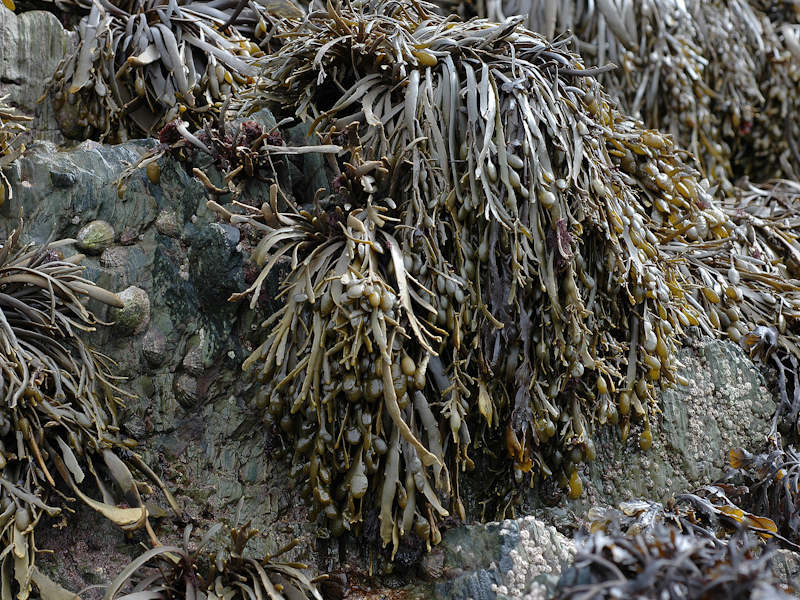
Ascophyllum nodosum on full salinity mid eulittoral rock
Photographer: Dr Keith Hiscock Copyright: Dr Keith Hiscock

Map Key
- Orange points: Core Records
- Pale Blue points: Non-core, certain determination
- Black points: Non-core, uncertain determination
- Yellow areas: Predicted habitat extent
| Researched by | Owen Harris, Frances Perry, Jacqueline Hill & Amy Watson | Refereed by | Prof. Stuart Jenkins |
|---|
Summary
UK and Ireland classification
Description
Bedrock, or stable boulders and cobbles, in the mid-eulittoral zone of sheltered to very sheltered shores, typically in fully marine or near fully marine conditions, are characterized by a dense canopy of Ascophyllum nodosum. Fucus vesiculosus also occurs and in some places may co-dominate the canopy. Such mixed canopies occur when clearings are formed in the Ascophyllum, since F. vesiculosus is able to colonise such clearings more rapidly. Ascophyllum (which may over 25 years) will, however, eventually out-compete any Fucus vesiculosus. Such changes in the overlying canopy have little effect on the under-storey species. Beneath the canopy, filamentous and foliose red algae, including Mastocarpus stellatus and Chondrus crispus, and the green alga Cladophora rupestris, occur in moderate to low densities. The Ascophyllum is generally epiphytised by Polysiphonia lanosa (compare with Asc.VS). Very steep and vertical surfaces are often characterized by barnacles and limpets (BPat.Sem), but by small fucoids in areas of extreme shelter. Large numbers of the winkle Littorina obtusata may be present. This biotope usually lies between the Fucus spiralis (Fspi) and Fucus serratus (Fser) zones, although on some shores a narrow zone of Fucus vesiculosus (Fves) may occur immediately above the Ascophyllum. With increasing wave exposure the Ascophyllum canopy is replaced by Fucus vesiculosus (Fves). Asc.Asc may also occur on moderately exposed shores, where there is localised shelter.
Depth range
Mid shoreAdditional information
Ascophyllum nodosum communities support high levels of biodiversity (Jenkins et al., 1999; Pocklington et al., 2018) and are characterized by a diverse understorey of red algae, together with sessile and mobile invertebrates. The understorey may include, depending on location, red algae such as Osmundia pinnatifida, Lomenataria articulata, Mastocarpus stellatus, Chondrus crispus, Gelidium spp. and encrusting corallines; green algae such as Cladophora rupestris and Ulva spp.; sessile invertebrates such as Semibalanaus balanoides, Perforatus perforatus, Spirorbis spirorbis; and mobile species such as Carcinus maenas, Patella vulgata, Littorina littorea, Littoria obtusata and Phocus lineatus (Jenkins et al., 1999; Pocklington et al., 2018). Disturbed areas may also be colonized by Fucus serratus or Fucus vesiculosus depending on wave exposure and shore height (Jenkins et al., 1999, 2004; Pocklington et al., 2018).
Sensitivity review
Sensitivity characteristics of the habitat and relevant characteristic species
This biotope is characterized by a dense canopy of Ascophyllum nodosum. The fucoid Fucus vesiculosus is also common within this biotope. The red seaweed Polysiphonia lanosa is a common epiphyte on Ascophyllum nodosum. The sheltered nature of this biotope allows Ascophyllum nodosum ecad mackayi to form on rare occasions. The barnacle Semibalanus balanoides is found on the rock surfaces beneath the canopy, along with the limpet species Patella vulgata. Both species are important in the structuring of the biological community on rocky intertidal ecosystems (Hawkins, 1983). Several littorinids are found within this biotope and are important grazers. The crab Carcinus maenas and the dog whelk Nucella lapillus are dominant predators.
Ascophyllum nodosum is the key structuring species of this biotope. This species acts as an ecosystem engineer and the canopy that their fronds create modify habitat conditions (Jenkins et al., 2008; Pocklington et al., 2018). Although Fucus vesiculosus is important to this biotope, its loss from the biotope would not result in loss of the biotope. The fucoid canopy provides protection from desiccation for the various underlying seaweeds in addition to providing a substratum for epifauna and being the primary food resource for grazers. This can facilitate the existence and survival of other intertidal species and, therefore, strongly influences the structure and function of intertidal ecosystems (Cervin et al., 2005; Jenkins et al., 2008; Pocklington et al., 2018). Therefore, the sensitivity assessment is based on the key structuring species Ascophyllum nodosum, although the sensitivity of other species is addressed where relevant.
Resilience and recovery rates of habitat
Ascophyllum nodosum has been reported to survive for over 120 years in areas free from ice scour (Åberg, 1992a, b). However, individual fronds are more likely to last for 15 to 20 years, after which they break off, and new fronds grow from the holdfast. The average age within populations of Ascophyllum nodosum is high, and there is little population turn over (Schiel & Foster, 2006). Åberg (1992a, b) concluded that the maximum lifespan of Ascophyllum nodosum in two sites in Sweden was 40 to 60 years, based on demographics and modelling. Furthermore, Åberg (1992a, b) suggested that 10% of sub-populations could survive as long as 120 years and that the mean extinction time for subpopulations was approx. 163 years, based on his models. Ascophyllum nodosum plots surveyed by Olesen et al. (2025) in Kobberfjord, Greenland, showed that plants were a minimum of 19 years old. The average lifespan of plants was estimated at 37.5 years, based on measurements of intrinsic mortality rate over the next seven years.
Ascophyllum nodosum takes five years to become sexually mature (Sundene, 1973). As many as 2.5 x 10⁹ eggs/m2/year may be produced in a mature stand of Ascophyllum nodosum (Åberg & Pavia, 1997). However, Åberg & Pavia (1997) estimated that approx. one hundred millionths of eggs survive (2 x 10⁸) to become 1.5-year-old recruits (Åberg & Pavia, 1997). Fucoids (inc. Ascophyllum nodosum) have a low dispersal capacity, which suggests recolonization of a shore after a mass mortality event can be extremely slow. It can also limit the speed at which the species recovers from partial die-back.
Olesen et al. (2025) estimated a recruitment rate of 0.01 /year for Ascophyllum nodosum, which equates to a 1% annual addition to the adult population. Lazo et al. (1994) found that grazing can reduce annual recruit survival rates to 0.01%. Other factors that affect the survival rates of recruited Ascophyllum nodosum include their susceptibility to sedimentation (Airoldi, 2003), inability to tolerate desiccation at low tide (Brawley & Johnson, 1991), and inter and intraspecific density-dependent competition of germlings (Choi & Norton, 2005).
Lamote & Johnson (2008) studied temporal and spatial variation in recruitment of fucoids (including Ascophyllum nodosum). They found that recruitment to artificial substrata located in different micro-habitats along a semi-exposed shore was noticeably different. Under the fucoid canopy in the study area, recruitment was 10 to 50 times greater than it was on exposed surfaces and in tide pools. To determine if this difference was due to lower levels of mortality under the canopy or to restricted distribution capacity, newly settled recruits from under the canopy were relocated to alternative microhabitats. Mortality rates of the relocated germlings were higher in the more exposed locations. However, the difference was not great enough to explain the observed difference in the number of germlings within the two different microhabitats. Lamote & Johnson (2008) concluded that the number of recruits was greater from under the fucoid canopy because of restricted distribution abilities.
Svensson et al. (2009) compared the population growth of Ascophyllum nodosum from two shores, one on the Isle of Man and one from Sweden. Although there were significant differences in the demography and appearance of the two populations, the phenotypic plasticity, and sensitivities of the two populations were very similar. This is curious as the poor dispersal abilities of Ascophyllum nodosum means that minimal recruitment would occur between the two study populations. In addition, the geographical locations of the two shores mean that the environmental factors are significantly different and provide different selective pressures. It was suggested that the combination of different selective pressures and lack of genetic crossover could lead some level of allopatric speciation. However, this was not the case, and it was suggested that Ascophyllum nodosum has significant life history plasticity and was able to withstand ‘very large environmental variation’ (Svensson et al., 2009). The results from Svensson et al. (2009) also suggest that pressures that affect the survival or growth of large sexually reproductive Ascophyllum nodosum could have severe negative effects on regional abundance and biomass of the species.
The ability of this species to recolonize a habitat after the negative effects of a pressure vary. However, Ascophyllum nodosum takes a long time to recover and provides suitable habitat for the associated understorey community (Pocklington et al., 2018). Pocklington et al. (2018) examined community disturbance after removal of 100%, 50%, 25% and 0% of Ascophyllum nodosum fronds. They concluded that a pulse disturbance (frond removal) of 50% loss of fronds increased the temperature under the canopy and significantly decreased the abundance of mobile invertebrates such as Littorina obtusata. Sessile taxa such as Osmundia pinnatifida and encrusting corallines could withstand a 75% loss of Ascophyllum fronds but declined by half if 100% were removed. Therefore, the recovery of this biotope hinges on the recovery of the sufficient cover of the Ascophyllum nodosum canopy.
Choi & Norton (2005) examined the competitive interactions between the germlings of Ascophyllum nodosum and Fucus vesiculosus. Experiments undertaken on the Isle of Man and in the laboratory found that growth rates of both species decreased as the density of germlings increased. Of the two species, Ascophyllum nodosum germlings grew slower and were least competitive in mixed cultures. This finding was mirrored in earlier experiments undertaken by Sundene (1973) who noted that the production of sexual cells in Ascophyllum nodosum was as rapid as it was in Fucus vesiculosus. It was the growth rate of Ascophyllum nodosum that led to Fucus vesiculosus being more competitive on the shore. However, Choi & Norton (2005) found that the presence of Fucus vesiculosus increased the survival of Ascophyllum nodosum when exposed to desiccation stress. This showed that the presence of a mixed culture could either facilitate germling survival or lead to competitive exclusion under different environmental conditions (Choi & Norton, 2005). Competition is reversed in mature ecosystems where Ascophyllum nodosum plants can outcompete fucoids (Keser et al., 1981).
Jenkins et al. (1999, 2004) removed the canopy and holdfasts from quadrats and found that the understorey of red algae diminished together with the diversity of mobile and sessile invertebrates. Although Ascophyllum showed high recruitment, recovery took more than 12 years, and cleared areas were dominated by Fucus serratus, Fucus vesiculosus and a mixed canopy of Fucus sp. Neither the density of Ascophyllum nodosum canopy nor the understorey community of red algae had recovered after 12 years of study. Cervin et al. (2005) noted that loss of the canopy and underlying turf promoted Ascophyllum recruitment, but the mixed Fucus serratus and Fucus vesiculosus canopy dominated after seven years because the Ascophyllum recruits were too slow-growing to form a canopy.
Baardseth (1970) also reported slow regrowth of Ascophyllum nodosum after harvesting from the holdfast. Harvesting was found to destroy beds for extended periods where Ascophyllum nodosum was harvested from the bed by scraping it from the substratum. On shores where Ascophyllum nodosum had been removed, recolonization was dominated by Fucus vesiculosus, with little recovery of Ascophyllum nodosum.
Ascophyllum nodosum resilience can depend on the size of the cleared area and recovery can take 13 years to recover (Dudgeon & Petraitis, 2005; Dudgeon & Petraitis, 2022). Dudgeon & Petraitis (2022) experimentally cleared Ascophyllum plots of varying sizes and then monitored the recovery over the next 25 years. Ascophyllum-dominated communities only returned in plots at wave-sheltered sites where cover returned to approx. 75% after 13 years and to 100% in 15 to 18 years in the small clearings (≤2 m diameter), while 21 of the 24 large clearings (4 to 8 m diameter) became dominated by Fucus vesiculosus. Plots that were re-cleared 14 years later to simulate repeated ice scour were also more likely to become dominated by Fucus. The authors attributed the reduced Ascophyllum recruitment in exposed sites to their short zygote dispersal distances which are limited to less than 4 m (Dudgeon et al., 2001). In their tile experiment, Dudgeon & Petraitis (2022) showed that tiles with fully established Fucus vesiculosus plants reduced Ascophyllum nodosum recruitment by approx. 30% and doubled germling mortality.
Harvesting operators often only partially harvest Ascophyllum nodosum canopies. For example, in Maine (USA), harvesters must leave a minimum of 40.6 cm stipe length after harvesting (Johnston et al., 2023). Given the strong evidence of recovery in the literature, it seems that their harvesting is done at a level that ensures recovery between harvests. However, each study uses multiple different metrics for recovery, and some metrics recover while others do not. The evidence suggests that Ascophyllum nodosum biomass seems to make a full recovery within 1 to 5 years (Lauzon-Guay et al., 2022; Johnston et al., 2023; Gunnarsdóttir et al., 2026), but in some cases the height of the canopy does not (Johnston et al., 2023; Gunnarsdóttir et al., 2026), which suggests that biomass recovery is due to the growth of horizontal shoots, as was observed by Lauzon-Guay et al. (2023).
There is considerable evidence to suggest that if Ascophyllum nodosum fronds are cut higher up the thallus recovery times are reduced considerably to two to three years (Ang et al., 1996; Fegley, 2001; Keser et al., 1981; Sharp, 1987; Ugarte et al., 2006; cited in Phillippi et al., 2014). However, when removed at the holdfast, recovery takes many years (Phillippi et al., 2014). Keser et al. (1981) recorded the levels of regrowth exhibited by Ascophyllum nodosum and Fucus vesiculosus after experimental harvesting in Maine. Fronds were cut to three different lengths: frond removed to the holdfast, to 15 cm from the holdfast and to 25 cm from the holdfast. Subsequent harvesting was repeated annually for three years. The experiment was carried out at eight sites, six of which were in sheltered areas. Regrowth of Ascophyllum nodosum was found to be dependent on the age structure of the population, the extent and pattern of branching within a clump, the presence or absence of grazers (Littorina littorea), and the environmental conditions. Recovery was found to be more rapid in estuaries (Keser et al., 1981). Of the fronds that were cut back to the holdfast, only those within sheltered, estuarine and grazer free conditions showed any regrowth. More mature Ascophyllum nodosum fronds cut back to 15 cm and 25 cm within a sheltered site showed some regrowth. However, there were high rates of mortality. The lack of regrowth was suggested to be caused by a lack of functional growing points found towards the bottom of the frond in older individuals. Almost all (95%) of young Ascophyllum nodosum individuals cut back to 15 cm and 25 cm regrew. In almost all populations measured within the experiment, repeat harvests resulted in lower biomass yields (Keser et al., 1981).
Printz (1959) also carried out harvesting experiments where fronds were cut back to 25 cm, 15 cm, and 5 cm from the holdfast. Individuals that had been cut back to 25 cm had an ‘abundance of new shoots’ and had grown to 30 to 35 cm in length after a year. Individuals that had been trimmed back to 5 cm showed almost no change a year after the harvesting event. When the 5 cm individuals where revisited three years after the harvesting event they were still almost unaltered. The reasons for the lack of regrowth were attributed to the lack of regenerative tissue found in the older flesh further down the thallus (Printz, 1959).
Numerous studies have concluded that Ascophyllum nodosum takes long periods of time to recover from removal include Bertness et al. (2002), Jenkins et al. (1999, 2004), Petraitis & Dudgeon (2005), Cervin et al. (2005) and Ingólfsson & Hawkins (2008). Ingólfsson & Hawkins (2008) summarised findings from previous studies on Ascophyllum nodosum recolonization times, stating that “the partial recovery of the Ascophyllum nodosum canopy after a 12-year period is consistent with some very early studies”.
The amount of primary production that is allocated to reproduction instead of growth can vary by latitude. Albuquerque et al. (2025) showed that reproductive allocation in Ascophyllum nodosum decreased towards the northern edge of their distribution at 69°N in Greenland. Therefore, recovery after disturbance may be slower in the northern range of Ascophyllum nodosum’s distribution. Latitude can also affect phenology (the timing of reproduction). The annual peak of reproduction can be delayed by 4.5 days per degree North, and by 14 days per 1°C decrease in temperature (Albuquerque et al., 2025). Therefore, the recovery and resilience of northern populations of Ascophyllum nodosum may be significantly slower than populations in their range centre or southern range edge.
Mass mortality events caused by changes in the physical environment have been observed in Ascophyllum nodosum. A total mortality event of an Ascophyllum nodosum population occurred in Long Island Sound in 1984 caused by water temperatures from two power plant thermal discharge pipes exceeding 27 to 28oC (Keser et al., 2005). From 1984 onwards temperatures at the site fluctuated with the opening of a third thermal discharge pipe and the closing and reopening of the pipes all three pipes. However, there was no recovery of the population in the 18 years since the mortality event at the end of Keser et al.’s (2005) study. Keser et al. (2005) reported that similar mortality events were observed near other power plant thermal discharge pipes in Maine (Vadas et al., 1978) and Massachusetts (Wilce et al., 1978).
Ascophyllum nodosum germination can occur at temperatures between 12 and 18°C and at light levels of 40 and 80 μmol photons/m2/s (Coutinho et al., 2025). In the first month, rhizoids grew significantly more in the 12°C treatment than in the 18°C treatment. In addition, low light was favourable for growth at 12°C, which yielded more than twice as much growth than in the low light treatment at 12°C. Conversely, at 18°C, high light was slightly better for growth. However, in the second month, the direction of the responses to light reversed at 12°C, with significantly more germling growth in the high light treatment, and this response continued into the third month. Therefore, recruitment success in Ascophyllum nodosum may depend strongly on the interaction between temperature and light, as well as the timing of changes in these factors.
Experiments on the effect of wave action on Ascophyllum nodosum showed that a low-velocity wave can remove 99% of 15-minute old zygotes from experimental tiles (Vadas et al., 1990). Further investigation with the use of refuges found that 75 to 90% of zygotes as old as four hours could be removed by a single wave. The attachment success of Ascophyllum nodosum was very poor at current speeds of over 0.2 m/s) (Vadas et al., 1992). Therefore, calm conditions typical of wave sheltered habitats are required for successful recruitment in Ascophyllum nodosum.
When artificial substrata, such as sea walls, are introduced into an intertidal area Ascophyllum nodosum can take many years to colonize. Fucus vesiculosus and Fucus spiralis were the first species to colonize a breakwater built in Norway (Baardseth, 1970). It took two years for occasional Ascophyllum nodosum individuals to appear on the breakwater, and after eight years there was still no distinct Ascophyllum nodosum zone. Another breakwater studied had an established Ascophyllum nodosum zone after 30 years (Knight & Parke, 1950).
Semibalanus balanoides are often quick to colonize available gaps on intertidal rocky shores. Bennell (1981) observed that barnacles that were removed when the surface rock was scraped off in a barge accident at Amlwch, North Wales returned to pre-accident levels within three years. Petraitis & Dudgeon (2005) also found that Semibalanus balanoides quickly recruited (present a year after and increasing in density) to experimentally cleared areas within the Gulf of Maine, that had been dominated by Ascophyllum nodosum previously. However, barnacles are gregarious and larvae settle within areas where adults are present (Knight-Jones & Stevenson, 1950).
Recolonization of Patella vulgata on rocky shores is rapid. Limpet spat appeared six months after the Torrey Canyon oil spill and reached peak numbers 4 to 5 years after the spill. However, although recolonization was rapid, the alteration to the population structure (size and age class) persisted for about 15 years because of the complex cycles of dominance involving limpets, barnacles, and algae (Lewis & Bowman, 1975; Hawkins & Southward, 1992).
Resilience Assessment
Ascophyllum nodosum has high egg and juvenile mortality rates, slow growth, and can take over five years to reach reproductive maturity. Small scale perturbations (e.g. frond removal; Keser et al., 1981; Pocklington et al., 2018) and small-scale clearances (e.g. Cervin et al., 2005; Jenkins et al., 1999, 2004; Petraitis & Dudgeon, 2005) have been shown to affect the community significantly. Minor disturbances that result in the cutting of the frond only may allow regrowth in within two to three years depending on the length remaining, shelter and grazing pressure (Keser et al., 1981; Phillippi et al., 2014). However, even small-scale disturbances like the clearance studies (i.e. the removal of small patches, flush with the substratum and/or including the holdfast, within the bed), may require over 12 years for partial recovery of the Ascophyllum canopy and its associated community (Jenkins et al., 1999; 2004; Cervin et al., 2005). Mass mortality due to ice scour (Åberg (1992a, b) or thermal effluent (Keser et al., 2005) would probably require over 18 years for partial, if any, recovery (Keser et al., 2005). Therefore, where resistance to a specific pressure is assessed as Medium (<25% loss) or Low (25 to 75% loss) or 'None' (>75% loss) then resilience is probably ‘Low’ (10 to 25 years). An exception is made for permanent or ongoing (long-term) pressures where recovery is not possible as the pressure is irreversible, and resilience is assessed as ‘Very low’ (at least 25 years) by default.
Note. The resilience and the ability to recover from human induced pressures is a combination of the environmental conditions of the site, the frequency (repeated disturbances versus a one-off event) and the intensity of the disturbance. Recovery of impacted populations will always be mediated by stochastic events and processes acting over different scales including, but not limited to, local habitat conditions, further impacts and processes such as larval-supply and recruitment between populations. Full recovery is defined as the return to the state of the habitat that existed prior to impact. This does not necessarily mean that every component species has returned to its prior condition, abundance, or extent but that the relevant functional components are present and the habitat is structurally and functionally recognisable as the initial habitat of interest. It should be noted that the recovery rates are only indicative of the recovery potential.
Hydrological Pressures
Use [show more] / [show less] to open/close text displayed
| Resistance | Resilience | Sensitivity | |
Temperature increase (local) [Show more]Temperature increase (local)Benchmark. A 5°C increase in temperature for one month, or 2°C for one year (Temperature change pressure definition). EvidenceSchonbeck & Norton (1979) demonstrated that fucoids can increase tolerance in response to a gradual change in temperature through a process known as 'drought hardening'. However, acute changes in temperatures may cause damage to other species. Temperature ranges of species may not accurately describe their ability to withstand localized changes in temperature. However, they will display the limits of the species genetic ability to acclimatize to temperatures. The juvenile life stages of organisms can be less tolerant of environmental conditions than more mature stages. Ascophyllum nodosum is found in the middle of its range in the British Isles, with populations in the Northeast Atlantic as far south as Portugal and extending north to the White Sea and Iceland and west into the Kattegat on the shores of Sweden. Ascophyllum nodosum is unlikely to be affected by a short-term change of 5°C, as it was not damaged during the unusually hot summer of 1983 when the average temperature was 8.3°C higher than normal (Hawkins & Hartnoll, 1985). They are also regularly exposed to rapid and short-term variations in temperature. Both exposure at low tide or rising tide on a sun-heated shore involves considerable temperature changes, and during winter the air temperature may be far below freezing point. According to OBIS (2026), Ascophyllum nodosum is found in temperatures from 5 to 15°C, with most records coming from the 10 to 15°C range. The growth of Ascophyllum nodosum has been measured between 2.5 and 35°C with an optimum between 10 and 17°C (Strömgren, 1977). Ascophyllum nodosum can be damaged by temperatures that remain above 24°C for several weeks (Lobban & Harrison, 1997), and temperatures exceeding 27 to 28°C can cause direct mortality (Keser et al., 2005). Water temperature is an excellent predictor of gamete release in Ascophyllum (Bacon & Vadas, 1991). Consequently, changes in temperatures could impact on gamete release. Investigations into the tolerance of Ascophyllum nodosum germlings from Norway to temperatures between 7 and 17°C found that there was no difference in survival rates within the given range (Steen & Rueness, 2004). Germination of Ascophyllum nodosum has been recorded between the temperatures of 4 and 23°C (Steen & Rueness, 2004) and between 12 and 18°C with light levels of 40 and 80 μmol photons /m2/s (Coutinho et al., 2025). Temperature and light can have interactive effects on early life stages of Ascophyllum nodosum, and the direction of these effects can change between life stages. Coutinho et al. (2025) investigated this and saw that rhizoid growth in the first month of germination was significantly higher at 12°C than at 18°C treatment. In addition, low light (40 μmol photons /m2/s) was favourable for growth at 12°C, which yielded more than twice as much growth than in the high light treatment (80 μmol photons /m2/s) at 12°C. Conversely, at 18°C, high light was slightly better for growth. However, in the second month, the direction of the responses to light reversed at 12°C, with significantly more germling growth in the high light treatment, and this response continued into the third month. Therefore, recruitment success in Ascophyllum nodosum may depend strongly on the interaction between temperature and light, as well as the timing of changes in these factors. Hernández et al. (2023) found that the upper survival temperature of Ascophyllum nodosum varied between populations across a latitudinal gradient from northern Portugal to central Norway. The upper survival temperature at which ≥50% mortality occurred was approx. 24°C for most populations south of Norway, compared to 27.9°C for Norwegian populations. They also found that growth declined with increasing temperature, and that the populations with the highest thermal tolerance had the lowest growth. The amount of primary production allocated to reproduction varies by latitude. Albuquerque et al. (2025) showed that reproductive allocation in Ascophyllum nodosum decreased towards the northern edge of their distribution at 69°N in Greenland. Therefore, recovery after disturbance may be slower in the northern range of Ascophyllum nodosum’s distribution. Latitude and temperature can also affect phenology (the timing of reproduction). The annual peak of reproduction can be delayed by 4.5 days per °N, and by 14 days per 1°C decrease in temperature (Albuquerque et al., 2025). Pereira et al. (2025a) investigated Ascophyllum nodosum responses to elevated air and water temperatures across consecutive tidal cycles. The experiment design accounted for latitudinal differences in temperatures and differences in thermal tolerances between populations. Ascophyllum plants were subjected to repeated emersion periods of 5 hours per tidal cycle for 10 consecutive days, with peak air temperatures of 28.5, 36.5, 38.5 and 40.5°C, following submersion temperatures of 15 or 20.5°C. No mortality occurred in the plants subjected to the lowest air temperature (28.5°C) regardless of submersion temperatures. Survival decreased as the difference between submerged and emersed temperatures increased. Survival was significantly different between southern, central, and northern populations in treatments in which temperature differences between emersion and submersion were more than 16°C. At the highest temperature difference (25.5°C), survival was approx. 68.9% in southern populations (Portugal and Spain), 56.3% in central populations (France), and 42.5% in northern populations (Norway). This suggests a decline in resistance to elevated temperatures with increasing latitudes. Growth increasingly declined with increasing air temperatures, while net primary productivity declined with increasing differences between emersion and submersion temperatures. Pereira et al. (2025b) studied thermal tolerance whilst excluding desiccation effects. They subjected four fucoids including Ascophyllum nodosum to several air temperature treatments over a standardised 4-hour emersion period (shorter than Ascophyllum’s average emersion period of 6.5 to 8.5 hours per day) for 20 consecutive days. Growth and photosynthetic efficiency in this case were not affected by temperature, and no mortality was observed until the 20th day at 40 and 41°C, in which mortality was 17%. Lipid peroxidation (an indicator of oxidative damage to cell membranes) did not significantly differ between the control (28°C) and highest temperature (41°C). Mass mortality events caused by changes in the physical environment have been observed in Ascophyllum nodosum. A total mortality event of an Ascophyllum nodosum population occurred in Long Island Sound in 1984 caused by water temperatures from two power plant thermal discharge pipes exceeding 27 to 28°C (Keser et al., 2005). From 1984 onwards temperatures at the site fluctuated with the opening of a third thermal discharge pipe and the closing and reopening of the pipes all three pipes. However, there was no recovery of the population in the 18 years since the mortality event at the end of Keser et al.’s (2005) study. Keser et al. (2005) reported that similar mortality events were observed near other power plant thermal discharge pipes in Maine (Vadas et al., 1978) and Massachusetts (Wilce et al., 1978). In Europe, Ascophyllum nodosum could face a poleward range shift of up to 157 km under the least extreme climate change scenario (RCP2.6), in which sea surface temperatures around Europe are expected to increase by 0.6°C by 2100 (Westmeijer et al., 2019). Under the most extreme warming scenario (2.7°C under RCP8.5), this poleward expansion is estimated to be as high as 580 km. Hernández et al. (2023) suggest that under the RCP8.5 climate change scenario, Ascophyllum nodosum will completely disappear from the Bay of Biscay. Similar poleward expansions have been predicted for the northwest Atlantic. According to species distribution models by Wilson et al. (2019), the southern range edge of Ascophyllum nodosum in the northwest Atlantic will shift northward by an average of 182 km by the year 2100 under the RCP8.5 climate change scenario, while their northward expansion could increase the total suitable habitat space by 84%. Other species found within this biotope are probably tolerant of temperature changes at the benchmark level as they are widely distributed in the UK. The balance of interactions between fucoids and barnacles’ changes with geographical location. Warmer conditions further south than the British Isles favour greater penetration of barnacles into sheltered locations (Ballantine, 1961 cited in Raffaelli & Hawkins, 1996). Warmer conditions are also likely to favour Chthamalus spp. rather than Semibalanus balanoides although a change of species will not alter the function of the biotope. Those species which are mobile, such as Carcinus maenas can move away from areas if physical conditions become too harsh. Sensitivity AssessmentThe characterizing species Ascophyllum nodosum is found in the middle of its habitat range in the British Isles. Although the range of this species can extend down to Portugal, a short-term acute temperature increase, leaving no time for acclimation, might result in damage to or mortality of Ascophyllum, especially if the increase occurred during the summer months in southern populations. Throughout the UK, northern to southern Sea Surface Temperature (SST) ranges from 8 to 16°C in summer and 6 to 13°C in winter (Beszczynska-Möller & Dye, 2013). Significant mortality has been reported in instances where water temperatures exceeded the pressure benchmark level (Keser et al., 2005; Hernández et al., 2023), even at shorter timescales than that of the benchmark (Hernández et al., 2023). Therefore, based on the worst-case scenario, resistance is assessed as ‘Low’ (25 to 75% mortality), resilience as ‘Low’, and sensitivity as ‘High’. | LowHelp | LowHelp | HighHelp |
Temperature decrease (local) [Show more]Temperature decrease (local)Benchmark. A 5°C decrease in temperature for one month, or 2°C for one year (Temperature change pressure definition). EvidenceSchonbeck & Norton (1979) demonstrated that fucoids can increase tolerance in response to a gradual change in temperature through a process known as 'drought hardening'. However, acute changes in temperatures may cause damage to macroalgae and other species. Temperature ranges of species may not accurately describe their ability to withstand localized changes in temperature. However, they will display the limits of the species genetic ability to acclimatize to temperatures. The juvenile life stages of organisms can be less tolerant of environmental conditions than more mature stages. Ascophyllum nodosum is found in the middle of its range in the British Isles, with populations in the Northeast Atlantic as far south as Portugal and extending north to the White Sea and Iceland and west into the Kattegat on the shores of Sweden. According to OBIS (2026), Ascophyllum nodosum is found in temperatures from 5 to 15°C, with most records coming from the 10 to 15°C range. Rhizoid and embryo growth have been shown to have significantly higher growth at 12°C than at 18°C treatment (Coutinho et al., 2025). The growth of Ascophyllum nodosum adults has been measured between 2.5 and 35°C with an optimum between 10 and 17°C (Strömgren, 1977). Water temperature is an excellent predictor of gamete release in Ascophyllum (Bacon & Vadas, 1991). Consequently, changes in temperatures could impact on gamete release. Investigations into the tolerance of Ascophyllum nodosum germlings from Norway to temperatures between 7 and 17°C found that there was no difference in survival rates within the given range (Steen & Rueness, 2004). Germination of Ascophyllum nodosum has been recorded in temperatures ranging from 4 to 23°C (Steen & Rueness, 2004) and between 12 and 18°C with light levels of 40 and 80 μmol photons /m2/s (Coutinho et al., 2025). Ascophyllum nodosum was reported to survive freezing to -20°C (MacDonald et al., 1974, cited in Åberg, 1992a). Olesen et al. (2025) noted that Ascophyllum nodosum populations in Kobberfjord, Greenland, were stable despite ice cover for 2 to 7.5 months of the year, mean daily temperatures varying from -3.9 to 15.4°C, and low nutrient supply. A large number of the species found within this biotope are found throughout the British Isles and are not on the edge of their range. Therefore, it is unlikely that a decrease in temperature is going to cause significant mortalities. In addition, mobile species such as Carcinus maenas could move away from areas if physical conditions become too harsh. Hence, these species may decrease in abundance. Sensitivity AssessmentThe characterizing species Ascophyllum nodosum is found in the middle of its habitat range in the British Isles. It is unlikely to be affected by a short-term decrease of 5°C for one month or 2°C for a year in UK waters as it survives harsher winter conditions in northern waters of Iceland and in Sweden where populations are also subjected to ice scour and ice cover (Åberg, 1992a, b; Ingólfsson & Hawkins, 2008; Olesen et al., 2025). Therefore, resistance is assessed as ‘High’, resilience as ‘High’, and sensitivity as ‘Not sensitive’. | HighHelp | HighHelp | Not sensitiveHelp |
Salinity increase (local) [Show more]Salinity increase (local)Benchmark. An increase in one MNCR salinity category above the usual range of the biotope or habitat (Salinity regime change pressure definition). EvidenceIntertidal macroalgae often experience large but short-term changes in salinities (Lobban & Harrison, 1997). Salinities within these habitats vary due to weather conditions such as rainfall at low tide and evaporation from rock pools causing hypersaline conditions on hot days. Intertidal shores within estuarine environments can also experience considerable short-term changes in salinities. However, intertidal macroalgae tolerances to longer-term changes in salinities can be minimal and can quickly reduce photosynthetic abilities and cause mortality. According to OBIS (2026), Ascophyllum nodosum is found in salinities ranging from 20 to 40 PSU, with most records coming from the 30 to 35 PSU range. LR.LLR.F.Asc is recorded in variable (18 to 35 PSU) to full salinity (30 to 40 PSU) (Connor et al., 2004: JNCC, 2022), while LR.LLR.F.Asc.FS, LR.LLR.F.Asc.X, and LR.LLR.F.AscT are only found in full salinity. Consequently, an increase in salinity could make the conditions hypersaline. Little empirical evidence was found to assess how an increase in salinity at this benchmark would affect Ascophyllum nodosum. Baardseth, 1970 noted that Ascophyllum nodosum is euryhaline with a salinity tolerance of about 15 to 37 PSU. Chock & Mathieson (1979) found Ascophyllum nodosum plants in the laboratory photosynthesised at salinities from 0 to 40 PSU, although the long-term effects within this range were not evaluated. No information could be found on the effects of an increase in salinity on the reproductive cycle of Ascophyllum nodosum. A number of the species associated with this biotope can also be found within rockpools where hypersaline conditions can be found for short periods (Newell, 1979). Consequently, an increase in salinity within the benchmark may not cause negative impacts. Semibalanus balanoides can tolerate salinities between 12 and 50 PSU; below and above this, cirral activity ceases (Foster, 1970). Carcinus maenas is mobile and can therefore move to suitable conditions on the shore. Sensitivity AssessmentAlthough many species within this biotope could be able to cope with a short-term increase in salinity, long-term hypersaline conditions could cause mass mortalities of the biological community within this biotope. However, there was insufficient evidence on the effects of hypersaline conditions on Ascophyllum nodosum or its associated community. | Insufficient evidence (IEv)Help | Insufficient evidence (IEv)Help | Help |
Salinity decrease (local) [Show more]Salinity decrease (local)Benchmark. A decrease in one MNCR salinity category above the usual range of the biotope or habitat (Salinity regime change pressure definition detail). EvidenceIntertidal macroalgae often experience large but short-term changes in salinities (Lobban & Harrison, 1994). Salinities within these habitats vary due to weather conditions such as rainfall at low tide and evaporation from rock pools causing hypersaline conditions on hot days. Intertidal shores within estuarine environments can also experience considerable short-term changes in salinities. However intertidal macroalgae tolerances to longer-term changes in salinities are minimal and can quickly reduce photosynthetic abilities and cause mortality. According to OBIS (2026), Ascophyllum nodosum is found in salinities ranging from 20 to 40 PSU, with most records coming from the 30 to 35 PSU range. LR.LLR.F.Asc is recorded in variable (18 to 35 PSU) to full salinity (30 to 40 PSU) (Connor et al., 2004: JNCC, 2022), while LR.LLR.F.Asc.FS, LR.LLR.F.Asc.X, and LR.LLR.F.AscT are only found in full salinity. Ascophyllum nodosum is euryhaline with a salinity tolerance of about 15 to 37 PSU (Baardseth, 1970). The species can also withstand periodic emersion in freshwater (Baardseth, 1970) and frequently inhabits estuaries where salinity is variable. Doty & Newhouse (1954) reported Ascophyllum nodosum from estuarine waters with a maximum salinity of 17.3 PSU and a minimum of 0 PSU. Chock & Mathieson (1979) found Ascophyllum nodosum plants in the laboratory photosynthesised at salinities from 0 to 40 PSU, although the long-term effects within this range were not evaluated. In the Teign Estuary in South Devon, Ascophyllum nodosum inhabits areas subject to salinities as low as 8 PSU (Laffoley & Hiscock, 1993). Investigations into the salinity tolerance of Ascophyllum nodosum in laboratory-controlled conditions found that the photosynthetic capabilities of this species decreased with reduced salinities. Ascophyllum nodosum tolerated seven days at salinities of 5 PSU but all samples died after 15 days (Connan & Stengel, 2011). There is some evidence to suggest that reduced salinities can influence the rate of receptacle maturation in fucoids (Munda, 1964). The rate of fructification in Ascophyllum nodosum has been measured to increase in diluted seawater (Munda, 1964). A number of the other species within the biotope can also be found within rockpools where hyposaline conditions can be found for short periods (Newell, 1979). Consequently, a decrease in salinity within the benchmark of this pressure may not cause significant mortalities. For example, Semibalanus balanoides can tolerate salinities between 12 and 50 PSU; below and above this, cirral activity ceases (Foster, 1970). Carcinus maenas is a mobile species and can move to suitable conditions on the shore. Sensitivity AssessmentAscophyllum nodosum occurs in estuarine conditions, inhabits areas subject to salinities as low as 8 psu, and can tolerate seven days at a salinity of 5 (Laffoley & Hiscock, 1993; Connan & Stengel, 2011). Therefore, it is unlikely to suffer a reduction in abundance due to a reduction in salinity at the benchmark level. A decrease in salinity by one MNCR category is assessed as a change from Full (30 to 35 PSU) to reduced (18 to 30 PSU) at the benchmark level. LR.LLR.F.Asc is recorded in variable (18 to 35 PSU) to full salinity (30 to 40 PSU) (JNCC, 2022), while its sub-biotopes LR.LLR.F.Asc.FS and LR.LLR.F.Asc.X are only recorded from full salinity. Therefore, while the abundance of Ascophyllum nodosum is unlikely to be affected, the relative proportion of other species is likely to change, as less salinity tolerant species are reduced in abundance or lost. The biotopes would probably become less species-rich and resemble the similar LLR.FVS.AscVS biotope. Therefore, resistance is assessed as ‘Medium’ to represent a loss in abundance of some associated species within a year (the benchmark). Most of the associated species (e.g. hydroids, barnacles, and littorinids) are probably ubiquitous or opportunistic so resilience is assessed as ‘High’, and sensitivity as ‘Low’. | MediumHelp | HighHelp | LowHelp |
Water flow (tidal current) changes (local) [Show more]Water flow (tidal current) changes (local)Benchmark. A change in peak mean spring bed flow velocity of between 0.1 m/s and 0.2 m/s for more than one year (Water flow pressure definition). EvidenceWater motion is a key determinant of marine macroalgal ecology, influencing physiological rates and community structure (Hurd, 2000). Higher water flow rates increase mechanical stress on macroalgae by increasing drag. Fucoids are highly flexible but not physically robust and an increase in water flow could cause mechanical damage, breaking fronds or even dislodging whole algae from the substratum. Fucoids are, however, highly flexible and able to re-orientate their position in the water column to become more streamlined. This ability allows fucoids to reduce the relative velocity between algae and the surrounding water, thereby reducing drag and lift (Denny et al., 1998). Fucoids are permanently attached to the substratum and would not be able to re-attach if removed. Organisms living on the fronds and holdfasts will be washed away with the algae whereas free-living community components could find new habitat in surrounding areas. Wave exposure has been shown to limit the size of fucoids (Blanchette, 1997) as smaller individuals create less resistance to water movement, water flow likely exerts a very similar pressure on fucoids. Fucus vesiculosus individuals of 10 cm or larger have been recorded to be completely removed at 7-8 m/s (Jonsson et al., 2006). Flow rates at which adult Ascophyllum nodosum are removed are not known. However, Thompson & Wernberg (2005) provide strong evidence of an increase in the break force required to remove algae with an increase in thallus size. Consequently, the force required to remove Ascophyllum nodosum from the shore is likely to be comparable to that of Fucus vesiculosus as both are large macroalgae with similar thallus sizes. Propagule dispersal, fertilization, settlement, and recruitment are also influenced by water movement (Pearson & Brawley, 1996). An increase in water flow could have negative impacts on the reproductive success of Ascophyllum nodosum. Experiments on the effect of wave action on Ascophyllum nodosum showed that a low-velocity wave can remove 99% of 15-minute old zygotes from experimental tiles (Vadas et al., 1990). Further investigation with the use of refuges found that 75-90% of zygotes as old as four hours could be removed by a single wave. The attachment success of Ascophyllum nodosum was poor at current speeds of over 20 cm/s (Vadas et al., 1992). These studies show the need for periods of calm conditions for successful recruitment for Ascophyllum nodosum. An increase in the mean water flow could reduce the time during which attachment is possible. In addition, greater water flow can increase scour through increased sediment movement. Small life stages of macroalgae are likely to be affected by removing new recruits from the substratum and hence reducing successful recruitment (Devinny & Volse, 1978) (see ‘siltation’ pressures). Changes in water motion can thus strongly influence local distribution patterns of Fucus spp. (Ladah et al., 2008). Sensitivity AssessmentThe LR.LLR.F.Asc biotopes are recorded in tidal currents ranging from 1 - 3 knots (0.5 – 1.5 m/s) (Connor et al., 2004). Also, Ascophyllum nodosum is recorded in tide-swept conditions (e.g. LR.HLR.FT.AscT) in strong (1.5-3 m/s) to very strong (>3 m/s) water flow. Therefore, a change in the current flow of 0.1-0.2 m/s is unlikely to have an impact on many examples of this biotope. Hence, resistance and resilience have been assessed as ‘High’ and the biotope is assessed as ‘Not Sensitive’ at the benchmark level. | HighHelp | HighHelp | Not sensitiveHelp |
Emergence regime changes [Show more]Emergence regime changesBenchmark. 1) A change in the time covered or not covered by the sea for a period of ≥1 year, or 2) an increase in relative sea level or decrease in high water level for ≥1 year. (Emergence regime change pressure definition). EvidenceDespite the stressful conditions that intertidal species face during emersion, such as desiccation and elevated temperatures, Ascophyllum nodosum are adapted to the emersion periods experienced by their position in the eulittoral zone and are therefore somewhat resistant to these conditions (Martins et al., 2021). In fact, gross primary productivity (GPP) in Ascophyllum nodosum increases significantly for the first two hours of emersion and then gradually declines until the return of the tide (Golléty et al., 2024). This suggests that the initial increase in productivity may partly offset the later decline during emersion. However, if emersion periods were to increase, desiccation would likely further reduce overall productivity and lead to severe physiological stress. Research shows that low tide heat stress in kelp (King et al., 2018; Hereward et al., 2020) and fucoids (Harris et al., 2025) is cumulative. Higher temperatures can increase the rate of desiccation and consequently lead to a loss of productivity, and eventually mortality (Keser et al., 1981). Therefore, the magnitude of decline in physiological performance and resilience can be greater with each repeated exposure to stressors during emersion, which, along with increased emersion periods, could have severe consequences for Ascophyllum nodosum. Pereira et al. (2025) investigated Ascophyllum nodosum’s responses to elevated air and water temperatures across consecutive tidal cycles. They observed a decrease in survival and net primary productivity as the difference between submerged and emersed temperatures increased. In addition, growth increasingly declined with increasing air temperatures. Therefore, increases in emersion times could potentially subject Ascophyllum nodosum to stressful air temperatures for longer periods and increase the risk of mortality. Within the British Isles, populations of Ascophyllum nodosum can suffer from bleaching and consequent mortality during exceptionally hot weather (Schonbeck & Norton, 1978, Hawkins & Hartnoll, 1985, Norton, 1985). However, these mortality events do not occur every year and tend to occur when the effects of unusually hot conditions combine with large tides and result in rapid changes that do not allow for macroalgae to acclimate (Raffaelli & Hawkins, 1996). Stengel & Dring (1997) reported that growth rates in Ascophyllum nodosum decreased with height on the shore, correlating with an increase in environmental severity. Ascophyllum nodosum productivity is affected by desiccation when water loss exceeds 50% (Brinkhuis et al., 1976). When Stengel & Dring (1997) transplanted Ascophyllum nodosum from the lower shore to the upper shore, 80% of the transplants died within three months. In contrast, 100% of the individuals from the upper shore transplanted to the lower shore survived, as did all of the controls. The plants that survived transplantation to the upper shore acclimated to the conditions on the upper shore, yet their survival was determined by thallus morphology, a predetermined genetic attribute which may be fixed (Stengel & Dring, 1997). Choi & Norton (2005) also carried out transplantation experiments and found that the growth rates of Ascophyllum nodosum decreased dramatically from the lower shore to the upper shore. The southern and northern range limits of several intertidal macroalgae fall within Portugal. Lima et al. (2007) mapped the readjustment of 129 macroalgal ranges in relation to the change in air and sea temperatures observed within the northeastern Atlantic over the past 50 years. Significant differences in distributions of algae were found, yet there was a disparity in the level of change found in the ranges of those of warm and cold adapted species. The species that were at the northern limit of their range in Portugal showed a greater change in distribution than the cold adapted species. Roughly half of the cold adapted species, including Ascophyllum nodosum, showed no significant change in their distribution. Lima et al. (2007) suggested that the cold adapted species had greater tolerance to adverse conditions for longer periods than the warm adapted species. Information regarding the effect of changes in the level of exposure on Ascophyllum nodosum germlings was not available. Germlings would be protected from desiccation stresses due to air exposure because of the protection provided to them by the fucoid canopy. Increases in temperature will be one of the effects changes in air exposure will have on germlings. Dense aggregations of algae can reduce the effect of more severe physical conditions such as those experienced with greater levels of exposure. Clumping enables organisms to retain moisture and reduce heat stress (Scrosati & DeWreede, 1998, Stafford & Davies, 2005). Sensitivity AssessmentDesiccation and the associated osmotic stress, especially when combined with high temperatures can cause mortalities (Pearson et al., 2009). The sensitivity of the characterizing species to emersion pressure will depend on the health and demography of individual populations, with germlings being most vulnerable life stage to this pressure. Ascophyllum nodosum has a level of resistance to an increase in emersion. However, an increase in the emergence time for a year is likely to change in the height of the biotope on the shore, with the top of the biotope being most sensitive to change as it is already at the upper tolerance limits. Conversely, a decrease in emergence may allow the biotope to increase its extent up the shore. Overall, an increase in emergence is likely to result in LR.LLR.F.Asc and its associated sub-biotopes shifting downwards on the shore. Ascophyllum nodosum can take as many as twelve years to recover, with the return of ecosystem function taking considerably longer. Therefore, the resistance of this biotope has been assessed as ‘Low’ and resilience as ‘Low’ so that sensitivity is assessed as ‘High’ to changes in emergence regime at the pressure benchmark. | LowHelp | LowHelp | HighHelp |
Wave exposure changes (local) [Show more]Wave exposure changes (local)Benchmark. A change in near shore significant wave height of >3% but <5% for more than one year (Wave action pressure definition). EvidenceAn increase in wave exposure generally leads to a decrease in macroalgae abundance and size (Lewis, 1961, Stephenson & Stephenson, 1972, Hawkins et al., 1992, Jonsson et al., 2006). Fucoids are highly flexible but not physically robust and an increase in wave exposure can cause mechanical damage, break fronds, or even dislodge whole algae from the substratum. Ascophyllum nodosum is permanently attached to the substratum and would not be able to reattach if removed. Organisms living on the fronds and holdfasts will be washed away with the algae whereas free-living community components could find new habitat in surrounding areas. Wave exposure has been shown to limit the size of fucoids (Blanchette, 1997) as smaller individuals create less resistance to waves. As exposure to waves increases the fucoid population will become dominated by small juvenile algae and dwarf forms of macroalgae which are more resistant to strong wave action. An increase in wave action beyond the tolerance of these fucoid species leads to a further increase in the abundance of robust fucoids, such as Fucus spiralis f. nana and red seaweeds, such as Corallina officinalis (Connor et al., 2004). Ascophyllum nodosum cannot resist very heavy wave action so exposure to wave action is an important factor controlling the distribution of the species, and therefore this biotope. This biotope is found in sheltered to extremely sheltered conditions. Propagule dispersal, fertilization, settlement, and recruitment are also influenced by water movement (Pearson & Brawley, 1996). An increase in water flow due to wave exposure could have negative impacts on the reproductive success of Ascophyllum nodosum. Experiments on the effect of wave action on Ascophyllum nodosum showed that a low-velocity wave can remove 99% of 15-minute old zygotes from experimental tiles (Vadas et al., 1990). Further investigation with the use of refuges found that 75 to 90% of zygotes as old as four hours could be removed by a single wave. Current speeds over 20 cm/s reduce attachment success of Ascophyllum nodosum (Vadas et al., 1992). These studies show the need for periods of calm conditions for successful recruitment. An increase in the mean wave exposure will reduce the time during which attachment is possible. In addition, greater wave action can increase scour through increased sediment movement. Small life stages of macroalgae are likely to be affected by removing new recruits from the substratum and hence reducing successful recruitment (Devinny & Volse, 1978) (see ‘siltation’ pressures). The other characterizing species are found in a range of wave exposures and unlikely to be directly affected. However, loss of the fucoid cover would result in major changes to the associated community, especially attached epifauna and understorey algae. Sensitivity AssessmentAll biotopes in this group occur in sheltered to extremely sheltered sites except for LR.LLR.F.Asc which only occurs in very sheltered and extremely sheltered sites. Therefore, a decrease in wave exposure is unlikely to change Ascophyllum nodosum abundance. However, an increase in wave action from sheltered to exposed categories is likely to adversely affect fucoid cover, especially that of Ascophyllum nodosum. The biotope would probably be lost if wave exposure increased from e.g. sheltered to moderately exposed for a year. In addition, an increase in wave exposure from very sheltered to sheltered may change the abundance of sessile fauna which distinguish LR.LLR.F.AscT from the other biotopes under assessment. Based on the findings of Vadas et al. (1990, 1992) and Devinny & Volse (1978), wave exposures stronger than those experienced by these biotopes seem likely to remove Ascophyllum nodosum. Therefore, resistance is assessed as ‘Low’, resilience as ‘Low’, and sensitivity as ‘High’. | LowHelp | LowHelp | HighHelp |
Chemical Pressures
Use [show more] / [show less] to open/close text displayed
| Resistance | Resilience | Sensitivity | |
Transition elements & organo-metal contamination [Show more]Transition elements & organo-metal contaminationBenchmark. Exposure of marine species or habitat to one or more relevant Transitional metal or organometal (e.g. TBT) contaminants via uncontrolled releases or incidental spills (Transitional metals and organometals pressure definition). EvidenceThis pressure is Not assessed but evidence is presented where available. Very few studies have investigated whether these contaminants are harmful to macroalgae. Most studies merely note the presence of these contaminants in macroalgae, and often instead focus on the harmful effects of the consumption of macroalgae by humans and other organisms that depend on the algae. Evidence for the effects of transition-element contamination on Ascophyllum nodosum is limited, and available studies mainly demonstrate accumulation, adsorption, or release rather than direct toxicity. Wegeberg et al. (2023) showed that the main heavy metals detected in Ascophyllum nodosum were cadmium (Cd), copper (Cu), mercury (Hg), lead (Pb), and zinc (Zn), confirming that this species can accumulate a range of metal contaminants. Its capacity to bind metals is also supported by Selvakumar et al. (2023), who showed that Ascophyllum nodosum can be used as an adsorbent product to remove chromium (Cr), nickel (Ni), and Zn from seawater. However, Ascophyllum nodosum has been shown to release 20 to 30% of its bioaccumulated uranium (U) over 300 hours (Zerbini et al., 2024), indicating some level of resistance to this contaminant. | Not Assessed (NA)Help | Not assessed (NA)Help | Not assessed (NA)Help |
Hydrocarbon & PAH contamination [Show more]Hydrocarbon & PAH contaminationBenchmark. Exposure of marine species or habitat to one or more relevant hydrocarbon or polyaromatic hydrocarbon (PAH) contaminants via uncontrolled releases or incidental spills (Hydrocarbon & PAH pressure definition). EvidenceThis pressure is Not assessed but evidence is presented where available. | Not Assessed (NA)Help | Not assessed (NA)Help | Not assessed (NA)Help |
Synthetic compound contamination [Show more]Synthetic compound contaminationBenchmark. Exposure of marine species or habitat to one or more synthetic compound contaminants via uncontrolled releases or incidental spills (Synthetic compound contamination pressure definition). EvidenceThis pressure is Not assessed but evidence is presented where available. | Not Assessed (NA)Help | Not assessed (NA)Help | Not assessed (NA)Help |
Radionuclide contamination [Show more]Radionuclide contaminationBenchmark. An increase in 10µGy/h above background levels (Radionuclides contamination pressure definition). EvidenceNo evidence. | No evidence (NEv)Help | Not relevant (NR)Help | No evidence (NEv)Help |
Introduction of other substances [Show more]Introduction of other substancesBenchmark. Exposure of marine species or habitat to one or more relevant "other" substances (solid, liquid or gas) contaminants via uncontrolled releases or incidental spills (Introduction of other substances pressure definition). EvidenceThis pressure is Not assessed. | Not Assessed (NA)Help | Not assessed (NA)Help | Not assessed (NA)Help |
De-oxygenation [Show more]De-oxygenationBenchmark. Exposure to dissolved oxygen concentration of less than or equal to 2 mg/l for one week (a change from WFD poor status to bad status) (deoxygenation pressure definition). EvidenceReduced oxygen concentrations have been shown to inhibit both photosynthesis and respiration in macroalgae (Kinne, 1977). Despite this, macroalgae are thought to buffer the environmental conditions of low oxygen, thereby acting as a refuge for organisms in oxygen-depleted regions especially if the oxygen depletion is short-term (Frieder et al., 2012). Reduced oxygen levels are likely to inhibit respiration whilst immersed, but it is unlikely to cause a loss of the macroalgae population directly. This biotope is found in a mid-eulittoral position and consequently, a proportion of time will be spent in the air where oxygen is not limited. As long as certain physical conditions are not exceeded, respiration and photosynthesis will be able to continue. Although the macroalgae species within this biotope may not be negatively affected some of the associated fauna may be lost, causing a reduction in species richness. Josefson & Widbom (1988) investigated the response of benthic macro and meiofauna to reduced dissolved oxygen levels in the bottom waters of a fjord. At dissolved oxygen concentrations of 0.21 mg/l, the macrofaunal community was eradicated and was not fully re-established 18 months after the hypoxic event. Meiofauna seemed, however, unaffected by deoxygenation. Mobile species will be able to relocate to more optimal conditions, whereas immobile species such as barnacles are likely to be put under more stress by de-oxygenation. Complete smothering caused by the Torrey Canyon oil spill appeared to have little impact on barnacle species; a few Semibalanus balanoides died, yet Chthamalus montagui seemed unaffected (Smith, 1968). Semibalanus balanoides can respire anaerobically, so they can tolerate some reduction in oxygen concentration (Newell, 1979). When placed in wet nitrogen, where oxygen stress is maximal and desiccation stress is low, Semibalanus balanoides have a mean survival time of 5 days (Barnes et al., 1963). Sensitivity AssessmentThe characterizing species Ascophyllum nodosum would not be negatively affected by a decrease in oxygen within the water column at the benchmark level of this pressure. However, some of the associated faunal community within this biotope may be negatively affected. Mobile species such as the crab Carcinus maenas would relocate to conditions that were less physiologically taxing and would be able to return when the pressure abated. Those immobile species such as the barnacle Semibalanus balanoides may experience some mortality. However, barnacles can completely recolonize within three years (Bennell, 1981). The sheltered to extremely sheltered conditions that are characteristic of this biotope mean that water mixing is not very strong. Therefore, water movement within this area will not reverse any oxygen depletion quickly, possibly exacerbating any negative effects. However, the biotope occurs in the mid-littoral so that emergence will mitigate the effects of hypoxic surface waters. Therefore, resistance is assessed as ‘High’. Hence, resilience is assessed as ‘High’, and the biotope is assessed as 'Not sensitive'. | HighHelp | HighHelp | Not sensitiveHelp |
Nutrient enrichment [Show more]Nutrient enrichmentBenchmark. Increased levels of the elements nitrogen, phosphorus, silicon, and iron in the marine environment compared to background concentrations (Nutrient enrichment pressure definition). EvidenceThe nutrient enrichment of a marine environment can lead to the progression of eutrophic symptoms (Bricker et al., 2008), changes in species diversity and evenness (Johnston & Roberts, 2009) decreases in dissolved oxygen and uncharacteristic microalgal blooms (Bricker et al., 1999, 2008). Johnston & Roberts (2009) undertook a review and meta-analysis of the effect of contaminants on species richness and evenness in the marine environment. Of the 47 papers reviewed relating to nutrients as a contaminant, over 75% found that it had a negative impact on species diversity, <5% found increased diversity, and the remaining papers finding no detectable effect. Not all 47 papers considered the impact of nutrients on intertidal rocky shores. Yet this finding is still relevant as the meta-analysis revealed that the effects of marine pollutants on species diversity were ‘remarkably consistent’ between habitats (Johnston & Roberts, 2009). It was found that any single pollutant reduced species richness by 30 to 50% within any of the marine habitats considered (Johnston & Roberts, 2009). Throughout their investigation, there were only a few examples where species richness was increased due to the anthropogenic introduction of a contaminant. These examples were almost entirely from the introduction of nutrients, either from aquaculture or sewage outfalls. However, research into the impacts of nutrient enrichment from these sources on intertidal rocky shores often lead to shores lacking species diversity and the domination by algae with fast growth rates (Abou-Aisha et al., 1995, Archambault et al., 2001, Arévalo et al., 2007, Diez et al., 2003, Littler & Murray, 1975). Nutrient enrichment alters the selective environment by favouring fast growing, ephemeral species such as Ulva lactuca and Ulva intestinalis (Berger et al., 2004, Kraufvelin, 2007). Rohde et al. (2008) found that both free growing filamentous algae and epiphytic microalgae can increase in abundance with nutrient enrichment. This stimulation of annual ephemerals may accentuate the competition for light and space and hinder perennial species development or harm their recruitment (Berger et al., 2003; Kraufvelin et al., 2007). Nutrient enrichment can also enhance fouling of Fucus fronds by biofilms (Olsenz, 2011). Nutrient enriched environments can not only increase algae abundance but the abundance of grazing species (Kraufvelin, 2007). Changes in community composition on intertidal rocky shores can happen rapidly, and fast-growing ephemeral species can become established quickly in the presence of higher concentrations of nutrients. The establishment and growth of these species are not controlled by wave exposure (Kraufvelin, 2007). However, even though these fast-growing ephemeral species can become well established quickly, healthy communities on intertidal rocky shores can survive long periods of time, and maintain ecological function after these species have become established (Bokn et al., 2002, 2003; Karez et al.,2004; Kraufvelin et al., 2006; Kraufvelin, 2007). White et al. (2011) investigated the effects of nutrient effluent from land-based finfish farms on the morphologies of Ascophyllum nodosum in the vicinity of the outfall pipes. It was estimated that the nitrogen effluent from the farm was 1,500 kg/year. The background levels of nitrite at the test site were 300 μM. In comparison, the ambient nitrite levels in southwest Nova Scotia are 3 μM (White et al., 2011). Ascophyllum nodosum at the test sites were found to be younger than those at the control sites, but significantly larger. This experiment suggested that nutrient effluent could have positive impacts on Ascophyllum nodosum. Yet it must be noted that the effect of the effluent on the rest of the biological community was not studied. Sensitivity AssessmentA slight increase in nutrients may enhance growth rates but high nutrient concentrations could lead to the overgrowth of the algae by ephemeral green algae and an increase in the number of grazers. If the biotope is well established and in a healthy state the biotope could persist. The evidence from White et al. (2011) suggests that Ascophyllum nodosum can survive and grow rapidly in nutrient enrichment. Therefore, resistance is assessed as ‘High’ the absence of other evidence. Hence, resilience is ‘High’ and sensitivity assessed as ‘Not sensitive’, but with ‘Low’ confidence. | HighHelp | HighHelp | Not sensitiveHelp |
Organic enrichment [Show more]Organic enrichmentBenchmark. A deposit of 100 gC/m2/yr (Organic enrichment pressure definition). EvidenceThe organic enrichment of a marine environment at this pressure benchmark leads to organisms no longer being limited by the availability of organic carbon. The consequent changes in ecosystem functions can lead to the progression of eutrophic symptoms (Bricker et al., 2008), changes in species diversity and evenness (Johnston & Roberts, 2009) and decreases in dissolved oxygen and uncharacteristic microalgae blooms (Bricker et al., 1999, 2008). Johnston & Roberts (2009) undertook a review and meta-analysis of the effect of contaminants on species richness and evenness in the marine environment. Of the 49 papers reviewed relating to sewage as a contaminant, over 70% found that it had a negative impact on species diversity, <5% found increased diversity, and the remaining papers finding no detectable effect. Not all of the 49 papers considered the impact of sewage on intertidal rocky shores. Yet this finding is still relevant as the meta-analysis revealed that the effects of marine pollutants on species diversity were ‘remarkably consistent’ between habitats (Johnston & Roberts, 2009). It was found that any single pollutant reduced species richness by 30-50% within any of the marine habitats considered (Johnston & Roberts, 2009). Throughout their investigation, there were only a few examples where species richness was increased due to the anthropogenic introduction of a contaminant. These examples were almost entirely from the introduction of nutrients, either from aquaculture or sewage outfalls. However, research into the impacts of organic enrichment from these sources on intertidal rocky shores often lead to shores lacking species diversity and the domination by algae with fast growth rates (Abou-Aisha et al., 1995, Archambault et al., 2001, Arévalo et al., 2007, Diez et al., 2003, Littler & Murray, 1975). Nutrient enrichment alters the selective environment by favouring fast growing, ephemeral species such as Ulva lactuca and Ulva intestinalis (Berger et al., 2004, Kraufvelin, 2007). Rohde et al., (2008) found that both free growing filamentous algae and epiphytic microalgae can increase in abundance with nutrient enrichment. This stimulation of annual ephemerals may accentuate the competition for light and space and hinder perennial species development or harm their recruitment (Berger et al., 2003; Kraufvelin et al., 2007). Nutrient enrichment can also enhance fouling of fucoid fronds by biofilms (Olsenz, 2011). Nutrient enriched environments cannot only increase algae abundance but the abundance of grazing species (Kraufvelin, 2007). Bellgrove et al. (2010) found that coralline turfs out-competed fucoids at a site associated with organic enrichment caused by an ocean sewage outfall. Changes in community composition on intertidal rocky shores can happen rapidly, and fast growing ephemeral species can become established quickly in the presence of higher concentrations of nutrients. The establishment and growth of these species are not controlled by wave exposure (Kraufvelin, 2007). However, even though these fast growing ephemeral species can become well established quickly, healthy communities on intertidal rocky shores can survive long periods of time, and maintain ecological function after these species have become established (Bokn et al., 2002, 2003, Karez et al.,2004; Kraufvelin et al., 2006; Kraufvelin, 2007). Sensitivity AssessmentLittle empirical evidence was found to support an assessment of this biotope at this benchmark. Due to the negative impacts that can be experienced with the introduction of excess organic carbon both resistance and resilience have been assessed as ‘Medium’. This gives an overall sensitivity assessment of ‘Medium’. | MediumHelp | MediumHelp | MediumHelp |
Physical Pressures
Use [show more] / [show less] to open/close text displayed
| Resistance | Resilience | Sensitivity | |
Physical loss (to land or freshwater habitat) [Show more]Physical loss (to land or freshwater habitat)Benchmark. A permanent loss of existing saline habitat within the site (Physical loss pressure definition). EvidenceAll marine habitats and benthic species are considered to have a resistance of ‘None’ to this pressure and to be unable to recover from a permanent loss of habitat (resilience is ‘Very low’). Sensitivity within the direct spatial footprint of this pressure is, therefore ‘High’. Although no specific evidence is described confidence in this assessment is ‘High’, due to the incontrovertible nature of this pressure. | NoneHelp | Very LowHelp | HighHelp |
Physical change (to another seabed type) [Show more]Physical change (to another seabed type)Benchmark. Permanent change from sedimentary or soft rock substrata to hard rock or artificial substrata, or vice versa (Physical change in subtratum type pressure definition). EvidenceThis biotope occurs on rock substratum so that a change to sedimentary or soft rock substratum would lead to the direct loss of suitable attachment areas. This change in substratum would result in the loss of the characterizing species Ascophyllum nodosum along with other species found within the associated community of this biotope, and reclassification of the biotope. Therefore, resistance is assessed as ‘None’. As this pressure represents a permanent change, recovery is impossible as a suitable substratum for the biological community of this biotope is lacking. Hence, resilience is assessed as ‘Very low’ and sensitivity is assessed as ‘High’. Although no specific evidence is described confidence in this assessment is ‘High’, due to the incontrovertible nature of this pressure. | NoneHelp | Very LowHelp | HighHelp |
Physical change (to another sediment type) [Show more]Physical change (to another sediment type)Benchmark. Permanent change in one Folk class (based on UK SeaMap simplified classification) (Physical change in sediment type pressure definition). EvidenceNot relevant. | Not relevant (NR)Help | Not relevant (NR)Help | Not relevant (NR)Help |
Habitat structure changes - removal of substratum (extraction) [Show more]Habitat structure changes - removal of substratum (extraction)Benchmark. The extraction of substratum to 30 cm (where substratum includes sediments and soft rock but excludes hard bedrock) (Removal of substratum pressure definition). EvidenceThe species characterizing this biotope occur on rock and would be sensitive to the removal of the habitat. However, extraction of rock substratum is considered unlikely and this pressure is considered to be ‘Not relevant’ to hard substratum habitats. | Not relevant (NR)Help | Not relevant (NR)Help | Not relevant (NR)Help |
Abrasion / disturbance of the surface of the substratum or seabed [Show more]Abrasion / disturbance of the surface of the substratum or seabedBenchmark. Damage to surface features (e.g. species and physical structures within the habitat) (Surface abrasion/disturbance pressure definition). EvidenceDudgeon & Petraitis (2022) reported that Ascophyllum nodosum recovery from clearance can depend on the size of the clearing. They experimentally cleared Ascophyllum plots of varying sizes and then monitored the recovery over the next 25 years. Ascophyllum-dominated communities only returned in plots at wave-sheltered sites where cover returned to approx. 75% after 13 years and to 100% in 15 to 18 years in the small clearings (≤2 m diameter), while 21 of the 24 large clearings (4 to 8 m diameter) became dominated by Fucus vesiculosus. Plots that were re-cleared 14 years later to simulate repeated ice scour were also more likely to become dominated by Fucus. The authors attributed the reduced Ascophyllum recruitment in exposed sites to their short zygote dispersal distances, which are limited to less than 4 m (Dudgeon et al., 2001). Trampling on the rocky shore has been observed to reduce fucoid cover which decreased the microhabitat available for epiphytic species, increased bare space, and increased the cover of opportunistic species such as Ulva (Fletcher & Frid, 1996). This biotope is found in the mid intertidal shore; an area easily accessible by humans, especially at low tide. Fucoids are intolerant of abrasion from human trampling, which has been reported to reduce the cover of seaweeds on a shore (Holt et al., 1997; Tyler-Walters & Arnold, 2008). Ascophyllum nodosum seems to be particularly intolerant of damage from trampling (Flavell, unpublished; cited in Holt et al., 1997), as its length means it is more likely that the thallus is ‘cut’ between a footstep and sharp rock (Boalch et al., 1974, Tyler-Walters & Arnold, 2008). Araujo et al. (2009) found that trampling negatively affected both Ascophyllum nodosum abundances, reduced understorey species, and promoted the colonization of ephemeral green algae. However, within a year of the disturbance event, Fucus vesiculosus had become the dominant canopy-forming species. The replacement of Ascophyllum nodosum with Fucus vesiculosus may have been due to the poor recovery rate of Ascophyllum nodosum. The increase in abundance suggests the competitive superiority of Fucus vesiculosus individuals in occupying newly available space in the disturbed patches. Similar results were found by Jenkins et al. (2004), Cervin et al. (2005) and Araujo et al. (2012). Rita et al. (2012) also undertook experiments on the effect of trampling on Ascophyllum nodosum and its associated communities. They concluded that trampling caused significant damage to both the macroalgae and the understorey communities, which had not recovered within five years of the initial experiment. Brosnan (1993) investigated the effect of trampling on a number of algal species, including Fucus vesiculosus, on an intertidal rocky shore in Oregon. The effects of 250 tramples per plot, once a month for a year were recorded. Abundances of algae in each plot were reduced from 80 to 35% within a month of the introduction of the pressure and remained low for the remainder of the experiment. As few as 20 steps/m2 on stations on an intertidal rocky shore in northeast England were sufficient to reduce the abundance of fucoids (Fletcher & Frid, 1996). This reduction in the complexity of the algae community, in turn, reduced the microhabitat available for epiphytic species. Trampling pressure can thus result in an increase in the area of bare rock on the shore (Hill et al., 1998). Chronic trampling can affect community structure with shores becoming dominated by algal turf or crusts (Tyler-Walters & Arnold, 2008). Pinn & Rodgers (2005) compared the biological communities found on two intertidal rocky shore ledges in Dorset. They found that the ledge that had a higher number of visitors had few branching algal species, including fucoids, but had greater abundances of crustose and ephemeral species (Pinn & Rodgers, 2005). The densities of fucoids were recorded from the intertidal rocky shore at Wembury, Devon in 1930 (Colman, 1933) and 1973 (Boalch et al., 1974). Boalch et al. (1974) found a reduction in fucoids on the shore at Wembury (accessed by the public) and that the average frond length of Ascophyllum nodosum was smaller. Sensitivity AssessmentAbrasion of the substratum will cause a reduction in the abundances of Ascophyllum nodosum, as well as other species found in the associated community. Therefore, the resistance is assessed as ‘Low’. Experiments undertaken on the trampling effects on Ascophyllum nodosum have shown that for the community to return to its pre-experimental state can take over 12 years. Hence, resilience is assessed as ‘Low’ and sensitivity as ‘High’. | LowHelp | LowHelp | HighHelp |
Penetration or disturbance of the substratum subsurface [Show more]Penetration or disturbance of the substratum subsurfaceBenchmark. Damage to sub-surface features (e.g. species and physical structures within the habitat) (Sub-surface penetration pressure definition). EvidenceThe species characterizing this biotope group are epifauna or epiflora occurring on hard rock, which is resistant to subsurface penetration. Therefore, ‘penetration’ is 'Not relevant'. The assessment for abrasion at the surface only is, therefore, considered to equally represent sensitivity to this pressure’. Please refer to ‘abrasion’ above. | Not relevant (NR)Help | Not relevant (NR)Help | Not relevant (NR)Help |
Changes in suspended solids (water clarity) [Show more]Changes in suspended solids (water clarity)Benchmark. A change in one rank on the WFD (Water Framework Directive) scale, e.g. from clear to intermediate for one year (Suspended sediment pressure definition). EvidenceLight is an essential resource for all photoautotrophic organisms and a change in turbidity would affect light availability to photosynthesising organisms during immersion which could result in reduced biomass of plants. Changes in the suspended sediment load can change the levels of scour and alter the abundances of certain species. Greater levels of suspended particulate matter may also increase the amount of material which is falling out of suspension, which could consequently smother organisms (see siltation pressures). An increase in turbidity would alter the light available for photosynthesis during immersion. The shallow water depth within this biotope means that although light attenuation will be greater, the change in turbidity at this pressure benchmark will still allow light to penetrate to the depth at which the algae are found. Ascophyllum nodosum will also be able to continue to photosynthesize at low tide when the plants are emersed, as long as the plant has sufficient water content (Beer & Kautsky, 1992). Daly & Mathieson (1977) found that Ascophyllum nodosum was completely absent from an intertidal rocky shore which was subject to a high level of scour from sand movement. The lack of Ascophyllum nodosum from this shore was particularly conspicuous due to the high abundance of the species on a nearby rocky shore with very similar conditions, except for the level of suspended sediment. Ascophyllum nodosum is not likely to be directly intolerant of a decrease in suspended sediment because the species is a primary producer. Scour caused by increased sediment in suspension can cause mortality to many of the other species found within this biotope. For example, Daly & Mathieson, (1977) found that Semibalanus balanoides could be totally removed from a shore if scour is severe enough. A reduction in light levels due to an increase in the level of suspended sediment will not have a negative impact on the fauna within this biotope, and it is unlikely to have a significant negative impact on the other flora species, due to the intertidal nature of the biotope. An increase in levels of suspended sediment could be beneficial to filter-feeding organisms. Sensitivity AssessmentThis biotope is found on the mid intertidal shore and consequently is subject to long periods of emersion during which time macroalgae can continue to photosynthesize as long as plants have sufficient water content. Therefore, photosynthesis and consequently growth will not be greatly affected. The level of water movement through wave exposure and tidal streams is unlikely to be high enough to cause any significant damage through scour. Hence, resistance and resilience have been assessed as ‘High’. The sensitivity of this biotope to this pressure at the benchmark is assessed as ‘Not Sensitive’. | HighHelp | HighHelp | Not sensitiveHelp |
Smothering and siltation rate changes (light) [Show more]Smothering and siltation rate changes (light)Benchmark. ‘Light’ deposition of up to 5 cm of fine material added to the seabed in a single discrete event (Smothering pressure definition). EvidenceA discrete event where sediment inundates this biotope to 5 cm will have very different effects on the characterizing species and the associated community depending on the state of the tide. High tide will mean that both of the characterizing species will be vertical in the water column, meaning only a small proportion of the stipe and holdfast will be smothered, leaving the fronds sediment free, and able to continue photosynthesising. In contrast, if the tide is out then fronds of the characterizing fucoid canopy will be flat on the substratum and will be smothered by the sediment deposit. The level of water flow caused by tidal movements and wave exposure within this biotope will mean that the sediment won’t be removed from the shore quickly. Smothering will prevent photosynthesis resulting in reduced growth and eventually death. However, germlings are likely to be smothered and killed in both scenarios and are inherently most susceptible to this pressure. Indeed early life stages are smaller in size than adults and are thus most vulnerable to this pressure as even a small load of added sediment will lead to the complete burial. Sediment deposition can reduce macroalgal recruitment by (1) reducing the amount of substratum available for attachment of propagules; (2) scour, removing attached juveniles and (3) burial, altering the light and/or the chemical micro-environment (Devinny & Volse, 1978, Eriksson & Johansson, 2003). Ascophyllum nodosum is intolerant of sediment movement. Daly & Mathieson (1977) compared two rocky shores that were similar except for the level of sediment movement experienced on the shore. The shore with more sediment movement was devoid of Ascophyllum nodosum. Smothering will cause direct mortalities in the associated community, notably of the filter-feeding sessile organisms unable to clear their feeding appendages or relocate. Airoldi & Hawkins (2007) found that Patella vulgata reduces its feeding activity by 35% with just 1 mm of sediment over the substratum (equivalent to 50 mg/cm2). At 200 mg/cm2 mortality occurred. It is possible that 5 cm of sand may create similar mortality events to other grazing organisms, as not only will they be weighted down by sand but food availability will also be restricted. Sensitivity assessment. Ascophyllum nodosum adults are sediment intolerant, and germlings of Ascophyllum nodosum are intolerant of even small levels of sediment. Many of the smaller species found within the associated community will be smothered by 5 cm. The level of water movement within this biotope is not excessive and consequently deposited sediment will persist over a number of tides before it is all entrained and removed. This is likely to cause some damage to the characterizing species and the other associated species. Therefore, resistance is assessed as ‘Medium’. Resilience is probably 'Low' so that sensitivity is assessed as ‘Medium’ at the level of the benchmark. | MediumHelp | MediumHelp | MediumHelp |
Smothering and siltation rate changes (heavy) [Show more]Smothering and siltation rate changes (heavy)Benchmark. ‘Heavy’ deposition of up to 30 cm of fine material added to the seabed in a single discrete event (Smothering pressure definition). EvidenceSeveral studies found that increasing the vertical sediment burden negatively impact fucoids survival and associated communities. At the level of the benchmark (30 cm of fine material added to the seabed in a single event), smothering is likely to result in mortalities of understorey algae, invertebrate grazers and young (germling) fucoids. Water movement will remove sediment but within this biotope is it likely to take a number of tidal cycles. Resistance and resilience are assessed as ‘Low’ and sensitivity as ‘High’ to siltation at the pressure benchmark. | LowHelp | LowHelp | HighHelp |
Litter [Show more]LitterBenchmark. The introduction of man-made objects able to cause physical harm (surface, water column, seafloor or strandline) (Litter pressure definition). EvidenceNot assessed. | Not Assessed (NA)Help | Not assessed (NA)Help | Not assessed (NA)Help |
Electromagnetic changes [Show more]Electromagnetic changesBenchmark. A local electric field of 1 V/m or a local magnetic field of 10 µT (Electromagnetic pressure definition). EvidenceEvidence on the effect of electromagnetic fields (EMFs) on benthic organisms is still severely lacking. There have been no studies examining the effect of EMFs on macroalgae. Some studies have investigated the effect of anthropogenically induced EMFs on benthic invertebrates at intensities ranging between 2 nT and 40 mT, which is often much higher than in-situ measurements from subsea cables. While some report changes to behaviour, physiology, reproduction, development, immunology, cytotoxicity and orientation, others demonstrate no effect from exposure to the EMF (Albert et al., 2020; Hutchison et al., 2020), depending on the study species and duration and intensity of exposure. There have been no studies investigating the effect of EMFs at the population or community level for benthic organisms. Sensitivity AssessmentGiven the lack of data at the level of individual biotopes, resistance and resilience to EMFs cannot be robustly assessed. Sensitivity is therefore recorded as ‘Insufficient evidence’. | Insufficient evidence (IEv)Help | Insufficient evidence (IEv)Help | Help |
Underwater noise changes [Show more]Underwater noise changesBenchmark. MSFD indicator levels (SEL or peak SPL) exceeded for 20% of days in a calendar year. Further detail EvidenceSpecies characterizing this habitat do not have hearing perception but vibrations may cause an impact, however, no studies exist to support an assessment. | Not relevant (NR)Help | Not relevant (NR)Help | Not relevant (NR)Help |
Introduction of light or shading [Show more]Introduction of light or shadingBenchmark. A change in incident light via anthropogenic means (Introduced light or shade pressure definition). EvidenceIncreased levels of diffuse irradiation correlate with increased growth in macroalgae (Aguilaria et al., 1999). Levels of diffuse irradiation increase in summer, and with a decrease in latitude. As Ascophyllum nodosum is found in the middle its natural range in the British Isles an increase in the level of diffuse irradiation will not negatively impact the species or the biotope. Ascophyllum nodosum germination can occur at temperatures between 12 and 18°C and at light levels of 40 and 80 μmol/m2/s (Coutinho et al., 2025). In the first month, rhizoids grew significantly more in the 12°C treatment than in the 18°C treatment. In addition, low light was favourable for growth at 12°C, which yielded more than twice as much growth than in the high light treatment at 12°C. Conversely, at 18°C, high light was slightly better for growth. However, in the second month, the direction of the responses to light reversed at 12°C, with significantly more germling growth in the high light treatment, and this response continued into the third month. Therefore, recruitment success in Ascophyllum nodosum may depend strongly on the interaction between temperature and light, as well as the timing of changes in these factors. Sanz-Martín et al. (2019) showed that increased photoperiods boost photosynthetic activity in Ascophyllum nodosum. However, increased photoperiods are only possible through the addition of artificial light at night (ALAN). There is now a growing body of evidence to show that ALAN is widespread in the marine environment, with biologically relevant levels of light penetrating to depths of up to 50m (Davies et al., 2020; Smyth et al., 2021). ALAN has been shown to change the timing of Ascophyllum nodosum and Fucus serratus reproduction, with receptacles (the reproductive tissues of fucoid macroalgae) continuing to ripen into the winter months instead of peaking in the summer (Moyse et al., 2025). This change in the timing of reproduction could result in gametes being released during suboptimal conditions, such as winter storms, and therefore reduce fertilization success. Reduced recruitment may lead to shifts in macroalgal assemblages in favour of species which are less sensitive to ALAN, such as Fucus vesiculosus, which seems to be unaffected (Moyse et al., 2025). ALAN can also vary significantly on small spatial scales and therefore affect some macroalgal forests more than others even if they are close to one another. It is therefore possible that ALAN could cause changes in macroalgal assemblages over time. Cervin et al. (2005) noted that loss of canopy and degradation of the underlying turf promoted the recruitment of Ascophyllum nodosum to experimental plots. They also reported that Ascophyllum recruits had low growth rates in shade, under the canopy, that prevented the development of mature Ascophyllum plants. The modal size of Ascophyllum plants without canopy after six years was over twice that of individuals that grew under an intact canopy and the maximum size was six times greater (Cervin et al., 2005). It is possible that artificial shading, e.g. from a jetty, could slow the growth of Ascophyllum and decrease its ability to compensate for grazing or its ability to outcompete other fucoids. However, no evidence was found to support an assessment. Shading of the biotope (e.g. by coastal development) could adversely affect the biotope in areas already low in water clarity. This may shift the balance toward shade-tolerant species, leading to loss of the biotope within shaded zones or a reduction in the characterising species. However, Olesen et al. (2025) noted that Ascophyllum nodosum populations in Kobberfjord, Greenland, were stable despite ice cover for 2 to 7.5 months of the year, mean daily temperatures varying from -3.9 to 15.4°C, and low nutrient supply. Sensitivity AssessmentAn increase in irradiance is more likely to increase Ascophyllum nodosum growth in later life stages (Aguilaria et al., 1999; Coutinho et al., 2025). However, an increase in artificial light at night could affect recruitment dynamics (Moyse et al., 2025), although this effect would most likely only be observable if the pressure persisted for longer than the duration of a whole recruitment cycle. The effects of shading on the biotope are currently unclear, with reports of reduced growth in juvenile Ascophyllum nodosum under the shade of the adults (Cervin et al., 2005) and the stability of populations that experience shading from ice cover for most of the year (Olesen et al., 2025). Based on the worst-case scenario, resistance is assessed as ‘Medium’, resilience as ‘Low’ if the addition of light or shading is removed but ‘Very low’ if permanent, and sensitivity as ‘Medium’. Confidence in this assessment is ‘Medium’ due to the different directions of the impact of shading reported in the literature. | MediumHelp | Very LowHelp | MediumHelp |
Barrier to species movement [Show more]Barrier to species movementBenchmark. A permanent or temporary barrier to species movement over ≥50% of water body width or a 10% change in tidal excursion (Barrier to species movement pressure definition). EvidenceThis pressure is considered applicable to mobile species, e.g. fish and marine mammals rather than seabed habitats. Physical and hydrographic barriers may limit propagule dispersal. But propagule dispersal is not considered under the pressure definition and benchmark. Therefore this pressure is considered ‘Not relevant’ for this biotope. | Not relevant (NR)Help | Not relevant (NR)Help | Not relevant (NR)Help |
Death or injury by collision [Show more]Death or injury by collisionBenchmark. Injury or mortality from collisions of biota with both static or moving structures due to 0.1% of tidal volume on an average tide, passing through an artificial structure (Death for collision pressure definition). EvidenceNot relevant to seabed habitats. NB. Collision by grounding vessels is addressed under ‘surface abrasion’. | Not relevant (NR)Help | Not relevant (NR)Help | Not relevant (NR)Help |
Visual disturbance [Show more]Visual disturbanceBenchmark. The daily duration of transient visual cues exceeds 10% of the period of site occupancy by the feature (Visual disturbance pressure definition). EvidenceNot relevant. | Not relevant (NR)Help | Not relevant (NR)Help | Not relevant (NR)Help |
Biological Pressures
Use [show more] / [show less] to open/close text displayed
| Resistance | Resilience | Sensitivity | |
Genetic modification & translocation of indigenous species [Show more]Genetic modification & translocation of indigenous speciesBenchmark. Translocation of indigenous species or the introduction of genetically modified or genetically different populations of indigenous species may result in changes in the genetic structure of local populations, hybridization, or a change in community structure (Translocation pressure definition). EvidenceKey characterizing species within this biotope are not cultivated or translocated. This pressure is, therefore, considered ‘Not relevant’ to this biotope. | Not relevant (NR)Help | Not relevant (NR)Help | Not relevant (NR)Help |
Introduction of microbial pathogens [Show more]Introduction of microbial pathogensBenchmark. The introduction of relevant microbial pathogens or metazoan disease vectors to an area where they are currently not present (e.g. Martelia refringens and Bonamia, Avian influenza virus, viral Haemorrhagic Septicaemia virus) (pathogen or disease pressure definition). EvidenceAscophyllum nodosum periodically sheds outer epidermal cell wall layers, and with them, fouling epibionts which include bacteria, microalgae, protists, yeasts, and filamentous fungi (Halat et al., 2020). Therefore, it is possible that Ascophyllum nodosum may be able to resist infections from microbial pathogens to a certain extent. Some pathogenic species have been detected in the microbiome of Ascophyllum nodosum, such as Botryotinia fuckeliana, Diaporthe eres, Cladosporium sp., Pseudoalteromonas spp., and Pseudomonas spp. (Tourneroche et al., 2019). However, while these are known to be pathogenic, no detrimental effects on Ascophyllum nodosum have been reported. Sensitivity AssessmentWhile Ascophyllum nodosum has antifouling mechanisms, there was no evidence of it resisting infection from pathogenic microbes. Therefore, there is Insufficient Evidence for a sensitivity assessment. | Insufficient evidence (IEv)Help | Insufficient evidence (IEv)Help | Help |
Removal of target species [Show more]Removal of target speciesBenchmark. Removal of species targeted by fishery, shellfishery or harvesting at a commercial or recreational scale (targeted removal pressure definition). EvidenceSeaweeds have been collected from the middle of the 16th century for the iodine industry. Modern industrial uses for seaweed are extensive and include fertilizer, animal feed, alginate extracts (Phillippi et al., 2014), water treatment, and human food and health supplements (Bixler & Porse, 2010). The characteristic fucoid algae within this biotope are commercially collected. These commercial harvests remove seaweed canopies which have important effects on the wider ecosystem. Due to the intolerance of macroalgae communities to human exploitation, the European Union put in place a framework to regulate the exploitation of algae establishing an organic label that implies that ‘harvest shall not cause any impact on ecosystems’ (no. 710/2009 and 834/2007). In Maine (USA), harvesters must leave a minimum of 40.6 cm stipe length after harvesting (Johnston et al., 2023). Given the strong evidence of recovery in the literature, it seems that harvesting is done at a level that ensures recovery between harvests. However, each study uses multiple metrics for recovery, and some metrics recover while others do not. The evidence suggests that Ascophyllum nodosum biomass seems to make a full recovery within one to five years (Lauzon-Guay et al., 2022; Johnston et al., 2023; Gunnarsdóttir et al., 2026), but in some cases the height of the canopy does not (Johnston et al., 2023; Gunnarsdóttir et al., 2026), which suggests that biomass recovery is due to the growth of horizontal shoots, as was observed by Lauzon-Guay et al. (2023). While harvesting methods do not result in the loss of the biotope, harvested stands of Ascophyllum nodosum may differ in their three-dimensional structure. In particular, harvested plants may compensate through lateral growth and increased shoot density rather than vertical canopy regrowth. These changes may affect epibiont species composition and abundance, and/or physical conditions such as shading, moisture retention, desiccation, and refuge availability, which are of greater importance to associated communities during periods of emersion. In New Brunswick, Canada, long-term harvesting below 25% of Ascophyllum nodosum standing stock has been shown to cause no significant changes in biomass over 25 years (Lauzon-Guay et al., 2021). Moreover, following experimental harvesting of 50% of its biomass, Ascophyllum nodosum biomass has been shown to fully recover within a year in New Brunswick and within two years in the Outer Hebrides, Scotland (Lauzon-Guay et al., 2022). Furthermore, Lauzon-Guay et al. (2023) showed that harvesting did not affect the biomass or vertical distribution of Ascophyllum nodosum shoots (the site from which fronds protrude), but it did increase lateral growth of Ascophyllum clumps (assemblages of shoots and fronds from several overlapping individuals). Despite the increased circumference of Ascophyllum clumps, overall morphology did not differ between harvested and non-harvested sites. A study on commercial harvesting of Ascophyllum nodosum in Breiðafjörður (Iceland) from 2016 to 2021 showed that harvesting removed from 35 to 66% of Ascophyllum biomass in harvested sites (Gunnarsdóttir et al., 2026). They also found that pre-harvest levels of Ascophyllum cover recovered within three years of harvesting, biomass recovered within five years, but canopy height did not recover within the five-year study period. Johnston et al. (2023) suggested that previous studies on harvesting impact focused on small experimental plots and often reported large impacts. However, their study showed that impact depends on the scale at which it is measured, and that when harvesting is assessed across entire commercial beds, impacts are generally smaller. They surveyed 38 sites (19 harvested, 19 controls) across Maine, USA, at three time points: before harvest, immediately after harvest, and one year after harvest, and measured Ascophyllum nodosum canopy height, biomass, and holdfast density. Harvesting was conducted by harvesting companies following a minimum cutting height of 40.6 cm. On the scale of whole beds, the average decline in canopy height after the harvest was 12 cm, while biomass declined on average by 2.97 kg/m2. Within a year, 74% of sites showed a complete recovery in biomass, while others exceeded their pre-harvest biomass. However, only 47% of harvested sites fully recovered their original height. As expected, the sites that had the greatest harvesting intensity recovered less within the one-year recovery period. Stagnol et al. (2013) investigated the effects of commercial harvesting of intertidal fucoids on ecosystem biodiversity and functioning. The study found that the removal of the macroalgae canopy affected the metabolic flux of the area. Flows from primary production and community respiration were lower on the impacted area as the removal of the canopy caused changes in temperature and humidity conditions (Stagnol et al., 2013). Bertness et al. (1999) found that the presence of an Ascophyllum nodosum canopy reduced maximum daily rock temperatures by 5 to 10°C. It was also reported that water loss via evaporation was an order of magnitude less than in areas where the fucoid canopy had been removed (Bertness et al., 1999). Stagnol et al. (2013) found that suspension feeders were the most affected by the canopy removal as canopy-forming algae are crucial habitats for these species. Other studies confirm that loss of canopy had both short and long-term consequences for benthic community diversity resulting in shifts in community composition and a loss of ecosystem functioning such as primary productivity (Lilley & Schiel, 2006; Gollety et al., 2008). Studies on the effects of commercial harvesting on the faunal communities associated with Ascophyllum nodosum have found that removing this key species can reduce abundances of epifauna found on the un-harvested biomass (Jarvis & Seed, 1996, Johnson & Scheibling, 1987; taken from Phillippi et al., 2014). Changes Ascophyllum nodosum have also been found to affect the large, mobile fauna such as crabs or grazing gastropods (Bertness et al., 1999; Fegley, 2001; Jenkins et al., 1999, 2004, Phillipi et al., 2014; Pocklington et al., 2018). Phillippi et al. (2014) replicated commercial harvesting techniques in Maine, where Ascophyllum nodosum fronds were cut down to 40.6 cm from the holdfast leaving the lowest lateral branch to remain with the holdfast (DMR, 2009). The experiment looked specifically at the effect of canopy reduction on infaunal species living within the soft sediments within intertidal rocky shores where Ascophyllum nodosum was present. The experiment found that invertebrate species found living on and within sediments were not negatively affected by the harvesting activity (Phillippi et al., 2014). However, Pocklington et al. (2018) examined community disturbance after removal of 100%, 50%, 25% and 0% of Ascophyllum nodosum fronds (but not holdfasts). They concluded that a pulse disturbance (frond removal) of 50% loss of fronds increased the temperature under the canopy significantly and decreased the abundance of mobile invertebrates such as Littorina obtusata. Sessile taxa such as Osmundea pinnatifida and encrusting corallines could withstand a 75% loss of fronds but declined by half if 100% were removed. Keser et al. (1981) recorded the levels of regrowth exhibited by Ascophyllum nodosum and Fucus vesiculosus after experimental harvesting in Maine. Harvesting was simulated by cutting fronds to three different lengths, that is, frond removed to the holdfast, to 15 cm from the holdfast and to 25 cm from the holdfast. Subsequent harvesting was repeated annually for three years. The experiment was carried out at eight sites, six of which were in sheltered areas. Regrowth of Ascophyllum nodosum was found to be dependent on; the age structure of the population; the extent and pattern of branching with a clump; the presence or absence of grazers (importantly Littorina littorea), and the environmental conditions. Recovery was found to be more rapid in estuaries (Keser et al., 1981). Of the fronds which that were cut back to the holdfast, only those within sheltered, estuarine and grazer free conditions showed any regrowth. More mature Ascophyllum nodosum fronds cut back to 15 cm and 25 cm within a sheltered site showed some regrowth. However, there were high rates of mortality. The lack of regrowth was suggested to be caused by a lack of functional growing points found towards the bottom of the frond in older individuals. Almost all (95%) of young Ascophyllum nodosum individuals cut back to 15 cm and 25 cm regrew. In almost all populations measured within the experiment, repeat harvests resulted in lower biomass yields (Keser et al., 1981). Printz (1959) also carried out harvesting experiments where fronds were cut back to 25, 15, and 5 cm from the holdfast. Individuals that had been cut back to 25 cm had an ‘abundance of new shoots’ and had grown to 30 to 35 cm in length after a year. Individuals that had been trimmed back to 5 cm showed almost no change a year after the harvesting event. When the 5 cm individuals where revisited three years after the harvesting event they were still almost unaltered. The reasons for the lack of regrowth were attributed to the lack of regenerative tissue found in the older flesh further down the thallus (Printz, 1959). There is considerable evidence to suggest that if Ascophyllum nodosum fronds are cut higher up the thallus recovery times are reduced considerably to two to three years (Ang et al., 1996; Fegley, 2001; Keser et al., 1981; Sharp, 1987; Ugarte et al., 2006; cited in Phillippi et al., 2014). However, Keser et al. (1981) noted that repeated annual harvest reduced biomass and suggested staggering annual harvest between sites to prevent large-scale destruction of the resource. Sensitivity AssessmentThe removal of Ascophyllum nodosum canopy will significantly change the community composition of the biotope. The quantity of biomass removed from the shore and the regularity of removal will all affect how quickly the biotope will be able to recover. Ascophyllum nodosum probably has a ‘Low’ resistance to removal as it is easy to access. Resilience to harvesting (the removal of fronds above the holdfast) is probably ‘Medium’ (2 to 10 years) depending on the cut length, site, grazing pressure, and age-size composition of the population (Keser et al., 1981; Phillippi et al., 2014), so sensitivity would be ‘Medium’. However, harvesting quantities that exceed the legal guidelines are likely to hinder recovery, so resilience in this worst-case scenario would be ‘Low’ and sensitivity would be ‘High’. | LowHelp | LowHelp | HighHelp |
Removal of non-target species [Show more]Removal of non-target speciesBenchmark. Removal of features or incidental non-targeted catch (by-catch) through targeted fishery, shellfishery or harvesting at a commercial or recreational scale (non-targeted removed pressure definition). EvidenceDirect, physical impacts from harvesting, trampling or removal are assessed through the abrasion and penetration of the seabed pressures. This pressure focuses on the biological effects of the incidental (accidental) removal of a proportion of the dominant members of the community. Loss of the Ascophyllum canopy has been shown to alter the understorey community of sessile and mobile inveretebrates and red algal turf species significantly (Jenkins et al., 1999, 2004; Cervin et al., 2005; Phillippi et al., 2014; Pocklington et al., 2018). Subsequent recovery of the community results in intermediary communities, dominated by space and grazers or dominated by other fucoids, that may not correspond to this biotope. Sensitivity AssessmentRemoval of a large percentage of the dominant characterizing species would alter the character of the biotope. The resistance to incidental removal is assessed as ‘Low’ due to the easy accessibility of the biotopes location and the inability of the species to evade removal. Therefore, resilience is assessed as ‘Low’ and sensitivity is as ‘High’. | LowHelp | LowHelp | HighHelp |
Introduction or spread of invasive non-indigenous species (INIS) Pressures
Use [show more] / [show less] to open/close text displayed
| Resistance | Resilience | Sensitivity | |
The American slipper limpet, Crepidula fornicata [Show more]The American slipper limpet, Crepidula fornicataEvidenceAbundances at its northern and southern extremes may be low but densities in UK and France are often over 1000 individuals/m2 and it may carpet the seafloor in the Solent and Essex. In the UK, it was reported to reach abundances of >1000 individuals/m2 (max. 2,748 individuals/m2) in the Milford Harbour Waterway (Bohn et al., 2012), 84 individuals/m2 in Portsmouth, 174 individuals/m2 in Langstone and 306 individuals/m2 in Chichester harbours in 2017 (Helmer et al., 2019). In France, it has been reported to reach >4,700 individuals/m2 in the Bay of Marennes-Oleron, France, 11.6 tonnes/ha in Bay of Mont-Saint-Michel, 8.2 tonnes/ha in the Bay of Brest and 2.8 tonnes/ha in the Bay of Saint-Brieuc (Blanchard, 2009; Bohn et al., 2012, 2015; Powell-Jennings & Calloway, 2018). Its density and ability to spread within and between sites (e.g., bays) depend on the availability of suitable habitat, competition with other species, larval retention within the site, human activities (e.g., dredging), and seasonal temperatures, particularly in the intertidal zone. For example, the Crepidula fornicata population in the Bay of Mont-Saint-Michel grew by 50% between 1996 and 2004, covering 25% of the area at high density (51 to 100% cover), aided by local oyster farming and shellfish dredging (Blanchard, 2009). However, in Arcachon Bay, France, Crepidula fornicata was limited to only 155 tonnes in 1999 and 312 tonnes in 2011 (De Montaudouin et al., 2001, 2018). It was confined to muddy sediments, which accounted for only approx. 8% of the bay and were colonized by Zostera beds. These areas represented just 0.4% of the suspension feeder biomass compared to the oysters Magallana gigas in the bay, and there was no indication of increasing biomass over a 12-year period. In addition, benthic trawling was prohibited in the bay (De Montaudouin et al., 2001, 2018). As a result, De Montaudouin et al. (2018) concluded that Crepidula fornicata was not invasive in the Bay of Arcachon. Crepidula fornicata is recorded from shallow, sheltered bays, lagoons and estuaries or the sheltered sides of islands, in variable salinity (from 18 to 40 PSU) although it prefers around 30 PSU (Tillin et al., 2020). Larvae require hard substrata for settlement. It prefers muddy gravelly, shell-rich, substrata that include gravel, or shells of other Crepidula, or other species e.g., oysters, and mussels. It is highly gregarious and seeks out adult shells for settlement, forming characteristic ‘stacks’ of adults. It has also recorded from rock, artificial substrata, and Sabellaria alveolata reefs (Blanchard, 1997, 2009; Bohn et al., 2012, 2013a, 2013b, 2015; De Montaudouin et al., 2018; Hinz et al., 2011; Helmer et al., 2019; Powell-Jennings & Calloway, 2018; Preston et al., 2020; Stiger-Pouvreau & Thouzeau, 2015; Tillin et al., 2020). In the eastern Solent harbours of Portsmouth, Langstone, and Chichester, 75% to 98% of Crepidula larvae settled on dead Crepidula shells, while approx. 4% settled on stone, 2.5% on live Crepidula, 0.3% oyster shell, 0.6% cockle shell, 0.3% winkle shell and 0.1% periwinkle shell (Preston et al., 2020). In the Milford Harbour Waterway, the highest densities of Crepidula were found in areas of sediment with hard substrata, e.g., mixed fine sediment with shell, or gravel or both but, while Crepidula density increased as gravel cover increased in the subtidal, the reverse was found in the intertidal (Bohn et al., 2015). However, gravel formed the base of most stacks of Crepidula in the intertidal, which suggested that initial colonization occurred on available hard substrata (i.e., gravel) in the absence of adult shells of Crepidula. The availability of hard substrata (e.g., gravel) may only restrict initial colonization as higher densities of Crepidula functions as substrata for subsequent colonization (Thieltges et al., 2004; Blanchard, 2009). Bohn et al. (2015) also noted that Crepidula density was low in areas of homogenous fine sediment and absent in areas dominated by boulders. Bohn et al. (2015) suggested that wave action (exposure) probably prevented the establishment of large numbers of Crepidula in high-energy areas. However, Hinz et al. (2011) recorded Crepidula off the Isle of Wight in the English Channel, at approx. 60 m on rough ground in areas of high tidal flow. Tillin et al. (2020) suggested that the effect of oscillatory wave meditated flow might have a greater effect on Crepidula than tidal flow, presumably due to mobilization of the substratum. Similarly, Crepidula was absent from sandy substrata in Swansea Bay but was most abundant in the shelter of the breakwater at Swansea east site (Powell-Jennings & Calloway, 2018). Crepidula fornicata has been recorded from the lower intertidal to approx. 160 m in depth but it most common in the shallow subtidal and low water springs (Blanchard, 1997; Thieltges et al., 2003; Bohn et al., 2012, 2015; Hinz et al., 2011; OBIS, 2026; Tillin et al., 2020). Bohn et al. (2012, 2013a, 2013b, 2015) suggested that extreme conditions in the intertidal limited its upward distribution due to early post-settlement mortality. It reached its highest densities in the lower shore (below approx. 0.7 m) and was absent from high tidal level (approx. 1.8 m) in the Milford Harbour Waterway (Bohn et al., 2015).
The density of Crepidula populations in the northern Europe (Germany, Denmark, and Norway) is significantly lower (<100 individuals/m2) than in southern waters. Thieltges et al. (2004) reported that the population of Crepidula was affected strongly by cold winters in the Wadden Sea. The winters of 2001 and 2003 resulted in approx. 56 to 64% mortality of intertidal Crepidula and up to 97% on one mussel bed, compared to only 11 to 14% in southern areas without frost. Crepidula almost vanished from the Wadden Sea after the 1978/79 winter and took ten years to recover due to moderate winters which regularly affected the population. Similarly, 25% mortality was observed in Crepidula populations on the south coast of the UK after the extreme 1962/63 winter (Crisp, 1964, Bohn et al., 2012). Thieltges et al. (2003) suggested that global warming way allow Crepidula populations become more abundant in northern Europe. Valdizan et al. (2011) noted higher water temperatures between 2000 to 2001 and 2006 to 2007 together with elevated chlorophyll-a corresponded to an increase in gametogenesis and the duration of broods in Crepidula population in Bournerf Bay, France. They suggested that rising temperatures in northern Europe could increase its reproductive success due favourable breeding temperatures and increased phytoplankton (Valdizan et al., 2011). Sensitivity AssessmentThere is currently no evidence of Crepidula fornicata colonizing the middle eulittoral where Ascophyllum nodosum biotopes occur. Crepidula often colonizes muddy, gravelly, shell-rich substrata that include gravel, shells of other Crepidula, or shells of other species e.g., oysters, and mussels. However, Bohn et al. (2015) found that Crepidula was absent or only occurred in low density in areas dominated by boulders. The up-shore distribution of Crepidula in the intertidal is limited due to early post-settlement mortality with its highest density in the lower shore and absence from the upper littoral (Bohn et al., 2015). In addition, Tillin et al. (2020) suggested that the sweeping action of the fronds of macroalgae may prevent recruitment in Crepidula, based on its low abundance from Zostera beds in Arcachon Bay, France. Therefore, this biotope is probably unsuitable for colonization by Crepidula or limited to small numbers of individuals. The biotope is assessed as ‘Not sensitive’ (resistance and resilience are ‘High’) but with ‘Low’ confidence based on limited evidence. | HighHelp | HighHelp | Not sensitiveHelp |
The carpet sea squirt, Didemnum vexillum [Show more]The carpet sea squirt, Didemnum vexillumEvidenceThe carpet sea squirt Didemnum vexillum (syn. Didemnum vestitum; Didemnum vestum) is a colonial ascidian with rapidly expanding populations that have invaded most temperate coastal regions around the world (Kleeman, 2009; Stefaniak et al., 2012; Tillin et al., 2020). It is an ecosystem engineer that can change or modify invaded habitats and alter biodiversity (Griffith et al., 2009; Mercer et al., 2009). A lack of published descriptions and an incomplete historical record has led to the widespread misidentification of Didemnum vexillum and it is often recorded as Didemnum spp. Hence, the native range of the species is not known conclusively (Lambert, 2009; Stefaniak et al., 2012; McKenzie et al., 2017; Holt, 2024). However, molecular data and limited historical evidence have suggested that the species may be native to Japan with its native range possibly extending into continental Asia and north-western Pacific (Stefaniak et al., 2012; Tillin et al., 2020; Holt, 2024). Previously unrecorded populations of a colonial ascidian have been recently identified as Didemnum vexillum (Tillin et al., 2020). Didemnum vexillum has colonized and established populations in the northeast Pacific, Canadian and USA coast; New Zealand; France, Spain, and the Wadden Sea, Netherlands; the Mediterranean Sea and Adriatic Sea (Bullard et al., 2007; Coutts & Forrest, 2007; Dijkstra et al., 2007; Valentine et al., 2007a; Valentine et al., 2007b; Lambert, 2009; Hitchin, 2012; Tagliapietra et al., 2012; Gittenberger et al., 2015; Vercaemer et al., 2015; McKenzie et al., 2017; Cinar & Ozgul, 2023; Holt, 2024). In the UK, Didemnum vexillum has colonized Holyhead marina and Milford Haven, Wales; the west coast of Scotland (marinas around Largs, Clyde, Loch Creran and Loch Fyne), South Devon (Plymouth, Yealm, and Dartmouth estuaries), the Solent, northern Kent, Essex, and Suffolk coasts (Griffith et al., 2009; Lambert, 2009; Hitchin, 2012; Minchin & Nunn, 2013; Bishop et al., 2015; McKenzie et al., 2017; Tillin et al., 2020, Holt, 2024; NBN, 2024). Didemnum vexillum has the ability to rapidly overgrow and displace on other sessile organisms such as other colonial ascidians (Ciona intestinalis, Styela clava, Ascidiella aspera, Botrylloides violaceus, Botryllus schlosseri, Diplosoma listerianium and Aplidium spp.), bryozoan, hydroids, sponges (Clione celata and Halichrondria sp.), anemone (Diadumene cincta), calcareous tube worms, eelgrass (Zostera marina), kelp (Laminaria spp. and Agarum sp.), green algae (Codium fragile subsp. fragile), red algae (Plocamium, Chondrus crispus and bush weed Agardhiella subulata), brown algae (Ascophyllum nodosum, Sargassum, Halidrys, Fucus evanescens and Fucus serratus), calcareous algae (Corallina officinalis), mussels (Mytilus galloprovincialis, Perna canaliculus and Mytilus edulis), barnacles, oysters (Magallana gigas, Ostrea edulis and Crassostrea virginica), sea scallops (Placopecten magellanicus), or dead shells (Dijkstra et al., 2007; Gittenberger, 2007; Valentine et al., 2007a; Valentine et al., 2007b; Griffith et al., 2009; Carman & Grunden, 2010; Dijkstra & Nolan, 2011; Groner et al., 2011; Hitchin, 2012; Tagliapietra et al., 2012; Minchin & Nunn, 2013; Gittenberger et al., 2015; Long & Grosholz, 2015; Vercaemer et al., 2015). Didemnum vexillum has been found colonizing the stipes of Laminaria spp. in the Gulf of Maine (Dijkstra et al., 2007) and in Norway (Legrand et al., 2025). However, it has not been recorded in sites exposed to wave action, that is ‘very wave exposed’, ‘wave exposed’ and ‘moderately wave exposed’ (sensu MNCR, Hiscock, 1996), especially in the intertidal where wave action is not ameliorated by depth (see Hiscock, 1983). This species requires suitable hard substrata for successful settlement and the establishment of colonies. It can grow quickly and can establish large colonies of dense encrusting mats on a variety of hard substrata (Valentine et al., 2007a; Griffith et al., 2009; Lambert, 2009; Groner et al., 2011; Cinar & Ozgul, 2023). Mats can be up to several meters in area, covering large portions of the seafloor (Mercer et al., 2009). Gittenberger (2007) stated that invasive Didemnum sp. was a threat to native ecosystems by its ability to overgrow virtually all hard substrata present. Suitable hard substrata can include rocky substrata such as bedrock gravel, pebble, cobble, or boulders (Tillin et al., 2020). Didemnum vexillum has been reported colonizing these types of hard substrata in the USA, Canada, northern Kent and the Solent (Bullard et al., 2007; Valentine et al., 2007a; Valentine et al., 2007b; Hitchin, 2012; Vercaemer et al., 2015; Tillin et al., 2020). It is therefore likely that the substrate in this biotope is suitable for Didemnum vexillum colonisation. In addition, the depth range at which Laminaria hyperborea biotopes are found (0 to 30 m) overlaps with the depth range that is suitable for suitable for Didemnum vexillum colonization. Didemnum vexillum has been recorded from less than 1 m to at least 81 m deep (Bullard et al., 2007; Tagliapietra et al., 2012; Tillin et al., 2020). Didemnum vexillum tolerates a wide range of environmental conditions including temperature and salinity (Herborg et al., 2009; Tillin et al., 2020). Didemnum vexillum can withstand a wide range of salinities from 20 to 44 PSU, is commonly found in marine waters around 33 PSU but is unable to survive in salinities below 20 PSU (Bullard & Whitlatch, 2009; Groner et al., 2011; Tillin et al., 2020). It has been recorded in estuarine conditions and tidal lagoons (Dijkstra et al., 2007; Tillin et al., 2020). In the Lagoon of Venice, Mediterranean, Didemnum vexillum is found in a mean salinity value of 30 PSU. It was absent in low salinity, such as the estuary and around the saltmarshes, but well established in the euhaline and tidally well flushed zones of the Lagoon of Venice (Tagliapietra et al., 2012). Similar results were found in Connecticut and Rhode Island where Didemnum vexillum was not found in environments with salinity less than 20 PSU (Bullard & Whitlatch, 2009). However, in the Wadden Sea, colonies of Didemnum vexillum were abundant in salinities between 17.91 to 25.97 PSU (Gittenberger, 2007; Gittenberger et al., 2015). Didemnum vexillum is a temperate species that can survive a broad temperature range of -2 to 24°C, with an upper survival limit suggested to be 25°C (Bullard et al., 2007; Valentine et al., 2007a; Herborg et al., 2009; Kleeman, 2009; McKenzie et al., 2017; Holt, 2024). It thrives best at 14 to 20°C, with optimal growth temperature between 14 to 18°C during summer months (May, June, September, October) (Gittenberger, 2007; Kleeman, 2009; McKenzie et al., 2017). Reinhardt et al. (2012) examined the effects of water flow and hydrodynamics on the encrusting and tendril forms of Didemnum vexillum. They reported that a current speed of approx. 7.6 m/s was required to induce fragmentation of tendrils, but that natural tidal flow alone was insufficient to cause fragmentation of tendrils. They suggested that rare instances of wave action such as storms that resulted in wave orbital velocities of approx. 8 m/s or (more likely) human activity could cause fragmentation of tendrils. They also noted that the tensile strength of Didemnum vexillum was an order of magnitude higher than Botrylloides sp. and was similar to that of Alcyonium digitatum. Alcyonium digitatum is reported from sheltered to very wave exposed conditions, but in the sublittoral. Reinhardt et al. (2012) also suggested that seasonal changes in the condition of Didemnum vexillum reduced the tensile strength of colonies and was associated with the period of greater larval production, and implied that fragmentation aided dispersal. The Sandwich tide pools (USA) were subject to air exposure at low tide, and daily changes in water depth and temperatures (Valentine et al., 2007a). Didemnum vexillum colonies survived exposure to air at low tides for a short time (not exceeding two hours) during rapid colony growth in the summer months of July to September (Valentine et al., 2007a). However, parts of the large established colonies, which were artificially exposed to air for two to three hours in October, were observed desiccated or predated on by grazing periwinkles 30 days later, in the winter month of November (Valentine et al., 2007a). They suggested that the invasive tunicates’ ability to tolerate exposure to air varies with the seasonal growth cycle. Didemnum vexillum also tolerated emersion in Kent, as colonies on the mid-shore at Reculver flourish and survive in air exposure for up to three hours per cycle during springs (Hitchin, 2012). Hitchin (2012) suggested the porous nature of the sandstone boulders the species colonized retained water. The Kent shore was sheltered but held water due to its shallow slope and flats, which may allow Didemnum sp. to survive in the low to mid-shore. There is evidence that Didemnum vexillum died when exposed to air for more than six hours (Laing et al., 2010). The oscillatory nature of wave-mediated water flow (wave orbital velocities) combined with wave pressure in the lacerating zone, where breaking wave causes multidirectional strong water movement (Hiscock, 1983), would probably dislodge and break up Didemnum vexillum colonies, prevent them from forming suffocating mats, and restrict the colonies to crevices and overhangs. However, it is unclear if moderately wave exposed conditions would be adequate to prevent Didemnum vexillum from developing extensive mats in the summer months when wave action is typically reduced. Hitchin (2012) suggested that the presence of Didemnum vexillum in Whitstable, Kent was contrary to its then known habitat preferences. Sensitivity AssessmentThere is no evidence of Didemnum vexillum colonizing this biotope in the UK. However, Didemnum vexillum requires hard substrata for successful colonization, therefore, it could colonize the rock and boulders typical of this biotope. Also, Didemnum vexillum has a preference for wave sheltered conditions. Didemnum vexillum has been recorded in the lower intertidal but in the mid-shore examples of the biotope, the abundance and extent of colonies may be limited due to emersion. However, it has been observed growing on Ascophyllum nodosum (Valentine et al., 2007a). No direct evidence was found on how Didemnum vexillum affects macroalgae or if it contributes to their mortality, although epifaunal growth by Membranacea membrancea was reported to reduce the physical strength of kelp fronds and make them susceptible to removal by wave action (Krumhansl et al., 2011). In addition, overgrowth by epiphytes contributed to the decline of Saccharina latissima in Norway (Andersen et al., 2011). However, Didemnum vexillum may compete for light and space with macroalgae and epifauna and could interfere with recruitment, which could lead to the mortality of some epifauna, the loss of macroalgae, and a reduction in biodiversity. Therefore, a resistance of ‘Medium’ is suggested as a precaution. Resilience is likely to be ‘Very low’ as Didemnum vexillum would need to be physically removed to allow recovery. Hence, sensitivity to invasion by Didemnum is assessed as ‘Medium’. However, confidence in the assessment is ‘Low’ due to the lack of direct evidence of damage to fucoid beds. | MediumHelp | Very LowHelp | MediumHelp |
The Pacific oyster, Magallana gigas [Show more]The Pacific oyster, Magallana gigasEvidenceThe Pacific oyster, Magallana (syn. Crassostrea) gigas, is native to warm temperate regions from the northwest Pacific to Japan and northeast Asia, including Cape Mariya (Russia) to Hong Kong (China) (Carrasco & Baron, 2010; GBNNSIP, 2011, 2012). It is a fast-growing and tolerant species that has become a successful invader in the coastal waters of all continents, aside from Antarctica (Wrange et al., 2010; Carrasco & Baron, 2010; Padilla, 2010). It was initially introduced for aquaculture in Europe and the UK in the 1960s due to a decline in the Portuguese oyster (Crassostrea angulata) and the European flat oyster (Ostrea edulis) (Spencer et al., 1994; GBNNSIP, 2011, 2012; Humphreys et al., 2014, cited in Alves et al., 2021; Hansen et al., 2023). It was also introduced to the northeast Adriatic Sea (Ezgeta-Balic et al., 2019) and southwest England from France, possibly via fouling on ships (GBNNSIP, 2011, 2012; Padilla, 2010; Ezgeta-Balic et al., 2019). Magallana gigas has a high fecundity, a long-lived pelagic larval phase (2 to 4 weeks) and can produce up to 200 million eggs during spawning (Herbert et al., 2012, 2016; Alves et al., 2021; Wood et al., 2021; Hansen et al., 2023). Hence, as a broadcast spawner, it has a high dispersal potential of more than 1000 km (Padilla, 2010; Wood et al., 2021). Although larval mortality can be as large as 99% due to sensitivity to environmental conditions (Alves et al., 2021), adults are long-lived so that populations can survive with infrequent recruitment (Padilla, 2010). Larval dispersal has facilitated the establishment of populations in various regions, such as the Oosterschelde estuary in the Netherlands and the Scandinavian coastlines, where northward drift on tidal and wind-driven currents has been suggested (Hansen et al., 2023). Offshore structures and aquaculture operations can enhance spread (Wood et al., 2021). Magallana gigas is an ecosystem engineer and can dramatically change habitat structure when it invades. Once successfully settled, groups of Pacific oysters may form dense aggregations, potentially forming a reef, which in some regions can reach densities of 700 individuals/m2 (Herbert et al., 2012, 2016). Once, the density of live or dead Pacific oysters reaches or exceeds 200 individuals/m2, little of the underlying substratum remains visible (Herbert et al., 2016). These reefs can stabilize the sediment surface locally (Troost, 2010). When such reefs are formed or, particularly when the species colonizes soft sediments such as mud or sand, it can change and affect local communities, by creating hard substrata for mobile species, which might not otherwise be present before the invasion (Padilla, 2010). However, Hansen et al. (2023) suggested that no immediate ecosystem risk is observed where the Pacific oyster occurs sporadically. Settlement requires hard substrata, including rock, bedrock, chalk, bare boulders, cobbles and pebbles and shells (Kochmann, 2012, Kochmann et al., 2013; McKinstry & Jensen, 2013; Herbert et al., 2016; Tillin et al., 2020). Magallana gigas also attaches to available hard materials in mixed sediment environments such as shingle and sand within otherwise unsuitable mudflats (Spencer et al., 1994; McKinstry & Jensen, 2013; Tillin et al., 2020). Populations of Magallana gigas have been found wave exposed rocky shores to wave sheltered soft sediment environments and it has been described as a habitat generalist (Troost, 2010; Kochmann, 2012, Kochmann et al., 2013). For example, in Scotland, wild Magallana gigas are mainly located in the lower intertidal on bedrock, bedrock encrusted with barnacles, within bedrock crevices, and large and small boulders (Cook et al., 2014). Patches of Pacific oyster reefs have been recorded on littoral rock in Kent, southern England and on littoral sediments in southern England, the North Sea, and the English Channel (Herbert et al., 2012, 2016; Morgan et al., 2021). Magallana gigas has been reported from estuaries growing on intertidal mudflats and sandflats, and other soft sediments (Padilla, 2010; Herbert et al., 2016; Cabral et al., 2020). The settlement of spat on hard substrata within sediments has been observed in the estuaries of the River Dart, Exe, Fal, Fowey, Tamar, Teign, and Yealm in Devon and Cornwall, the Menai Straits, Wales and large estuaries of Lough Swilly, Lough Foyle and the Shannon in Ireland, and the Tagus Estuary in Portugal (Spencer et al., 1994; Kochmann, 2012, Kochmann et al., 2013; Cabral et al., 2020). In Lough Swilly, Lough Foyle and the Shannon, the Pacific oyster was often associated with intertidal mud or sandflats (Kochmann et al., 2013). In contrast, the Pacific oysters were absent from sandflat areas in Poole Harbour (McKinstry & Jensen, 2013). It frequently occurs between Mean High Water and Mean Low Water in intertidal zones but has also been recorded at 1 to 10 m depth in regions like Sweden, Ireland, and the UK (Kochmann et al., 2013; Herbert et al., 2016; Bergstrom et al., 2021). In Lough Swilly and Lough Foyle, Ireland, oysters were found on shallow subtidal mussel beds and mixed mud and sand habitats (Kochmann, 2012). In the Thames Estuary and parts of Essex and Kent, oysters have also been found subtidally, 2 to 3 m below chart datum (Tillin et al., 2020). Bergstrom et al. (2021) suggested the optimal depth in the Skagerrak is around 0.5 m, although presence is documented down to 5 m. In Lim Bay (Adriatic Sea), M. gigas occurs in the intertidal and shallow subtidal (down to 1 m), but not beyond 3 m depth (Stagličić et al., 2020). The species has not been recorded below extreme low water on rocky habitats, although it has been found subtidally on soft sediments in some areas (Herbert et al., 2012). The Pacific oyster prefers wide intertidal areas with shallow gradients; it is generally absent from steep shores (McKinstry & Jensen, 2013; Herbert et al., 2016; Tillin et al., 2020). In Ireland and the Solway Firth, it is more commonly found on intertidal shores over 40 to 50 m wide (Kochmann et al., 2013; Cook et al., 2014). It has been suggested that recruitment is enhanced, and abundances are higher in wave sheltered conditions (Robinson et al., 2005; Ruesink, 2007 cited in Teschke et al., 2020; Tillin et al., 2020). Teschke et al. (2020) found the abundance of Magallana gigas was significantly higher at wave-protected sites within the artificial harbours of Helgoland, North Sea, compared to wave exposed sites outside the harbours. The authors suggested that the successful colonization in wave-protected sites could be due to the relative retention of water masses in the harbours that reduces larval drift and whiplash effect on newly settled larvae. In addition, better growth and higher survival rates were observed at wave-protected sites, whereas mortality rates increased at wave exposed sites, due to the wave exposure causing dislodgement or detachment from the settlement substratum (Teschke et al., 2020; Tillin et al., 2020). Similarly, Bergstrom et al. (2021) noted that the occurrence of high densities of both Ostrea edulis and Magallana gigas decreased with increasing wave exposure. Magallana gigas can withstand a wide range of salinities (from 11 to 34 PSU), but no oysters were observed in areas on the west Swedish coast which had salinities less than 20 PSU (Wrange et al., 2010; Kochmann, 2012; Chu et al., 1996 cited in Tillin et al., 2020). Bergstrom et al. (2021) noted that in the Skagerrak, native and Pacific oyster densities increased with rising salinity above 15 to 27 PSU. Larvae can survive salinities between 19 to 35 PSU (Troost, 2010; Tillin et al., 2020). Growth of Pacific oysters can occur between 10 to 30 PSU (Troost, 2010). Carrasco & Baron (2010) suggested that Magallana gigas has successfully adapted to colonize a range of thermal niches. Temperature is important for the life cycle of the Pacific oyster and influences the establishment of feral and wild populations (Alves et al., 2021). Within its native range, Magallana gigas occurs in areas where the sea surface temperatures range from 14.0°C to 28.6°C in the warmest month of the year, and between -1.9°C and 19.8°C in the coldest month (Carrasco & Baron, 2010). Magallana gigas has a seasonal reproductive cycle (Alves et al., 2021). Spawning occurs in the summer months, when temperatures are 16 to 34°C and larvae require a water temperature of 18°C or above for successful development (Mann 1979; Troost, 2010; Kochmann, 2012; Ezgeta-Balic et al., 2020; Alves & Tidbury, 2022). In Poole, UK, spawning temperatures were estimated at 19.7°C (Alves & Tidbury, 2022). Ezgeta-Balic et al.’s (2020) study indicated that temperatures in the Mediterranean and the Adriatic were favourable for Pacific oyster larval development, with gametogenesis initiated at temperatures from around 10 to 15°C and spawning initiated at around 24°C. However, the lower thermal limit for spawning was recognized as 16°C (Carrasco & Baron, 2010) and once settled, larvae are unable to survive in temperatures below 3°C (Alves & Tidbury, 2022). Adults can survive in water temperatures up to 40°C and at low tide, freezing air temperatures as low as -17°C, depending on the salinity of the water in their shells (Troost, 2010; Tillin et al., 2020; Hansen et al., 2023). Growth of Pacific oysters occurs between 3 to 40°C (Troost, 2010; Kochmann, 2012). Dense macroalgal cover is unsuitable for the Magallana gigas (Herbert et al., 2012, 2016; Tillin et al., 2020), being rarely found under macroalgal cover in Northern Ireland, absent from exposed bedrock or large boulders with macroalgae cover in the Solway Firth, Scotland, and absent in Poole Harbour where there was competition with macroalgae (Kochmann, 2012, Kochmann et al., 2013; McKinstry & Jensen, 2013; Cook et al., 2014; Tillin et al., 2020). Fucus cover significantly reduced larval recruitment of the Pacific oyster in the Wadden Sea (Diederich, 2005). Hence, the Pacific oyster is more likely to colonize bare rock, boulders, or mussel beds without macroalgae (Diederich, 2005; Cook et al., 2014). Kochmann et al. (2013) suggested that macrophyte canopies prevent larvae from settling on the rock underneath and macroalgae fronds inhibit settlement and recruitment by exuding metabolites. Sensitivity AssessmentWhile most of the evidence suggests the environmental conditions within this biotope are suitable for Magallana gigas, the evidence above suggests that competition with macroalgae can exclude Magallana from rocky shores (Kochmann et al., 2012, 2013; McKinstry & Jensen, 2013; Cook et al., 2014; Tillin et al., 2020). While a few individuals may occur in gaps, it is probably unable to form beds, and the habitat is unlikely to be adversely affected. It is unlikely that they would be able to colonize this biotope without the removal of the macroalgal canopy. Therefore, this biotope is assessed as ‘Not Sensitive’ to this pressure. | HighHelp | HighHelp | Not sensitiveHelp |
Wireweed, Sargassum muticum [Show more]Wireweed, Sargassum muticumEvidenceSargassum muticum is a circumglobal invasive species (Engelen et al., 2015). It is recorded (2015) from Norway to Morocco and into the Mediterranean in the eastern Atlantic and from Alaska to Baja California in the eastern Pacific and from southern Russia to southern China in the western Pacific (Engelen et al., 2015). It colonizes a variety of habitats and can tolerate -1°C to 30°C and survive salinities below 10 PSU. Although fertilization does not occur below 15 PSU and growth of germlings is limited below 10°C it can complete its life cycle if temperatures are over 8°C for at least four months of the year (Engelen et al., 2015). However, its distribution is limited by the availability of hard substratum (e.g., stones >10 cm) and light (Staehr et al., 2000; Strong & Dring 2011; Engelen et al., 2015). It is most abundant between 1 and 3 m below mean water. But it has been recorded at 18 m or 30 m in the clear waters of California. However, it is a poor competitor under low light and only develops dense canopies in shallow areas (Engelen et al., 2015). Sargassum muticum was shown to replace and outcompete leathery, canopy-forming macroalgae such as Saccharina latissima, Halidrys siliquosa, and Fucus spp. and, to a lesser degree, understorey species such as Codium fragile, Chondrus crispus and Dictyota dichotoma in Limfjorden, Denmark between 1984 and 1997 (Staehr et al., 2000; Engelen et al., 2015; De Bettignies et al., 2021). The invasion in Limfjorden had stabilized by 2005 although many of the native macroalgal species continued to decline (Engelen et al., 2015). In Limfjorden, the distribution of Sargassum muticum was limited to areas with hard substratum, in particular stones >10 cm in diameter, while smaller stones, gravel and sand were unsuitable. It was most abundant between 1 and 4 m in depth but had low cover at 0 to 0.5 m and 4 to 6 m, in the turbid waters of the Limfjorden. Limfjorden is wave sheltered but wave exposure has been reported to restrict the growth and survival of Sargassum muticum (Staehr et al., 2000). Viejo et al. (1995) reported that Sargassum muticum transplanted to wave exposed shores in Spain experienced >80% breakages within a month and that the growth of undamaged plants was significantly lower than that of plants on sheltered shores. Similarly, Andrew & Viejo (1998) noted that Sargassum muticum was restricted to intertidal rockpools in wave exposed sites in the Bay of Biscay. Strong & Dring (2011) used canopy removal experiments to investigate inter- and intra-species competition between Sargassum muticum and Saccharina latissima in the Dorn, Strangford Lough, N. Ireland. The Dorn consists of tidal pools, very sheltered from wave action but with moderately strong tidal streams (1 to 2 knots). Sargassum muticum grew better in mixed stands with Saccharina latissima than in the highest-density monospecific stands examined. However, the growth of Saccharina was not affected by the proportion of Sargassum in mixed stands. They concluded that Saccharina was not impacted significantly by the alien species while Sargassum benefited from growth in mixed stands. Experimental manipulation of subtidal algal canopies in the San Juan Islands, Washington State, USA, showed that Sargassum muticum reduced the abundance of native macroalgae, including the kelp Laminaria bongardiana due to shading. However, the experimental removal of Sargassum resulted in the recovery of native species within about one year (Britton-Simmons, 2004; Engelen et al., 2015). The negative effects of Sargassum muticum on native macroalgae are mainly due to competition for light, rather than changes in nutrient availability, sedimentation or water flow (Britton-Simmons, 2004; Engelen et al., 2015). Sensitivity AssessmentThe above evidence suggests that Sargassum muticum in the intertidal are restricted to rockpools (Andrew & Viejo, 1998) in which they can become the dominant macroalgae (JNCC, 2022). Ascophyllum nodosum is a long-lived species (Olesen et al., 2025), and their zonation in the intertidal indicates that they are fairly tolerant of desiccation. It is therefore unlikely that Sargassum muticum could occupy the same space as Ascophyllum unless the Ascophyllum canopy were removed by another stressor. Resistance is considered to be ‘High’, resilience as ‘High’ (by default), so sensitivity is assessed as ‘Not Sensitive’. However, in the absence of direct evidence, this assessment was based on expert judgement, so confidence in the assessment is 'Low'. | HighHelp | HighHelp | Not sensitiveHelp |
Wakame, Undaria pinnatifida [Show more]Wakame, Undaria pinnatifidaEvidenceUndaria pinnatifida (Wakame or Asian kelp) is a large brown seaweed and an Invasive Non-Indigenous Species (INIS) that could outcompete native UK kelp species (see Farrell & Fletcher, 2006; Thompson & Schiel, 2012; Brodie et al., 2014; Heiser et al., 2014; Arnold et al., 2016; Epstein & Smale, 2017; Epstein & Smale, 2018; Kraan, 2017; Epstein et al., 2019a,b; Tidbury, 2020). Undaria pinnatifida originates from Japan but is established currently on the coastlines of New Zealand, Australia, Northern France, Spain, Italy, the UK, Portugal, Belgium, Holland, Argentina, Mexico, and the USA (De Leij et al., 2017). Undaria pinnatifida was first recorded in the UK in the Hamble Estuary in 1994 (Macleod et al., 2016) and has since proliferated along UK coastlines. One year after its discovery at the Queen Anne Battery marina, Plymouth, it became a major fouling plant on pontoons (Minchin & Nunn, 2014). Although initially restricted to artificial habitats, such as marinas and ports, it is now widespread in natural habitats in several areas, including Plymouth Sound. Undaria pinnatifida seems to settle better on artificial substrata (e.g., floats, marinas or piers) than on natural rocky shores among local kelps (Vaz-Pinto et al., 2014). It is found predominantly in low intertidal to shallow subtidal habitats (+1 to -4 m) (Epstein et al., 2019b) and is significantly more abundant on artificial substrata compared to natural rocky substrata (Heiser et al., 2014; Epstein & Smale, 2018). James (2017) suggested that Undaria pinnatifida could outcompete native species on artificial substrata (such as marinas and wharf structures). In Plymouth, UK, De Leij et al. (2017) found that natural habitats with dense native macroalgal canopies, such as Laminaria hyperborea, Laminaria ochroleuca, Laminaria digitata and Saccharina latissima had more resistance to Undaria pinnatifida invasion than disturbed or sparse canopies, due to limited space and light availability for Undaria pinnatifida recruits. However, the dense canopies did not always prevent the invasion of Undaria pinnatifida as sporophytes were still recorded within dense Laminaria canopies, so that canopy disturbance was not always required (De Leij et al., 2017; Epstein & Smale, 2018). Undaria behaves as a winter annual, and recruitment occurs in winter followed by rapid growth through spring, maturity and then senescence through summer, with only the microscopic life stages persisting through autumn. It exhibits multiple dispersal strategies, such as short-range spore dispersal, and long-range dispersal as whole drift plants or fragments. Undaria pinnatifida has spread rapidly across the UK and Europe, resulting in community-wide responses and impacts (Vaz-Pinto et al., 2014; Epstein & Smale, 2017). Its impacts are complex and context-specific, depending on space, time, and taxa present in the introduced location (Epstein & Smale, 2017; Teagle et al., 2017; Tidbury, 2020). Undaria pinnatifida has a wide physiological niche meaning it can occur in both coastal and estuarine environments showing tolerance for varying salinities, turbidity and siltation (Heiser et al., 2014; Epstein & Smale, 2018). Undaria pinnatifida has a greater preference for sites sheltered with low wave exposure and weak tidal streams (Heiser et al., 2014; Epstein & Smale, 2018). In natural habitats, Undaria pinnatifida was not recorded if the wave fetch was greater than 642 km but increased in abundance and cover in very sheltered sites (Epstein & Smale, 2018). Sensitivity AssessmentUndaria pinnatifida occurs at depths of 1 to 4 m, so it is unlikely that it would colonize the mid eulittoral zone where this biotope is found. Therefore, sensitivity is assessed as ‘Not Sensitive’. | HighHelp | HighHelp | Not sensitiveHelp |
Other INIS [Show more]Other INISEvidenceGracilaria vermiculophylla is suggested to be one of the most successful marine non-native species (Kim et al., 2010; Sfriso et al., 2010 cited in Thomsen et al., 2013). This species invades wave sheltered, shallow water areas, and has been found in biotopes naturally dominated by fucoid canopies (Weinberger et al., 2008). To date, Gracilaria vermiculophylla has only been recorded in Northern Ireland, and not in mainland Britain. The introduction of this species to intertidal rocky shores around the British Isles could have negative impacts on native fucoid biotopes and could become relevant to this specific biotope. Sensitivity AssessmentGracilaria vermiculophylla has been found in fucoid-dominated biotopes outside of the UK. However, no evidence was found regarding harmful effects to the native fucoids. Therefore, there is insufficient evidence for a sensitivity assessment. | Insufficient evidence (IEv)Help | Insufficient evidence (IEv)Help | Help |
Bibliography
Arnold, M., Teagle, H., Brown, M.P. & Smale, D.A., 2016. The structure of biogenic habitat and epibiotic assemblages associated with the global invasive kelp Undaria pinnatifida in comparison to native macroalgae. Biological Invasions, 18 (3), 661–676. DOI https://doi.org/10.1007/s10530-015-1037-6
Åberg, P. & Pavia, H., 1997. Temporal and multiple scale spatial variation in juvenile and adult abundance of the brown alga Ascophyllum nodosum. Marine Ecology Progress Series, 158, 111-119. DOI https://doi.org/10.3354/meps158111
Åberg, P., 1992a. A demographic study of two populations of the seaweed Ascophyllum nodosum. Ecology, 73 (4), 1473-1487. DOI https://doi.org/10.2307/1940691
- Åberg, P., 1992b. Size-based demography of the seaweed Ascophyllum nodosum in stochastic environments. Ecology, 73 (4), 1488-1501. DOI https://doi.org/10.2307/1940692
Abou-Aisha, K.M., Kobbia, I., El Abyad, M., Shabana, E.F. & Schanz, F., 1995. Impact of phosphorus loadings on macro-algal communities in the Red Sea coast of Egypt. Water, Air, and Soil Pollution, 83 (3-4), 285-297.
Aguilera, J., Karsten, U., Lippert, H., Voegele, B., Philipp, E., Hanelt, D. & Wiencke, C., 1999. Effects of solar radiation on growth, photosynthesis and respiration of marine macroalgae from the Arctic. Marine Ecology Progress Series, 191, 109-119.
Airoldi, L., 2003. The effects of sedimentation on rocky coast assemblages. Oceanography and Marine Biology: An Annual Review, 41,161-236
Airoldi, L. & Hawkins, S.J., 2007. Negative effects of sediment deposition on grazing activity and survival of the limpet Patella vulgata. Marine Ecology Progress Series, 332, 235-240. DOI https://doi.org/10.3354/meps332235
Albert, L., Deschamps, F., Jolivet, A., Olivier, F., Chauvaud, L. & Chauvaud, S., 2020. A current synthesis on the effects of electric and magnetic fields emitted by submarine power cables on invertebrates. Marine Environmental Research, 159. DOI https://doi.org/10.1016/j.marenvres.2020.104958
Albuquerque, C., Olesen, B., Marbà, N. & Krause‐Jensen, D., 2025. Reproductive Allocation of the Habitat-Forming Intertidal Macroalga Ascophyllum nodosum Decreases at Its Northern Distribution Edge. Ecology and Evolution 15 (9). e72141. DOI https://doi.org/doi:10.1002/ece3.72141
Alves, M. T. & Tidbury, H. J., 2022. Invasive non-native species management under climatic and anthropogenic pressure: application of a modelling framework. Management of Biological Invasions, 13 (2), 259-273. DOI https://doi.org/10.3391/mbi.2022.13.2.01
Alves, M. T., Taylor, N. G. H. & Tidbury, H. J., 2021. Understanding drivers of wild oyster population persistence. Sci Rep, 11 (1), 7837. DOI https://doi.org/10.1038/s41598-021-87418-1
- Anacleto, P., Van Den Heuvel, F. H. M., Oliveira, C., Rasmussen, R. R., Fernandes, J. O., Sloth, J. J., Barbosa, V., Alves, R. N., Marques, A. & Cunha, S. C., 2017. Exploration of the Phycoremediation Potential of Laminaria digitata Towards Diflubenzuron, Lindane, Copper and Cadmium in a Multitrophic Pilot-Scale Experiment. Food and Chemical Toxicology, 104, 95–108. DOI https://doi.org/10.1016/j.fct.2017.01.030
Andersen, G.S., Steen, H., Christie, H., Fredriksen, S. & Moy, F.E., 2011. Seasonal patterns of sporophyte growth, fertility, fouling, and mortality of Saccharina latissima in Skagerrak, Norway: implications for forest recovery. Journal of Marine Biology, 2011, Article ID 690375, 8 pages. DOI: https://doi.org/10.1155/2011/690375
Andrew, N.L. & Viejo, R.M., 1998. Ecological limits to the invasion of Sargassum muticum in northern Spain. Aquatic Botany, 60 (3), 251-263. DOI https://doi.org/10.1016/S0304-3770(97)00088-0
Ang, P., Sharp, G. & Semple, R., 1996. Comparison of the structure of populations of Ascophyllum nodosum (Fucales, Phaeophyta) at sites with different harvesting histories. Hydrobiologia, 326 (1), 179-184.
Arévalo, R., Pinedo, S. & Ballesteros, E. 2007. Changes in the composition and structure of Mediterranean rocky-shore communities following a gradient of nutrient enrichment: descriptive study and test of proposed methods to assess water quality regarding macroalgae. Marine Pollution Bulletin, 55(1), 104-113.
Araújo, R., Isabel, S.-P., Serrao, E.A. & Per, Å., 2012. Recovery after trampling disturbance in a canopy-forming seaweed population. Marine Biology, 159 (3), 697-707. DOI https://doi.org/10.1007/s00227-011-1847-8
Araújo, R., Vaselli, S., Almeida, M., Serrão, E. & Sousa-Pinto, I., 2009. Effects of disturbance on marginal populations: human trampling on Ascophyllum nodosum assemblages at its southern distribution limit. Marine Ecology Progress Series, 378, 81-92. DOI https://doi.org/10.3354/meps07814
Archambault, P., Banwell, K. & Underwood, A., 2001. Temporal variation in the structure of intertidal assemblages following the removal of sewage. Marine Ecology Progress Series, 222, 51-62.
Assis, J., Lucas, A.V., Bárbara, I. & Serrão, E.Á., 2016. Future climate change is predicted to shift long-term persistence zones in the cold-temperate kelp Laminaria hyperborea. Marine Environmental Research, 113, 174-182. DOI https://doi.org/10.1016/j.marenvres.2015.11.005
Baardseth, E., 1970. Synopsis of the biological data on knotted wrack Ascophyllum nodosum (L.) Le Jolis. FAO Fisheries Synopsis, no. 38, Rev. 1.
Bacon, L.M. & Vadas, R.L., 1991. A model for gamete release in Ascophyllum nodosum (Phaeophyta). Journal of Phycology, 27, 166-173.
Ballantine, W., 1961. A biologically-defined exposure scale for the comparative description of rocky shores. Field Studies, 1, 73-84.
Barnes, H., Finlayson, D.M. & Piatigorsky, J., 1963. The effect of desiccation and anaerobic conditions on the behaviour, survival and general metabolism of three common cirripedes. Journal of Animal Ecology, 32, 233-252.
Barrientos, S., Piñeiro-Corbeira, C. & Barreiro, R., 2025. Twenty-five years on: Widespread kelp forest decline revealed in a potential climatic refugium. Journal of Environmental Management, 373. DOI https://doi.org/10.1016/j.jenvman.2024.123734
Bass, A.V., Smith, K.E. & Smale, D.A., 2023. Marine heatwaves and decreased light availability interact to erode the ecophysiological performance of habitat-forming kelp species. Journal of Phycology, 59 (3), 481–495. DOI https://doi.org/10.1111/jpy.13332
Beer, S. & Kautsky, L., 1992. The recovery of net photosynthesis during rehydration of three Fucus species from the Swedish West Coast following exposure to air. Botanica Marina, 35 (6), 487-492.
Bellgrove, A., McKenzie, P.F., McKenzie, J.L. & Sfiligoj, B.J., 2010. Restoration of the habitat-forming fucoid alga Hormosira banksii at effluent-affected sites: competitive exclusion by coralline turfs. Marine Ecology Progress Series, 419, 47-56.
Bennell, S.J., 1981. Some observations on the littoral barnacle populations of North Wales. Marine Environmental Research, 5, 227-240.
Berger, R., Bergström, L., Granéli, E. & Kautsky, L., 2004. How does eutrophication affect different life stages of Fucus vesiculosus in the Baltic Sea? - a conceptual model. Hydrobiologia, 514 (1-3), 243-248.
Bergström, P., Thorngren, L., Strand, Å. & Lindegarth, M., 2021. Identifying high-density areas of oysters using species distribution modeling: Lessons for conservation of the native Ostrea edulis and management of the invasive Magallana (Crassostrea) gigas in Sweden. Ecology and Evolution, 11 (10), 5522–5532. DOI https://doi.org/10.1002/ece3.7451
Bertness, M.D., Ewanchuk, P.J., & Silliman, B.R., 2002. Anthropogenic modification of New England salt marsh landscapes. Proceedings of the National Academy of Sciences, USA, 99, 1395-1398.
Bertness, M.D., Leonard, G.H., Levine, J.M., Schmidt, P.R. & Ingraham, A.O., 1999. Testing the relative contribution of positive and negative interactions in rocky intertidal communities. Ecology, 80 (8), 2711-27
Bishop, J. D. D., Wood, C. A., Yunnie, A. L. E. & Griffiths, C. A., 2015. Unheralded arrivals: non-native sessile invertebrates in marinas on the English coast. Aquatic Invasions, 10 (3), 249-264. DOI https://doi.org/10.3391/ai.2015.10.3.01
Bixler, H.J. & Porse, H., 2010. A decade of change in the seaweed hydrocolloids industry. Journal of Applied Phycology, 23 (3), 321-335.
Blanchard, M., 2009. Recent expansion of the slipper limpet population (Crepidula fornicata) in the Bay of Mont-Saint-Michel (Western Channel, France). Aquatic Living Resources, 22 (1), 11-19. DOI https://doi.org/10.1051/alr/2009004
Blanchard, M., 1997. Spread of the slipper limpet Crepidula fornicata (L.1758) in Europe. Current state and consequences. Scientia Marina, 61, Supplement 9, 109-118. Available from: http://scimar.icm.csic.es/scimar/index.php/secId/6/IdArt/290/
Blanchette, C.A., 1997. Size and survival of intertidal plants in response to wave action: a case study with Fucus gardneri. Ecology, 78 (5), 1563-1578.
Boaden, P.J.S. & Dring, M.T., 1980. A quantitative evaluation of the effects of Ascophyllum harvesting on the littoral ecosystem. Helgolander Meerestuntersuchungen, 33, 700-710.
Boalch, G.T., Holme, N.A., Jephson, N.A. & Sidwell, J.M.C., 1974. A resurvey of Colman's intertidal traverses at Wembury, South Devon. Journal of the Marine Biological Association of the United Kingdom, 5, 551-553.
Bohn, K., Richardson, C. & Jenkins, S., 2012. The invasive gastropod Crepidula fornicata: reproduction and recruitment in the intertidal at its northernmost range in Wales, UK, and implications for its secondary spread. Marine Biology, 159 (9), 2091-2103. DOI https://doi.org/10.1007/s00227-012-1997-3
Bohn, K., Richardson, C.A. & Jenkins, S.R., 2015. The distribution of the invasive non-native gastropod Crepidula fornicata in the Milford Haven Waterway, its northernmost population along the west coast of Britain. Helgoland Marine Research, 69 (4), 313.
Bohn, K., Richardson, C.A. & Jenkins, S.R., 2013a. Larval microhabitat associations of the non-native gastropod Crepidula fornicata and effects on recruitment success in the intertidal zone. Journal of Experimental Marine Biology and Ecology, 448, 289-297. DOI https://doi.org/10.1016/j.jembe.2013.07.020
Bohn, K., Richardson, C.A. & Jenkins, S.R., 2013b. The importance of larval supply, larval habitat selection and post-settlement mortality in determining intertidal adult abundance of the invasive gastropod Crepidula fornicata. Journal of Experimental Marine Biology and Ecology, 440, 132-140. DOI https://doi.org/10.1016/j.jembe.2012.12.008
Bokn, T., 1987. Effects of diesel oil and subsequent recovery of commercial benthic algae. Hydrobiologia, 151/152, 277-284.
Bokn, T.L., Duarte, C.M., Pedersen, M.F., Marba, N., Moy, F.E., Barrón, C., Bjerkeng, B., Borum, J., Christie, H. & Engelbert, S., 2003. The response of experimental rocky shore communities to nutrient additions. Ecosystems, 6 (6), 577-594.
Bokn, T.L., Moy, F.E., Christie, H., Engelbert, S., Karez, R., Kersting, K., Kraufvelin, P., Lindblad, C., Marba, N. & Pedersen, M.F., 2002. Are rocky shore ecosystems affected by nutrient-enriched seawater? Some preliminary results from a mesocosm experiment. Sustainable Increase of Marine Harvesting: Fundamental Mechanisms and New Concepts: Springer, pp. 167-175.
Brawley, S.H. & Johnson, L.E., 1991. Survival of fucoid embryos in the intertidal zone depends upon developmental stages and microhabitat. Journal of Phycology, 27 (2), 179-186.
Brawley, S.H., 1992b. Mesoherbivores. In Plant-animal interactions in the marine benthos (ed. D.M John, S.J. Hawkins & J.H. Price), pp. 235-263. Oxford: Clarendon Press. [Systematics Association Special Volume, no. 46.]
Bricker, S.B., Clement, C.G., Pirhalla, D.E., Orlando, S.P. & Farrow, D.R., 1999. National estuarine eutrophication assessment: effects of nutrient enrichment in the nation's estuaries. NOAA, National Ocean Service, Special Projects Office and the National Centers for Coastal Ocean Science, Silver Spring, MD, 71 pp.
Bricker, S.B., Longstaff, B., Dennison, W., Jones, A., Boicourt, K., Wicks, C. & Woerner, J., 2008. Effects of nutrient enrichment in the nation's estuaries: a decade of change. Harmful Algae, 8 (1), 21-32.
Brinkhuis, B.H., Tempel, N.R. & Jones, R.F., 1976. Photosynthesis and respiration of exposed salt-marsh fucoids. Marine Biology, 34, 339-348.
Britton-Simmons, K.H., 2004. Direct and indirect effects of the introduced alga Sargassum muticum on benthic, subtidal communities of Washington State, USA. Marine Ecology Progress Series, 277, 61-78. DOI https://doi.org/10.3354/meps277061
Brodie J., Williamson, C.J., Smale, D.A., Kamenos, N.A., Mieszkowska, N., Santos, R., Cunliffe, M., Steinke, M., Yesson, C. & Anderson, K.M., 2014. The future of the northeast Atlantic benthic flora in a high CO2 world. Ecology and Evolution, 4 (13), 2787-2798. DOI https://doi.org/10.1002/ece3.1105
Brosnan, D.M., 1993. The effect of human trampling on biodiversity of rocky shores: monitoring and management strategies. Recent Advances in Marine Science and Technology, 1992, 333-341.
Brosnan, D.M., 1993. The effect of human trampling on biodiversity of rocky shores: monitoring and management strategies. Recent Advances in Marine Science and Technology, 1992, 333-341.
Brosnan, D.M. & Crumrine, L.L., 1994. Effects of human trampling on marine rocky shore communities. Journal of Experimental Marine Biology and Ecology, 177, 79-97.
Bryan, G.W. & Gibbs, P.E., 1983. Heavy metals from the Fal estuary, Cornwall: a study of long-term contamination by mining waste and its effects on estuarine organisms. Plymouth: Marine Biological Association of the United Kingdom. [Occasional Publication, no. 2.]
Bullard, S. G. & Whitlatch, R. B., 2009. In situ growth of the colonial ascidian Didemnum vexillum under different environmental conditions. Aquatic Invasions, 4, 275-278. DOI https://doi.org/10.3391/ai.2009.4.1.27
Bullard, S. G., Lambert, G., Carman, M. R., Byrnes, J., Whitlatch, R. B., Ruiz, G., Miller, R. J., Harris, L., Valentine, P. C., Collie, J. S., Pederson, J., McNaught, D. C., Cohen, A. N., Asch, R. G., Dijkstra, J. & Heinonen, K., 2007. The colonial ascidian Didemnum sp. A: Current distribution, basic biology and potential threat to marine communities of the northeast and west coasts of North America. Journal of Experimental Marine Biology and Ecology, 342 (1), 99-108. DOI https://doi.org/10.1016/j.jembe.2006.10.020
Cabral, S., Carvalho, F., Gaspar, M., Ramajal, J., Sá, E., Santos, C., Silva, G., Sousa, A., Costa, J. L. & Chainho, P., 2020. Non-indigenous species in soft-sediments: Are some estuaries more invaded than others?. Ecological Indicators, 110. DOI https://doi.org/10.1016/j.ecolind.2019.105640
Carman, M.R. & Grunden, D.W., 2010. First occurrence of the invasive tunicate Didemnum vexillum in eelgrass habitat. Aquatic Invasions, 5 (1), 23-29. DOI https://doi.org/10.3391/ai.2010.5.1.4
Carrasco, Mauro F. & Barón, Pedro J., 2010. Analysis of the potential geographic range of the Pacific oyster Crassostrea gigas (Thunberg, 1793) based on surface seawater temperature satellite data and climate charts: the coast of South America as a study case. Biological Invasions, 12 (8), 2597-2607. DOI https://doi.org/10.1007/s10530-009-9668-0
Casado-Amezúa, P., Araújo, R., Bárbara, I., Bermejo, R., Borja, Á, Díez, I., Fernández, C., Gorostiaga, J. M., Guinda, X., Hernández, I., Juanes, J. A., Peña, V., Peteiro, C., Puente, A., Quintana, I., Tuya, F., Viejo, R. M., Altamirano, M., Gallardo, T. & Martínez, B., 2019. Distributional shifts of canopy-forming seaweeds from the Atlantic coast of Southern Europe. Biodiversity and Conservation, 28 (5), 1151–1172. DOI https://doi.org/10.1007/s10531-019-01716-9
Castric-Fey, A., Girard, A. & L'Hardy-Halos, M.T., 1993. The Distribution of Undaria pinnatifida (Phaeophyceae, Laminariales) on the Coast of St. Malo (Brittany, France). Botanica Marina, 36 (4), 351-358. DOI https://doi.org/10.1515/botm.1993.36.4.351
Cereja, R., Pereira, A., Brito, A. C., Pires, C., Diniz, M., Ferreira, I., Mil-Homens, M., Brito, P., Costa, P. R. & Marques, A., 2026. Laminaria ochroleuca as a natural remediator of copper-based antifouling agents in aquaculture systems. Marine Pollution Bulletin, 223, 119023. DOI https://doi.org/10.1016/j.marpolbul.2025.119023
Cervin, G., Åberg, P. & Jenkins, S.R., 2005. Small-scale disturbance in a stable canopy dominated community: implications for macroalgal recruitment and growth. Marine Ecology Progress Series, 305, 31-40. DOI https://doi.org/10.3354/meps305031
Chock, J.S. & Mathieson, A.C., 1979. Physiological ecology of Ascophyllum nodosum (L.) Le Jolis and its detached ecad scorpioides (Hornemann) Hauck (Fucales, Phaeophyta). Botanica Marina, 22, 21-26.
Chock, J.S. & Mathieson, A.C., 1979. Physiological ecology of Ascophyllum nodosum (L.) Le Jolis and its detached ecad scorpioides (Hornemann) Hauck (Fucales, Phaeophyta). Botanica Marina, 22, 21-26.
Choi, H.G. & Norton, T.A., 2005. Competition and facilitation between germlings of Ascophyllum nodosum and Fucus vesiculosus. Marine Biology, 147(2), 525-532.
Chu, F. E., Volety, A. K. & Constantin, G., 1996. A comparison of Crassostrea gigas and Crassostrea virginica: effects of temperature asalinity on susceptibility to the protozoan parasite, Perkinsus marinus. Journal of Shellfish Research, 15 (2), 375–380.
Cinar, M. E. & Ozgul, A., 2023. Clogging nets Didemnum vexillum (Tunicata: Ascidiacea) is in action in the eastern Mediterranean. Journal of the Marine Biological Association of the United Kingdom, 103. DOI https://doi.org/10.1017/s0025315423000802
Colman, J., 1933. The nature of the intertidal zonation of plants and animals. Journal of the Marine Biological Association of the United Kingdom, 18, 435-476.
Connan, S. & Stengel, D.B., 2011. Impacts of ambient salinity and copper on brown algae: 1. Interactive effects on photosynthesis, growth, and copper accumulation. Aquatic Toxicology, 104 (1–2), 94-107.
Connor, D.W., Allen, J.H., Golding, N., Howell, K.L., Lieberknecht, L.M., Northen, K.O. & Reker, J.B., 2004. The Marine Habitat Classification for Britain and Ireland. Version 04.05. ISBN 1 861 07561 8. In JNCC (2015), The Marine Habitat Classification for Britain and Ireland Version 15.03. [2019-07-24]. Joint Nature Conservation Committee, Peterborough. Available from https://mhc.jncc.gov.uk/
Cook, E., Beveridge, C., Lamont, P., O'Higgins, T. & Wilding, T., 2014. Survey of wild Pacific Oyster (Crassostrea gigas) in Scotland. Scottish Aquaculture Research Forum. DOI https://doi.org/10.13140/RG.2.1.1371.7369
Cousens, R., 1984. Estimation of annual production by the intertidal brown algae Ascophyllum nodosum (L.) Le Jolis. Botanica Marina, 27, 217-227.
Coutinho, A., Chemello, S., Borges, D., Arenas, F., Sousa-Pinto, I. & Costa, I., 2025. Influence of Light Intensity and Temperature on the Development of Early Life Stages of Ascophyllum nodosum (Phaeophyceae). Phycology, 5 (1), 4. DOI https://doi.org/doi:10.3390/phycology5010004
Coutts, A.D.M. & Forrest, B.M., 2007. Development and application of tools for incursion response: Lessons learned from the management of the fouling pest Didemnum vexillum. Journal of Experimental Marine Biology and Ecology, 342 (1), 154-162. DOI https://doi.org/10.1016/j.jembe.2006.10.042
Crisp, D.J. (ed.), 1964. The effects of the severe winter of 1962-63 on marine life in Britain. Journal of Animal Ecology, 33, 165-210.
Daly, M.A. & Mathieson, A.C., 1977. The effects of sand movement on intertidal seaweeds and selected invertebrates at Bound Rock, New Hampshire, USA. Marine Biology, 43, 45-55.
David, H.M., 1943. Studies in the autecology of Ascophyllum nodosum. Journal of Ecology, 31, 178-198.
Davies, T.W., McKee, D., Fishwick, J., Tidau, S. & Smyth, T., 2020. Biologically important artificial light at night on the seafloor. Scientific Reports, 10 (1). DOI https://doi.org/10.1038/s41598-020-69461-6
De Bettignies, T., De Bettignies, F., Bartsch, I., Bekkby, T., Boiffin, A., Casado de Amezúa, P., Christie, H., Edwards, H., Fournier, N., García, A., Gauthier, L., Gillham, K., Halling, C., Harrald, M., Hennicke, J., Hernández, S., Kilnäs, M., Martinez, B., Mieszkowska, N., Moore, P., Moy, F., Mueller, M., Norderhaug, K.M., Ó Cadhla, O., Parry, M., Ramsay, K., Robertson, M., Russel, T., Serrão, E., Smale, D., Sousa Pinto, I., Steen, H., Street, M., Walday, M., Werner, T. & La Rivière, M., 2021. Background Document for Kelp Forests. OSPAR Commission, London, OSPAR 788/2021, 66 pp. Available from: https://www.ospar.org/documents?v=46796
De Leij, R., Epstein, G., Brown, M.P. & Smale, D.A., 2017. The influence of native macroalgal canopies on the distribution and abundance of the non-native kelp Undaria pinnatifida in natural reef habitats. Marine Biology, 164 (7). DOI https://doi.org/10.1007/s00227-017-3183-0
De Montaudouin, X., Andemard, C. & Labourg, P-J., 1999. Does the slipper limpet (Crepidula fornicata L.) impair oyster growth and zoobenthos diversity ? A revisited hypothesis. Journal of Experimental Marine Biology and Ecology, 235, 105-124.
De Montaudouin, X., Blanchet, H. & Hippert, B., 2018. Relationship between the invasive slipper limpet Crepidula fornicata and benthic megafauna structure and diversity, in Arcachon Bay. Journal of the Marine Biological Association of the United Kingdom, 98 (8), 2017-2028. DOI https://doi.org/10.1017/s0025315417001655
De Montaudoüin, X., Labarraque, D., Giraud, K. & Bachelet, G., 2001. Why does the introduced gastropod Crepidula fornicata fail to invade Arcachon Bay (France)? Journal of the Marine Biological Association of the United Kingdom, 81 (1), 97-104. DOI https://doi.org/10.1017/S0025315401003447
Denny, M., Gaylord, B., Helmuth, B. & Daniel, T., 1998. The menace of momentum: dynamic forces on flexible organisms. Limnology and Oceanography, 43 (5), 955-968.
Devinny, J. & Volse, L., 1978. Effects of sediments on the development of Macrocystis pyrifera gametophytes. Marine Biology, 48 (4), 343-348.
Diederich, S., 2005. Differential recruitment of introduced Pacific oysters and native mussels at the North Sea coast: coexistence possible? Journal of Sea Research, 53 (4), 269-281.
Dıez, I., Santolaria, A. & Gorostiaga, J., 2003. The relationship of environmental factors to the structure and distribution of subtidal seaweed vegetation of the western Basque coast (N Spain). Estuarine, Coastal and Shelf Science, 56 (5), 1041-1054.
Dijkstra, J. A. & Nolan, R., 2011. Potential of the invasive colonial ascidian, Didemnum vexillum, to limit escape response of the sea scallop, Placopecten magellanicus. Aquatic Invasions, 6 (4), 451-456. DOI https://doi.org/10.3391/ai.2011.6.4.10
Dijkstra, J., Harris, L.G. & Westerman, E., 2007. Distribution and long-term temporal patterns of four invasive colonial ascidians in the Gulf of Maine. Journal of Experimental Marine Biology and Ecology, 342 (1), 61-68. DOI https://doi.org/10.1016/j.jembe.2006.10.015
DMR, 2009. Laws and regulations, chapter 29 - seaweed. Department of Marine Resources, State of Maine. Available from: https://www.maine.gov/dmr/laws-regulations/regulations/documents/29.pdf
Doty, S. & Newhouse, J., 1954. The distribution of marine algae into estuarine waters. American Journal of Botany, 41, 508-515.
Dudgeon, S. & Petraitis, P.S., 2005. First year demography of the foundation species, Ascophyllum nodosum, and its community implications. Oikos, 109 (2), 405-415. DOI https://doi.org/10.1111/j.0030-1299.2005.13782.x
Dudgeon, S. R. & Petraitis, P. S., 2022. Experimental evidence for resilience of rockweeds on rocky shores in the Gulf of Maine, USA. Limnology and Oceanography, 67 (S1), S211–S223. DOI https://doi.org/10.1002/lno.11941
Dudgeon, S., Kübler, J., Wright, W., Vadas Sr, R. & Petraitis, P.S., 2001. Natural variability in zygote dispersal of Ascophyllum nodosum at small spatial scales. Functional Ecology, 15 (5), 595-604.
Engelen, A.H., Serebryakova, A., Ang, P., Britton-Simmons, K., Mineur, F., Pedersen, M. F., & Toth, G., 2015. Circumglobal invasion by the brown seaweed Sargassum muticum. Oceanography and Marine Biology: An Annual Review, 53, 81-126.
Epstein, G. & Smale, D.A., 2017. Undaria pinnatifida: A case study to highlight challenges in marine invasion ecology and management. Ecology and Evolution, 7 (20), 8624-8642. DOI https://doi.org/10.1002/ece3.3430
Epstein, G. & Smale, D.A., 2018. Environmental and ecological factors influencing the spillover of the non-native kelp, Undaria pinnatifida, from marinas into natural rocky reef communities. Biological Invasions, 20 (4), 1049-1072. DOI https://doi.org/10.1007/s10530-017-1610-2
Epstein, G., Foggo, A. & Smale, D.A., 2019a. Inconspicuous impacts: Widespread marine invader causes subtle but significant changes in native macroalgal assemblages. Ecosphere, 10 (7). DOI https://doi.org/10.1002/ecs2.2814
Epstein, G., Hawkins, S.J. & Smale, D.A., 2019b. Identifying niche and fitness dissimilarities in invaded marine macroalgal canopies within the context of contemporary coexistence theory. Scientific Reports, 9. DOI https://doi.org/10.1038/s41598-019-45388-5
Eriksson, B.K. & Johansson, G., 2003. Sedimentation reduces recruitment success of Fucus vesiculosus (Phaeophyceae) in the Baltic Sea. European Journal of Phycology, 38 (3), 217-222.
Ezgeta-Balic, D., Radonic, I., Varezic, D. B., Zorica, B., Arapov, J., Staglicic, N., Jozic, S., Peharda, M., Briski, E., Lin, Y. P. & Segvic-Bubic, T., 2020. Reproductive cycle of the non-native Pacific oyster, Crassostrea gigas, in the Adriatic Sea. Mediterranean Marine Science, 21 (1), 146-156. DOI https://doi.org/10.12681/mms.21304
Ezgeta-Balic, D., Segvic-Bubic, T., Staglicic, N., Lin, Y. P., Bojanic Varezic, D., Grubisic, L. & Briski, E., 2019. Distribution of non-native Pacific oyster Magallana gigas (Thunberg, 1793) along the eastern Adriatic coast. Acta Adriatica, 60 (2), 137-146. DOI https://doi.org/10.32582/aa.60.2.3
Farrell, P. & Fletcher, R., 2006. An investigation of dispersal of the introduced brown alga Undaria pinnatifida (Harvey) Suringar and its competition with some species on the man-made structures of Torquay Marina (Devon, UK). Journal of Experimental Marine Biology and Ecology, 334 (2), 236-243.
Fegley, J., 2001. Ecological implications of rockweed, Ascophyllum nodosum (L.) Le Jolis, harvesting. University of Maine, Orono, ME.
Fish, J.D. & Fish, S., 1996. A student's guide to the seashore. Cambridge: Cambridge University Press.
Fletcher, H. & Frid, C.L.J., 1996a. Impact and management of visitor pressure on rocky intertidal algal communities. Aquatic Conservation: Marine and Freshwater Ecosystems, 6, 287-297.
Fletcher, L. M., Forrest, B. M., Atalah, J. & Bell, J. J., 2013a. Reproductive seasonality of the invasive ascidian Didemnum vexillum in New Zealand and implications for shellfish aquaculture. Aquaculture Environment Interactions, 3 (3), 197-211. DOI https://doi.org/10.3354/aei00063
Fletcher, R. & Farrell, P., 1998. Introduced brown algae in the North East Atlantic, with particular respect to Undaria pinnatifida (Harvey) Suringar. Helgolander Meeresuntersuchungen, 52 (3-4), 259-275.
Fletcher, R.L., 1996. The occurrence of 'green tides' - a review. In Marine Benthic Vegetation. Recent changes and the Effects of Eutrophication (ed. W. Schramm & P.H. Nienhuis). Berlin Heidelberg: Springer-Verlag. [Ecological Studies, vol. 123].
Foster, B.A., 1970. Responses and acclimation to salinity in the adults of some balanomorph barnacles. Philosophical Transactions of the Royal Society of London, Series B, 256, 377-400.
Franco, J. N., Tuya, F., Bertocci, I., Rodríguez, L., Martínez, B., Sousa-Pinto, I. & Arenas, F., 2018. The ‘golden kelp’ Laminaria ochroleuca under global change: integrating multiple eco-physiological responses with species distribution models. Journal of Ecology, 106 (1), 47–58. DOI https://doi.org/10.1111/1365-2745.12810
Frieder, C., Nam, S., Martz, T. & Levin, L., 2012. High temporal and spatial variability of dissolved oxygen and pH in a nearshore California kelp forest. Biogeosciences, 9 (10), 3917-3930.
GBNNSIP, 2011b. Risk assessment for Crassostrea gigas. GB Non-native Species Information Portal, GB Non-native Species Secretariat. Available from: https://www.nonnativespecies.org/assets/Uploads/RA_Crassostrea_gigas_finalpoc.pdf
GBNNSIP, 2012. Pacific oyster Magallana gigas. Factsheet. GB Non-native Species Information Portal, [online] GB Non-native Species Secretariat. [Accessed July 2024]. Available from: https://www.nonnativespecies.org/non-native-species/information-portal/view/1013
Gittenberger, A, Rensing, M, Dekker, R, Niemantsverdriet, P, Schrieken, N & Stegenga, H, 2015. Native and non-native species of the Dutch Wadden Sea in 2014. Issued by Office for Risk Assessment and Research, The Netherlands Food and Consumer Product Safety Authority.
Gittenberger, A., 2007. Recent population expansions of non-native ascidians in The Netherlands. Journal of Experimental Marine Biology and Ecology, 342 (1), 122-126. DOI https://doi.org/10.1016/j.jembe.2006.10.022
Golléty, C., Yearsley, J., Migné, A. & Davoult, D., 2024. Functioning of a canopy-dominated intertidal community during emersion: highly productive but heterotrophic at the annual scale. Marine Biology, 171 (4), 93. DOI https://doi.org/10.1007/s00227-024-04395-5
Gollety, C., Migne, A. & Davoult, D., 2008. Benthic metabolism on a sheltered rocky shore: Role of the canopy in the carbon budget. Journal of Phycology, 44 (5), 1146-1153.
Griffith, K., Mowat, S., Holt, R.H., Ramsay, K., Bishop, J.D., Lambert, G. & Jenkins, S.R., 2009. First records in Great Britain of the invasive colonial ascidian Didemnum vexillum Kott, 2002. Aquatic Invasions, 4 (4), 581-590. DOI https://doi.org/10.3391/ai.2009.4.4.3
Griffith, K., Mowat, S., Holt, R.H., Ramsay, K., Bishop, J.D., Lambert, G. & Jenkins, S.R., 2009. First records in Great Britain of the invasive colonial ascidian Didemnum vexillum Kott, 2002. Aquatic Invasions, 4 (4), 581-590.
Groner, F., Lenz, M., Wahl, M. & Jenkins, S.R., 2011. Stress resistance in two colonial ascidians from the Irish Sea: The recent invader Didemnum vexillum is more tolerant to low salinity than the cosmopolitan Diplosoma listerianum. Journal of Experimental Marine Biology and Ecology, 409 (1), 48-52. DOI https://doi.org/10.1016/j.jembe.2011.08.002
Gunnarsdóttir, L., Hawkins, S. J., Svavarsson, J., Woods, P. J. & Gunnarsson, K., 2026. Recovery Following Harvesting of Ascophyllum nodosum Forests: Impacts on Populations and Canopy Composition. Ecol Evol, 16 (7), e73926. DOI https://doi.org/10.1002/ece3.73926
Halat, L., Galway, M. E. & Garbary, D. J., 2020. Cell wall structural changes lead to separation and shedding of biofouled epidermal cell wall layers by the brown alga Ascophyllum nodosum. Protoplasma, 257 (5), 1319–1331. DOI https://doi.org/10.1007/s00709-020-01502-3
Hansen, B.W., Dolmer, P. & Vismann, B., 2023. Too late for regulatory management on Pacific oysters in European coastal waters? Journal of Sea Research, 191. DOI https://doi.org/10.1016/j.seares.2022.102331
Harris, O., King, N. G., Foggo, A. & Smale, D. A., 2025. Intraspecific facilitation in an intertidal foundation species plays fundamental role in promoting resistance to extreme climatic events. Oikos, 2025 (6). DOI https://doi.org/10.1111/oik.11079
Hartnoll, R.G. & Hawkins, S.J., 1985. Patchiness and fluctuations on moderately exposed rocky shores. Ophelia, 24, 53-63.
Hawkins, S., 1983. Interactions of Patella and macroalgae with settling Semibalanus balanoides (L.). Journal of Experimental Marine Biology and Ecology, 71 (1), 55-72.
Hawkins, S.J. & Harkin, E., 1985. Preliminary canopy removal experiments in algal dominated communities low on the shore and in the shallow subtidal on the Isle of Man. Botanica Marina, 28, 223-30.
Hawkins, S.J. & Southward, A.J., 1992. The Torrey Canyon oil spill: recovery of rocky shore communities. In Restoring the Nations Marine Environment, (ed. G.W. Thorpe), Chapter 13, pp. 583-631. Maryland, USA: Maryland Sea Grant College.
Hawkins, S.J., Proud, S.V., Spence, S.K. & Southward, A.J., 1994. From the individual to the community and beyond: water quality, stress indicators and key species in coastal systems. In Water quality and stress indicators in marine and freshwater ecosystems: linking levels of organisation (individuals, populations, communities) (ed. D.W. Sutcliffe), 35-62. Ambleside, UK: Freshwater Biological Association.
Heiser, S., Hall-Spencer, J.M. & Hiscock, K., 2014. Assessing the extent of establishment of Undaria pinnatifida in Plymouth Sound Special Area of Conservation, UK. Marine Biodiversity Records, 7, e93. DOI https://doi.org/10.1017/S1755267214000608
Helmer, L., Farrell, P., Hendy, I., Harding, S., Robertson, M. & Preston, J., 2019. Active management is required to turn the tide for depleted Ostrea edulis stocks from the effects of overfishing, disease and invasive species. Peerj, 7 (2). DOI https://doi.org/10.7717/peerj.6431
Herbert, R.J.H., Humphreys, J., Davies, C.J., Roberts, C., Fletcher, S. & Crowe, T.P., 2016. Ecological impacts of non-native Pacific oysters (Crassostrea gigas) and management measures for protected areas in Europe. Biodiversity and Conservation, 25 (14), 2835-2865. DOI https://doi.org/10.1007/s10531-016-1209-4
Herbert, R.J.H., Roberts, C., Humphreys, J., & Fletcher, S. 2012. The Pacific oyster (Crassostrea gigas) in the UK: economic, legal and environmental issues associated with its cultivation, wild establishment and exploitation. Available from: https://www.daera-ni.gov.uk/publications/pacific-oyster-uk-issues-associated-its-cultivation-wild-establishment-and-exploitation
Herborg, L.M., O’Hara, P. & Therriault, T.W., 2009. Forecasting the potential distribution of the invasive tunicate Didemnum vexillum. Journal of Applied Ecology, 46 (1), 64-72. DOI https://doi.org/10.1111/j.1365-2664.2008.01568.x
Hereward, H. F. R., King, N. G. & Smale, D. A., 2020. Intra-annual variability in responses of a canopy forming kelp to cumulative low tide heat stress: implications for populations at the trailing range edge. Journal of Phycology, 56 (1), 146–158. DOI https://doi.org/10.1111/jpy.12927
Hernández, S., García, A. G., Arenas, F., Escribano, M. P., Jueterbock, A., De Clerck, O., Maggs, C. A., Franco, J. N. & Martinez, B. D. C., 2023. Range-edge populations of seaweeds show niche unfilling and poor adaptation to increased temperatures. Journal of Biogeography, 50 (4), 780–791. DOI https://doi.org/10.1111/jbi.14572
Hill, S., Burrows, S.J. & Hawkins, S.J., 1998. Intertidal Reef Biotopes (Volume VI). An overview of dynamics and sensitivity characteristics for conservation management of marine Special Areas of Conservation. Oban: Scottish Association for Marine Science (UK Marine SACs Project)., Scottish Association for Marine Science (UK Marine SACs Project). Available from: http://ukmpa.marinebiodiversity.org/uk_sacs/pdfs/reefbiot.pdf
Hinz, H., Capasso, E., Lilley, M., Frost, M. & Jenkins, S.R., 2011b. Temporal differences across a bio-geographical boundary reveal slow response of sub-littoral benthos to climate change. Marine Ecology Progress Series, 423, 69-82. DOI https://doi.org/10.3354/meps08963
Hiscock, K., 1983. Water movement. In Sublittoral ecology. The ecology of shallow sublittoral benthos (ed. R. Earll & D.G. Erwin), pp. 58-96. Oxford: Clarendon Press.
Hiscock, K. (ed.), 1996. Marine Nature Conservation Review: Rationale and Methods. Coasts and seas of the United Kingdom. MNCR series, Joint Nature Conservation Committee, Peterborough, 167 pp.
Hitchin, B., 2012. New outbreak of Didemnum vexillum in North Kent: on stranger shores. Porcupine Marine Natural History Society Newsletter, 31, 43-48.
Holt, R., 2024. GB Non-native organism risk assessment for Didemnum vexillum. GB Non-native Species Information Portal, GB Non-native Species Secretariat. Available from: https://www.nonnativespecies.org/assets/Uploads/Didemnum-vexillum-final_forwebsite.pdf
Holt, T.J., Hartnoll, R.G. & Hawkins, S.J., 1997. The sensitivity and vulnerability to man-induced change of selected communities: intertidal brown algal shrubs, Zostera beds and Sabellaria spinulosa reefs. English Nature, Peterborough, English Nature Research Report No. 234.
Humphreys, J., Herbert, R. J. H., Roberts, C. & Fletcher, S., 2014. A reappraisal of the history and economics of the Pacific oyster in Britain. Aquaculture, 428-429, 117–124. DOI https://doi.org/10.1016/j.aquaculture.2014.02.034
Hurd, C.L., 2000. Water motion, marine macroalgal physiology, and production. Journal of Phycology, 36 (3), 453-472.
Hutchison, Z.L., Secor, D.H. & Gill, A.B., 2020. The interaction between resource species an electromagnetic fields associated with electricity production by offshore wind farms. Oceanography, 33 (4), 96–107. DOI https://doi/org/10.5670/oceanog.2020.409
Ingolfsson, A. & Hawkins, S., 2008. Slow recovery from disturbance: a 20 year study of Ascophyllum canopy clearances. Journal of the Marine Biological Association of the United Kingdom, 88 (4), 689-691. DOI https://doi.org/10.1017/S0025315408001161
Järnegren, J.; Gulliksen, B.; Husa, V.; Malmstrøm, M.; Oug, E.; Berg, P.R.; Bryn, A.; Geange, S.R.; Hindar, K.; Hole, L.R.; Kausrud, K.L.; Kirkendall, L.R.; Nielsen, A.; Sandercock, B.K.; Thorstad, E.B.; Velle, G., 2023. Assessment of risk and risk-reducing measures related to the introduction and dispersal of the invasive alien carpet tunicate Didemnum vexillum in Norway. Scientific Opinion of the Panel on Biodiversity of the Norwegian Scientific Committee for Food and Environment.
James, K, 2017. A review of the impacts from invasion by the introduced kelp Undaria pinnatifida. Waikato Regional Council Technical Report 2016/40, Institute of Marine Science, University of Auckland, Hamilton, 40 pp. Available from: https://www.waikatoregion.govt.nz/assets/WRC/WRC-2019/TR201640.pdf
Jarvis, S. & Seed, R., 1996. The meiofauna of Ascophyllum nodosum (L.) Le Jolis: characterization of the assemblages associated with two common epiphytes. Journal of Experimental Marine Biology and Ecology, 199, 249-267.
- Jenkins, S.R. & Hawkins, S.J., 2003. Barnacle larval supply to sheltered rocky shores: a limiting factor? Hydrobiologia, 503 (1), 143-151. DOI https://doi.org/10.1023/b:Hydr.0000008496.68710.22
Jenkins, S.R., Hawkins, S.J. & Norton, T.A., 1999. Direct and indirect effects of a macroalgal canopy and limpet grazing in structuring a sheltered inter-tidal community. Marine Ecology Progress Series, 188, 81-92.
Jenkins, S.R., Moore, P., Burrows, M.T., Garbary, D.J., Hawkins, S.J., Ingólfsson, A., Sebens, K.P., Snelgrove, P.V., Wethey, D.S. & Woodin, S.A., 2008. Comparative ecology of North Atlantic shores: do differences in players matter for process? Ecology, 89 (11), 3-S23. DOI https://doi.org/10.1890/07-1155.1
Jenkins, S.R., Norton, T.A. & Hawkins, S.J., 2004. Long term effects of Ascophyllum nodosum canopy removal on mid shore community structure. Journal of the Marine Biological Association of the United Kingdom, 84, 327-329. DOI https://doi.org/10.1017/S0025315404009221h
JNCC (Joint Nature Conservation Committee), 2022. The Marine Habitat Classification for Britain and Ireland Version 22.04. [Date accessed]. Available from: https://mhc.jncc.gov.uk/
Johnson, S. & Scheibling, R., 1987. Structure and dynamics of epifaunal assemblages on intertidal macroalgae Ascophyllum nodosum and Fucus vesiculousus in Nova Scotia, Canada. Marine Ecology Progress Series, 37, 209-227.
Johnston, E.L. & Roberts, D.A., 2009. Contaminants reduce the richness and evenness of marine communities: a review and meta-analysis. Environmental Pollution, 157 (6), 1745-1752.
Johnston, Elliot M., Mittelstaedt, Hannah N., Braun, Laura A., Muhlin, Jessica F., Olsen, Brian J., Webber, Hannah M. & Klemmer, Amanda J., 2023. Bed-scale impact and recovery of a commercially important intertidal seaweed. Journal of Experimental Marine Biology and Ecology, 561, 151869. DOI https://doi.org/10.1016/j.jembe.2023.151869
Jonsson, P.R., Granhag, L., Moschella, P.S., Åberg, P., Hawkins, S.J. & Thompson, R.C., 2006. Interactions between wave action and grazing control the distribution of intertidal macroalgae. Ecology, 87 (5), 1169-1178.
Josefson, A. & Widbom, B., 1988. Differential response of benthic macrofauna and meiofauna to hypoxia in the Gullmar Fjord basin. Marine Biology, 100 (1), 31-40.
Karez, R., Engelbert, S., Kraufvelin, P., Pedersen, M.F. & Sommer, U., 2004. Biomass response and changes in composition of ephemeral macroalgal assemblages along an experimental gradient of nutrient enrichment. Aquatic Botany, 78 (2), 103-117.
Keser, M., Swenarton, J.T. & Foertch, J.F., 2005. Effects of thermal input and climate change on growth of Ascophyllum nodosum (Fucales, Phaeophyceae) in eastern Long Island Sound (USA). Journal of Sea Research, 54 (3), 211-220. DOI https://doi.org/10.1016/j.seares.2005.05.001
Keser, M., Vadas, R. & Larson, B., 1981. Regrowth of Ascophyllum nodosum and Fucus vesiculosus under various harvesting regimes in Maine, USA. Botanica Marina, 24 (1), 29-38.
King, N.G., Wilcockson, D.C., Webster, R., Smale, D.A., Hoelters, L.S. & Moore, P.J., 2018. Cumulative stress restricts niche filling potential of habitat-forming kelps in a future climate. Functional Ecology, 32 (2), 288–299. DOI https://doi.org/10.1111/1365-2435.12977
Kinne, O. (ed.), 1972. Marine Ecology: A Comprehensive, Integrated Treatise on Life in Oceans and Coastal Waters,Vol.1, Environmental Factors, part 3. New York: John Wiley & Sons.
Kleeman, S.N., 2009. Didemnum vexillum - Feasibility of Eradication and/or Control. CCW Contract Science report, 53 pp. Available from: https://www.nonnativespecies.org/assets/Management-documents/Kleeman_2009-1.pdf
Knight, M. & Parke, M., 1950. A biological study of Fucus vesiculosus L. and Fucus serratus L. Journal of the Marine Biological Association of the United Kingdom, 29, 439-514.
Knight-Jones, E. & Stevenson, J., 1950. Gregariousness during settlement in the barnacle Elminius modestus Darwin. Journal of the Marine Biological Association of the United Kingdom, 29 (02), 281-297.
Knight-Jones, E. & Stevenson, J., 1950. Gregariousness during settlement in the barnacle Elminius modestus Darwin. Journal of the Marine Biological Association of the United Kingdom, 29 (02), 281-297.
Kochmann, J, 2012. Into the Wild Documenting and Predicting the Spread of Pacific Oysters (Crassostrea gigas) in Ireland. PhD Thesis, University College Dublin. Available from: https://www.tcd.ie/research/simbiosys/images/JKPhD.pdf
Kochmann, J., O’Beirn, F., Yearsley, J. & Crowe, T.P., 2013. Environmental factors associated with invasion: modelling occurrence data from a coordinated sampling programme for Pacific oysters. Biological Invasions, 15 (10), 2265-2279. DOI https://doi.org/10.1007/s10530-013-0452-9
Kraan, S., 2017. Undaria marching on; late arrival in the Republic of Ireland. Journal of Applied Phycology, 29 (2), 1107-1114. DOI https://doi.org/10.1007/s10811-016-0985-2
Kraufvelin, P., 2007. Responses to nutrient enrichment, wave action and disturbance in rocky shore communities. Aquatic Botany, 87 (4), 262-274.
Kraufvelin, P., Moy, F.E., Christie, H. & Bokn, T.L., 2006. Nutrient addition to experimental rocky shore communities revisited: delayed responses, rapid recovery. Ecosystems, 9 (7), 1076-1093.
Krumhansl, K.A., Lee, J.M. & Scheibling, R.E., 2011. Grazing damage and encrustation by an invasive bryozoan reduce the ability of kelps to withstand breakage by waves. Journal of Experimental Marine Biology and Ecology, 407 (1), 12-18. DOI: https://doi.org/10.1016/j.jembe.2011.06.033
Ladah, L., Feddersen, F., Pearson, G. & Serrão, E., 2008. Egg release and settlement patterns of dioecious and hermaphroditic fucoid algae during the tidal cycle. Marine Biology, 155 (6), 583-591.
Laffoley, D. & Hiscock, K., 1993. The classification of benthic estuarine communities for nature conservation assessments in Great Britain. Netherlands Journal of Aquatic Ecology, 27, 181-187.
Laing, I., Bussell, J. & Somerwill, K., 2010. Project report: Assessment of the impacts of Didemnum vexillum and options for the management of the species in England. CEFAS. 62 pp.
Lambert, G., 2009. Adventures of a sea squirt sleuth: unraveling the identity of Didemnum vexillum, a global ascidian invader. Aquatic Invaders, 4(1), 5-28. DOI https://doi.org/10.3391/ai.2009.4.1.2
Lamote, M. & Johnson, L.E., 2008. Temporal and spatial variation in the early recruitment of fucoid algae: the role of microhabitats and temporal scales. Marine Ecological Progress Series. 368, 93-102.
Lauzon-Guay, J., Feibel, A. I., Gibson, M., Mac Monagail, M., Morse, B. L., Robertson, C. A. & Ugarte, R. A., 2022. A novel approach reveals underestimation of productivity in the globally important macroalga, Ascophyllum nodosum. Marine Biology, 169 (11), 143. DOI https://doi.org/10.1007/s00227-022-04133-9
Lauzon-Guay, J., Feibel, A. I., Morse, B. L. & Ugarte, R. A., 2023. Morphology of Ascophyllum nodosum in relation to commercial harvesting in New Brunswick, Canada. Journal of Applied Phycology, 35 (5), 2371–2381. DOI https://doi.org/10.1007/s10811-023-03028-6
Lauzon-Guay, J., Ugarte, R. A., Morse, B. L. & Robertson, C. A., 2021. Biomass and height of Ascophyllum nodosum after two decades of continuous commercial harvesting in eastern Canada. Journal of Applied Phycology, 33 (3), 1695–1708. DOI https://doi.org/10.1007/s10811-021-02427-x
Lazo, L., Markham, J.H. & Chapman, A., 1994. Herbivory and harvesting: effects on sexual recruitment and vegetative modules of Ascophyllum nodosum. Ophelia, 40 (2), 95-113.
Legrand, E., Svensen, Ø., Husa, V., Lelièvre, Y. & Svensen, R., 2025. In situ growth dynamics of the invasive ascidian Didemnum vexillum in Norway: Insights from a two-year monitoring study. Marine Pollution Bulletin, 211, 117440. DOI https://doi.org/10.1016/j.marpolbul.2024.117440
Lengyel, N.L., Collie, J.S. & Valentine, P.C., 2009. The invasive colonial ascidian Didemnum vexillum on Georges Bank - Ecological effects and genetic identification. Aquatic Invasions, 4(1), 143-152. DOI https://doi.org/10.3391/ai.2009.4.1.15
Lewis, J., 1961. The Littoral Zone on Rocky Shores: A Biological or Physical Entity? Oikos, 12 (2), 280-301.
Lewis, J. & Bowman, R.S., 1975. Local habitat-induced variations in the population dynamics of Patella vulgata L. Journal of Experimental Marine Biology and Ecology, 17 (2), 165-203.
Lewis, J.R., 1964. The Ecology of Rocky Shores. London: English Universities Press.
Lilley, S.A. & Schiel, D.R., 2006. Community effects following the deletion of a habitat-forming alga from rocky marine shores. Oecologia, 148 (4), 672-681.
Lima, F.P., Ribeiro, P.A., Queiroz, N., Hawkins, S.J. & Santos, A.M., 2007. Do distributional shifts of northern and southern species of algae match the warming pattern? Global Change Biology, 13 (12), 2592-2604.
Lindsay, S.J. & Thompson, H. 1930. The determination of specific characters for the identification of certain ascidians. Journal of the Marine Biological Association of the United Kingdom, 17, 1-35.
Little, C. & Kitching, J.A., 1996. The Biology of Rocky Shores. Oxford: Oxford University Press.
Littler, M. & Murray, S., 1975. Impact of sewage on the distribution, abundance and community structure of rocky intertidal macro-organisms. Marine Biology, 30 (4), 277-291.
Lobban, C.S. & Harrison, P.J., 1997. Seaweed ecology and physiology. Cambridge: Cambridge University Press.
Long, H. A. & Grosholz, E. D., 2015. Overgrowth of eelgrass by the invasive colonial tunicate Didemnum vexillum: Consequences for tunicate and eelgrass growth and epifauna abundance. Journal of Experimental Marine Biology and Ecology, 473, 188-194. DOI https://doi.org/10.1016/j.jembe.2015.08.014
Macleod, A., Cottier-Cook, E., Hughes, D. & Allen, C., 2016. Investigating the impacts of marine invasive non-native species. Natural England Commissioned Report NECR223, Natural England, 58 pp. Available from: https://pureadmin.uhi.ac.uk/ws/portalfiles/portal/3729569/NECR223_edition_1.pdf
Mann, R., 1979b. Some biochemical and physiological aspects of growth and gametogenesis in Crassostrea gigas and Ostrea edulis grown at sustained elevated temperatures. Journal of the Marine Biological Association of the United Kingdom, 59 (1), 95-110. DOI https://doi.org/10.1017/S0025315400046208
Martins, M., Soares, C., Figueiredo, I., Sousa, B., Torres, A.C., Sousa-Pinto, I., Veiga, P., Rubal, M. & Fidalgo, F., 2021. Fucoid macroalgae have distinct physiological mechanisms to face emersion and submersion periods in their southern limit of distribution. Plants-Basel, 10 (9). DOI https://doi.org/10.3390/plants10091892
McKenzie, C.H, Reid, V., Lambert, G., Matheson, K., Minchin, D., Pederson, J., Brown, L., Curd, A., Gollasch, S., Goulletquer, P, Occphipinti-Ambrogi, A., Simard, N. & Therriault, T.W., 2017. Alien species alert: Didemnum vexillum Kott, 2002: Invasion, impact, and control. ICES Cooperative Research Reports (CRR), 33 pp. DOI http://doi.org/10.17895/ices.pub.2138
McKinstry K. & Jensen A., 2013. Distribution, abundance and temporal variation of the Pacific oyster, Crassostrea gigas in Poole Harbour. Available from: https://assets.publishing.service.gov.uk/government/uploads/system/uploads/attachment_data/file/313003/fcf-oyster.pdf
McNeill, G., Nunn, J. & Minchin, D., 2010. The slipper limpet Crepidula fornicata Linnaeus, 1758 becomes established in Ireland. Aquatic Invasions, 5 (Suppl. 1), S21-S25. DOI https://doi.org/10.3391/ai.2010.5.S1.006
Mercer, J.M, Whitlatch, R.B, & Osman, R.W. 2009. Potential effects of the invasive colonial ascidian (Didemnum vexillum Kott, 2002) on pebble-cobble bottom habitats in Long Island Sound, USA. Aquatic Invasions, 4, 133-142. DOI https://doi.org/10.3391/ai.2009.4.1.14
Minchin, D. & Nunn, J., 2014. The invasive brown alga Undaria pinnatifida (Harvey) Suringar, 1873 (Laminariales: Alariaceae), spreads northwards in Europe. Bioinvasions Records, 3 (2), 57-63. DOI http://dx.doi.org/10.3391/bir.2014.3.2.01
Minchin, D.M & Nunn, J.D., 2013. Rapid assessment of marinas for invasive alien species in Northern Ireland. Northern Ireland Environment Agency Research and Development Series, Northern Ireland Environment Agency.
Morgan, A., Slater, M., Mortimer, N., McNie, F., Singfield, C., Bailey, L., Covey, R., McNair, S., Waddell, C., Crundwell, R., Gall, A., Selley, H. & Packer, N., 2021. Partnership led strategy to monitor and manage spread of Pacific oyster populations in south Devon and Cornwall. Natural England Research Reports, NERR100. Natural England Research Reports, NERR100, Natural England, Truro, Cornwall, 258 pp. Available from: https://publications.naturalengland.org.uk/publication/4889256448491520#:~:text=Between 2017 and 2020, volunteers,method of controlling population expansion.
Moyse, E., Firth, L. B., Smyth, T. & Davies, T.W., 2025. Artificial light at night alters seaweed reproductive phenology. Environmental Pollution, 385, 127155. DOI https://doi.org/10.1016/j.envpol.2025.127155
Munda, I., 1964. The influence of salinity on the chemical composition, growth and fructification of some Fucaceae. New York: Pergamon Press.
NBN, 2024. National Biodiversity Network 2024(20/05/2024).https://data.nbn.org.uk/
NBN (National Biodiversity Network) Atlas. Available from: https://www.nbnatlas.org.
Nehls, G., Diederich, S., Thieltges, David W. & Strasser, M., 2006. Wadden Sea mussel beds invaded by oysters and slipper limpets: competition or climate control? Helgoland Marine Research, 60 (2), 135-143. DOI https://doi.org/10.1007/s10152-006-0032-9
Newell, R.C., 1979. Biology of intertidal animals. Faversham: Marine Ecological Surveys Ltd.
Norton, T.A. (ed.), 1985. Provisional Atlas of the Marine Algae of Britain and Ireland. Huntingdon: Biological Records Centre, Institute of Terrestrial Ecology.
OBIS (Ocean Biodiversity Information System), 2026. OBIS (Ocean Biodiversity Information System). Available from: www.iobis.org
Olesen, Birgit, Marbà, Núria, Duarte, Carlos M. & Krause-Jensen, Dorte, 2025. Long lifespan and substantial biomass production support stable high biomass of Ascophyllum nodosum under interannual climate fluctuations in Greenland. Journal of Phycology, 61 (5), 1288–1305. DOI https://doi.org/10.1111/jpy.70071
Olsenz, J.L., 2011. Stress ecology in Fucus: abiotic, biotic and genetic interactions. Advances in Marine Biology, 59, 37-105. DOI https://doi.org/10.1016/B978-0-12-385536-7.00002-9
Padilla, D.K., 2010. Context-dependent impacts of a non-native ecosystem engineer, the Pacific Oyster Crassostrea gigas. Integrative and Comparative Biology, 50 (2), 213-225. DOI https://doi.org/10.1093/icb/icq080
Pearson, G.A. & Brawley, S.H., 1996. Reproductive ecology of Fucus distichus (Phaeophyceae): an intertidal alga with successful external fertilization. Marine Ecology Progress Series. Oldendorf, 143 (1), 211-223.
Pearson, G.A., Lago‐Leston, A. & Mota, C., 2009. Frayed at the edges: selective pressure and adaptive response to abiotic stressors are mismatched in low diversity edge populations. Journal of Ecology, 97 (3), 450-462.
Pereira, L. F., Arenas, F., Seabra, R., da Silva, R., Monteiro, C., Pereira, J., Vale, C. G., Serôdio, J., Frankenbach, S., Ghiglione, V., Ribeiro, P. & Lima, F. P., 2025a. Simulated intertidal heat stress on the brown seaweed Ascophyllum nodosum demonstrates differential population sensitivity to future climate. Journal of Ecology, 113 (6), 1504–1520. DOI https://doi.org/10.1111/1365-2745.70037
Pereira, L.F., Monteiro, C., Serodio, J., Silva, J., Seabra, R., Lima, F.P., Teixeira, J. & Arenas, F., 2025. Response of intertidal fucales to low-tide heat stress at their southern distributional limit. Marine Environmental Research, 211. DOI https://doi.org/10.1016/j.marenvres.2025.107433
Pereira, T.R., Engelen, A.H., Pearson, G.A., Valero, M. & Serrao, E.A., 2017. Population dynamics of temperate kelp forests near their low-latitude limit. Aquatic Botany, 139, 8–18. DOI https://doi.org/10.1016/j.aquabot.2017.02.006
Petraitis, P.S. & Dudgeon, S.R., 2005. Divergent succession and implications for alternative states on rocky intertidal shores. Journal of Experimental Marine Biology and Ecology, 326 (1), 14-26. DOI https://doi.org/10.1016/j.jembe.2005.05.013
Phillippi, A., Tran, K. & Perna, A., 2014. Does intertidal canopy removal of Ascophyllum nodosum alter the community structure beneath? Journal of Experimental Marine Biology and Ecology, 461, 53-60. DOI https://doi.org/10.1016/j.jembe.2014.07.018
Pinn, E.H. & Rodgers, M., 2005. The influence of visitors on intertidal biodiversity. Journal of the Marine Biological Association of the United Kingdom, 85 (02), 263-268.
- Pocklington, J.B., Jenkins, S.R., Bellgrove, A., Keough, M.J., O#&39;Hara, T.D., Masterson-Algar, P.E. & Hawkins, S.J., 2018. Disturbance alters ecosystem engineering by a canopy-forming alga. Journal of the Marine Biological Association of the United Kingdom, 98 (4), 687-698. DOI https://doi.org/10.1017/S0025315416002009
Powell-Jennings, C. & Callaway, R., 2018. The invasive, non-native slipper limpet Crepidula fornicata is poorly adapted to sediment burial. Marine Pollution Bulletin, 130, 95-104. DOI https://doi.org/10.1016/j.marpolbul.2018.03.006
Prentice, M. B., Vye, S. R., Jenkins, S. R., Shaw, P. W. & Ironside, J. E., 2021. Genetic diversity and relatedness in aquaculture and marina populations of the invasive tunicate Didemnum vexillum in the British Isles. Biological Invasions, 23 (12), 3613-3624. DOI https://doi.org/10.1007/s10530-021-02615-3
Preston, J., Fabra, M., Helmer, L., Johnson, E., Harris-Scott, E. & Hendy, I.W., 2020. Interactions of larval dynamics and substrate preference have ecological significance for benthic biodiversity and Ostrea edulis Linnaeus, 1758 in the presence of Crepidula fornicata. Aquatic Conservation: Marine and Freshwater Ecosystems, 30 (11), 2133-2149. DOI https://doi.org/10.1002/aqc.3446
Printz, H.S., 1959. Investigations of the failure of recuperation and re-populating in cropped Ascophyllum areas. Avhandlinger utgitt av Det Norske Videnskap-Akademi i Oslo No. 3.
Raffaelli, D.G. & Hawkins, S.J., 1999. Intertidal Ecology 2nd edn.. London: Kluwer Academic Publishers.
Raffaelli, D.G. & Hawkins, S.J., 1996. Intertidal Ecology London: Chapman and Hall.
Reinhardt, J.F., Gallagher, K.L., Stefaniak, L.M., Nolan, R., Shaw, M.T. & Whitlatch, R. B., 2012. Material properties of Didemnum vexillum and prediction of tendril fragmentation. Marine Biology, 159 (12), 2875-2884. DOI https://doi.org/10.1007/s00227-012-2048-9
Rita, A., Isabel, S.-P., Serrao, E.A. & Per, Å., 2012. Recovery after trampling disturbance in a canopy-forming seaweed population. Marine Biology, 159 (3), 697-707.
Rohde, S., Hiebenthal, C., Wahl, M., Karez, R. & Bischof, K., 2008. Decreased depth distribution of Fucus vesiculosus (Phaeophyceae) in the Western Baltic: effects of light deficiency and epibionts on growth and photosynthesis. European Journal of Phycology, 43 (2), 143-150.
Ruesink, J.L., 2007. Biotic resistance and facilitation of a non-native oyster on rocky shores. Marine Ecology Progress Series, 331, 1–9. DOI https://doi.org/10.3354/meps331001
Sanz-Martín, M., Hendriks, I. E., Carstensen, J., Marbà, N., Krause-Jensen, D., Sejr, M. K. & Duarte, C. M., 2019. Continuous photoperiod of the Artic summer stimulates the photosynthetic response of some marine macrophytes. Aquatic Botany, 158, 103126. DOI https://doi.org/10.1016/j.aquabot.2019.06.005
Schiel, D.R. & Foster, M.S., 2006. The population biology of large brown seaweeds: ecological consequences of multiphase life histories in dynamic coastal environments. Annual Review of Ecology, Evolution, and Systematics, 343-372.
Schoenrock, K.M., O’Callaghan, T., O’Callaghan, R. & Krueger-Hadfield, S.A., 2019. First record of Laminaria ochroleuca Bachelot de la Pylaie in Ireland in Béal an Mhuirthead, county Mayo. Marine Biodiversity Records, 12 (1), 9. DOI https://doi.org/10.1186/s41200-019-0168-3
Schonbeck, M.W. & Norton, T.A., 1978. Factors controlling the upper limits of fucoid algae on the shore. Journal of Experimental Marine Biology and Ecology, 31, 303-313.
Scrosati, R. & DeWreede, R.E., 1998. The impact of frond crowding on frond bleaching in the clonal intertidal alga Mazzaella cornucopiae (Rhodophyta, Gigartinaceae) from British Columbia, Canada. Journal of Phycology, 34 (2), 228-232.
Selvakumar, D., Thiru, S., Ezhilkumar, M. R. & Yuvaraja, R., 2023. Chemically modified Ascophyllum nodosum seaweed: a sustainable solution for heavy metal removal from wastewater. Global Nest Journal, 25 (9), 111–126. DOI https://doi.org/10.30955/gnj.005258
Sharp, G., 1987. Ascophyllum nodosum and its harvesting in Eastern Canada. FAO Fisheries Technical Paper, 281, 3-46.
Smaal, A. C., Kater, B. J. & Wijsman, J., 2009. Introduction, establishment and expansion of the Pacific oyster Crassostrea gigas in the Oosterschelde (SW Netherlands). Helgoland Marine Research, 63 (1), 75-83. DOI https://doi.org/10.1007/s10152-008-0138-3
Smale, D.A. & Vance, T., 2015. Climate-driven shifts in species’ distributions may exacerbate the impacts of storm disturbances on North-east Atlantic kelp forests. Marine and Freshwater Research, 67 (1), 65-74. DOI https://doi.org/10.1071/MF14155
Smale, D.A., Burrows, M.T., Evans, A.J., King, N., Sayer, M.D.J., Yunnie, A.L.E. & Moore, P.J., 2016. Linking environmental variables with regional-scale variability in ecological structure and standing stock of carbon within UK kelp forests. Marine Ecology Progress Series, 542, 79–95. DOI https://doi.org/10.3354/meps11544
Smale, D.A., Wernberg, T., Yunnie, A.L. & Vance, T., 2014. The rise of Laminaria ochroleuca in the Western English Channel (UK) and comparisons with its competitor and assemblage dominant Laminaria hyperborea. Marine ecology.
Smith, J.E. (ed.), 1968. 'Torrey Canyon'. Pollution and marine life. Cambridge: Cambridge University Press.
Smyth, T. J., Wright, A. E., McKee, D., Tidau, S., Tamir, R., Dubinsky, Z., Iluz, D. & Davies, T. W., 2021. A global atlas of artificial light at night under the sea. Elementa: Science of the Anthropocene, 9 (1). DOI https://doi.org/10.1525/elementa.2021.00049
Spencer, B. E., Edwards, D. B., Kaiser, M. J. & Richardson, C. A., 1994. Spatfalls of the non-native Pacific oyster, Crassostrea gigas, in British waters. Aquatic Conservation: Marine and Freshwater Ecosystems, 4 (3), 203-217. DOI https://doi.org/10.1002/aqc.3270040303
Stæhr, P.A., Pedersen, M.F., Thomsen, M.S., Wernberg, T. & Krause-Jensen, D., 2000. Invasion of Sargassum muticum in Limfjorden (Denmark) and its possible impact on the indigenous macroalgal community. Marine Ecology Progress Series, 207, 79-88. DOI https://doi.org/10.3354/meps207079
Staehr, P.A., Pedersen, M.F., Thomsen, M.S., Wernberg, T. & Krause-Jensen, D., 2000. Invasion of Sargassum muticum in Limfjorden (Denmark) and its possible impact on the indigenous macroalgal community. Marine Ecology Progress Series, 207, 79-88. DOI https://doi.org/10.3354/meps207079
Stafford, R. & Davies, M.S., 2005. Spatial patchiness of epilithic biofilm caused by refuge-inhabiting high shore gastropods. Hydrobiologia, 545 (1), 279-287.
Stagličić, N., Segvic-Bubic, T., Ezgeta-Balic, D., Varezic, D. B., Grubisic, L., Zuvic, L., Lin, Y. P. & Briski, E., 2020. Distribution patterns of two co-existing oyster species in the northern Adriatic Sea: The native European flat oyster Ostrea edulis and the non-native Pacific oyster Magallana gigas. Ecological Indicators, 113. DOI https://doi.org/10.1016/j.ecolind.2020.106233
Stagnol, D., Renaud, M. & Davoult, D., 2013. Effects of commercial harvesting of intertidal macroalgae on ecosystem biodiversity and functioning. Estuarine, Coastal and Shelf Science, 130, 99-110.
Steen, H. & Rueness, J., 2004. Comparison of survival and growth in germlings of six fucoid species (Fucales, Phaeophyceae) at two different temperature and nutrient levels. Sarsia, 89 (3), 175–183. DOI https://doi.org/10.1080/00364820410005818
Steen, H. & Rueness, J., 2004. Comparison of survival and growth in germlings of six fucoid species (Fucales, Phaeophyceae) at two different temperature and nutrient levels. Sarsia, 89, 175-183.
Stefaniak, L. M. & Whitlatch, R. B., 2014. Life history attributes of a global invader: factors contributing to the invasion potential of Didemnum vexillum. Aquatic Biology, 21 (3), 221-229. DOI https://doi.org/10.3354/ab00591
Stefaniak, L., Zhang, H., Gittenberger, A., Smith, K., Holsinger, K., Lin, S. & Whitlatch, R.B., 2012. Determining the native region of the putatively invasive ascidian Didemnum vexillum Kott, 2002. Journal of Experimental Marine Biology and Ecology, 422-423, 64-71. DOI https://doi.org/10.1016/j.jembe.2012.04.012
Stengel, D.B. & Dring, M.J., 1997. Morphology and in situ growth rates of plants of Ascophyllum nodosum (Phaeophyta) from different shore levels and responses of plants to vertical transplantation. European Journal of Phycology, 32, 193-202.
Stengel, D.B. & Dring, M.J., 2000. Copper and iron concentrations in Ascophyllum nodosum (Fucales, Phaeophyta) from different sites in Ireland and after culture experiments in relation to thallus age and epiphytism. Journal of Experimental Marine Biology and Ecology, 246, 145-161.
Stengel, D.B. & Dring, M.J., 2000. Copper and iron concentrations in Ascophyllum nodosum (Fucales, Phaeophyta) from different sites in Ireland and after culture experiments in relation to thallus age and epiphytism. Journal of Experimental Marine Biology and Ecology, 246, 145-161.
Stephenson, T.A. & Stephenson, A., 1972. Life between tidemarks on rocky shores. Journal of Animal Ecology, 43 (2), 606-608.
Stiger-Pouvreau, V. & Thouzeau, G., 2015. Marine Species Introduced on the French Channel-Atlantic Coasts: A Review of Main Biological Invasions and Impacts. Open Journal of Ecology, 5, 227-257. DOI https://doi.org/10.4236/oje.2015.55019
Strömgren, T., 1977. Short-term effects of temperature upon the growth of intertidal fucales. Journal of Experimental Marine Biology and Ecology, 29 (2), 181-195. DOI https://doi.org/10.1016/0022-0981(77)90047-8
Strömgren, T., 1977. Short-term effects of temperature upon the growth of intertidal fucales. Journal of Experimental Marine Biology and Ecology, 29 (2), 181-195. DOI https://doi.org/10.1016/0022-0981(77)90047-8
Strömgren, T., 1979a. The effect of copper on the increase in length of Ascophyllum nodosum. Journal of Experimental Marine Biology and Ecology, 37, 153-159.
Strong, J.A. & Dring, M.J., 2011. Macroalgal competition and invasive success: testing competition in mixed canopies of Sargassum muticum and Saccharina latissima. Botanica Marina, 54 (3), 223-229.
Sundene, O., 1973. Growth and reproduction in Ascophyllum nodosum (Phaeophyceae). Norwegian Journal of Botany, 20, 249-255.
Svensson, C.J., Pavia, H. & Åberg, P., 2009. Robustness in life history of the brown seaweed Ascophyllum nodosum (Fucales, Phaeophyceae) across large scales: effects of spatially and temporally induced variability on population growth. Marine Biology, 156 (6), 1139-1148.
Tagliapietra, D., Keppel, E., Sigovini, M. & Lambert, G., 2012. First record of the colonial ascidian Didemnum vexillum Kott, 2002 in the Mediterranean: Lagoon of Venice (Italy). Bioinvasions Records, 1 (4), 247-254. DOI http://dx.doi.org/10.3391/bir.2012.1.4.02
Taylor-Robinson, C., King, N.G., Foggo, A. & Smale, D.A., 2024. Spatiotemporal variability in the population demography of the golden kelp, Laminaria ochroleuca (Phaeophyceae), at its leading range edge. European Journal of Phycology, 60 (1), 24–34. DOI https://doi.org/10.1080/09670262.2024.2433471
Teagle, H. & Smale, D.A., 2018. Climate-driven substitution of habitat-forming species leads to reduced biodiversity within a temperate marine community. Diversity and Distributions, 24 (10), 1367–1380. DOI https://doi.org/10.1111/ddi.12775
Teagle, H., Hawkins, S. J., Moore, P. J. & Smale, D. A., 2017. The role of kelp species as biogenic habitat formers in coastal marine ecosystems. Journal of Experimental Marine Biology and Ecology, 492, 81-98. DOI https://doi.org/10.1016/j.jembe.2017.01.017
Teschke, K., Karez, R., Schubert, P. R. & Beermann, J., 2020. Colonisation success of introduced oysters is driven by wave-related exposure. Biological Invasions, 22 (7), 2121-2127. DOI https://doi.org/10.1007/s10530-020-02246-0
Thieltges, D.W., Strasser, M. & Reise, K., 2003. The American slipper-limpet Crepidula fornicata (L.) in the Northern Wadden Sea 70 years after its introduction. Helgoland Marine Research, 57, 27-33
Thieltges, D.W., Strasser, M., Van Beusekom, J.E. & Reise, K., 2004. Too cold to prosper—winter mortality prevents population increase of the introduced American slipper limpet Crepidula fornicata in northern Europe. Journal of Experimental Marine Biology and Ecology, 311 (2), 375-391. DOI https://doi.org/10.1016/j.jembe.2004.05.018
Thompson, G.A. & Schiel, D.R., 2012. Resistance and facilitation by native algal communities in the invasion success of Undaria pinnatifida. Marine Ecology, Progress Series, 468, 95-105.
Thomsen, M. & Wernberg, T., 2005. Miniview: What affects the forces required to break or dislodge macroalgae. European Journal of Phycology, 40 (2), 139-148.
Thomsen, M., Staehr, P., Nejrup, L. & Schiel, D., 2013. Effects of the invasive macroalgae Gracilaria vermiculophylla on two co-occuring foundation species and associated invertebrates. Aquatic Invasions, 8 (2), 133-145.
Tidbury, H, 2020. Wakame (Undaria pinnatifida). GB Non-native Species Rapid Risk Assessment., 15 pp. Available from: http://www.nonnativespecies.org/index.cfm?pageid=143
Tillin, H.M., Kessel, C., Sewell, J., Wood, C.A. & Bishop, J.D.D., 2020. Assessing the impact of key Marine Invasive Non-Native Species on Welsh MPA habitat features, fisheries and aquaculture. NRW Evidence Report. Report No: 454. Natural Resources Wales, Bangor, 260 pp. Available from https://naturalresourceswales.gov.uk/media/696519/assessing-the-impact-of-key-marine-invasive-non-native-species-on-welsh-mpa-habitat-features-fisheries-and-aquaculture.pdf
Tourneroche, A., Lami, R., Hubas, C., Blanchet, E., Vallet, M., Escoubeyrou, K., Paris, A. & Prado, S., 2019. Bacterial–Fungal Interactions in the Kelp Endomicrobiota Drive Autoinducer-2 Quorum Sensing. Frontiers in Microbiology, Volume 10 - 2019. DOI https://doi.org/10.3389/fmicb.2019.01693
Troost, K., 2010. Causes and effects of a highly successful marine invasion: case-study of the introduced Pacific oyster Crassostrea gigas in continental NW European estuaries. Journal of Sea Research, 64 (3), 145-165. DOI https://doi.org/10.1016/j.seares.2010.02.004
Tyler-Walters, H. & Arnold, C., 2008. Sensitivity of Intertidal Benthic Habitats to Impacts Caused by Access to Fishing Grounds. Report to Cyngor Cefn Gwlad Cymru / Countryside Council for Wales from the Marine Life Information Network (MarLIN) [Contract no. FC 73-03-327], Marine Biological Association of the UK, Plymouth, 48 pp. Available from: www.marlin.ac.uk/publications
Ugarte, R., Sharp, G. & Moore, B., 2006. Changes in the brown seaweed Ascophyllum nodosum (L.) Le Jolis. plant morphology and biomass produced by cutter rake harvests in souther New Brunswick, Canada. Journal of applied Phycology, 18, 351-359.
Vadas, R.L., Johnson, S. & Norton, T.A., 1992. Recruitment and mortality of early post-settlement stages of benthic algae. British Phycological Journal, 27, 331-351.
Vadas, R.L., Keser, M. & Larson, B., 1978. Effects of reduced temperatures on previously stressed populations of an intertidal alga. In Energy and environmental stress in aquatic systems (eds. J.H. Thorp & J.W. Gibbons), DOE Symposium Series 48 (CONF-721114), pp. 434-451., Washington DC: U.S. Government Printing Office.
Vadas, R.L., Wright, W.A. & Miller, St. L., 1990. Recruitment in Ascophyllum nodosum: wave action as a source of mortality. Marine Ecology Progress Series, 61, 263-272.
Valdizan, A., Beninger, P. G., Decottignies, P., Chantrel, M. & Cognie, B., 2011. Evidence that rising coastal seawater temperatures increase reproductive output of the invasive gastropod Crepidula fornicata. Marine Ecology Progress Series, 438, 153-165. DOI https://doi.org/10.3354/meps09281
Valentine, P.C., Carman, M.R., Blackwood, D.S. & Heffron, E.J., 2007a. Ecological observations on the colonial ascidian Didemnum sp. in a New England tide pool habitat. Journal of Experimental Marine Biology and Ecology, 342 (1), 109-121. DOI https://doi.org/10.1016/j.jembe.2006.10.021
Valentine, P.C., Collie, J.S., Reid, R.N., Asch, R.G., Guida, V.G. & Blackwood, D.S., 2007b. The occurrence of the colonial ascidian Didemnum sp. on Georges Bank gravel habitat — Ecological observations and potential effects on groundfish and scallop fisheries. Journal of Experimental Marine Biology and Ecology, 342 (1), 179-181. DOI https://doi.org/10.1016/j.jembe.2006.10.038
Vaz-Pinto, F., Rodil, I.F., Mineur, F., Olabarria, C. & Arenas, F., 2014. Understanding biological invasions by seaweeds. In Pereira, L. & Neto, J.M. (eds.). Marine algae: biodiversity, taxonomy, environmental assessment and biotechnology. Boca Raton, Florida: CRC Press, pp. 140-177.
Vercaemer, B., Sephton, D., Clément, P., Harman, A., Stewart-Clark, S. & DiBacco, C., 2015. Distribution of the non-indigenous colonial ascidian Didemnum vexillum (Kott, 2002) in the Bay of Fundy and on offshore banks, eastern Canada. Management of Biological Invasions, 6, 385-394. DOI https://doi.org/10.3391/mbi.2015.6.4.07
Vethaak, A.D., Cronie, R.J.A. & van Soest, R.W.M., 1982. Ecology and distribution of two sympatric, closely related sponge species, Halichondria panicea (Pallas, 1766) and H. bowerbanki Burton, 1930 (Porifera, Demospongiae), with remarks on their speciation. Bijdragen tot de Dierkunde, 52, 82-102.
Viejo, R.M., Arrontes, J. & Andrew, N.L., 1995. An Experimental Evaluation of the Effect of Wave Action on the Distribution of Sargassum muticum in Northern Spain. , 38 (1-6), 437-442. DOI https://doi.org/10.1515/botm.1995.38.1-6.437
Wapstra, M. & van Soest, R.W.M., 1987. Sexual reproduction, larval morphology and behaviour in demosponges from the southwest of the Netherlands. Berlin: Springer-Verlag.
Wegeberg, S., Søndergaard, J. & Geertz-Hansen, O., 2023. Elements and sugars in kelp and fucoid species in Greenland, correlation and seasonality. Algal Research, 75, 103240. DOI https://doi.org/10.1016/j.algal.2023.103240
Weinberger, F., Buchholz, B., Karez, R. & Wahl, M., 2008. The invasive red alga Gracilaria vermiculophylla in the Baltic Sea: adaptation to brackish water may compensate for light limitation. Aquatic Biology, 3 (3), 251-264.
Westmeijer, G., Everaert, G., Pirlet, H., De Clerck, O. & Vandegehuchte, M.B., 2019. Mechanistic niche modelling to identify favorable growth sites of temperate macroalgae. Algal Research, 41, 101529. DOI https://doi.org/10.1016/j.algal.2019.101529
White, K.L., Kim, J.K. & Garbary, D.J., 2011. Effects of land-based fish farm effluent on the morphology and growth of Ascophyllum nodosum (Fucales, Phaeophyceae) in southwestern Nova Scotia. Algae, 26 (3), 253-263.
Wilce, R., Foertch, J., Grocki, W., Kilar, J., Levine, H. & Wilce, J., 1978. Benthic studies in the vicinity of pilgrim nuclear power station, 1969-1977. Boston Edison Co., 307-656 pp.
Wilson, K. L., Skinner, M. A. & Lotze, H. K., 2019. Projected 21st-century distribution of canopy-forming seaweeds in the Northwest Atlantic with climate change. Diversity and Distributions, 25 (4), 582–602. DOI https://doi.org/10.1111/ddi.12897
Wood, L. E., Silva, T. A. M., Heal, R., Kennerley, A., Stebbing, P., Fernand, L. & Tidbury, H. J., 2021. Unaided dispersal risk of Magallana gigas into and around the UK: combining particle tracking modelling and environmental suitability scoring. Biological Invasions, 23 (6), 1719-1738. DOI https://doi.org/10.1007/s10530-021-02467-x
Wotton, D.M., O'Brien, C., Stuart, M.D. & Fergus, D.J., 2004. Eradication success down under: heat treatment of a sunken trawler to kill the invasive seaweed Undaria pinnatifida. Marine Pollution Bulletin, 49 (9), 844-849.
Wrange, A.L., Valero, J., Harkestad, L.S., Strand, Ø., Lindegarth, S., Christensen, H.T., Dolmer, P., Kristensen, P. S. & Mortensen, S., 2010. Massive settlements of the Pacific oyster, Crassostrea gigas, in Scandinavia. Biological Invasions, 12 (5), 1145-1152. DOI https://doi.org/10.1007/s10530-009-9535-z
Zerbini, M., Solari, P. L., Orange, F., Jeanson, A., Leblanc, C., Gomari, M., Auwer, C. D. & Beccia, M. R., 2024. Exploring uranium bioaccumulation in the brown alga Ascophyllum nodosum: insights from multi-scale spectroscopy and imaging. Scientific Reports, 14 (1), 1021. DOI https://doi.org/10.1038/s41598-023-49293-w
Citation
This review can be cited as:
Last Updated: 28/09/2026