
Coralline crusts in surge gullies and scoured infralittoral rock
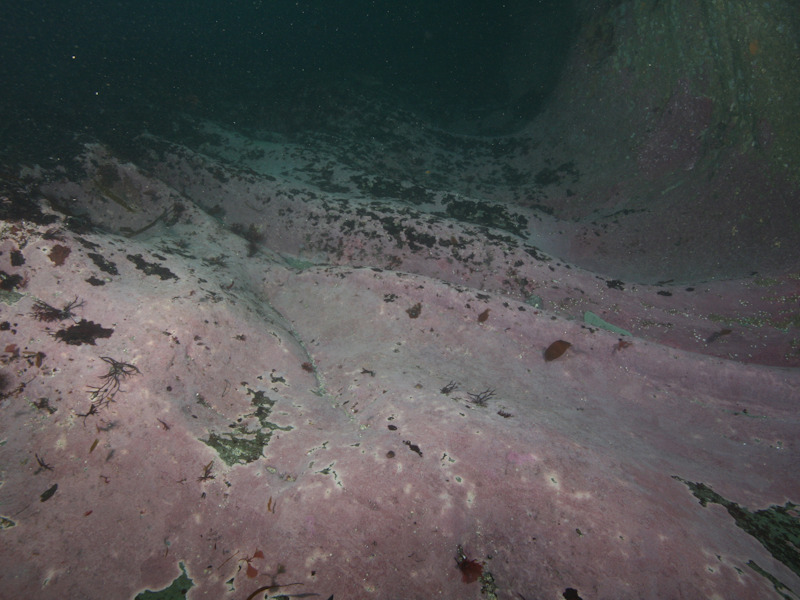
Coralline crusts in surge gullies and scoured infralittoral rock
Photographer: Dr Keith Hiscock Copyright: Dr Keith Hiscock

Map Key
- Orange points: Core Records
- Pale Blue points: Non-core, certain determination
- Black points: Non-core, uncertain determination
- Yellow areas: Predicted habitat extent
| Researched by | George Charalambides & Dr Heidi Tillin | Refereed by | Admin |
|---|
Summary
UK and Ireland classification
Description
Scoured rock in wave-surged caves, tunnels or gullies often looks rather bare and may be characterized by a limited scour-tolerant fauna of Balanus crenatus and/or Spirobranchus (Pomatoceros) triqueter with spirorbid polychaetes. In areas where sufficient light is available and scour is severe, encrusting coralline algae and non-calcareous crusts cover the rock surface, giving a pink appearance. This biotope most commonly occurs at the bottom of walls in caves and gullies, where abrasion by cobbles and stones is severe, especially during winter. In some gullies, extreme scouring and abrasion produce a narrow band of bare coralline algal crust at the very bottom of the walls, with a band of Spirobranchus (Pomatoceros) triqueter and/or Balanus crenatus immediately above. Other scour-tolerant species, such as encrusting bryozoans, may also be common. Crevices and cracks in the rock provide a refuge for sponge crusts such as Halichondria panicea and occasional anemones Urticina felina and Cylista elegans. More mobile fauna is usually restricted to the echinoderms Asterias rubens and Echinus esculentus, as well as the crab Cancer pagurus. Two variants have been identified: wave-surged bedrock with coralline crust Balanus crenatus and Spirobranchus triqueter (CC.BalSpi) and coralline crusts on mobile boulders in severely scoured caves (CC.Mo) (JNCC, 2015, 2022).
Depth range
0-5 m, 5-10 m, 10-20 mAdditional information
-
Sensitivity review
Sensitivity characteristics of the habitat and relevant characteristic species
Two variants of this biotope have been identified: wave-surged bedrock with coralline crust, Balanus crenatus and Spirobranchus (as Pomatoceros) triqueter (CC.BalSpi) and coralline crusts on mobile boulders in severely scoured caves (CC.Mo). The sensitivity assessments presented for this biotope focus on the barnacle, tubeworm and coralline crusts and the assessments are considered applicable to both variants. Although other species may be associated with this biotope, such as anemones and sponges, these are present in low abundances and are not considered to be characterizing and are not considered within the assessments.
Severe abrasion resulting from scouring by cobbles and pebbles are key factors structuring the biotope, and significant alteration to scouring is likely to change the character of the biotope. Where pressures may alter this factor, this is identified and discussed within the sensitivity assessments.
A 'coralline crust' is a generic term in the UK biotopes that refers to non-geniculate (crustose) species from the family Corallinaceae that could include Lithophyllum incrustans, which is noted to form thick crusts in tidepools, especially in the south-west (Adey & Adey, 1973), as well as Lithothamnion spp. and Phymatolithon spp.
Resilience and recovery rates of habitat
Although ubiquitous in marine coastal systems, little is understood about the taxonomy, biology, and ecology of the associated crustose corallines (Littler & Littler, 2013). A 'coralline crust' is a generic term in the UK biotopes that refers to non-geniculate (crustose) species from the family Corallinaceae that could include Lithophyllum incrustans, which is noted to form thick crusts in tidepools, especially in the south-west (Adey & Adey, 1973), as well as Lithothamnion spp. and Phymatolithon spp. The assessments for encrusting corallines are generic due to the lack of evidence for individual species, although species-specific information is presented where available.
Edyvean & Ford (1984a & b; 1986; 1987) describe aspects of reproduction and growth of encrusting coralline, Lithophyllum incrustans. Studies by Edyvean & Forde (1987) in populations of Lithophyllum incrustans in Pembroke, south-west Wales, suggest that reproduction occurs on average early in the third year. Reproduction may be sexual or asexual. Populations release spores throughout the year, but abundance varies seasonally, with the populations studied in Cullercoats Bay and Lannacombe Bay (North East and South West England, respectively) producing fewer spores in the summer. Spore release is initiated by changes in temperature or salinity (see relevant pressure information) at low tide so that spore dispersal is restricted to within the tide pool, enhancing local recruitment. Within subtidal biotopes, this is not possible, and recruitment success may be altered, although this may be compensated for by avoidance of desiccation. Spore survival is extremely low, with only a tiny proportion of spores eventually recruiting to the adult population (Edyvean & Ford, 1986). However, high-latitude studies have shown that Lithothamnion spp. can release spores and recruit successfully even during the polar night, suggesting that settlement is not strictly light-dependent and may occur over extended seasonal windows (Ronowicz et al., 2024; Sowa et al., 2023). The spores are released from structures on the surface called conceptacles; these are formed annually and are subsequently buried by the new layer of growth. Plants can be aged by counting the number of layers of conceptacles.
Edyvean & Ford (1984a) found that the age structure of populations sampled from Orkney (Scotland), Berwick (northern England), and Devon (England) were similar. Mortality seemed highest in younger year classes, with surviving individuals after the age of 10 years appearing relatively long-lived (up to 30 years). In St Mary’s Northumberland, the population was dominated by the age six-to-seven-year classes (Edyvean & Ford, 1984a). Growth rates were highest in young plants measured at Pembroke (south-west Wales), with an approximate increase in diameter of plants of 24 mm in year class 0 and 155 mm in year one, and slowing towards an annual average horizontal growth rate of 3 mm/year (Edyvean & Ford, 1987).
Some repair of damaged encrusting coralline occurs through vegetative growth. Chamberlain (1996) observed that although Lithophyllum incrustans was quickly affected by oil during the Sea Empress spill, recovery occurred within about a year. The oil was found to have destroyed about one-third of the thallus thickness, but regeneration occurred from thallus filaments below the damaged area. Recolonization by propagules is an important recovery mechanism. Airoldi (2000) observed that encrusting coralline algae recruited rapidly onto experimentally cleared subtidal rock surfaces in the Mediterranean Sea, reaching up to 68% cover in two months.
Laboratory studies indicate that environmental context strongly mediates resilience. For example, under combined temperature–pH stress, nutrient enrichment enhanced calcification in Lithophyllum incrustans (Qui-Minet et al., 2019), while recovery of photosynthetic function was observed following chemical stressors such as hydrogen peroxide exposure, although structural damage persisted (Legrand et al., 2022). Similarly, short-term multi-stressor experiments on congeneric rhodoliths (Lithophyllum sp.) showed rapid recovery of photosynthetic performance once stressors were removed (Koerich et al., 2021). These findings suggest that while crustose corallines are sometimes sensitive to disturbance, they may demonstrate considerable capacity for recovery under favourable conditions.
Spirobranchus triqueter is a species of serpulid worm that forms encrusting tubes, typically 2 to 3 cm long, on rock and shell surfaces. Once settled onto the substratum, the worm forms a temporary, delicate, semi-transparent tube. Mature tubes are formed by a secretion of calcium carbonate. The growth rate was observed by Dons (1927) to be 1.5 mm per month, although this varies with external conditions. Hayward & Ryland (1995) and Dons (1927) stated that sexual maturity is reached in approximately four months. Spirobranchus triqueter lives for two to four years (Dons, 1927; Castric-Fey, 1983; Hayward & Ryland, 1995a). Spirobranchus triqueter is also a visually dominant species within mobile and/or disturbed biotopes, e.g. SS.SCS.CCS.SpiB (Connor et al., 2004; JNCC, 2022), indicating this species is either highly resilient to physical disturbance or has a rapid recolonization rate. In agreement, Hiscock (1983) noted that a community, under conditions of scour and abrasion from stones and boulders moved by storms, developed into a community consisting of fast-growing species such as Spirobranchus triqueter. Furthermore, Michaelis et al. (2019) noted a shift in epibenthic assemblages of hard substrata habitats (particularly at less disturbed sites) in the German Bight from short-lived taxa (<5 years), like Spirobranchus triqueter, to long-lived taxa (>5 years), like Flustra foliacea.
Despite being short-lived, Spirobranchus triqueter have a very long reproductive period (with unpredictable peaks, more frequent from late summer to autumn), have a high reproduction rate, are broadcast spawners, and are therefore likely to have large dispersal capacity (Fava, Ponti & Abbiati, 2016). Larvae are pelagic for about two to three weeks in the summer. However, in the winter, this amount of time increases to about two months (Hayward & Ryland, 1995). The time of reproduction is variable. Hayward & Ryland (1995) and Segrove (1941) suggested that Spirobranchus triqueter reproduction probably takes place throughout the year, but peaks in spring and summer. However, Moore (1937) noted that Spirobranchus triqueter breeding only took place in April in Port Erin, Isle of Man. Castric-Fey (1983) studied variations in settlement rate and concluded that, although the species settled all year round, a very rare settlement was observed during winter and maximum settlement occurred in April, June, August and Sept-Oct. Studies in Bantry Bay, Ireland, revealed a single peak in recruitment during summer (especially July and August) with very little recruitment at other times of the year (Cotter et al., 2003). Also, Spirobranchus triqueter is a protandrous hermaphrodite, with older, larger individuals more likely to be female (Cotter et al., 2003). Spirobranchus triqueter settlers exhibit gregarious behaviour, so the first recruiters may favour the fast growth of local populations (Klockner, 1976 cited in Fava, Ponti & Abbiati, 2016).
Spirobranchus triqueter is also a primary fouling organism (Crisp, 1965) colonizing artificial, commercially important structures such as buoys, ship hulls, docks, and offshore oil rigs (OECD, 1967). Spirobranchus triqueter is a pioneer species and commonly the initial recruit to new substrata (Sebens, 1985; Sebens, 1986; Hatcher, 1998).
For example, Fava, Ponti & Abbiati (2016) noted in a recruitment study in the Northern Adriatic Continental Shelf that Spirobranchus, along with the bivalve Anomia ephippium, were the first species to colonize the set out bare travertine tiles. The experiment lasted three years (January 2006 to August 2008), and within the first month, the most abundant taxa were serpulid polychaetes, mainly Spirobranchus triqueter (6.5 ± 0.8%), and by June 2006, Spirobranchus triqueter coverage reached 19.5 ± 2.2% (Fava, Ponti & Abbiati, 2016). During the first 10 months of the experiment, Spirobranchus triqueter was the most abundant species, and the early stages of recruitment lasted 10 to 12 months, by which time even species from natural substrata began colonizing tiles by settlement of planktonic propagules (e.g., encrusting calcareous Rhodophyta) or by lateral encroachment (e.g., sponges and ascidians) (Fava, Ponti & Abbiati, 2016). As many other pioneer species, Spirobranchus triqueter is a poor competitor for space, and it is often overgrown by other organisms (Andersson et al., 2009 cited in Fava, Ponti & Abbiati, 2016), as observed after the first year, despite some recruitment occurring in autumn of the second year (Fava, Ponti & Abbiati, 2016). In addition, Fava, Ponti & Abbiati (2016) highlighted that the relatively low sedimentation rate at the northern site of their study was among one of the environmental conditions that may have favoured settlement and recruitment of Spirobranchus triqueter.
Similarly, Spirobranchus triqueter colonized artificial reefs soon after deployment in summer (Jensen et al., 1994), colonized settlement plates within 2 to 3.5 months and dominated spring recruitment (Hatcher, 1998). Nerlovic et al. (2018) studied the composition of biofouling communities in the northern Adriatic Sea, Croatia. Significant differences in the composition of biofouling assemblages were detected between depths (1 and 5 m) and at the larger spatial scale (tens of km). In addition, the biofouling community showed different patterns in relation to the time of immersion (2, 4, 6 and 8 months). Spirobranchus triqueter was the most frequent taxon (between 92.09 and 94.19%) across all four sampling times of immersion at 1 and 5 m deep, and Spirobranchus triqueter was particularly abundant throughout the whole experiment at both locations and at both depths, but were more abundant at 5 m deep (Nerlovic et al., 2018). Comparable frequency and abundance results for these species were obtained for biofouling communities of the Adriatic and Mediterranean Sea (Raby et al. 1994, Saldanha et al. 2003, Hammond and Griffiths 2004, and Sarà et al. 2007 cited in Nerlovic et al., 2018).
Fortic et al. (2021) studied the temporal changes of the fouling community on brick plates in Piran Bay, Gulf of Trieste (northern Adriatic Sea), for two years. The dominant taxonomic groups observed were bryozoans, which accounted for almost half of the total coverage (46%), serpulid polychaetes (25%), and bivalves (11%); most of the species belonging to the dominant taxa occurred throughout the year, with peak occurrence in summer (Fortic et al., 2021). High bryozoan coverage characterized the communities placed in winter and spring, while the plates placed in summer and autumn were dominated by serpulid polychaetes, mainly represented by Spirobranchus triqueter (Fortic et al., 2021). Spirobranchus triqueter was the most common species observed, with a 75% frequency of occurrence after one month of submersion (out of 12 plates sampled), and 88% on all plates examined (out of 132 plates sampled) (Fortic et al., 2021). In addition, Spirobranchus triqueter can colonize mobile hard substrata such as marine debris or other organisms (Gündogdu, Çevik & Karaca, 2017; Abelouah et al., 2024). In Northern Norway, Spirobranchus triqueter had a coverage range of 20 to 73% on Buccinum sp. and Littorina sp. shells utilized by Pagurus pubescens (Balazy & Kuklinski, 2018). Settling on mobile species or floating marine debris may aid Spirobranchus dispersal and recovery.
Balanus crenatus is widely distributed across cold and temperate waters of the Northern Hemisphere (Dauvin et al., 2021; Regel, 2024). Balanus crenatus produce a single, large brood annually with peaks in April and May (Luther, 1987); although subsidiary broods may be produced, the first large brood is the most important for larval supply (Barnes & Barnes, 1968). Balanus crenatus has a lifespan of 18 months (Barnes & Powell, 1953) and grows rapidly (except in winter). Monthly growth increments for Balanus crenatus were estimated at 2 mm in body length and 1.35 mm in basal diameter, respectively, and barnacles with a 9.1 to 10 mm body length were approximately seven months old (Dvoretsky & Dvoretsky, 2024).
Balanus crenatus is a typical early colonizer of sublittoral rock surfaces (Kitching, 1937). For example, it heavily colonized a site that was dredged for gravel within seven months (Kenny & Rees, 1994). Dauvin et al. (2021) deployed an experimental artificial structure in March 2014 in the intertidal zone of the Bay of Seine (eastern part of the English Channel), and at intervals of one year until April 2018, i.e., from February 2015 onwards, two blocks were collected in April each year. The abundance of the sessile fauna was very high in 2014 due to the rapid settlement of the barnacle Balanus crenatus, which remained the dominant species throughout the study (Dauvin et al., 2021). The abundance of Balanus crenatus on the blocks reached 33,000 ind./m2 in April 2014, then varied between 800 and 5,500 ind./m2 from 2015 to 2018 (Dauvin et al., 2021). Although a decrease was observed in the number of individuals on the blocks between 2014 and 2018, the abundances were not significantly different compared with the other years, and at the end of the study in 2017 and 2018, the abundances were of the same order of magnitude for the four blocks (Dauvin et al., 2021).
In other studies, Balanus crenatus colonized settlement plates or artificial reefs within one to three months of deployment in summer and became abundant on settlement plates shortly afterwards (Brault & Bourget, 1985; Hatcher, 1998). In addition, the ship, HMS Scylla, was colonized by Balanus crenatus four weeks after sinking in March; the timing of the sinking in March would have ensured a good larval supply from the spring spawning. The presence of adult Balanus crenatus enhances the settlement rate of larvae on artificial panels (Miron et al., 1996), so that surviving adults enhance recovery rates.
Spirobranchus triqueter and Balanus crenatus are both relatively short-lived species that mature rapidly, have long reproductive seasons and produce pelagic larvae. Balanus crenatus and Spirobranchus (studied as Pomatoceros) triqueter can utilise a variety of substrata, including artificial and natural hard substrata, bivalves, and other animals. The life-history traits and broad habitat preferences mean that populations of both species can recover rapidly following disturbance. Off Chesil Bank, UK, the epifaunal community dominated by Spirobranchus triqueter, Balanus crenatus and Electra pilosa decreased in cover in October as it was scoured away in winter storms, and was recolonized in May to June (Warner 1985). Warner (1985) reported that the community did not contain any persistent individuals, being dominated by rapidly colonizing organisms. While larval recruitment was patchy and varied between the years studied, recruitment was sufficiently predictable to result in a dynamic stability, and a similar community was present in 1979, 1980 and 1983 (Warner, 1985). Holme & Wilson (1985) suggested that the fauna of the Balanus-Pomatoceros assemblage in the central English Channel was restricted to rapid-growing colonizers able to settle rapidly and utilize space in short periods of stability in the summer months.
Resilience assessment
Both Balanus crenatus and Spirobranchus triqueter are rapid colonizers and likely to recover quickly, probably within months (Fava, Ponti & Abbiati, 2016; Fortic et al., 2021; Dauvin et al., 2021). Therefore, the resilience of these species is assessed as 'High’ for any level of perturbation. However, while new coralline crustose bases may recruit and develop quickly, the formation of new fronds from these bases and the recovery of the original cover may take longer. Therefore, where resistance is ‘Medium’ or Low’, and parts of the crustose corallines remain, then the biotope resilience is assessed as ‘High’. However, where resistance is ‘Low’ or ‘None’, and the key characterizing crustose corallines are likely to be removed, then resilience is assessed as ‘Medium’.
NB: The resilience and the ability to recover from human-induced pressures is a combination of the environmental conditions of the site, the frequency (repeated disturbances versus a one-off event) and the intensity of the disturbance. Recovery of impacted populations will always be mediated by stochastic events and processes acting over different scales, including, but not limited to, local habitat conditions, further impacts, and processes such as larval supply and recruitment between populations. Full recovery is defined as the return to the state of the habitat that existed prior to impact. This does not necessarily mean that every component species has returned to its prior condition, abundance, or extent, but that the relevant functional components are present and the habitat is structurally and functionally recognizable as the initial habitat of interest. It should be noted that the recovery rates are only indicative of the recovery potential.
Hydrological Pressures
Use [show more] / [show less] to open/close text displayed
| Resistance | Resilience | Sensitivity | |
Temperature increase (local) [Show more]Temperature increase (local)Benchmark. A 5°C increase in temperature for one month, or 2°C for one year (Temperature change pressure definition). EvidenceThis biotope occurs in the subtidal and is, therefore, protected from exposure to air so that the thermal regime is more stable and desiccation is not a factor. Examples of distribution and thermal tolerances tested in laboratory experiments are provided as evidence to support the sensitivity assessment. In general, populations can acclimate to prevailing conditions, which can alter tolerance thresholds, and care should, therefore, be used when interpreting reported tolerances. The encrusting coralline, Lithophyllum incrustans, is close to the northern edge of its reported distribution range in the UK, and found further south than the UK (Kain, 1982; Guiry & Guiry, 2015), and is therefore considered likely to be tolerant of an increase in temperature, particularly in this subtidal biotope, where it is protected from desiccation. Edyvean & Ford (1984b) suggest that populations of Lithophyllum incrustans are affected by temperature changes and salinity, and that temperature and salinity ‘shocks’ induce spawning, but no information on thresholds was provided. Populations of Lithophyllum incrustans were less stable in tide pools with a smaller volume of water, which were more exposed to temperature and salinity changes due to lower buffering capacity. Sexual algae (or their spores) were suggested to be more susceptible than asexual ones to extremes of local environmental variables (temperature, salinity, etc.) as they occurred with greater frequency at sites where temperature and salinity were more stable (Edyvean & Forde, 1984b). In a multidecadal analysis, Fernández (2016) reported that in northern Spain, resurveys of 20 shores previously sampled in 1977 found declines in cold-temperate algae species but increases in warm-temperate taxa, including coralline algae such as Lithophyllum incrustans, suggesting that some crustose corallines may expand under warming conditions. Qui-Minet et al. (2019) tested physiological responses of Lithophyllum incrustans alongside rhodolith-forming Lithothamnion coralloides and Phymatolithon calcareum under a high-emissions future climate scenario (+3 °C, reduced pH; IPCC RCP 8.5) with and without nutrient enrichment. Responses were species-specific and seasonally dependent. In winter, future conditions impaired light harvesting and photoprotective mechanisms in the rhodolith species, and calcification rates declined to net dissolution under low nutrient concentrations, although nutrient enrichment reduced these losses. In contrast, Lithophyllum incrustans showed enhanced calcification in the dark under nutrient enrichment in summer. While all three species displayed higher maximal calcification rates in winter under future conditions, inhibition at high irradiance occurred in Phymatolithon calcareum, and summer calcification dropped in Lithothamnion coralloides. The study highlights how local nutrient and irradiance regimes can mediate coralline responses to climate stressors. Simon-Nutbrown et al. (2020) modelled future distributions of non-geniculate corallines in the UK and predicted significant range contractions under a range of future climate warming predictions, with declines of 38% following an increase of <2°C (IPCC RCP2.6) and 84% under the “worst-case” climate scenario representing a temperature increase of 3°C (IPCC RCP 8.5). Although this biotope is characterized by crustose corallines, several of the species that can occur in this biotope, including Lithothamnion crispatum, Lithothamnion glaciale, and Phymatolithon lusitanicum, can form free-living rhodoliths in addition to crusts, and so studies on their rhodolith forms can provide additional insight into potential physiological responses, albeit with caution given morphological and ecological differences. Koerich et al. (2021) showed that Lithothamnion crispatum rhodoliths off Brazil experienced reduced photosynthetic performance when exposed to combined warming (an increase of 6°C), eutrophication and acidification consistent with worst-case future projections (IPCC RCP 8.5) for five days, but recovered to pre-experiment values within five days once conditions returned to ambient. Species distribution models projected a future range expansion under RCP 8.5. Bélanger & Gagnon (2021) reported that Lithothamnion glaciale rhodoliths from Newfoundland maintained normal growth between approx. 1 and 16°C, with resilience to higher temperatures than normally experienced in situ. Legrand et al. (2017) found that net primary production in Lithothamnion coralloides was not altered by a +3°C treatment, although gross primary production declined at higher winter temperatures. Muñoz et al. (2018) reported that Lithothamnion crispatum showed reduced physiological performance under combined future pH and temperature conditions (30 ± 2°C, pH 7.4), but suggested that their overall biological viability indicated capacity to persist under projected climate change scenarios. Schubert et al. (2019) recorded significant declines (40 to 55%) in calcification of Lithothamnion crispatum at 28°C, although photosynthesis and respiration both increased with temperature. Sordo et al. (2019) found that photosynthesis, calcification, and respiration of Phymatolithon lusitanicum rhodoliths increased with temperature in addition to high CO2. Spirobranchus triqueter is described as a temperate species by Kupriyanova & Badyaev (1998) and is found in both warmer and colder waters than experienced in the UK (De Kluijver et al., 2016). Spirobranchus triqueter is recorded as abundant in sub-tidal habitats of Trondheimsfjord (63°N) (Kukliński & Barnes, 2008); the most northern records for the species are in northern Norway, ca. 70°N (OBIS, 2026). The most southerly records are from the Iberian Peninsula, Spain (Ramos, 2010), as well as from the Alexandria coast of Egypt, Mediterranean Sea (Dorgham et al., 2013). Across this latitudinal gradient, Spirobranchus triqueter is likely to experience a range of temperatures from approximately 5 to 28°C (Seatemperature, 2015). Balanus crenatus is described as a boreal species (Newman & Ross, 1976) and is found throughout the northeast Atlantic from the Arctic to the west coast of France as far south as Bordeaux; east and west coasts of North America and Japan (Dauvin et al., 2021; Regel, 2024). In Queens Dock, Swansea, where the water was on average 10°C higher than average due to condenser effluent, Balanus crenatus was replaced by the subtropical barnacle Balanus amphitrite. After the water temperature cooled, Balanus crenatus returned (Naylor, 1965). The increase in water temperature in Queens Dock was greater than an increase at the pressure benchmark (2 to 5°C). Balanus crenatus has a peak rate of cirral beating at 20°C, and all spontaneous activity ceases at about 25°C (Southward, 1955). The tolerance of Balanus crenatus, collected in the summer (and thus acclimated to higher temperatures), to increased temperatures was tested in the laboratory. The median upper lethal temperature tolerance was 25.2°C (Davenport & Davenport, 2005), confirming the observations of Southward (1955). Merder et al. (2018) conducted a temporal analysis of change in the rocky intertidal community of Ireland based on the raw dataset described in Simkanin et al. (2005), cited in Merder et al. (2018) (all fieldwork was carried out from March to November 2003 by the same two operators). The averaged sea-surface temperature (2000 to 2003) for every site ranged from 9.76 to 13.6°C, and showed a clear differentiation between north-east and south-west, with the south-west consistently approx. 2 to 3°C warmer than the north-east of Ireland (Merder et al., 2018). Balanus crenatus was documented as being restricted to the east (Merder et al., 2018). Balanus crenatus is a low shore specialist and is known to be intolerant of the higher temperatures that could result from heating up of the substratum by insolation at low tide (Southward, 1958, cited in Merder et al., 2018). Merder et al. (2018) noted that the temperature variables presented a largely latitudinal trend, whereas there was a longitudinal (east/west) trend in community composition. In Sayda Bay, Russian Barents Sea, Balanus crenatus experience temperature ranges of 1°C in March to 10°C in June, and during their observations, Dvoretsky & Dvoretsky (2024) noted that Balanus crenatus infestation levels of red king crab were lower in winter, most likely due to less favourable temperature conditions. Sensitivity assessmentTypical surface water temperatures around the UK coast vary seasonally from 4 to 19°C (Huthnance, 2010). The biotope would probably tolerate a 2°C increase in temperature for a year. An acute increase at the pressure benchmark may be tolerated in winter, but a sudden return to typical temperatures could lead to mortalities among acclimated animals. The distribution of Lithophyllum incrustans and other crusting corallines in southern Europe and the Mediterranean suggests that these are tolerant of higher temperatures. Field observations in Australia indicate that crustose coralline cover may decline under prolonged seasonal warming above ~29°C, although carbonate production rates remain stable (Dee et al., 2021), and elevated summer mortality has also been recorded following marine heatwaves (Short et al., 2015). However, the temperatures observed in these studies exceed those assessed under the benchmark. Experimental and modelling studies on rhodolith-forming corallines show broad tolerance to moderate warming but potential declines under more extreme scenarios (e.g. Legrand et al., 2017, 2019; Muñoz et al., 2018; Schubert et al., 2019; Simon-Nutbrown et al., 2020), but these results may not be directly transferable to the crustose forms in this biotope. Spirobranchus triqueter records from the Alexandria coast of Egypt, Mediterranean Sea (Dorgham et al., 2013) indicate the species is unlikely to be affected at the benchmark level. An acute increase of 5°C in summer could be close to the lethal thermal temperature for Balanus crenatus, and the loss of this species would alter the character of the biotope, although it would remain recognizable as seasonal scour probably causes seasonal change in the abundance of the component species. Biotope resistance is, therefore, assessed as ‘Medium’, resilience as ‘High’, and biotope sensitivity as ‘Low’. | MediumHelp | HighHelp | LowHelp |
Temperature decrease (local) [Show more]Temperature decrease (local)Benchmark. A 5°C decrease in temperature for one month, or 2°C for one year (Temperature change pressure definition). EvidenceThis biotope occurs in the subtidal and is therefore protected from exposure to air, so that the thermal regime is more stable and desiccation is not a factor. Examples of distribution and thermal tolerances tested in laboratory experiments are provided as evidence to support the sensitivity assessment. In general, populations can acclimate to prevailing conditions, which can alter tolerance thresholds, and care should, therefore, be used when interpreting reported tolerances. Lithophyllum incrustans are close to the northern edge of their reported distribution range in the UK (Guiry & Guiry, 2015). Edyvean & Forde (1984b) suggest that populations of Lithophyllum incrustans are affected by temperature changes and salinity, and that temperature and salinity ‘shocks’ induce spawning, but no information on thresholds was provided (Edyvean & Ford, 1984b). Although this biotope is characterized by crustose corallines, several of the species that can occur in this biotope, including Lithothamnion crispatum, Lithothamnion glaciale, and Phymatolithon lusitanicum, can form free-living rhodoliths in addition to crusts, and so studies on their rhodolith forms can provide additional insight into potential physiological responses, albeit with caution given morphological and ecological differences. Ronowicz et al. (2024) observed high settlement of Lithothamnion sp. during the polar night in Svalbard, indicating that spore release and colonization can occur at temperatures as low as 1.4°C without solar radiation. Arnold et al. (2022) found that Lithothamnion glaciale rhodoliths maintained normal growth rates when exposed to near-zero temperatures (approx. 0.5 to 1 °C) for 85 days, with irradiance a stronger predictor of growth than temperature. Bélanger & Gagnon (2021) reported that Lithothamnion glaciale rhodolith growth ceased at approx. 0.5 °C in field experiments, but was otherwise unaffected between approx. 1 and 16 °C in mesocosms, suggesting resilience to temperature decreases across a broad range. Spirobranchus triqueter is described as a temperate species by Kupriyanova & Badyaev (1998) and is found in both warmer and colder waters than experienced in the UK (De Kluijver et al., 2016). Spirobranchus triqueter is recorded as abundant in sub-tidal habitats of Trondheimsfjord (63°N) (Kukliński & Barnes, 2008); the most northern records for the species are in northern Norway, ca. 70°N (OBIS, 2026). Averaged across several years, the lowest winter temperature within Trondheimsfjord is 4.9°C (Seatemperature, 2015). Spirobranchus triqueter is unable to build calcareous tubes below 7°C. However, this effect is not considered to lead to mortality in adults at the duration (one month) of the acute pressure benchmark (Thomas, 1940). Intertidal populations of Spirobranchus triqueter were reported to suffer 50% mortality at Mumbles, on the Gower, after the extreme winter of 1962 to 1963 (Crisp, 1964b). However, the decrease in temperature exceeds the pressure benchmark. Mature adults may survive a decrease at the pressure benchmark; however, larvae may not be able to attach to the substratum (Riley & Ballerstedt, 2005) if a temperature decrease co-occurred with cold winter temperatures in the UK. However, settlement is reportedly low during winter (See resilience section), and therefore, the effects on recruitment are likely to be minor. Balanus crenatus is relatively tolerant of lower temperatures. Balanus crenatus is described as a boreal species (Newman & Ross, 1976) and is found throughout the northeast Atlantic from the Arctic to the west coast of France as far south as Bordeaux; east and west coasts of North America and Japan (Dauvin et al., 2021; Regel, 2024). Balanus crenatus was unaffected during the severe winter of 1962 to 1963, when average temperatures were 5 to 6°C below normal (Crisp, 1964a, b). The tolerance of Balanus crenatus collected from the lower intertidal in the winter (and thus acclimated to lower temperatures) to low temperatures was tested in the laboratory. The median lower lethal temperature tolerance was -1.4°C (Davenport & Davenport, 2005). An acute or chronic decrease in temperature, at the pressure benchmark, is therefore unlikely to negatively affect this species. Meadows (1969) noted that the severe winter of 1962 to 1963 decreased sea temperatures at Newcastle but did not affect fauna, including Balanus crenatus, on settlement panels that were deployed in the area. In Sayda Bay, Russian Barents Sea, Balanus crenatus experience temperature ranges of 1°C in March to 10°C in June, and during their observations, Dvoretsky & Dvoretsky (2024) noted that Balanus crenatus infestation levels of red king crab were lower in winter, most likely due to less favourable temperature conditions. Sensitivity assessmentOverall, a long-term chronic change in temperature at the pressure benchmark is considered likely to fall within natural variation and to be tolerated by the characterizing and associated species, although Lithothyllum incrustans may experience reduced growth (as it is primarily a southern species). An acute change at the pressure benchmark is considered unlikely to adversely affect the biotope, as the characterizing species can potentially adapt to a wide range of temperatures experienced in both northern and southern waters (Spirobranchus triqueter) or are found primarily in colder, more northern waters (Balanus crenatus). Lithophyllum incrustans may be less tolerant, but reductions in growth, rather than mortalities, may result. Biotope resistance is, therefore, assessed as ‘Medium’ and resilience as ‘High’, so that sensitivity is assessed as ‘Low’. | MediumHelp | HighHelp | LowHelp |
Salinity increase (local) [Show more]Salinity increase (local)Benchmark. An increase in one MNCR salinity category above the usual range of the biotope or habitat (Salinity regime change pressure definition). EvidenceThe crustose corallines that occur in this biotope may also be found on rocky shores and in rockpools where salinities may fluctuate markedly during exposure to the air. Edyvean & Ford (1984b) suggest that populations of Lithophyllum incrustans are affected by temperature changes and salinity and that temperature and salinity ‘shocks’ induce spawning, but no information on thresholds was provided (Edyvean & Ford, 1984b). Populations of Lithophyllum incrustans were less stable in rockpools with a smaller volume of water that were more exposed to temperature and salinity changes due to lower buffering capacity. Sexual plants (or the spores that give rise to them) were suggested to be more susceptible than asexual plants to extremes of local environmental variables (temperature, salinity, etc.) as they occur with greater frequency at sites where temperature and salinity were more stable (Edyvean & Ford, 1984b). Lyster (1965) tested the tolerance of Spirobranchus triqueter larvae to various hyper- and hypo-salinity treatments. Larvae were placed in cultures ranging from 0 to 90‰, and notes were made on the time taken for larvae to die or begin displaying abnormal behaviour. Spirobranchus triqueter larvae were tolerant of salinities ranging from 20 to 50‰. Salinities above 50‰ caused high mortality. Spirobranchus triqueter is, therefore, unlikely to be affected at the pressure benchmark. Balanus crenatus occurs in both full-salinity environments, such as in Sayda Bay, Russian Barents Sea, where it experiences salinity between 32 psu in summer and 34 psu in winter (Dvoretsky & Dvoretsky, 2024), and estuarine areas, and is therefore adapted to variable salinity (Davenport, 1976). When subjected to sudden changes in salinity, Balanus crenatus closes its opercular valves so that the blood is maintained temporarily at a constant osmotic concentration (Davenport, 1976). Early stages may be more sensitive than adults. Experimental culturing of Balanus crenatus eggs found that viable nauplii larvae were obtained between 25 and 40‰, but eggs did not develop to viable larvae when held at salinities above 40‰, and only a small proportion (7%) of eggs exposed at later stages developed into viable nauplii, and these were not vigorous swimmers (Barnes & Barnes, 1974). When exposed to salinities of 50‰ and 60‰, eggs exposed at an early developmental stage did not produce viable larvae and, again, only a small proportion of eggs (7% and 1%, respectively) exposed at a later developmental stage produced nauplii; these were deformed and probably non-viable. There was no larval development at 70‰ (Barnes & Barnes, 1974). Sensitivity assessmentThis biotope is recorded in full salinity (30 to 35 ppt) habitats (Connor et al., 2004), and the sensitivity assessment considers an increase from full to >40 ppt. Some increases in salinity may be tolerated by the characterizing species. However, the biotope is probably sensitive to an increase in salinity to >40 ppt (based on species distribution in Barnes & Barnes, 1974, and Edyvean & Ford, 1984b). Therefore, resistance is assessed as ‘Low’ and resilience as ‘High’ (following the restoration of prior salinity), so sensitivity is assessed as ‘Low’. | LowHelp | HighHelp | LowHelp |
Salinity decrease (local) [Show more]Salinity decrease (local)Benchmark. A decrease in one MNCR salinity category above the usual range of the biotope or habitat (Salinity regime change pressure definition detail). EvidenceEdyvean & Ford (1984b) suggest that populations of the crustose coralline Lithophyllum incrustans are affected by temperature changes and salinity and that temperature and salinity ‘shocks’ induce spawning, but no information on the relevant thresholds was provided (Edyvean & Ford, 1984b). Populations of Lithophyllum incrustans were less stable in tide pools with a smaller volume of water that were more exposed to temperature and salinity changes due to lower buffering capacity. Sexual plants (or the spores that give rise to them) were suggested to be more susceptible than asexual plants to extremes of local environmental variables (temperature, salinity, etc.) as they occur with greater frequency at sites where temperature and salinity were more stable (Edyvean & Ford, 1984b). Spirobranchus triqueter has not been recorded from brackish or estuarine waters. Therefore, it is likely that the species will be very intolerant of a decrease in salinity. However, Dixon (1985, cited in Riley & Ballerstedt, 2005) views the species as able to withstand significant reductions in salinity. Lyster (1965) tested the tolerance of Spirobranchus triqueter larvae to various hyper- and hypo-salinity treatments. Larvae were placed in cultures ranging from 0 to 90‰, and notes were made on the time taken for larvae to die or begin displaying abnormal behaviour. Spirobranchus triqueter larvae can survive very well in salinities down to 20‰ and can tolerate salinities down to 10‰. Adults are tolerant of salinities as low as 3‰ and can be found in areas where salinity ranges from 18 to 23‰ (Alexander et al., 1935). Spirobranchus triqueter is also present in the biotope CR.MCR.EcCr.UrtScr, which occurs in variable-salinity (as well as full) habitats (Connor et al., 2004). Balanus crenatus occurs in both full-salinity environments, such as in Sayda Bay, Russian Barents Sea, where it experiences salinity between 32 psu in summer and 34 psu in winter (Dvoretsky & Dvoretsky, 2024), and estuarine areas, and is therefore adapted to variable salinity (Davenport, 1976). When subjected to sudden changes in salinity, Balanus crenatus closes its opercular valves so that the blood is maintained temporarily at a constant osmotic concentration (Davenport, 1976). Acclimation to different salinity regimes alters the point at which opercular closure and resumption of activity occur (Davenport, 1976). Balanus crenatus can tolerate salinities down to 14 psu if given time to acclimate (Foster, 1970). At salinities below 6 psu, motor activity ceases, respiration falls, and the animal falls into a "salt sleep". In this state, the animals may survive (Barnes & Barnes, 1974) in freshwater for three weeks, enabling them to withstand changes in salinity over moderately long periods (Barnes & Powell, 1953). Larvae are more sensitive than adults. In culture experiments, eggs maintained below 10‰ rupture due to osmotic stress (Barnes & Barnes, 1974). At 15 to 17‰, there is either no development of early stages or the nauplii larvae are deformed and “probably not viable”; similarly, at 20‰, development occurs, but about half of the larvae are deformed and not viable. (Barnes & Barnes, 1974). Normal development resulting in viable larvae occurs between salinities of 25 to 40‰ (Barnes & Barnes, 1974). Sensitivity assessmentThis biotope is recorded in full salinity (30 to 35 ppt) (Connor et al., 2004; JNCC, 2022). A change from full to reduced salinity (18 to 30 ppt) is assessed at the pressure benchmark. The characterizing species are found in a similar biotope (CR.MCR.EcCr.UrtScr), which is present in variable salinities (Connor et al., 2004). It is therefore likely that the characterizing species will tolerate a reduction in salinity from full to reduced. As the characterizing species are found in biotopes in both full and variable salinity habitats, the biotope is considered ‘Not sensitive’ to a decrease in salinity from full to variable. Biotope resistance is therefore assessed as ‘High’, resilience as ‘High’ (by default), and the biotope is assessed as ‘Not sensitive’. | HighHelp | HighHelp | Not sensitiveHelp |
Water flow (tidal current) changes (local) [Show more]Water flow (tidal current) changes (local)Benchmark. A change in peak mean spring bed flow velocity of between 0.1 m/s and 0.2 m/s for more than one year (Water flow pressure definition). EvidenceThis biotope occurs across a range of flow speeds, from very weak (negligible) to moderately strong (0.5 to 1.5 m/s) (Connor et al., 2004; JNCC, 2022). The suspension feeders within the biotope benefit from high water flow, supplying food. The coralline crusts characterizing this biotope are securely attached, and as these are flat, they are subject to little or no drag compared to upright growth forms of algae. Colonies of Lithophyllum incrustans appear to thrive in conditions exposed to strong water movement (Irvine & Chamberlain, 1994). Spirobranchus triqueter has been recorded in areas with very sheltered to exposed water flow rates (Price et al., 1980; Tillin & Tyler-Walters, 2014). Wood (1988) observed Spirobranchus sp. in strong tidal streams, and Hiscock (1983) found that in strong tidal streams or strong wave action where abrasion occurs, fast-growing species such as Spirobranchus triqueter occur. Balanus crenatus is found in a very wide range of water flows (Tillin & Tyler-Walters, 2014), although it usually occurs in sites sheltered from wave action (Eckman & Duggins, 1993) and can adapt its feeding behaviour according to flow rates. In the absence of any current, the barnacle rhythmically beats its cirri to create a current to collect zooplankton. The growth of Balanus crenatus (measured as an increase in basal area), maintained for 69 days at constant flow speeds in laboratory experiments, was greatest at intermediate flow speeds (0.08 m/s) and decreased at higher speeds (Eckman & Duggins, 1993). Over the entire range of flow speeds measured (0.02 to 0.25 m/s), Balanus crenatus was able to control the cirrus with little or no deformation by flow observed (Eckman & Duggins, 1993). Sensitivity assessmentScour is a key factor structuring this biotope (Connor et al., 2004; JNCC, 2022), so changes in flow exceeding the pressure benchmark may increase or decrease sediment transport and associated scour may lead to indirect changes in the character of the biotope. However, the scour and mobility of the substratum are probably dominated by wave action rather than water flow. As the biotope and the associated species can occur in a range of flow speeds, the resistance of the biotope to changes in water flow is assessed as ‘High’ and resilience as ‘High’ (by default), so that the biotope is assessed as ‘Not sensitive’. | HighHelp | HighHelp | Not sensitiveHelp |
Emergence regime changes [Show more]Emergence regime changesBenchmark. 1) A change in the time covered or not covered by the sea for a period of ≥1 year, or 2) an increase in relative sea level or decrease in high water level for ≥1 year. (Emergence regime change pressure definition). EvidenceNot relevant to subtidal biotopes. However, 100% mortality could be expected in adult Spirobranchus (as Pomatoceros) triqueter after 24.1 h and 35.4 h when exposed to air at 7°C and 13°C, respectively (Campbell & Kelly, 2002).
| Not relevant (NR)Help | Not relevant (NR)Help | Not relevant (NR)Help |
Wave exposure changes (local) [Show more]Wave exposure changes (local)Benchmark. A change in near shore significant wave height of >3% but <5% for more than one year (Wave action pressure definition). EvidenceThis biotope is recorded from locations that range from 'very exposed' to 'exposed' to wave action (Connor et al., 2004; JNCC, 2022). Colonies of Lithophyllum incrustans appear to thrive in conditions exposed to strong water movement. Irvine & Chamberlain (1994) observe that the species is best developed on wave-exposed shores. Roik et al. (2016) reported that calcification rates of crustose coralline algae were up to 8.8 times higher at offshore exposed sites compared with nearshore sheltered sites in the Red Sea, suggesting positive effects of higher wave exposure. In addition, the crustose corallines associated with this biotope have a flat growth form and are unlikely to be dislodged by increased wave action. As this biotope occurs across a range of exposures, this was therefore considered to indicate, by proxy, that biotopes in the middle of the wave exposure range would tolerate either an increase or decrease in significant wave height at the pressure benchmark. Balanus crenatus and Spirobranchus triqueter are suspension feeders relying on water currents to supply food. These taxa, therefore, thrive in conditions of vigorous water flow. Balanus crenatus and Spirobranchus triqueter are firmly attached to the substratum and are unlikely to be dislodged by an increase in wave action at the pressure benchmark. These species are found in biotopes from a range of wave exposures, from extremely wave-sheltered to very wave-exposed (Tillin & Tyler-Walters, 2014). Sensitivity assessmentScour is a key factor structuring this biotope (Connor et al., 2004; JNCC, 2022) and the mobility of the substratum, hence, scour is probably dominated by wave action. Therefore, changes in wave action (wave exposure) could result in significant changes to this biotope. Any activity or pressure that redirected, blocked, or mitigated wave energy reaching the biotope could result in a reduction in scour and reclassification of the biotope. An increase in wave exposure by one category (the benchmark) from very to extremely wave exposed would probably favour the IR.FIR.SG.CC.Mo sub-biotope, which occurs in areas of severe scour (abrasion), and the characteristic Spirobranchus and Balanus species are limited to refugia. However, the IR.FIR.SG.CC biotope would remain identifiable. A decrease in wave exposure from exposed to moderately exposed would result in reduced scour and allow other opportunistic species to colonize the biotope. The biotope would probably transition to IR.FIR.SG.FoSwCC, which occurs on surge gully entrances, or allow crustose sponge biotopes typical of wave-surged gullies (e.g. IR.FIR.SG.CrSp), which can be found above this IR.FIR.SG.CC biotope. However, the transition would depend on the time taken for other species to colonize the biotope and is unlikely to be complete within one year (the benchmark duration). Therefore, resistance is assessed as ‘Medium’ to represent temporary changes in the community. Resilience is probably ‘High’, so sensitivity is assessed as ‘Low’ at the benchmark level. Prolonged reduction in wave action (over one year) would result in loss of the biotope. | MediumHelp | HighHelp | LowHelp |
Chemical Pressures
Use [show more] / [show less] to open/close text displayed
| Resistance | Resilience | Sensitivity | |
Transition elements & organo-metal contamination [Show more]Transition elements & organo-metal contaminationBenchmark. Exposure of marine species or habitat to one or more relevant Transitional metal or organometal (e.g. TBT) contaminants via uncontrolled releases or incidental spills (Transitional metals and organometals pressure definition). EvidenceThis pressure is Not assessed, but any evidence is presented where available. No information was found concerning the effects of heavy metals on encrusting coralline algae. Bryan (1984) suggested that the general order for heavy metal toxicity in seaweeds is: organic Hg> inorganic Hg > Cu > Ag > Zn> Cd> Pb. Contamination at levels greater than the pressure benchmark may adversely impact the biotope. Cole et al. (1999) reported that Hg was very toxic to macrophytes. The sub-lethal effects of Hg (organic and inorganic) on the sporelings of an intertidal red algae, Plumaria elegans, were reported by Boney (1971). 100% growth inhibition was caused by 1 ppm Hg. Contamination at levels greater than the pressure benchmark may adversely impact the biotope. Barnacles accumulate heavy metals and store them as insoluble granules (Rainbow, 1987). Pyefinch & Mott (1948) recorded a median lethal concentration of 0.19 mg/l copper and 1.35 mg/l mercury for Balanus crenatus over 24 hours. Barnacles may tolerate fairly high levels of heavy metals in nature, for example, they are found in Dulas Bay, Anglesey, where copper reaches concentrations of 24.5 µg/l due to acid mine waste (Foster et al., 1978). | Not Assessed (NA)Help | Not assessed (NA)Help | Not assessed (NA)Help |
Hydrocarbon & PAH contamination [Show more]Hydrocarbon & PAH contaminationBenchmark. Exposure of marine species or habitat to one or more relevant hydrocarbon or polyaromatic hydrocarbon (PAH) contaminants via uncontrolled releases or incidental spills (Hydrocarbon & PAH pressure definition). EvidenceThis pressure is Not assessed, but any evidence is presented where available Where exposed to direct contact with fresh hydrocarbons, encrusting coralline algae appear to have a high intolerance. Crump et al. (1999) described 'dramatic and extensive bleaching' of 'Lithothamnia' following the Sea Empress oil spill. Observations following the Don Marika oil spill (K. Hiscock, pers. comm.) were of rockpools with completely bleached coralline algae. However, Chamberlain (1996) observed that although Lithophyllum incrustans was affected in a short period of time by oil during the Sea Empress spill, recovery occurred within about a year. The oil was found to have destroyed about one-third of the thallus thickness, but regeneration occurred from thallus filaments below the damaged area. No information is available on the intolerance of Balanus crenatus to hydrocarbons. However, other littoral barnacles generally have a high tolerance to oil (Holt et al., 1995) and were little impacted by the Torrey Canyon oil spill (Smith, 1968), so Balanus crenatus is probably fairly resistant to oil. | Not Assessed (NA)Help | Not assessed (NA)Help | Not assessed (NA)Help |
Synthetic compound contamination [Show more]Synthetic compound contaminationBenchmark. Exposure of marine species or habitat to one or more synthetic compound contaminants via uncontrolled releases or incidental spills (Synthetic compound contamination pressure definition). EvidenceThis pressure is Not assessed, but any evidence is presented where available. Cole et al. (1999) suggested that herbicides were (not surprisingly) very toxic to algae and macrophytes. Hoare & Hiscock (1974) noted that, with the exception of Phyllophora species, all red algae, including encrusting coralline forms, were excluded from the vicinity of an acidified halogenated effluent discharge in Amlwch Bay, Anglesey and that intertidal populations of Corallina officinalis occurred in significant numbers only 600 m east of the effluent. Chamberlain (1996) observed that although Lithophyllum incrustans was quickly affected by oil during the Sea Empress spill, recovery occurred within about a year. The oil was found to have destroyed about one-third of the thallus thickness, but regeneration occurred from thallus filaments below the damaged area. Barnacles have a low resilience to chemicals such as dispersants, dependent on the concentration and type of chemical involved (Holt et al., 1995). They are less intolerant than some species (e.g. Patella vulgata) to dispersants (Southward & Southward, 1978) and Balanus crenatus was the dominant species on pier pilings at a site subject to urban sewage pollution (Jakola & Gulliksen, 1987). Hoare & Hiscock (1974) found that Balanus crenatus survived near an acidified halogenated effluent discharge where many other species were killed, suggesting a high tolerance to chemical contamination. Little information is available on the impact of endocrine disrupters on adult barnacles. Holt et al. (1995) concluded that barnacles are fairly sensitive to chemical pollution, therefore, intolerance is reported as high. The species is an important early colonizer of sublittoral rock surfaces (Kitching, 1937), and it heavily recolonized a site that was dredged for gravel within seven months (Kenny & Rees, 1994). Therefore, recovery is predicted to be high. Most pesticides and herbicides were suggested to be very toxic to invertebrates, especially crustaceans (amphipods, isopods, mysids, shrimp and crabs) and fish (Cole et al., 1999). | Not Assessed (NA)Help | Not assessed (NA)Help | Not assessed (NA)Help |
Radionuclide contamination [Show more]Radionuclide contaminationBenchmark. An increase in 10µGy/h above background levels (Radionuclides contamination pressure definition). EvidenceNo evidence. | No evidence (NEv)Help | Not relevant (NR)Help | No evidence (NEv)Help |
Introduction of other substances [Show more]Introduction of other substancesBenchmark. Exposure of marine species or habitat to one or more relevant "other" substances (solid, liquid or gas) contaminants via uncontrolled releases or incidental spills (Introduction of other substances pressure definition). EvidenceThis pressure is Not assessed. | Not Assessed (NA)Help | Not assessed (NA)Help | Not assessed (NA)Help |
De-oxygenation [Show more]De-oxygenationBenchmark. Exposure to dissolved oxygen concentration of less than or equal to 2 mg/l for one week (a change from WFD poor status to bad status) (deoxygenation pressure definition). EvidenceSpecific information concerning oxygen consumption and reduced oxygen tolerances was not found for the key characterizing species within the biotope. It is likely that, as this biotope occurs in areas that are shallow and tidally flushed, re-oxygenation is likely, limiting the effects of any de-oxygenation events. However, this may mean that the species present have little exposure to low oxygen and may be sensitive to this pressure. In general, respiration in most marine invertebrates does not appear to be significantly affected until extremely low concentrations are reached. For many benthic invertebrates, this concentration is about 2 ml/l, or even less (Herreid, 1980; Rosenberg et al., 1991; Diaz & Rosenberg, 1995). Balanus crenatus, however, respires anaerobically, so it can withstand some decrease in oxygen levels. When placed in wet nitrogen, where oxygen stress is maximal and desiccation stress is minimal, Balanus crenatus has a mean survival time of 3.2 days (Barnes et al., 1963), and this species is probably ‘Not sensitive’ to this pressure. Sensitivity assessmentBased on Balanus crenatus and the mitigation of de-oxygenation by strong water movements, this biotope is considered to have 'High' resistance and 'High' resilience (by default) and is, therefore, assessed as 'Not sensitive' at the benchmark level. | HighHelp | HighHelp | Not sensitiveHelp |
Nutrient enrichment [Show more]Nutrient enrichmentBenchmark. Increased levels of the elements nitrogen, phosphorus, silicon, and iron in the marine environment compared to background concentrations (Nutrient enrichment pressure definition). EvidenceNutrient enrichment at the pressure benchmark is unlikely to affect the fauna within this biotope. Over geological timescales, periods of increased nutrient availability have experienced increases in the distribution of crustose coralline species at the expense of corals (Littler & Littler, 2013), suggesting that this group have some tolerance for enhanced nutrient levels. For example, the encrusting coralline Lithophyllum incrustans was present at sites dominated by Ulva spp. in the Mediterranean exposed to high levels of nutrient enrichment from domestic sewage (Arévalo et al., 2007). However, Bélanger & Gagnon (2020) found that Lithothamnion glaciale rhodoliths grew two times slower under elevated nutrient concentrations in mesocosms (NO₃⁻: 10.2 to 29.5 µmol/l; NH₃: 14.4 to 33.9 µmol/l; PO₄³⁻: 2.9 to 5 µmol/l compared with ambient NO₃⁻: 3.2 µmol/l, NH₃: 3.5 µmol/l, PO₄³⁻: 0.6 µmol/l). In field experiments, growth was also reduced under elevated phosphate (1.2 µmol/l vs. ambient 0.4 µmol/l), although some recovery was observed after the first six weeks. Koerich et al. (2021) reported that Lithothamnion crispatum showed reduced photosynthetic performance when exposed to combined warming (+6°C), acidification (pH 7.7), and nutrient enrichment (70 µM ammonium, 14 µM nitrate, 10 µM phosphate) for five days, but recovered after returning to ambient conditions. Qui-Minet et al. (2019) showed that nutrient enrichment (PO₄³⁻: 0.8 to 1.2 µmol/l in winter, 0.9 to 1.7 µmol/l in summer; NO₃⁻: 30 to 50 µmol/l in winter, 25 to 55 µmol/l in summer) reduced dissolution of Lithothamnion corallioides and Phymatolithon calcareum in winter under future climate scenarios, and enhanced dark calcification in Lithophyllum incrustans in summer. Schubert et al. (2019) found that nutrient concentration (ambient: NO₃⁻ 2.0 µmol/l, NH₄⁺ 1.1 µmol/l, PO₄³⁻ 1.6 µM; enriched: NO₃⁻ 21 µmol/l, NH₄⁺ 70 µmol/l, PO₄³⁻ 4 µmol/l) had no significant effect on photosynthesis or respiration in Lithothamnion crispatum, but when combined with high temperature (28°C vs. 23°C) the negative effects were additive, reducing daily carbonate production. Overall, Littler & Littler (2013) suggest that corallines as a group can tolerate both low and elevated levels of nutrients. Balanus crenatus and Spirobranchus triqueter are suspension feeders relying on water currents to supply food. Nutrient enrichment of coastal waters that enhances the population of phytoplankton may be beneficial to both species in terms of an increased food supply, but the effects are uncertain (Hartnoll, 1998). However, high primary productivity in the water column combined with high summer temperature and the development of thermal stratification (which prevents mixing of the water column) can lead to hypoxia of the bottom waters. Balanus crenatus was the dominant species on pier pilings, which were subject to urban pollution (Jakola & Gulliksen, 1987). Sensitivity assessmentLimited evidence on the effects of nutrient enrichment on the characteristic species was found. The evidence suggests that the characteristic species vary in their response to nutrients. However, the evidence is ‘Insufficient’ to form the basis of an assessment. | Insufficient evidence (IEv)Help | Not relevant (NR)Help | Help |
Organic enrichment [Show more]Organic enrichmentBenchmark. A deposit of 100 gC/m2/yr (Organic enrichment pressure definition). EvidenceAs the biotope occurs in tide-swept or wave-exposed areas (Connor et al., 2004), water movements will disperse organic matter and reduce the level of exposure to this pressure. For example, the crusting coralline Lithophyllum incrustans was present at sites dominated by Ulva spp. in the Mediterranean exposed to high levels of organic pollution from domestic sewage (Arévalo et al., 2007), suggesting the encrusting corallines are not sensitive to this pressure. The animals found within the biotope may be able to utilise the input of organic matter as food, or are likely to be tolerant of inputs at the benchmark level. In a recent review, assigning species to ecological groups based on tolerances to organic pollution, characterizing animal species, Balanus crenatus and Spirobranchus triqueter were assigned to AMBI Group II, described as 'species indifferent to enrichment, always present in low densities with non-significant variations with time, from initial state to slight unbalance' (Gittenberger & Van Loon, 2011). Sensitivity assessmentIt is not clear whether the pressure benchmark would lead to enrichment effects in this dynamic, scoured habitat. High water movements would disperse organic matter particles, mitigating the effect of this pressure. This biotope is probably ‘Not sensitive’ to this pressure, based on the AMBI categorisation (Borja et al., 2000; Gittenberger & Van Loon, 2011). Although species within the biotope may be sensitive to gross organic pollution resulting from sewage disposal and aquaculture, they are considered to have ‘High’ resistance to the pressure benchmark, which represents organic enrichment and therefore ‘High’ resilience, so that the biotope is assessed as ‘Not Sensitive’. | HighHelp | HighHelp | Not sensitiveHelp |
Physical Pressures
Use [show more] / [show less] to open/close text displayed
| Resistance | Resilience | Sensitivity | |
Physical loss (to land or freshwater habitat) [Show more]Physical loss (to land or freshwater habitat)Benchmark. A permanent loss of existing saline habitat within the site (Physical loss pressure definition). EvidenceAll marine habitats and benthic species are considered to have a resistance of ‘None’ to this pressure and to be unable to recover from a permanent loss of habitat (resilience is ‘Very Low’). Sensitivity within the direct spatial footprint of this pressure is, therefore, ‘High’. Although no specific evidence is described, confidence in this assessment is ‘High’, due to the incontrovertible nature of this pressure. | NoneHelp | Very LowHelp | HighHelp |
Physical change (to another seabed type) [Show more]Physical change (to another seabed type)Benchmark. Permanent change from sedimentary or soft rock substrata to hard rock or artificial substrata, or vice versa (Physical change in subtratum type pressure definition). EvidenceIn the absence of a hard substratum, crustose corallines can propagate as free-living rhodolith nodules and can form extensive subtidal habitats (Littler & Little, 2013). However, these biogenic reefs are not analogous to this habitat type. The loss of hard substrata would remove the habitat, and sediments would be unsuitable for the crustose corallines and other attached algae that characterize this biotope. Balanus crenatus and Spirobranchus triqueter. These species were reported from a variety of substratum types, including fine (muddy sand, sandy mud, and fine sands) and coarse sediments, where some hard surfaces (such as pebbles or shells) are present for the attached species (Tillin & Tyler-Walters, 2014). Spirobranchus triqueter is also known to colonize floating marine debris, mostly favouring plastics (Gündogdu, Çevik & Karaca, 2017; Abelouah et al., 2024). Balanus crenatus and Spirobranchus triqueter are fouling organisms and occur on a wide variety of substrata (Harms & Anger, 1983; Andersson et al., 2009). As well as artificial and natural hard substrata, Balanus crenatus and Spirobranchus triqueter also encrust a range of invertebrates. For example, Spirobranchus triqueter has been recorded on the hermit crab, Pagurus bernhardus (Fernandez-Leborans & Gabilondo, 2006). In Northern Norway, Spirobranchus triqueter had a coverage range of 20 to 73% on Buccinum sp. and Littorina sp. shells utilized by Pagurus pubescens (Balazy & Kuklinski, 2018). Similarly, Balanus crenatus has been reported to encrust empty shells of the invasive non-indigenous species Ensis americanus (Donovan, 2011) and Carcinus maenas (Heath, 1976; Campos et al., 2022), and the red king crab Paralithodes camtschaticus (Dvoretsky & Dvoretsky, 2024). Settling on mobile species or floating marine debris may aid Balanus crenatus and Spirobranchus triqueter dispersal and recovery. Sensitivity assessmentA permanent change in substratum type to artificial or sedimentary would lead to the reclassification of the biotope. Biotope resistance to this pressure is therefore assessed as ‘None’ (loss of >75% of extent), as the change at the benchmark is permanent, and resilience is assessed as ‘Very low’. Sensitivity, based on combined resistance and resilience, is therefore assessed as ‘High’. | NoneHelp | Very LowHelp | HighHelp |
Physical change (to another sediment type) [Show more]Physical change (to another sediment type)Benchmark. Permanent change in one Folk class (based on UK SeaMap simplified classification) (Physical change in sediment type pressure definition). EvidenceNot relevant to biotopes occurring on bedrock. | Not relevant (NR)Help | Not relevant (NR)Help | Not relevant (NR)Help |
Habitat structure changes - removal of substratum (extraction) [Show more]Habitat structure changes - removal of substratum (extraction)Benchmark. The extraction of substratum to 30 cm (where substratum includes sediments and soft rock but excludes hard bedrock) (Removal of substratum pressure definition). EvidenceThe species characterizing this biotope are epifauna occurring on rock and would be sensitive to the removal of the habitat. However, extraction of rock substratum is considered unlikely, and this pressure is considered to be ‘Not relevant’ to hard substratum habitats. | Not relevant (NR)Help | Not relevant (NR)Help | Not relevant (NR)Help |
Abrasion / disturbance of the surface of the substratum or seabed [Show more]Abrasion / disturbance of the surface of the substratum or seabedBenchmark. Damage to surface features (e.g. species and physical structures within the habitat) (Surface abrasion/disturbance pressure definition). EvidenceThe species characterizing this biotope occur on the rock and therefore have no protection from surface abrasion. High levels of abrasion from scouring by mobile sands and gravels are an important structuring factor in this biotope (Connor et al., 2004; JNCC, 2022) and prevent replacement by less scour-tolerant species, such as red algae. Mechanical abrasion from scuba divers was reported to impact encrusting corallines, with cover of Lithophyllum stictaeforme greater in areas where diving was forbidden than in visited areas (abundance, 6.36 vs 1.4; it is presumed this refers to proportion of cover, although this is not clear from the text, Guarinieri et al., 2012). Dethier (1994) manipulated surface abrasion on a range of encrusting algae experimentally, including Lithophyllum impressum. Crusts were brushed with either a nylon or steel brush for one minute each month for 24 months. Unbrushed controls grew by approximately 50%, whereas the cover of nylon-brushed crusts and steel-brushed crusts decreased by approximately 25% and 40%, respectively (interpreted from figures in Dethier, 1994). In laboratory tests on chips of Lithophyllum impressum, brushing with a steel brush for one minute once a week for three weeks resulted in no cover loss in two samples, while a third ‘thinned and declined’ (Dethier, 1994). Hiscock (1983) noted that a community, under conditions of scour and abrasion from stones and boulders moved by storms, developed into a community consisting of fast-growing species such as Spirobranchus (formerly Pomatoceros) triqueter. Off Chesil Bank, UK, the epifaunal community dominated by Spirobranchus (as Pomatoceros) triqueter and Balanus crenatus decreased in cover in October as it was scoured away in winter storms, but recolonized in May to June (Gorzula, 1977). Warner (1985) reported that the community did not contain any persistent individuals, but that recruitment was sufficiently predictable to result in a dynamic stability and a similar community, dominated by Spirobranchus (as Pomatoceros triqueter), Balanus crenatus, and Electra pilosa (an encrusting bryozoan), as was present in 1979, 1980, and 1983 (Warner,1985). Fishing disturbance is unlikely to affect species on cave and gully walls. However, it can be looked at as an example of how epifaunal communities react to scour. For example, Picton & Goodwin (2007) noted that an area of boulders with a rich fauna of sponges and hydroids on the east coast of Rathlin Island, Northern Ireland, was significantly altered since the 1980s. Scallop dredging had begun in 1989, and boulders were observed to have been turned and the gravel harrowed. In addition, many of the boulders had disappeared, and rare hydroid communities were greatly reduced (Picton & Goodwin, 2007). Furthermore, re-sampling of fishing grounds that were historically studied (from the 1930s) indicated that some encrusting species, including serpulid worms and several species of barnacles, had decreased in abundance in gravel substrata subject to long-term scallop fishing (Bradshaw et al., 2002). These may have been adversely affected by the disturbance of the stones and dead shells onto which they attach (Bradshaw et al., 2002). Where individuals are attached to mobile pebbles, cobbles, and boulders rather than bedrock, surfaces can be displaced and turned over, preventing feeding and leading to smothering. This observation is supported by experimental trawling, carried out in shallow, wave-disturbed areas using a toothed clam dredge, which found that Spirobranchus sp. decreased in intensively dredged areas over the monitoring period (Constantino et al., 2009). In contrast, a study of Spirobranchus spp. aggregations found that the tube heads were not significantly affected by biannual beam trawling in the eastern Irish Sea (Kaiser et al., 1999). No changes in the number or size of serpulid tube heads were apparent throughout the study, and no significant changes were detectable in the composition of the tube head fauna that could be attributed to fishing disturbance (Kaiser et al., 1999). Subsequent laboratory experiments on collected tube heads found that these were unlikely to resettle on the seabed in an orientation similar to that prior to disturbance (Kaiser et al., 1999). This may lead to the death of resident serpulids and sessile associated fauna. Sensitivity assessmentThe impact of surface abrasion will depend on the footprint, duration, and magnitude of the pressure. High levels of abrasion from scouring by mobile cobbles and pebbles are an important structuring factor in this biotope (Connor et al., 2004; JNCC, 2022), and the persistence of the assemblage probably depends on rapid recovery rather than high resistance (Gorzula, 1977). The evidence for the effects of severe scour and trawling on Balanus crenatus and Spirobranchus triqueter suggests that resistance to a single abrasion event is ‘Low’, but resilience is ‘High’, so that sensitivity is assessed as ‘Low’, based on the information for these species and the characterizing Coralline spp. | LowHelp | HighHelp | LowHelp |
Penetration or disturbance of the substratum subsurface [Show more]Penetration or disturbance of the substratum subsurfaceBenchmark. Damage to sub-surface features (e.g. species and physical structures within the habitat) (Sub-surface penetration pressure definition). EvidenceThe species characterizing this biotope group are epifauna or epiflora occurring on rock, which is resistant to subsurface penetration. The assessment for abrasion at the surface only is, therefore, considered to equally represent sensitivity to this pressure. | Not relevant (NR)Help | Not relevant (NR)Help | Not relevant (NR)Help |
Changes in suspended solids (water clarity) [Show more]Changes in suspended solids (water clarity)Benchmark. A change in one rank on the WFD (Water Framework Directive) scale, e.g. from clear to intermediate for one year (Suspended sediment pressure definition). EvidenceThis biotope occurs in scoured habitats, and it is likely, depending on local sediment supply, that the biotope is exposed to chronic or intermittent episodes of high levels of suspended solids as local sediments are re-mobilised and transported. A significant increase in suspended solids may result in smothering (see siltation pressures) where these are deposited. Based on Cole et al. (1999) and Devlin et al. (2008), this biotope is considered to experience intermediate turbidity (10 to 100 mg/l) based on UK TAG (2014). An increase at the pressure benchmark refers to a change to medium turbidity (100-300 mg/l), and a decrease is assessed as a change to clear (<10 mg/l) based on UK TAG (2014). The biotope occurs in shallow waters where light attenuation due to increases in turbidity is probably low, and the characterizing animals are unlikely to be affected by increased or decreased clarity. Encrusting coralline algae, especially, are known to be shade-tolerant and are common components of the understorey on seaweed-dominated shores. Therefore, an increase or decrease in light intensity is unlikely to adversely affect the crustose corallines, as plants can acclimate to different light levels. Legrand et al. (2021) reported that the deposition of salmon faeces at a depositional flux of 15 g/m2 per day, equivalent to locations between 100 and 200 m from a high-capacity salmon farm, reduced light by 60% in mesocosms, resulting in a 94% decline in calcification rates of Lithophyllum soriferum rhodoliths over six weeks. An accumulation of sediment within the turf may attract more sediment-dwelling interstitial invertebrates such as nematodes, harpacticoids, and polychaetes, although in wave-exposed locations, accumulation of sediment is likely to be minimal. Increased suspended sediment may also result in increased scour, which may adversely interfere with settling spores and recruitment if the factor is coincident with their major reproductive period. However, coralline algae, especially the crustose forms, are thought to be resistant to sediment scour (Littler & Kauker, 1984) and will probably not be adversely affected at the benchmark level. Recoverability is likely to be very high as species are likely to remain in situ, from which recruitment can occur. An increase in turbidity could be beneficial if the suspended particles are composed of organic matter. However, high levels of suspended solids with increased inorganic particles may reduce filter-feeding efficiencies. A reduction in suspended solids will reduce food availability for filter-feeding species in the biotope (where the solids are organic), although effects are not likely to be lethal over the course of a year. A reduction in light penetration could also reduce the growth rate of phytoplankton and so limit zooplankton levels. However, light penetration itself is unlikely to be an important factor as both Balanus crenatus and Spirobranchus triqueter are recorded from the lower eulittoral or the lower circalittoral. Available evidence indicates that Spirobranchus triqueter is tolerant of a wide range of suspended sediment concentrations (Riley & Ballerstedt, 2005). Stubbings and Houghton (1964) recorded Spirobranchus (as Pomatoceros) triqueter in Chichester Harbour, UK, which is a muddy environment. However, Spirobranchus (as Pomatoceros) triqueter has also been noted to occur in areas where there is little or no silt present (Price et al., 1980). According to Bacescu (1972), sabellids are accustomed to turbidity and silt. Spirobranchus triqueter has also recently been recorded by De Kluijver (1993) from Scotland in the aphotic zone, indicating that the species would not be sensitive to an increase in turbidity. Barnes & Bagenal (1951) found that the growth rate of Balanus crenatus epizoic on Nephrops norvegicus was considerably slower than that of animals on raft-exposed panels. This was attributed to reduced currents and increased silt loading of water in the immediate vicinity of Nephrops norvegicus. In dredge disposal areas in the Weser estuary, Germany, where turbidity is 35% above the natural rate of 10 to 100 mg/l, the abundance of Balanus crenatus was lower than in reference areas (Witt et al., 2004). Separating the effect of increased suspended solids from increased sedimentation and changes in sediment from sediment dumping is problematic (Witt et al., 2004). Balanids may stop filtration after silt layers of a few millimetres have been discharged (Witt et al., 2004), as the feeding apparatus is very close to the sediment surface. This community is unlikely to be dependent on suspended sediment. A reduction in suspended sediment will probably reduce the risk of scour and reduce food availability for the suspension-feeding species in the biotope (e.g. barnacles and sabellids present), although effects are not likely to be lethal. Sensitivity assessmentOverall biotope resistance is assessed as ‘High’ to an increase in suspended solids. Resilience is assessed as ‘High’ (by default), as adults are likely to remain in situ, from which recruitment can occur. Hence, the biotope is assessed as ’Not sensitive’ to decreased suspended solids. | HighHelp | HighHelp | Not sensitiveHelp |
Smothering and siltation rate changes (light) [Show more]Smothering and siltation rate changes (light)Benchmark. ‘Light’ deposition of up to 5 cm of fine material added to the seabed in a single discrete event (Smothering pressure definition). EvidenceThe characterizing species occur in biotopes subject to sedimentation and scour (such as CR.MCR.EcCr.UrtScr) and are therefore likely to tolerate intermittent episodes of sediment movement and deposition. At the pressure benchmark, ‘light deposition’ represents a low thickness of deposit (5 cm) but could still completely bury the characterizing species. Removal of ‘light’ sediments by wave action and tidal currents would be quick but could result in scour. The effect of this pressure will be mediated by the length of exposure to the deposit and the nature of the deposit. In a review of the effects of sedimentation on rocky coast assemblages, Airoldi (2003) outlined the evidence for the sensitivity of encrusting coralline algae to sedimentation. The reported results are contradictory, with some authors suggesting that coralline algae are negatively affected by sediments while others report that encrusting corallines are often abundant or even dominant in a variety of sediment-impacted habitats (Airoldi, 2003). Encrusting coralline algae, especially, are known to be shade-tolerant and are common components of the understorey on seaweed-dominated shores. Therefore, an increase or decrease in light intensity is unlikely to adversely affect the crustose corallines, as plants can acclimate to different light levels. While studying coralligenous assemblages of the Apulian continental shelf in the Mediterranean Sea, Piazzi et al. (2019) found that sedimentation was higher on deep outcrops and suggested that it was the main driver of differences between shallow and deep assemblages. Furthermore, in these areas of high sedimentation, an abundance of stress-tolerant organisms was observed, such as the anemone Parazoanthus axinellae (Piazzi et al., 2019). Legrand et al. (2021) reported that the deposition of salmon faeces at a depositional flux of 15 g/m2 per day, equivalent to locations between 100 and 200 m from a high-capacity salmon farm, reduced light by 60% in mesocosms, resulting in a 94% decline in calcification rates of Lithophyllum soriferum rhodoliths over six weeks. An accumulation of sediment within the turf may attract more sediment-dwelling interstitial invertebrates such as nematodes, harpacticoids, and polychaetes, although in more wave-exposed locations, accumulation of sediment is likely to be minimal. Increased suspended sediment may also result in increased scour, which may adversely interfere with settling spores and recruitment if the factor is coincident with their major reproductive period. However, coralline algae, especially the crustose forms, are thought to be resistant to sediment scour (Littler & Kauker, 1984) and will probably not be adversely affected at the benchmark level. Recoverability is likely to be very high as species are likely to remain in situ, from which recruitment can occur. Crustose corallines have been reported to survive under a turf of filamentous algae and sediment for 58 days (the duration of the experiment) in the Galapagos (species not identified, Kendrick, 1991). The crustose coralline Hydrolithon reinboldii has also been reported to survive deposition of silty sediments on subtidal reefs off Hawaii (Littler, 1973). In an experimental study, Balata et al. (2007) enhanced sedimentation on experimental plots in the Mediterranean (close to Tuscany) by adding 400 g of fine sediment every 45 days on plots of 400 cm2 for one year. Nearby sites with higher and lower levels of sedimentation were assessed as control plots. Some clear trends were observed. Crustose corallines declined at medium and high levels of sedimentation (Balata et al., 2007). The experiment relates to chronic low levels of sedimentation rather than a single acute event, as in the pressure benchmark, however, the trends observed are considered to have some relevance to the pressure assessment. As small, sessile species attached to the substratum, siltation at the pressure benchmark would bury Balanus crenatus and Spirobranchus triqueter. Spirobranchus triqueter is sessile and thus would be unable to avoid the deposition of a smothering layer of sediment. Furthermore, Spirobranchus triqueter are an encrusting species, and depending on retention time, sediment could block larval settlement. Available evidence indicates that Spirobranchus triqueter is tolerant of a wide range of suspended sediment concentrations (Riley & Ballerstedt, 2005). Stubbings and Houghton (1964) recorded Spirobranchus (as Pomatoceros) triqueter in Chichester Harbour, UK, which is a muddy environment. However, Spirobranchus (as Pomatoceros) triqueter has also been noted to occur in areas where there is little or no silt present (Price et al., 1980). According to Bacescu (1972), sabellids are accustomed to turbidity and silt. Spirobranchus triqueter has also recently been recorded by De Kluijver (1993) from Scotland in the aphotic zone, indicating that the species would not be sensitive to an increase in turbidity. Holme & Wilson (1985) described a Pomatoceros-Balanus assemblage on ‘hard surfaces subjected to periodic severe scour and ‘deep submergence by sand or gravel’ in the English Channel. They inferred that the Pomatoceros-Balanus assemblage was restricted to fast-growing settlers able to establish themselves in short periods of stability during summer months (Holme & Wilson, 1985), as all fauna were removed in the winter months. Barnacles may stop filtration after silt layers of a few millimetres have been discharged, as the feeding apparatus is very close to the sediment surface (Witt et al., 2004). In dredge disposal areas in the Weser estuary, Germany, where the modelled exposure to sedimentation was 10 mm for 25 days, with the centre of the disposal ground exposed to 65 mm for several hours before dispersal, Balanus crenatus declined in abundance compared to reference areas (Witt et al., 2004). However, separating the effect of sedimentation from increased suspended solids and changes in sediment from sediment dumping was problematic (Witt et al., 2004). Sensitivity assessmentThis biotope is IR.FIR.SG.CC and its sub-biotopes (CC.Mo & CC.BalSpi) are described as subject to significant scour (Connor et al., 2004; JNCC, 2022). The biotope occurs on the walls of caves and gullies, above the floor of coarse sediments (cobbles and stones) (JNCC, 2022), where the step or vertical surfaces would be immune to smothering and the high-energy water flow would remove a deposit of fine sediment within one tidal cycle. Therefore, resistance has been assessed as ‘High’, and resilience as ‘High’. Sensitivity has been assessed as ‘Not Sensitive’. | HighHelp | HighHelp | Not sensitiveHelp |
Smothering and siltation rate changes (heavy) [Show more]Smothering and siltation rate changes (heavy)Benchmark. ‘Heavy’ deposition of up to 30 cm of fine material added to the seabed in a single discrete event (Smothering pressure definition). EvidenceThe characterizing species occur in biotopes subject to sedimentation and scour (such as CR.MCR.EcCr.UrtScr) and are therefore likely to tolerate intermittent episodes of sediment movement and deposition. At the pressure benchmark, ‘light deposition’ represents a low thickness of deposit (30 cm) but could still completely bury the characterizing species. Removal of ‘light’ sediments by wave action and tidal currents would be quick but could result in scour. The effect of this pressure will be mediated by the length of exposure to the deposit and the nature of the deposit. In a review of the effects of sedimentation on rocky coast assemblages, Airoldi (2003) outlined the evidence for the sensitivity of encrusting coralline algae to sedimentation. The reported results are contradictory, with some authors suggesting that coralline algae are negatively affected by sediments, while others report that encrusting corallines are often abundant or even dominant in a variety of sediment-impacted habitats (Airoldi, 2003). Encrusting coralline algae, especially, are known to be shade-tolerant and are common components of the understorey on seaweed-dominated shores. Therefore, an increase or decrease in light intensity is unlikely to adversely affect the crustose corallines, as plants can acclimate to different light levels. While studying coralligenous assemblages of the Apulian continental shelf in the Mediterranean Sea, Piazzi et al. (2019) found that sedimentation was higher on deep outcrops and suggested that it was the main driver of differences between shallow and deep assemblages. Furthermore, in these areas of high sedimentation, an abundance of stress-tolerant organisms was observed, such as the anemone Parazoanthus axinellae (Piazzi et al., 2019). Legrand et al. (2021) reported that the deposition of salmon faeces at a depositional flux of 15 g/m2 per day, equivalent to locations between 100 and 200 m from a high-capacity salmon farm, reduced light by 60% in mesocosms, resulting in a 94% decline in calcification rates of Lithophyllum soriferum rhodoliths over six weeks. An accumulation of sediment within the turf may attract more sediment-dwelling interstitial invertebrates such as nematodes, harpacticoids, and polychaetes, although in more wave-exposed locations, accumulation of sediment is likely to be minimal. Increased suspended sediment may also result in increased scour, which may adversely interfere with settling spores and recruitment if the factor is coincident with their major reproductive period. However, coralline algae, especially the crustose forms, are thought to be resistant to sediment scour (Littler & Kauker, 1984) and will probably not be adversely affected at the benchmark level. Recoverability is likely to be very high as species are likely to remain in situ, from which recruitment can occur. Crustose corallines have been reported to survive under a turf of filamentous algae and sediment for 58 days (the duration of the experiment) in the Galapagos (species not identified, Kendrick, 1991). The crustose coralline Hydrolithon reinboldii has also been reported to survive deposition of silty sediments on subtidal reefs off Hawaii (Littler, 1973). In an experimental study, Balata et al. (2007) enhanced sedimentation on experimental plots in the Mediterranean (close to Tuscany) by adding 400 g of fine sediment every 45 days on plots of 400 cm2 for one year. Nearby sites with higher and lower levels of sedimentation were assessed as control plots. Some clear trends were observed. Crustose corallines declined at medium and high levels of sedimentation (Balata et al., 2007). The experiment relates to chronic low levels of sedimentation rather than a single acute event, as in the pressure benchmark, however, the trends observed are considered to have some relevance to the pressure assessment. As small, sessile species attached to the substratum, siltation at the pressure benchmark would bury Balanus crenatus and Spirobranchus triqueter. Spirobranchus triqueter is sessile and thus would be unable to avoid the deposition of a smothering layer of sediment. Furthermore, Spirobranchus triqueter are an encrusting species, and depending on retention time, sediment could block larval settlement. Available evidence indicates that Spirobranchus triqueter is tolerant of a wide range of suspended sediment concentrations (Riley & Ballerstedt, 2005). Stubbings and Houghton (1964) recorded Spirobranchus (as Pomatoceros) triqueter in Chichester Harbour, UK, which is a muddy environment. However, Spirobranchus (as Pomatoceros) triqueter has also been noted to occur in areas where there is little or no silt present (Price et al., 1980). According to Bacescu (1972), sabellids are accustomed to turbidity and silt. Spirobranchus triqueter has also recently been recorded by De Kluijver (1993) from Scotland in the aphotic zone, indicating that the species would not be sensitive to an increase in turbidity. Holme & Wilson (1985) described a Pomatoceros-Balanus assemblage on ‘hard surfaces subjected to periodic severe scour and ‘deep submergence by sand or gravel’ in the English Channel. They inferred that the Pomatoceros-Balanus assemblage was restricted to fast-growing settlers able to establish themselves in short periods of stability during summer months (Holme & Wilson, 1985), as all fauna were removed in the winter months. Barnacles may stop filtration after silt layers of a few millimetres have been discharged, as the feeding apparatus is very close to the sediment surface (Witt et al., 2004). In dredge disposal areas in the Weser estuary, Germany, where the modelled exposure to sedimentation was 10 mm for 25 days, with the centre of the disposal ground exposed to 65 mm for several hours before dispersal, Balanus crenatus declined in abundance compared to reference areas (Witt et al., 2004). However, separating the effect of sedimentation from increased suspended solids and changes in sediment from sediment dumping was problematic (Witt et al., 2004). Sensitivity assessmentThis biotope is IR.FIR.SG.CC and its sub-biotopes (CC.Mo & CC.BalSpi) are described as subject to significant scour (Connor et al., 2004; JNCC, 2022). The biotope occurs on the walls of caves and gullies, above the floor of coarse sediments (cobbles and stones) (JNCC, 2022), where the step or vertical surfaces would be immune to smothering and the high-energy water flow would remove a deposit of fine sediment within one tidal cycle. Therefore, resistance has been assessed as ‘High’, and resilience as ‘High’. Sensitivity has been assessed as ‘Not Sensitive’. | HighHelp | HighHelp | Not sensitiveHelp |
Litter [Show more]LitterBenchmark. The introduction of man-made objects able to cause physical harm (surface, water column, seafloor or strandline) (Litter pressure definition). EvidenceAll characterizing species for this biotope are sessile encrusting epifauna. Fishing disturbance is unlikely to affect species on cave and gully walls. However, ghost fishing from discarded or lost gear could be responsible for damage to epifaunal communities (Sheehan et al., 2017; Giusti et al., 2019). In addition, Spirobranchus triqueter is also known to colonize floating marine debris, mostly favouring plastics (Gündogdu, Çevik & Karaca, 2017; Abelouah et al., 2024). Settling on floating marine debris may aid Spirobranchus dispersal and recovery. There are no records of ghost fishing affecting the characterizing species for this biotope. However, epifaunal communities are vulnerable to damage from fishing gear, and are likely vulnerable to being dislodged or damaged through lost fishing gear, and possibly certain types of marine litter. At present, there is 'Insufficient evidence' to complete a sensitivity assessment on the effect of litter on this biotope. | Insufficient evidence (IEv)Help | Not relevant (NR)Help | Help |
Electromagnetic changes [Show more]Electromagnetic changesBenchmark. A local electric field of 1 V/m or a local magnetic field of 10 µT (Electromagnetic pressure definition). EvidenceEvidence on the effect of electromagnetic fields (EMFs) on benthic organisms is still severely lacking. Some studies have investigated the effect of anthropogenically induced EMFs on benthic invertebrates at intensities ranging between 2 nT and 40 mT, which is often much higher than in-situ measurements from subsea cables. While some report changes to behaviour, physiology, reproduction, development, immunology, cytotoxicity and orientation, others demonstrate no effect from exposure to the EMF (Albert et al., 2020; Hutchison et al., 2020), depending on the study species and duration and intensity of exposure. There have been no studies investigating the effect of EMFs at the population or community level for benthic organisms. No studies have examined the effect of EMFs on the characterizing species. However, one study was performed on the reef-forming annelid, Ficopomatus enigmaticus (Oliva et al., 2023). Sperm cells from this species were exposed to 0.5 and 1.0 mT of a static magnetic field. After only three hours of exposure, sperm fertilization rate was reduced, and significant increases in DNA damage and mitochondrial activity, indicative of a stress response, were reported. However, there is ‘Insufficient evidence’ on which to base an assessment of the likely sensitivity of this biotope to EMFs. | Insufficient evidence (IEv)Help | Not relevant (NR)Help | Help |
Underwater noise changes [Show more]Underwater noise changesBenchmark. MSFD indicator levels (SEL or peak SPL) exceeded for 20% of days in a calendar year. Further detail EvidenceNot relevant | Not relevant (NR)Help | Not relevant (NR)Help | Not relevant (NR)Help |
Introduction of light or shading [Show more]Introduction of light or shadingBenchmark. A change in incident light via anthropogenic means (Introduced light or shade pressure definition). EvidenceEncrusting corallines can occur in deeper water than other algae, where light penetration is limited. Spiecker & Menge (2024) reported that shading increased crustose algal cover by between 22 and 32% in a New Zealand field experiment, depending on grazer presence. Arnold et al. (2022) found that Lithothamnion glaciale rhodoliths in Newfoundland grew steadily across irradiances from 0.02 to 0.78 mol photons/m²/day, indicating broad light tolerance. Bélanger & Gagnon (2021) reported that Lithothamnion glaciale rhodoliths maintained similar growth rates at 15 m and 25 m depth, despite approx. 60% lower irradiance, showing high light-use efficiency. Sowa et al. (2023) found that crustose corallines dominated experimental settlement plates during the winter in Svalbard. Similarly, Ronowicz et al. (2024) observed high settlement of crustose Lithothamnion sp. during the polar night in Svalbard, indicating that reproduction and recruitment can occur without solar radiation and confirming adaptation to very low light conditions. However, Tâmega & Figueiredo (2019) found that low light inhibited the growth of Porolithon onkodes and Lithophyllum stictaeforme, while Porolithon onkodes dominated high-light environments and grew faster, indicating species-specific responses. Legrand et al. (2021) found that salmon faeces deposition at 15 g/m²/day reduced light by approx. 60% in mesocosms and led to a 94% decline in calcification and 41% lower net primary production of Lithothamnion soriferum rhodoliths after six weeks. Samples of Lithophyllum impressum suspended from a raft and shaded (50 to 75% light reduction) continued to grow over two years (Dethier, 1994). Similarly, Plocamium cartilagineum grows in shaded conditions beneath laminarian canopies, where irradiance is greater, growth is lower, and it appears that light levels of 0.5 mmol/m2/s are inhibitory (Kain, 1987). In areas of higher light levels, the fronds and bases may be lighter in colour due to bleaching (Colhart & Johansen, 1973). Other red algae in the biotope are flexible regarding light levels and can also acclimate to different light levels. Spirobranchus triqueter is found in a variety of light environments, from shallow sublittoral biotopes where light levels are relatively high, to deeper sites that are aphotic (De Kluijver, 1993). Balanus crenatus possesses a rudimentary eye and can detect and respond to sudden shading, which may be an anti-predator defence (Forbes et al., 1971). Balanus crenatus tend to orient themselves when settling, with the least light-sensitive area directed towards the light (Forbes et al., 1971), so that the more sensitive area can detect shading from predator movements in the area where light availability is lower (Forbes et al., 1971). It should be noted that, since 2016, research on artificial light at night (ALAN) has expanded rapidly. ALAN alters benthic communities, algal cover, and ecological interactions in coastal systems (reviewed in Marangoni et al., 2022; Ferretti et al., 2025), with experimental studies demonstrating effects on algal assemblages under both increased and reduced light conditions (Schaefer et al., 2025; Trethewy et al., 2023). Although no studies have tested direct effects on any of the characterizing species, the assumption that light is an insignificant pressure is no longer supported by the wider evidence base. Sensitivity assessmentAlthough Spirobranchus triqueter and Balanus crenatus are demonstrably tolerant of variation in natural light and shade (Forbes et al., 1971; De Kluijver, 1993), and crustose and rhodolith-forming corallines also show broad tolerance of natural light variation, with growth and recruitment maintained under shading and very low light (e.g. Bélanger & Gagnon 2021; Arnold et al., 2022; Sowa et al., 2023; Ronowicz et al., 2024), there is now substantial evidence that artificial light at night (ALAN) alters coastal communities and trophic interactions, including algal assemblages (e.g. Marangoni et al., 2022; Trethewy et al., 2023; Ferretti et al., 2025; Schaefer et al., 2025). As no studies have tested direct effects on any of the characterizing species, the sensitivity of this biotope to the introduction of light via anthropogenic means is assessed as ‘Insufficient evidence’. | Insufficient evidence (IEv)Help | Not relevant (NR)Help | Help |
Barrier to species movement [Show more]Barrier to species movementBenchmark. A permanent or temporary barrier to species movement over ≥50% of water body width or a 10% change in tidal excursion (Barrier to species movement pressure definition). EvidenceBarriers that reduce the degree of tidal excursion may alter larval supply to suitable habitats from source populations. Conversely, the presence of barriers may enhance local population supply by preventing the loss of larvae from enclosed habitats. Barriers and changes in the tidal excursion are not considered relevant to the characterizing crusting corallines, as species dispersal is limited by the rapid rate of settlement and vegetative growth from bases rather than reliance on recruitment from outside populations. Resistance to this pressure is assessed as 'High' and resilience as 'High' by default. This biotope is therefore considered to be 'Not sensitive'. | HighHelp | HighHelp | Not sensitiveHelp |
Death or injury by collision [Show more]Death or injury by collisionBenchmark. Injury or mortality from collisions of biota with both static or moving structures due to 0.1% of tidal volume on an average tide, passing through an artificial structure (Death for collision pressure definition). Evidence'Not relevant' to seabed habitats. NB. Collision by grounding vessels is addressed under surface abrasion | Not relevant (NR)Help | Not relevant (NR)Help | Not relevant (NR)Help |
Visual disturbance [Show more]Visual disturbanceBenchmark. The daily duration of transient visual cues exceeds 10% of the period of site occupancy by the feature (Visual disturbance pressure definition). EvidenceMany invertebrate species within the biotope probably respond to light levels, detecting shade and shadow to avoid predators and day length in their behavioural or reproductive strategies. However, their visual acuity is probably very limited, and they are unlikely to respond to a visual disturbance at the benchmark level. This pressure is, therefore, assessed as ‘Not relevant’. Balanus crenatus possesses a rudimentary eye and can detect and respond to sudden shading, which may be an anti-predator defence (Forbes et al., 1971). Balanus crenatus tend to orient themselves when settling, with the least light-sensitive area directed towards the light (Forbes et al., 1971), so that the more sensitive area can detect shading from predator movements in the area where light availability is lower (Forbes et al., 1971). | Not relevant (NR)Help | Not relevant (NR)Help | Not relevant (NR)Help |
Biological Pressures
Use [show more] / [show less] to open/close text displayed
| Resistance | Resilience | Sensitivity | |
Genetic modification & translocation of indigenous species [Show more]Genetic modification & translocation of indigenous speciesBenchmark. Translocation of indigenous species or the introduction of genetically modified or genetically different populations of indigenous species may result in changes in the genetic structure of local populations, hybridization, or a change in community structure (Translocation pressure definition). EvidenceKey characterizing species within this biotope are not cultivated or translocated. This pressure is therefore considered ‘Not relevant’ to this biotope group. | Not relevant (NR)Help | Not relevant (NR)Help | Not relevant (NR)Help |
Introduction of microbial pathogens [Show more]Introduction of microbial pathogensBenchmark. The introduction of relevant microbial pathogens or metazoan disease vectors to an area where they are currently not present (e.g. Martelia refringens and Bonamia, Avian influenza virus, viral Haemorrhagic Septicaemia virus) (pathogen or disease pressure definition). EvidenceNo evidence was found that microbial pathogens cause high levels of disease or mortality in this biotope. Diseased encrusting corallines were first observed in the tropics in the early 1990s when the bacterial pathogen Coralline Lethal Orange Disease (CLOD) was discovered (Littler & Littler, 1995). All species of articulated and crustose species tested to date are easily infected by CLOD, and it has been increasing in occurrence at sites where it was first observed and spreading through the tropics. Another bacterial pathogen causing a similar CLOD disease has been observed with a greater distribution, and a black fungal pathogen first discovered in American Samoa has been dispersing (Littler & Littler, 1998). An unknown pathogen has also been reported to lead to white ‘target-shaped’ marks on corallines, again in the tropics (Littler et al., 2007). No evidence was found that these pathogens are impacting temperate coralline habitats. Sensitivity assessment. Based on the lack of reported mortalities of the characterizing species and the available evidence for the characterizing coralline crust, the biotope is judged to have ‘High’ resistance to this pressure. By default, resilience is assessed as ‘High’, and the biotope is classed as ‘Not sensitive’ at the pressure benchmark. | HighHelp | HighHelp | Not sensitiveHelp |
Removal of target species [Show more]Removal of target speciesBenchmark. Removal of species targeted by fishery, shellfishery or harvesting at a commercial or recreational scale (targeted removal pressure definition). EvidenceDirect, physical impacts from harvesting are assessed through the abrasion and penetration of seabed pressures. The sensitivity assessment for this pressure considers any biological/ecological effects resulting from the removal of target species from this biotope. No commercial application or harvesting of characterizing or associated species are described in the literature. Hence, this pressure is considered to be 'Not relevant'. | Not relevant (NR)Help | Not relevant (NR)Help | Not relevant (NR)Help |
Removal of non-target species [Show more]Removal of non-target speciesBenchmark. Removal of features or incidental non-targeted catch (by-catch) through targeted fishery, shellfishery or harvesting at a commercial or recreational scale (non-targeted removed pressure definition). EvidenceIncidental removal of the key characterizing species would alter the character of the biotope, resulting in reclassification and the loss of species richness. The ecological services such as primary and secondary production, provided by characterizing and associated species, would also be lost. As most species present in this biotope are relatively large, conspicuous, and either sedentary or attached to rock surfaces, they have little protection against removal. Sensitivity assessmentRemoval of a large percentage of the characterizing species resulting in bare rock would alter the character of the biotope, species richness and ecosystem function. Therefore, resistance is assessed as ‘Low’ and resilience as ‘Medium’ (based on the removal of coralline crusts), so that biotope sensitivity is assessed as 'Medium’. | LowHelp | MediumHelp | MediumHelp |
Introduction or spread of invasive non-indigenous species (INIS) Pressures
Use [show more] / [show less] to open/close text displayed
| Resistance | Resilience | Sensitivity | |
The American slipper limpet, Crepidula fornicata [Show more]The American slipper limpet, Crepidula fornicataEvidenceCrepidula fornicata larvae require hard substrata for settlement. It prefers muddy, gravelly, shell-rich substrata that include gravel, the shells of other Crepidula, or other species, e.g., oysters and mussels. It is highly gregarious and seeks out adult shells for settlement, forming characteristic ‘stacks’ of adults. But it also recorded from rock, artificial substrata, and Sabellaria alveolata reefs (Blanchard, 1997, 2009; Bohn et al., 2012, 2013a, 2013b, 2015; De Montaudouin et al., 2018; Hinz et al., 2011; Helmer et al., 2019; Powell-Jennings & Calloway, 2018; Preston et al., 2020; Tillin et al., 2020). Close examination of the literature (2023) shows that evidence of its colonization and density on bedrock in the infralittoral or circalittoral was lacking. Tillin et al. (2020) suggested that Crepidula could colonize circalittoral rock due to its presence on tide-swept rough grounds at 60 metres in the English Channel (Hinz et al., 2011). However, Hinz et al. (2011) reported that Crepidula fornicata only dominated one assemblage (with an average of 181 individuals per trawl) on a gravel substratum with boulders. Bohn et al. (2015) noted that Crepidula occurred at low density or was absent in areas dominated by boulders. Bohn et al. (2013a, 2013b, 2015) and Preston et al. (2020) showed that while Crepidula could settle on slate panels or ‘stone’, it preferred shell, especially that of conspecifics. In addition, no evidence was found of the effect of Crepidula populations on faunal turf-dominated habitats. It was only recorded at low density (0.1-0.9/m2) in one faunal turf biotope (CR.MCR.CFaVS.CuSpH.As) (JNCC, 2015). Faunal turfs are dominated by suspension feeders, so larval predation is probably high, which may prevent colonization by Crepidula. Also, faunal turf species actively compete for space, and many are fast-growing and opportunistic, so they may out-compete Crepidula for space even if it gained a foothold in the community. Sensitivity assessmentThe wave-exposed infralittoral rock and high levels of scour characterizing this biotope is likely to be unsuitable for the colonization by Crepidula fornicata. Crepidula has been recorded from areas of strong tidal streams (Hinz et al., 2011) and has been recorded from the lower intertidal to ca 160 m in depth, but it is most common in the shallow subtidal above 50 m (Blanchard, 1997; Thieltges et al., 2003; Bohn et al., 2012, 2015; Hinz et al., 2011; OBIS, 2023; Tillin et al., 2020). However, no evidence was found of the effect of Crepidula populations on coralline crust-dominated habitats. As scouring of this biotope by mobile sediments limits the establishment of all but robust species, resistance to Crepidula fornicata is assessed as ‘High’ and resilience as ‘High’ (by default), so that the biotope is assessed as ‘Not sensitive’. | HighHelp | HighHelp | Not sensitiveHelp |
The carpet sea squirt, Didemnum vexillum [Show more]The carpet sea squirt, Didemnum vexillumEvidenceThe carpet sea squirt Didemnum vexillum (syn. Didemnum vestitum; Didemnum vestum) is a colonial ascidian with rapidly expanding populations that have invaded most temperate coastal regions around the world (Kleeman, 2009; Stefaniak et al., 2012; Tillin et al., 2020). It is an ‘ecosystem engineer’ that can change or modify invaded habitats and alter biodiversity (Griffith et al., 2009; Mercer et al., 2009). Didemnum vexillum has colonized and established populations in the northeast Pacific, Canadian and USA coast; New Zealand; France, Spain, and the Wadden Sea, Netherlands; the Mediterranean Sea and Adriatic Sea (Bullard et al., 2007; Coutts & Forrest, 2007; Dijkstra et al., 2007; Valentine et al., 2007a; Valentine et al., 2007b; Lambert, 2009; Hitchin, 2012; Tagliapietra et al., 2012; Gittenberger et al., 2015; Vercaemer et al., 2015; McKenzie et al., 2017; Cinar & Ozgul, 2023; Holt, 2024). In the UK, Didemnum vexillum has colonized Holyhead marina and Milford Haven, Wales; the west coast of Scotland (marinas around Largs, Clyde, Loch Creran and Loch Fyne), South Devon (Plymouth, Yealm, and Dartmouth estuaries), the Solent, northern Kent, Essex, and Suffolk coasts (Griffith et al., 2009; Lambert, 2009; Hitchin, 2012; Minchin & Nunn, 2013; Bishop et al., 2015; McKenzie et al., 2017; Tillin et al., 2020, Holt, 2024; NBN, 2024). Although a widespread invader, Didemnum vexillum has a limited ability for natural dispersal since the pelagic larvae remain in the water column for a short time (up to 36 hours). Therefore, it has a short dispersal phase that can allow the species to build localized populations (Herborg et al., 2009; Vercaemer et al., 2015; Holt, 2024). However, Bullard et al. (2007) suggested that Didemnum vexillum can form new colonies asexually by fragmentation. Colonies can produce long tendrils from an encrusting colony, which can fragment, disperse and settle, attaching to suitable hard substrata elsewhere (Bullard et al., 2007; Lambert, 2009; Stefaniak & Whitlatch, 2014). A fragmented colony can spread naturally for up to three weeks, transported by ocean currents, attached to floating seaweed, seagrass or other floating biota, or as free-floating spherical colonies (Bullard et al., 2007; Lengyel et al., 2009; Stefaniak & Whitlatch, 2014; Holt, 2024). Fragments can reattach to suitable substrata within six hours of contact. Fragments have the potential to disperse around 20 km before reattachment (Lengyel et al., 2009). Valentine et al. (2007a) reported that colonies of Didemnum vexillum enlarged by 6 to 11 times by asexual budding after 15 days and enlarged 11 to 19 times after 30 days. Valentine et al. (2007a) concluded fragments could successfully grow, survive, and help to spread Didemnum vexillum. While natural fragmentation of tendrils is thought to allow Didemnum vexillum to invade longer distances and increase its dispersal potential, Stefaniak & Whitlatch (2014) found that only one tendril out of 80 reattached to the flat, bare substrata used in their study, because tendrils required an extensive (at least eight-hour) period of contact to reattach. Stefaniak & Whitlatch (2014) suggested that once fragmented from a colony, the success of tendril reattachment was limited, and reattachment was not a major contributor to the invasive success of Didemnum vexillum. However, Stefaniak & Whitlatch (2014) also found that larvae-packed tendril fragments may increase natural dispersal distance, reproduction, and invasive success of Didemnum vexillum, and increase the distance larvae can travel. Not all colonies produce tendrils at all locations. Human-mediated transport via aquaculture facilities, boat hulls, commercial fishing vessels, and ballast water is probably the most important vector that has aided the long-distance dispersal of Didemnum vexillum and explains its prevalence in harbours and marinas (Bullard et al., 2007; Dijkstra et al., 2007; Griffith et al., 2009; Herborg et al., 2009). Fragmentation of colonies during transport or human disturbance (such as trawling or dredging) could indirectly disperse the species and enable it to find suitable conditions for establishment (Herborg et al., 2009). For example, in oyster farms in British Columbia, large fragments of Didemnum sp. come off oyster strings when they are pulled out of water, and other fragments can be pulled off oysters and mussels and thrown back into the water, which is likely to aid dispersal of the invasive species (Bullard et al., 2007). Dijkstra et al. (2007) hypothesised that Didemnum sp. was introduced to the Gulf of Maine with oyster aquaculture in the Damariscotta River and transported via Pacific oysters. Didemnum vexillum was likely introduced into the UK from northern Europe or Ireland via poorly maintained or not antifouled vessels, movement of contaminated shellfish stock and aquaculture equipment, or via marine industries such as oil, gas, renewables, and dredging (Holt, 2024). Recent evidence from genetic material suggests that human-mediated dispersal between marinas and shellfish culture sites is the most likely pathway for connectivity of Didemnum vexillum populations throughout Ireland and Britain (Prentice et al., 2021; Holt, 2024). Didemnum vexillum can disperse away from artificial substrata, invading and colonizing natural substrata in surrounding areas (Tillin et al., 2020). Holt (2024) noted that Didemnum vexillum had not spread as far as feared in the UK since it was first recorded. The current evidence of Didemnum vexillum’s ability to spread on natural habitats in this area is sparse and often conflicting, complicated by genetics, its apparent variable habitat preferences and tolerances and its variable ability to adapt to ‘new’ conditions (Holt 2024). Didemnum vexillum has a seasonal growth cycle that is influenced by temperature (Valentine et al., 2007a). In warmer months (June and July), colonies may be large and well-developed encrusting mats. Populations experience more rapid growth from July to September, sometimes continuing into December. Colonies begin to decline in health and ‘die-off’ when temperatures drop below 5°C during winter months from around October to April (Gittenberger, 2007; Valentine et al., 2007a; Herborg et al., 2009). Cold-water months cause colonies to regress and reduce in size, yet they often regenerate as temperatures warm (Griffith et al., 2009; Kleeman, 2009; Mercer et al., 2009), although some populations may not survive winter at all (Dijkstra et al., 2007). The early growth phase, from May to July, is initiated by smaller colonies developing from remnants of colonies that survived the cold water (Valentine et al., 2007a). The seasonal growth cycle is also likely influenced by location. For example, the Didemnum sp. growth cycle for colonies in Sandwich tide pool (temperature range from -1 °C to 24 °C, with daily fluctuations), probably does not occur in deep offshore subtidal habitats in Georges Bank (annual temperature range from 4 °C to 15°C, and daily fluctuations are minimal) (Valentine et al., 2007a). Larval release and recruitment typically occur between 14 and 20°C and slow or cease below 9 to 11°C as summer ends (Griffith et al., 2009; McKenzie et al., 2017). In New Zealand, recruitment occurs from November to July, where the highest average temperatures were recorded in February (18 to 22°C), and the lowest average temperatures were recorded in July (9 to 10°C) (Fletcher et al., 2013a). In this New Zealand study, higher water temperatures were associated with a higher level of recruitment (Fletcher et al., 2013a). Didemnum vexillum requires suitable hard substrata for successful settlement and the establishment of colonies. It can grow quickly and establish large colonies of dense encrusting mats on a variety of hard substrata (Valentine et al., 2007a; Griffith et al., 2009; Lambert, 2009; Groner et al., 2011; Cinar & Ozgul, 2023). Gittenberger (2007) stated that invasive Didemnum sp. was a threat to native ecosystems because of its ability to overgrow virtually all hard substrata present. Suitable hard substrata can include rocky substrata such as bedrock, gravel, pebble, cobble, or boulders or artificial substrata such as a variety of maritime structures, such as pontoons, docks, wood and metal pilings, chains, ropes and moorings, plastic and ship hulls and at aquaculture facilities (Valentine et al., 2007a&b; Bullard et al., 2007; Griffith et al., 2009; Lambert, 2009; Tagliapietra et al., 2012; Tillin et al., 2020). Didemnum vexillum has been reported colonizing these types of hard substrata in the USA, Canada, northern Kent, and the Solent (Bullard et al., 2007; Valentine et al., 2007a; Valentine et al., 2007b; Hitchin, 2012; Vercaemer et al., 2015; Tillin et al., 2020). Didemnum vexillum has the ability to rapidly overgrow and displace on other sessile organisms such as other colonial ascidians (Ciona intestinalis, Styela clava, Ascidiella aspera, Botrylloides violaceus, Botryllus schlosseri, Diplosoma listerianium and Aplidium spp.), bryozoan, hydroids, sponges (Clione celata and Halichrondria sp.), anemone (Diadumene cincta), calcareous tube worms, eelgrass (Zostera marina), kelp (Laminaria spp. and Agarum sp.), green algae (Codium fragile subsp. fragile), red algae (Plocamium, Chondrus crispus and bush weed Agardhiella subulata), brown algae (Ascophyllum nodosum, Sargassum, Halidrys, Fucus evanescens and Fucus serratus), calcareous algae (Corallina officinalis), mussels (Mytilus galloprovincialis, Perna canaliculus and Mytilus edulis), barnacles, oysters (Magallana gigas, Ostrea edulis and Crassostrea virginica), sea scallops (Placopecten magellanicus), or dead shells (Dijkstra et al., 2007; Gittenberger, 2007; Valentine et al., 2007a; Valentine et al., 2007b; Griffith et al., 2009; Carman & Grunden, 2010; Dijkstra & Nolan, 2011; Groner et al., 2011; Hitchin, 2012; Tagliapietra et al., 2012; Minchin & Nunn, 2013; Gittenberger et al., 2015; Long & Groholz, 2015; Vercaemer et al., 2015). In contrast, Didemnum vexillum’s preference for sheltered conditions, established colonies observed in Georges Bank and Long Island Sound were exposed to moderately strong tidal currents (1 to 2 knots; ca 0.5 to 1 m/s recorded at both sites) that may mobilise sediment (Valentine et al., 2007b; Mercer et al., 2009; Tillin et al., 2020). However, Valentine et al. (2007b) describe the substratum as immobile, presumably consolidated, gravel, cobbles, and pebbles. Kleeman (2009) stated that the presence of a consistent mild wave action or ‘swash zone’ appears to favour Didemnum sp. establishment in the intertidal. Although some evidence suggests that waves and currents can facilitate the fragmentation and spread of Didemnum vexillum (McKenzie et al., 2017), the tidal current velocities at some sites where Didemnum vexillum has been reported (for example, New England, where current velocities reach up to around 3 m/s) is lower than the current velocity required for the dislodgement of Didemnum vexillum fragments (around 7.6 m/s) (Reinhardt et al., 2012). This suggests that not all tidal currents are likely to dislodge Didemnum vexillum fragments. When on boat hulls, the species can experience higher current velocities, which are enough to cause dislodgement (Reinhardt et al., 2012). Sensitivity assessmentDidemnum vexillum has been recorded in the sublittoral to depths of 81 m in Georges Bank and 30 m in Long Island, USA (Bullard et al., 2007; Valentine et al., 2007b; Mercer et al., 2009). This biotope, and related biotopes, occurs on bedrock, boulders, or cobbles, which could provide a suitable hard substratum for colonization by Didemnum sp. Didemnum vexillum is reported to prefer sheltered conditions but has also been recorded in moderately strong currents (Valentine et al., 2007b; Mercer et al., 2009; Tillin et al., 2020) and is predicted to survive stronger currents, as the current velocity which will dislodge Didemnum vexillum is around 7.6 m/s (Reinhardt et al., 2012). This biotope, and related biotopes, experiences very weak to moderately strong water flow (>0.5 to 1.5 m/s) and moderately exposed to very exposed wave exposure. The biotope is structured by severe wave-driven scour, especially in the winter months, which removes all but the most resistant coralline species. The CC.BalSpi sub-biotope occurs where scour is reduced sufficiently to allow Balanus crenatus and Spirobranchus triqueter to colonize the rock in spring, only to be reduced or removed again in winter. However, other species can occur in crevices and cracks that provide refugia from scour, e.g. Halichrondria sp., Urticina felina, and Cylista elegans. If Didemnum sp. could gain a 'foothold' in such refugia, or occupy other biotopes in the vicinity (e.g. crustose sponge and ascidian-dominated biotopes), then it might be able to colonize the bare rock in spring in the CC.BalSpi biotope, smother, and compete with other epifauna, but it is unlikely to dominate the biotope. Therefore, a resistance of 'Medium' (some, <25% mortality) is suggested as a precaution in case Didemnum vexillum could colonize the biotope, but with 'Low' confidence due to the lack of direct evidence. Resilience is assessed as 'High', as recovery would require the physical removal of Didemnum sp., which is likely due to the scouring nature of this biotope, so sensitivity is assessed as 'Low'. | MediumHelp | HighHelp | LowHelp |
The Pacific oyster, Magallana gigas [Show more]The Pacific oyster, Magallana gigasEvidenceThe majority of the evidence indicates that infralittoral rock and other habitats that occur at depths more than 10 m are unlikely to be suitable for Magallana gigas because it is considered an intertidal and shallow subtidal species rarely recorded below extreme low water (Herbert et al., 2012, 2016; Tillin et al., 2020). Therefore, this biotope is probably 'Not sensitive to this INIS. | HighHelp | HighHelp | Not sensitiveHelp |
Wireweed, Sargassum muticum [Show more]Wireweed, Sargassum muticumEvidenceThe wave surge and scour, combined with the low levels of light within this biotope, particularly the low walls of gullies, are considered to inhibit colonization of invasive algal species. Hence, it is unlikely to be colonized by Sargassum. Therefore, this biotope is probably 'Not sensitive to this INIS. | HighHelp | HighHelp | Not sensitiveHelp |
Wakame, Undaria pinnatifida [Show more]Wakame, Undaria pinnatifidaEvidenceThe wave surge and scour, combined with the low levels of light within this biotope, particularly the low walls of gullies, are considered to inhibit colonization of invasive algal species. Hence, it is unlikely to be colonized by Undaria. Therefore, this biotope is probably 'Not sensitive’ to this INIS. | HighHelp | HighHelp | Not sensitiveHelp |
Other INIS [Show more]Other INISEvidenceIncreased warming has allowed the Australian barnacle Austrominius (formerly Elminius) modestus to dominate sites previously occupied by Semibalanus balanoides and Balanus crenatus (Witte, 2010). However, on settlement panels deployed in SW Ireland, Austrominius modestus initially dominated panels in the lower subtidal, but post-recruitment mortality over a year allowed Balanus crenatus to become the dominant barnacle (Watson et al., 2005). Balanus crenatus and Austrominius modestus have shown recruitment differences, which may alter the seasonal dominance patterns (Witte, 2010). Free-living aggregations (Balanuliths) of Balanus crenatus have been observed growing on shell fragments of the INIS, Ensis directus (Cadée, 2007). Sensitivity assessmentAs scouring of this biotope by mobile sediments limits the establishment of all but robust species, resistance to INIS is assessed as ‘High’ and resilience as ‘High’ (by default), so that the biotope is assessed as ‘Not sensitive’. | HighHelp | HighHelp | Not sensitiveHelp |
Bibliography
Abelouah, M., Ben-Haddad, M., Hajji, S., Nouj, N., Ouheddou, M., Mghili, B., De-la-Torre, G., Costa, L., Banni, M. & Alla, A., 2024. Exploring marine biofouling on anthropogenic litter in the Atlantic coastline of Morocco. Marine Pollution Bulletin, 199. DOI http://doi.org/10.1016/j.marpolbul.2023.115938
Adey, W.H. & Adey, P.J., 1973. Studies on the biosystematics and ecology of the epilithic crustose corallinacea of the British Isles. British Phycological Journal, 8, 343-407.
Airoldi, L., 2003. The effects of sedimentation on rocky coast assemblages. Oceanography and Marine Biology: An Annual Review, 41,161-236
Airoldi, L., 2000. Responses of algae with different life histories to temporal and spatial variability of disturbance in subtidal reefs. Marine Ecology Progress Series, 195 (8), 81-92.
Albert, L., Deschamps, F., Jolivet, A., Olivier, F., Chauvaud, L. & Chauvaud, S., 2020. A current synthesis on the effects of electric and magnetic fields emitted by submarine power cables on invertebrates. Marine Environmental Research, 159. DOI https://doi.org/10.1016/j.marenvres.2020.104958
Alexander, W., Southgate, B.A. & Bassindale, R., 1935. Survey of the River Tees: The Estuary, Chemical and Biological. HM Stationery Office.
Andersson, M.H., Berggren, M., Wilhelmsson, D. & Öhman, M.C., 2009. Epibenthic colonization of concrete and steel pilings in a cold-temperate embayment: a field experiment. Helgoland Marine Research, 63, 249-260.
Arévalo, R., Pinedo, S. & Ballesteros, E. 2007. Changes in the composition and structure of Mediterranean rocky-shore communities following a gradient of nutrient enrichment: descriptive study and test of proposed methods to assess water quality regarding macroalgae. Marine Pollution Bulletin, 55(1), 104-113.
Arnold, Cassidy L., Bélanger, David & Gagnon, Patrick, 2022. Growth resilience of subarctic rhodoliths (Lithothamnion glaciale, Rhodophyta) to chronic low sea temperature and irradiance. Journal of Phycology, 58 (2), 251–266. DOI https://doi.org/10.1111/jpy.13231
Bélanger, D. & Gagnon, P., 2020. Low growth resilience of subarctic rhodoliths (Lithothamnion glaciale) to coastal eutrophication. Marine Ecology Progress Series, 642, 117-132. DOI https://doi.org/10.3354/meps13312
Bélanger, D. & Gagnon, P., 2021. High growth resilience of subarctic rhodoliths (Lithothamnion glaciale) to ocean warming and chronic low irradiance. Marine Ecology Progress Series, 663, 77-97. DOI https://doi.org/10.3354/meps13647
Bacescu, M.C., 1972. Substratum: Animals. In: Marine Ecology: A Comprehensive Treatise on Life in Oceans and Coastal Waters. Volume 1 Environmental Factors Part 3. (ed. O. Kinne ). Chichester: John Wiley & Sons.
Balata, D., Piazzi, L. & Cinelli, F., 2007. Increase of sedimentation in a subtidal system: effects on the structure and diversity of macroalgal assemblages. Journal of Experimental Marine Biology and Ecology, 351(1), 73-82.
Balazy, P. & Kuklinski, P., 2018. Year-to-year variability of epifaunal assemblages on a mobile hard substrate-Case study from high latitudes. Marine Ecology-an Evolutionary Perspective, 39 (6). DOI http://doi.org/10.1111/maec.12533
Barnes, H. & Bagenal, T.B., 1951. Observations on Nephrops norvegicus and an epizoic population of Balanus crenatus. Journal of the Marine Biological Association of the United Kingdom, 30, 369-380.
Barnes, H. & Barnes, M., 1974. The responses during development of the embryos of some common cirripedes to wide changes in salinity. Journal of Experimental Marine Biology and Ecology, 15 (2), 197-202.
Barnes, H. & Barnes, M., 1968. Egg numbers, metabolic efficiency and egg production and fecundity; local and regional variations in a number of common cirripedes. Journal of Experimental Marine Biology and Ecology, 2, 135-153.
Barnes, H. & Powell, H.T., 1953. The growth of Balanus balanoides and B. crenatus under varying conditions of submersion. Journal of the Marine Biological Association of the United Kingdom, 32, 107-127.
Barnes, H., Finlayson, D.M. & Piatigorsky, J., 1963. The effect of desiccation and anaerobic conditions on the behaviour, survival and general metabolism of three common cirripedes. Journal of Animal Ecology, 32, 233-252.
Bishop, J. D. D., Wood, C. A., Yunnie, A. L. E. & Griffiths, C. A., 2015. Unheralded arrivals: non-native sessile invertebrates in marinas on the English coast. Aquatic Invasions, 10 (3), 249-264. DOI https://doi.org/10.3391/ai.2015.10.3.01
Blanchard, M., 2009. Recent expansion of the slipper limpet population (Crepidula fornicata) in the Bay of Mont-Saint-Michel (Western Channel, France). Aquatic Living Resources, 22 (1), 11-19. DOI https://doi.org/10.1051/alr/2009004
Blanchard, M., 1997. Spread of the slipper limpet Crepidula fornicata (L.1758) in Europe. Current state and consequences. Scientia Marina, 61, Supplement 9, 109-118. Available from: http://scimar.icm.csic.es/scimar/index.php/secId/6/IdArt/290/
Bohn, K., Richardson, C. & Jenkins, S., 2012. The invasive gastropod Crepidula fornicata: reproduction and recruitment in the intertidal at its northernmost range in Wales, UK, and implications for its secondary spread. Marine Biology, 159 (9), 2091-2103. DOI https://doi.org/10.1007/s00227-012-1997-3
Bohn, K., Richardson, C.A. & Jenkins, S.R., 2015. The distribution of the invasive non-native gastropod Crepidula fornicata in the Milford Haven Waterway, its northernmost population along the west coast of Britain. Helgoland Marine Research, 69 (4), 313.
Bohn, K., Richardson, C.A. & Jenkins, S.R., 2013a. Larval microhabitat associations of the non-native gastropod Crepidula fornicata and effects on recruitment success in the intertidal zone. Journal of Experimental Marine Biology and Ecology, 448, 289-297. DOI https://doi.org/10.1016/j.jembe.2013.07.020
Bohn, K., Richardson, C.A. & Jenkins, S.R., 2013b. The importance of larval supply, larval habitat selection and post-settlement mortality in determining intertidal adult abundance of the invasive gastropod Crepidula fornicata. Journal of Experimental Marine Biology and Ecology, 440, 132-140. DOI https://doi.org/10.1016/j.jembe.2012.12.008
Boney, A.D., 1971. Sub-lethal effects of mercury on marine algae. Marine Pollution Bulletin, 2, 69-71.
Borja, A., Franco, J. & Perez, V., 2000. A marine biotic index to establish the ecological quality of soft-bottom benthos within European estuarine and coastal environments. Marine Pollution Bulletin, 40 (12), 1100-1114.
Bradshaw, C., Veale, L.O., Hill, A.S. & Brand, A.R., 2002. The role of scallop-dredge disturbance in long-term changes in Irish Sea benthic communities: a re-analysis of an historical dataset. Journal of Sea Research, 47, 161-184. DOI https://doi.org/10.1016/S1385-1101(02)00096-5
Brault, S. & Bourget, E., 1985. Structural changes in an estuarine subtidal epibenthic community: biotic and physical causes. Marine Ecology Progress Series, 21, 63-73.
Bryan, G.W., 1984. Pollution due to heavy metals and their compounds. In Marine Ecology: A Comprehensive, Integrated Treatise on Life in the Oceans and Coastal Waters, vol. 5. Ocean Management, part 3, (ed. O. Kinne), pp.1289-1431. New York: John Wiley & Sons.
Bullard, S. G., Lambert, G., Carman, M. R., Byrnes, J., Whitlatch, R. B., Ruiz, G., Miller, R. J., Harris, L., Valentine, P. C., Collie, J. S., Pederson, J., McNaught, D. C., Cohen, A. N., Asch, R. G., Dijkstra, J. & Heinonen, K., 2007. The colonial ascidian Didemnum sp. A: Current distribution, basic biology and potential threat to marine communities of the northeast and west coasts of North America. Journal of Experimental Marine Biology and Ecology, 342 (1), 99-108. DOI https://doi.org/10.1016/j.jembe.2006.10.020
Cadée, G.C., 2007. Balanuliths: free-living clusters of the barnacle Balanus crenatus. Palaios, 22, 680-681.
Campbell, D.A. & Kelly, M.S., 2002. Settlement of Pomatoceros triqueter (L.) in two Scottish lochs, and factors determining its abundance on mussels grown in suspended culture. Journal of Shellfish Research, 21, 519-528.
Campos, J., Ribas, F., Bio, A., Freitas, Souza, A. & van der Veer, H., 2022. Body condition and energy content of the shore crab Carcinus maenas L. in a temperate coastal system: the cost of barnacle epibiosis. Biofouling, 38 (8), 764–777. DOI https://doi.org/10.1080/08927014.2022.2130269
Carman, M.R. & Grunden, D.W., 2010. First occurrence of the invasive tunicate Didemnum vexillum in eelgrass habitat. Aquatic Invasions, 5 (1), 23-29. DOI https://doi.org/10.3391/ai.2010.5.1.4
Castric-Fey, A., 1983. Recruitment, growth and longevity of Pomatoceros triqueter and Pomatoceros lamarckii (Polychaeta, Serpulidae) on experimental panels in the Concarneau area, South Brittany. Annales de l'Institut Oceanographique, Paris, 59, 69-91.
Chamberlain, Y.M., 1996. Lithophylloid Corallinaceae (Rhodophycota) of the genera Lithophyllum and Titausderma from southern Africa. Phycologia, 35, 204-221.
Cinar, M. E. & Ozgul, A., 2023. Clogging nets Didemnum vexillum (Tunicata: Ascidiacea) is in action in the eastern Mediterranean. Journal of the Marine Biological Association of the United Kingdom, 103. DOI https://doi.org/10.1017/s0025315423000802
Cole, S., Codling, I.D., Parr, W. & Zabel, T., 1999. Guidelines for managing water quality impacts within UK European Marine sites. Natura 2000 report prepared for the UK Marine SACs Project. 441 pp., Swindon: Water Research Council on behalf of EN, SNH, CCW, JNCC, SAMS and EHS. [UK Marine SACs Project.]. Available from: http://ukmpa.marinebiodiversity.org/uk_sacs/pdfs/water_quality.pdf
Collie, J.S., Hermsen, J.M., Valentine, P.C. & Almeida, F.P., 2005. Effects of fishing on gravel habitats: assessment and recovery of benthic megafauna on Georges Bank. American Fisheries Society Symposium, American Fisheries Society, 41, pp. 325.
Colthart, B.J., & Johanssen, H.W., 1973. Growth rates of Corallina officinalis (Rhodophyta) at different temperatures. Marine Biology, 18, 46-49.
Connor, D.W., Allen, J.H., Golding, N., Howell, K.L., Lieberknecht, L.M., Northen, K.O. & Reker, J.B., 2004. The Marine Habitat Classification for Britain and Ireland. Version 04.05. ISBN 1 861 07561 8. In JNCC (2015), The Marine Habitat Classification for Britain and Ireland Version 15.03. [2019-07-24]. Joint Nature Conservation Committee, Peterborough. Available from https://mhc.jncc.gov.uk/
Constantino, R., Gaspar, M., Tata-Regala, J., Carvalho, S., Cúrdia, J., Drago, T., Taborda, R. & Monteiro, C., 2009. Clam dredging effects and subsequent recovery of benthic communities at different depth ranges. Marine Environmental Research, 67, 89-99.
Cotter, E., O’Riordan, R.M. & Myers, A.A., 2003. Recruitment patterns of serpulids (Annelida: Polychaeta) in Bantry Bay, Ireland. Journal of the Marine Biological Association of the United Kingdom, 83 (1), 41- 48. DOI https://doi.org/10.1017/S0025315403006787h
Coutts, A.D.M. & Forrest, B.M., 2007. Development and application of tools for incursion response: Lessons learned from the management of the fouling pest Didemnum vexillum. Journal of Experimental Marine Biology and Ecology, 342 (1), 154-162. DOI https://doi.org/10.1016/j.jembe.2006.10.042
Crisp, D.J. (ed.), 1964. The effects of the severe winter of 1962-63 on marine life in Britain. Journal of Animal Ecology, 33, 165-210.
Crisp, D.J., 1964b. Mortalities in marine life in North Wales during the winter of 1962-63. Journal of Animal Ecology, 33, 190-197.
Crisp, D.J., 1965. The ecology of marine fouling. In: Ecology and the Industrial Society, 5th Symposium of the British Ecological Society, 99-117 (ed. G.T. Goodman, R.W. Edwards & J.M. Lambert).
Crump, R.G., Morley, H.S., & Williams, A.D., 1999. West Angle Bay, a case study. Littoral monitoring of permanent quadrats before and after the Sea Empress oil spill. Field Studies, 9, 497-511.
Dauvin, J., Deloor, M., Pezy, J., Raoux, A., Claquin, P. & Foveau, A., 2021. Four-Year Temporal Study of an Intertidal Artificial Structure in the English Channel. Journal of Marine Science and Engineering, 9 (11). DOI http://doi.org/10.3390/jmse9111174
Davenport, J., 1976. A comparative study of the behaviour of some balanomorph barnacles exposed to fluctuating sea water concentrations. Journal of the Marine Biological Association of the United Kingdom, 5, pp.889-907.
Davenport, J. & Davenport, J.L., 2005. Effects of shore height, wave exposure and geographical distance on thermal niche width of intertidal fauna. Marine Ecology Progress Series, 292, 41-50.
De Kluijver, M.J., 1993. Sublittoral hard-substratum communities off Orkney and St Abbs (Scotland). Journal of the Marine Biological Association of the United Kingdom, 73 (4), 733-754.
De Montaudouin, X., Blanchet, H. & Hippert, B., 2018. Relationship between the invasive slipper limpet Crepidula fornicata and benthic megafauna structure and diversity, in Arcachon Bay. Journal of the Marine Biological Association of the United Kingdom, 98 (8), 2017-2028. DOI https://doi.org/10.1017/s0025315417001655
Dee, S., Cuttler, M., Cartwright, P., McIlwain, J. & Browne, N., 2021. Encrusters maintain stable carbonate production despite temperature anomalies among two inshore island reefs of the Pilbara, Western Australia. Marine Environmental Research, 169. DOI https://doi.org/10.1016/j.marenvres.2021.105386
Dethier, M.N., 1994. The ecology of intertidal algal crusts: variation within a functional group. Journal of Experimental Marine Biology and Ecology, 177 (1), 37-71.
Devlin, M.J., Barry, J., Mills, D.K., Gowen, R.J., Foden, J., Sivyer, D. & Tett, P., 2008. Relationships between suspended particulate material, light attenuation and Secchi depth in UK marine waters. Estuarine, Coastal and Shelf Science, 79 (3), 429-439.
Diaz, R.J. & Rosenberg, R., 1995. Marine benthic hypoxia: a review of its ecological effects and the behavioural responses of benthic macrofauna. Oceanography and Marine Biology: an Annual Review, 33, 245-303.
Dijkstra, J. A. & Nolan, R., 2011. Potential of the invasive colonial ascidian, Didemnum vexillum, to limit escape response of the sea scallop, Placopecten magellanicus. Aquatic Invasions, 6 (4), 451-456. DOI https://doi.org/10.3391/ai.2011.6.4.10
Dijkstra, J., Harris, L.G. & Westerman, E., 2007. Distribution and long-term temporal patterns of four invasive colonial ascidians in the Gulf of Maine. Journal of Experimental Marine Biology and Ecology, 342 (1), 61-68. DOI https://doi.org/10.1016/j.jembe.2006.10.015
Dixon, D.R., 1985. Cytogenetic procedures. Pomatoceros triqueter: A test system for environmental mutagenesis. In The effects of stress and pollution in marine animals.
Donovan, S.K., 2011. Postmortem encrustation of the alien bivalve Ensis americanus (Binney) by the barnacle Balanus crenatus Brugière in the North Sea. Palaios, 26, 665-668.
Dons, C., 1927. Om Vest og voskmåte hos Pomatoceros triqueter. Nyt Magazin for Naturvidenskaberne, LXV, 111-126.
Dorgham, M.M., Hamdy, R., El-Rashidy, H.H. & Atta, M.M., 2013. First records of polychaetes new to Egyptian Mediterranean waters. Oceanologia, 55 (1), 235-267.
Dvoretsky, A. & Dvoretsky, V., 2024. Winter Epibiotic Community of the Red King Crab Paralithodes camtschaticus in Sayda Bay (Barents Sea). Animals, 14 (1). DOI http://doi.org/10.3390/ani14010100
Eckman, J.E. & Duggins, D.O., 1993. Effects of flow speed on growth of benthic suspension feeders. Biological Bulletin, 185, 28-41.
Edyvean, R. & Ford, H., 1986. Spore production by Lithophyllum incrustans (Corallinales, Rhodophyta) in the British Isles. British Phycological Journal, 21 (3), 255-261.
Edyvean, R.G.J. & Ford, H., 1987. Growth rates of Lithophyllum incrustans (Corallinales, Rhodophyta) from south west Wales. British Phycological Journal, 22 (2), 139-146.
Edyvean, R.G.J. & Ford, H., 1984a. Population biology of the crustose red alga Lithophyllum incrustans Phil. 2. A comparison of populations from three areas of Britain. Biological Journal of the Linnean Society, 23 (4), 353-363.
Edyvean, R.G.J. & Ford, H., 1984b. Population biology of the crustose red alga Lithophyllum incrustans Phil. 3. The effects of local environmental variables. Biological Journal of the Linnean Society, 23, 365-374.
Fava, F., Ponti, M. & Abbiati, M., 2016. Role of Recruitment Processes in Structuring Coralligenous Benthic Assemblages in the Northern Adriatic Continental Shelf. PLoS ONE, 11 (10). DOI http://doi.org/10.1371/journal.pone.0163494
Fernández, C., 2016. Current status and multidecadal biogeographical changes in rocky intertidal algal assemblages: The northern Spanish coast. Estuarine Coastal and Shelf Science, 171, 35–40. DOI https://doi.org/10.1016/j.ecss.2016.01.026
Fernandez‐Leborans, G. & Gabilondo, R., 2006. Taxonomy and distribution of the hydrozoan and protozoan epibionts on Pagurus bernhardus (Linnaeus, 1758) (Crustacea, Decapoda) from Scotland. Acta Zoologica, 87, 33-48.
Ferretti, M., Rossi, F., Benedetti-Cecchi, L. & Maggi, E., 2025. Ecological consequences of artificial light at night on coastal species in natural and artificial habitats: a review. Marine Biology, 172 (1). DOI https://doi.org/10.1007/s00227-024-04568-2
Fletcher, L. M., Forrest, B. M., Atalah, J. & Bell, J. J., 2013a. Reproductive seasonality of the invasive ascidian Didemnum vexillum in New Zealand and implications for shellfish aquaculture. Aquaculture Environment Interactions, 3 (3), 197-211. DOI https://doi.org/10.3354/aei00063
Forbes, L., Seward, M.J. & Crisp, D.J., 1971. Orientation to light and the shading response in barnacles. In: Proceedings of the 4th European Marine Biology Symposium. Ed. Crisp, D.J., Cambridge University Press, Cambridge. pp 539-558.
Fortic, A., Mavric, B., Pitacco, V. & Lipej, L., 2021. Temporal changes of a fouling community: Colonization patterns of the benthic epifauna in the shallow northern Adriatic Sea. Regional Studies in Marine Science, 45. DOI http://doi.org/10.1016/j.rsma.2021.101818
Foster, B.A., 1970. Responses and acclimation to salinity in the adults of some balanomorph barnacles. Philosophical Transactions of the Royal Society of London, Series B, 256, 377-400.
Foster, P., Hunt, D.T.E. & Morris, A.W., 1978. Metals in an acid mine stream and estuary. Science of the Total Environment, 9, 75-86.
Gündogdu, S., Çevik, C. & Karaca, S., 2017. Fouling assemblage of benthic plastic debris collected from Mersin Bay, NE Levantine coast of Turkey. Marine Pollution Bulletin, 124 (1), 147–154. DOI http://doi.org/10.1016/j.marpolbul.2017.07.023
Gittenberger, A, Rensing, M, Dekker, R, Niemantsverdriet, P, Schrieken, N & Stegenga, H, 2015. Native and non-native species of the Dutch Wadden Sea in 2014. Issued by Office for Risk Assessment and Research, The Netherlands Food and Consumer Product Safety Authority.
Gittenberger, A. & Van Loon, W.M.G.M., 2011. Common marine macrozoobenthos species in the Netherlands, their characteristics and sensitivities to environmental pressures. GiMaRIS Report no 2011.08. DOI: https://doi.org/10.13140/RG.2.1.3135.7521
Giusti, M., Canese, S., Fourt, M., Bo, M., Innocenti, C., Goujard, A., Daniel, B., Angeletti, L., Taviani, M., Aquilina, L. & Tunesi, L., 2019. Coral forests and Derelict Fishing Gears in submarine canyon systems of the Ligurian Sea. Progress in Oceanography, 178. DOI http://doi.org/10.1016/j.pocean.2019.102186
Gorzula, S., 1977. A study of growth in the brittle-star Ophiocomina nigra. Western Naturalist, 6, 13-33.
Griffith, K., Mowat, S., Holt, R.H., Ramsay, K., Bishop, J.D., Lambert, G. & Jenkins, S.R., 2009. First records in Great Britain of the invasive colonial ascidian Didemnum vexillum Kott, 2002. Aquatic Invasions, 4 (4), 581-590.
Groner, F., Lenz, M., Wahl, M. & Jenkins, S.R., 2011. Stress resistance in two colonial ascidians from the Irish Sea: The recent invader Didemnum vexillum is more tolerant to low salinity than the cosmopolitan Diplosoma listerianum. Journal of Experimental Marine Biology and Ecology, 409 (1), 48-52. DOI https://doi.org/10.1016/j.jembe.2011.08.002
Guarnieri, G., Terlizzi, A., Bevilacqua, S. & Fraschetti, S., 2012. Increasing heterogeneity of sensitive assemblages as a consequence of human impact in submarine caves. Marine Biology, 159 (5), 1155-1164.
Guiry, M.D. & Guiry, G.M. 2015. AlgaeBase [Online], National University of Ireland, Galway [cited 30/6/2015]. Available from: http://www.algaebase.org/
Harms, J. & Anger, K., 1983. Seasonal, annual, and spatial variation in the development of hard bottom communities. Helgoländer Meeresuntersuchungen, 36, 137-150.
Hartnoll, R.G., 1998. Circalittoral faunal turf biotopes: an overview of dynamics and sensitivity characteristics for conservation management of marine SACs, Volume VIII. Scottish Association of Marine Sciences, Oban, Scotland, 109 pp. [UK Marine SAC Project. Natura 2000 reports.] Available from: http://ukmpa.marinebiodiversity.org/uk_sacs/pdfs/circfaun.pdf
Hatcher, A.M., 1998. Epibenthic colonization patterns on slabs of stabilised coal-waste in Poole Bay, UK. Hydrobiologia, 367, 153-162.
Hayward, P.J. & Ryland, J.S. (ed.), 1995. The marine fauna of the British Isles and north-west Europe. Volume 2. Molluscs to Chordates. Oxford Science Publications. Oxford: Clarendon Press.
Heath, D., 1976. The distribution and orientation of epizoic barnacles on crabs. Zoological Journal of the Linnean Society, 59, 59-67.
Helmer, L., Farrell, P., Hendy, I., Harding, S., Robertson, M. & Preston, J., 2019. Active management is required to turn the tide for depleted Ostrea edulis stocks from the effects of overfishing, disease and invasive species. Peerj, 7 (2). DOI https://doi.org/10.7717/peerj.6431
Herbert, R.J.H., Humphreys, J., Davies, C.J., Roberts, C., Fletcher, S. & Crowe, T.P., 2016. Ecological impacts of non-native Pacific oysters (Crassostrea gigas) and management measures for protected areas in Europe. Biodiversity and Conservation, 25 (14), 2835-2865. DOI https://doi.org/10.1007/s10531-016-1209-4
Herbert, R.J.H., Roberts, C., Humphreys, J., & Fletcher, S. 2012. The Pacific oyster (Crassostrea gigas) in the UK: economic, legal and environmental issues associated with its cultivation, wild establishment and exploitation. Available from: https://www.daera-ni.gov.uk/publications/pacific-oyster-uk-issues-associated-its-cultivation-wild-establishment-and-exploitation
Herborg, L.M., O’Hara, P. & Therriault, T.W., 2009. Forecasting the potential distribution of the invasive tunicate Didemnum vexillum. Journal of Applied Ecology, 46 (1), 64-72. DOI https://doi.org/10.1111/j.1365-2664.2008.01568.x
Herreid, C.F., 1980. Hypoxia in invertebrates. Comparative Biochemistry and Physiology Part A: Physiology, 67 (3), 311-320. DOI https://doi.org/10.1016/S0300-9629(80)80002-8
Hinz, H., Tarrant, D., Ridgeway, A., Kaiser, M.J. & Hiddink, J.G., 2011a. Effects of scallop dredging on temperate reef fauna. Marine Ecology Progress Series, 432, 91-102.
Hiscock, K., 1983. Water movement. In Sublittoral ecology. The ecology of shallow sublittoral benthos (ed. R. Earll & D.G. Erwin), pp. 58-96. Oxford: Clarendon Press.
Hitchin, B., 2012. New outbreak of Didemnum vexillum in North Kent: on stranger shores. Porcupine Marine Natural History Society Newsletter, 31, 43-48.
Hoare, R. & Hiscock, K., 1974. An ecological survey of the rocky coast adjacent to the effluent of a bromine extraction plant. Estuarine and Coastal Marine Science, 2 (4), 329-348.
Holme, N.A. & Wilson, J.B., 1985. Faunas associated with longitudinal furrows and sand ribbons in a tide-swept area in the English Channel. Journal of the Marine Biological Association of the United Kingdom, 65, 1051-1072. DOI https://doi.org/10.1017/S0025315400019500
Holt, R., 2024. GB Non-native organism risk assessment for Didemnum vexillum. GB Non-native Species Information Portal, GB Non-native Species Secretariat. Available from: https://www.nonnativespecies.org/assets/Uploads/Didemnum-vexillum-final_forwebsite.pdf
Holt, T.J., Jones, D.R., Hawkins, S.J. & Hartnoll, R.G., 1995. The sensitivity of marine communities to man induced change - a scoping report. Countryside Council for Wales, Bangor, Contract Science Report, no. 65.
Hudon, C., Bourget, E., & Legendre, P., 1983. An integrated study of the factors influencing the choice of the settling site of Balanus crenatus cyprid larvae. Canadian Journal of Fisheries and Aquatic Sciences, 40 (8), 1186-1194.
Hutchison, Z.L., Secor, D.H. & Gill, A.B., 2020. The interaction between resource species an electromagnetic fields associated with electricity production by offshore wind farms. Oceanography, 33 (4), 96–107. DOI https://doi/org/10.5670/oceanog.2020.409
Huthnance, J., 2010. Ocean Processes Feeder Report. London, DEFRA on behalf of the United Kingdom Marine Monitoring and Assessment Strategy (UKMMAS) Community.
Irvine, L. M. & Chamberlain, Y. M., 1994. Seaweeds of the British Isles, vol. 1. Rhodophyta, Part 2B Corallinales, Hildenbrandiales. London: Her Majesty's Stationery Office.
Jakola, K.J. & Gulliksen, B., 1987. Benthic communities and their physical environment to urban pollution from the city of Tromso, Norway. Sarsia, 72, 173-182.
Jensen, A.C., Collins, K.J., Lockwood, A.P.M., Mallinson, J.J. & Turnpenny, W.H., 1994. Colonization and fishery potential of a coal-ash artificial reef, Poole Bay, United Kingdom. Bulletin of Marine Science, 55, 1263-1276.
JNCC (Joint Nature Conservation Committee), 2022. The Marine Habitat Classification for Britain and Ireland Version 22.04. [Date accessed]. Available from: https://mhc.jncc.gov.uk/
Kain, J.M., 1982. The reproductive phenology of nine species of the Rhodophycota in the subtidal region of the Isle of Man. British Phycological Journal, 17, 321-331.
Kain, J.M., 1987. Photoperiod and temperature as triggers in the seasonality of Delesseria sanguinea. Helgolander Meeresuntersuchungen, 41, 355-370.
Kaiser, M.J., Cheney, K., Spence, F.E., Edwards, D.B. & Radford, K., 1999. Fishing effects in northeast Atlantic shelf seas: patterns in fishing effort, diversity and community structure VII. The effects of trawling disturbance on the fauna associated with the tubeheads of serpulid worms. Fisheries Research (Amsterdam), 40, 195-205.
Kaliszewicz, A., Panteleeva, N., Olejniczak, I., Boniecki, P. and Sawicki, M., 2012. Internal brooding affects the spatial structure of intertidal sea anemones in the Arctic-boreal region. Polar biology, 35 (12), pp.1911-1919.
Kendrick, G.A., 1991. Recruitment of coralline crusts and filamentous turf algae in the Galapagos archipelago: effect of simulated scour, erosion and accretion. Journal of Experimental Marine Biology and Ecology, 147 (1), 47-63
Kenny, A.J. & Rees, H.L., 1994. The effects of marine gravel extraction on the macrobenthos: early post dredging recolonisation. Marine Pollution Bulletin, 28, 442-447.
Kitching, J.A., 1937. Studies in sublittoral ecology. II Recolonization at the upper margin of the sublittoral region; with a note on the denudation of Laminaria forest by storms. Journal of Ecology, 25, 482-495.
Kleeman, S.N., 2009. Didemnum vexillum - Feasibility of Eradication and/or Control. CCW Contract Science report, 53 pp. Available from: https://www.nonnativespecies.org/assets/Management-documents/Kleeman_2009-1.pdf
Koerich, G., Costa, G. B., Sissini, M. N., Ortiz, C. L., Canever, B. F., Oliveira, W., Tonkin, J. D. & Horta, P. A., 2021. Physiology, niche characteristics and extreme events: Current and future habitat suitability of a rhodolith-forming species in the Southwestern Atlantic. Marine Environmental Research, 169. DOI https://doi.org/10.1016/j.marenvres.2021.105394
Kukliński, P. & Barnes, D.K., 2008. Structure of intertidal and subtidal assemblages in Arctic vs temperate boulder shores. Polish Polar Research, 29 (3), 203-218.
Kupriyanova, E.K. & Badyaev, A.V., 1998. Ecological correlates of arctic Serpulidae (Annelida, Polychaeta) distributions. Ophelia, 49 (3), 181-193.
Lambert, G., 2009. Adventures of a sea squirt sleuth: unraveling the identity of Didemnum vexillum, a global ascidian invader. Aquatic Invaders, 4(1), 5-28. DOI https://doi.org/10.3391/ai.2009.4.1.2
Legrand, E., Kutti, T., Casal, E. V. G., Rastrick, S. P. S., Andersen, S. & Husa, V., 2021. Reduced physiological performance in a free-living coralline alga induced by salmon faeces deposition. Aquaculture Environment Interactions, 13, 225–236. DOI https://doi.org/10.3354/aei00403
Legrand, E., Parsons, A.E., Escobar-Lux, R.H., Freytet, F., Agnalt, A.L., Samuelsen, O.B. & Husa, V., 2022. Effect of sea lice chemotherapeutant hydrogen peroxide on the photosynthetic characteristics and bleaching of the coralline alga Lithothamnion soriferum. Aquatic Toxicology, 247. DOI https://doi.org./10.1016/j.aquatox.2022.106173
Legrand, E., Riera, P., Lutier, M., Coudret, J., Grall, J. & Martin, S., 2017. Species interactions can shift the response of a maerl bed community to ocean acidification and warming. Biogeosciences, 14 (23), 5359–5376. DOI https://doi.org/10.5194/bg-14-5359-2017
Lengyel, N.L., Collie, J.S. & Valentine, P.C., 2009. The invasive colonial ascidian Didemnum vexillum on Georges Bank - Ecological effects and genetic identification. Aquatic Invasions, 4(1), 143-152. DOI https://doi.org/10.3391/ai.2009.4.1.15
Littler, M. & Littler, D., 1998. An undescribed fungal pathogen of reef-forming crustose corraline algae discovered in American Samoa. Coral Reefs, 17 (2), 144-144.
Littler, M. & Littler, D.S. 2013. The nature of crustose coralline algae and their interactions on reefs. Smithsonian Contributions to the Marine Sciences, 39, 199-212
Littler, M.M., 1973. The population and community structure of Hawaiian fringing-reef crustose Corallinaceae (Rhodophyta, Cryptonemiales). Journal of Experimental Marine Biology and Ecology, 11 (2), 103-120.
Littler, M.M. & Littler, D.S., 1995. Impact of CLOD pathogen on Pacific coral reefs. Science, 267, 1356-1356.
Littler, M.M., & Kauker, B.J., 1984. Heterotrichy and survival strategies in the red alga Corallina officinalis L. Botanica Marina, 27, 37-44.
Littler, M.M., Littler, D.S. & Brooks, B.L. 2007. Target phenomena on south Pacific reefs: strip harvesting by prudent pathogens? Reef Encounter, 34, 23-24
Long, H. A. & Grosholz, E. D., 2015. Overgrowth of eelgrass by the invasive colonial tunicate Didemnum vexillum: Consequences for tunicate and eelgrass growth and epifauna abundance. Journal of Experimental Marine Biology and Ecology, 473, 188-194. DOI https://doi.org/10.1016/j.jembe.2015.08.014
Luther, G., 1987. Seepocken der deutschen Küstengewässer. Helgol Meeresunters 41, 1–43
Lyster, I., 1965. The salinity tolerance of polychaete larvae. Journal of Animal Ecology, 34 (3), 517-527.
Marangoni, L.F.B., Davies, T., Smyth, T., Rodríguez, A., Hamann, M., Duarte, C., Pendoley, K., Berge, J., Maggi, E. & Levy, O., 2022. Impacts of artificial light at night in marine ecosystems - A review. Global Change Biology, 28 (18), 5346–5367. DOI https://doi.org/10.1111/gcb.16264
McKenzie, C.H, Reid, V., Lambert, G., Matheson, K., Minchin, D., Pederson, J., Brown, L., Curd, A., Gollasch, S., Goulletquer, P, Occphipinti-Ambrogi, A., Simard, N. & Therriault, T.W., 2017. Alien species alert: Didemnum vexillum Kott, 2002: Invasion, impact, and control. ICES Cooperative Research Reports (CRR), 33 pp. DOI http://doi.org/10.17895/ices.pub.2138
Meadows, P.S., 1969. Sublittoral fouling communities on northern coasts of Britain. Hydrobiologia, 34 (3-4), pp.273-294.
Mercer, J.M, Whitlatch, R.B, & Osman, R.W. 2009. Potential effects of the invasive colonial ascidian (Didemnum vexillum Kott, 2002) on pebble-cobble bottom habitats in Long Island Sound, USA. Aquatic Invasions, 4, 133-142. DOI https://doi.org/10.3391/ai.2009.4.1.14
Merder, J., Freund, J., Meysick, L., Simkanin, C., O'Riordan, R. & Power, A., 2018. East-west spatial groupings in intertidal communities, environmental drivers and key species. Journal of the Marine Biological Association of the United Kingdom, 98 (2), 423–435. DOI https://doi.org/10.1017/s0025315416001442
Michaelis, R., Hass, H., Mielck, F., Papenmeier, S., Sander, L., Gutow, L. & Wiltshire, K., 2019. Epibenthic assemblages of hard-substrate habitats in the German Bight (south-eastern North Sea) described using drift videos. Continental Shelf Research, 175, 30–41. DOI http://doi.org/10.1016/j.csr.2019.01.011
Minchin, D.M & Nunn, J.D., 2013. Rapid assessment of marinas for invasive alien species in Northern Ireland. Northern Ireland Environment Agency Research and Development Series, Northern Ireland Environment Agency.
Miron, G., Bourget, E. & Archambault, P., 1996. Scale of observation and distribution of adult conspecifics: their influence in assessing passive and active settlement mechanisms in the barnacle Balanus crenatus (Brugière). Journal of Experimental Marine Biology and Ecology, 201 (1), 137-158.
Moore, H.B., 1937. Marine Fauna of the Isle of Man. Liverpool University Press.
Muñoz, P.T., Sáez, C.A., Martínez-Callejas, M.B., Flores-Molina, M.R., Bastos, E., Fonseca, A., Gurgel, C.F.D., Barufi, J.B., Rörig, L., Hall-Spencer, J.M. & Horta, P.A., 2018. Short-term interactive effects of increased temperatures and acidification on the calcifying macroalgae Lithothamnion crispatum and Sonderophycus capensis. Aquatic Botany, 148, 46–52. DOI https://doi.org/10.1016/j.aquabot.2018.04.008
Naylor, E., 1965. Effects of heated effluents upon marine and estuarine organisms. Advances in Marine Biology, 3, 63-103.
NBN, 2024. National Biodiversity Network 2024(20/05/2024).https://data.nbn.org.uk/
Nerlovic, V., Peric, L., Sliskovic, M. & Mrcelic, G., 2018. The invasive Anadara transversa (Say, 1822) (Mollusca: Bivalvia) in the biofouling community of northern Adriatic mariculture areas. Management of Biological Invasions, 9 (3), 239–251. DOI http://doi.org/10.3391/mbi.2018.9.3.06
Newman, W. A. & Ross, A., 1976. Revision of the Balanomorph barnacles including a catalogue of the species. San Diego Society of Natural History Memoirs, 9, 1–108.
North, W.J. & Schaefer, M., 1964. An investigation of the effects of discharged wastes on kelp. Resource Agency of California, State Water Quality Control Board, Publication, 26.
OBIS (Ocean Biodiversity Information System), 2026. OBIS (Ocean Biodiversity Information System). Available from: www.iobis.org
OECD (ed.), 1967. Catalogue of main marine fouling organisms. Vol. 3: Serpulids. Paris: Organisation for Economic Co-operation and Development.
Oliva, M., De Marchi, L., Cuccaro, A., Fumagalli, G., Freitas, R., Fontana, N., Raugi, M., Barmada, S. & Pretti, C., 2023. Introducing energy into marine environments: A lab-scale static magnetic field submarine cable simulation and its effects on sperm and larval development on a reef forming serpulid*. Environmental Pollution, 328. DOI https://doi.org/10.1016/j.envpol.2023.121625
Picton, B. & Goodwin, C., 2007. Sponge biodiversity of Rathlin Island, Northern Ireland. Journal of the Marine Biological Association of the United Kingdom, 87 (06), 1441-1458. DOI https://doi.org/10.1017/S0025315407058122
Porter, J., 2012. Seasearch Guide to Bryozoans and Hydroids of Britain and Ireland. Ross-on-Wye: Marine Conservation Society.
Powell-Jennings, C. & Callaway, R., 2018. The invasive, non-native slipper limpet Crepidula fornicata is poorly adapted to sediment burial. Marine Pollution Bulletin, 130, 95-104. DOI https://doi.org/10.1016/j.marpolbul.2018.03.006
Prentice, M. B., Vye, S. R., Jenkins, S. R., Shaw, P. W. & Ironside, J. E., 2021. Genetic diversity and relatedness in aquaculture and marina populations of the invasive tunicate Didemnum vexillum in the British Isles. Biological Invasions, 23 (12), 3613-3624. DOI https://doi.org/10.1007/s10530-021-02615-3
Preston, J., Fabra, M., Helmer, L., Johnson, E., Harris-Scott, E. & Hendy, I.W., 2020. Interactions of larval dynamics and substrate preference have ecological significance for benthic biodiversity and Ostrea edulis Linnaeus, 1758 in the presence of Crepidula fornicata. Aquatic Conservation: Marine and Freshwater Ecosystems, 30 (11), 2133-2149. DOI https://doi.org/10.1002/aqc.3446
Price, J.H., Irvine, D.E. & Farnham, W.F., 1980. The shore environment. Volume 2: Ecosystems. London Academic Press.
Pyefinch, K.A. & Mott, J.C., 1948. The sensitivity of barnacles and their larvae to copper and mercury. Journal of Experimental Biology, 25, 276-298.
Qui-Minet, Z. N., Coudret, J., Davoult, D., Grall, J., Mendez-Sandin, M., Cariou, T. & Martin, S., 2019. Combined effects of global climate change and nutrient enrichment on the physiology of three temperate maerl species. Ecology and Evolution, 9 (24), 13787–13807. DOI https://doi.org/10.1002/ece3.5802
Rainbow, P.S., 1987. Heavy metals in barnacles. In Barnacle biology. Crustacean issues 5 (ed. A.J. Southward), 405-417. Rotterdam: A.A. Balkema.
Ramos, M., 2010. IBERFAUNA. The Iberian Fauna Databank, 2015(2015/12/21). http://iberfauna.mncn.csic.es/
Regel, K., 2024. Semibalanus balanoides (L.) and Balanus crenatus Bruguiere (Balanidae) Are Intermediate Hosts of Fimbriarioides intermedia (Fuhrmann, 1913) and Two Species of the Genus Microsomacanthus (Cestoda: Hymenolepidae), Parasites of Sea Ducks from the Atlantic Sector of the Arctic and Northern Pacific. Doklady Biochemistry and Biophysics, 518 (1), 313–324. DOI https://doi.org/10.1134/s1607672924701035
Reinhardt, J.F., Gallagher, K.L., Stefaniak, L.M., Nolan, R., Shaw, M.T. & Whitlatch, R. B., 2012. Material properties of Didemnum vexillum and prediction of tendril fragmentation. Marine Biology, 159 (12), 2875-2884. DOI https://doi.org/10.1007/s00227-012-2048-9
Riley, K. & Ballerstedt, S., 2005. Spirobranchus triqueter. Marine Life Information Network: Biology and Sensitivity Key Information Sub-programme [on-line]. Plymouth: Marine Biological Association of the United Kingdom:. [cited 08/01/2016]. Available from: https://www.marlin.ac.uk/species/detail/1794
Roik, A., Roder, C., Röthig, T. & Voolstra, C.R., 2016. Spatial and seasonal reef calcification in corals and calcareous crusts in the central Red Sea. Coral Reefs, 35 (2), 681–693. DOI https://doi.org/10.1007/s00338-015-1383-y
Ronowicz, M., Balazy, P., Chelchowski, M., Kuklinski, P., Patuła, W., Sowa, A., Søreide, J.E. & Weydmann-Zwolicka, A., 2024. Factors shaping pelagic-benthic coupling in the process of settlement in an Arctic fjord. Scientific Reports, 14 (1). DOI https://doi.org/10.1038/s41598-024-74062-8
Rosenberg, R., 1995. Benthic marine fauna structured by hydrodynamic processes and food availability. Netherlands Journal of Sea Research, 34, 303-317.
Schaefer, N., Hoey, A.S., Bishop, M.J., Bugnot, A.B., Herbert, B., Mayer-Pinto, M., Sherman, C.D.H., Foster-Thorpe, C., Vozzo, M.L. & Dafforn, A., 2025. Shining the light on marine infrastructure: The use of artificial light to manipulate benthic marine communities. Journal of Applied Ecology, 62 (2), 220–230. DOI https://doi.org/10.1111/1365-2664.14843
Schubert, N., Salazar, V. W., Rich, W. A., Bercovich, M. V., Saá, A. C. A., Fadigas, S. D., Silva, J. & Horta, P. A., 2019. Rhodolith primary and carbonate production in a changing ocean: The interplay of warming and nutrients. Science of the Total Environment, 676, 455–468. DOI https://doi.org/10.1016/j.scitotenv.2019.04.280
SeaTemperature, 2015. World Sea Temperatures. (15/10/2015). http://www.seatemperature.org/
Sebens, K.P., 1985. Community ecology of vertical rock walls in the Gulf of Maine: small-scale processes and alternative community states. In The Ecology of Rocky Coasts: essays presented to J.R. Lewis, D.Sc. (ed. P.G. Moore & R. Seed), pp. 346-371. London: Hodder & Stoughton Ltd.
Sebens, K.P., 1986. Spatial relationships among encrusting marine organisms in the New England subtidal zone. Ecological Monographs, 56, 73-96. DOI https://doi.org/10.2307/2937271
Segrove, F., 1941. The development of the serpulid Pomatoceros triqueta L. Quarterly Journal of Microscopical Science, 82, 467-540.
Sheehan, E.V., Rees, A., Bridger, D., Williams, T. & Hall-Spencer, J.M., 2017. Strandings of NE Atlantic gorgonians. Biological Conservation, 209, 482–487. DOI https://doi.org/10.1016/j.biocon.2017.03.020
Simon-Nutbrown, C., Hollingsworth, P. M., Fernandes, T. F., Kamphausen, L., Baxter, J. M. & Burdett, H. L., 2020. Species Distribution Modeling Predicts Significant Declines in Coralline Algae Populations Under Projected Climate Change With Implications for Conservation Policy. Frontiers in Marine Science, 7. DOI https://doi.org/10.3389/fmars.2020.575825
Smith, J.E. (ed.), 1968. 'Torrey Canyon'. Pollution and marine life. Cambridge: Cambridge University Press.
Sordo, L., Santos, R., Barrote, I. & Silva, J., 2019. Temperature amplifies the effect of high CO2 on the photosynthesis, respiration, and calcification of the coralline algae Phymatolithon lusitanicum. Ecology and Evolution, 9 (19), 11000–11009. DOI https://doi.org/10.1002/ece3.5560
Southward, A.J. & Southward, E.C., 1978. Recolonisation of rocky shores in Cornwall after use of toxic dispersants to clean up the Torrey Canyon spill. Journal of the Fisheries Research Board of Canada, 35, 682-706.
Southward, A.J., 1955. On the behaviour of barnacles. I. The relation of cirral and other activities to temperature. Journal of the Marine Biological Association of the United Kingdom, 34, 403-432.
Sowa, A., Kuklinski, P., Weydmann-Zwolicka, A., Balazy, P., Chelchowski, M., Søreide, J. E. & Ronowicz, M., 2023. Factors shaping epibionts recruitment in the high Arctic (Isfjorden, Spitsbergen): A year-round investigation using experimental plates. Estuarine, Coastal and Shelf Science, 283, 108281. DOI https://doi.org/10.1016/j.ecss.2023.108281
Spiecker, B.J. & Menge, B.A., 2024. Testing effects of bottom-up factors, grazing, and competition on New Zealand rocky intertidal algal communities. Ecology and Evolution, 14 (3). DOI https://doi.org/10.1002/ece3.10704
Stefaniak, L. M. & Whitlatch, R. B., 2014. Life history attributes of a global invader: factors contributing to the invasion potential of Didemnum vexillum. Aquatic Biology, 21 (3), 221-229. DOI https://doi.org/10.3354/ab00591
Stefaniak, L., Zhang, H., Gittenberger, A., Smith, K., Holsinger, K., Lin, S. & Whitlatch, R.B., 2012. Determining the native region of the putatively invasive ascidian Didemnum vexillum Kott, 2002. Journal of Experimental Marine Biology and Ecology, 422-423, 64-71. DOI https://doi.org/10.1016/j.jembe.2012.04.012
Stubbings, H.G. & Houghton, D.R., 1964. The ecology of Chichester Harbour, south England, with special reference to some fouling species. Internationale Revue der Gesamten Hydrobiologie, 49, 233-279.
Tâmega, F.T.S. & Figueiredo, M.A.O., 2019. Colonization, Growth and Productivity of Crustose Coralline Algae in Sunlit Reefs in the Atlantic Southernmost Coral Reef. Frontiers in Marine Science, 6. DOI https://doi.org/10.3389/fmars.2019.00081
Tagliapietra, D., Keppel, E., Sigovini, M. & Lambert, G., 2012. First record of the colonial ascidian Didemnum vexillum Kott, 2002 in the Mediterranean: Lagoon of Venice (Italy). Bioinvasions Records, 1 (4), 247-254. DOI http://dx.doi.org/10.3391/bir.2012.1.4.02
Thomas, J.G., 1940. Pomatoceros, Sabella and Amphitrite. LMBC Memoirs on typical British marine plants and animals no.33. University Press of Liverpool. Liverpool
Tillin, H. & Tyler-Walters, H., 2014b. Assessing the sensitivity of subtidal sedimentary habitats to pressures associated with marine activities. Phase 2 Report – Literature review and sensitivity assessments for ecological groups for circalittoral and offshore Level 5 biotopes. JNCC Report No. 512B, 260 pp. Available from: www.marlin.ac.uk/publications
Tillin, H.M., Kessel, C., Sewell, J., Wood, C.A. & Bishop, J.D.D., 2020. Assessing the impact of key Marine Invasive Non-Native Species on Welsh MPA habitat features, fisheries and aquaculture. NRW Evidence Report. Report No: 454. Natural Resources Wales, Bangor, 260 pp. Available from https://naturalresourceswales.gov.uk/media/696519/assessing-the-impact-of-key-marine-invasive-non-native-species-on-welsh-mpa-habitat-features-fisheries-and-aquaculture.pdf
Trethewy, M., Mayer-Pinto, M. & Dafforn, K.A., 2023. Urban shading and artificial light at night alter natural light regimes and affect marine intertidal assemblages. Marine Pollution Bulletin, 193. DOI https://doi.org/10.1016/j.marpolbul.2023.115203
UKTAG, 2014. UK Technical Advisory Group on the Water Framework Directive [online]. Available from: http://www.wfduk.org
Valentine, P.C., Carman, M.R., Blackwood, D.S. & Heffron, E.J., 2007a. Ecological observations on the colonial ascidian Didemnum sp. in a New England tide pool habitat. Journal of Experimental Marine Biology and Ecology, 342 (1), 109-121. DOI https://doi.org/10.1016/j.jembe.2006.10.021
Valentine, P.C., Collie, J.S., Reid, R.N., Asch, R.G., Guida, V.G. & Blackwood, D.S., 2007b. The occurrence of the colonial ascidian Didemnum sp. on Georges Bank gravel habitat — Ecological observations and potential effects on groundfish and scallop fisheries. Journal of Experimental Marine Biology and Ecology, 342 (1), 179-181. DOI https://doi.org/10.1016/j.jembe.2006.10.038
Vercaemer, B., Sephton, D., Clément, P., Harman, A., Stewart-Clark, S. & DiBacco, C., 2015. Distribution of the non-indigenous colonial ascidian Didemnum vexillum (Kott, 2002) in the Bay of Fundy and on offshore banks, eastern Canada. Management of Biological Invasions, 6, 385-394. DOI https://doi.org/10.3391/mbi.2015.6.4.07
Warner, G.F., 1985. Dynamic stability in two contrasting epibenthic communities. In Proceedings of the 19th European Marine Biology Symposium, Plymouth, Devon, UK, 16-21 September, 1984 (ed. P.E. Gibbs), pp. 401-410.
Watson, D.I., O'Riordan, R.M., Barnes, D.K. & Cross, T., 2005. Temporal and spatial variability in the recruitment of barnacles and the local dominance of Elminius modestus Darwin in SW Ireland. Estuarine, Coastal and Shelf Science, 63 (1), pp.119-131.
Witt, J., Schroeder, A., Knust, R. & Arntz, W.E., 2004. The impact of harbour sludge disposal on benthic macrofauna communities in the Weser estuary. Helgoland Marine Research, 58 (2), 117-128.
Witte, S., Buschbaum, C., van Beusekom, J.E. & Reise, K., 2010. Does climatic warming explain why an introduced barnacle finally takes over after a lag of more than 50 years? Biological Invasions, 12 (10), 3579-3589.
Wood, E. (ed.), 1988. Sea Life of Britain and Ireland. Marine Conservation Society. IMMEL Publishing, London
Citation
This review can be cited as:
Last Updated: 10/09/2026