
Common green branched weed (Cladophora rupestris)
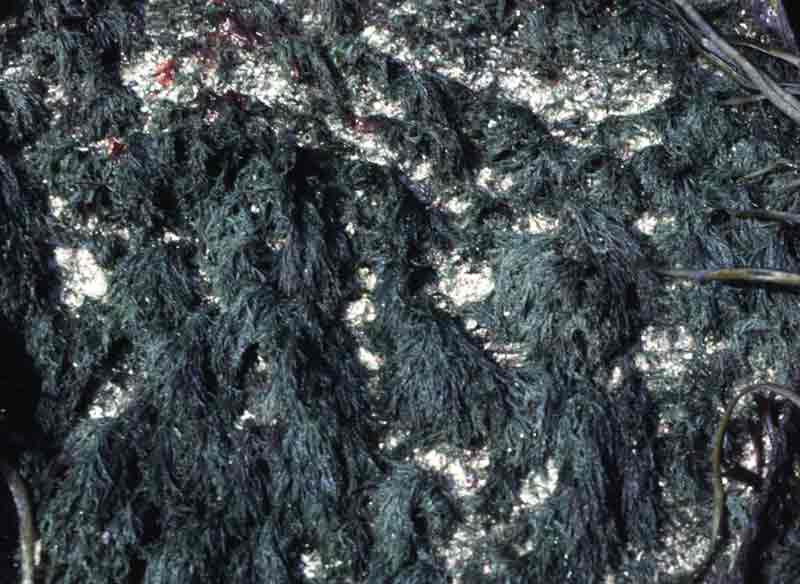
Dense stand of Cladophora rupestris on a gently sloping granite shore.
Photographer: Dr Keith Hiscock Copyright: Dr Keith Hiscock
Distribution data supplied by the Ocean Biodiversity Information System (OBIS). To interrogate UK data visit the NBN Atlas.Map Help
| Researched by | Georgina Budd | Refereed by | Dr Fabio Rindi |
| Authority | (Linnaeus) Kützing, 1843 | ||
| Other common names | - | Synonyms | - |
Summary
Description
Cladophora rupestris is a densely tufted plant, that grows up to 20 cm in height, with dark green or bluish coloured dull fronds. Typical specimens branch profusely upwards from the base, in an irregular, whorled or opposite pattern. The stoutness, density and arrangement of branches gives the seaweed a coarse feel.
Recorded distribution in Britain and Ireland
Found all round the coast of Britain and Ireland on suitable substrata.Global distribution
See additional information.Habitat
Cladophora rupestris grows in rock pools, on the surface of rocks, hanging in 'ropes' in crevices or forming undergrowth to macroalgae at all levels on the shore.Depth range
See additional informationIdentifying features
- Plants grow up to 15-20 cm in height.
- Dark green or bluish in colour.
- Coarse texture, rather like rope.
- Basal plate of rhizoids give rise to numerous erect fronds.
- Fronds (thalli) straight or slightly curved outwards.
- Thallus is a uniseriate (constructed of cells in a single row) usually highly branched filament of cells, whose cells decrease in size from base to apex.
Additional information
The morphology of the species is fairly constant over a wide range of habitat conditions and over a wide geographical area. Its morphology is affected by physical damage due to grazing by animals and loss of the apical region on reproduction, both instances are followed by regeneration and proliferation of branches. Cladophora rupestris sometimes forms an almost complete cover of stunted growth at high tide level and occasionally in the splash zone where pools are brackish. Filaments are short and branching dense in the most wave exposed locations (Burrows, 1991).
Listed by
- none -
Biology review
Taxonomy
| Level | Scientific name | Common name |
|---|---|---|
| Phylum | Chlorophyta | Green seaweeds |
| Class | Ulvophyceae | |
| Order | Cladophorales | |
| Family | Cladophoraceae | |
| Genus | Cladophora | |
| Authority | (Linnaeus) Kützing, 1843 | |
| Recent Synonyms | ||
Biology
| Parameter | Data | ||
|---|---|---|---|
| Typical abundance | |||
| Male size range | |||
| Male size at maturity | |||
| Female size range | Medium (11-20 cm) | ||
| Female size at maturity | |||
| Growth form | Shrub | ||
| Growth rate | |||
| Body flexibility | High (greater than 45 degrees) | ||
| Mobility | Sessile, permanent attachment | ||
| Characteristic feeding method | Autotroph | ||
| Diet/food source | Autotroph | ||
| Typically feeds on | Not relevant | ||
| Sociability | Not relevant | ||
| Environmental position | Epilithic | ||
| Dependency | No text entered. | ||
| Supports | See additional information | ||
| Is the species harmful? | No | ||
Biology information
Species of the genus Cladophora are colonized by a wide variety of epiphytes and motile animals because they can offer protection from predation, provide food (either in the form of epiphytes, or itself), or a substratum that is anchored against water flow turbulence (Dodds & Gudder, 1992). Cladophora rupestris is only very rarely epiphytic (F. Rindi, pers. comm.).
Habitat preferences
| Parameter | Data |
|---|---|
| Physiographic preferences | Open coast, Offshore seabed, Strait or Sound, Sea loch or Sea lough, Ria or Voe, Enclosed coast or Embayment |
| Biological zone preferences | Lower eulittoral, Lower infralittoral, Lower littoral fringe, Mid eulittoral, Sublittoral fringe, Supralittoral, Upper eulittoral, Upper infralittoral, Upper littoral fringe |
| Substratum / habitat preferences | Macroalgae, Bedrock, Cobbles, Large to very large boulders, Small boulders |
| Tidal strength preferences | Moderately strong 1 to 3 knots (0.5-1.5 m/sec.) |
| Wave exposure preferences | Exposed, Moderately exposed, Sheltered, Very exposed |
| Salinity preferences | Full (30-40 psu), Low (<18 psu), Reduced (18-30 psu), Variable (18-40 psu) |
| Depth range | See additional information |
| Other preferences | No text entered |
| Migration Pattern | Non-migratory or resident |
Habitat Information
The species occurs throughout the year but attains maximum development in summer near low tide level (Burrows, 1991). It is mostly an intertidal species although it may also extend into the sublittoral but only by a few metres (F. Rindi, pers. comm.).Global distribution
European Atlantic coast from Scandinavia to the Mediterranean, Adriatic, Baltic Sea, Murman Sea and White Sea. Atlantic coasts of North America from Canadian Arctic, south to Massachusetts, Greenland, Iceland and Faeroes. Also found in Morocco, Brazil, Japan, Lord Howe Island (Australia) and in the Antarctic (Guiry & Nic Dhonncha, 2002).
Life history
Adult characteristics
| Parameter | Data |
|---|---|
| Reproductive type | Alternation of generations |
| Reproductive frequency | Annual protracted |
| Fecundity (number of eggs) | No information |
| Generation time | <1 year |
| Age at maturity | Insufficient information |
| Season | |
| Life span | Insufficient information |
Larval characteristics
| Parameter | Data |
|---|---|
| Larval/propagule type | - |
| Larval/juvenile development | Spores (sexual / asexual) |
| Duration of larval stage | - |
| Larval dispersal potential | Greater than 10 km |
| Larval settlement period | Not relevant |
Life history information
Information on the ecology of reproduction and propagation of the genus Cladophora is limited. Reproduction is achieved by the release of quadriflagellate zoospores and biflagellate isogametes formed in the terminal cells of fronds. The life history consists of an isomorphic (indistinguishable except for the type of reproductive bodies produced) alternation of gametophyte and sporophyte generations, the plants are dioecious (Burrows, 1991). Both zoospores and gametes can be found at most times of the year. Archer (1963, cited in Burrows, 1991) was unable to find any correlation between the time of reproduction, the state of tide or environmental conditions. Most species of Cladophora attach to the substratum by multicellular, branching rhizoids (van den Hoek, 1982); these basal holdfasts may serve as resistant structures from which new growths can arise.Sensitivity review
The MarLIN sensitivity assessment approach used below has been superseded by the MarESA (Marine Evidence-based Sensitivity Assessment) approach (see menu). The MarLIN approach was used for assessments from 1999-2010. The MarESA approach reflects the recent conservation imperatives and terminology and is used for sensitivity assessments from 2014 onwards.
Physical pressures
Use / to open/close text displayed
| Intolerance | Recoverability | Sensitivity | Evidence / Confidence | |
Substratum loss [Show more]Substratum lossBenchmark. All of the substratum occupied by the species or biotope under consideration is removed. A single event is assumed for sensitivity assessment. Once the activity or event has stopped (or between regular events) suitable substratum remains or is deposited. Species or community recovery assumes that the substratum within the habitat preferences of the original species or community is present. Further details EvidenceCladophora rupestris forms a permanent attachment to substrata, so would be intolerant of substratum loss. Intolerance has been assessed to be high. Recoverability has been assessed to be very high (see additional information below). | High | Very high | Low | High |
Smothering [Show more]SmotheringBenchmark. All of the population of a species or an area of a biotope is smothered by sediment to a depth of 5 cm above the substratum for one month. Impermeable materials, such as concrete, oil, or tar, are likely to have a greater effect. Further details. EvidenceCladophora rupestris is a stout shrub-like seaweed, whose fronds may grow up to 20 cm in height. A covering of sediment to a depth of 5 cm is likely to partially cover the seaweed, and at low tide the whole plant may be covered whilst lying limply on the rock. Unless the sediment is removed by the incoming tide, photosynthesis would be inhibited and fronds begin to decay over the duration of one month. Spores, germlings and juveniles are likely to be highly intolerant of smothering by sediment (Vadas et al. 1992). An intolerance assessment of intermediate has been made to reflect the probable impact of smothering on germlings, thereby preventing recruitment for that period, and the inhibitory effects upon more mature specimens. On return to prior conditions, the species is likely to recover, either new growth will arise from the resistant multicellular branching rhizoids (van den Hoek, 1982) that may remain in situ, or the species is likely to recruit to cleared substrata via its 'swarmers' (reproductive propagules). Recoverability has been assessed to be very high. For instance, after the Torrey Canyon tanker oil spill in mid March 1967, recolonization by sporelings of Ulva and Cladophora had occurred by the end of April. | Intermediate | Very high | Low | Moderate |
Increase in suspended sediment [Show more]Increase in suspended sedimentBenchmark. An arbitrary short-term, acute change in background suspended sediment concentration e.g., a change of 100 mg/l for one month. The resultant light attenuation effects are addressed under turbidity, and the effects of rapid settling out of suspended sediment are addressed under smothering. Further details EvidenceThe filamentous branching morphology of Cladophora rupestris would probably enable it to effectively accumulate sediment from suspension. For instance, Boney & Venn (1982) observed Cladophora rupestris to accumulate deposits of ferric oxide from suspension, derived from iron ore spillage and wind-winnowed dust from stockyards on the British Steel Hunsteston Peninsula, Firth of Clyde, Scotland. However, the specimens were apparently healthy with green chloroplasts and starch filled pyrenoids, despite incrustations of ferric oxide. The probable indirect effects of increased suspended sediment are addressed elsewhere, and include smothering (above) as a result of siltation, and increased turbidity and therefore light attenuation (see below). Available evidence suggests that Cladophora rupestris is tolerant of elevated levels of suspended sediment and an assessment of tolerant has been made, but at low confidence. | Tolerant | Not relevant | Not sensitive | Low |
Decrease in suspended sediment [Show more]Decrease in suspended sedimentBenchmark. An arbitrary short-term, acute change in background suspended sediment concentration e.g., a change of 100 mg/l for one month. The resultant light attenuation effects are addressed under turbidity, and the effects of rapid settling out of suspended sediment are addressed under smothering. Further details EvidenceCladophora rupestris is unlikely to be adversely affected by a decrease in suspended sediment concentrations, and an assessment of tolerant has been made. | Tolerant | Not relevant | Not sensitive | Not relevant |
Desiccation [Show more]Desiccation
EvidenceCladophora rupestris is a bushy filamentous algae, Norton et al. (1982) supposed that the numerous filaments retained large quantities of water when the plant became exposed on the shore, which might be a vital function in the prevention of desiccation. However, as soon as the seaweed is removed from water its photosynthetic rate drops sharply, owing to the restriction of inorganic carbon (Lobban & Harrison, 1997). Those individuals living at the highest level on the shore are living at the top of their physiological tolerance limits and so would not be likely to tolerate a further increase in emersion levels. This would probably result in the upper extent of the species being depressed. An intolerance assessment of intermediate has been made. On return to prior conditions, the species is likely to recover, and recoverability has been assessed to be very high (see additional information below). | Intermediate | Very high | Low | Low |
Increase in emergence regime [Show more]Increase in emergence regimeBenchmark. A one hour change in the time covered or not covered by the sea for a period of one year. Further details EvidenceAn increase in the period of emersion involves exposure to desiccation, chilling or heating, removal of most nutrients required for growth, and, frequently, changes in the salinity of the water in the surface film on the seaweed and in the free space between cells (Lobban & Harrison, 1997). Although Cladophora rupestris is tolerant of a range of salinity, it is likely to be intolerant of desiccation stress resulting from an increase in the emergence regime, and an intolerance assessment of intermediate has been made. Should the abundance of the species be affected, e.g. decline in the upper distribution, on return to prior conditions, recovery is likely to be rapid (see additional information, below). | Intermediate | Very high | Low | Low |
Decrease in emergence regime [Show more]Decrease in emergence regimeBenchmark. A one hour change in the time covered or not covered by the sea for a period of one year. Further details EvidenceCladophora rupestris is found in the shallow sublittoral and therefore could potentially benefit from a decrease in the emergence regime. Cladophora rupestris is considered to be relatively palatable to invertebrates (Dodds & Gudder, 1992), all of which will probably be more active grazing during periods of immersion, so that the additional grazing pressure may affect the abundance of the species. An intolerance assessment of low has been made. A recoverability of very high has been recorded (see additional information, below). | Low | Very high | Very Low | Moderate |
Increase in water flow rate [Show more]Increase in water flow rateA change of two categories in water flow rate (view glossary) for 1 year, for example, from moderately strong (1-3 knots) to very weak (negligible). Further details EvidenceLewis (1964) named Cladophora rupestris to be amongst the understorey algae of tidal rapids at Lough Ine. Part of the success of species of the genus Cladophora is probably related to its ability to withstand the shear stress experienced in rocky intertidal habitats. The thallus of the seaweed is tough, but flexible, and allows water to flow through and around it (Dodds, 1991). At low current velocities the thallus spreads out, but becomes more streamlined as the current velocity increases. As tufts of Cladophora become more compact with higher current, transport of materials to and from the plant may be inhibited or self shading may increase, leading to an overall decrease in photosynthesis (Pfeifer & McDiffett, 1975). An intolerance assessment of low has been made to reflect the possible effects of increased water flow on photosynthesis by the seaweed. Following a reduction in water flow, recovery is likely to be immediate, as the fronds splay out and photosynthesis increases. | Low | Immediate | Not sensitive | Moderate |
Decrease in water flow rate [Show more]Decrease in water flow rateA change of two categories in water flow rate (view glossary) for 1 year, for example, from moderately strong (1-3 knots) to very weak (negligible). Further details EvidenceWater flow is important to macroalgae as the processes of photosynthesis, respiration and growth is dependent on a flux of substrates (CO2, O2 & nutrients) and to remove waste products. Therefore a reduction in the water flow below a certain level may have an adverse effect on the species. An intolerance assessment of low has been made as the viability of the species may be affected. On return to prior conditions, recovery is likely to be immediate. | Low | Immediate | Not sensitive | Low |
Increase in temperature [Show more]Increase in temperature
For intertidal species or communities, the range of temperatures includes the air temperature regime for that species or community. Further details EvidenceCladophora rupestris occurs to the south of the British Isles, so is likely to be tolerant of a chronic increase in temperature of 2 °C. Fortes & Lüning (1980) and Lüning (1984) reported that Cladophora rupetrsis from Helgoland were able to survive at temperatures between 0 - 28°C (for a period of a week), so the species is likely to tolerate the benchmark acute increase in temperature, the species is also characteristic of upper shore rock pools, where water and air temperatures are greatly elevated on hot days. An assessment of tolerant has been made. | Tolerant | Not relevant | Not sensitive | Moderate |
Decrease in temperature [Show more]Decrease in temperature
For intertidal species or communities, the range of temperatures includes the air temperature regime for that species or community. Further details EvidenceGrowth measurements of Cladophora rupestris from Roscoff, France, led Cambridge et al. (1984) to conclude that the species was tolerant of temperatures of below -5°C and at the benchmark level the species has been assessed to be tolerant of a decrease in temperature. | Tolerant | Not relevant | Not sensitive | Moderate |
Increase in turbidity [Show more]Increase in turbidity
EvidenceAlthough Cladophora rupestris is common on shaded overhangs (Lewis, 1964) the light attenuating effects of increased turbidity are likely to impact on the photosynthetic efficiency of the species, with consequential effects on growth. An intolerance assessment of low has been made to reflect the effect of increased turbidity on the viability of the species. On return to prior conditions recovery is likely to be rapid and growth resume, a recoverability of very high has been recorded. | Low | Very high | Very Low | Low |
Decrease in turbidity [Show more]Decrease in turbidity
EvidenceAs a photoautotroph, Cladophora rupestris is likely to benefit from reduced turbidity, as the light attenuating effects of turbid water reduce photosynthesis. An assessment of tolerant* has been made. | Tolerant* | Not relevant | Not sensitive* | Not relevant |
Increase in wave exposure [Show more]Increase in wave exposureA change of two ranks on the wave exposure scale (view glossary) e.g., from Exposed to Extremely exposed for a period of one year. Further details EvidenceCladophora biomass in rock pools is affected by wave action. Loosely attached mats slough off with wave action as they become thick (Dethier, 1982) and cause a localized decline in abundance. Morphology of Cladophora has also been linked to hydrodynamic factors. Branching of marine species of Cladophora may become more pronounced with increased wave energy (Van den Hoek, 1964; 1982). Increased wave action may therefore cause distortion of morphology. Furthermore, wave action is likely to be effective in the dislodgement/breaking off of fronds of Cladophora rupestris. Either new growth will arise from the resistant multicellular branching rhizoids (van den Hoek, 1982) that may remain in situ, or the species is likely to recruit to cleared substrata via its 'swarmers' (reproductive propagules). Recoverability has been assessed to be very high. For instance, after the Torrey Canyon tanker oil spill in mid March 1967, recolonization by sporelings of Ulva and Cladophora had occurred by the end of April. Intolerance has been assessed to be low. Recovery has been assessed to be very high. | Low | Very high | Very Low | Low |
Decrease in wave exposure [Show more]Decrease in wave exposureA change of two ranks on the wave exposure scale (view glossary) e.g., from Exposed to Extremely exposed for a period of one year. Further details EvidenceCladophora rupestris is unlikely to be adversely affected by reduced wave action, as it also thrives in wave sheltered locations. An assessment of tolerant has been made. | Tolerant | Not relevant | Not sensitive | Low |
Noise [Show more]Noise
EvidenceSeaweeds have no known mechanism for noise perception. | Not relevant | Not relevant | Not relevant | Not relevant |
Visual presence [Show more]Visual presenceBenchmark. The continuous presence for one month of moving objects not naturally found in the marine environment (e.g., boats, machinery, and humans) within the visual envelope of the species or community under consideration. Further details EvidenceSeaweeds have no known mechanism for visual perception. | Not relevant | Not relevant | Not relevant | Not relevant |
Abrasion & physical disturbance [Show more]Abrasion & physical disturbanceBenchmark. Force equivalent to a standard scallop dredge landing on or being dragged across the organism. A single event is assumed for assessment. This factor includes mechanical interference, crushing, physical blows against, or rubbing and erosion of the organism or habitat of interest. Where trampling is relevant, the evidence and trampling intensity will be reported in the rationale. Further details. EvidenceAs Cladophora rupestris may grow in the form of a thick turf over the rock, and amongst other algae it may be more resistant to abrasion in the form of trampling and dragging of chain for example, owing to the cushion effect of the fronds overlying the holdfast. Individual fronds may incur damage, but the factor is unlikely to cause a substantial decline in the species abundance. At the benchmark level an assessment of tolerant has been made, but with low confidence. A more severe abrasive impact such as the grounding of a vessel would be likely to cause damage and intolerance expected to be higher. | Tolerant | Not relevant | Not sensitive | Low |
Displacement [Show more]DisplacementBenchmark. Removal of the organism from the substratum and displacement from its original position onto a suitable substratum. A single event is assumed for assessment. Further details EvidenceCladophora rupestris forms a permanent attachment to solid substrata. It is likely to be intolerant of displacement as, once removed, mature plants are unable to reattach. Intolerance has been assessed to be high. The species has a considerable ability for recovery. For instance, after the Torrey Canyon tanker oil spill in mid March 1967, recolonization by sporelings of Ulva and Cladophora had occurred by the end of April. Recoverability has been assessed to be very high. | High | Very high | Low | High |
Chemical pressures
Use [show more] / [show less] to open/close text displayed
| Intolerance | Recoverability | Sensitivity | Evidence / Confidence | |
Synthetic compound contamination [Show more]Synthetic compound contaminationSensitivity is assessed against the available evidence for the effects of contaminants on the species (or closely related species at low confidence) or community of interest. For example:
The evidence used is stated in the rationale. Where the assessment can be based on a known activity then this is stated. The tolerance to contaminants of species of interest will be included in the rationale when available; together with relevant supporting material. Further details. EvidenceFollowing the Torrey Canyon tanker oil spill in 1967, copious amounts of non-ionic detergents were employed to disperse the oil. The detergents used contained a surfactant, an organic solvent and a stabilizer; the solvents all contained a proportion of aromatic compounds which made the detergent more effective but more toxic. Porthleven Reef, Cornwall, was badly polluted, an estimated total of 35 000 gallons of detergent was used in an eight day period. The algae most seriously damaged occurred at the higher levels of the shore. Smith (1968) reported Cladophora rupestris to be amongst the algae of very unhealthy appearance, with bleached fronds and dead specimens, although apparently healthy specimens were still found lower on the shore. In follow-up toxicity experiments, Cladophora rupestris was found to be the most intolerant of the intertidal species tested. Severe damage was noted at the apical cells of the filaments, which are the growing points, after six hours immersed in 6% solutions of all detergents (except BP1002, which was apparently harmless at that concentration). Less severe, but irreversible damage was noted down to about 1% concentration. Intolerance has been assessed to be intermediate. The species has a high capacity for recovery. On return to prior conditions, the species is likely to recover, either new growth will arise from the resistant multicellular branching rhizoids (van den Hoek, 1982) that may remain in situ, or the species is likely to recruit to cleared substrata via its swarmers. Recoverability has been assessed to be very high. For instance, after the Torrey Canyon tanker oil spill in mid March 1967, recolonization by sporelings of Ulva and Cladophora had occurred by the end of April. | Intermediate | Very high | Low | Moderate |
Heavy metal contamination [Show more]Heavy metal contaminationEvidenceThe order of metal toxicity to algae varies, with the algal species and environmental conditions, (Rice et al., 1973; Rai et al., 1981) but Bryan (1984) suggested that the general order for heavy metal toxicity in seaweeds is: Organic Hg > inorganic Hg > Cu > Ag > Zn > Cd > Pb. No information was found concerning the specific effects of heavy metals on Cladophora rupestris. | No information | Not relevant | No information | Not relevant |
Hydrocarbon contamination [Show more]Hydrocarbon contaminationEvidenceThe toxic effects of oil on algae may be categorized as those associated with the coating of the fronds, e.g. coating by oil is likely to reduce CO2 diffusion and light penetration to the plant, and those attributable to the uptake of hydrocarbons and subsequent disruption of cellular metabolism (Lobban & Harrison, 1997). | Intermediate | Very high | Low | Moderate |
Radionuclide contamination [Show more]Radionuclide contaminationEvidenceInsufficient | No information | Not relevant | No information | Not relevant |
Changes in nutrient levels [Show more]Changes in nutrient levelsEvidenceNutrient enrichment of the water column, e.g. resulting from sewage discharge, can stimulate blooms of opportunistic benthic macroalgae, especially Cladophora and Ulva (Knox, 1986). An assessment of tolerant* has been made, as the species may increase in abundance as a result of nutrient enrichment. | Tolerant* | Not relevant | Not sensitive* | High |
Increase in salinity [Show more]Increase in salinity
EvidenceCladophora rupestris found in intertidal rock pools can withstand 5-30 psu (Jansson, 1974) and as the species is successful in the high intertidal zone it is likely that the species has a broad salinity tolerance (Dodds & Gudder, 1992). At the benchmark level an assessment of not sensitive has been made. | Tolerant | Not relevant | Not sensitive | Low |
Decrease in salinity [Show more]Decrease in salinity
EvidenceCladophora rupestris can tolerate salinities as low as 5 psu (Burrows, 1991) and as the species is successful in the high intertidal zone it is likely that the species has a broad salinity tolerance (Dodds & Gudder, 1992). At the benchmark level an assessment of not sensitive has been made. However, Thomas et al. (1988) found that, at extreme temperatures, Cladophora rupestris had a reduced salinity tolerance range, e.g. the most marked inhibition of photosynthesis occurred in conditions of low salinity (0 psu) and high temperatures (25 - 30°C). | Tolerant | Not relevant | Not sensitive | Low |
Changes in oxygenation [Show more]Changes in oxygenationBenchmark. Exposure to a dissolved oxygen concentration of 2 mg/l for one week. Further details. EvidenceThere insufficient information available to make an assessment about the effects of reduced oxygen in the water column upon Cladophora rupestris. | No information | Not relevant | No information | Not relevant |
Biological pressures
Use [show more] / [show less] to open/close text displayed
| Intolerance | Recoverability | Sensitivity | Evidence / Confidence | |
Introduction of microbial pathogens/parasites [Show more]Introduction of microbial pathogens/parasitesBenchmark. Sensitivity can only be assessed relative to a known, named disease, likely to cause partial loss of a species population or community. Further details. EvidenceNo information was found concerning the effects of microbial pathogens on Cladophora rupestris. | Not relevant | Not relevant | Not relevant | Not relevant |
Introduction of non-native species [Show more]Introduction of non-native speciesSensitivity assessed against the likely effect of the introduction of alien or non-native species in Britain or Ireland. Further details. EvidenceNo non-native species are known to adversely impact upon Cladophora rupestris. | Not relevant | Not relevant | Not relevant | Not relevant |
Extraction of this species [Show more]Extraction of this speciesBenchmark. Extraction removes 50% of the species or community from the area under consideration. Sensitivity will be assessed as 'intermediate'. The habitat remains intact or recovers rapidly. Any effects of the extraction process on the habitat itself are addressed under other factors, e.g. displacement, abrasion and physical disturbance, and substratum loss. Further details. EvidenceThe benchmark for extraction is the removal of 50% of the Cladophora rupestris population from the area under consideration. Intolerance has therefore been assessed to be intermediate and recovery very high as a local population of the species will remain from which recruitment can occur. | Intermediate | Very high | Low | Moderate |
Extraction of other species [Show more]Extraction of other speciesBenchmark. A species that is a required host or prey for the species under consideration (and assuming that no alternative host exists) or a keystone species in a biotope is removed. Any effects of the extraction process on the habitat itself are addressed under other factors, e.g. displacement, abrasion and physical disturbance, and substratum loss. Further details. EvidenceNo other species are identified to be host or prey items for Cladophora rupestris. During experiments to investigate intertidal and subtidal canopy interactions, Hawkins & Harkin (1985) removed the overlying canopy of both Fucus serratus and Laminaria digitata on shores of differing wave exposure, and results led them to conclude that in the region that spans the boundary between the intertidal and subtidal on N.W. European shores, canopy effects are the dominant biological factors structuring the community. It was noted that, following removal of Fucus serratus, the more permanent understorey algae (Cladophora rupestris and Corallina officinalis) became covered to some extent by Ulva intestinalis, Palmaria palmata and Fucus serratus, and decreased in cover but still survived. Ulva intestinalis grew on and amongst the understorey, whereas Palmaria palmata and Fucus serratus shaded the plants by growth from gaps in the understorey turf. An intolerance assessment of low has been made to reflect the fact that the understorey alga Cladophora rupestris may decline in abundance following removal of key structuring macroalgae, owing to overgrowth, but still survive. | Low | Very high | Very Low | Moderate |
Additional information
Recoverability. It is likely that Cladophora rupestris will have a considerable capacity for recovery. The species is widespread around the British Isles and Ireland and may be found in reproductive condition all year round. Numerous motile 'swarmers' (reproductive propagules) are released and in the water column, they can be dispersed over considerable distances. In addition to recruitment by swarmers, new growth may arise from the resistant multicellular branching rhizoids (van den Hoek, 1982) that may remain in situ. Recoverability has been assessed to be very high. For instance, after the Torrey Canyon tanker oil spill in mid-March 1967, recolonization by sporelings of Ulva and Cladophora occurred by the end of April (Smith, 1968).
Importance review
Policy/legislation
- no data -
Status
| National (GB) importance | - | Global red list (IUCN) category | - |
Non-native
| Parameter | Data |
|---|---|
| Native | - |
| Origin | - |
| Date Arrived | - |
Importance information
Cladophora rupestris forms an important habitat and food resource for juvenile isopods and amphipods that are a major component of fish diets (Jansson, 1967).Bibliography
Archer, A.A., 1963. A new approach to the taxonomy of the branched members of the Cladophoraceae in the British Isles. , Ph.D. thesis, Liverpool University.
Bryan, G.W., 1984. Pollution due to heavy metals and their compounds. In Marine Ecology: A Comprehensive, Integrated Treatise on Life in the Oceans and Coastal Waters, vol. 5. Ocean Management, part 3, (ed. O. Kinne), pp.1289-1431. New York: John Wiley & Sons.
Burrows, E.M., 1991. Seaweeds of the British Isles. Volume 2. Chlorophyta. London: British Museum (Natural History).
Cambridge, M., Breeman, A.M., van Oosterwijk, R. & van den Hoek, C., 1984. Temperature responses of some North American Cladophora species (Chlorophyceae) in relation to their geographic distribution. Helgoländer Wissenschaftliche Meeresuntersuchungen, 38, 349-363.
Cullinane, J.P., McCarthy, P. & Fletcher, A., 1975. The effect of oil pollution in Bantry Bay. Marine Pollution Bulletin, 6, 173-176.
Dethier, M.N., 1982. Pattern and process in tidepool algae: factors influencing seasonality and distribution. Botanica Marina, 25, 55-66
Dickinson, C.I., 1963. British seaweeds. London & Frome: Butler & Tanner Ltd.
Dodds, W.K. & Gudder, D.A., 1992. The ecology of Cladophora. Journal of Phycology, 28, 415-427.
Dodds, W.K., 1991. Micro-environmental characteristics of filamentous algal communities in flowing freshwaters. Freshwater Biology, 25, 199-209.
Fortes, M.D. & Lüning, K., 1980. Growth rates of North Sea macroalgae in relation to temperature, irradiance and photoperiod. Helgolander Meeresuntersuchungen, 34, 15-29.
Guiry, M.D. & Nic Dhonncha, E., 2002. AlgaeBase. World Wide Web electronic publication http://www.algaebase.org,
Hardy, F.G. & Guiry, M.D., 2003. A check-list and atlas of the seaweeds of Britain and Ireland. London: British Phycological Society
Hawkins, S.J. & Harkin, E., 1985. Preliminary canopy removal experiments in algal dominated communities low on the shore and in the shallow subtidal on the Isle of Man. Botanica Marina, 28, 223-30.
Hayward, P., Nelson-Smith, T. & Shields, C. 1996. Collins pocket guide. Sea shore of Britain and northern Europe. London: HarperCollins.
Jansson, A.M., 1967. The food-web of the Cladophora-belt fauna. Helgolander Wissenschaftliche Meeresuntersuchungen, 15, 574-588.
Jansson, A.M., 1974. Wintertime fluctuations in the epifauna of Cladophora rupestris in a rock pool on the Swedish west coast. Annales Zoologici Fennici, 11, 185-192.
Knox, G.A., 1986. Estuarine ecosystems: a systems approach. Florida: CRC Press.
Lewis, J.R., 1964. The Ecology of Rocky Shores. London: English Universities Press.
Lobban, C.S. & Harrison, P.J., 1997. Seaweed ecology and physiology. Cambridge: Cambridge University Press.
Lüning, K., 1984. Temperature tolerance and biogeography of seaweeds: the marine algal flora of Helgoland (North Sea) as an example. Helgolander Meeresuntersuchungen, 38, 305-317.
Norton, T.A. (ed.), 1985. Provisional Atlas of the Marine Algae of Britain and Ireland. Huntingdon: Biological Records Centre, Institute of Terrestrial Ecology.
Norton, T.A., Mathieson, A.C. & Neushul, M., 1982. A review of some aspects of form and function in seaweeds. Botanica Marina, 25, 501-510.
Pfeifer, R.F. & McDiffett, W.F., 1975. Some factors affecting primary productivity of stream riffle communities. Archive for Hydrobiology, 75, 306-317.
Rai, L., Gaur, J.P. & Kumar, H.D., 1981. Phycology and heavy-metal pollution. Biological Reviews, 56, 99-151.
Rice, H., Leighty, D.A. & McLeod, G.C., 1973. The effects of some trace metals on marine phytoplankton. CRC Critical Review in Microbiology, 3, 27-49.
Smith, J.E. (ed.), 1968. 'Torrey Canyon'. Pollution and marine life. Cambridge: Cambridge University Press.
Thomas, D.N., Collins, J.C. & Russell, G., 1988. Interaction effects of temperature and salinity upon net photosynthesis of Cladophora glomerata (L.) Kutz. and Cladophora rupestris (L.) Kutz. Botanica Marina, 31, 73-77.
Vadas, R.L., Johnson, S. & Norton, T.A., 1992. Recruitment and mortality of early post-settlement stages of benthic algae. British Phycological Journal, 27, 331-351.
Van den Hoek, C., 1963. Revision of the European species of Cladophora. Leiden.
Van den Hoek, C., 1964. Criteria and procedures in present day algal taxonomy. In Algae and man, (ed. D.F. Jackson), pp.31-58. New York: Plenum Press.
Van den Hoek, C., 1982. The distribution of benthic marine algae in relation to the temperature regulation of their life histories. Biological Journal of the Linnean Society, 18, 81-144.
Datasets
Bristol Regional Environmental Records Centre, 2017. BRERC species records recorded over 15 years ago. Occurrence dataset: https://doi.org/10.15468/h1ln5p accessed via GBIF.org on 2018-09-25.
Centre for Environmental Data and Recording, 2018. Ulster Museum Marine Surveys of Northern Ireland Coastal Waters. Occurrence dataset https://www.nmni.com/CEDaR/CEDaR-Centre-for-Environmental-Data-and-Recording.aspx accessed via NBNAtlas.org on 2018-09-25.
Cofnod – North Wales Environmental Information Service, 2018. Miscellaneous records held on the Cofnod database. Occurrence dataset: https://doi.org/10.15468/hcgqsi accessed via GBIF.org on 2018-09-25.
Environmental Records Information Centre North East, 2018. ERIC NE Combined dataset to 2017. Occurrence dataset: http://www.ericnortheast.org.ukl accessed via NBNAtlas.org on 2018-09-38
Fenwick, 2018. Aphotomarine. Occurrence dataset http://www.aphotomarine.com/index.html Accessed via NBNAtlas.org on 2018-10-01
Fife Nature Records Centre, 2018. St Andrews BioBlitz 2014. Occurrence dataset: https://doi.org/10.15468/erweal accessed via GBIF.org on 2018-09-27.
Fife Nature Records Centre, 2018. St Andrews BioBlitz 2015. Occurrence dataset: https://doi.org/10.15468/xtrbvy accessed via GBIF.org on 2018-09-27.
Fife Nature Records Centre, 2018. St Andrews BioBlitz 2016. Occurrence dataset: https://doi.org/10.15468/146yiz accessed via GBIF.org on 2018-09-27.
Kent Wildlife Trust, 2018. Biological survey of the intertidal chalk reefs between Folkestone Warren and Kingsdown, Kent 2009-2011. Occurrence dataset: https://www.kentwildlifetrust.org.uk/ accessed via NBNAtlas.org on 2018-10-01.
Kent Wildlife Trust, 2018. Kent Wildlife Trust Shoresearch Intertidal Survey 2004 onwards. Occurrence dataset: https://www.kentwildlifetrust.org.uk/ accessed via NBNAtlas.org on 2018-10-01.
Lancashire Environment Record Network, 2018. LERN Records. Occurrence dataset: https://doi.org/10.15468/esxc9a accessed via GBIF.org on 2018-10-01.
Manx Biological Recording Partnership, 2017. Isle of Man wildlife records from 01/01/2000 to 13/02/2017. Occurrence dataset: https://doi.org/10.15468/mopwow accessed via GBIF.org on 2018-10-01.
Manx Biological Recording Partnership, 2018. Isle of Man historical wildlife records 1995 to 1999. Occurrence dataset: https://doi.org/10.15468/lo2tge accessed via GBIF.org on 2018-10-01.
Merseyside BioBank., 2018. Merseyside BioBank (unverified). Occurrence dataset: https://doi.org/10.15468/iou2ld accessed via GBIF.org on 2018-10-01.
National Trust, 2017. National Trust Species Records. Occurrence dataset: https://doi.org/10.15468/opc6g1 accessed via GBIF.org on 2018-10-01.
NBN (National Biodiversity Network) Atlas. Available from: https://www.nbnatlas.org.
OBIS (Ocean Biodiversity Information System), 2025. Global map of species distribution using gridded data. Available from: Ocean Biogeographic Information System. www.iobis.org. Accessed: 2025-07-13
Outer Hebrides Biological Recording, 2018. Non-vascular Plants, Outer Hebrides. Occurrence dataset: https://doi.org/10.15468/goidos accessed via GBIF.org on 2018-10-01.
Royal Botanic Garden Edinburgh, 2018. Royal Botanic Garden Edinburgh Herbarium (E). Occurrence dataset: https://doi.org/10.15468/ypoair accessed via GBIF.org on 2018-10-02.
South East Wales Biodiversity Records Centre, 2018. SEWBReC Algae and allied species (South East Wales). Occurrence dataset: https://doi.org/10.15468/55albd accessed via GBIF.org on 2018-10-02.
South East Wales Biodiversity Records Centre, 2018. Dr Mary Gillham Archive Project. Occurance dataset: http://www.sewbrec.org.uk/ accessed via NBNAtlas.org on 2018-10-02
Yorkshire Wildlife Trust, 2018. Yorkshire Wildlife Trust Shoresearch. Occurrence dataset: https://doi.org/10.15468/1nw3ch accessed via GBIF.org on 2018-10-02.
Citation
This review can be cited as:
Last Updated: 14/08/2007