
Coral weed (Corallina officinalis)
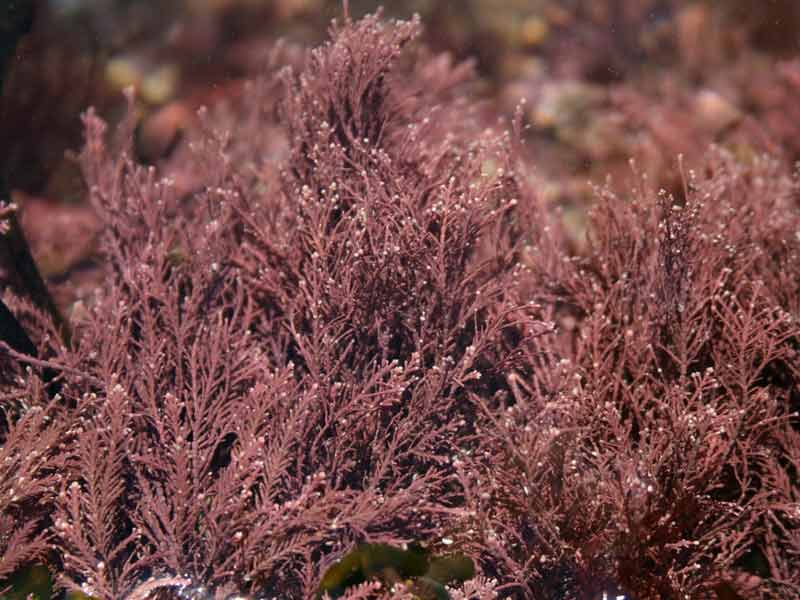
Corallina officinalis in a rockpool.
Photographer: Judith Oakley Copyright: Judith Oakley
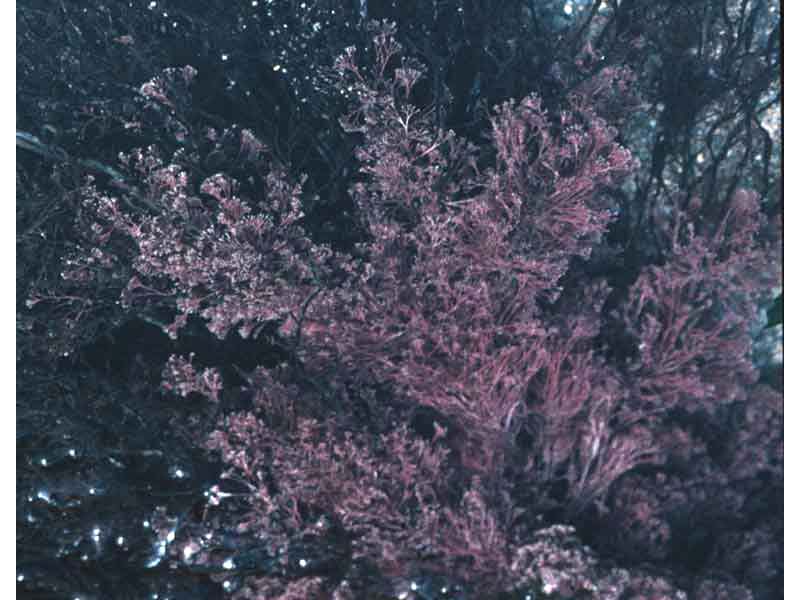
Corallina officinalis fronds in rockpool.
Photographer: Dr Keith Hiscock Copyright: Dr Keith Hiscock
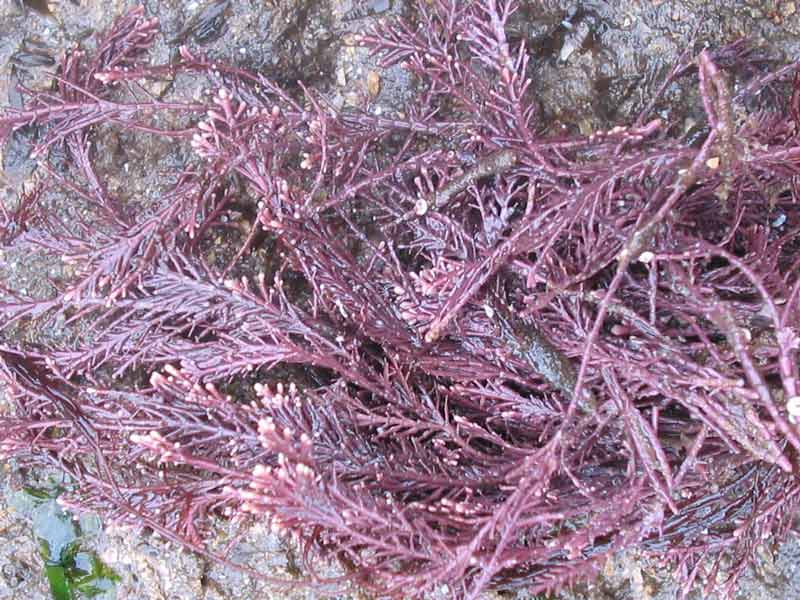
Corallina officinalis out of the water.
Photographer: Judith Oakley Copyright: Judith Oakley
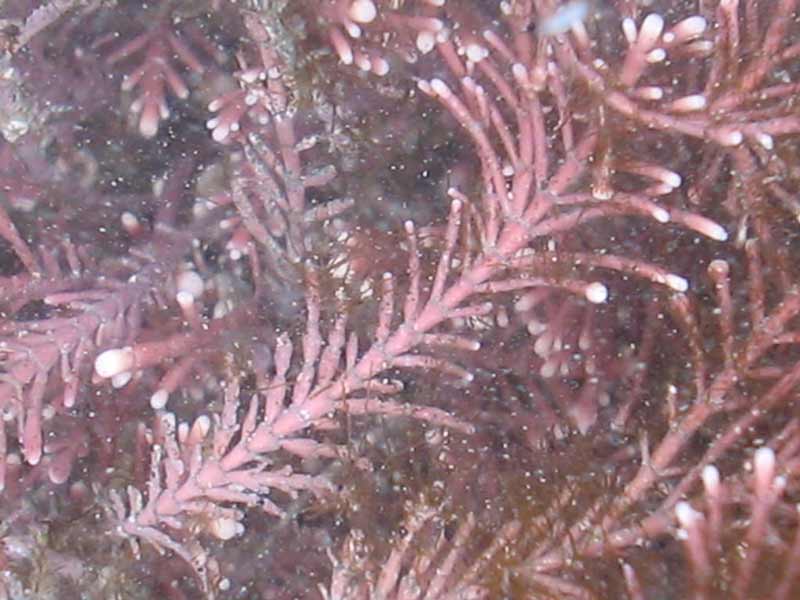
Close up view of Corallina officinalis in murky water.
Photographer: Judith Oakley Copyright: Judith Oakley
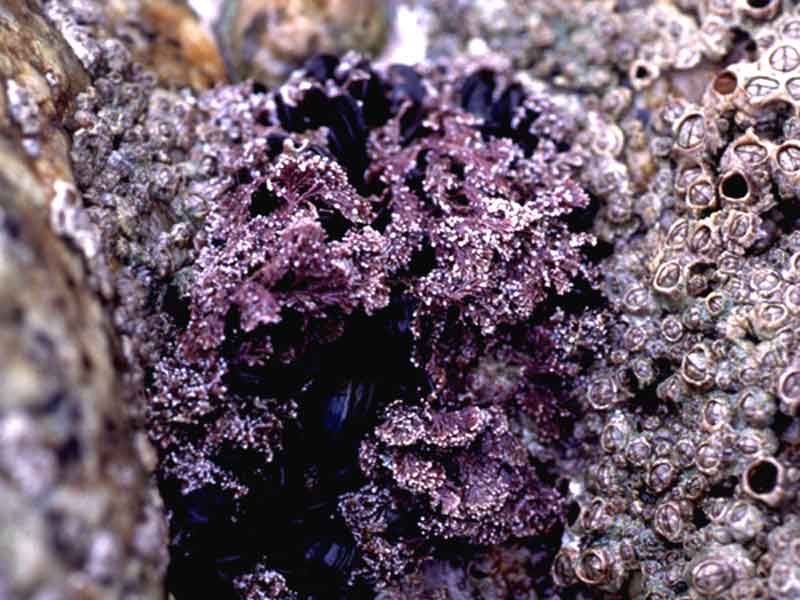
Compact Corallina officinalis in rock cleft.
Photographer: Dr Keith Hiscock Copyright: Dr Keith Hiscock
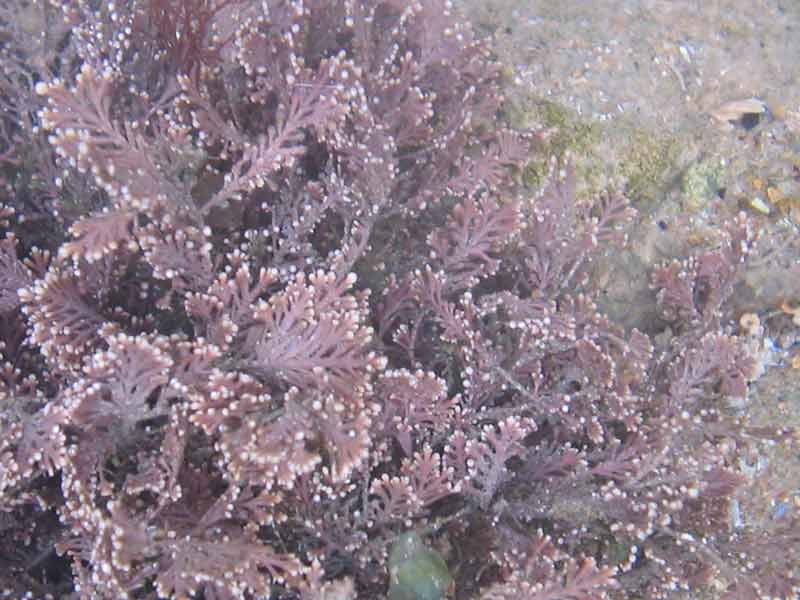
Pale Corallina officinalis specimen.
Photographer: Judith Oakley Copyright: Judith Oakley
Distribution data supplied by the Ocean Biodiversity Information System (OBIS). To interrogate UK data visit the NBN Atlas.Map Help
| Researched by | Dr Harvey Tyler-Walters | Refereed by | Dr Thomas Wiedemann |
| Authority | Linnaeus, 1758 | ||
| Other common names | - | Synonyms | Corallina officinalis Linnaeus, 1758 |
Summary
Description
Corallina officinalis consists of calcareous, branching, segmented fronds, usually erect, up to 12 cm high but often much shorter. Fronds rise from a calcareous crustose, disk shaped, holdfast about 70 mm in diameter. Fronds consist of a jointed chain of calcareous segments, each becoming wedge shaped higher up the frond. Branches are opposite, resulting in a feather-like appearance. Colour varied, purple, red, pink or yellowish with white knuckles and white extremities. Paler in brightly lit sites. Different colours normally represent light induced stress and degradation of pigments (bleaching). Reproductive organs are urn shaped, usually borne at the tips of the fronds but occasionally laterally on segments. Distinguished from the similar Corallina elongata by the structure of its reproductive bodies which bear horns or antennae and from Jania rubens which branches dichotomously.
Recorded distribution in Britain and Ireland
Generally distributed around all shores of the British Isles.Global distribution
Recorded widely in the north Atlantic, from northern Norway to Morocco, from Greenland to Argentina. Also reported in Japan, China and Australasia.Habitat
Typically forms a turf in pools and wet gullies from the mid tidal level to the sublittoral fringe. A characteristic algae of rock pools on the middle to lower shore. Occurs as scattered clumps in the sublittoral down to 18 m although it has been recorded down to 29 m in continental Europe. It often flourishes in exposed conditions. Occasionally found on mollusc shells or macroalgae such as Furcellaria.Depth range
0 - 18mIdentifying features
- Erect stiff, articulated fronds, coarse to the touch.
- Purple, reddish, pink or yellowish in colour.
- Branching opposite (pinnate).
- Disc shaped holdfast.
- Reproductive organs urn shaped.
Additional information
Also known as 'Cunach Tra' or 'An Fheamainn Choirealach' in Ireland. Growth form can be variable, for example:
- stunted specimens occur in high shore pools
- much branched forms in the lower littoral
- thick elongate forms in sublittoral
In Norway fronds 1-2 cm long recorded in lower littoral in contrast to 10-17 cm long fronds in pools. This variability has resulted in numerous species descriptions that are probably synonymous with Corallina officinalis (Irvine & Chamberlain 1994).
Listed by
- none -
Biology review
Taxonomy
| Level | Scientific name | Common name |
|---|---|---|
| Phylum | Rhodophyta | Red seaweeds |
| Class | Florideophyceae | |
| Order | Corallinales | |
| Family | Corallinaceae | |
| Genus | Corallina | |
| Authority | Linnaeus, 1758 | |
| Recent Synonyms | Corallina officinalis Linnaeus, 1758 | |
Biology
| Parameter | Data | ||
|---|---|---|---|
| Typical abundance | Moderate density | ||
| Male size range | |||
| Male size at maturity | |||
| Female size range | Medium(11-20 cm) | ||
| Female size at maturity | |||
| Growth form | Articulate | ||
| Growth rate | 2.2mm/month | ||
| Body flexibility | |||
| Mobility | |||
| Characteristic feeding method | Autotroph | ||
| Diet/food source | |||
| Typically feeds on | Not relevant | ||
| Sociability | |||
| Environmental position | Epifloral | ||
| Dependency | Independent. | ||
| Supports | None | ||
| Is the species harmful? | No | ||
Biology information
The biology of articulate corallines was reviewed by Johanssen (1974). In culture Corallina officinalis fronds exhibited an average growth rate of 2.2 mm/month at 12 and 18 deg C. Growth rate was only 0.2 mm/month at 6 deg C and no growth was observed at 25 deg C (Colhart & Johanssen 1973). The crustose holdfast or base is perennial and grows apically, similar to encrusting corallines such as Lithothamnia sp.. The basal crust may grow continuously until stimulated to produce fronds (Littler & Kauker 1984; Colhart & Johanssen 1973). Growth rates may be comparable to encrusting corallines, for example, 2 -7mm per year was reported for Lithophyllum incrustans (Littler 1972). Fronds are highly sensitive to desiccation and do not recover from an 15 percent water loss, which might occur within 40 -45 minutes during a spring tide in summer (Wiedemann 1994). Littler & Kauker (1984) suggest that the crustose bases were adapted to resist grazing and desiccation whereas the fronds were adapted for higher primary productivity and reproduction. Corallina officinalis may support epiphytes, including Mesophyllum lichenoides, Titanoderma pustulatum, and Titanoderma corallinae, the latter causing tissue damage (Irvine & Chamberlain 1994). Corallina officinalis may be overgrown by epiphytes, especially during summer. This overgrowth regularly leads to high mortality of fronds due to light reduction (Wiedemann pers comm.). Other, crustose corallines produce anti-epiphytal substances, like e.g. allelopathics (Suzuki et al. 1998), however, this type of substance has not been found yet in Corallina officinalis.
Habitat preferences
| Parameter | Data |
|---|---|
| Physiographic preferences | Open coast, Strait or Sound, Sea loch or Sea lough, Ria or Voe, Estuary, Enclosed coast or Embayment |
| Biological zone preferences | Lower eulittoral, Mid eulittoral, Sublittoral fringe, Upper infralittoral |
| Substratum / habitat preferences | Artificial (man-made), Bedrock, Crevices / fissures, Large to very large boulders, Rockpools |
| Tidal strength preferences | Moderately strong 1 to 3 knots (0.5-1.5 m/sec.), Very weak (negligible), Weak < 1 knot (<0.5 m/sec.) |
| Wave exposure preferences | Exposed, Moderately exposed, Sheltered, Very exposed |
| Salinity preferences | Full (30-40 psu), Variable (18-40 psu) |
| Depth range | 0 - 18m |
| Other preferences | No text entered |
| Migration Pattern | Non-migratory or resident |
Habitat Information
In exposed conditions it may grow as a cushion like or compact turf (Irvine & Chamberlain 1994; Dommasnes 1968). Corallina officinalis growing under macroalgal canopies may be abraded and fronds shortened by macroalgal lamina moved by tidal action. Recorded from Scandinavia, Iceland, northern Norway, Baltic Sea, Helgoland, Faroes, Netherlands, northern France, Spain, Portugal, the Azores, Morocco, Madeira, and the Canary Islands in the north east Atlantic. Reported from Spain, Balearic Islands, Corsica, Sardinia, Italy, Scilly, Adriatic, Greece, Turkey, Levant States, Libya, Tunisia, and Algeria in the Mediterranean. It is also recorded from west coast of South Africa., Japan, China, Australia (Queensland) and New Zealand. Also recorded from Greenland and Arctic Canada to the USA, Caribbean Venezuela, Columbia and Argentina.Life history
Adult characteristics
| Parameter | Data |
|---|---|
| Reproductive type | Isogamous |
| Reproductive frequency | Annual episodic |
| Fecundity (number of eggs) | No information |
| Generation time | Insufficient information |
| Age at maturity | Insufficient information |
| Season | Insufficient information |
| Life span | Insufficient information |
Larval characteristics
| Parameter | Data |
|---|---|
| Larval/propagule type | - |
| Larval/juvenile development | Not relevant |
| Duration of larval stage | 2-10 days |
| Larval dispersal potential | No information |
| Larval settlement period |
Life history information
The typical life cycle of members of the Florideophycidae is summarised as follows:- Male haploid gametophytes release male gametes (spermatia) from spermatangia on male fronds.
- Female haploid gametophytes produce the female gamete, the carpogonium on female fronds
- After fusion (fertilization) the carposporophyte develops, enclosed in a cystocarp and releases diploid carpospores.
- Carpospores develop into the tetrasporophyte, a diploid sporophyte stage.
- The sporophyte develops tetrasporangia in which haploid tetraspores are formed by meiosis.
- The tetraspores develop into gametophytes.
Sensitivity review
The MarLIN sensitivity assessment approach used below has been superseded by the MarESA (Marine Evidence-based Sensitivity Assessment) approach (see menu). The MarLIN approach was used for assessments from 1999-2010. The MarESA approach reflects the recent conservation imperatives and terminology and is used for sensitivity assessments from 2014 onwards.
Physical pressures
Use / to open/close text displayed
| Intolerance | Recoverability | Sensitivity | Evidence / Confidence | |
Substratum loss [Show more]Substratum lossBenchmark. All of the substratum occupied by the species or biotope under consideration is removed. A single event is assumed for sensitivity assessment. Once the activity or event has stopped (or between regular events) suitable substratum remains or is deposited. Species or community recovery assumes that the substratum within the habitat preferences of the original species or community is present. Further details EvidenceRemoval of the substratum would remove both the fronds and crustose bases on this species. Recovery would be dependent on settlement of carpospores or tetraspores. Corallina officinalis settled on artificial substances within 1 week of their placement in the intertidal in New England summer suggesting that recruitment is high (Harlin & Lindbergh 1977). New fronds of Corallina officinalis appeared on sterilised plots within six months and 10 percent cover was reached with 12 months (Littler & Kauker 1984). | High | High | Moderate | Low |
Smothering [Show more]SmotheringBenchmark. All of the population of a species or an area of a biotope is smothered by sediment to a depth of 5 cm above the substratum for one month. Impermeable materials, such as concrete, oil, or tar, are likely to have a greater effect. Further details. EvidenceCorallina spp. accumulate more sediment than any other alga (Hicks 1985). Significant sediment cover of the middle to lower intertidal in a South Californian shore, resulting from fresh water runoff, caused substantial decline in Corallina spp. cover (Seapy & Littler 1982). However, die back of barnacles and Pelvetia spp. due to smothering allowed Corallina spp. to expand up the shore in the following 6 months (Seapy & Littler 1982). Although the fronds may be intolerant, rapid recovery will result from the resistant crustose bases. | Intermediate | Very high | Low | Moderate |
Increase in suspended sediment [Show more]Increase in suspended sedimentBenchmark. An arbitrary short-term, acute change in background suspended sediment concentration e.g., a change of 100 mg/l for one month. The resultant light attenuation effects are addressed under turbidity, and the effects of rapid settling out of suspended sediment are addressed under smothering. Further details EvidenceCoralline algae, especially the crustose forms are thought to be resistant of sediment scour (Littler & Kauker 1984). Corallina spp. accumulate more sediment than any other alga (Hicks 1985). Significant sediment cover of the middle to lower intertidal in a South Californian shore, resulting from fresh water runoff, caused substantial decline in Corallina spp. cover (Seapy & Littler 1982). However, die back of barnacles and Pelvetia spp. due to smothering allowed Corallina spp. to expand up the shore in the following 6 months (Seapy & Littler 1982). Although the fronds may be intolerant rapid recovery will result from the resistant crustose bases. | Intermediate | Very high | Low | Moderate |
Decrease in suspended sediment [Show more]Decrease in suspended sedimentBenchmark. An arbitrary short-term, acute change in background suspended sediment concentration e.g., a change of 100 mg/l for one month. The resultant light attenuation effects are addressed under turbidity, and the effects of rapid settling out of suspended sediment are addressed under smothering. Further details Evidence | No information | |||
Desiccation [Show more]Desiccation
EvidenceFinely branched fronds or cushion-like turfs may hold water, reducing desiccation stress. Padilla (1984) noted that finely branched Corallina vancouveriensis held more water than coarsely branched or crustose corallines and survived on emergent substrata around tidepools. This effect is less marked in Corallina officinalis (Wiedemann pers. comm.). Corallina officinalis inhabits damp or wet gullies and rock pools and does not inhabit the upper shore, suggesting that it is intolerant of desiccation. Fronds are highly intolerant of desiccation and do not recover from a 15 percent water loss, which might occur within 40 -45 minutes during a spring tide in summer (Wiedemann 1994). An abrupt increase in temperature of 10 deg C caused by the hot, dry 'Santa Ana' winds (between January and February) in Santa Cruz, California resulted in die back of several species of algae exposed at low tide (Seapy & Littler, 1984). Although fronds of Corallina spp. dramatically declined, summer regrowth resulted in dense cover by the following October, suggesting that the crustose bases survived. Severe damage was noted in Corallina officinalis as a result of desiccation during unusually hot and sunny weather in summer 1983 (an increase of between 4.8 and 8.5 deg C) (Hawkins & Hartnoll 1985). Hawkins & Hartnoll (1985) found that Corallina officinalis and encrusting corallines often die when their protective canopy of other algal species is removed. Therefore, this species is likely to be highly intolerant of increased desiccation, equivalent to being raised one level on the shore.Corallina officinalis settled on artificial substances within 1 week of their placement in the intertidal in New England summer suggesting that recruitment is high (Harlin & Lindbergh 1977). New fronds of Corallina officinalis appeared on sterilised plots within six months and 10 percent cover was reached with 12 months (Littler & Kauker 1984). In experimental plots, up to 15 percent cover of Corallina officinalis fronds returned within 3 months after removal of fronds and all other epiflora/fauna (Littler & Kauker 1984). Littler & Kauker (1984) suggested that the crustose base was more resistant of desiccation or heating than fronds. Although new bases may recruit and develop quickly the formation of new fronds from these bases and recovery of original cover may take longer, however, the population is likely to recover within 5 years. | High | High | Moderate | Moderate |
Increase in emergence regime [Show more]Increase in emergence regimeBenchmark. A one hour change in the time covered or not covered by the sea for a period of one year. Further details EvidenceBleached corallines were observed 15 months after the 1964 Alaska earthquake which elevated areas in Prince William Sound by 10 m. Similarly, increased exposure caused by upward movement of 15 cm due to nuclear tests at Armchitka Island, Alaska adversely affected Corallina pilulifera (Johansen, 1974). The upper shore extent of this species is determined by the availability of rock pools and wet gullies. Therefore, an increase in emergence and concomitant increase in desiccation is likely to reduce the extent or abundance of the population. | Intermediate | Very high | Low | Low |
Decrease in emergence regime [Show more]Decrease in emergence regimeBenchmark. A one hour change in the time covered or not covered by the sea for a period of one year. Further details Evidence | No information | |||
Increase in water flow rate [Show more]Increase in water flow rateA change of two categories in water flow rate (view glossary) for 1 year, for example, from moderately strong (1-3 knots) to very weak (negligible). Further details EvidenceCorallina officinalis occurs from very weak to moderately strong water flow. An increase in flow rate outside these limits may result in removal of fronds and competition from other species. | Low | Very high | Very Low | Very low |
Decrease in water flow rate [Show more]Decrease in water flow rateA change of two categories in water flow rate (view glossary) for 1 year, for example, from moderately strong (1-3 knots) to very weak (negligible). Further details Evidence | No information | |||
Increase in temperature [Show more]Increase in temperature
For intertidal species or communities, the range of temperatures includes the air temperature regime for that species or community. Further details EvidenceLüning (1990) reports that Corallina officinalis from Helgoland survives between 0 deg C and 28 deg C when exposed for 1 week. New Zealand specimens were found to tolerate -4 deg C (Frazier et al. 1988, cited in Lüning 1990). An abrupt increase in temperature of 10 deg C caused by the hot, dry 'Santa Ana' winds (between January -and February) in Santa Cruz, California resulted in die back of several species of algae exposed at low tide (Seapy & Littler, 1984). Although fronds of Corallina spp. dramatically declined, summer regrowth resulted in dense cover by the following October, suggesting that the crustose bases survived. Severe damage was noted in Corallina officinalis as a result of desiccation during unusually hot and sunny weather in summer 1983 (an increase of between 4.8 and 8.5 deg C) (Hawkins & Hartnoll 1985). Hawkins & Hartnoll (1985) found that Corallina officinalis and encrusting corallines often die when their protective canopy of other algal species is removed. In exerimental plots, up to 15 percent cover of Corallina officinalis fronds returned within 3 months after removal of fronds and all other epiflora/fauna (Littler & Kauker, 1984). Littler & Kauker (1984) suggested that the crustose base was more resistant of desiccation or heating than fronds. It is likely that Corallina officinalis is intolerant of abrupt short term temperature increase although it may not be affected by long term chronic change and the crustose bases are probably less intolerant than fronds. | Intermediate | High | Low | Moderate |
Decrease in temperature [Show more]Decrease in temperature
For intertidal species or communities, the range of temperatures includes the air temperature regime for that species or community. Further details Evidence | No information | |||
Increase in turbidity [Show more]Increase in turbidity
EvidenceCorallina officinalis is an understory, shade tolerant algae. It is unlikely to be affected by a reduced light attenuation except at the deepest extent of its distribution in subtidal populations. However, reduced light will probably reduce growth rates. | Low | Immediate | Not sensitive | Low |
Decrease in turbidity [Show more]Decrease in turbidity
Evidence | No information | |||
Increase in wave exposure [Show more]Increase in wave exposureA change of two ranks on the wave exposure scale (view glossary) e.g., from Exposed to Extremely exposed for a period of one year. Further details EvidenceCorallina officinalis thrives in exposed conditions where it may replace fucoids, although it is also found in sheltered conditions. In exposed conditions it may grow as a cushion like or compact turf (Irvine & Chamberlain 1994; Dommasnes 1968). | Low | Very high | Very Low | Moderate |
Decrease in wave exposure [Show more]Decrease in wave exposureA change of two ranks on the wave exposure scale (view glossary) e.g., from Exposed to Extremely exposed for a period of one year. Further details Evidence | No information | |||
Noise [Show more]Noise
EvidenceMacrophytes have no known sound or vibration receptors | Tolerant | Not relevant | Not sensitive | Not relevant |
Visual presence [Show more]Visual presenceBenchmark. The continuous presence for one month of moving objects not naturally found in the marine environment (e.g., boats, machinery, and humans) within the visual envelope of the species or community under consideration. Further details EvidenceMacrophytes have no known visual receptors | Tolerant | Not relevant | Not sensitive | Not relevant |
Abrasion & physical disturbance [Show more]Abrasion & physical disturbanceBenchmark. Force equivalent to a standard scallop dredge landing on or being dragged across the organism. A single event is assumed for assessment. This factor includes mechanical interference, crushing, physical blows against, or rubbing and erosion of the organism or habitat of interest. Where trampling is relevant, the evidence and trampling intensity will be reported in the rationale. Further details. EvidenceModerate (50 steps per 0.09 sq. metres) or more trampling on intertidal articulated coralline algal turf in New Zealand reduced turf height by up to 50%, and weight of sand trapped within turf to about one third of controls. This resulted in declines in densities of the meiofaunal community within two days of trampling. Although the community returned to normal levels within 3 months of trampling events, it was suggested that the turf would take longer to recover its previous cover (Brown & Taylor 1999). Similarly, Schiel & Taylor (1999) noted that trampling had a direct detrimental effect on coralline turf species on the New Zealand rocky shore. At one site coralline bases were seen to peel from the rocks (Schiel & Taylor 1999), however, this was probably due to increased desiccation caused by loss of the algal canopy. The crustose base has nearly twice the mechanical resistance (measured by penetration) of fronds (Littler & Kauker, 1984). Abrasion due to anchoring and mooring may be comparable. Therefore, intolerance has been assessed as low and recoverability high. | Low | High | Low | High |
Displacement [Show more]DisplacementBenchmark. Removal of the organism from the substratum and displacement from its original position onto a suitable substratum. A single event is assumed for assessment. Further details EvidenceFronds once removed form bases may re-attach to suitable substratum and build a new base and grow at a higher rate that the parent plant (Rosevinge 1917, Wiedemann pers. ob..). New fronds can grow from bases and appreciable cover return in 3 - 12 months (Seapy & Littler 1982; Littler & Kauker 1984). Crustose bases are unlikely to be removed from the rock surface, without removing the substratum (see substratum loss). | Low | High | Low | Moderate |
Chemical pressures
Use [show more] / [show less] to open/close text displayed
| Intolerance | Recoverability | Sensitivity | Evidence / Confidence | |
Synthetic compound contamination [Show more]Synthetic compound contaminationSensitivity is assessed against the available evidence for the effects of contaminants on the species (or closely related species at low confidence) or community of interest. For example:
The evidence used is stated in the rationale. Where the assessment can be based on a known activity then this is stated. The tolerance to contaminants of species of interest will be included in the rationale when available; together with relevant supporting material. Further details. EvidenceOil and detergent dispersants affected high water specimens of Corallina officinalis more than low shore specimens and some specimens were protected in deep pools. In areas of heavy spraying, however, Corallina officinalis was killed, and was affected down to 6m in one site, presumably due to wave action and mixing (Smith 1968). However, regrowth of fronds had begun within 2 months after spraying ceased (Smith 1968). Cole et al. 1999 suggest that macrophytes are generally sensitive to herbicides and Corallina officinalis is probably no exception, although no evidence to this effect was found. | Intermediate | High | Low | Moderate |
Heavy metal contamination [Show more]Heavy metal contaminationEvidenceCorallines are about 74 percent calcified and uptake bicarbonate from seawater readily. As they age the frond accumulate increasing levels of magnesium. However, no information on heavy metal contamination or its effects was found. | No information | No information | No information | Not relevant |
Hydrocarbon contamination [Show more]Hydrocarbon contaminationEvidenceOil and detergent dispersants affected high water specimens of Corallina officinalis more than low shore specimens and some specimens were protected in deep pools. In areas of heavy spraying, however, Corallina officinalis was killed, and was affect down to 6m in one site, presumably due to wave action and mixing (Smith 1968). However, regrowth of fronds had begun within 2 months after spraying ceased (Smith 1968). Crump et al. (1999) noted a dramatic bleaching on encrusting corallines and signs of bleaching in Corallina officinalis, Chondrus crispus and Mastocarpus stellatus at West Angle Bay, Pembrokeshire after the Sea Empress oil spill. However, encrusting corallines recovered quickly and Corallina officinalis was not killed. It seems likely, therefore, that Corallina officinalis was more intolerant of dispersants used during the Torry Canyon oil spill than the oil itself. | Low | Very high | Very Low | Moderate |
Radionuclide contamination [Show more]Radionuclide contaminationEvidenceInsufficientinformation | No information | No information | No information | Not relevant |
Changes in nutrient levels [Show more]Changes in nutrient levelsEvidenceCorallines seem to be tolerant and successful in polluted waters. Kindig & Littler (1980) demonstrated that Corallina officinalis var. chilensis in South California showed equivalent or enhanced health indices, highest productivity and lowest mortalites (amongst the species examined) when exposed to primary or secondary sewage effluent. Little difference in productivity was noted in chlorinated secondary effluent or pine oil disinfectant. However, specimens from unpolluted areas were less tolerant, suggesting physiological adaptation to sewage pollution (Kindig & Littler 1980). | Low | Very high | Very Low | High |
Increase in salinity [Show more]Increase in salinity
EvidenceCorallina officinalis inhabits rock pools and gullies from mid to low water. Therefore, it is likely to be exposed to short term hyposaline (freshwater runoff and rainfall) and hypersaline (evaporation) events. However, its distribution in the Baltic is restricted to increasingly deep water as the surface salinity decreases, suggesting that it requires full salinity in the long term (Kinne 1971). Kinne (1971) cites maximal growth rates for Corallina officinalis between 33 and 38 psu in Texan lagoons. A change in salinity equivalent to one level on the MNCR scale for a year is likely to reduce the extent of the population. | Intermediate | High | Low | Low |
Decrease in salinity [Show more]Decrease in salinity
Evidence | No information | |||
Changes in oxygenation [Show more]Changes in oxygenationBenchmark. Exposure to a dissolved oxygen concentration of 2 mg/l for one week. Further details. EvidenceIt is thought that algae are not sensitive to deoxygenation since they can produce their own oxygen. However, they may be intolerant in darkness when they can only respire. Corallines may be more tolerant than most algae due to their low rates of respiration (see Littler & Kauker 1984 for values). | No information | No information | No information | Not relevant |
Biological pressures
Use [show more] / [show less] to open/close text displayed
| Intolerance | Recoverability | Sensitivity | Evidence / Confidence | |
Introduction of microbial pathogens/parasites [Show more]Introduction of microbial pathogens/parasitesBenchmark. Sensitivity can only be assessed relative to a known, named disease, likely to cause partial loss of a species population or community. Further details. EvidenceSeveral coralline and non-coralline species are epiphytic on Corallina officinalis. Irvine & Chamberlain (1994) cite tissue destruction caused by Titanoderma corallinae. However, no information on pathogenic organisms in the UK was found. | Low | Very high | Very Low | Very low |
Introduction of non-native species [Show more]Introduction of non-native speciesSensitivity assessed against the likely effect of the introduction of alien or non-native species in Britain or Ireland. Further details. EvidenceNo non-native species are known to compete with Corallina officinalis. | Not relevant | Not relevant | Not relevant | Not relevant |
Extraction of this species [Show more]Extraction of this speciesBenchmark. Extraction removes 50% of the species or community from the area under consideration. Sensitivity will be assessed as 'intermediate'. The habitat remains intact or recovers rapidly. Any effects of the extraction process on the habitat itself are addressed under other factors, e.g. displacement, abrasion and physical disturbance, and substratum loss. Further details. EvidenceThis species was used in Europe as a vermifuge although it no longer seems to be collected for this purpose (Guiry & Blunden 1991). Corallina officinalis is collected for medical purposes; the fronds are dried and converted to hydroxyapatite and used as bone forming material (Ewers et al. 1987). It is also sold as a powder for use in the cosmetic industry. An European research proposal for cultivation of Corallina officinalis is pending (Wiedemann pers. comm.). | Intermediate | High | Low | Low |
Extraction of other species [Show more]Extraction of other speciesBenchmark. A species that is a required host or prey for the species under consideration (and assuming that no alternative host exists) or a keystone species in a biotope is removed. Any effects of the extraction process on the habitat itself are addressed under other factors, e.g. displacement, abrasion and physical disturbance, and substratum loss. Further details. EvidenceRemoval of canopy species, such as Laminarians (kelps) and fucoids results in increased desiccation (see above). Hawkins & Hartnoll (1985) found that Corallina officinalis and encrusting corallines often die when their protective canopy of other algal species is removed. However, in the subtidal, red algae such as Corallina officinalis may benefit from additional light afforded by removal of kelp species. Therefore, targeted extraction of other species may reduce the extent or abundance of this species. | Intermediate | High | Low | Moderate |
Additional information
Importance review
Policy/legislation
- no data -
Status
| National (GB) importance | - | Global red list (IUCN) category | - |
Non-native
| Parameter | Data |
|---|---|
| Native | - |
| Origin | - |
| Date Arrived | - |
Importance information
This species was used in Europe as a vermifuge although it no longer seems to be collected for this purpose (Guiry & Blunden 1991). Corallina officinalis is collected for medical purposes; the fronds are dried and converted to hydroxyapatite and used as bone forming material (Ewers et al. 1987). It is also sold as a powder for use in the cosmetic industry. An European research proposal for cultivation of Corallina officinalis is pending (Thomas Wiedemann pers. comm.). Corallina officinalis turf provides substratum for various epiphytes, and supports a diverse, species rich invertebrate community due to its provision of interstices and build up of sediment within its fronds. This community includes harpaticoid copepods, amphipods, ostracods and isopods and the serpulid Spirorbis corallinae, which is rarely found on other algae (Crisp & Mwaiseje 1989; Bamber & Irving, 1993; Dommasnes, 1968; Hull, 1997; Grahame & Hanna 1989). Corallina officinalis is likely to be grazed by sea urchins, especially when no other food such as kelps are available; e.g. Tetrapygus niger grazes crustose red algae in Chile (Wiedemann pers. comm.) and fronds of Corallina officinalis were grazed by Strongylocentrotus purpuratus in field experiments (Littler & Kauker 1984). Padilla (1984) noted that fronds of Corallina vancouveriensis could be swallowed whole by the chiton Katharina tunicata.Bibliography
Bamber, R.N. & Irving, P.W., 1993. The Corallina run-offs of Bridgewater Bay. Porcupine Newsletter, 5, 190-197.
Brown, P.J. & Taylor, R.B., 1999. Effects of trampling by humans on animals inhabiting coralline algal turf in the rocky intertidal. Journal of Experimental Marine Biology and Ecology, 235, 45-53.
Colthart, B.J., & Johanssen, H.W., 1973. Growth rates of Corallina officinalis (Rhodophyta) at different temperatures. Marine Biology, 18, 46-49.
Crisp, D.J. & Mwaiseje, B., 1989. Diversity in intertidal communities with special reference to the Corallina officinalis community. Scientia Marina, 53, 365-372.
Crump, R.G., Morley, H.S., & Williams, A.D., 1999. West Angle Bay, a case study. Littoral monitoring of permanent quadrats before and after the Sea Empress oil spill. Field Studies, 9, 497-511.
Dickinson, C.I., 1963. British seaweeds. London & Frome: Butler & Tanner Ltd.
Dommasnes, A., 1968. Variation in the meiofauna of Corallina officinalis with wave exposure. Sarsia, 34, 117-124.
Ewers, R., Kasperk, C. & Simmons, B., 1987. Biologishes Knochenimplantat aus Meeresalgen. Zahnaerztliche Praxis, 38, 318-320.
Fish, J.D. & Fish, S., 1996. A student's guide to the seashore. Cambridge: Cambridge University Press.
Grahame, J., & Hanna, F.S., 1989. Factors affecting the distribution of the epiphytic fauna of Corallina officinalis (L.) on an exposed rocky shore. Ophelia, 30, 113-129.
Guiry, M.D. & Blunden, G., 1991. Seaweed Resources in Europe: Uses and Potential. Chicester: John Wiley & Sons.
Guiry, M.D. & Nic Dhonncha, E., 2000. AlgaeBase. World Wide Web electronic publication http://www.algaebase.org, 2000-01-01
Hardy, F.G. & Guiry, M.D., 2003. A check-list and atlas of the seaweeds of Britain and Ireland. London: British Phycological Society
Harlin, M.M., & Lindbergh, J.M., 1977. Selection of substrata by seaweed: optimal surface relief. Marine Biology, 40, 33-40.
Hawkins, S.J. & Hartnoll, R.G., 1985. Factors determining the upper limits of intertidal canopy-forming algae. Marine Ecology Progress Series, 20, 265-271.
Hicks, G.R.F., 1985. Meiofauna associated with rocky shore algae. In The Ecology of Rocky Coasts: essays presented to J.R. Lewis, D.Sc., (ed. P.G. Moore & R. Seed, ed.). pp. 36-56. London: Hodder & Stoughton Ltd.
Hiscock, S., 1986b. A field key to the British Red Seaweeds. Taunton: Field Studies Council. [Occasional Publication No.13]
Hull, S., 1997. Seasonal changes in diversity and abundance of ostracodes on four species of intertidal algae with differing structural complexity. Marine Ecology Progress Series, 161, 71-82.
Irvine, L. M. & Chamberlain, Y. M., 1994. Seaweeds of the British Isles, vol. 1. Rhodophyta, Part 2B Corallinales, Hildenbrandiales. London: Her Majesty's Stationery Office.
JNCC (Joint Nature Conservation Committee), 1999. Marine Environment Resource Mapping And Information Database (MERMAID): Marine Nature Conservation Review Survey Database. [on-line] http://www.jncc.gov.uk/mermaid
Johansen, W.H., 1974. Articulated coralline algae. Oceanography and Marine Biology: an Annual Review, 12, 77-127.
Jones, W.E., & Moorjani, S.A., 1973. The attachment and early development of tetraspores of some coralline red algae. Special Publication of the Marine Biological Association of India, 293-304.
Kindig, A.C., & Littler, M.M., 1980. Growth and primary productivity of marine macrophytes exposed to domestic sewage effluents. Marine Environmental Research, 3, 81-100.
Kinne, O. (ed.), 1971a. Marine Ecology: A Comprehensive, Integrated Treatise on Life in Oceans and Coastal Waters. Vol. 1 Environmental Factors, Part 2. Chichester: John Wiley & Sons.
Littler, M.M., & Kauker, B.J., 1984. Heterotrichy and survival strategies in the red alga Corallina officinalis L. Botanica Marina, 27, 37-44.
Littler, M.W., 1972. The Crustose Corallinaceae. Oceanography and Marine Biology: an Annual Review, 10, 311-347.
Moore, P.G. & Seed, R. (ed.), 1985. The Ecology of Rocky Coasts. London: Hodder and Stoughton Publ.
Norton, T.A. (ed.), 1985. Provisional Atlas of the Marine Algae of Britain and Ireland. Huntingdon: Biological Records Centre, Institute of Terrestrial Ecology.
Padilla, D.K., 1984. The importance of form: differences in competitive ability, resistance to consumers and environmental stress in an assemblage of coralline algae. Journal of Experimental Marine Biology and Ecology, 79, 105-127.
Picton, B.E. & Costello, M.J., 1998. BioMar biotope viewer: a guide to marine habitats, fauna and flora of Britain and Ireland. [CD-ROM] Environmental Sciences Unit, Trinity College, Dublin.
Rosenvinge, L.K., 1917. The marine algae of Denmark. Contributions to their natural history. II Rhodophyceae II (Cryptomeniales). Kongelige Dansk Videnskabernes Selskabs Skrifter, Naturvidenskabelig Matematik Afdeling, 7, 153-284.
Schiel, D.R. & Taylor, D.I., 1999. Effects of trampling on a rocky intertidal algal assemblage in southern New Zealand. Journal of Experimental Marine Biology and Ecology, 235, 213-235.
Seapy , R.R. & Littler, M.M., 1982. Population and Species Diversity Fluctuations in a Rocky Intertidal Community Relative to Severe Aerial Exposure and Sediment Burial. Marine Biology, 71, 87-96.
Smith, J.E. (ed.), 1968. 'Torrey Canyon'. Pollution and marine life. Cambridge: Cambridge University Press.
Suzuki, Y., Takabayashi, T., Kawaguchi, T. & Matsunaga, K., 1998. Isolation of an allelopathic substance from the crustose coralline algae, Lithophyllum spp. and its effect on the brown alga Laminaria religiosa Miyabe (Phaeophyta). Journal of Experimental Marine Biology and Ecology, 225, 69-77.
Wiedemann, T., 1994. Oekologische Untersuchungen in Gezeitentuempeln des Helgolaender Nord-Ost Felswatts. , Diploma thesis, University of Kiel, Germany.
Datasets
Bristol Regional Environmental Records Centre, 2017. BRERC species records recorded over 15 years ago. Occurrence dataset: https://doi.org/10.15468/h1ln5p accessed via GBIF.org on 2018-09-25.
Centre for Environmental Data and Recording, 2018. Ulster Museum Marine Surveys of Northern Ireland Coastal Waters. Occurrence dataset https://www.nmni.com/CEDaR/CEDaR-Centre-for-Environmental-Data-and-Recording.aspx accessed via NBNAtlas.org on 2018-09-25.
Cofnod – North Wales Environmental Information Service, 2018. Miscellaneous records held on the Cofnod database. Occurrence dataset: https://doi.org/10.15468/hcgqsi accessed via GBIF.org on 2018-09-25.
Environmental Records Information Centre North East, 2018. ERIC NE Combined dataset to 2017. Occurrence dataset: http://www.ericnortheast.org.ukl accessed via NBNAtlas.org on 2018-09-38
Fenwick, 2018. Aphotomarine. Occurrence dataset http://www.aphotomarine.com/index.html Accessed via NBNAtlas.org on 2018-10-01
Fife Nature Records Centre, 2018. St Andrews BioBlitz 2014. Occurrence dataset: https://doi.org/10.15468/erweal accessed via GBIF.org on 2018-09-27.
Fife Nature Records Centre, 2018. St Andrews BioBlitz 2015. Occurrence dataset: https://doi.org/10.15468/xtrbvy accessed via GBIF.org on 2018-09-27.
Fife Nature Records Centre, 2018. St Andrews BioBlitz 2016. Occurrence dataset: https://doi.org/10.15468/146yiz accessed via GBIF.org on 2018-09-27.
Kent Wildlife Trust, 2018. Biological survey of the intertidal chalk reefs between Folkestone Warren and Kingsdown, Kent 2009-2011. Occurrence dataset: https://www.kentwildlifetrust.org.uk/ accessed via NBNAtlas.org on 2018-10-01.
Kent Wildlife Trust, 2018. Kent Wildlife Trust Shoresearch Intertidal Survey 2004 onwards. Occurrence dataset: https://www.kentwildlifetrust.org.uk/ accessed via NBNAtlas.org on 2018-10-01.
Manx Biological Recording Partnership, 2017. Isle of Man wildlife records from 01/01/2000 to 13/02/2017. Occurrence dataset: https://doi.org/10.15468/mopwow accessed via GBIF.org on 2018-10-01.
Manx Biological Recording Partnership, 2018. Isle of Man historical wildlife records 1990 to 1994. Occurrence dataset: https://doi.org/10.15468/aru16v accessed via GBIF.org on 2018-10-01.
Manx Biological Recording Partnership, 2018. Isle of Man historical wildlife records 1995 to 1999. Occurrence dataset: https://doi.org/10.15468/lo2tge accessed via GBIF.org on 2018-10-01.
Manx Biological Recording Partnership, 2022. Isle of Man historical wildlife records 1990 to 1994. Occurrence dataset:https://doi.org/10.15468/aru16v accessed via GBIF.org on 2024-09-27.
National Trust, 2017. National Trust Species Records. Occurrence dataset: https://doi.org/10.15468/opc6g1 accessed via GBIF.org on 2018-10-01.
NBN (National Biodiversity Network) Atlas. Available from: https://www.nbnatlas.org.
Norfolk Biodiversity Information Service, 2017. NBIS Records to December 2016. Occurrence dataset: https://doi.org/10.15468/jca5lo accessed via GBIF.org on 2018-10-01.
OBIS (Ocean Biodiversity Information System), 2025. Global map of species distribution using gridded data. Available from: Ocean Biogeographic Information System. www.iobis.org. Accessed: 2025-08-02
Outer Hebrides Biological Recording, 2018. Non-vascular Plants, Outer Hebrides. Occurrence dataset: https://doi.org/10.15468/goidos accessed via GBIF.org on 2018-10-01.
Royal Botanic Garden Edinburgh, 2018. Royal Botanic Garden Edinburgh Herbarium (E). Occurrence dataset: https://doi.org/10.15468/ypoair accessed via GBIF.org on 2018-10-02.
South East Wales Biodiversity Records Centre, 2018. SEWBReC Algae and allied species (South East Wales). Occurrence dataset: https://doi.org/10.15468/55albd accessed via GBIF.org on 2018-10-02.
South East Wales Biodiversity Records Centre, 2018. Dr Mary Gillham Archive Project. Occurance dataset: http://www.sewbrec.org.uk/ accessed via NBNAtlas.org on 2018-10-02
The Wildlife Information Centre, 2018. TWIC Biodiversity Field Trip Data (1995-present). Occurrence dataset: https://doi.org/10.15468/ljc0ke accessed via GBIF.org on 2018-10-02.
Yorkshire Wildlife Trust, 2018. Yorkshire Wildlife Trust Shoresearch. Occurrence dataset: https://doi.org/10.15468/1nw3ch accessed via GBIF.org on 2018-10-02.
Citation
This review can be cited as:
Last Updated: 22/05/2008