
European mud scud (Corophium volutator)
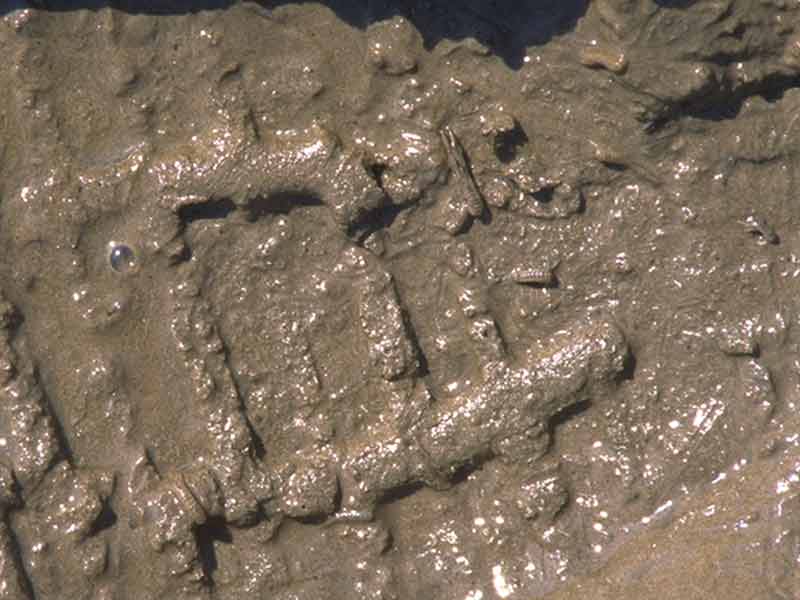
Corophium volutator in a muddy footprint.
Photographer: Sue Scott Copyright: Sue Scott
Distribution data supplied by the Ocean Biodiversity Information System (OBIS). To interrogate UK data visit the NBN Atlas.Map Help
| Researched by | Ken Neal & Penny Avant | Refereed by | This information is not refereed |
| Authority | (Pallas, 1766) | ||
| Other common names | Mud dwelling amphipod | Synonyms | - |
Summary
Description
Corophium volutator has a long slender body that is whitish with brown markings and grows up to 11 mm in length. It has a clearly segmented, dorso-ventrally flattened body. The head is small with two pairs of forward pointing antennae; the second pair are a distinguishing feature of Corophium volutator and are particularly long and thick. There are seven pairs of segmented legs with the top segment of each being typically small and separate from that of the next segment.
Recorded distribution in Britain and Ireland
Widely distributed on all coasts of Britain. Widely separated records in Ireland.Global distribution
North Atlantic, American and European coasts; from western Norway to the Mediterranean and the Black Sea and Azov Sea. There is also a Japanese variety, Corophium volutator orientalis (Omori & Tanaka, 1998).Habitat
The amphipod occupies semi-permanent U-shaped burrows in the fine sediments of mud flats, salt marsh pools and brackish ditches. It tolerates a wide range of salinities from nearly fully saline to almost freshwater. When present in high densities the openings of the burrows are clearly visible on the surface of the sediment.Depth range
IntertidalIdentifying features
- Body dorso-ventrally flattened.
- Head with small pointed rostrum.
- Antennae 2 forward pointing longer and thicker than antennae 1.
- Gnathopods are small with many setae.
- Last pair of pleopods are longer than the preceding pairs.
- Coxal plates are small and separate.
Additional information
The morphology of the male and female antennae differs significantly and for identification refer to the appropriate key, e.g. Lincoln (1979).
Listed by
- none -
Biology review
Taxonomy
| Level | Scientific name | Common name |
|---|---|---|
| Family | Corophiidae | |
| Genus | Corophium | |
| Authority | (Pallas, 1766) | |
| Recent Synonyms | ||
Biology
| Parameter | Data | ||
|---|---|---|---|
| Typical abundance | High density | ||
| Male size range | 1.0 - 11.0 mm | ||
| Male size at maturity | 4.6 mm | ||
| Female size range | 4.6 mm | ||
| Female size at maturity | |||
| Growth form | Articulate | ||
| Growth rate | 8 - 11mm/year | ||
| Body flexibility | High (greater than 45 degrees) | ||
| Mobility | Burrower, Swimmer | ||
| Characteristic feeding method | Active suspension feeder, See additional information, Surface deposit feeder | ||
| Diet/food source | See additional information | ||
| Typically feeds on | Particulate organic matter, epipelic (=living on fine sediment) and epipsammic (= living on sand) bacteria and diatoms. | ||
| Sociability | |||
| Environmental position | Infaunal | ||
| Dependency | No information found. | ||
| Supports | No information | ||
| Is the species harmful? | No | ||
Biology information
Abundance. Corophium volutator is one of the most abundant organisms in estuarine mudflats reaching densities of 100,000 m² in the Stour Estuary, Suffolk (Hughes, 1988). Densities vary with geographical region and season. In Gullmarsfjorden, Wadden Sea winter densities are 100 m² and rise to 1400 m² in the summer (Flach & de Bruin, 1993). In the Crouch Estuary in southeast England, Corophium volutator number 6,000 m² in winter and rise to 50,000 m² in the summer (Gerdol & Hughes, 1993).
Predation. Variations in density are the result of predation and subsequent recovery of Corophium volutator. Corophium volutator is an important food source for dunlin (Calidris alpina) (Jensen & Kristensen, 1990), redshank (Tringa totanus) (Hughes, 1988; Raffaelli et al., 1991), shelduck (Tadorna tadorna) and flounder (Platichthys flesus) and these predators can consume 55% of annual Corophium volutator production (Raffaelli et al., 1991). Corophium volutator is also fed upon by the brown shrimp (Crangon crangon) and the green shore crab (Carcinus maenas) which can consume 57% and 19% of Corophium volutator production respectively (Flach & de Bruin, 1994). In the summer months, as the tide recedes, male Corophium volutator crawl on the surface of the mud, searching for females (Fish & Mills, 1979; Hughes, 1988; Forbes et al., 1996), making them more vulnerable to predation. In North American estuaries, the semipalmated sandpiper (Calidris pusilla) can consume 50 males per minute as they follow the ebbing tide (Brown et al., 1999). There is no dispersive larval phase in the life history of Corophium volutator, instead, the embryos develop in a ventral thoracic brood pouch and emerge as miniature replicas of their parents and build a burrow off that of the parent (Hughes, 1988). Reproduction ceases below 7°C (McLusky, 1968) so, in the winter, predation significantly decreases the density of Corophium volutator.
Corophium volutator has the habit of swimming when immersed, which makes them available as prey for the common goby (Pomatoschistus microps) (Flach & de Bruin, 1994), herring (Clupea harengus), sprat (Sprattus sprattus) and smelt (Osmerus eperlanus) (Essink et al., 1989). The swimming behaviour of Corophium volutator has been reported by several authors. In the Ems Estuary, Wadden Sea, it was estimated that 0.06% of the population (3 x 10⁸ individuals) swim on the flood of each tide, leading to a net landward movement of the population (Essink et al. 1989). In the Stour Estuary, southeast England, Corophium volutator was found to swim only at night, on or around spring tides and only between May and August. It was estimated that on any one tide, 6-19% of the population swam and that it was mainly immature animals that swam (Hughes, 1988). Holmström & Morgan (1983a) also found this species swimming at spring tide, mainly on the ebb just after high tide. Corophium volutator is a poor swimmer and is vulnerable to predation whilst in the water column, so there must be a benefit to swimming that outweighs the risk of predation. Hughes (1988) proposed several theories as to why Corophium volutator would elect to swim:
- as a means of dispersal to prevent inbreeding;
- to prevent intrasibling competition;
- in response to diminishing food supplies in high density areas, or
- females may swim to release their young.
Feeding. Corophium volutator ingests particles 4 -63 µm in diameter. Food consists of bacteria, diatoms and particulate organic matter (POM) (Gerdol & Hughes, 1994a; Hughes, 1988; Jensen & Kristensen, 1990). There has been some disagreement in the literature about which of these is the most important in the diet. Diatoms are crushed individually to avoid ingestion of siliceous frustules, thus it is difficult to estimate the rate of diatom consumption by Corophium volutator (Gerdol & Hughes, 1994a). Feeding occurs at all stages of the tide, suspension feeding at high tide and deposit feeding at low tide. Three modes of feeding have been recorded in Corophium volutator.
- Suspension feeding from a current generated by the pleopods (Hughes, 1988). In this way, an individual can irrigate its burrow at a rate of 25-100 ml per hour (Limia & Rafaelli, 1997).
- Deposit feeding by leaving the burrow and scraping surface detritus and microorganisms into the burrow with the second antennae, the current generated by the pleoplods then passes this material over the mouth parts(Hughes, 1988).
- Epipsammic browsing, where the microbial biofilm is scraped off individual sediment grains (Gerdol & Hughes, 1994a, 1994b).
Habitat preferences
| Parameter | Data |
|---|---|
| Physiographic preferences | Open coast, Estuary |
| Biological zone preferences | Lower eulittoral, Mid eulittoral, Sublittoral fringe, Upper eulittoral |
| Substratum / habitat preferences | Mud, Muddy sand, Sandy mud |
| Tidal strength preferences | Very weak (negligible), Weak < 1 knot (<0.5 m/sec.) |
| Wave exposure preferences | Extremely sheltered, Sheltered, Very sheltered |
| Salinity preferences | Full (30-40 psu), Low (<18 psu), Reduced (18-30 psu), Variable (18-40 psu) |
| Depth range | Intertidal |
| Other preferences | No text entered |
| Migration Pattern | Non-migratory or resident |
Habitat Information
The distribution of Corophium volutator within estuaries changes with season and hydrodynamic conditions. Because of the flood tide swimming habit of Corophium volutator in certain areas (see adult general biology), it is often concentrated within creeks and embayments and all but absent from mudflats even though they are suitable habitat. In the Ythan Estuary, Corophium volutator were found to move in and out of areas depending on salinity. In the summer when freshwater input was low, Corophium volutator was much more widespread than in the winter when high rainfall reduced the interstitial salinity and made certain areas uninhabitable (McLusky, 1968). This pattern is presumably repeated in other estuaries as well.Life history
Adult characteristics
| Parameter | Data |
|---|---|
| Reproductive type | Gonochoristic (dioecious) |
| Reproductive frequency | See additional information |
| Fecundity (number of eggs) | 11-100 |
| Generation time | <1 year |
| Age at maturity | See additional information |
| Season | See additional information |
| Life span | <1 year |
Larval characteristics
| Parameter | Data |
|---|---|
| Larval/propagule type | - |
| Larval/juvenile development | Direct development |
| Duration of larval stage | Not relevant |
| Larval dispersal potential | <10 m |
| Larval settlement period | Not relevant |
Life history information
Reproductive season. Corophium volutator lives for a maximum of one year (Hughes, 1988) and females can have 2-4 broods in a lifetime (Conradi & Depledge, 1999). Populations in southerly areas such as the Dovey Estuary, Wales or Starrs Point, Nova Scotia have two reproductive episodes per year. Those populations in colder, more northerly areas such as the Ythan Estuary, Scotland or in the Baltic Sea only have one (Wilson & Parker, 1996; Table 1). Gravid females first appear in March with peak numbers occurring in May. These females, having successfully overwintered and reproduced, die out during June. The juveniles born in May undergo rapid growth and maturation to reproduce from July to September and generate the next overwintering population (Fish & Mills, 1979).
Reproductive cycle. Female Corophium volutator require the presence of a male to mate and must moult to become ovigerous (McCurdy et al., 2000). Males search for females over the mud at low tide on spring tides (Fish & Mills, 1979) and enter burrows of mature females. Fertilization is internal by copulation and the female has to moult before the male can copulate, often leading to males guarding and fighting over females (Forbes et al., 1996). Fertilized eggs are deposited in a ventral thoracic brood pouch where the embryos develop over the following 14 days and are released as juveniles on the spring tide (Fish & Mills, 1979). Brood sizes are 20 -52 embryos (Fish & Mills, 1979; Jensen & Kristensen, 1990). Populations worldwide generally have a 1:1 sex ratio, but in the Bay of Fundy, the sex ratio was highly skewed towards females. Only 16 to 36% were male and this was not due to higher predation pressure on males by wading birds (Schneider et al., 1994).
Sensitivity review
The MarLIN sensitivity assessment approach used below has been superseded by the MarESA (Marine Evidence-based Sensitivity Assessment) approach (see menu). The MarLIN approach was used for assessments from 1999-2010. The MarESA approach reflects the recent conservation imperatives and terminology and is used for sensitivity assessments from 2014 onwards.
Physical pressures
Use / to open/close text displayed
| Intolerance | Recoverability | Sensitivity | Evidence / Confidence | |
Substratum loss [Show more]Substratum lossBenchmark. All of the substratum occupied by the species or biotope under consideration is removed. A single event is assumed for sensitivity assessment. Once the activity or event has stopped (or between regular events) suitable substratum remains or is deposited. Species or community recovery assumes that the substratum within the habitat preferences of the original species or community is present. Further details EvidenceCorophium volutator has a very specific preference for muddy sand or mud as a suitable substratum. If all of the mud and muddy sand was removed from a beach or estuary it is quite likely that all of the Corophium volutator would be killed and fail to recolonize. Corophium volutator has no larval dispersal phase and relies on tidal currents to move swimming adults and juveniles a few metres at a time (Essink et al., 1989; Hughes, 1988; Holmström & Morgan, 1983b). Therefore, if Corophium volutator was made completely extinct from an area that was isolated by anything more than a few tens of metres from other Corophium volutator habitat, it is unlikely that the extirpated area would be recolonized. On the other hand, Corophium volutator regularly moves in and out of areas within estuaries as they become suitable/unsuitable due to various biotic and/or abiotic factors (McLusky, 1968; Raffaelli et al. 1991). If, then, part of an estuary was cleared of Corophium volutator, it would be quickly recolonized once the clearing factor had ceased. An intolerance of high has been recorded because of the reliance of Corophium volutator on its substratum for feeding and shelter. It is a highly productive species, however, and a defaunated area is likely to be gradually recolonized by immigration from adjacent populations and a recoverability of high has been recorded. | High | High | Moderate | Low |
Smothering [Show more]SmotheringBenchmark. All of the population of a species or an area of a biotope is smothered by sediment to a depth of 5 cm above the substratum for one month. Impermeable materials, such as concrete, oil, or tar, are likely to have a greater effect. Further details. EvidenceHigh rates of sedimentation can have a drastic effect on Corophium volutator numbers. Any obstruction to flow in an estuary causes high rates of sedimentation in the lee of the obstruction. Experimental fences placed on mudflats caused sedimentation rates of 2-2.5 cm/month and reduced Corophium volutator densities from approximately 1700 m² to approximately 400 m². In areas without fences, Corophium volutator numbers increased from approximately 1700 per m² to 3500 per m² (Turk & Risk, 1981). Therefore, any sort of structure that is constructed out onto intertidal mud is likely to alter hydrodynamic conditions and increase sediment accretion. This will lead to a drop in Corophium volutator numbers. In the Ythan Estuary, where eutrophication has led to the formation of beds of the gutweed,Ulva intestinalis, Corophium volutator was almost completely eliminated from beneath it. In the winter when the gutweed died, however, high densities of Corophium volutator quickly reappeared where the gutweed used to be (Raffaelli et al., 1991). Smothering causes significant mortality to Corophium volutator so an intolerance of high has been recorded but it has also been shown that recoverability of affected populations is high. | High | High | Moderate | High |
Increase in suspended sediment [Show more]Increase in suspended sedimentBenchmark. An arbitrary short-term, acute change in background suspended sediment concentration e.g., a change of 100 mg/l for one month. The resultant light attenuation effects are addressed under turbidity, and the effects of rapid settling out of suspended sediment are addressed under smothering. Further details EvidenceCorophium volutator lives in areas with very high sediment loads and it might be postulated that an increase would not affect them but the evidence for the effect of smothering (see above) suggests there may be a reduction in number and an intolerance of intermediate has been recorded. | Intermediate | High | Low | Very low |
Decrease in suspended sediment [Show more]Decrease in suspended sedimentBenchmark. An arbitrary short-term, acute change in background suspended sediment concentration e.g., a change of 100 mg/l for one month. The resultant light attenuation effects are addressed under turbidity, and the effects of rapid settling out of suspended sediment are addressed under smothering. Further details EvidenceA decrease in suspended sediment may decrease the efficiency of suspension feeding in Corophium volutator but since they can deposit feed, this is unlikely to affect their nutrition as a whole and tolerant has been recorded. | Tolerant | Not relevant | Not sensitive | Low |
Desiccation [Show more]Desiccation
EvidenceDespite the large amount of interest in the biology of Corophium volutator, no information was found detailing its resistance to desiccation. However, it occupies estuarine mud that has a high interstitial water content that rarely dries out . Therefore it probably avoids the effects of desiccation in its burrow. Males crawl on the mud surface shortly after emersion (Fish & Mills, 1979; Hughes, 1988; Forbes et al., 1996) but this behaviour only lasts a short time and probably does not make them vulnerable to desiccation. Tolerant has been recorded because of the burrowing habit of Corophium volutator. | Tolerant | Not relevant | Not sensitive | Low |
Increase in emergence regime [Show more]Increase in emergence regimeBenchmark. A one hour change in the time covered or not covered by the sea for a period of one year. Further details EvidenceAn increase in emergence caused by a decrease in tidal amplitude would dry out mud at the top of the shore and exclude Corophium volutator. As a consequence the amount of suitable habitat for Corophium volutator would probably decrease (squeezed between the dry upper shore and tidal/river channels at the bottom of the shore) and lead to a population decline. Increased emergence is unlikely to kill Corophium volutator in the mid shore but may cause some mortality at the population fringes. Intermediate intolerance has been recorded to account for the worst case scenario, and potential loss of population extent. | Intermediate | Very high | Low | Low |
Decrease in emergence regime [Show more]Decrease in emergence regimeBenchmark. A one hour change in the time covered or not covered by the sea for a period of one year. Further details EvidenceCorophium volutator is an intertidal animal and a decrease in emergence would cause part of the population to become subtidal. The affected part of the population is likely to swim to suitable intertidal habitat. The activity of Corophium volutator is entrained by inundation by the tides and therefore has a natural periodicity of 12.4 hours. This can be re-entrained artificially to unnatural tidal cycles in the laboratory (Harris & Morgan, 1984a,b). The part of the population that remained intertidal after a decrease in emergence is likely to re-entrain to the new tidal cycle rapidly and the part made subtidal is likely to swim to the intertidal and therefore tolerant has been recorded. | Tolerant | Not relevant | Not sensitive | Low |
Increase in water flow rate [Show more]Increase in water flow rateA change of two categories in water flow rate (view glossary) for 1 year, for example, from moderately strong (1-3 knots) to very weak (negligible). Further details EvidenceSmall Corophium volutator cannot resettle after swimming at current speeds as low as 1cm/s (Ford & Paterson, 2001), which probably explains why they mainly swim at high tide (Hughes, 1988). An increase in water flow rate could cause swimming Corophium volutator to be swept away from suitable habitat and cause high mortality. Corophium volutator inhabits muddy sand and mud habitats that are found in areas of low water movement. An increase in water flow rate at the benchmark level would probably shear away the mud surface and make Corophium volutator locally extinct. An intolerance of high has been recorded. | High | High | Moderate | Moderate |
Decrease in water flow rate [Show more]Decrease in water flow rateA change of two categories in water flow rate (view glossary) for 1 year, for example, from moderately strong (1-3 knots) to very weak (negligible). Further details EvidenceSince Corophium volutator is often found in areas of slow water movement, it is very unlikely that the flow rate will decrease any further. Therefore not relevant has been recorded. | Not relevant | Not relevant | Not relevant | Low |
Increase in temperature [Show more]Increase in temperature
For intertidal species or communities, the range of temperatures includes the air temperature regime for that species or community. Further details EvidenceCorophium volutator is subject to temperatures of 1°C in the winter to 17°C in the summer (Wilson & Parker, 1996) but can tolerate much higher temperatures (Meadows & Ruagh, 1981). Therefore a long term, chronic change of 2°C is unlikely to affect this species and tolerant has been recorded. | Low | Very high | Very Low | High |
Decrease in temperature [Show more]Decrease in temperature
For intertidal species or communities, the range of temperatures includes the air temperature regime for that species or community. Further details EvidenceCorophium volutator is subject to temperatures of 1°C in the winter to 17°C in the summer (Wilson & Parker, 1996). Therefore a chronic drop in temperature is unlikely to kill any members of the population but it may reduce activity and delay reproduction if the temperature drops below 7°C. Sudden pulses of very cold water can disrupt the circa-tidal rhythms of Corophium volutator by resetting the onset of swimming behaviour. For example, a 6 hour cold spell would lead to the population trying to swim at low tide and leave them vulnerable to increased predation. However, it took temperatures of 15-20°C below ambient temperature to induce this response (Holmström & Morgan, 1983b). Therefore at the benchmark level, a decrease in temperature is unlikely to cause increased mortality and an intolerance of low has been recorded. | Low | Very high | Very Low | High |
Increase in turbidity [Show more]Increase in turbidity
EvidenceCorophium volutator lives in areas of extreme turbidity so it is unlikely that the increased turbidity will have an effect and tolerant has been recorded. | Tolerant | Not relevant | Not sensitive | Low |
Decrease in turbidity [Show more]Decrease in turbidity
EvidenceA decrease in turbidity my increase the vulnerability of Corophium volutator to predation by fish. It may also increase epipelic diatom production due to increased irradiance, which would be of benefit to Corophium volutator. | Tolerant | Not relevant | Not sensitive | Low |
Increase in wave exposure [Show more]Increase in wave exposureA change of two ranks on the wave exposure scale (view glossary) e.g., from Exposed to Extremely exposed for a period of one year. Further details EvidenceIncreased wave action may disturb the mud in which Corophium volutator lives and make it impossible for them to maintain burrows and may affect their ability to settle after swimming. An intolerance of intermediate has been recorded to represent this potential loss of habitat. | Intermediate | High | Low | Low |
Decrease in wave exposure [Show more]Decrease in wave exposureA change of two ranks on the wave exposure scale (view glossary) e.g., from Exposed to Extremely exposed for a period of one year. Further details EvidenceCorophium volutator lives estuaries which tend to be sheltered because of their enclosed nature. Therefore, it is unlikely that a reduction in wave exposure would occur. If such a decrease did occur, however, it is unlikely that it would affect Corophium volutator and tolerant has been recorded. | Tolerant | Not relevant | Not sensitive | |
Noise [Show more]Noise
EvidenceCorophium volutator is probably sensitive to surface vibrations but little is know about the effects of noise on invertebrates. However, it is unlikely to be affected at the benchmark level and tolerant has been recorded. | Tolerant | Not relevant | Not sensitive | Very low |
Visual presence [Show more]Visual presenceBenchmark. The continuous presence for one month of moving objects not naturally found in the marine environment (e.g., boats, machinery, and humans) within the visual envelope of the species or community under consideration. Further details EvidenceCorophium volutator has limited visual acuity and since it spends most of its life in a burrow it is unlikely to be affected by presence at the benchmark level. | Not relevant | Not relevant | Not relevant | Not relevant |
Abrasion & physical disturbance [Show more]Abrasion & physical disturbanceBenchmark. Force equivalent to a standard scallop dredge landing on or being dragged across the organism. A single event is assumed for assessment. This factor includes mechanical interference, crushing, physical blows against, or rubbing and erosion of the organism or habitat of interest. Where trampling is relevant, the evidence and trampling intensity will be reported in the rationale. Further details. EvidenceIn the Columbia river, no significant difference was found in Corophium volutator densities before and after dredging a channel and no difference between the dredged site and a control site (McCabe et al., 1998). Presumably, the dredging did cause mortality of Corophium volutator but recolonization was so rapid that no difference was found. In contrast, bait worm digging in Corophium volutator patches was found to reduce overall numbers by 39% due to low recruitment and mortality. Juveniles were especially affected and were reduced by 55% (Shepherd & Boates, 1999).The edible cockle (Cerastoderma edule) and the lugworm (Arenicola marina) have a significant negative effect on Corophium volutator density, causing a ~50% drop in numbers at densities of 11-18 lugworms/m² and 250-500 cockles/m². The sediment turnover caused by the cockles and lugworms disturbed the burrows of Corophium volutator and caused an increased rate of swimming making the amphipod more vulnerable to predation by the brown shrimp (Crangon crangon), the green shore crab (Carcinus maenas) and the common goby (Pomatoschistus microps) (Flach & de Bruin, 1993, 1994). Based upon this information, any abrasion or physical disturbance is likely to reduce the density of Corophium volutator by emigration and increased mortality and an intolerance of intermediate has been recorded. However, once a disturbance has ceased, repopulation by immigration is rapid (Raffaelli et al., 1991). | Intermediate | Very high | Low | High |
Displacement [Show more]DisplacementBenchmark. Removal of the organism from the substratum and displacement from its original position onto a suitable substratum. A single event is assumed for assessment. Further details EvidenceCorophium volutator regularly swims on spring high tides and these events can involve 1-19% of the population in a single tide (Essink et al., 1989; Homström & Morgan, 1983; Hughes, 1988). These swimming events may be in response to unfavourable abiotic or biotic conditions and the distribution of Corophium volutator within an estuary can change seasonally (McLusky, 1968). Corophium volutator is preadapted for displacement and 'tolerant' has been recorded. | Tolerant | Not relevant | Not sensitive | Moderate |
Chemical pressures
Use [show more] / [show less] to open/close text displayed
| Intolerance | Recoverability | Sensitivity | Evidence / Confidence | |
Synthetic compound contamination [Show more]Synthetic compound contaminationSensitivity is assessed against the available evidence for the effects of contaminants on the species (or closely related species at low confidence) or community of interest. For example:
The evidence used is stated in the rationale. Where the assessment can be based on a known activity then this is stated. The tolerance to contaminants of species of interest will be included in the rationale when available; together with relevant supporting material. Further details. EvidenceCorophium volutator is paralysed by pyrethrum based insecticide sprayed onto the surface of the mud (Gerdol & Hughes, 1993) and pyrethrum would probably cause significant mortalities if it found its way into estuaries from agricultural runoff.Nonylphenol is an anthropogenic pollutant that regularly occurs in water bodies, it is an oestrogen mimic that is produced during the sewage treatment of non-ionic surfactants and can affect Corophium volutator (Brown et al., 1999). Nonylphenol is a hydrophobic molecule and often becomes attached to sediment in water bodies. This will make nonylphenol available for ingestion by Corophium volutator in estuaries where much of the riverine water-borne sediment flocculates and precipitates out of suspension to form mudflats. Nonylphenol is not lethal to Corophium volutator but does reduce growth and has the effect of causing the secondary antennae of males to become enlarged. This causes an encumbrance to the males and makes them more vulnerable than usual to predation by waders when they crawl across the mud surface in search of females (Brown et al., 1999). Corophium volutator is killed by 1% ethanol if exposed for 24 hours or more but can withstand higher concentrations in short pulses. Such short pulses, however, have the effect of rephasing the diel rhythm and will delay the timing of swimming activity for the duration of the ethanol pulse (Harris & Morgan, 1984b). For example, if a population of Corophium volutator is entrained to swim at 12 noon and is subjected to a pulse of ethanol between 9 and 10 am, Corophium volutator will not swim until 1 o' clock. This re-entrainment lasts for several tidal cycles (Harris & Morgan, 1984b) and has implications for the vulnerability of Corophium volutator to predation. In a similar way to ethanol, the antibiotic/insecticide/nematodicide valinomycin, affects the diel rhythm of swimming in Corophium volutator but instead of delaying the onset of swimming behaviour, valinomycin advances it (Harris & Morgan, 1984b). So in the example above, swimming would start at 11 am rather than noon, probably increasing their vulnerability to predation. An intolerance of high has been recorded because synthetic chemicals studied caused direct mortality or increased mortality due to behavioural modification. | High | Very high | Low | High |
Heavy metal contamination [Show more]Heavy metal contaminationEvidenceCorophium volutator is more vulnerable to metals in water than bound to sediment because the ions can cross respiratory surfaces as well as be ingested during feeding. A concentration 38 mg Cu/l was needed to kill 50% of Corophium volutator in 96 hour exposures (Bat et al., 1998). Other metals are far more toxic to Corophium volutator, e.g. zinc is toxic over 1 mg/l and toxicity to metals increases with increasing temperature and salinity (Bryant et al., 1985b). Mortality of 50% is caused by 14 mg/l (Bat et al., 1998). The sublethal effects of zinc included: slowed growth; delayed sexual maturation and reduced fecundity at concentrations from 0.2 to 0.6 mg/l. Exposure to a concentration of 0.8 mg/l zinc prevented sexual maturation. Zinc exposure also reduced the survivorship of juveniles (Conradi & Depledge, 1999). Although exposure to zinc may not be lethal, it may affect the perpetuation of a population by reducing reproductive fitness.Mercury was found to be very toxic to Corophium volutator, e.g. concentrations as low as 0.1 mg/l caused 50% mortality in 12 days. Mercury also caused significant mortality of the sediment bacteria on which Corophium volutator feeds but bacterial mortalities were greater than 85% before any significant mortality of Corophium volutator occurred (Meadows & Erdem, 1982). Other metals tested include:
| High | High | Moderate | High |
Hydrocarbon contamination [Show more]Hydrocarbon contaminationEvidenceLight fractions (C10 - C19) of oils are much more toxic to Corophium volutator than heavier fractions (C19 - C40). In exposures of up to 14 days, light fraction concentrations of 0.1 g/kg sediment caused high mortality. It took 9 g/kg sediment to achieve similar mortalities with the heavy fraction (Brils et al., 2002). In the Forth estuary, Corophium volutator was excluded for several hundred metres around the outfalls from hydrocarbon processing plants. However, within 1 year of effluent cessation Corophium volutator had reached densities of approximately 2500 m² (McLusky & Martins, 1998). Therefore, an intolerance of high and a recovery of high have been recorded. | High | High | Moderate | High |
Radionuclide contamination [Show more]Radionuclide contaminationEvidenceCorophium volutator readily absorbs radionuclides such as americium and plutonium from water and contaminated sediments (Miramand et al., 1982). However, the effect of contamination of the individuals is not known but an accumulation through the food chain is assumed (Miramand et al., 1982), and this may affect humans consuming contaminated fish. Corophium volutator avoids irradiated sediments with a radiation level of more than 0.8 mrad. This is not because Corophium volutator can detect radiation or because the radiation kills the sediment bacteria. The radiation does cause massive mortalities amongst microorganisms but it is some other chemical change in the sediment that makes Corophium volutator choose un-irradiated sediment when given the choice (Deans et al., 1977). An intolerance of low has been recorded because radiation does not cause high mortality to Corophium volutator but will cause them to swim in order to escape the indirect effects of the radiation. | Low | Very high | No information | High |
Changes in nutrient levels [Show more]Changes in nutrient levelsEvidenceAn intolerance of high has been recorded for nutrients to account for the worst case scenario as found in the Ythan Estuary, Scotland. Here, nutrient enrichment causes the mudflats to become covered with algal mats consisting mainly of the gutweed Ulva intestinalis. These mats physically perturb Corophium volutator by preventing burrowing and normal feeding. In areas where the mats did not occur, the density of Corophium volutator was 11 times higher than under the algae. When the algae died-back in the winter, the areas were rapidly recolonized from adjacent patches where the gutweed could not grow and population growth was high from feeding on the rotting algae. In the spring, the gutweed returned and the Corophium volutator are excluded once again (Raffaelli et al., 1991). The burrows of Corophium volutator lower the depth of the redox potential discontinuity allowing oxygen to penetrate into the sediment and can aid the recovery of organically enriched sediments (Limia & Raffaelli, 1997). | High | Very high | Low | High |
Increase in salinity [Show more]Increase in salinity
EvidenceCorophium volutator is an exceptionally euryhaline species able to tolerate 2-50 psu (McLusky, 1968) but growth is fastest at 15-20 psu (McLusky, 1967; McLusky, 1970 in Meadows & Ruagh, 1981). The interstitial salinity is more important for Corophium volutator than that of the overlying water and there is not ready exchange of water and solutes between the two. Sustained periods of increased salinity are required to alter that of the interstitial water and there is a lag between salinity changes and the response of Corophium volutator (McLusky, 1968). Salinity is thought to entrain Corophium volutator to the tides and sudden increases in salinity delay swimming activity (Harris & Morgan, 1984a). Because of its wide tolerance, an increase in salinity is unlikely to kill Corophium volutator but an acute change may put their behaviour out of synchrony with the tides. Corophium volutator will also emigrate from areas of unfavourable salinity (McLusky, 1968) and an intolerance of tolerant has been recorded. | Tolerant | None | Not sensitive | High |
Decrease in salinity [Show more]Decrease in salinity
EvidenceCorophium volutator is an exceptionally euryhaline species able to tolerate 2-50 psu (McLusky, 1968) but growth is fastest at 15-20 psu (McLusky, 1970 in Meadows & Ruagh, 1981). Corophium volutator is a hyperosmotic regulator and the tolerance of its tissues is 13-50 psu but it needs a salinity of above 5 psu in order moult, since osmoregulation is lost during moulting (McLusky, 1967). A salinity of at least 7.5 psu is required for reproduction (McLusky, 1968). The salinity tolerance of Corophium volutator is greater than the benchmark. However, if freshwater input suddenly increased (due to increased rainfall for example) or saline input was reduced (due to a man-made obstruction in the estuary) the distribution of Corophium volutator within that area is likely to change drastically due to emigration from unsuitable areas. Changes in salinity may alter population distribution and dynamics but are very unlikely to cause mortality and tolerant has been recorded. | Tolerant | Not relevant | Not sensitive | High |
Changes in oxygenation [Show more]Changes in oxygenationBenchmark. Exposure to a dissolved oxygen concentration of 2 mg/l for one week. Further details. EvidenceCorophium volutator is highly sensitive to hypoxia and suffers 50% mortality after just 4 hours in hypoxic conditions, or in 2 hours if there is rapid build-up of sulphide (Gamenick et al., 1996). These conditions often occur in estuaries where drifting macroalgae (such as Fucus sp.) settle on the mudflats in small patches therefore an intolerance of high has been recorded. | High | Very high | Low | High |
Biological pressures
Use [show more] / [show less] to open/close text displayed
| Intolerance | Recoverability | Sensitivity | Evidence / Confidence | |
Introduction of microbial pathogens/parasites [Show more]Introduction of microbial pathogens/parasitesBenchmark. Sensitivity can only be assessed relative to a known, named disease, likely to cause partial loss of a species population or community. Further details. EvidenceInsufficientinformation | No information | No information | No information | Not relevant |
Introduction of non-native species [Show more]Introduction of non-native speciesSensitivity assessed against the likely effect of the introduction of alien or non-native species in Britain or Ireland. Further details. EvidenceInsufficientinformation | No information | No information | No information | Not relevant |
Extraction of this species [Show more]Extraction of this speciesBenchmark. Extraction removes 50% of the species or community from the area under consideration. Sensitivity will be assessed as 'intermediate'. The habitat remains intact or recovers rapidly. Any effects of the extraction process on the habitat itself are addressed under other factors, e.g. displacement, abrasion and physical disturbance, and substratum loss. Further details. EvidenceCorophium volutator is not targeted for extraction. | Not relevant | Not relevant | Not relevant | Low |
Extraction of other species [Show more]Extraction of other speciesBenchmark. A species that is a required host or prey for the species under consideration (and assuming that no alternative host exists) or a keystone species in a biotope is removed. Any effects of the extraction process on the habitat itself are addressed under other factors, e.g. displacement, abrasion and physical disturbance, and substratum loss. Further details. EvidenceThe extraction of cockles by sediment raking and mechanical disturbance and digging for lugworms for bait is likely to cause significant mortality of Corophium volutator. Bait digging was found to reduce Corophium volutator densities by 39%, juveniles were most affected suffering a 55% reduction in dug areas (Shepherd & Boates, 1999). Therefore, an intolerance of intermediate has been recorded and recoverability is also very high. | Intermediate | Very high | Low | High |
Additional information
Once a perturbation has ceased, Corophium volutator has great potential for recovery as it changes density and local distribution on an annual basis (Essink et al., 1989; Flach & de Bruin, 1993; Hughes, 1988; Hughes & Gerdol, 1997; McLusky, 1968; Raffaelli et al. 1991). The females can produce 20-52 embryos in each reproductive episode (Fish & Mills 1979; Jensen & Kristensen, 1990) which recruit within a few centimetres of the parent, although they may disperse later by swimming (Hughes, 1988). In the warmer regions where Corophium volutator is found, juveniles can mature in 2 months (Fish & Mills, 1979) and add their own broods to the population. Where perturbation causes local extinction (in areas on the scale of tens of square metres) Corophium volutator can rapidly recolonize by immigration and recruitment of juveniles from immigrants. However, in areas of suitable habitat that are isolated from immigration, mass mortalities may have more serious implications for the recoverability of Corophium volutator. In the Ythan Estuary, where eutrophication has lead to the formation of beds of the gutweed Ulva intestinalis, Corophium volutator was almost completely eliminated from beneath it. In the winter, however, high densities of Corophium volutator reappeared within a few months once the gutweed had disappeared (Raffaelli et al., 1991).Importance review
Policy/legislation
- no data -
Status
| National (GB) importance | - | Global red list (IUCN) category | - |
Non-native
| Parameter | Data |
|---|---|
| Native | - |
| Origin | - |
| Date Arrived | - |
Importance information
Corophium volutator is an important food source for dunlin (Calidris alpina) (Jensen & Kristensen, 1990), redshank (Tringa totanus) (Hughes, 1988; Raffaelli et al., 1991), shelduck (Tadorna tadorna) and flounder (Platichthys flesus) and these predators can consume 55% of annual Corophium volutator production (Raffaelli et al., 1991). Corophium volutator is also fed upon by the brown shrimp (Crangon crangon) and the green shore crab (Carcinus maenas) which can consume 57% and 19% of Corophium volutator production respectively (Flach & de Bruin, 1994). In the summer months, as the tide recedes, male Corophium volutator crawl on the surface of the mud, searching for females (Fish & Mills, 1979; Hughes, 1988; Forbes et al., 1996), making them more vulnerable to predation. In North American estuaries, the semipalmated sandpiper (Calidris pusilla) can consume 50 males per minute as they follow the ebbing tide (Brown et al., 1999).Bibliography
Bat, L., Raffaelli, D. & Marr, I.L., 1998. The accumulation of copper, zinc and cadmium by the amphipod Corophium volutator (Pallas). Journal of Experimental Marine Biology and Ecology, 223, 167-184.
Briggs, A.D., Greenwood, N. & Grant, A., 2003. Can turbidity caused by Corophium volutator (Pallas) activity be used to assess sediment toxicity rapidly? Marine Environmental Research, 55, 181-192.
Brils, J.M., Huwer, S.L., Kater, B.J., Schout, P.G., Harmsen, J., Delvigne, G.A.L. & Scholten, M.C.T., 2002. Oil effect in freshly spiked marine sediment on Vibrio fischeri, Corophium volutator, and Echinocardium caudatum. Environmental Toxicology and Chemistry, 21, 2242-2251.
Brown, R.J., Conradi, M. & Depledge, M.H., 1999. Long-term exposure to 4-nonylphenol affects sexual differentiation and growth of the amphipod Corophium volutator (Pallas, 1766). Science of the Total Environment, 233, 77-88.
Bruce, J.R., Colman, J.S. & Jones, N.S., 1963. Marine fauna of the Isle of Man. Liverpool: Liverpool University Press.
Bryant, V., McLusky, D.S., Roddie, K. & Newbery, D.M., 1984. Effect of temperature and salinity on the toxicity of chromium to three estuarine invertebrates (Corophium volutator, Macoma balthica, Nereis diversicolor). Marine Ecology Progress Series, 20 (1-2), 137-149. DOI https://doi.org/10.3354/meps020137
Bryant, V., Newbery, D.M., McLusky, D.S. & Campbell, R., 1985b. Effect of temperature and salinity on the toxicity of nickel and zinc to two estuarine invertebrates (Corophium volutator, Macoma balthica). Marine Ecology Progress Series, 24, 139-153.
Conradi, M. & Depledge, M.H., 1999. Effects of zinc on the life-cycle, growth and reproduction of the marine amphipod Corophium volutator. Marine Ecology Progress Series, 176, 131-138.
Deans, E.A., Anderson, J.G. & Meadows, P.S., 1977. Responses of a benthic marine invertebrate to gamma-irradiated sediment Nature, 270, 595-596.
Essink, K., Kleef, H.L. & Visser, W., 1989. On the pelagic occurrence and dispersal of the benthic amphipod Corophium volutator. Journal of the Marine Biological Association of the United Kingdom, 69, 11-15.
Fish, J.D. & Mills, A., 1979. The reproductive biology of Corophium volutator and C. arenarium (Crustacea: Amphipoda). Journal of the Marine Biological Association of the United Kingdom, 59, 355-368.
Fish, J.D. & Fish, S., 1996. A student's guide to the seashore. Cambridge: Cambridge University Press.
Flach, E.C. & De Bruin, W., 1993. Effects of Arenicola marina and Cerastoderma edule on distribution, abundance and population structure of Corophium volutator in Gullmarsfjorden western Sweden. Sarsia, 78, 105-118.
Flach, E.C. & De Bruin, W., 1994. Does the activity of cockles, Cerastoderma edule (L.) and lugworms, Arenicola marina (L.), make Corophium volutator Pallas more vulnerable to epibenthic predators: a case of interaction modification? Journal of Experimental Marine Biology and Ecology, 182, 265-285.
Forbes, M.R., Boates, S.J., McNeil, N.L. & Brison, A.E., 1996. Mate searching by males of the intertidal amphipod Corophium volutator (Pallas). Canadian Journal of Zoology, 74, 1479-1484.
Ford, R.B. & Paterson, D.M., 2001. Behaviour of Corophium volutator in still versus flowing water. Estuarine, Coastal and Shelf Science, 52, 357-362.
Galay Burgos, M. & Rainbow, P.S., 1998. Uptake, Accumulation and excretion by Corophium volutator (Crustacea: Amphipoda) of zinc, cadmium and coblat added to sewage sludge. Estuarine, Coastal and Shelf Science, 47, 603-620.
Gamenick, I., Jahn, A., Vopel, K. & Giere, O., 1996. Hypoxia and sulphide as structuring factors in a macrozoobenthic community on the Baltic Sea shore: Colonization studies and tolerance experiments. Marine Ecology Progress Series, 144, 73-85. DOI https://doi.org/10.3354/meps144073
Gerdol, V. & Hughes, R.G., 1993. Effect of the amphipod Corophium volutator on the colonisation of mud by the halophyte Salicornia europea. Marine Ecology Progress Series, 97, 61-69.
Gerdol, V. & Hughes, R.G., 1994a. Feeding behaviour and diet of Corophium volutator in an estuary in southeastern England. Marine Ecology Progress Series, 114, 103-108
Gerdol, V. & Hughes, R.G., 1994b. Effect of Corophium volutator on the abundance of benthic diatoms, bacteria and sediment stability in two estuaries in southeastern England. Marine Ecology Progress Series, 114, 109-115.
Harris, G.J. & Morgan, E., 1984a. The effects of salinity changes on the endogenous circa-tidal rhythm of the amphipod Corophium volutator (Pallas). Marine Behaviour and Physiology, 10, 199-217.
Harris, G.J. & Morgan, E., 1984b. The effects of ethanol, valinomycin and cycloheximide on the endogenous circa-tidal rhythm of the estuarine amphipod Corophium volutator (Pallas). Marine Behaviour and Physiology, 10, 219-233. DOI https://doi.org/10.1080/10236248409378619
Hayward, P., Nelson-Smith, T. & Shields, C. 1996. Collins pocket guide. Sea shore of Britain and northern Europe. London: HarperCollins.
Hayward, P.J. & Ryland, J.S. (ed.) 1995b. Handbook of the marine fauna of North-West Europe. Oxford: Oxford University Press.
Holmström, W.F. & Morgan, E., 1983a. Variation in the naturally occurring ryhthm of the estuarine amphipod Corophium volutator (Pallas). Journal of the Marine Biological Association of the United Kingdom, 63, 833-850.
Holmström, W.F. & Morgan, E., 1983b. The effects of low temperature pulses in rephasing the endogenous activity rhythm of Corophium volutator (Pallas). Journal of the Marine Biological Association of the United Kingdom, 63, 851-860.
Howson, C.M. & Picton, B.E., 1997. The species directory of the marine fauna and flora of the British Isles and surrounding seas. Belfast: Ulster Museum. [Ulster Museum publication, no. 276.]
Hughes, R.G. & Gerdol, V., 1997. Factors affecting the distribution of the amphipod Corophium volutator in two estuaries in south-east England. Estuarine, Coastal and Shelf Science, 44, 621-627.
Hughes, R.G., 1988. Dispersal by benthic invertebrates: the in situ swimming behaviour of the amphipod Corophium volutator. Journal of the Marine Biological Association of the United Kingdom, 68, 565-579.
Jensen, K.T. & Kristensen, L.D., 1990. A field experiment on competition between Corophium volutator (Pallas) and Corophium arenarium Crawford (Crustacea: Amphipoda): effects on survival, reproduction and recruitment. Journal of Experimental Marine Biology and Ecology, 137, 1-24.
Limia, J. & Raffaelli, D., 1997. The effects of burrowing by the amphipod Corophium volutator on the ecology of intertidal sediments. Journal of the Marine Biological Association of the United Kingdom, 77, 409-423.
Lincoln, R.J., 1979. British Marine Amphipoda: Gammaridea. London: British Museum (Natural History).
McCabe, G.T. Jr., Hinton, S.A. & Emmett, R.L., 1998. Benthic invertebrates and sediment characteristics in a shallow navigation channel of the lower Columbia River. Northwest Science, 72, 116-126.
McCurdy, D.G., Boates, J.S. & Forbes, M.R., 2000. Reproductive synchrony in the intertidal amphipod Corophium volutator. Oikos, 88, 301-308.
McLusky, D.S., 1967. Some effects of salinity on the survival, moulting, and growth of Corophium volutator (Amphipoda). Journal of the Marine Biological Association of the United Kingdom, 47, 607-617.
McLusky, D.S., 1968. Some effects of salinity on the distribution and abundance of Corophium volutator in the Ythan estuary. Journal of the Marine Biological Association of the United Kingdom, 48, 443-454.
Meadows, P.S. & Erdem, C., 1982. The effect of mercury of Corophium volutator viability and uptake. Marine Environmental Research, 6, 227-233.
Meadows, P.S. & Ruagh, A.A., 1981. Temperature preferences and activity of Corophium volutator (Pallas) in a new choice apparatus. Sarsia, 66, 67-72.
Miramand, P., Germain, P. & Camus, H., 1982. Uptake of americium and plutonium from contaminated sediments by three benthic species: Arenicola marina, Corophium volutator and Scrobicularia plana. Marine Ecology Progress Series, 7, 59-65.
Omori, K. & Tanaka, M., 1998. Estimation of maximum density of a mudflat amphipod Corophium volutator orientalis (Amphipoda: Crustacea) on the basis of its occupied area. Journal of Experimental Marine Biology and Ecology, 231, 31-45.
Raffaelli, D., Limia, J., Hull, S. & Pont, S., 1991. Interactions between the amphipod Corophium volutator and macroalgal mats on estuarine mudflats. Journal of the Marine Biological Association of the United Kingdom, 71, 899-908.
Schneider, S.D., Boates, J.S. & Forbes, M., 1994. Sex ratios of Corophium volutator (Pallas) (Crustacea: Amphipoda) in Bay of Fundy populations. Canadian Journal of Zoology, 72, 1915-1921.
Shepherd, P.C.F. & Boates, S.J., 1999. Effects of commercial baitworm harvest on semipalmated sandpipers and their prey in the Bay of Fundy hemispheric shorebird reserve. Conservation Biology, 13, 347-356.
Turk, T.R. & Risk, M.J., 1981. Invertebrate populations of Cobequid Bay, Bay of Fundy. Canadian Journal of Fisheries and Aquatic Sciences, 38, 642-648.
Wilson, W.H. & Parker, K., 1996. The life history of the amphipod, Corophium volutator: the effects of temperature and shorebird predation. Journal of Experimental Marine Biology and Ecology, 196, 239-250.
Datasets
Bristol Regional Environmental Records Centre, 2017. BRERC species records recorded over 15 years ago. Occurrence dataset: https://doi.org/10.15468/h1ln5p accessed via GBIF.org on 2018-09-25.
Environmental Records Information Centre North East, 2018. ERIC NE Combined dataset to 2017. Occurrence dataset: http://www.ericnortheast.org.ukl accessed via NBNAtlas.org on 2018-09-38
Fenwick, 2018. Aphotomarine. Occurrence dataset http://www.aphotomarine.com/index.html Accessed via NBNAtlas.org on 2018-10-01
Kent Wildlife Trust, 2018. Kent Wildlife Trust Shoresearch Intertidal Survey 2004 onwards. Occurrence dataset: https://www.kentwildlifetrust.org.uk/ accessed via NBNAtlas.org on 2018-10-01.
Manx Biological Recording Partnership, 2017. Isle of Man wildlife records from 01/01/2000 to 13/02/2017. Occurrence dataset: https://doi.org/10.15468/mopwow accessed via GBIF.org on 2018-10-01.
Merseyside BioBank., 2018. Merseyside BioBank (unverified). Occurrence dataset: https://doi.org/10.15468/iou2ld accessed via GBIF.org on 2018-10-01.
National Trust, 2017. National Trust Species Records. Occurrence dataset: https://doi.org/10.15468/opc6g1 accessed via GBIF.org on 2018-10-01.
NBN (National Biodiversity Network) Atlas. Available from: https://www.nbnatlas.org.
OBIS (Ocean Biodiversity Information System), 2025. Global map of species distribution using gridded data. Available from: Ocean Biogeographic Information System. www.iobis.org. Accessed: 2025-07-31
South East Wales Biodiversity Records Centre, 2018. SEWBReC Myriapods, Isopods, and allied species (South East Wales). Occurrence dataset: https://doi.org/10.15468/rvxsqs accessed via GBIF.org on 2018-10-02.
South East Wales Biodiversity Records Centre, 2018. Dr Mary Gillham Archive Project. Occurance dataset: http://www.sewbrec.org.uk/ accessed via NBNAtlas.org on 2018-10-02
Suffolk Biodiversity Information Service., 2017. Suffolk Biodiversity Information Service (SBIS) Dataset. Occurrence dataset: https://doi.org/10.15468/ab4vwo accessed via GBIF.org on 2018-10-02.
The Wildlife Information Centre, 2018. TWIC Biodiversity Field Trip Data (1995-present). Occurrence dataset: https://doi.org/10.15468/ljc0ke accessed via GBIF.org on 2018-10-02.
Citation
This review can be cited as:
Last Updated: 10/11/2006