
Dulse (Palmaria palmata)
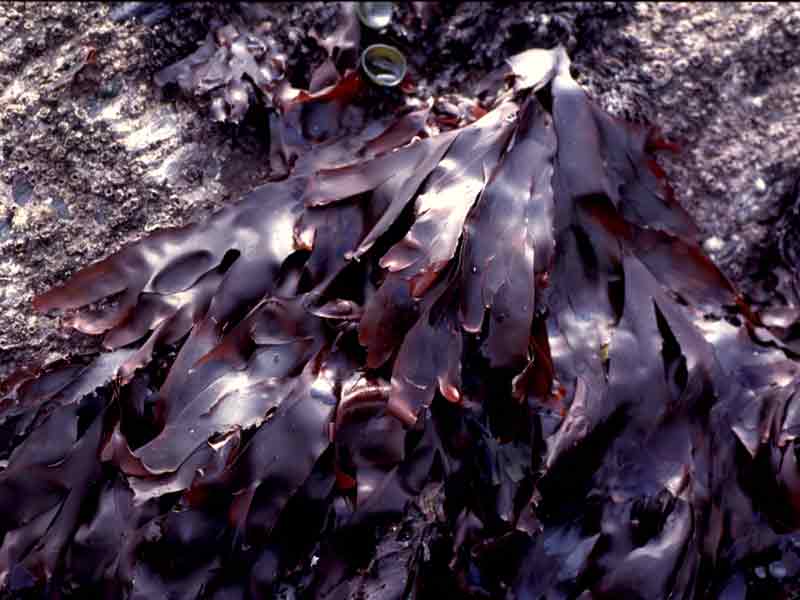
Palmaria palmata fronds on lower eulittoral rock.
Photographer: Keith Hiscock Copyright: Dr Keith Hiscock
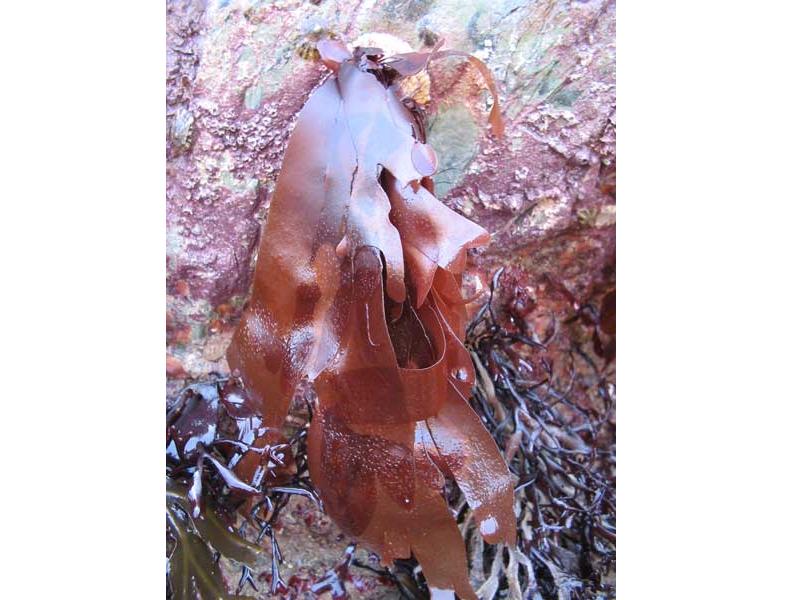
Palmaria palmata hanging from an intertidal rock.
Photographer: Judith Oakley Copyright: Judith Oakley
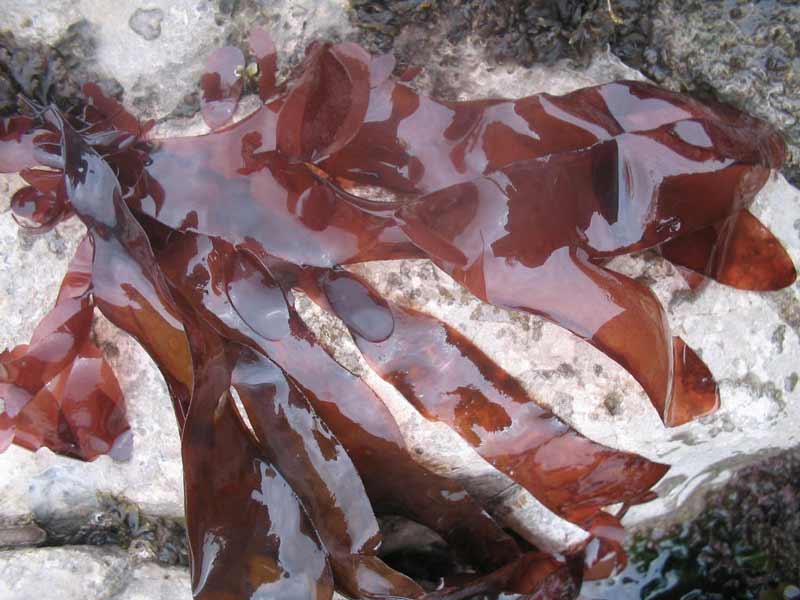
Palmaria palmata in between rockpools.
Photographer: Judith Oakley Copyright: Judith Oakley
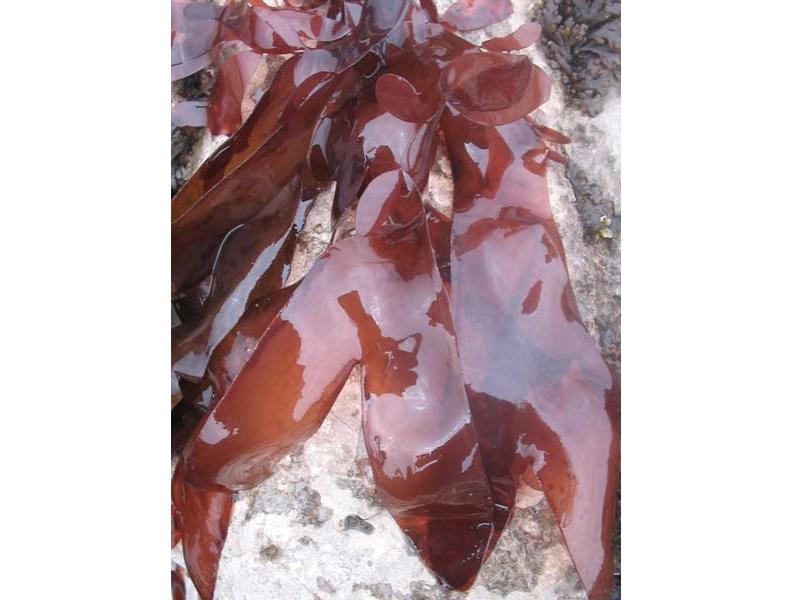
Palmaria palmata near an intertidal rockpool.
Photographer: Judith Oakley Copyright: Judith Oakley
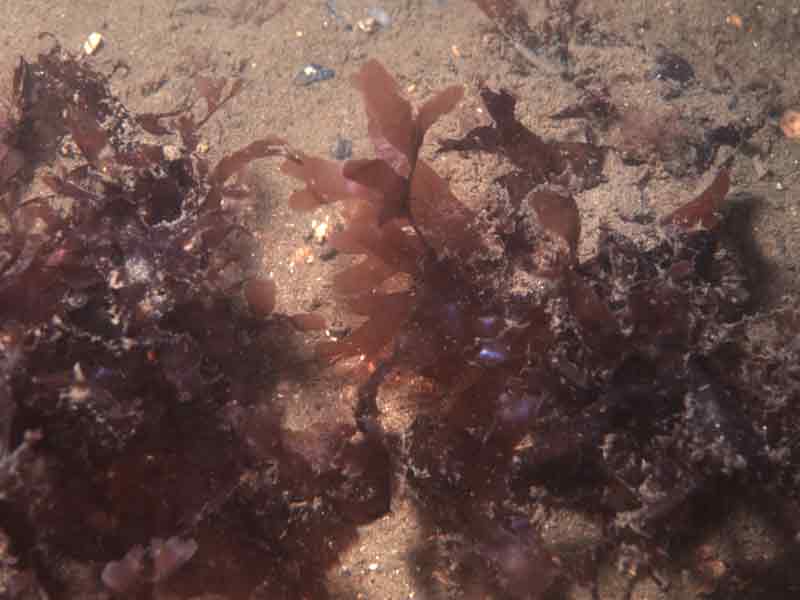
Palmaria palmata.
Photographer: Keith Hiscock Copyright: Dr Keith Hiscock
Distribution data supplied by the Ocean Biodiversity Information System (OBIS). To interrogate UK data visit the NBN Atlas.Map Help
| Researched by | Jacqueline Hill | Refereed by | Dr Thomas Wiedemann |
| Authority | (Linnaeus) Weber & Mohr, 1805 | ||
| Other common names | - | Synonyms | - |
Summary
Description
A foliose red algae with a tough flat frond usually between 20 and 50 cm in length, but sometimes up to 1m. The algae grows directly from a small discoid holdfast gradually widening and subdividing. The stipe is inconspicuous, rarely to 5 mm long. Older parts may have small 'leaflets' along the margin especially where damaged. Dark red, with purple tints under water.
Recorded distribution in Britain and Ireland
Generally distributed throughout Britain and Ireland, but apparently absent from significant stretches of coast in eastern England.Global distribution
Arctic Russia to Portugal; Baltic. Artic Canada to USA (New Jersey); USA (Alaska to California); Japan, Korea.Habitat
Epilithic and epiphytic, especially on Laminaria hyperborea stipes. Littoral and sublittoral to a depth of 20 m in both sheltered and moderately exposed areas.Depth range
To a depth of 20mIdentifying features
- Blade leathery-membranous without midrib, the total length usually between 20 cm and 50c m long, but sometimes up to 1 m. Blade width about 3-8 cm rarely up to 16 cm.
- Fronds solitary or a few together, simple below or branching from the base, stipe inconspicuous, blade gradually expanding above, dichotomously or palmately divided into broad segments. Blade sometimes simple, with marginal proliferations often dichotomous and large, resembling primary blade.
- Thallus with a discoid holdfast and erect fronds, purplish red in colour.
Additional information
Sometimes the blade divisions are wedge-shaped and finely dissected above or the blade has numerous linear divisions throughout. This phenomenon seems to occur under fairly sheltered, silty conditions. Such plants are difficult to identify without examining the anatomical structure and the cortical cells in surface view, and have been confused with Callophyllis cristata (L. ex Turn.) Kütz. and Gracilaria foliifera (Forsk.) Børk (Irvine, 1983). Palmaria palmata has a multiaxial, pseudoparenchymatous construction and, in section, can be seen to consist of a large-celled medulla bounded on each side by a small-celled cortex.
Listed by
- none -
Biology review
Taxonomy
| Level | Scientific name | Common name |
|---|---|---|
| Phylum | Rhodophyta | Red seaweeds |
| Class | Florideophyceae | |
| Order | Palmariales | |
| Family | Palmariaceae | |
| Genus | Palmaria | |
| Authority | (Linnaeus) Weber & Mohr, 1805 | |
| Recent Synonyms | ||
Biology
| Parameter | Data | ||
|---|---|---|---|
| Typical abundance | |||
| Male size range | up to 50cm | ||
| Male size at maturity | |||
| Female size range | Large(>50cm) | ||
| Female size at maturity | |||
| Growth form | Crustose soft | ||
| Growth rate | 100% body wt/week | ||
| Body flexibility | High (greater than 45 degrees) | ||
| Mobility | Sessile, permanent attachment | ||
| Characteristic feeding method | Autotroph | ||
| Diet/food source | |||
| Typically feeds on | Not relevant | ||
| Sociability | |||
| Environmental position | Epilithic | ||
| Dependency | Independent. Often epiphytic - see additional information. | ||
| Supports | Substratum algal epiphytes and endophytes and a number of marine fungi. | ||
| Is the species harmful? | No Palmaria palmata is an edible species. | ||
Biology information
- The life-cycle of Palmaria palmata is diplohaplontic and strongly heteromorphic, with a reduced crustose female gametophyte and a macroscopic foliose male gametophyte.
- Where competition for space and light restricts the occurance of Palmaria palmata on rock the species often has an epiphytic habit on other algae, especially kelps.
Habitat preferences
| Parameter | Data |
|---|---|
| Physiographic preferences | Open coast, Strait or Sound, Enclosed coast or Embayment |
| Biological zone preferences | Lower eulittoral, Sublittoral fringe, Upper infralittoral |
| Substratum / habitat preferences | Macroalgae, Bedrock, Large to very large boulders |
| Tidal strength preferences | Moderately strong 1 to 3 knots (0.5-1.5 m/sec.), Strong 3 to 6 knots (1.5-3 m/sec.), Weak < 1 knot (<0.5 m/sec.) |
| Wave exposure preferences | Moderately exposed, Sheltered |
| Salinity preferences | Full (30-40 psu) |
| Depth range | To a depth of 20m |
| Other preferences | No text entered |
| Migration Pattern | Non-migratory or resident |
Habitat Information
No text enteredLife history
Adult characteristics
| Parameter | Data |
|---|---|
| Reproductive type | Oogamous |
| Reproductive frequency | Annual episodic |
| Fecundity (number of eggs) | No information |
| Generation time | Insufficient information |
| Age at maturity | See additional text. |
| Season | |
| Life span | Insufficient information |
Larval characteristics
| Parameter | Data |
|---|---|
| Larval/propagule type | - |
| Larval/juvenile development | Spores (sexual / asexual) |
| Duration of larval stage | Not relevant |
| Larval dispersal potential | <10 m |
| Larval settlement period | Not relevant |
Life history information
Lifespan. Palmaria palmata is a perennial species with new growth every year. Therefore, the holdfast could remain for several years.
Life cycle. The unusual life cycle of Palmaria palmata is diplohaplontic and strongly heteromorphic, with a reduced female gametophyte, a macroscopic male gametophyte and a foliose tetrasporophyte. The foliose plants seen on the shore and in the shallow subtidal are generally tetrasporophytes and scarcer male gametophytes.
- The female is a small crust-like plant, in which the carpogonia are borne directly by the vegetative cells.
- The male gametophyte, on the other hand, is blade-like and produces spermatia that can fertilize the carpogonia of the female crusts.
- After fertilization the carpogonium does not produce carpospores but instead develops into a blade-like tetrasporophyte.
- When young, the tetrasporophyte grows attached to the female gametophyte, later its own basal system develops and completely overgrows the tiny female thallus.
- The adult foliose tetrasporophyte, which is diploid, produces tetraspores meiotically and these in turn develop into crust-like female gametophytes and foliose male gametophytes.
- Male plants became fertile within 9-12 months. Females need only a few days to become sexually mature.
- Dispersal distances are short. Females do not release carpospores so male gametophytes release spermatia that then sink rapidly so that male and female gametes can come into contact for fertilization.
Sensitivity review
The MarLIN sensitivity assessment approach used below has been superseded by the MarESA (Marine Evidence-based Sensitivity Assessment) approach (see menu). The MarLIN approach was used for assessments from 1999-2010. The MarESA approach reflects the recent conservation imperatives and terminology and is used for sensitivity assessments from 2014 onwards.
Physical pressures
Use / to open/close text displayed
| Intolerance | Recoverability | Sensitivity | Evidence / Confidence | |
Substratum loss [Show more]Substratum lossBenchmark. All of the substratum occupied by the species or biotope under consideration is removed. A single event is assumed for sensitivity assessment. Once the activity or event has stopped (or between regular events) suitable substratum remains or is deposited. Species or community recovery assumes that the substratum within the habitat preferences of the original species or community is present. Further details EvidencePalmaria palmata will be removed with the substratum, unable to re-attach and it is therefore highly intolerant of substratum loss. There is little information on recruitment or recolonization rates. However, in kelp canopy removal experiments in the Isle of Man, Hawkins & Harkin (1985) observed a rapid increase in the number of Palmaria palmata sporelings and the species came to dominate cleared plots within five months. Rhodophyceae have non flagellate, and non-motile spores that stick on contact with the substratum. Norton (1992) noted that algal spore dispersal is probably determined by currents and turbulent deposition. However, red algae produce large numbers of spores that may settle close to the adult especially where currents are reduced by an algal turf or in kelp forests. It is likely that this species could recolonize an area from adjacent populations within a short period of time in ideal conditions. However, since the dispersal range of spores is limited because the female does not release carpospores and needs to be close to the adult male population, recolonization from distant populations would probably take much longer. | High | High | Moderate | High |
Smothering [Show more]SmotheringBenchmark. All of the population of a species or an area of a biotope is smothered by sediment to a depth of 5 cm above the substratum for one month. Impermeable materials, such as concrete, oil, or tar, are likely to have a greater effect. Further details. EvidenceAdult plants are usually about 20cm in height and will probably survive smothering to a depth of 5cm by sediment. Smaller germlings and juveniles are likely to be more intolerant of smothering. Algal spores and propagules are adversely affected by a layer of sediments, which can exclude up to 98% of light (Vadas et al., 1992), and is likely to interfere with settlement and attachment of spores. | Intermediate | High | Low | Moderate |
Increase in suspended sediment [Show more]Increase in suspended sedimentBenchmark. An arbitrary short-term, acute change in background suspended sediment concentration e.g., a change of 100 mg/l for one month. The resultant light attenuation effects are addressed under turbidity, and the effects of rapid settling out of suspended sediment are addressed under smothering. Further details EvidencePalmaria palmata is likely to have low intolerance to siltation because it is often found in areas of high siltation. In the Bay of Fundy for example, where the tidal flux of nutrients from the marshes includes a high level of suspended sediment, there is luxurious growth of Palmaria palmata. Irvine (1983) has also observed morphological adaptation of the plant in fairly sheltered, silty conditions. Sometimes the blade divisions are wedge-shaped and finely dissected above or the blade has numerous linear divisions throughout. It is likely that this form reduces possible smothering that may result from increased siltation. | Low | High | Low | High |
Decrease in suspended sediment [Show more]Decrease in suspended sedimentBenchmark. An arbitrary short-term, acute change in background suspended sediment concentration e.g., a change of 100 mg/l for one month. The resultant light attenuation effects are addressed under turbidity, and the effects of rapid settling out of suspended sediment are addressed under smothering. Further details Evidence | No information | |||
Desiccation [Show more]Desiccation
EvidenceExtending into the intertidal Palmaria palmata is exposed to regular periods of emersion and so is probably tolerant of a limited amount of desiccation. Perhaps surprisingly, the flux of water vapour from flat laminae, such as those of Palmaria palmata, is less than from cylinders constructed of similar material (Schonbeck & Norton, 1979). Palmaria palmata grew more abundantly higher up the shore following the massive mortality of molluscan grazers after the Torrey Canyon oil spill suggesting the upper limit is set by grazing rather than desiccation (Hawkins & Hartnoll, 1983). Spores and developing germlings are particularly susceptible to desiccation as they have very large surface-to-volume ratios, although they benefit from the film of water that persists in concavities on the substratum (Kain & Norton, 1990). An increase in desiccation at the benchmark level is likely to result in the death of the upper portion of the population depressing the upper limit of the species. Recovery is high because sub-tidal populations of the species are likely to remain unaffected and will constitute a reservoir from which recruitment can occur. Conversely, a decrease in desiccation may enable the population to extend its range up the shore. | Intermediate | High | Low | High |
Increase in emergence regime [Show more]Increase in emergence regimeBenchmark. A one hour change in the time covered or not covered by the sea for a period of one year. Further details EvidencePalmaria palmata is a low shore and shallow sub-tidal species and is therefore, likely to be tolerant of a degree of emergence. A change in emergence time of one hour for a period of a year is likely to affect the distribution range of the species because of changes in desiccation, insolation and competition from other algae. An increase in emergence may result in the death of plants at the upper limit and will depress the extent of the population up the shore. Conversely, a decrease is likely to enable the population to extend its range up the shore. Recovery is high because sub-tidal populations of the species are likely to remain unaffected and will constitute a reservoir from which recruitment can occur. | Intermediate | High | Low | Moderate |
Decrease in emergence regime [Show more]Decrease in emergence regimeBenchmark. A one hour change in the time covered or not covered by the sea for a period of one year. Further details Evidence | No information | |||
Increase in water flow rate [Show more]Increase in water flow rateA change of two categories in water flow rate (view glossary) for 1 year, for example, from moderately strong (1-3 knots) to very weak (negligible). Further details EvidenceModerate water movement is beneficial to seaweeds. It carries a supply of nutrients and gases to the plants, removes waste products, and prevents settling of silt. Seaweeds in still water rapidly deplete the nutrients in the immediate vicinity (Kain & Norton, 1990). In contrast, plants growing in moving water have a steady supply of nutrients. Palmaria palmata is found in a range of water flow regimes from moderately strong to weak. In increasing water flow rate the downstream deflection of the thallus caused by flowing water increases the plants rate of growth by presenting the thallus perpendicular to the incident light. As a result Palmaria palmata can achieve a remarkable stature when growing in steady tidal streams, growing up to a meter long (Jorde, 1966). However, an increase to very strong flows may inhibit settlement of spores and may remove adults or germlings although flow rates experienced within kelp forests will be reduced. | Intermediate | High | Low | Moderate |
Decrease in water flow rate [Show more]Decrease in water flow rateA change of two categories in water flow rate (view glossary) for 1 year, for example, from moderately strong (1-3 knots) to very weak (negligible). Further details Evidence | No information | |||
Increase in temperature [Show more]Increase in temperature
For intertidal species or communities, the range of temperatures includes the air temperature regime for that species or community. Further details EvidencePalmaria palmata does well in low temperatures, with an optimum between 6 and 15°C, consistent with a distribution in northern temperate and arctic waters. In the laboratory, plants only became fertile if left at temperatures between 5-7°C with a short light period (Meer van der, 1979). In tank cultures of the species at 20°C and above, all plants were dead within a week (Morgan et al., 1980). Such high temperature, however, are unlikely in most parts of Britain and Ireland. However, Kain & Norton (1990) suggest that a widely distributed species like Palmaria palmata reacts less strongly to temperature differences than some other red algae. | Intermediate | High | Low | Moderate |
Decrease in temperature [Show more]Decrease in temperature
For intertidal species or communities, the range of temperatures includes the air temperature regime for that species or community. Further details Evidence | No information | |||
Increase in turbidity [Show more]Increase in turbidity
EvidenceRed algae are well adapted to low light conditions and so may be tolerant of increased turbidity. In the Bay of Fundy for example, where the tidal flux of nutrients from the marshes includes a high level of suspended sediment Palmaria palmata grows well despite high turbidity. In the absence of nutrients short term increase in turbidity may affect growth and reproduction, however, as a perennial, the adults will probably survive. Palmaria palmata is likely to be intolerant of large scale long term (years) increases in turbidity limiting the maximum depth to which it can survive. | Low | Very high | Very Low | Low |
Decrease in turbidity [Show more]Decrease in turbidity
Evidence | No information | |||
Increase in wave exposure [Show more]Increase in wave exposureA change of two ranks on the wave exposure scale (view glossary) e.g., from Exposed to Extremely exposed for a period of one year. Further details EvidenceAlthough Palmaria palmata is most abundant on moderately exposed to sheltered shores it has been recorded from highly exposed shores in Norway (Jorde, 1966) in association with Alaria esculenta stipes. Rock dwelling plants were abundant only on moderately exposed and sheltered shores. Therefore an increase in wave exposure is likely to limit the species to an epiphytic habit where plants are sheltered from the worst effects of wave action by depth or kelp plants. On return to normal conditions recovery is likely to be high with recolonization of rock by Palmaria palmata plants possible within 5 months (Hawkins & Harkin, 1985). | Intermediate | High | Low | Moderate |
Decrease in wave exposure [Show more]Decrease in wave exposureA change of two ranks on the wave exposure scale (view glossary) e.g., from Exposed to Extremely exposed for a period of one year. Further details Evidence | No information | |||
Noise [Show more]Noise
EvidenceMarine algae have no known sound or vibration receptors. | Not relevant | Not relevant | Not relevant | Not relevant |
Visual presence [Show more]Visual presenceBenchmark. The continuous presence for one month of moving objects not naturally found in the marine environment (e.g., boats, machinery, and humans) within the visual envelope of the species or community under consideration. Further details EvidenceMarine algae have no known response to visual stimuli. | Not relevant | Not relevant | Not relevant | Not relevant |
Abrasion & physical disturbance [Show more]Abrasion & physical disturbanceBenchmark. Force equivalent to a standard scallop dredge landing on or being dragged across the organism. A single event is assumed for assessment. This factor includes mechanical interference, crushing, physical blows against, or rubbing and erosion of the organism or habitat of interest. Where trampling is relevant, the evidence and trampling intensity will be reported in the rationale. Further details. EvidenceLittle information is available on the effects of abrasion on intertidal red algae. However, the growth form of Palmaria palmata, which is leathery and membranous, suggests it would be damaged by abrasion but not entirely removed. Although there are no reports of the effects of trampling on British shores, Brosnan & Crumrine (1994) found that the foliose red algae Mastocarpus papillatus was intolerant of moderate levels of trampling. Therefore, an intolerance of intermediate has been suggested. Recovery from abrasive damage is good because growth can continue from the production of small leaflets at damaged margins and recolonization is rapid on cessation of trampling. | Intermediate | High | Low | Low |
Displacement [Show more]DisplacementBenchmark. Removal of the organism from the substratum and displacement from its original position onto a suitable substratum. A single event is assumed for assessment. Further details EvidenceIf Palmaria palmata is removed from the substratum it is unable to reattach and so intolerance is very high. However, it is likely that this species could recolonize an area from adjacent populations within a short period of time in ideal conditions. In kelp canopy removal experiments in the Isle of Man, for example, Hawkins & Harkin (1985) observed a rapid increase in the number of Palmaria palmata sporelings on bare rock and the species came to dominate cleared plots within five months. Recolonization from distant populations would probably take longer, however, because dispersal distances are limited, with spores sinking and attaching close to adult plants. | High | High | Moderate | High |
Chemical pressures
Use [show more] / [show less] to open/close text displayed
| Intolerance | Recoverability | Sensitivity | Evidence / Confidence | |
Synthetic compound contamination [Show more]Synthetic compound contaminationSensitivity is assessed against the available evidence for the effects of contaminants on the species (or closely related species at low confidence) or community of interest. For example:
The evidence used is stated in the rationale. Where the assessment can be based on a known activity then this is stated. The tolerance to contaminants of species of interest will be included in the rationale when available; together with relevant supporting material. Further details. EvidenceO'Brien & Dixon (1976) suggested that red algae were the most sensitive group of algae to oil contamination, although the filamentous forms were the most sensitive. Laboratory studies of the effects of oil and dispersants on several red algae species, including Palmaria palmata (Grandy, 1984 cited in Holt et al., 1995) concluded that they were all intolerant of oil/ dispersant mixtures, with little differences between adults, sporelings, diploid or haploid life stages. Cole et al. (1999) suggested that herbicides, such as simazina and atrazine were very toxic to macrophytes. Hoare & Hiscock (1974) noted that all red algae was excluded from Amlwch Bay, Anglesey by acidified halogenated effluent discharge. Such evidence suggests Palmaria palmata has high intolerance to synthetic chemicals. | High | High | Moderate | Moderate |
Heavy metal contamination [Show more]Heavy metal contaminationEvidenceBryan (1984) suggested that the general order for heavy metal toxicity in seaweeds is: Organic Hg > inorganic Hg > Cu > Ag > Zn > Cd > Pb. Cole et al. (1999) reported that Hg was very toxic to macrophytes. The sub-lethal effects of Hg (organic and inorganic) on the sporelings of another intertidal red algae, Plumaria elegans, were reported by Boney (1971), where 100% growth inhibition was caused by 1 ppm Hg in his study. However, little information concerning the effects of heavy metals on Palmaria palmata was found. Heavy metals have the potential to accumulate in plant tissue, therefore it may take some time for tissue levels to fall before recovery can begin. | Intermediate | High | Low | Low |
Hydrocarbon contamination [Show more]Hydrocarbon contaminationEvidenceO'Brien & Dixon (1976) suggested that red algae were the most sensitive group of algae to oil or dispersant contamination, possibly due to the susceptibility of phycoerythrins to destruction, but that the filamentous forms were the most sensitive. Laboratory studies of the effects of oil and dispersants on several red algae species, including Palmaria palmata (Grandy 1984 cited in Holt et al. 1995) concluded that they were all sensitive to oil/ dispersant mixtures, with little differences between adults, sporelings, diploid or haploid life stages. | High | High | Moderate | Moderate |
Radionuclide contamination [Show more]Radionuclide contaminationEvidenceInsufficientinformation. | No information | No information | No information | Not relevant |
Changes in nutrient levels [Show more]Changes in nutrient levelsEvidenceMarine algae are often nutrient limited, by nitrogen in particular, so an increase in nutrient levels usually results in increase growth and fecundity. In the Bay of Fundy, for example, where there is a tidal flux of nutrients from the marshes there is luxurious growth of Palmaria palmata. However, very high levels of nutrients can be toxic to macroalgae. Plants placed in tanks with continuous immersion in high nutrients over several weeks stopped growing (Morgan et al., 1980). In general, the great majority of reports refer to an increase in the number of green algae associated with eutrophicated waters, usually at the expense of red and brown algae. In Palmaria palmata luxury nitrogen accumulates in the blades when growth does not keep up with uptake (Morgan et al., 1980). Such storage can be particularly important at high latitudes where nutrient availability and light are limited at certain times of the year. | Intermediate | High | Low | High |
Increase in salinity [Show more]Increase in salinity
EvidenceIn laboratory experiments maximum rates of photosynthesis and respiration in Palmaria palmata were observed at a salinity 32psu (Robbins, 1978) although photosynthetic rates were high down to a salinity of 21psu. Palmaria palmata is likely to be tolerant of small changes in salinity because as an intertidal species it is regularly exposed to precipitation. However, the species is not recorded as inhabiting reduced salinity habitats and intolerance has therefore been assessed as intermediate. | Intermediate | High | Low | Moderate |
Decrease in salinity [Show more]Decrease in salinity
Evidence | No information | |||
Changes in oxygenation [Show more]Changes in oxygenationBenchmark. Exposure to a dissolved oxygen concentration of 2 mg/l for one week. Further details. EvidenceLittle information on the effects of oxygen depletion on macroalgae was found although Kinne (1972) reports that reduced oxygen concentrations inhibit both photosynthesis and respiration which may affect growth and reproduction. The effects of decreased oxygen concentration equivalent of the benchmark would be greatest during the dark when the kelps are dependant on respiration. However, Palmaria palmata extends into the intertidal and will be able to respire during periods of emersion. Therefore, it is likely that intolerance to low oxygenation (2mg/l) in seawater for a week is low. Effects are likely to be short lasting on return to normal oxygen concentrations so recovery is assessed as immediate. | Low | Immediate | Not sensitive | Low |
Biological pressures
Use [show more] / [show less] to open/close text displayed
| Intolerance | Recoverability | Sensitivity | Evidence / Confidence | |
Introduction of microbial pathogens/parasites [Show more]Introduction of microbial pathogens/parasitesBenchmark. Sensitivity can only be assessed relative to a known, named disease, likely to cause partial loss of a species population or community. Further details. EvidenceFronds frequently bear algal epiphytes and endophytes and a number of marine fungi but more rarely the parasite Halosacciocolax kjellmanii Lund (Guiry). Galls are produced by nematodes, copepods and bacteria (Irvine, 1983). The effect of such organisms however, is not known. | No information | Not relevant | No information | Not relevant |
Introduction of non-native species [Show more]Introduction of non-native speciesSensitivity assessed against the likely effect of the introduction of alien or non-native species in Britain or Ireland. Further details. EvidenceNo non-native species were identified that compete with Palmaria palmata. | Not relevant | Not relevant | Not relevant | Not relevant |
Extraction of this species [Show more]Extraction of this speciesBenchmark. Extraction removes 50% of the species or community from the area under consideration. Sensitivity will be assessed as 'intermediate'. The habitat remains intact or recovers rapidly. Any effects of the extraction process on the habitat itself are addressed under other factors, e.g. displacement, abrasion and physical disturbance, and substratum loss. Further details. EvidencePalmaria palmata is used as a vegetable substitute or animal fodder although harvesting on a commercial scale only takes place in Ireland and France. Recovery from extraction of 50% of the species is likely to be high because remaining plants constitute a reservoir from which recruitment can occur. In the Isle of Man recruitment of new plants to kelp cleared plots occurred within five months (Hawkins & Harkin, 1985). | Intermediate | High | Low | High |
Extraction of other species [Show more]Extraction of other speciesBenchmark. A species that is a required host or prey for the species under consideration (and assuming that no alternative host exists) or a keystone species in a biotope is removed. Any effects of the extraction process on the habitat itself are addressed under other factors, e.g. displacement, abrasion and physical disturbance, and substratum loss. Further details. EvidenceLight is important for photosynthesis and shading from kelps can limit the growth of understorey algae. Clearances of Laminaria spp. allowed dramatic increases in growth of Palmaria palmata (Hawkins & Harkin, 1985). | Intermediate | High | Low | High |
Additional information
Importance review
Policy/legislation
- no data -
Status
| National (GB) importance | - | Global red list (IUCN) category | - |
Non-native
| Parameter | Data |
|---|---|
| Native | - |
| Origin | - |
| Date Arrived | - |
Importance information
In North America and Europe (Brittany, Ireland and Iceland) the fronds of Palmaria palmata are eaten raw as a vegetable substitute or dried and eaten as a condiment (Guiry & Blunden, 1991). The species is also used as fodder for a variety of animals in many countries.Bibliography
Boney, A.D., 1971. Sub-lethal effects of mercury on marine algae. Marine Pollution Bulletin, 2, 69-71.
Brosnan, D.M. & Crumrine, L.L., 1994. Effects of human trampling on marine rocky shore communities. Journal of Experimental Marine Biology and Ecology, 177, 79-97.
Bryan, G.W., 1984. Pollution due to heavy metals and their compounds. In Marine Ecology: A Comprehensive, Integrated Treatise on Life in the Oceans and Coastal Waters, vol. 5. Ocean Management, part 3, (ed. O. Kinne), pp.1289-1431. New York: John Wiley & Sons.
Guiry, M.D. & Blunden, G., 1991. Seaweed Resources in Europe: Uses and Potential. Chicester: John Wiley & Sons.
Hardy, F.G. & Guiry, M.D., 2003. A check-list and atlas of the seaweeds of Britain and Ireland. London: British Phycological Society
Hawkins, S.J. & Harkin, E., 1985. Preliminary canopy removal experiments in algal dominated communities low on the shore and in the shallow subtidal on the Isle of Man. Botanica Marina, 28, 223-30.
Hawkins, S.J. & Hartnoll, R.G., 1983. Grazing of intertidal algae by marine invertebrates. Oceanography and Marine Biology: an Annual Review, 21, 195-282.
Hayward, P., Nelson-Smith, T. & Shields, C. 1996. Collins pocket guide. Sea shore of Britain and northern Europe. London: HarperCollins.
Hoare, R. & Hiscock, K., 1974. An ecological survey of the rocky coast adjacent to the effluent of a bromine extraction plant. Estuarine and Coastal Marine Science, 2 (4), 329-348.
Irvine, L.M., 1983. Seaweeds of the British Isles vol. 1. Rhodophyta Part 2A. Cryptonemiales (sensu stricto), Palmariales, Rhodymeniales. London: British Museum (Natural History).
Jorde, I., 1966. Algal associations of a coastal area south of Bergen, Norway. Sarsia, 23, 1-52.
Kain, J.M., & Norton, T.A., 1990. Marine Ecology. In Biology of the Red Algae, (ed. K.M. Cole & Sheath, R.G.). Cambridge: Cambridge University Press.
Kinne, O. (ed.), 1972. Marine Ecology: A Comprehensive, Integrated Treatise on Life in Oceans and Coastal Waters,Vol.1, Environmental Factors, part 3. New York: John Wiley & Sons.
Morgan, K.C. & Simpson, F.J., 1981. The cultivation of Palmaria palmata: effect of light intensity and temperature on growth and chemical composition. Botanica Marina, 24, 547-552.
Morgan, K.C., Shacklock, P.F. & Simpson, F.J., 1980. Some aspects of the culture of Palmaria palmata in greenhouse tanks. Botanica Marina, 23, 765-770.
Norton, T.A., 1992. Dispersal by macroalgae. British Phycological Journal, 27, 293-301.
O'Brien, P.J. & Dixon, P.S., 1976. Effects of oils and oil components on algae: a review. British Phycological Journal, 11, 115-142.
Robbins, J.V., 1978. Effects of physical and chemical factors on photosynthetic and respiratory rates of Palmaria palmata (Florideophyceae), In Proceedings of the ninth International Seaweed Symposium, Santa Barbara, California, USA, 20-27 August 1977, (ed. Jensen, A. & Stein, J.R.), 273-283. Science Press, Princeton, NJ, USA.
Schonbeck, M.W. & Norton, T.A., 1978. Factors controlling the upper limits of fucoid algae on the shore. Journal of Experimental Marine Biology and Ecology, 31, 303-313.
Schonbeck, M.W. & Norton, T.A., 1979. An investigation of drought avoidance in intertidal fucoid algae. Botanica Marina, 22, 133-144.
Vadas, R.L., Johnson, S. & Norton, T.A., 1992. Recruitment and mortality of early post-settlement stages of benthic algae. British Phycological Journal, 27, 331-351.
Van der Meer, J.P. & Chen, C-M., 1979. Evidence for sexual reproduction in the red algae Palmaria palmata and Halosaccion ramentaceum. Canadian Journal of Botany, 57, 2452-2459.
van der Meer, J.P. & Todd, E.R., 1980. The life history of Palmaria palmata in culture. A new type for the Rhodophyta Canadian Journal of Botany, 58, 1250-1256.
Datasets
Centre for Environmental Data and Recording, 2018. Ulster Museum Marine Surveys of Northern Ireland Coastal Waters. Occurrence dataset https://www.nmni.com/CEDaR/CEDaR-Centre-for-Environmental-Data-and-Recording.aspx accessed via NBNAtlas.org on 2018-09-25.
Cofnod – North Wales Environmental Information Service, 2018. Miscellaneous records held on the Cofnod database. Occurrence dataset: https://doi.org/10.15468/hcgqsi accessed via GBIF.org on 2018-09-25.
Environmental Records Information Centre North East, 2018. ERIC NE Combined dataset to 2017. Occurrence dataset: http://www.ericnortheast.org.ukl accessed via NBNAtlas.org on 2018-09-38
Fenwick, 2018. Aphotomarine. Occurrence dataset http://www.aphotomarine.com/index.html Accessed via NBNAtlas.org on 2018-10-01
Fife Nature Records Centre, 2018. St Andrews BioBlitz 2014. Occurrence dataset: https://doi.org/10.15468/erweal accessed via GBIF.org on 2018-09-27.
Fife Nature Records Centre, 2018. St Andrews BioBlitz 2015. Occurrence dataset: https://doi.org/10.15468/xtrbvy accessed via GBIF.org on 2018-09-27.
Fife Nature Records Centre, 2018. St Andrews BioBlitz 2016. Occurrence dataset: https://doi.org/10.15468/146yiz accessed via GBIF.org on 2018-09-27.
Kent Wildlife Trust, 2018. Biological survey of the intertidal chalk reefs between Folkestone Warren and Kingsdown, Kent 2009-2011. Occurrence dataset: https://www.kentwildlifetrust.org.uk/ accessed via NBNAtlas.org on 2018-10-01.
Kent Wildlife Trust, 2018. Kent Wildlife Trust Shoresearch Intertidal Survey 2004 onwards. Occurrence dataset: https://www.kentwildlifetrust.org.uk/ accessed via NBNAtlas.org on 2018-10-01.
Manx Biological Recording Partnership, 2017. Isle of Man wildlife records from 01/01/2000 to 13/02/2017. Occurrence dataset: https://doi.org/10.15468/mopwow accessed via GBIF.org on 2018-10-01.
Manx Biological Recording Partnership, 2018. Isle of Man historical wildlife records 1990 to 1994. Occurrence dataset:https://doi.org/10.15468/aru16v accessed via GBIF.org on 2018-10-01.
Manx Biological Recording Partnership, 2018. Isle of Man historical wildlife records 1995 to 1999. Occurrence dataset: https://doi.org/10.15468/lo2tge accessed via GBIF.org on 2018-10-01.
Merseyside BioBank., 2018. Merseyside BioBank (unverified). Occurrence dataset: https://doi.org/10.15468/iou2ld accessed via GBIF.org on 2018-10-01.
National Trust, 2017. National Trust Species Records. Occurrence dataset: https://doi.org/10.15468/opc6g1 accessed via GBIF.org on 2018-10-01.
NBN (National Biodiversity Network) Atlas. Available from: https://www.nbnatlas.org.
OBIS (Ocean Biodiversity Information System), 2024. Global map of species distribution using gridded data. Available from: Ocean Biogeographic Information System. www.iobis.org. Accessed: 2024-05-19
Outer Hebrides Biological Recording, 2018. Non-vascular Plants, Outer Hebrides. Occurrence dataset: https://doi.org/10.15468/goidos accessed via GBIF.org on 2018-10-01.
Royal Botanic Garden Edinburgh, 2018. Royal Botanic Garden Edinburgh Herbarium (E). Occurrence dataset: https://doi.org/10.15468/ypoair accessed via GBIF.org on 2018-10-02.
South East Wales Biodiversity Records Centre, 2018. SEWBReC Algae and allied species (South East Wales). Occurrence dataset: https://doi.org/10.15468/55albd accessed via GBIF.org on 2018-10-02.
Yorkshire Wildlife Trust, 2018. Yorkshire Wildlife Trust Shoresearch. Occurrence dataset: https://doi.org/10.15468/1nw3ch accessed via GBIF.org on 2018-10-02.
Citation
This review can be cited as:
Last Updated: 29/05/2008